The old Western Star had not moved since the night Samuel Mercer disappeared.
For twenty-nine years, the black dump truck remained beside the equipment barn on the Mercer farm outside Cedar Rapids, Iowa. Rain dulled its paint, winters cracked its rubber seals, and weeds grew around the mud-caked tires. The chrome exhaust stacks had lost their shine, but Daniel Mercer refused to move the truck, sell it, or allow anyone to remove the dust inside its cab.
To everyone else, it was dead machinery.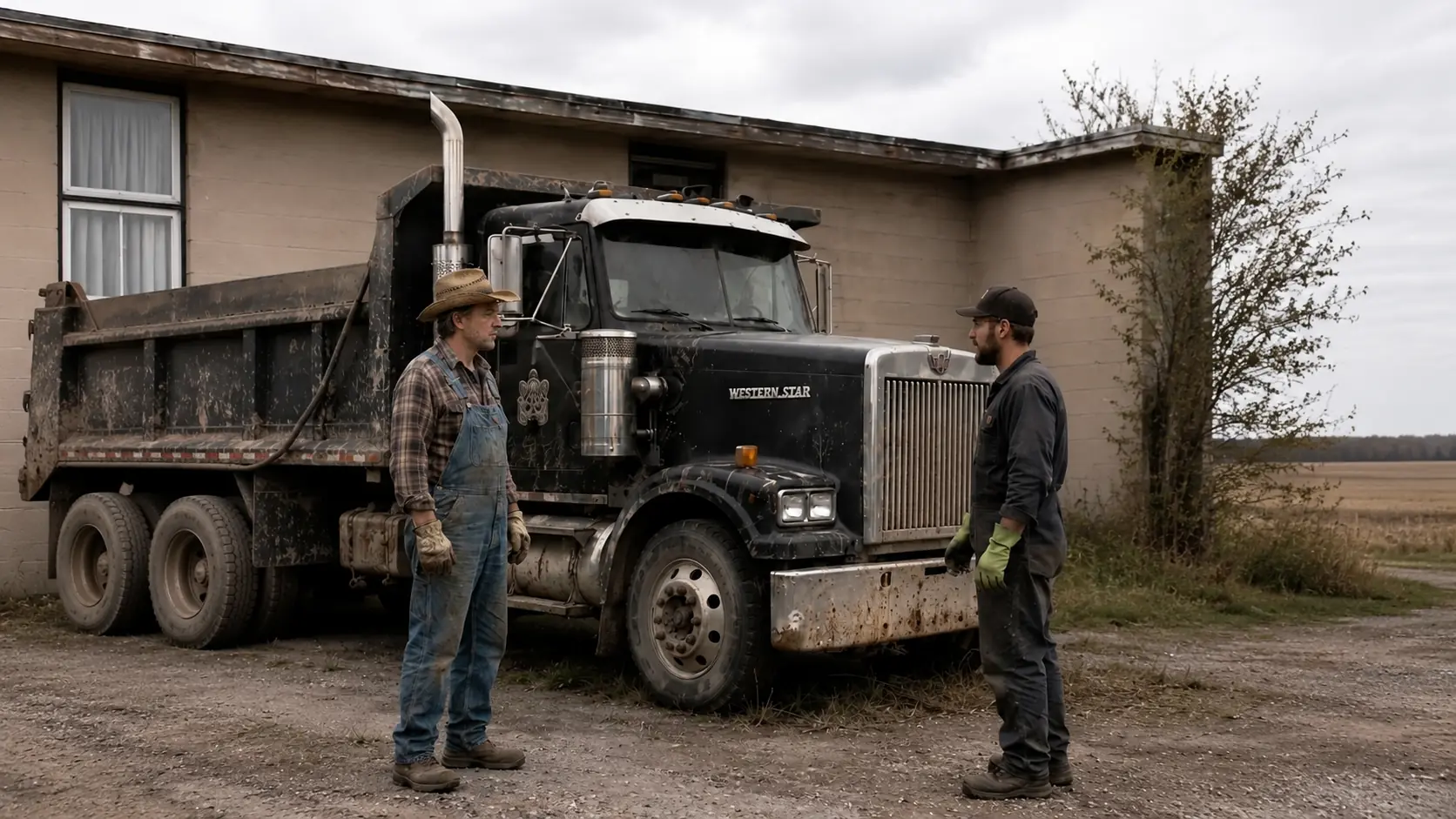
To Daniel, it was the last place his father had been alive.
On the morning the bank scheduled the farm auction, Daniel found Luke Bennett standing beside the truck with a tow chain in his hands.
Luke was thirty-four, broad through the shoulders, with a dark beard and green work gloves. He repaired tractors, combines, and grain trucks across three counties, and Daniel had hired him to prepare several unused machines for sale. The arrangement was supposed to raise enough money to delay foreclosure.
The Western Star had never been part of that agreement.
“What are you doing?” Daniel asked.
Luke glanced toward the rusted truck.
“Helping you.”
“By chaining my father’s truck?”
“The scrap dealer offered nine thousand dollars.”
Daniel stopped walking.
“You called a scrap dealer?”
“You need money by Friday.”
“I told you not to touch this truck.”
Luke dropped the chain beside the front wheel.
“It’s been dead twenty-nine years. Let me haul this rust away.”
Daniel stepped closer until only a few inches separated them.
“Touch my father’s truck, and you leave without your hands.”
Luke’s jaw hardened.
He had known Daniel for years and had never heard him threaten anyone. The sixty-one-year-old farmer was quiet even when angry, but the threat came from a place deeper than anger.
Luke clenched both fists.
“That wreck won’t save this farm from auction.”
Daniel turned toward the cab.
“Then stay and read where his final load really went.”
The driver’s door resisted when Daniel pulled the handle. He struck the edge twice with his palm, then pulled harder until the rusted hinges groaned and the door opened. A stale mixture of dust, oil, leather, and old tobacco drifted out.
Nothing inside had changed.
Samuel’s brown work gloves still rested on the dashboard. A faded photograph of Daniel, his younger sister, and their mother remained clipped above the radio. An empty coffee thermos lay on the passenger floor, and a red bandanna hung from the gearshift.
Daniel climbed onto the running board.
Behind the driver’s seat, beneath a mold-covered blanket, he found a narrow metal route box secured with a brass latch. He remembered seeing it when he was young. Samuel used it to carry delivery logs, scale receipts, contracts, and fuel records.
Daniel pulled it free.
The latch had been wrapped with thin steel wire.
Luke moved closer.
“Was that always there?”
“No.”
Daniel broke the wire with a pair of pliers and opened the box.
Inside lay a leather route ledger, several fuel receipts, an unsigned land agreement, and a sealed envelope bearing Daniel’s name in his father’s handwriting.
His hands began to shake.
Luke removed his gloves.
“You should open it.”
Daniel stared at the envelope for several seconds before tearing along the edge.
The letter inside was dated October 17, 1997.
The night Samuel disappeared.
Daniel,
If you are reading this, something kept me from coming home. The final load is not grain, and the route is not the one Conrad gave the company. Keep the scale ticket. Do not let Harland take the creek acreage. It belongs to you, your sister, and every Mercer who comes after us.
Follow the old county road past Miller Quarry. Look beneath marker seventeen. Trust the truck. I rebuilt the compartment myself.
Your father
Daniel read the letter twice.
Luke watched his face.
“What creek acreage?”
“The eastern bottomland.”
“The land Harland Grain owns?”
Daniel looked toward the fields beyond the barn.
Three hundred fourteen acres stretched east of the farmhouse toward Indian Creek. The soil was black, rich, and naturally irrigated by spring flooding. It was the most productive ground in the county.
The Mercer family had farmed it for four generations.
Yet legally, it belonged to Harland Agricultural Holdings.
Samuel had used the land as collateral during the farm crisis of the 1980s. Years later, after crop prices improved, he claimed he had repaid the obligation. Conrad Harland insisted the debt remained unresolved and produced documents showing Samuel transferred the acreage permanently.
Daniel’s mother fought the transfer in court after Samuel vanished.
She lost.
Without the creek ground, the Mercer farm became smaller, less profitable, and increasingly vulnerable to bad harvests. Daniel spent nearly three decades renting portions of his family’s former land from Harland’s company.
Now the same company intended to purchase the remaining farm at the bank auction.
Luke lifted the leather ledger.
“This says Samuel’s final delivery went to Harland Grain Terminal.”
“That is what everyone believed.”
Luke turned several pages.
“The last entry is different.”
Daniel looked.
Samuel’s handwriting recorded 76,400 pounds of corn loaded from Mercer Farm and scheduled for delivery to Harland Terminal Number Four. Beside it, he had written another location in smaller letters.
Miller Quarry, County Road 16.
There was no recorded arrival weight.
No payment receipt.
Only a hand-drawn circle around the number seventeen.
Luke examined the truck.
“Marker seventeen could still be there.”
“After twenty-nine years?”
“County markers don’t disappear easily.”
Daniel folded the letter and placed it inside his jacket.
“We’re going.”
Luke looked at the Western Star.
“In what?”
Daniel met his eyes.
“The truck.”
Luke laughed once, believing Daniel was joking.
Then he saw the old farmer’s face.
“This engine hasn’t turned since I was five.”
“My father said to trust it.”
“Your father wrote that twenty-nine years ago.”
“And you said the truck was worthless.”
Luke looked at the rusted body, flat front tire, corroded battery box, and weeds tangled around the rear axle.
“It might take a week just to free the brakes.”
“We have until Friday.”
“That’s three days.”
“Then stop talking.”
They worked until darkness.
Luke removed the batteries and discovered that Samuel had installed a mechanical disconnect before parking the truck. The wiring beneath the hood was old but unexpectedly clean. Oil remained inside the engine, thick and black but free of water.
The fuel tanks were nearly empty.
Daniel drained them while Luke removed the injectors.
Near midnight, they discovered the rear brakes were not seized. Samuel had backed off every adjuster and coated the exposed components with grease before leaving on his final route.
“He prepared this truck for storage,” Luke said.
“He expected it to sit.”
“Why would a man preparing for a normal delivery do that?”
Daniel looked toward the dark cab.
“Because he knew he might not bring it home himself.”
The next morning, Luke returned with batteries, filters, belts, oil, and diesel fuel. Daniel sold his last restored Farmall tractor to pay for the parts. The buyer offered to postpone the purchase after learning what they planned, but Daniel refused charity.
By noon, the Western Star had fresh fluids.
By evening, Luke had rebuilt the starter.
At sunset, Daniel climbed into the driver’s seat for the first time since his father vanished. The leather was split, the steering wheel cold beneath his hands, and Samuel’s photograph still watched from above the radio.
Luke stood outside with a fire extinguisher.
“Turn it for five seconds. No more.”
Daniel pressed the starter.
The engine moved once, then stopped.
Luke checked the wiring and shouted for him to try again.
The second attempt produced a slow mechanical groan.
On the third, the starter spun faster.
Gray smoke drifted from the exhaust stacks.
Daniel stopped.
Luke climbed onto the running board.
“It has compression.”
“Will it start?”
“It shouldn’t.”
“That wasn’t my question.”
Luke looked at the fuel-pressure gauge.
“Try again.”
Daniel turned the key.
The engine rotated, coughed violently, then released a thunderous explosion through the exhaust. Black smoke filled the yard. Birds fled the barn roof, and the farmhouse windows rattled.
The engine died.
Luke laughed.
Daniel did not.
He waited ten seconds and turned the key again.
This time, the Western Star started.
The old diesel roared unevenly, shaking the entire cab as smoke poured into the evening sky. Luke ran toward the engine, listening for a knock that never came. Daniel rested both hands on the steering wheel while tears filled his eyes.
The truck sounded exactly as he remembered.
For one impossible moment, he expected Samuel to appear beside the barn wearing his brown jacket and complaining that Daniel had flooded the engine.
Luke climbed onto the step.
“Your father built this thing like he expected the world to end.”
Daniel looked at the photograph.
“Maybe his did.”
They left before sunrise Thursday.
The Western Star moved slowly along the county highway, followed by Luke in his service truck. Daniel had not driven a vehicle that old in decades. The transmission demanded patience, the steering wandered, and every vibration traveled through the seat into his spine.
Yet the truck ran.
Farmers stopped beside fields to watch it pass.
Several recognized the black Western Star and called one another. By the time Daniel reached County Road 16, word had spread that Samuel Mercer’s truck was moving again.
Miller Quarry had closed seventeen years earlier. Trees grew through the cracked loading yard, and rusted fencing leaned across the entrance. Daniel guided the truck past the abandoned office and followed the narrow road climbing around the quarry rim.
The numbered markers remained.
Fourteen.
Fifteen.
Sixteen.
Marker seventeen stood beside a collapsed limestone wall.
Daniel stopped the truck.
Luke joined him with a shovel and metal detector.
They searched the ground beneath the marker for nearly an hour. The detector responded to nails, wire, and fragments of old machinery, but nothing significant.
Luke wiped sweat from his forehead.
“Maybe he meant something inside the truck.”
Daniel reread the letter.
Look beneath marker seventeen. Trust the truck. I rebuilt the compartment myself.
He looked toward the quarry wall.
Marker seventeen was not a road sign.
It marked an old loading bay.
Daniel walked toward the truck and examined the underside of the dump bed. Samuel had repaired the rear crossmember shortly before disappearing. One section carried welds different from the original frame.
Luke crawled beneath it.
“There’s a steel plate here.”
They removed six bolts packed with hardened grease. Behind the plate lay a narrow compartment built inside the crossmember.
Luke reached in and removed a waterproof canvas package.
Inside were three cassette tapes, a notarized repayment receipt, photographs, a second route ledger, and the original deed to the creek acreage.
Daniel sat down beside the truck.
The repayment receipt showed that Samuel had delivered cash and grain worth $186,000 to Conrad Harland, satisfying the complete farm obligation. The deed transferred the creek acreage back to the Mercer family.
Both documents carried Conrad’s signature.
The photographs showed Samuel standing beside Harland and a county notary on the day the papers were signed.
Luke lifted one cassette.
“We need something that plays these.”
Daniel remembered the old radio inside the truck.
Its cassette deck still worked.
They sat in the cab while Samuel’s voice emerged through static.
“October seventeenth, 1997. I’m recording this because Conrad changed the route after loading. He told me to bring the corn to Miller Quarry instead of Terminal Four. Says he has my final deed and repayment papers.”
The tape clicked.
Samuel’s voice returned.
“Conrad wants me to sign another transfer. Says the earlier repayment will disappear if I refuse. I’ve hidden copies in the truck. If anyone finds this, tell Daniel the farm is paid.”
A second voice entered the recording.
Conrad Harland.
“You should think about your family, Sam.”
“I am.”
“You can keep the house and west field. Sign the creek ground over, and this ends.”
“It already ended when I paid you.”
“That receipt exists because I allow it to exist.”
The recording stopped.
Daniel inserted the second cassette.
Wind and engine noise filled the cab.
Samuel spoke quickly.
“Conrad’s men are following me. I’m leaving the truck at the Mercer place and taking the pickup north. If I don’t return, he did more than threaten me.”
Daniel stared through the windshield.
The official investigation concluded that Samuel left voluntarily after suffering financial problems. His pickup was found abandoned near the Wisconsin border. No body was ever recovered.
Conrad told police that Samuel had been ashamed of losing the farm.
The tapes proved otherwise.
Luke turned toward him.
“We take this to the sheriff.”
Daniel looked at the evidence.
“No.”
“What do you mean, no?”
“First, we take it to the auction.”
Friday morning brought more than two hundred people to Mercer Farm.
Bank representatives arranged tables beside the grain shed. Buyers inspected tractors, trailers, tools, and livestock equipment. The remaining 286 acres would be offered after the machinery sale.
Conrad Harland arrived in a black SUV.
He was eighty-two, thin, immaculately dressed, and supported by a silver-handled cane. His son, Thomas, managed Harland Agricultural Holdings, but Conrad insisted on attending the sale personally.
He intended to purchase the Mercer farm and combine it with the creek acreage.
Daniel watched from inside the barn.
Luke stood beside him.
“You sure about this?”
“No.”
“That helps.”
The auctioneer climbed onto the platform.
Before he could begin, the deep roar of an old diesel rolled across the farm.
Every head turned.
The black Western Star emerged from behind the barn and crossed the yard slowly. Mud still covered its wheels, and smoke rose from both exhaust stacks. Daniel drove it directly toward the auction platform.
Conrad’s face changed.
The truck stopped twenty feet from him.
Daniel climbed down carrying the metal route box.
“You should be dead,” Conrad whispered.
The crowd fell silent.
Daniel approached him.
“You said my father ran away.”
Conrad gripped his cane.
“He did.”
“Then why are you afraid of his truck?”
Thomas Harland stepped forward.
“This auction is a legal proceeding. Remove the vehicle.”
Daniel opened the route box.
“The land being sold today includes property your company stole.”
The bank attorney stood.
“That is a serious allegation.”
Daniel raised the original deed.
“This returns the creek acreage to the Mercer family after Samuel Mercer paid Conrad Harland in full.”
Conrad shook his head.
“Forgery.”
Luke placed the notarized receipt beside it.
“Then you’ll enjoy hearing your own voice.”
Daniel carried a portable speaker onto the platform and inserted the digitized recording Luke had made overnight.
Conrad’s younger voice filled the farmyard.
You can keep the house and west field. Sign the creek ground over, and this ends.
Samuel answered.
It already ended when I paid you.
No one moved.
The recording continued.
That receipt exists because I allow it to exist.
Conrad turned toward his SUV.
Two county deputies blocked the way.
Sheriff Anita Walker stepped through the crowd holding a warrant. Daniel had delivered copies of the evidence to her office before dawn, but asked that she wait until Conrad appeared.
“Conrad Harland,” she said, “do not leave.”
His cane slipped against the gravel.
Thomas looked at Daniel.
“You staged this.”
“My father staged it twenty-nine years ago.”
The sheriff seized Conrad’s phone and financial documents. State investigators searched Harland Agricultural offices that afternoon. They recovered archived ledgers showing Samuel’s debt had been marked paid before the record was altered.
They also found payments to two men connected to Samuel’s disappearance.
One was still alive.
Faced with murder-conspiracy charges, he revealed where Samuel’s pickup had been moved and where his body had been buried near an abandoned logging road in Wisconsin.
Daniel brought his father home thirty years after he vanished.
The farm auction was canceled.
A judge restored the creek acreage to the Mercer family and suspended foreclosure proceedings after determining that Harland Agricultural had collected illegal rent for decades. The company was ordered to repay Daniel more than enough to clear the remaining farm debt.
Conrad died awaiting trial.
Thomas surrendered control of the company as civil claims consumed most of its assets.
Daniel never celebrated their destruction.
He planted corn.
The following spring, seed entered the creek ground under the Mercer name for the first time since Samuel disappeared. Caleb Mercer, Daniel’s twenty-two-year-old son, returned from agricultural college to help manage the restored farm.
Luke opened a repair shop inside the old equipment barn.
The Western Star received new tires, rebuilt brakes, fresh paint, and a repaired seat. Daniel refused to modernize the dashboard or replace the old cassette radio.
On the first harvest day, he climbed into the cab with Caleb beside him.
Samuel’s brown gloves remained on the dashboard.
“You think Grandpa knew the truck would survive?” Caleb asked.
Daniel started the engine.
“He built everything to last longer than the men trying to take it.”
The Western Star rolled toward the eastern fields, pulling a grain trailer beneath a wide Iowa sky.
For twenty-nine years, the truck appeared silent and useless beside the barn.
People saw rust.
Daniel saw grief.
Luke saw scrap.
Conrad saw evidence he hoped would never move again.
But Samuel Mercer had understood something all of them had forgotten.
A machine did not need to run every day to finish its final route.
Sometimes it only needed one honest man willing to turn the key.