The confrontation began beneath the polished lights of Merritt John Deere in Urbana, Illinois, beside a gleaming 8370R tractor identical to the machine Gerald Crouch had sold three years earlier. Green equipment filled the showroom in perfect rows, its yellow wheels spotless, while precision-agriculture displays promised efficiency, connectivity, and control. Gerald stood at the service counter in a weathered plaid shirt, brown canvas jacket, and mud-stained boots, holding a legal pad covered in his precise handwriting. Across from him, dealership owner Stan Merritt blocked the counter with anger tightening his square face.
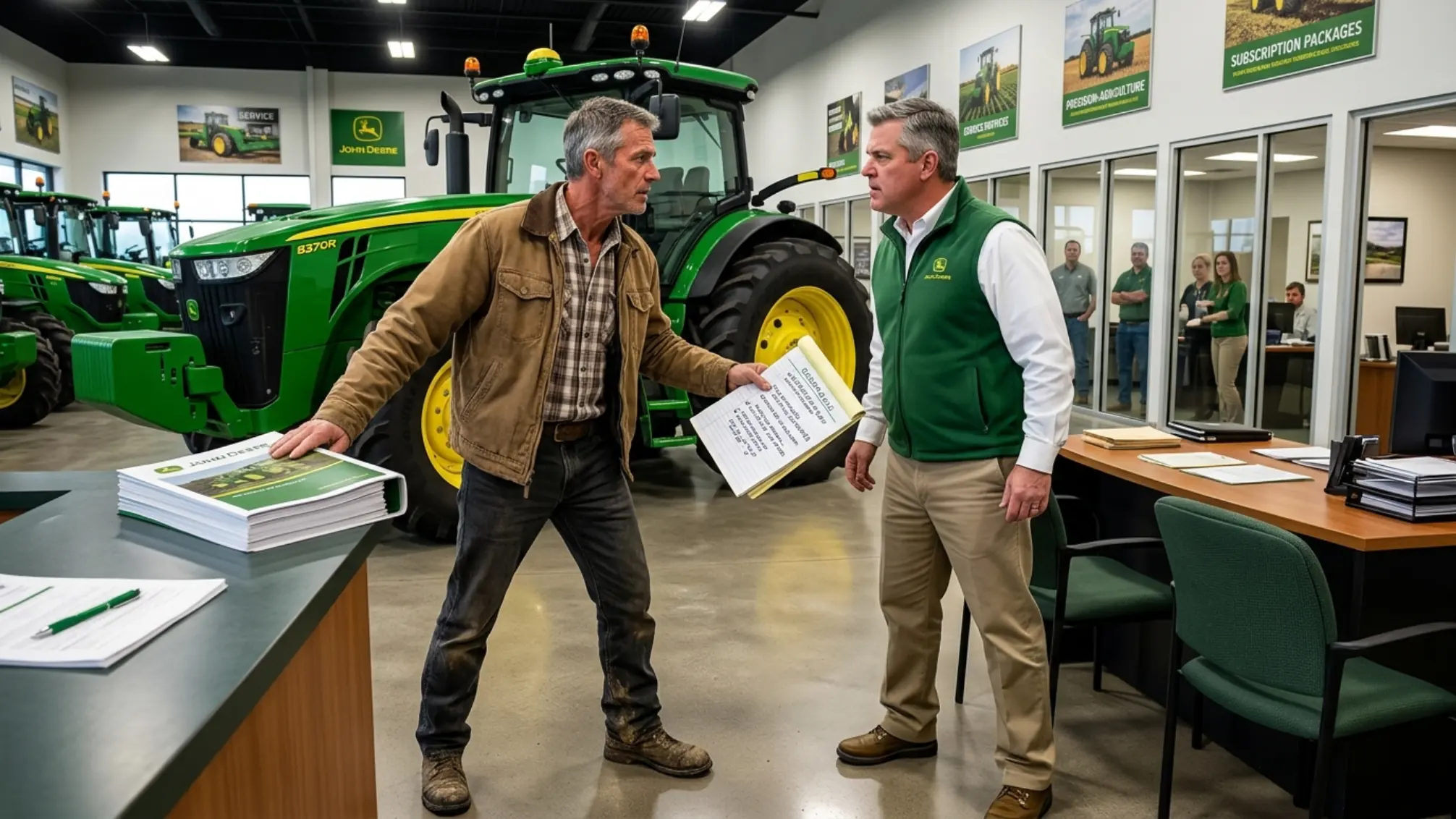
“Seven customers walked because of you,” Stan said. “Stop poisoning this county against my dealership.”
Gerald placed a printed John Deere investor-relations report on the counter.
“I showed them your manufacturer’s own numbers,” he replied. “They made their own decisions.”
Stan stepped closer. “You think one legal pad can destroy twenty-six years of loyalty?”
Gerald turned the third column toward him.
“Read it,” he said. “Then tell me which one of us is betraying the farmers.”
The employees behind the showroom’s glass offices stopped pretending not to listen. A salesman near the compact tractors lowered a brochure, while the service manager stared at the document as if it might explode between the two men. Stan had expected defensiveness, bitterness, perhaps a complaint about repairs or pricing. Instead, Gerald had brought arithmetic.
Three years earlier, the argument would have seemed impossible.
Gerald had owned John Deere equipment for twenty-two years. His 480-acre operation outside Urbana had been built around green machines: a 2016 8370R tractor, a dependable 2014 utility tractor, and a 2017 S780 combine that his son Aaron operated during harvest. Gerald maintained every machine carefully, paid his bills on time, and had never accused Stan’s dealership of dishonest service.
He did not leave because the equipment failed.
He left because he saw where the relationship was going.
The decision began on a Thursday morning in January 2019. Winter held the Champaign County fields beneath a gray stillness, and Gerald sat inside the small office attached to his equipment shed. He was reading a John Deere investor-relations document while other farmers in the county were studying seed catalogs, weather forecasts, or the morning newspaper.
Aaron entered at nine-thirty carrying two cups of coffee.
“What are you working on?” he asked.
“Equipment decision.”
“What equipment decision?”
Gerald looked up. “Whether we stay with John Deere or move the operation to Case IH.”
Aaron stopped before setting down the coffee. The answer sounded unreasonable coming from a man who had spent hundreds of thousands of dollars building a modern John Deere fleet. The S780 was only two years old, and the 8370R remained the operational center of the farm.
“We just bought the combine,” Aaron said.
“I know.”
“And the big tractor isn’t old.”
“I know that too.”
“Then why are we talking about replacing them?”
Gerald turned the legal pad toward his son. Three columns covered the page. The first listed current ownership and operating costs. The second projected expenses under John Deere’s developing data-and-service structure, while the third showed the seven-year difference between staying inside that system and moving to a more open equipment platform.
Aaron read the final number twice.
“This is significant.”
“Yes.”
“Where did you get the projection?”
“From John Deere.”
“They sent this to farmers?”
“No. They told their investors.”
Gerald tapped the printed report.
“That makes it more useful.”
For eighteen months, he had been collecting fragments from agricultural technology journals, equipment updates, university research, financial presentations, and manufacturer statements. The investor document finally assembled those fragments into a clear strategy. John Deere was moving toward a fully integrated proprietary ecosystem in which equipment, yield data, diagnostic tools, software updates, and service access would increasingly depend on the company’s own subscription infrastructure.
Nothing in the report described a crime or deception.
It described a business plan.
The problem was that Gerald understood where the cost of that plan would eventually land.
Modern farming depended on data. A 480-acre farm in Champaign County could not compete efficiently by treating every part of every field the same. Soil varied across short distances, as did drainage, fertility, compaction, and yield potential. Gerald’s agronomist needed clean sensor information to build precise application maps, and his independent mechanic needed complete diagnostic access when machinery failed during narrow planting or harvest windows.
Under the direction described in the report, more of those functions would pass through proprietary systems and paid services.
Gerald did not object to John Deere earning money. He objected to becoming dependent on a platform whose long-term interests were not necessarily identical to his farm’s. Once machinery, agronomic information, diagnostics, and service became parts of one closed structure, leaving would become harder and more expensive.
Aaron read the numbers again.
“You’ve been studying this for eighteen months?”
“Yes.”
“And you’re ready to act?”
“I was ready in November. I wanted the completed investor document before making the decision.”
“What does Case IH offer?”
“Open third-party compatibility. Direct agronomist integration. Independent diagnostic access. Fewer required layers between our machines and our own information.”
Aaron lifted his coffee.
“When do we switch?”
Gerald looked at him carefully. “You’re not going to argue?”
“You didn’t spend eighteen months doing this because you wanted red paint.”
That was all Gerald needed to hear.
The 8370R left the farm on February 14, loaded onto a consignment trailer before sunrise. Gerald watched from the equipment-shed doorway as the tractor disappeared along the county road. He felt no anger toward the machine and no desire to insult the brand stamped across its hood. It had performed the work he purchased it to perform.
But Gerald did not confuse appreciation with permanent obligation.
The empty bay was filled on March 2 by a 2019 Case IH Magnum 380. Dealer Walt Higgins delivered it personally and spent hours explaining the technical systems to Gerald and Aaron. Gerald did not ask about horsepower first. He asked about data ownership, software updates, third-party diagnostics, and whether his existing agronomist could work directly with unfiltered yield information.
Walt answered without avoiding the difficult questions.
The utility tractor went next.
The S780 combine was the final John Deere machine to leave the Crouch farm. An operation in Vermilion County paid a fair price, and a Case IH combine replaced it during the first week of May. By May 15, no green equipment remained inside Gerald’s shed for the first time in more than two decades.
His wife, Maren, found him standing inside the doorway that evening.
“How does it feel?” she asked.
“Like a correct decision.”
She smiled because she understood him. Gerald did not celebrate decisions before results arrived. Correctness had to be demonstrated by performance, cost, and time.
The county did not share his restraint.
Neighbors noticed the equipment change immediately. Some assumed Gerald had received an unusually attractive trade offer. Others believed he had argued with Stan Merritt or experienced an expensive repair dispute. When they learned he had left because of an investor document and a seven-year cost projection, amusement spread quickly.
Lester Dunn arrived at Gerald’s kitchen table on a Saturday morning in May.
At sixty-six, Lester had farmed 520 acres beside Gerald’s north and west boundaries for thirty-eight years. He had purchased John Deere equipment from Stan Merritt throughout his farming life and considered brand loyalty part of a serious farmer’s identity.
“I’ve watched green machines leave your shed since February,” Lester said. “I want to understand what you’re doing.”
Gerald retrieved the legal pad and investor document.
“Read the third column first.”
Lester studied the material for forty minutes. Gerald did not interrupt, summarize, or tell him what conclusion to reach. When Lester finished, he placed one finger against the report.
“This came directly from John Deere?”
“The investor-relations website.”
“And these numbers?”
“My seven-year operational projection for a farm our size.”
Lester leaned back. “Why didn’t you show me before you switched?”
“You didn’t ask.”
“We’ve been neighbors for decades.”
“That doesn’t give me the right to tell you how to spend your equipment money.”
Lester looked again at the third column.
“I’m asking now.”
“And now I’m showing you.”
Gerald explained the Case IH platform, his agronomist’s direct access, and the ability of his independent mechanic to use full diagnostic tools. He did not claim the red equipment was magically superior in every mechanical category. The machines were good, but his decision was about control, integration, and long-term operating structure.
Lester asked the only question that mattered.
“How does it perform?”
“Come back after harvest.”
The first Case IH harvest began in late September 2019. Gerald and Aaron treated the new machines cautiously, beginning with conservative settings while learning how they behaved on familiar ground. They adjusted slowly, recorded everything, and refused to confuse early enthusiasm with evidence.
The yield maps were the first major result.
Gerald’s agronomist connected to the Case IH system in twenty minutes. Instead of receiving information filtered through a proprietary layer, he accessed the raw sensor output and began building application maps with greater detail than the previous system had allowed.
“This data is cleaner,” the agronomist said.
“I know.”
“You knew before buying the equipment?”
“That was why I bought it.”
The final farm average reached 218.4 bushels per acre. The previous year, using John Deere equipment on the same ground, the average had been 211.7. Gerald refused to credit the entire improvement to the machinery.
“The yield came from better information,” he told Aaron. “The equipment carried the system, but the agronomist created the improvement.”
Lester returned in October.
Gerald showed him yield maps, operating records, integration costs, and application changes. Lester spent nearly two hours examining the information before looking toward the red Magnum parked outside.
“Six-point-seven bushels per acre in the first year.”
“The machine did not invent the yield,” Gerald said.
“The open data made the application maps possible.”
“Yes.”
Lester nodded slowly.
“I’m calling Walt.”
Gerald did not encourage him.
“Run your own accounting first.”
Lester did.
Eighteen months later, the last John Deere machine left his farm.
Two other neighbors followed after reviewing Gerald’s documents and comparing the numbers against their operations. Then another farmer requested the report. Each conversation followed the same pattern: Gerald showed the material, answered questions, and refused to tell anyone what to buy.
The decisions traveled through trust rather than promotion.
Stan Merritt noticed the movement in the spring of 2020.
Seven accounts had shifted away from his dealership in fourteen months. Historically, those farmers represented approximately $4.2 million in equipment purchases over the following five years. The losses clustered around the southern part of the county, with Gerald’s farm at the center.
Stan first blamed competitive pricing.
His prices were competitive.
Then he examined service records.
The dealership’s service performance was not unusually poor.
No major conflict had occurred with the departing customers, and every account had once appeared stable. The pattern did not look like anger. It looked like calculation.
Stan called Gerald.
“I want to talk about your equipment decision.”
“You’re welcome to come out.”
But before the scheduled meeting, Stan’s frustration changed the plan. He asked Gerald to meet him at the dealership so they could review the transition beside the same equipment Gerald had once owned. Gerald agreed and arrived carrying the legal pad and report.
That was how they ended up facing each other inside the showroom.
“Seven customers walked because of you,” Stan repeated. “Four-point-two million dollars in future business.”
“They walked because their own numbers told them to.”
“You gave them the argument.”
“I gave them information.”
“You knew they would follow.”
“I knew they were farmers.”
Stan’s voice rose. “What is that supposed to mean?”
“They calculate risk for a living.”
“You could have come to me before selling your equipment.”
Gerald’s expression remained steady.
“For what?”
“To discuss the concern.”
“The report describes your manufacturer’s strategy. Were you prepared to change it?”
“I could have explained it.”
“Explaining a cost doesn’t remove it.”
Stan pointed toward the showroom. “These are good machines.”
“I never said otherwise.”
“You sold them anyway.”
“Because a machine exists inside a larger system.”
The service manager shifted uneasily behind the counter. The distinction mattered, and everyone listening understood it. Gerald was not attacking the tractors. He was challenging the economic structure surrounding them.
Stan looked down at the third column.
“What does this number include?”
“Subscriptions, proprietary data services, dealer-dependent diagnostic access, integration costs, and the operational value of delayed or filtered information over seven years.”
“You’re making assumptions.”
“Yes.”
Stan looked up sharply.
Gerald continued before he could respond.
“Every projection contains assumptions. Mine are listed beneath the calculation. Change any one of them and run it again.”
Stan examined the notes.
“You included annual increases.”
“Based on the strategic revenue targets in the investor report.”
“You included service dependence.”
“Because the report identifies the transition from mechanical revenue to recurring digital and service revenue as a priority.”
“That revenue supports dealerships.”
Gerald nodded.
“I know.”
The answer stopped Stan.
He had expected Gerald to misunderstand the dealership’s position. Instead, the farmer understood it too clearly.
Stan opened the folder he had brought and removed a service-revenue summary.
“Forty-two percent of my 2019 service revenue came from precision-agriculture subscriptions and data-management services.”
Gerald studied the page.
“I expected something close to that.”
“You understood my revenue model when you switched?”
“I understood where the manufacturer wanted it to go.”
“And you still showed this report to my customers.”
“They’re my neighbors.”
“They were my customers.”
“Both can be true.”
Stan’s anger returned. “Your accounting threatens a business I spent twenty-six years building.”
“The manufacturer’s strategy created the accounting.”
“You don’t know what running a dealership costs.”
“No, but I know what running a farm costs.”
They stood in silence beside the green tractor.
Finally, Stan picked up the investor document and began reading properly. Not scanning for a sentence he could challenge, but moving through the pages line by line. Gerald waited while the showroom employees returned uneasily to their work.
Twenty minutes passed.
Then thirty.
When Stan finished, he looked older than he had when Gerald entered.
“This really came from our investor-relations site.”
“Yes.”
“And you first read it in 2018?”
“Yes.”
Stan tapped the cost projection.
“Most farmers don’t read financial documents intended for investors.”
“Most shouldn’t have to.”
“But you did.”
“I wanted to know where the company was going before buying another seven years of equipment.”
Stan looked across the showroom he had spent half his life building. Green machines represented more than inventory to him. They represented customer relationships, emergency repairs completed during midnight harvests, farmers whose fathers had purchased tractors from Stan’s father, and a reputation established one honest service call at a time.
“Is John Deere actually going this direction?” he asked.
Gerald answered without satisfaction.
“They have been executing it since the report was published.”
“And Case IH?”
“My data belongs to the farm. My agronomist enters directly. My mechanic has full access. There are still costs and limitations, but the structure fits my operation better.”
Stan looked at him.
“What do I do with this?”
The question no longer sounded hostile.
Gerald closed the legal pad.
“What do you want this dealership to be seven years from now?”
Stan frowned. “What kind of answer is that?”
“The only useful one.”
“I want it to remain where farmers come for machines and service they trust.”
“Then decide whether the system you’re selling helps you remain that dealer or turns you into the delivery mechanism for costs working against your customers.”
Stan stared at him.
“You’re asking me to question a twenty-six-year manufacturer relationship.”
“No. You asked what to do with the numbers.”
“And that is your answer?”
“My answer is to read them honestly.”
Stan walked away from the counter and stopped beside the 8370R. He ran one hand along the spotless hood.
“I came into this conversation expecting to recover seven accounts.”
“They’re not coming back.”
“You’re certain?”
“They made complete decisions.”
Stan’s mouth tightened.
“Then what am I supposed to protect?”
“The forty customers who haven’t run the accounting yet.”
The dealer turned.
Gerald continued.
“They will eventually. The costs will make them. When they do, they deserve a dealer who has already read the same report and can discuss it honestly.”
Stan looked at the legal pad again.
“You never told the seven farmers to switch?”
“No.”
“You just showed them this?”
“When they asked.”
“And allowed them to reach their own conclusions?”
“They’re adults risking their own farms.”
Stan gave a quiet, humorless laugh.
“That still cost me seven accounts.”
Gerald shook his head.
“It informed seven farmers. There’s a difference.”
The sentence landed harder than their earlier accusations.
Six months later, Stan visited Gerald’s farm with an answer.
He had spent the summer challenging his regional representatives, analyzing subscription structures, and reconsidering how his dealership earned service revenue. He did not abandon John Deere, nor did he pretend the manufacturer’s strategy would reverse because one rural dealer objected.
Instead, he began rebuilding his service operation around transparency.
Customers received clear seven-year cost projections before purchasing connected equipment. Subscription fees were separated from mechanical costs. Stan invested in technicians who could explain the digital architecture honestly, and he began advocating within the dealer network for stronger customer control over data and diagnostics.
“I can’t promise the platform will become open,” Stan told Gerald at the kitchen table. “But I can promise farmers won’t discover the third column after they’ve signed.”
Gerald nodded.
“That’s an honest answer.”
The seven lost accounts did not return.
But the forty remaining customers stayed long enough to have informed conversations. Some eventually switched brands. Others remained with John Deere after deciding its services justified the additional costs for their specific operations.
Stan stopped treating either choice as betrayal.
By the end of Gerald’s third Case IH season, his farm averaged more than 221 bushels per acre. The improvement continued to come primarily from better use of field data rather than the color of the machinery. His seven-year projection was not perfect, but the actual numbers remained close enough to confirm the decision.
The story spread far beyond one farm and one dealership.
People simplified it into a brand rivalry because rivalry was easier to understand. They said Gerald had rejected John Deere, persuaded his neighbors to follow him, and forced the dealer to surrender.
That was not what happened.
Gerald never claimed John Deere built bad tractors.
He never called Stan dishonest.
He read a company’s stated strategy, calculated what it meant for his farm, and acted before the consequences became unavoidable.
Three years later, the dealer confronted him beneath the showroom lights, furious that seven customers had followed the same arithmetic.
Gerald did not answer with an insult.
He opened the report to the third column.
And once Stan read it honestly, there was nothing left for either man to fight about.