“You sued us because you don’t know how to maintain an engine.” The factory representative stood beside the open hood of the red tractor, one hand pointing toward Jack Caldwell while the other gripped a folder containing warranty notices, inspection reports, and legal papers. Jack stood in the Kansas wheat field with his arms crossed over a faded denim shirt, grease still dark beneath his fingernails, and looked at the man as if he had just heard the stupidest sentence of the summer. “Then explain why your engine died three times before harvest.”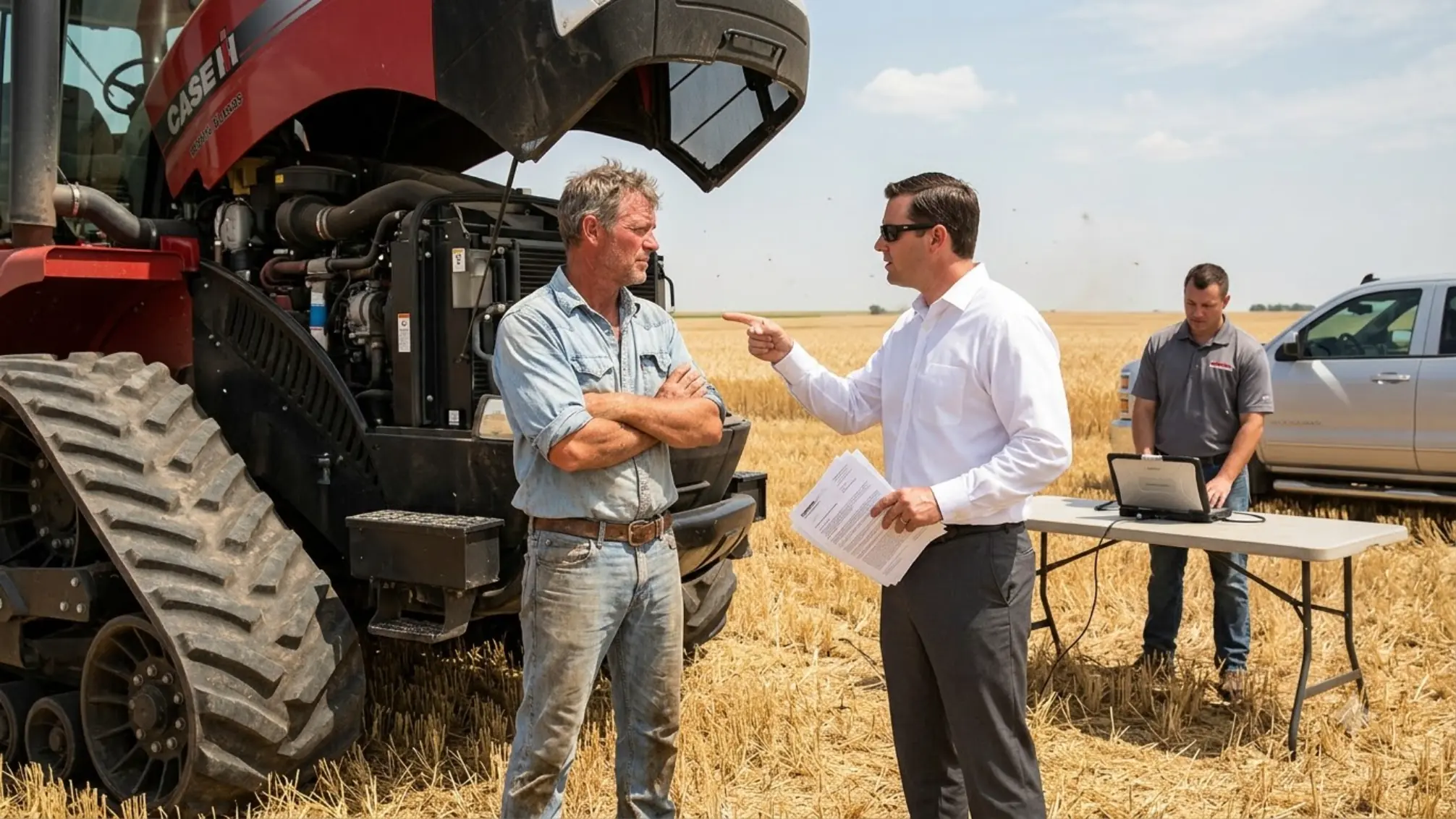
The representative, Victor Haines, stepped closer. He wore a crisp white shirt, dark trousers, expensive sunglasses, and the kind of expression Jack had learned to distrust during twenty-eight years of farming. “Touch that tractor again and your warranty, your lawsuit, and your farm are finished.” Jack turned toward the cab, reached for the ignition, and answered, “Good—then listen to what a real engine sounds like.”
Behind Victor, a factory technician named Owen Pierce stood beside an open diagnostic laptop on a folding table. A silver company pickup was parked several yards away, spotless enough to look absurd against the dust and stubble of the field. Owen had spent the morning connecting cables to a tractor that no longer contained the engine the company expected to find. He had already realized something was very wrong with Victor’s confidence.
Jack climbed into the cab and turned the key. For two seconds, the field remained silent except for the wind moving across dry wheat. Then the old Cat 3406B came alive with a deep mechanical rumble that rolled across the field like distant thunder. Victor’s mouth stopped moving.
Jack let the engine settle into a steady idle. No warning lights. No coughing. No sudden loss of oil pressure. No temperature spike. Just the hard, even sound of an engine that had been built decades earlier and still understood exactly what its job was.
Victor tore off his sunglasses. “What the hell did you do?” Jack leaned out of the cab window. “Solved your problem.” Victor’s face reddened. “That is not our engine.”
“That’s the point.”
The lawsuit had begun eight months earlier, but the real problem started almost two years before that. Jack Caldwell had purchased the tractor new because his old machine had reached nearly fifteen thousand hours, and he could no longer afford breakdowns during narrow planting and harvest windows. The Meridian Apex 950 had been advertised as a premium high-horsepower machine built for long days, heavy loads, and large-acreage operations. Jack spent more than he ever had on one piece of equipment because he believed reliability was worth the debt.
The first failure came at 312 hours. Jack was pulling a deep ripper across the south quarter when the engine suddenly lost power and filled the cab display with warnings. He shut it down immediately, called the dealer, and waited nearly eleven hours for a service truck. The technician blamed a sensor and replaced two components under warranty.
Jack accepted that explanation. New machines had electronics, and electronics failed. He had no interest in starting a war over a defective sensor.
The second failure came at 498 hours. This time the tractor began consuming coolant without any visible external leak. Jack documented every gallon he added, every temperature reading, and every hour of operation. The dealer replaced a cooler assembly and told him the problem was resolved.
It was not.
At 623 hours, the engine failed catastrophically while Jack was pulling an air seeder. Oil pressure disappeared first. Then came a metallic knock so violent he shut the engine off before the display finished flashing red.
The dealer hauled the tractor away.
Three weeks later, Jack received a rebuilt engine.
The invoice listed more than $34,000 in warranty work.
Jack paid nothing directly, but his farm paid anyway.
For twenty-two days, his most important tractor sat in a dealership shop during planting season. Jack rented a replacement machine at a rate that made him sick every time he looked at the paperwork. He worked nights to make up lost acres.
That autumn, the rebuilt engine failed again.
The company blamed contaminated fuel.
Jack sent fuel samples to an independent laboratory.
The fuel was clean.
Meridian blamed improper maintenance.
Jack produced service records.
Every oil change had been completed before the recommended interval.
Every filter carried a purchase receipt.
Every sample analysis was filed by date.
Then Meridian claimed Jack had overloaded the tractor.
That was when he stopped being patient.
Jack had farmed long enough to know the difference between mechanical failure and operator abuse. He also knew something many corporate warranty departments seemed to forget: farmers documented everything because one bad season could erase years of profit. Jack had binders containing oil samples, photographs, temperature readings, dealer emails, engine-hour logs, and every service invoice since delivery day.
He hired attorney Rachel Morton, a Kansas lawyer who specialized in agricultural equipment disputes. She reviewed the records for two weeks, then called Jack into her office. “They’re assuming you’ll give up because litigation costs less for them than downtime costs for you.”
Jack stared at her. “Will they win?”
“That depends on whether we can prove a defect.”
“And if we can?”
Rachel closed the folder. “Then they have a problem.”
The lawsuit alleged repeated engine failure, breach of warranty, lost production, rental costs, and misrepresentation surrounding repair history. Meridian responded aggressively. Its lawyers claimed Jack had operated the tractor outside recommended parameters and failed to follow diagnostic guidance.
They also demanded inspection access.
Jack agreed immediately.
That surprised them.
Victor Haines entered the picture shortly afterward. He was Meridian’s regional field operations representative, known for appearing whenever claims became expensive enough to concern corporate headquarters. His job was technically customer resolution, but Jack quickly realized Victor saw every warranty dispute as a contest.
Their first meeting lasted eighteen minutes.
Victor arrived at Caldwell Farms in polished boots that had never seen mud and asked Jack whether he understood modern diesel engines.
Jack answered, “Enough to know when one stops running.”
Victor smiled.
That set the tone.
The company inspected the tractor, downloaded diagnostic logs, photographed maintenance areas, and collected oil samples. Jack provided everything they requested. Then Meridian issued a written conclusion saying the failures were “consistent with operating conditions and maintenance variables rather than a confirmed manufacturing defect.”
Rachel read the letter twice.
“They’re preparing to deny the claim.”
Jack looked through the window of her office.
“What do we do?”
“We make them defend that conclusion.”
Discovery changed the case.
Rachel demanded engineering bulletins, internal failure reports, warranty statistics, dealer communications, and design changes associated with the Apex 950 engine package. Meridian resisted nearly every request. A judge eventually ordered production of several categories of records.
That was when the pattern appeared.
Jack’s engine family had experienced repeated failures involving cooling, lubrication, and cylinder-liner sealing under sustained heavy-load conditions. Not every engine failed. Most did not. But the failure rate was significantly higher than Meridian had disclosed publicly.
More troubling was an internal email from a field engineer.
High-load agricultural duty appears to expose weakness earlier than standard validation cycle. Recommend extended endurance testing.
The email was written eighteen months before Jack purchased his tractor.
Another engineer responded:
Program schedule does not allow redesign before launch. Monitor warranty data post-release.
Jack read that sentence and became very quiet.
“They knew?”
Rachel corrected him.
“They knew there was a concern.”
“That’s the same thing.”
“Legally, it isn’t.”
Jack hated lawyers for sentences like that.
But Rachel was right.
Concern did not automatically prove Meridian knowingly sold defective engines. They needed more.
Then a former dealership technician contacted Jack.
His name was Evan Cole, and he had worked on three Apex 950 tractors before leaving the dealership. Evan said technicians had been instructed repeatedly to treat failures as isolated cases and replace components without discussing broader patterns with customers.
“Were you told to lie?” Rachel asked.
“No.”
“Were you told not to tell customers about other failures?”
“Yes.”
That distinction mattered.
Evan provided service bulletins and internal repair notes he was legally permitted to discuss. Several included temporary fixes later incorporated into production revisions. Jack’s tractor had been built before those revisions.
The lawsuit became stronger.
Meridian still refused settlement.
Victor became increasingly aggressive.
Then Jack made the decision everyone told him not to make.
He removed the Meridian engine.
Rachel almost screamed when she learned.
“You did what?”
“It was dead again.”
“You altered the evidence.”
“I preserved everything.”
“You cannot casually change the central machine in an active lawsuit.”
Jack slid a folder toward her.
“Photographs before removal. Video. Serial numbers. Oil samples. Compression readings. Components tagged. Engine stored untouched in my machine shed.”
Rachel stared at him.
“You planned this.”
“Yes.”
“You should have called me.”
“You would’ve said no.”
“Yes!”
“That’s why I didn’t.”
Rachel stood and paced around the office.
“What did you put in?”
Jack hesitated.
She stopped.
“No.”
He smiled.
“A Cat 3406B.”
Rachel closed her eyes.
“You installed a thirty-year-old mechanical diesel in a modern tractor involved in a warranty lawsuit.”
“Thirty-seven years old.”
“That does not improve the sentence.”
Jack laughed for the first time in weeks.
He had found the engine in a retired highway tractor sitting behind a grain-hauling company outside Salina. The 3406B had more hours than Jack’s Meridian engine would probably ever see, but its maintenance history was solid. It was simple, mechanical, heavily built, and familiar to anyone who had spent enough time around older trucks and equipment.
The conversion was not easy.
Nothing aligned.
Engine mounts required fabrication.
Cooling connections had to be redesigned.
The modern tractor’s electronic systems expected messages from an engine control module that no longer existed.
Jack worked with his longtime mechanic, Ray Sullivan, who had rebuilt everything from combines to irrigation pumps. Together they created adapters, modified mounts, preserved hydraulic drive compatibility, and built enough electronic interface work to prevent the tractor’s other systems from becoming useless.
It took seven weeks.
There were failures.
The first mount vibrated badly.
The cooling fan ratio was wrong.
A sensor workaround confused the transmission controller.
One hydraulic load caused the engine to bog more than expected.
They fixed each problem.
Eventually the tractor moved under its own power.
Then it worked.
Jack tested it lightly at first.
One hour.
Three.
Ten.
Oil samples remained normal.
Temperatures held.
Then he connected a cultivator.
No problem.
He pulled grain wagons.
No problem.
He connected the same heavy tillage equipment Meridian claimed had caused abuse.
The Cat pulled steadily.
Thirty hours became fifty.
Then one hundred.
No catastrophic failure.
Jack began recording everything.
Fuel consumption.
Oil pressure.
Exhaust temperature.
Load.
Engine speed.
Coolant temperature.
He did not pretend the old Cat was more efficient in every category.
It was not.
The Meridian engine used less fuel under some loads and integrated far better with the tractor’s original electronics.
But the old 3406B did one thing beautifully.
It kept running.
When Meridian learned about the swap, Victor demanded immediate inspection.
That brought them to the wheat field.
Now the Cat idled while Victor stared into the open engine bay.
“This proves nothing,” he said.
Jack climbed down.
“It proves the tractor isn’t the problem.”
“No, it proves you butchered a million-dollar machine.”
“Half-million.”
“Whatever you paid.”
Victor pointed toward the engine.
“This is irrelevant to your warranty claim.”
Rachel, standing several yards away beside her truck, finally spoke.
“Actually, we’re not presenting the replacement engine as proof of the original defect.”
Victor turned toward her.
“Then why am I standing here?”
“Because your company requested a field inspection after claiming Mr. Caldwell’s operating practices caused the failures.”
She handed him a folder.
“We’re documenting identical duty conditions with a different powerplant.”
Victor frowned.
“That is scientifically meaningless.”
Rachel nodded.
“Possibly.”
Jack smiled.
“She likes that word.”
Rachel ignored him.
Owen Pierce had been watching diagnostic sensors connected to the tractor’s hydraulic system rather than the engine itself. He finally approached Victor.
“Load profile is comparable.”
Victor looked at him.
“What?”
“The hydraulic demand and transmission load. He’s operating within the same range shown in the historical logs.”
Victor’s expression hardened.
“Owen.”
“I’m just telling you what the data shows.”
Victor stepped closer.
“The data shows an unauthorized engine swap.”
Jack folded his arms.
“The data also shows I wasn’t overloading anything.”
Victor pointed toward him.
“You think dropping some ancient truck engine into our chassis makes you an engineer?”
“No.”
Jack looked toward the tractor.
“It makes me a farmer who needed to finish harvest.”
That sentence ended the argument more effectively than shouting could have.
Because that was the part Meridian’s people had never understood.
Jack had not installed the Cat to win internet attention.
He did not care about humiliating corporate engineers.
He installed it because the wheat did not pause while lawyers exchanged motions.
A tractor sitting dead beside the barn produced nothing.
A lawsuit did not pull a grain cart.
A warranty letter did not plant corn.
The farm still had to work.
Victor left angry.
Owen remained behind for several minutes.
He walked around the tractor slowly.
“You really fabricated all this?”
“Ray did most of the pretty work.”
Owen inspected the mounts.
“This is not pretty.”
“Then Ray did all of it.”
Owen laughed despite himself.
Then he became serious.
“How many hours?”
“One hundred thirty-six.”
“Any problems?”
“Minor integration stuff.”
“Engine?”
“Nothing.”
Owen looked toward the Meridian pickup.
“Can I tell you something unofficially?”
Jack waited.
“Engineering has been fighting operations over that original engine family for two years.”
Jack’s face changed.
“What kind of fighting?”
“Cooling margin. Liner movement. Oil aeration under sustained load.”
Those words matched several of Jack’s failures.
“Will you testify?”
Owen looked toward the horizon.
“I have a mortgage.”
Jack nodded.
“I understand.”
But Owen continued thinking.
Three weeks later, Rachel received an email.
Owen wanted counsel.
Not Meridian’s counsel.
His own.
He had documents.
The case shifted quickly after that.
Owen produced internal validation reports showing early test engines experiencing problems under long-duration high-load cycles similar to agricultural tillage. Engineers recommended delaying launch for further testing.
Management declined.
The company believed the issue could be handled through calibration changes and service updates if necessary.
That alone still did not prove fraud.
Then Rachel found the document that mattered most.
A pre-launch risk report classified the failure mode as low frequency, high customer impact and specifically warned that failures during planting or harvest could produce significant secondary economic losses for agricultural buyers.
Someone had understood exactly what downtime meant.
The report had never been provided to dealers.
A mediation session was scheduled.
Meridian arrived with six attorneys.
Jack brought Rachel and one binder.
Victor attended too.
The company offered to replace Jack’s tractor with a newer model and cover part of his rental expenses if he dismissed the lawsuit and signed a confidentiality agreement.
Jack asked one question.
“What happens to everyone else with the same engine?”
The lead attorney answered carefully.
“This settlement concerns your individual claim.”
Jack closed the offer.
“No.”
Rachel had warned him this might happen.
“Jack.”
“No.”
The attorney leaned forward.
“You are rejecting a replacement machine worth substantially more than your current tractor.”
“Yes.”
“Why?”
“Because you’re trying to buy my silence cheaper than fixing the problem.”
The room went quiet.
Meridian denied that characterization.
Jack left anyway.
The lawsuit moved toward trial.
Then something unexpected happened.
Another farmer joined.
Then another.
A custom operator from Oklahoma reported two engine replacements.
A Nebraska grower produced similar oil-analysis records.
A Colorado operation had suffered a liner failure at fewer than nine hundred hours.
Not every case was identical.
But enough similarities existed that attorneys began coordinating discovery.
Meridian’s problem grew.
The company finally announced a voluntary service campaign affecting a specific production range of engines.
Officially, it was not called a recall.
The program included revised cooling components, updated lubrication parts, inspection procedures, and extended warranty coverage.
Jack read the announcement at his kitchen table.
His wife, Linda Caldwell, sat across from him.
“You won.”
Jack shook his head.
“Not yet.”
“What else do you want?”
He looked toward the fields.
“My rental money back would be nice.”
She laughed.
Eventually Meridian returned to settlement discussions.
This time the terms were different.
Jack received reimbursement for documented rental costs, lost operating expenses attributable to covered failures, attorney fees negotiated within the settlement, and replacement equipment options.
He also kept his tractor.
And the Cat.
That was non-negotiable.
Meridian initially demanded the experimental conversion be removed.
Jack refused.
Eventually they surrendered.
The original failed engine remained preserved until litigation closed.
When the settlement became final, Jack stood in his machine shed staring at it.
Ray joined him.
“What are you going to do with that pile?”
Jack rubbed his chin.
“Boat anchor?”
“Big boat.”
They laughed.
The Cat-powered tractor became locally famous.
Videos spread online showing the red Apex 950 working under load with the hood raised while an old mechanical diesel growled underneath.
Some people called Jack a genius.
Others called the machine sacrilege.
Professional mechanics argued endlessly about efficiency, emissions, gearing, electronics, and whether the conversion made economic sense.
Jack agreed with most of the criticism.
“It’s not better because it’s old,” he told anyone who asked.
That surprised people.
He explained that modern engines offered real advantages.
Better fuel control.
Cleaner emissions.
Electronic integration.
More sophisticated diagnostics.
The issue was not old versus new.
It was whether equipment designed for hard agricultural duty could survive hard agricultural duty.
The Cat became symbolic because it was available, durable, repairable, and capable of doing the work when the original engine could not.
That was all.
Owen Pierce eventually left Meridian.
He accepted a position with an independent agricultural testing company where his job involved endurance validation.
Jack visited him once.
“You happier?”
Owen smiled.
“I get paid to break things before customers do.”
“Sounds useful.”
“It is.”
Victor Haines remained with Meridian for another year.
Then he disappeared from the regional organization chart.
Jack never asked why.
He had stopped caring.
The service campaign reduced major failures dramatically in later machines.
Meridian revised portions of its durability testing.
Dealer technicians received updated diagnostic procedures.
Future models used improved engine components.
Jack considered those changes more important than any apology.
He never received a public one.
Companies rarely wrote sentences like you were right and we were wrong.
Instead they issued technical bulletins.
Updated part numbers.
Extended warranties.
Revised procedures.
Jack learned to read those things as corporate versions of confession.
Two years after the confrontation, Jack was harvesting wheat when the Cat-powered tractor rolled alongside the combine pulling grain carts.
His son Ethan, twenty-four, drove it now.
The radio crackled.
“Dad.”
“What?”
“You realize this thing has almost two thousand hours since the swap?”
Jack smiled.
“Keep driving.”
“Thought you'd want to know.”
“I know.”
“Oil pressure is perfect.”
“Stop flirting with the tractor.”
Ethan laughed.
The machine disappeared behind the combine in a cloud of dust.
That evening, Jack parked beside the same field where Victor had once pointed at him and blamed maintenance for everything.
The folding diagnostic table was gone.
The corporate pickup was gone.
The lawyers were gone.
Only the wheat remained.
Ray walked over carrying two beers.
He handed one to Jack.
“You ever wish you took the replacement tractor?”
Jack looked toward the Apex 950.
Its red paint was faded now.
Scratches covered the panels.
Under the hood sat the old Cat, still wearing paint worn away by years of life before it ever reached Caldwell Farms.
“No.”
Ray nodded.
“Me neither.”
They stood quietly.
After a while, Ray asked, “You know what the funniest part is?”
“What?”
“You sued them over an engine.”
“Yeah.”
“And then spent your own money putting another engine in.”
Jack laughed.
“Farm economics.”
“Makes no sense.”
“Never has.”
The sun dropped lower across the Kansas horizon.
Jack thought about the two years behind him.
The failures.
Rental bills.
Lawyers.
Documents.
Arguments.
People telling him he must have caused the problem because admitting otherwise was expensive.
The Cat had never been legal proof by itself.
Rachel reminded him of that often.
A different engine surviving the same field did not scientifically isolate every failure mechanism in the original design.
But it had done something equally important.
It had forced people to look.
When Victor claimed Jack’s farm destroyed engines, the old 3406B kept pulling.
When Meridian said the tractor had been abused, operating logs showed normal load.
When engineers finally spoke, internal data explained why.
When other farmers came forward, the pattern became impossible to treat as one angry customer.
Jack learned that being right was not enough.
You needed records.
Oil samples.
Service histories.
Photos.
Emails.
Engine-hour logs.
Independent reports.
People willing to say what they had seen.
Evidence turned frustration into leverage.
One afternoon, years later, a young farmer named Caleb Rhodes visited Caldwell Farms. He had purchased used equipment with a complicated warranty history and wanted Jack’s advice.
“You think I should sue?”
Jack shook his head.
“I don’t know anything about your case.”
“But you sued Meridian.”
“That doesn’t mean lawsuits fix tractors.”
Caleb looked disappointed.
Jack opened a cabinet.
Inside were binders.
Lots of them.
He handed Caleb one.
“Start here.”
“What is this?”
“Maintenance log.”
Then another.
“Oil analysis.”
Another.
“Dealer communications.”
Caleb stared.
“You kept all this?”
“Every page.”
Jack leaned against the workbench.
“Don't begin with anger.”
Caleb waited.
“Begin with records.”
That became Jack’s real advice.
Not swap every broken engine for a Cat.
Not distrust every factory.
Not assume every failure proved a conspiracy.
Document what happened.
Give people a chance to fix it.
Then document what they do next.
Because when someone eventually stood in your field pointing a finger and telling you the machine failed because you did not understand maintenance, memory would not be enough.
Jack walked Caleb outside.
The old red tractor sat near the shed.
Caleb stared at it.
“That’s the one?”
“Yep.”
“With the 3406B?”
“Yep.”
“Can you start it?”
Jack smiled.
“You sound like everybody else.”
He climbed into the cab.
The engine turned twice.
Then fired.
That deep mechanical rumble filled the yard again.
Caleb grinned.
Jack let it idle for several seconds before shutting it down.
The sudden silence felt almost dramatic.
Caleb looked toward him.
“So that engine won the lawsuit?”
Jack shook his head.
“No.”
“What did?”
Jack pointed toward the office.
“The paperwork.”
He looked back at the tractor.
“That thing just made sure they stopped laughing long enough to read it.”