Rick Hollander had spent most of his adult life believing loyalty meant something in farming. His family had bought equipment from Huxley and Sons in McCook, Nebraska, for decades, and nearly every major machine on his 2,400-acre wheat and cattle operation carried green paint and a leaping deer logo. Nine tractors, two S-series combines, sprayers, implements, and support equipment worth more than three million dollars had passed through that dealership. Rick was not merely another customer; his family name was literally mounted on a bronze dedication plaque inside the showroom.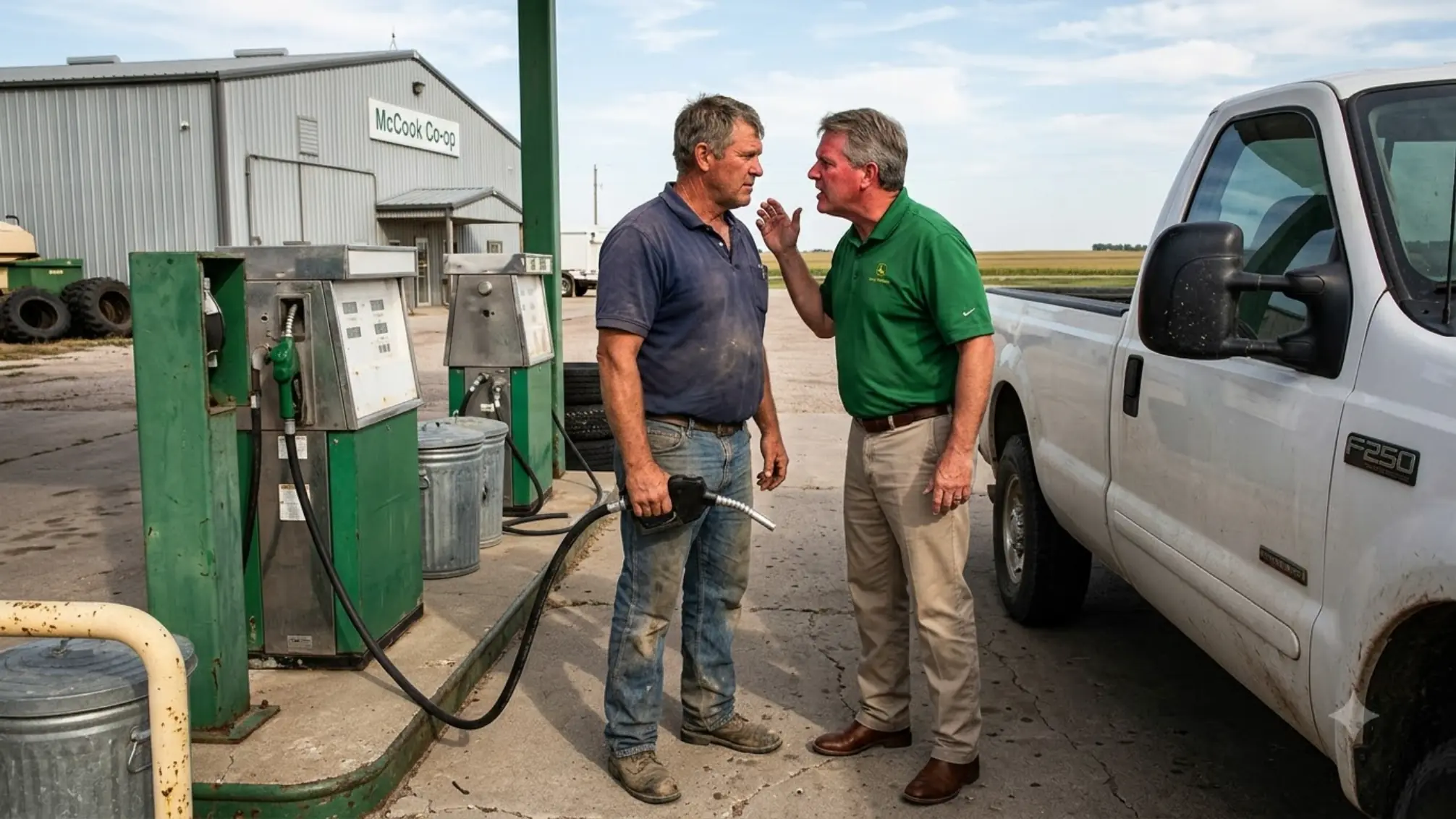
That belief ended on June 14, 2023, during the second day of wheat harvest. Rick was pushing his 2020 John Deere S780 through a 340-acre section north of the highway when the combine suddenly lurched hard enough to throw him forward in the seat. Alarms exploded across the display, the header stopped instantly, and the entire drivetrain locked in the middle of standing wheat. Rick shut everything down, climbed from the cab, opened the side panel, and immediately saw fluid and pieces of metal where solid transmission housing should have been.
The failure could not have happened at a worse time. Rick still had roughly 1,800 acres of wheat standing, the weather was cooperating, and every clear hour mattered because grain quality could deteriorate quickly if conditions changed. He called Huxley and Sons expecting the kind of emergency response three decades of business should have earned. Instead, the service manager told him somebody could probably come the following morning.
“Tomorrow?” Rick repeated, looking across hundreds of acres of ripe wheat. He explained that harvest was already underway and that he needed the combine diagnosed immediately. The answer remained the same: every technician was busy because every farmer in the region was harvesting. Rick swallowed his anger and waited.
The technician finally arrived about twenty-six hours later. One glance inside the damaged machine was enough. The transmission was destroyed, the replacement unit was specialized, and the expected lead time was somewhere between three and six weeks. Then came the estimated repair bill: approximately $47,300 before everything was finished.
Rick stared at the technician because the number itself almost mattered less than the calendar. Forty-seven thousand dollars hurt, but six weeks in the middle of wheat harvest could hurt much more. Rick called Tom Huxley directly and asked him to use every connection the dealership possessed to accelerate the repair. He offered to pay rush freight, overtime, special handling, anything necessary to make the S780 move again.
Tom sounded sympathetic but distant. He told Rick that the dealership could not control the supply chain and that Deere’s answer remained three weeks minimum. When Rick reminded him that Huxley and Sons had been a high-level dealer for years and surely knew people who could make calls, Tom said those calls had already been made. There was nothing else he could do.
“So what am I supposed to do?” Rick asked. Tom suggested renting a used S760 from the dealership at $315 an hour. Rick calculated the remaining harvest hours in his head and realized the rental could cost more than forty-four thousand dollars, almost as much as replacing the failed transmission without leaving him any asset at the end. He told Tom he would think about it and hung up.
That evening, Rick sat at his kitchen table with a laptop and a beer he barely touched. For the first time in years, he seriously researched equipment that was not John Deere. He read about Case IH, New Holland, Fendt, and Massey Ferguson, moving through owner forums, performance reports, dealer networks, fuel data, and videos from farmers who had no reason to protect a brand’s marketing department.
Massey Ferguson kept appearing. Operators praised the Ideal combines for fuel efficiency, straightforward threshing design, strong capacity, and parts availability. Rick noticed comments from wheat farmers in North Dakota and operators in Australia who were pushing the machines through difficult crops without the kind of delays currently paralyzing his harvest. He finally searched for the nearest dealer and found Johnston Ag in Kearney, eighty-three miles away.
Rick called the next morning. Dale Richter, the sales manager, answered without transferring him through three departments or promising to call back. Rick explained that his S780 transmission had failed and that he needed information about Massey Ferguson’s Ideal combine line. Dale immediately asked whether Rick wanted a temporary machine or a replacement.
“I’m not sure yet,” Rick said. Dale told him there was a low-hour 2022 Ideal 9 demonstration unit sitting on the lot. It was priced around $385,000, but the dealership wanted to move it before quarter-end and was willing to negotiate. More importantly, Dale invited Rick to come see it immediately.
Rick was in Kearney two hours later. The Ideal 9 looked completely foreign beside the green machines he had operated for decades, but Rick was not there to admire paint. Dale walked him through the rotor, grain tank, hydraulic layout, cab controls, maintenance points, and parts access, then said something Rick would remember long after the sale.
“When you call us, we answer.” Dale did not insult Deere or promise that machinery never broke. He simply told Rick that Johnston Ag understood downtime was more expensive than almost any part. Then he offered something Rick did not expect: take the Ideal home, run it through his own wheat, and return it if it failed to outperform the S780.
Rick thought he had misunderstood. Dale repeated himself. “I don’t sell machines. I sell proof.”
That afternoon the Ideal 9 entered the field where the S780 had died. Rick eased into the wheat cautiously because he had spent twenty years learning exactly how green combines sounded, reacted, loaded, and warned an operator before something went wrong. Within the first hour, he stopped being cautious.
The Massey Ferguson moved faster through the crop, produced a clean grain sample, used noticeably less fuel, and handled difficult sections without the hesitation Rick expected. Cab visibility was better than he anticipated, and the machine allowed him to push closer to terraces while remaining comfortable about header position. He ran it for six uninterrupted hours.
Then he called Dale. “I want it.” Dale asked whether he was sure, and Rick answered yes. But before the conversation ended, Rick added something that made Dale silent for several seconds.
“I want more than the combine.” Rick told him he wanted to discuss replacing his entire fleet. Tractors, another combine, support machines, everything Johnston Ag could reasonably match against what he currently owned. Dale immediately slowed the conversation because replacing millions of dollars in equipment during the emotional aftermath of one failure could be a disastrous decision.
Rick understood the warning. “I’m not doing it because I’m angry,” he said. “I’m doing it because I just spent six hours in a machine that works better for me, uses less fuel, and comes from a dealer who acts like my time matters.”
Over the following fourteen days, Rick built the plan carefully. Used Deere equipment still carried tremendous market value, so he began liquidating machinery instead of simply trading everything at once. The failed S780 was sold with the damaged transmission fully disclosed to a Kansas custom operator for approximately $110,000. His backup S690 went to Colorado, and tractors from the 8R, 6M, and utility ranges went through auction, private buyers, and distant dealers.
Within roughly ninety days, Rick had recovered about $2.7 million from the green fleet. Most of that money went directly into equipment from Johnston Ag. Two Ideal 9 combines arrived first, followed by three Massey Ferguson 8S 265 tractors, two 7S-series machines for loader and hay work, and a 5S utility tractor for feeding cattle and moving equipment around the operation.
By September, Rick’s machine sheds looked completely different. The familiar green line had vanished and been replaced by red and silver equipment. Every farmer who drove past noticed. Huxley and Sons noticed too.
The first sign of trouble came over a machine Rick had not replaced. He still owned an older Deere baler because it worked well and replacing perfectly functional equipment simply to erase a color from the farm would have been wasteful. When he called Huxley and Sons for a PTO shaft, the parts desk left him waiting and eventually claimed the part was discontinued.
Rick knew that made no sense because the baler remained in current use. He drove to the dealership and confronted the parts manager, Kurt, a man he had known for eight years. Kurt checked the system and suddenly discovered that the shaft was available after all, but now supposedly required a four-week special order.
“Four weeks for a PTO shaft?” Rick asked. Kurt shrugged and said supply chains had changed. Rick understood the message more clearly than the explanation.
He left without placing the order. An independent supplier had the shaft available, and it reached the farm in three days. Not long afterward, another Deere machine developed a minor hydraulic leak, and Huxley and Sons again claimed the necessary seal kit was unavailable while another dealership in Kansas shipped one immediately.
Rick began noticing a pattern. Calls went to voicemail. Parts that had been ordinary suddenly became difficult. Service windows stretched longer whenever his name appeared. He did not accuse anyone because he could not prove retaliation, but he stopped giving Huxley opportunities to inconvenience him.
Meanwhile, the Massey Ferguson fleet continued working. During corn harvest, Rick pushed both Ideal 9 combines through approximately 800 acres at more than five miles per hour while keeping grain loss low and fuel consumption noticeably below his previous machines. When he needed an adjustment kit, Dale had it couriered to the farm the same day.
That difference mattered more than brand loyalty. Rick calculated that he had previously spent around $18,000 annually on parts and service through Huxley and Sons. Now Johnston Ag was receiving that business. One customer leaving would not destroy a dealership, but the loss was real.
The conflict became public during a Farm Bureau meeting that November. About thirty local farmers gathered over coffee when Tom Huxley stood during open discussion and began talking about loyalty. He reminded the room that Huxley and Sons had served the community for fifty years, financed farmers when banks refused, and kept equipment working when parts were scarce.
Then Tom said loyalty worked both ways. He never mentioned Rick by name. He did not need to.
Everyone in the room looked at Rick. Rick simply drank his coffee. He refused to defend himself because his decision did not require a committee vote.
December brought the first serious test of the new fleet. Nebraska temperatures dropped into single digits, and experienced local farmers joked that red tractors might perform beautifully in August but would show their weaknesses when hydraulic fluid thickened and diesel engines faced bitter mornings. Rick did not argue.
He prepared the machines properly. Synthetic fluids, block heaters, winter fuel treatment, and maintenance checks were completed before the cold snap. At six degrees Fahrenheit, Rick climbed into an 8S.265, turned the key, and the tractor started immediately.
For three hours he fed cattle and moved bales without losing hydraulic performance. The machine did not hesitate. Rick smiled because every successful morning made the decision less about proving someone wrong and more about proving the operation could survive without the dealer he had once considered indispensable.
Then the pressure moved beyond machinery. In January, First National of McCook called Rick into a meeting regarding his equipment financing. The loan officer, Gary Went, raised concerns about the resale value of Massey Ferguson machines compared with Deere equipment in the local market and requested fifteen percent additional collateral coverage.
Rick stared across the desk. He had never missed a payment. His operation remained financially sound. Yet suddenly his bank considered the brand painted on his equipment enough reason to ask for more security.
“Did Tom Huxley call you?” Rick asked. Gary did not answer.
Rick stood. “I’ll refinance somewhere else.”
Within days, Frontier Bank in Kearney gave Rick a better rate without requiring extra collateral based on equipment color. When Gary later tried calling, Rick did not answer. Another relationship that once seemed permanent had become optional.
March produced a similar confrontation with Huxley Agronomy, a sister business operated by Tom’s brother Jeff. Rick had purchased seed and chemicals there for twelve years. When he called to place his spring order, Jeff suddenly said inventory was tight and supplies had to be prioritized for long-term loyal customers.
Rick almost laughed at the phrase. After twelve years, apparently loyalty had become conditional. He ended the call and drove to Landmark Cooperative in Holbrook, where he found the seed and chemicals he needed at better pricing.
By planting season, Rick no longer felt like he was defending his decision. Three 8S.265 tractors worked through more than two thousand acres with efficient CVT control, strong hydraulic performance, and reduced fuel consumption. A neighboring Deere operator with fewer acres finished planting two days after Rick.
The jokes at the co-op began fading. Farmers who had predicted failure started asking questions instead. How were parts? How did the transmissions feel? What was actual fuel consumption?
Then came the confrontation Rick had expected for months. He was fueling at the McCook co-op in May when Tom Huxley’s truck pulled in. Tom saw him, walked across the lot, and stopped only a few feet away.
“You made your point,” Tom said. Rick looked at him. “What point?”
“That you don’t need us.” Rick’s expression hardened. “I never said that.”
Tom accused Rick of walking away from thirty years of relationship between their families. Rick cut him off before he could finish. “You left me dead in harvest.”
Tom stopped talking. Rick reminded him that 1,800 acres of wheat had been standing when the S780 failed and that Huxley and Sons told him to wait weeks for a transmission while offering an expensive rental as the solution. He had not switched brands because he hated green paint; he switched because another dealer provided a machine when his operation needed one.
Tom’s jaw tightened. “Those red tractors will fail eventually.” Rick stepped closer.
“Then I’ll deal with it.” Tom warned him not to expect Huxley and Sons to rescue him afterward.
Rick held his stare. “I stopped calling you a year ago.”
Neither man moved for several seconds. Finally Tom walked back to his truck. Rick finished fueling.
One year after the S780 failure, Rick opened his accounting software and studied the numbers. The new fleet had completed a full production cycle with remarkably little downtime. Combined maintenance expense was around $11,400 compared with approximately $24,300 during the previous Deere year, while fuel savings approached $16,800.
His operation produced its best net income ever, around $447,000. Market prices had not been extraordinary and yields were not unusually high. The difference came from lower downtime, fewer emergency repair costs, stronger fuel efficiency, and a dealer relationship that responded when equipment needed attention.
During the following wheat harvest, both Ideal 9 combines moved through Rick’s acreage in nine days. A neighboring farmer running a newer Deere S790 needed eleven days on less ground. The difference was visible enough that farmers who had once laughed at the red fleet began approaching Rick at the cooperative.
“Johnston Ag really that good?” one asked. Rick answered honestly. He never claimed Massey Ferguson machines were impossible to break because all machinery eventually failed. What mattered was that when Rick needed support, somebody answered the phone.
By August, Dale began referring other farmers to Rick. One operator two counties away called and spent an hour asking about fleet conversion, resale value, service, parts, and whether Rick regretted burning such a long relationship with Huxley and Sons.
Rick thought carefully before answering. He remembered the stalled combine, the dealership delays, the strange parts problems afterward, the bank meeting, the agronomy refusal, and the Farm Bureau speech about loyalty. Then he looked toward equipment that had completed a full year of work.
“No,” Rick said. “Not once.”
September brought Tom Huxley back to Rick’s farm. Rick was combining corn when he saw the familiar truck arrive. He shut down and climbed from the machine expecting another argument.
Tom surprised him. “I’m not here to fight.”
Rick nodded. “All right.”
Tom admitted that Huxley and Sons had failed him. He said the dealership had changed response procedures, expanded parts inventory, and reconsidered how it treated major customers during emergencies. Watching Rick leave had forced them to recognize how comfortable they had become.
Rick listened without interrupting. Tom was not asking him to return because both men knew that bridge had already burned too far. He said he only wanted Rick to know the lesson had reached the dealership.
“Why tell me?” Rick asked. Tom looked toward the Massey Ferguson combines.
“Because you weren’t the first guy who thought about leaving.” Tom paused. “You were just the first one who actually did it.”
Rick extended his hand. Tom shook it. The handshake did not restore thirty years of business, but it ended the need to fight.
By October 2024, Rick was no longer trying to prove anything. His operation simply ran. Two combines and five tractors, all Massey Ferguson, carried the work while Johnston Ag continued answering service calls and providing parts.
At the McCook co-op, farmers increasingly asked about the differences between the 8S and 7S tractors or wanted Rick’s real-world opinion of the Ideal combines. Some eventually explored changing brands themselves. Rick never pressured them.
He had learned that machinery loyalty was useful only when it served the farm. A family history with a dealership could be valuable, but it could not harvest wheat when a combine sat dead for three weeks. A bronze plaque in a showroom could not feed cattle during a Nebraska winter.
The brand on the hood mattered less than the people standing behind it. Rick had once believed changing colors meant betraying decades of history. After one full production cycle, he understood the opposite.
Staying loyal to something that had stopped being loyal to his operation would have been the real betrayal. His grandfather had used Ford because Ford worked for him. His father had expanded with International Harvester because those machines fit his needs.
Rick used Deere for decades because Deere worked. When that relationship stopped working, he changed.
Years later, the most important moment was not the arrival of the first red combine. It was not Tom’s apology or the record income year.
It was the afternoon Rick stood beside the disabled S780 with 1,800 acres still waiting and heard his dealer say there was nothing more they could do. That sentence ended a relationship built over generations.
Another dealer answered the phone. Another machine entered the field. The wheat came off.
Everything after that followed naturally.
Rick Hollander did not become loyal to Massey Ferguson because the tractors were red. He became loyal to the people who showed up when he needed them.
And after spending millions of dollars and thirty years learning the difference, he finally understood the only kind of loyalty that mattered on a farm.
The kind that runs both ways.