“Sixty-five million dollars?”
Craig Dawson laughed so loudly that the receptionist stopped typing.
The sound carried through the marble showroom at SkyVault Aviation outside Dallas, Texas, drawing attention from the espresso bar, the lounge, and three sales offices positioned behind walls of glass.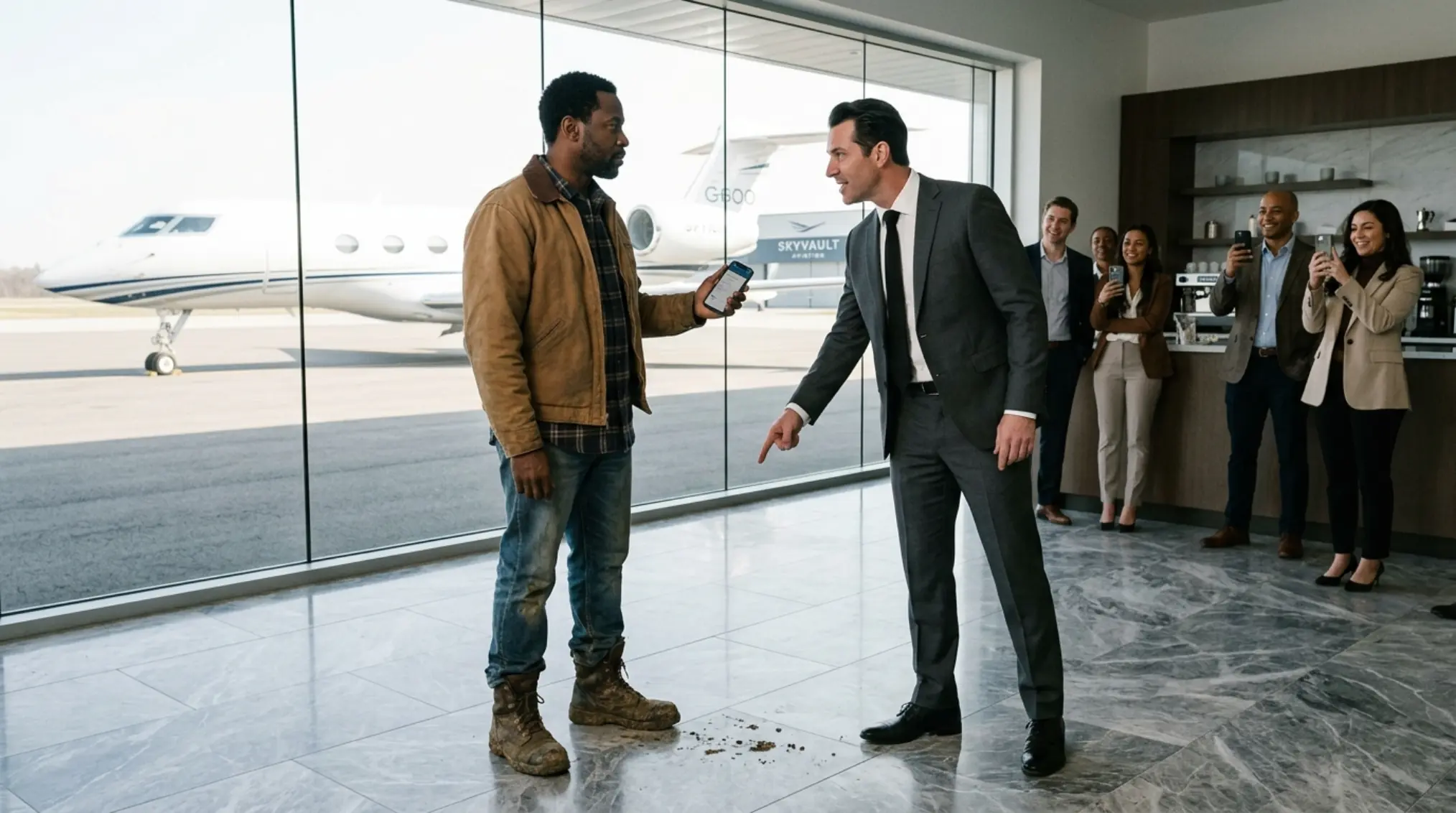
Craig pointed toward Byron Brooks’s boots.
Heavy brown work boots.
Old leather.
Deep red Texas mud dried around the soles.
“You can’t afford this jet,” Craig said. “Hell, you’re tracking farm dirt across a sixty-million-dollar floor.”
A few people laughed.
Byron did not.
The forty-seven-year-old Black farmer stood directly across from Craig with one hand resting inside the pocket of his faded brown canvas jacket. His jeans carried traces of dried soil near the knees, and his dark plaid shirt looked as though he had pulled it on before sunrise.
He had.
Byron had been awake since 4:15 that morning.
Before driving to Dallas, he had inspected a damaged irrigation controller on the eastern edge of his property, checked a pecan grove where last week’s rain had flooded two rows, and spent forty minutes discussing fertilizer schedules with his field manager.
The mud on his boots came from his own land.
Four thousand five hundred acres of it.
Craig looked at that mud and saw poverty.
Byron looked at it and saw thirty years of work.
“Then stop staring at my boots,” Byron said calmly, “and show me the airplane.”
Craig’s smile hardened.
“I’ve sold aircraft for eleven years.”
“Congratulations.”
“I know serious buyers.”
Byron nodded.
“Then this should be easy.”
Craig tilted his head.
“You still don’t understand.”
“No. I understand exactly what I came here to do.”
Byron glanced through the enormous glass wall separating the showroom from the private hangar.
A white Gulfstream G600 sat under brilliant overhead lights.
Long fuselage.
Swept wings.
Polished windows.
The kind of machine designed to cross continents without stopping.
Byron had spent four months researching it.
Not because he dreamed about champagne at forty thousand feet.
Because he hated wasting time.
Brooks Agricultural Systems now operated across Texas, Georgia, South Carolina, and parts of Arkansas. Commercial travel meant missed connections, delayed flights, overnight stays, rental cars, and hours sitting inside terminals when Byron would rather be on a farm or inside a manufacturing plant.
His chief financial officer, Sheila Moore, calculated the numbers twice.
Then three times.
A private aircraft would be expensive.
It would also return hundreds of hours each year to a man whose time increasingly affected thousands of employees and millions of dollars in agricultural contracts.
So Byron made a decision.
Buy the jet.
Cash.
He had expected negotiations.
He had not expected Craig Dawson.
Craig stepped closer.
“The G600 starts above sixty million.”
“I know.”
“Before options.”
“I know.”
“Operating expenses are substantial.”
“I know.”
“Maintenance.”
“I know.”
“Insurance.”
Byron looked at him.
“I know.”
Craig frowned.
Something about Byron’s calmness irritated him.
He had expected embarrassment.
Maybe confusion.
Instead, the farmer answered as though Craig were reciting information Byron had already memorized.
Because he had.
Byron continued.
“I’m considering the forward galley configuration, four-zone cabin, high-speed connectivity package, and additional sound insulation. I also want an estimate on delivery time if we choose a neutral interior now and customize after acceptance.”
Craig’s expression changed.
Only slightly.
For the first time, he considered the possibility that the man in front of him actually knew something.
Then he looked at the boots again.
The doubt returned.
“Where did you get those specifications?”
“From Gulfstream.”
“You called them?”
“I can read.”
A woman near the espresso bar covered a smile.
Craig heard it.
His face tightened.
“What do you do?”
“Farming.”
That answer restored his confidence instantly.
Craig laughed again.
“Farming.”
“Yes.”
“Cattle?”
“Some.”
“Corn?”
“Some.”
“You know, we have aircraft that make a lot more sense for agricultural operations.”
Byron folded his arms.
“I didn’t ask what makes sense to you.”
Craig ignored the remark.
“We have a beautiful King Air available. Turboprop. Practical. Reliable. Great machine for getting between regional airports.”
“I came for the G600.”
“Take a look first.”
“No.”
Craig pointed toward the smaller-aircraft section.
“Trust me.”
Byron stared at him.
“That’s becoming difficult.”
Across the showroom, twenty-eight-year-old salesman Derek Adams looked up from his desk.
Derek had worked at SkyVault for six months.
Long enough to understand the unofficial hierarchy.
Craig got wealthy clients.
Craig chose the best leads.
Craig handled celebrities, oil executives, professional athletes, technology founders, and families whose last names appeared on buildings.
Junior salespeople handled everyone else.
Derek had watched Craig decide who deserved attention in less than ten seconds.
Shoes.
Watch.
Vehicle.
Clothing.
Accent.
Sometimes skin color.
Nobody called it profiling.
They called it instinct.
Management rewarded it because Craig sold airplanes.
A lot of them.
Derek watched Byron refuse to be redirected.
He wanted to stand.
Then Craig glanced toward him.
That was enough.
Derek stayed seated.
Byron looked around the showroom.
It was beautiful.
Almost painfully so.
Cream-colored Italian marble.
Leather furniture arranged around low glass tables.
A barista making espresso behind a dark walnut counter.
Miniature aircraft displayed beneath museum lighting.
Everything communicated wealth without needing to say the word.
Byron had spent most of his life around dirt.
But dirt had never made him uncomfortable.
Rooms like this did not either.
Craig seemed disappointed by that.
“Tell you what,” he said. “If you’re serious, show me proof of funds.”
Byron looked at him.
“For a brochure?”
“For my time.”
“Is that company policy?”
Craig did not hesitate.
“Yes.”
Derek looked down.
It was not.
Nobody had asked the white businessman who walked in twenty minutes earlier to prove anything before touring a $40 million aircraft.
Nobody asked the retired oil executive yesterday.
Craig simply decided when the rule existed.
Byron asked:
“What kind of proof?”
“Bank statement. Letter from your banker. Verified asset sheet.”
“To look at specifications?”
Craig shrugged.
“I don’t waste time.”
Byron nodded slowly.
He looked toward the manager.
Nolan Pierce stood near a glass office holding a tablet.
Mid-fifties.
Gray hair.
Dark suit.
Floor manager.
Their eyes met.
“Mr. Pierce?” Byron asked.
Nolan approached reluctantly.
“Yes?”
“Is proof of funds required before a customer receives G600 specifications?”
Nolan looked at Craig.
Craig looked back.
A small exchange passed between them.
Then Nolan said:
“We allow our sales professionals discretion.”
Not an answer.
Byron understood it anyway.
Craig smiled.
“See?”
Byron looked at Nolan.
“You’re comfortable with this?”
Nolan shifted his tablet.
“Mr…”
“Brooks.”
“Mr. Brooks, luxury aviation is a specialized market. Our team has procedures designed to protect everybody’s time.”
Byron nodded.
“Everybody’s.”
Nolan heard the emphasis.
He chose not to respond.
Then he walked away.
Craig smiled wider.
“You heard the man.”
Byron looked across the showroom again.
Several customers were watching openly now.
Two men near the espresso bar had phones angled toward him.
Recording.
One whispered something.
The other laughed.
Craig stepped toward Byron until only a few feet separated them.
“Let me be straight with you.”
“I’d appreciate the change.”
Craig ignored that.
“I can smell buyers the second they walk through the door.”
Byron raised an eyebrow.
“You can smell them?”
“Absolutely.”
Craig pointed toward Byron’s jacket.
“And you don’t smell like one.”
“What do I smell like?”
Craig smiled.
“Diesel.”
A few people laughed.
Craig continued.
“Wet soil.”
Another laugh.
“And maybe a barn.”
The woman near the bar covered her mouth.
Byron looked around.
Not one person objected.
That interested him more than Craig.
The salesman was one man.
The room was something larger.
Craig leaned forward.
“You’re standing on marble that costs more per square foot than most farms make in a month.”
Byron glanced down.
One of his muddy footprints marked the white stone between them.
Then another.
He almost smiled.
“How much do you think farms make?”
Craig’s face hardened.
“Enough.”
“Clearly.”
Craig turned toward the others.
“You see what I deal with?”
There it was.
The performance.
This was no longer about removing Byron.
Craig wanted an audience.
He wanted the room to confirm that he was right.
Byron had encountered men like him before.
At banks.
Country clubs.
Real-estate meetings.
Once at a restaurant where a hostess asked whether he was delivering something while his white attorney walked past him and was immediately offered a table.
Byron rarely reacted.
Not because the moments did not hurt.
Because anger spent badly was expensive.
Craig walked toward a chair near reception.
He dragged it across the marble and positioned it between Byron and the aircraft display.
Then sat down.
“What are you doing?” Byron asked.
“Saving us both time.”
Craig crossed one ankle over his knee.
“You want to pretend you’re buying a Gulfstream?”
“I’m not pretending.”
“Sure.”
Byron’s jaw tightened slightly.
Craig continued.
“Maybe you drove past here on the way to a feed store and thought it would be fun to walk inside.”
Nobody laughed this time.
The mood had changed.
Even people who had enjoyed the beginning seemed increasingly uncomfortable.
Craig did not notice.
“You saw the airplanes, thought you’d dream for a few minutes. Nothing wrong with dreams.”
He smiled.
“But dreams don’t buy jets.”
Byron stared at him.
“Bank accounts do.”
“That’s right.”
Byron slowly reached into his jacket.
Craig’s eyes followed the movement.
Byron pulled out his phone.
Unlocked it.
Craig laughed.
“What, you going to show me pictures of your tractor?”
Byron opened a banking application.
He had no intention of doing this when he entered.
His finances were private.
He disliked people knowing his wealth.
But Craig had spent almost half an hour publicly declaring what Byron could and could not afford.
Perhaps numbers were now useful.
Byron turned the phone.
“Look.”
Craig barely glanced.
“I don’t need to see whatever screenshot you downloaded.”
Byron held the phone higher.
“Look at the account.”
Craig’s laughter faded.
The screen displayed one of Brooks Agricultural Systems’ operating investment accounts.
Available balance:
$448,372,901.16
Craig stared.
For two seconds, nothing happened.
Then he laughed again.
But this time it sounded different.
Nervous.
“Cute.”
Byron lowered the phone.
“You think it’s fake.”
“Obviously.”
“Good.”
“Good?”
Byron tapped a contact.
“Sheila.”
His CFO answered.
“Morning, Byron.”
“I’m at SkyVault.”
“How is it?”
He looked at Craig.
“Educational.”
Craig’s jaw tightened.
Byron continued.
“I’m ready to proceed with the G600 configuration we discussed.”
Silence spread through the showroom.
“Full purchase?” Sheila asked.
“Yes.”
“Sixty-five million allocation?”
“Yes.”
“We can initiate today.”
Craig stopped smiling.
Sheila continued.
“I’ll send a letter of financial capacity and wire authorization to the dealership once you give me a sales contact.”
Byron looked directly at Craig.
“That may be the problem.”
Sheila paused.
“Understood.”
“I’ll call back.”
He ended the call.
Craig straightened.
“Anybody can stage a phone call.”
Byron nodded.
“You’re committed.”
“To what?”
“Being wrong.”
Nolan Pierce’s receptionist suddenly looked toward her computer.
Her eyes widened.
“Nolan?”
The manager ignored her.
“Nolan.”
Something in her voice made him turn.
He walked quickly toward reception.
She whispered something.
Nolan leaned toward the monitor.
His posture changed.
Craig noticed.
“What?”
Nolan did not answer.
He read the email.
Then opened the attached document.
BROOKS AGRICULTURAL SYSTEMS
Financial Capacity Confirmation
Proposed Aircraft Acquisition: $65,000,000
The document came from one of the largest private banking divisions in Texas.
Verified.
Current.
Nolan scrolled.
He saw Byron’s name.
Then searched it on his tablet.
Results appeared.
Byron Brooks, Founder, Brooks Agricultural Systems.
Agricultural technology.
Patents.
Water-conservation systems.
Automated soil monitoring.
Fourteen-state licensing network.
Thousands of acres.
Estimated personal net worth exceeding $400 million.
Nolan’s mouth became dry.
“Craig.”
Craig looked annoyed.
“What?”
“Come here.”
“I’m handling this.”
“No.”
Nolan raised his voice.
“Come here.”
Every conversation stopped.
Craig walked toward the reception desk.
Nolan turned the screen.
Craig read the letter.
His face changed.
The arrogance disappeared first.
Then color.
Then whatever remained of certainty.
He looked across the showroom at Byron.
Same jacket.
Same jeans.
Same muddy boots.
Nothing had changed.
Except Craig now knew what those things were attached to.
“Mr. Brooks.”
Byron said nothing.
Craig approached.
The audience that had empowered him twenty minutes earlier suddenly felt unbearable.
“Mr. Brooks, I think there’s been a misunderstanding.”
Byron almost laughed.
“No.”
Craig swallowed.
“I may have made assumptions.”
“You did.”
“I apologize if—”
“Stop.”
Craig stopped.
“If?”
“I apologize.”
“For what?”
Craig stared.
Byron waited.
Craig looked toward Nolan.
No help came.
“For how I spoke to you.”
“And?”
“For not taking your inquiry seriously.”
“And?”
Craig’s jaw moved.
“For making assumptions.”
“About?”
The showroom was completely silent.
Craig lowered his voice.
“Your ability to purchase the aircraft.”
Byron nodded.
“That’s closer.”
Nolan stepped forward.
“Mr. Brooks, on behalf of SkyVault, I am deeply sorry.”
Byron looked at him.
“You watched.”
Nolan froze.
“You were standing ten feet away.”
“I should have intervened.”
“Yes.”
“I made a mistake.”
“No.”
Byron’s expression hardened.
“You made a decision.”
That distinction hit harder.
Nolan looked down.
Byron glanced toward the people who had recorded.
One man slowly lowered his phone.
The woman who laughed earlier would not meet his eyes.
Byron spoke quietly.
“I came here prepared to spend sixty-five million dollars.”
No one moved.
“I knew the aircraft.”
He pointed through the glass.
“I knew the configuration.”
Another pause.
“I knew the delivery options. My CFO had already prepared the funds.”
Craig swallowed.
“All I needed was somebody willing to sell me an airplane.”
Byron looked down at his boots.
“You saw dirt.”
He looked back up.
“And somehow the dirt told you everything you thought you needed to know.”
Craig opened his mouth.
Byron raised one hand.
“No.”
He slipped the phone into his jacket.
“You had almost thirty minutes to decide who I was.”
He pointed toward the showroom door.
“I only need thirty seconds to decide where I’m spending my money.”
Nolan stepped forward urgently.
“Mr. Brooks, please.”
Byron turned.
“We can assign another salesperson.”
“No.”
“We can offer preferred pricing.”
“No.”
“Complementary support package.”
“No.”
“Mr. Brooks—”
“I’m not buying from SkyVault.”
Craig looked devastated.
The lost commission alone was enormous.
But something in Byron’s expression suggested money was not the issue.
Craig tried once more.
“Please.”
Byron looked at him.
“You told me to come back when I had something besides mud on my boots and a dream in my pocket.”
Craig closed his eyes.
Byron continued.
“I’ll save you the trouble.”
He walked toward the exit.
Mud prints followed him across the marble.
No one laughed.
Derek Adams stood.
Craig looked toward him sharply.
This time Derek did not sit.
“Mr. Brooks.”
Byron stopped.
Derek walked across the showroom.
“I’m sorry.”
Byron studied him.
“You didn’t say anything.”
Derek’s face dropped.
“I know.”
“That matters.”
“Yes, sir.”
“But you’re saying something now.”
Derek nodded.
“It should have been sooner.”
“Yes.”
Derek swallowed.
“I just wanted you to know not everybody here thought it was okay.”
Byron looked across the room.
“Then next time, make sure the person being treated that way knows it while it’s happening.”
Derek nodded.
“Yes, sir.”
Byron left.
His ten-year-old Ford F-250 started outside.
Several showroom customers watched through the glass as the dusty truck pulled away between a Porsche and Mercedes.
Nobody made a joke.
Behind them, Nolan turned toward Craig.
“My office.”
Craig lifted both hands.
“Nolan—”
“Now.”
The door slammed thirty seconds later.
Derek remained at his desk.
He could hear the argument through the glass.
Craig insisting nobody could have known.
Nolan yelling about a sixty-five-million-dollar loss.
Craig claiming he followed policy.
Nolan pointing out there was no such policy.
Derek listened.
Then opened his laptop.
He began typing.
Not because Byron was wealthy.
Because Byron had been right.
Silence mattered.
Derek documented everything.
The jokes.
The refusal to provide specifications.
The false proof-of-funds rule.
The attempt to redirect Byron toward cheaper aircraft.
Nolan’s failure to intervene.
The customers recording.
Craig’s comments about smell, farms, mud, and money.
Then Derek wrote the sentence that frightened him most.
I observed conduct I believed was discriminatory and failed to intervene when I first had an opportunity to do so.
He almost deleted it.
He did not.
He sent the report to SkyVault corporate compliance.
Two days later, Byron received a call from SkyVault’s president.
Byron listened to the apology.
Private appointment.
Different sales team.
Personal tour.
Discount.
Complimentary management support.
Byron refused every offer.
“I already told you.”
The president asked:
“What would make this right?”
Byron looked across his pecan grove from his office window.
“You’re asking the wrong question.”
“What should I ask?”
“What makes sure it doesn’t happen to the next person?”
The president was silent.
Byron continued.
“Because the next man may not have four hundred million dollars available to prove he deserved basic courtesy.”
That became the core of everything that followed.
SkyVault’s internal review found Craig’s behavior was not isolated.
Three years of sales records showed patterns.
Customers who arrived in expensive cars received faster service.
Customers in casual clothing waited longer.
Minority walk-ins were disproportionately asked for financial verification before receiving detailed aircraft information.
The company had never formally ordered it.
That almost made things worse.
Bias had become habit without anyone needing to put it into writing.
Nolan had known.
Not every detail.
But enough.
He had tolerated Craig because Craig generated enormous commissions.
That ended.
Craig was terminated.
Nolan was removed from management.
SkyVault hired an outside firm to audit customer treatment across its locations.
Proof-of-funds procedures were standardized.
Salespeople could no longer invent financial requirements based on appearance.
Walk-in customer engagement times were audited.
Complaints bypassed local sales leadership when discrimination was alleged.
Derek Adams became one of the employees interviewed.
He told the truth.
Including the part where he initially remained seated.
The investigator asked:
“Why mention that?”
“Because pretending I was brave earlier than I was would make the rest of my statement dishonest.”
Months later, Derek accepted a position at another aviation brokerage.
His new manager had read the report.
“You stood up eventually.”
Derek shook his head.
“Too late.”
The manager answered:
“Then remember how late felt.”
Derek did.
Byron eventually bought his aircraft.
Not from SkyVault.
He found a smaller brokerage in Atlanta run by Gloria James, a forty-one-year-old Black aviation entrepreneur who had started her company from a rented office with two desks and one assistant.
Byron arrived without warning.
Same brown jacket.
Different morning.
Same boots.
Still muddy.
Gloria opened the door herself.
“Mr. Brooks?”
“Yes.”
“Gloria James.”
She shook his hand.
“What can I help you with?”
“G600.”
“Excellent.”
No surprise.
No laughter.
No inspection of his clothes.
“New or pre-owned?”
“New.”
“Timeline?”
“Soon as practical.”
“Budget?”
“Sixty-five, depending on options.”
Gloria nodded.
“Coffee?”
“Black.”
“Good answer.”
Byron smiled.
Twenty minutes later, they were reviewing configurations.
Two hours later, attorneys were exchanging documents.
The aircraft was delivered months afterward to a private hangar near Marshall.
Byron stood beside his truck watching the Gulfstream taxi toward him.
White fuselage glimmering beneath the Texas sun.
The engines shut down.
Silence returned.
Sheila Moore stood beside him.
“You finally bought the ridiculous airplane.”
Byron looked at her.
“You approved it.”
“I approve lots of ridiculous things when the math works.”
They laughed.
She looked down.
“You wore those boots.”
Byron followed her gaze.
Red clay around the soles.
“Of course.”
“You know there’s carpet in there.”
“I heard.”
She shook her head.
“You’re hopeless.”
They boarded.
Byron walked through the cabin slowly.
Cream leather.
Dark wood.
Quiet lighting.
Large windows.
He sat for a moment, then looked toward his boots.
A faint red mark appeared on the perfect carpet.
One of the crew members noticed.
“Mr. Brooks, I can clean that.”
Byron looked at it.
Then smiled.
“Leave it.”
The crew member hesitated.
“Sir?”
“Just for today.”
Byron looked through the window toward the land beyond the hangar.
The dirt had paid for the plane.
He saw no reason to pretend otherwise.
SkyVault’s scandal faded from headlines eventually.
Most scandals do.
But inside the luxury aviation industry, Craig Dawson became a story used during sales training.
Not because he accidentally insulted a billionaire.
That framing bothered Byron whenever reporters used it.
The lesson was not:
Be careful because the muddy farmer might secretly be rich.
That still measured dignity in dollars.
The lesson was simpler.
You did not need to know a man’s bank balance before treating him as though he belonged in the room.
Byron Brooks had $448 million available that morning.
But he should have received the same basic respect if his account held $448.
He asked for information.
Craig could have provided it.
If the conversation later revealed the aircraft was beyond Byron’s means, both men could have walked away respectfully.
Instead, Craig decided humiliation was entertainment.
That decision cost him more than a commission.
It exposed the culture around him.
Years later, Byron was invited to speak at an aviation-industry conference.
Eight hundred executives and brokers filled the ballroom.
Byron walked onto the stage in jeans and his familiar brown jacket.
And the boots.
Always the boots.
He stood behind the podium and looked across the room.
“I’m told I’m supposed to talk about customer experience.”
A few people smiled.
“I’m a farmer.”
More smiles.
“So I’ll make this simple.”
He lifted one boot slightly.
“Most of you know these.”
The room laughed gently.
“Some of you probably know them better than you know my patents.”
Another laugh.
Byron nodded.
“That’s fine.”
Then his expression became serious.
“But here’s the mistake.”
He paused.
“The man at SkyVault thought these boots told him my value.”
Nobody laughed.
“He was wrong because I happened to be wealthy.”
Another pause.
“But if I had been broke, he still would have been wrong.”
Silence.
Byron looked across the ballroom.
“That is the part people keep missing.”
He stepped away from the podium.
“My money made the story newsworthy.”
He pointed toward the audience.
“His behavior made it wrong.”
The room remained completely quiet.
Byron continued.
“Somebody comes through your door, you do not know what they survived.”
“You do not know what they built.”
“You do not know who they employ.”
“You do not know whether their coat came from a designer store or their father’s closet.”
“You do not know whether the dirt on their boots came from a ditch or four thousand acres they own.”
Then Byron smiled faintly.
“And you do not need to know.”
He stepped back.
“Treat them right first.”
The audience stood.
Byron hated standing ovations.
He waited until they finished.
Then returned to Texas.
The following morning, his alarm went off at 4:15.
He pulled on his boots.
Walked outside.
Checked an irrigation sensor.
Helped move equipment from a flooded section.
By seven-thirty, fresh red clay covered the leather again.
The Gulfstream waited fourteen miles away in its hangar.
Worth sixty-five million dollars.
Byron barely thought about it.
The land mattered more.
Because before there had been hundreds of millions in bank accounts, before aircraft and patents and executives answering his calls, there had been soil.
Work.
Failure.
Mornings before sunrise.
Years when money was tight enough that a broken tractor could ruin a month.
The mud represented all of it.
Craig Dawson had looked at those boots and believed they were evidence Byron did not belong around wealth.
The truth was almost exactly the opposite.
Those boots were where the wealth came from.
And that was why Byron never replaced them.