At six o’clock on a dry July morning, eight-year-old Maisie Callaway was elbow-deep in Mr. Henderson’s trash barrel. Her freckled face was streaked with dust, and her long chestnut-brown hair had been pulled into a messy ponytail that kept falling across her fierce hazel eyes. She wore a dirt-stained beige T-shirt beneath faded denim overalls and a pair of brown work boots that had once belonged to her older brother. When she finally pulled out a cracked green garden hose, she coiled it over one shoulder and began walking toward her bicycle.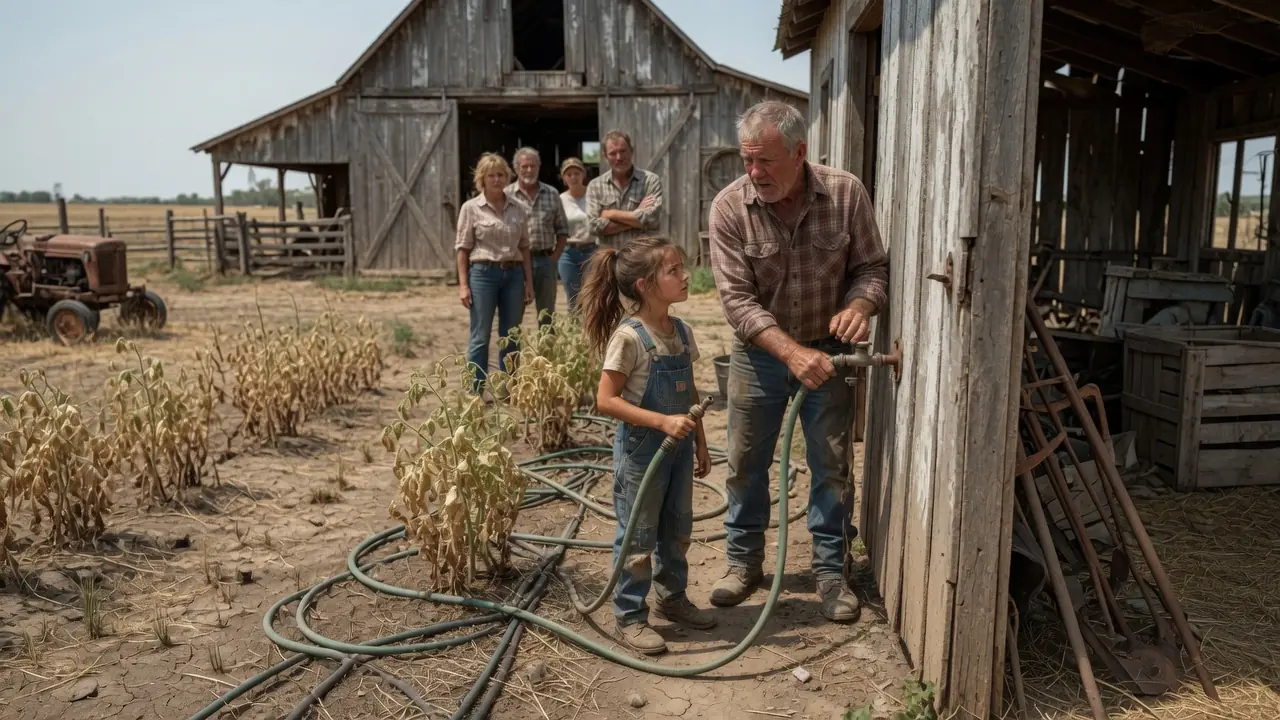
Mr. Henderson watched from his porch with a coffee mug suspended halfway to his mouth. He was sixty-two, broad through the shoulders, and convinced that forty years of farming had taught him everything worth knowing about land and water. The hose Maisie carried had been run over by his tractor, split along one side, and discarded because it could no longer spray properly. “You dragged home our trash because you’re too foolish to save that farm,” he called.
Maisie stopped beside her rusty bicycle but did not lower the hose. “That trash will save it.”
Henderson laughed so loudly that his wife opened the screen door to see what had happened. “Turn water through that thing, and I’ll tear every broken hose out myself.”
Maisie’s small hands tightened around the handlebars. “Touch them—and watch my first row prove you wrong.”
She rode away before he could answer, the hose bouncing against her back while the bicycle tires cut through the dusty road. By the end of that week, eleven discarded hoses lay stacked behind the Callaway family barn. Some were green, some black, and one had once been bright yellow before years of sunlight faded it almost white. Every one of them leaked, cracked, or had damaged connectors.
The neighbors could not understand why Maisie wanted them. She never carried tape when she collected them, never offered to repair anyone’s sprinklers, and never took the rubber to the recycling center in town. She simply knocked on doors before breakfast, asked whether people had broken hoses, and dragged each useless length home. Soon, the entire rural community of Red Creek, Nebraska, was talking about the strange little girl gathering garbage.
Her sixteen-year-old brother, Tucker, found her sorting the hoses beside the chicken coop one evening. He leaned against the fence with a feed bucket in one hand and watched her measure a cracked section using a piece of twine. “Mrs. Pruitt says you’re building a nest for the world’s biggest snake,” he said. “Mr. Henderson thinks the drought finally cooked your brain.”
Maisie ignored him and marked the rubber with a piece of chalk.
“You could at least tell me what you’re doing,” Tucker continued.
“I could,” she replied.
“But you won’t?”
“Not until it works.”
The Callaway farm stretched across sixty acres of red-brown soil that had belonged to Maisie’s family for three generations. Her father, Daniel, grew tomatoes, beans, peppers, squash, and sweet corn under contracts with two regional food cooperatives. In a normal summer, the fields remained green until September. That year, the ground had cracked into hard plates before July was half over.
It had not rained properly in thirty-three days. Afternoon temperatures rose above one hundred degrees, and hot wind stole moisture almost as quickly as Daniel could pump it from the well. The tomato leaves curled inward by midmorning, the bean plants developed pale edges, and immature peppers dropped from their stems before reaching market size. Every evening, Daniel walked the rows in silence, touching the soil as though apologizing to it.
“We lose the tomatoes, we lose the co-op contract,” he told his wife, Renata, one night at the kitchen table. “Without that payment, we cannot cover the equipment loan in October.”
Renata folded the overdue bills into a neat stack. She was practical, patient, and rarely allowed fear to speak before she had searched for a solution. “The Fletchers installed soaker hoses last year,” she said. “They claim they use almost half as much water.”
“A commercial system for our acreage would cost more than the crop is worth.”
“We could start with the tomato rows.”
“Delivery takes three weeks, and the plants may not have ten days.”
At the far end of the table, Grandpa Earl continued eating without joining the conversation. He was seventy-four, lean and sun-weathered, with pale blue eyes that seemed to notice things before everyone else. He had survived droughts, floods, hailstorms, and a tornado that once deposited half a neighboring barn in the Callaway pasture. That summer, however, even Earl had begun looking toward the sky with concern.
His gaze drifted through the kitchen window toward the old barn. Maisie’s small silhouette moved behind it, carrying another section of hose. Daniel followed his father-in-law’s eyes and sighed. “Do you know what she’s doing?”
“No,” Earl said.
“Aren’t you worried?”
“She’s been working back there every day for two weeks.”
“That doesn’t answer me.”
Earl cut another piece of meat. “Children playing make noise. Children working forget the world exists.”
Maisie’s idea had begun a month earlier beside the old oak tree near the vegetable patch. She had been carrying water to the chickens when she noticed a patch of grass that remained deep green while everything around it had turned brittle and yellow. The healthy grass surrounded a tiny crack in an irrigation pipe. Water escaped one drop at a time and disappeared into the soil before the heat could steal it.
She crouched there for nearly twenty minutes. The farm sprinklers threw water high into the air, where sunlight and wind turned part of it into vapor before it reached the ground. Other water landed too quickly, pooled on the hard surface, and ran away from the roots. But the small leak beneath the oak fed the soil slowly enough for every drop to sink in.
The next morning, she asked Grandpa Earl why the plants beside the leak looked healthier than the plants touched by the sprinkler. Earl studied her before answering.
“A sprinkler waters the air,” he said. “That leak waters the roots.”
The sentence remained in Maisie’s mind all day. At the town library, she found old gardening books, agricultural pamphlets, and diagrams of drip-irrigation systems. Some explanations were too complicated, but the pictures made sense. Narrow tubes carried water along crop rows, and tiny openings released it beside each plant.
A real system required special tubing, pressure regulators, filters, connectors, and money the Callaways did not have. Maisie stared at one diagram until she remembered the cracked hose behind Mr. Henderson’s shed. A broken hose already contained holes. It was considered useless because it could no longer deliver water strongly from one end, but strong delivery was exactly what the thirsty fields did not need.
She began collecting them the following morning.
Behind the barn, Maisie arranged the hoses from longest to shortest. She filled each one using buckets and observed where water escaped. Large splits released too much, while tiny punctures produced the slow drops she wanted. She drew plant rows in the dirt and placed chalk marks where additional holes would need to be made.
Grandpa Earl watched from the barn doorway for three days before speaking. “What will you use for the holes?”
Maisie showed him a sewing needle.
“You’ll need to control the size.”
“I know.”
“And heat it evenly.”
“I know.”
Earl nodded toward his workshop. “Use the candle lantern, not your mother’s stove.”
He did not ask what she was building. Instead, he brought her an old wooden board where she could heat the needle safely. He also gave her a pair of work gloves and showed her how to grip the metal with pliers. After that, he returned to repairing a tractor wheel as though helping an eight-year-old puncture broken hoses was an ordinary farm chore.
Maisie spent two afternoons creating small openings at measured intervals. She joined the first sections using electrical tape, strips cut from an old bicycle tube, and wire twisted carefully with pliers. The finished line stretched along twenty tomato plants. She buried it beneath a thin layer of grass clippings to reduce evaporation.
Tucker arrived just as she connected the hose to the outdoor spigot. “So this is the secret?”
“It’s a test.”
“It looks like garbage buried in more garbage.”
Maisie ignored him and turned the handle.
For one beautiful second, nothing happened. Then a connector exploded apart, shooting water sideways into Maisie’s face. Two hoses twisted across the ground, another joint split open, and half the tomato row flooded while the remaining plants received nothing.
Tucker jumped backward to avoid the spray. “Well, at least the system can wash you.”
Maisie sat in the mud with water dripping from her ponytail. She had spent days measuring every opening, but she had focused so much on the holes that she underestimated the pressure forcing the hoses apart. The flooded soil around her boots looked like proof that everyone in town had been right.
At dinner, she barely touched her food. Renata noticed dried mud behind her daughter’s ears, Daniel noticed her red eyes, and even Tucker avoided making another joke. Earl waited until everyone had nearly finished before setting down his fork.
“The first irrigation gate I built flooded my father’s east cornfield,” he said. “Water ran into the road and carried away enough soil to fill two wagons.”
Maisie looked up.
“My father called it the dumbest contraption he had ever seen.”
“What happened?” she asked.
“I rebuilt it.”
“Did it work?”
“The second one saved half the corn. The third one kept our cattle watered during the drought of 1977.”
Maisie glanced down at her plate.
Earl leaned back. “You don’t quit because the first design fails. You quit when you stop learning why it failed.”
The following morning, Maisie unwrapped every connection and began again. She used thicker strips of inner tube and replaced the wire with small metal clamps Earl found in a forgotten toolbox. She tested one section at a time rather than connecting the entire line. When pressure built too strongly, she opened the spigot less.
The second system did not burst. Water traveled from one hose to the next and emerged from the small openings in steady drops. Yet three mismatched connections leaked continuously, wasting almost as much as the irrigation holes delivered.
Maisie watched the wet patches grow until frustration filled her throat. She could not afford new connectors, and every hose seemed to have a different diameter. She considered abandoning the project before remembering a library diagram showing a rigid internal sleeve between two flexible tubes. The hose tightened around the sleeve while clamps prevented separation.
Earl had no commercial sleeves, but Daniel’s scrap pile contained short pieces of copper and plastic pipe. Maisie tested each until she found sections that fit tightly inside the old hoses. Tucker helped cut the pipe, pretending he was only there because their mother had sent him outside. By sunset, six strong connections lay in a row beside the barn.
The third attempt began before dawn three days later. Maisie connected the patchwork line, covered it with mulch, and turned the spigot only one-quarter of the way. A quiet hiss moved through the hoses. Then water appeared beside the tomato plants, drop after drop, without a single joint bursting.
She knelt and pressed her fingers into the soil. The surface remained mostly dry, but beneath the mulch, water collected slowly around the roots. She waited ten minutes, then twenty. The pressure remained steady.
Daniel found her there at sunrise.
“What did you build?” he asked.
“A drip line.”
“With those broken hoses?”
Maisie nodded.
Daniel examined the connections, measured the flow using a jar, and walked the entire row twice. He had spent so many years thinking of cracked hoses as ruined tools that the simplicity of the idea embarrassed him. His daughter had looked at the same damage and seen ready-made openings.
“How much water does it use?” he asked.
“I don’t know exactly.”
“Then we measure.”
For the next week, father and daughter created a proper test. One tomato row received ordinary sprinkler irrigation, another received Maisie’s hose system, and a third received less water as a control. Daniel marked the well meter before and after each session. They recorded soil moisture in the morning, at noon, and after sunset.
The patchwork line used less than half the water of the sprinkler. More importantly, the soil beneath the mulch remained moist hours longer. The plants did not receive water on their leaves, reducing stress and allowing nearly every drop to reach the ground.
By the second week, the difference could be seen from the road. The test row became deeper green while nearby tomatoes continued curling under the heat. New blossoms appeared, the stems thickened, and small fruit began expanding instead of dropping. Daniel walked the row each evening with an expression Maisie had not seen since spring.
The Callaways used the remaining hoses to build lines for four additional rows. Tucker stopped teasing and became responsible for cutting pipe sleeves. Renata gathered grass clippings and straw for mulch. Earl adjusted the water pressure and constructed a simple filter from mesh to keep dirt from blocking the small holes.
Word spread through Red Creek.
Mr. Henderson arrived first, carrying the cracked green hose he had given Maisie. Several farmers followed him, including Mrs. Pruitt, who had laughed about Maisie at church. They stood at the edge of the tomato patch with crossed arms, inspecting the strange network of old rubber disappearing beneath mulch.
Henderson picked up one exposed section. “This won’t survive harvest.”
“It only has to survive the drought,” Maisie said.
“You’re risking the family’s remaining water on trash.”
“It uses less water.”
“You’re eight years old. You don’t know what an entire farm requires.”
Daniel stepped forward, but Maisie raised one hand.
Henderson reached toward the main valve. “Turn this on, and I’ll tear every hose out myself.”
Maisie slapped his hand away from the handle. “Touch them—and watch my first row prove you wrong.”
The farmers stared at her. Henderson’s face reddened, but he stepped back. Daniel opened the valve, and the visitors followed the line as tiny drops darkened the soil beside every plant.
There was no impressive spray, no roaring pump, and no dramatic movement. The system worked so quietly that several people initially believed nothing was happening. Maisie lifted the mulch and showed them the dark earth beneath it.
Mrs. Pruitt pressed two fingers into the soil. “It’s cool.”
“Check the ground three feet away,” Maisie said.
The unwatered earth was hard, pale, and hot enough to make Mrs. Pruitt pull her hand back.
Henderson remained unconvinced. “One green row proves nothing.”
“Then wait for harvest,” Maisie said.
The drought continued into August. Wells across the county dropped, irrigation restrictions tightened, and farmers began abandoning weaker fields to preserve water for their most valuable crops. The Callaways expanded Maisie’s system only after testing each new line for pressure and flow. They could not save every acre, but they concentrated water on the tomatoes, beans, peppers, and squash required by their cooperative contract.
Daniel calculated that the patchwork system reduced their daily irrigation use by nearly fifty-three percent. The family’s old well, which might otherwise have fallen below pumping level, continued supplying enough water. The soil beneath the mulch improved as grass clippings decomposed and protected the surface from the wind.
Maisie kept a notebook beside her bed. She recorded blocked openings, weak joints, soil temperatures, and how long each row remained damp. Whenever one area received too much water, she sealed an opening with a rubber patch. When distant plants remained dry, she widened a hole using the heated needle.
By September, neighboring farms looked tired and colorless. The Callaway fields were not perfect, but the protected rows remained alive. Red tomatoes weighed down reinforced vines, peppers shone beneath green leaves, and squash spread across soil that should have been too dry to support them.
Harvest day arrived beneath a cloudless sky.
Daniel expected the usual crew of relatives and cooperative workers. Instead, nearly fifty neighbors gathered along the fence. They had heard about the green rows and wanted to see whether an eight-year-old’s broken hoses had truly produced enough crops to save the contract.
Maisie climbed onto the truck beside Tucker. Her overalls were patched at one knee, her ponytail was tangled, and dirt remained beneath her fingernails. She looked toward the crowd, spotted Mr. Henderson near the front, and began loading tomatoes without acknowledging him.
The first row filled twelve crates.
The second filled thirteen.
By noon, the truck bed carried more tomatoes than Daniel had promised the cooperative. The bean yield surpassed the previous year, while the peppers and squash produced enough surplus to sell at the county market. Even Earl seemed surprised by the final numbers.
Daniel stood beside the loaded truck and covered his face with one hand. Renata wrapped her arms around him. The co-op contract would survive, the October equipment payment could be made, and the Callaway farm would enter winter without losing the land.
Mr. Henderson walked slowly toward Maisie. He stared at the crates and then at the cracked hose beneath the mulch.
“I threw that away because it was useless,” he said.
“It was useless for spraying,” Maisie replied.
“How did you know it would work like this?”
“I didn’t.”
Henderson frowned.
“I thought it might work,” she explained. “Then it failed. So I fixed what failed.”
Mrs. Pruitt joined them, holding a tomato in both hands. “How does something broken produce all this?”
Maisie looked toward Grandpa Earl.
“A sprinkler waters the air,” she said. “This waters the roots.”
No one laughed.
During the following weeks, farmers began arriving with coils of damaged hose in their pickup trucks. Some asked Maisie to show them how to space the holes, while others wanted help connecting hoses of different sizes. Daniel established a testing area behind the barn where they could measure pressure before placing lines in fields.
Henderson returned with three hoses and an apology. “I should not have called you foolish.”
Maisie inspected one damaged section. “This split is too large.”
“I know.”
“You’ll have to cut it out and join the ends.”
“Will you show me?”
Maisie handed him a pipe sleeve. “Start with this.”
By the next growing season, twenty-three farms around Red Creek were using some version of the Callaway patchwork system. Agricultural agents visited to examine water consumption, and a university extension specialist helped the community improve filtration and pressure control. The homemade hoses were not perfect replacements for professional equipment, but they allowed struggling families to irrigate small plots without purchasing expensive systems.
Maisie received an award at the county fair. She stood on the stage in clean overalls while adults applauded the child they had once mocked for digging through trash. The plaque called her invention innovative, but Maisie knew every part of it came from observing ideas that already existed in nature, farming books, and the quiet leak beneath an oak tree.
After the ceremony, she sat with Grandpa Earl on the fence overlooking the restored tomato rows. Rain had finally returned, and the soil smelled rich beneath the evening air.
“Do you know what saved the farm?” Earl asked.
“The hoses.”
He shook his head.
“The mulch?”
“No.”
“The water?”
“That helped.”
Maisie looked at him impatiently. “Then what?”
“You noticed what everyone else ignored. Then you stayed with the problem long enough to understand it.”
Maisie watched a final drop fall from one of the old hoses and disappear beside a plant. The rubber was cracked, faded, patched, and considered worthless by almost everyone who had owned it. Yet the damage that made it fail as an ordinary hose had helped it become something new.
Across the field, Mr. Henderson was installing a line beside his late-season beans. Tucker was helping him tighten a clamp, while Daniel and Renata measured another section near the peppers. Nobody referred to the pile behind the barn as garbage anymore.
Maisie smiled and rested her muddy boots on the lower fence rail.
The whole town had believed she was collecting broken hoses.
She had been collecting a second chance.