The last bale came apart before it moved.
Dorothia Halverson drove her gloved fingers beneath the rotten twine, leaned back, and watched half the square collapse into a gray-green heap at her boots. Dust climbed through a shaft of November light. Mice had hollowed the center. Mold spread in white threads across hay that had been stacked when Lyndon Johnson was president and left untouched through four Nebraska winters.
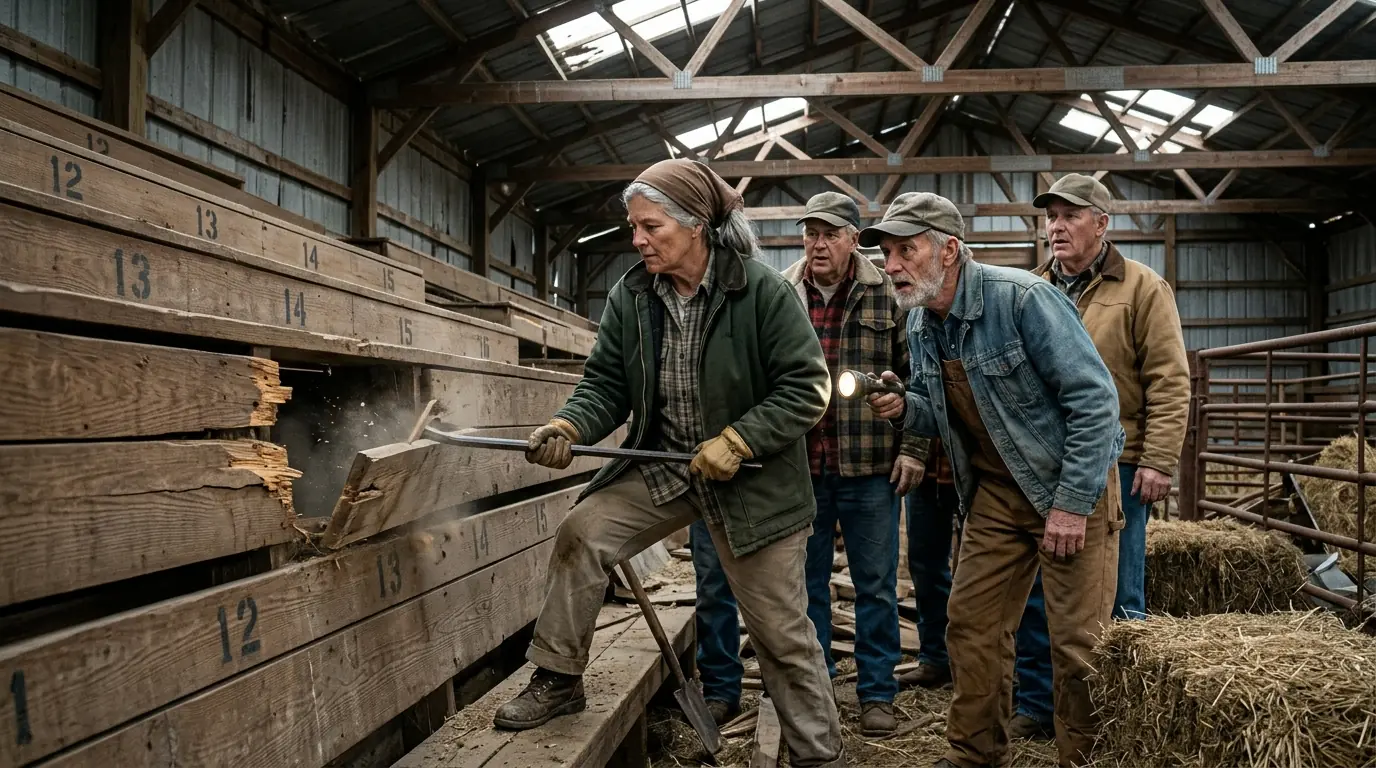
Behind Dot, three farmers laughed.
“You paid four hundred fifty dollars for bats and rotten hay.”
Harvey Kline said it loudly because the abandoned Orin livestock sale barn gave every word an echo. He stood near a rusted gate with his brothers, Mel and Curtis, their hands in coat pockets and their expressions carrying the pleasure of watching another person’s bad bargain.
Dot straightened slowly. At sixty-one, she knew better than to answer mockery while her back was deciding whether to cooperate. She tightened the faded brown headscarf over her silver-gray hair, planted both muddy boots, and looked at the heap.
“Help me drag the bottom half,” she said to Walt Ostrander.
Walt was sixty-eight, lean as old fencing wire, with a gray beard and the permanent squint of a man who had spent his life measuring weather. He hooked a hay fork beneath what remained of the bale. Together they pulled it away from the rear wall.
Except it was not the rear wall.
The barn’s exterior was corrugated metal over heavy timber framing. What appeared behind the hay was solid wood: rows of thick boards darkened with age, fitted vertically and braced from the other side. Faded white numbers remained on several planks—14, 27, 31, 46. Dot wiped one with her glove.
“Auction benches,” she said.
The Orin barn had once held weekly livestock sales. Farmers sat on numbered wooden benches around a dirt ring while an auctioneer called cattle, hogs, sheep, and horses. After the business closed in 1963, the benches disappeared. People assumed vandals or salvagers had taken them.
Someone had used them to build a wall inside the barn.
Walt held his flashlight against the boards, then turned toward the broken doorway. He paced from the concealed wall to a post, counted, paced again, and pulled a steel tape from his overalls. Outside, he measured along the north foundation through frozen weeds.
When he returned, concern had replaced curiosity.
“Dot… this room is eleven feet too short.”
The Kline brothers stopped laughing for a moment.
Dot took the tape and checked his numbers. The exterior foundation measured eighty-four feet from the loading pens to the rear corner. Inside, the usable floor ended at seventy-three. Roof trusses continued across the missing distance. No door, latch, or handle marked the bench wall.
Harvey recovered his grin. “Old construction. They boxed around something.”
“Around eleven feet of air?” Walt asked.
“Maybe the wall shifted.”
“Eleven feet?”
Curtis kicked loose hay. “Could be fill. Could be foundation. There’s nothing behind that wall.”
Dot walked to the tool pile and picked up a long iron pry bar. It had belonged to her husband, Earl, who died seventeen months earlier beneath a grain auger he had believed was safely disconnected. The bar was cold through her gloves and heavy enough to remind her that determination did not change leverage.