When eleven-year-old Emily Cutler spent her entire savings on a rusted John Deere, forty farmers filled the auction barn with laughter. They saw peeling paint, a flat tire, and a worthless machine—but Emily had inherited her grandfather’s notebook, and three pages inside warned her never to underestimate that tractor. The moment she mentioned a concealed plate beneath the steering pedestal, the auctioneer’s smile vanished and he tried to stop her from examining her purchase. What had Emily’s grandfather discovered—and why had the Hale family hidden it for thirty years?
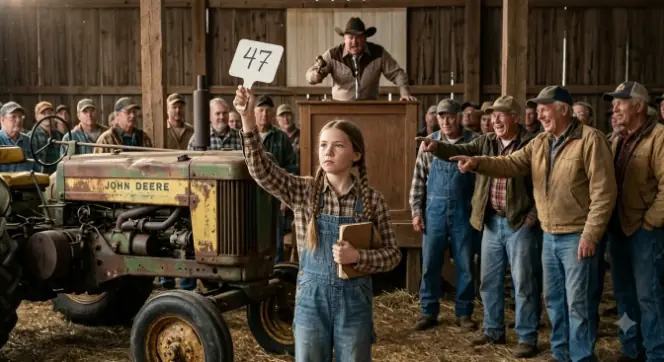
The rain had stopped before dawn, leaving the county fairgrounds slick with mud and the metal roof of the auction barn ticking as it cooled. Emily Cutler arrived with her mother at seven seventeen, carrying fifty-five dollars in an envelope and her grandfather’s notebook beneath her coat.
The notebook smelled faintly of oil even after four months in a dresser drawer. Its black cover had softened at the corners. Most pages contained ordinary things: belt sizes, valve clearances, sketches of hydraulic fittings, dates of oil changes, and names of farmers who paid late but always paid. Her grandfather, Thomas Cutler, had repaired tractors in Weller County for forty-six years. He trusted measurements, sharpened pencils, and people who returned borrowed tools.
Near the back were three pages Emily had read so often she knew the stains around each sentence.
JD 3020, diesel, narrow front. Hale west machine. Visible tag is not the first tag.
Under steering pedestal, left rear, feel for two blind screws beneath paint. Plate covers a dry pocket. Do not pry until machine belongs to you. Do not tell a Hale before witnesses are present.
If it ever comes up for sale, do not judge it by the skin. Fifty is fair for iron. What is inside does not belong to them.
The final line had been underlined twice.
Emily’s mother, Rachel, believed the pages recorded one of her father’s unfinished grudges. She had agreed to bring Emily only because the auction was public, the weather had canceled soccer practice, and Emily had earned her savings feeding calves, sorting bolts in the repair shed, and selling sweet corn beside County Road Nine. Rachel had also established rules. Emily could bid only on the tractor. She could not spend more than fifty-five dollars. She could not operate it. If she won, they would not move or open anything until an adult mechanic examined it.
“And if it is not the same tractor?” Rachel asked as they crossed the lot.
Emily touched the notebook through her coat. “Then I bought scrap metal.”
“With all your money.”
“Yes.”
Rachel sighed. “You are exactly like him in the least convenient ways.”
The Hale estate auction occupied two barns and half an acre of gravel. Gerald Hale had died in January, leaving machinery, tools, grain wagons, and household furniture to be sold before his sons divided the land. The Hales had farmed more acreage than anyone in the northern half of Weller County. Their white grain elevators stood above the highway like monuments. Their name appeared on the feed store, the livestock pavilion, and the scholarship banner at Emily’s school.
It also appeared twelve times in Thomas Cutler’s notebook.