The first Osage orange sapling went into the ground while three neighboring farmers stood beside a pickup truck and laughed.
Linnéa Dykstra heard them.
She simply kept digging.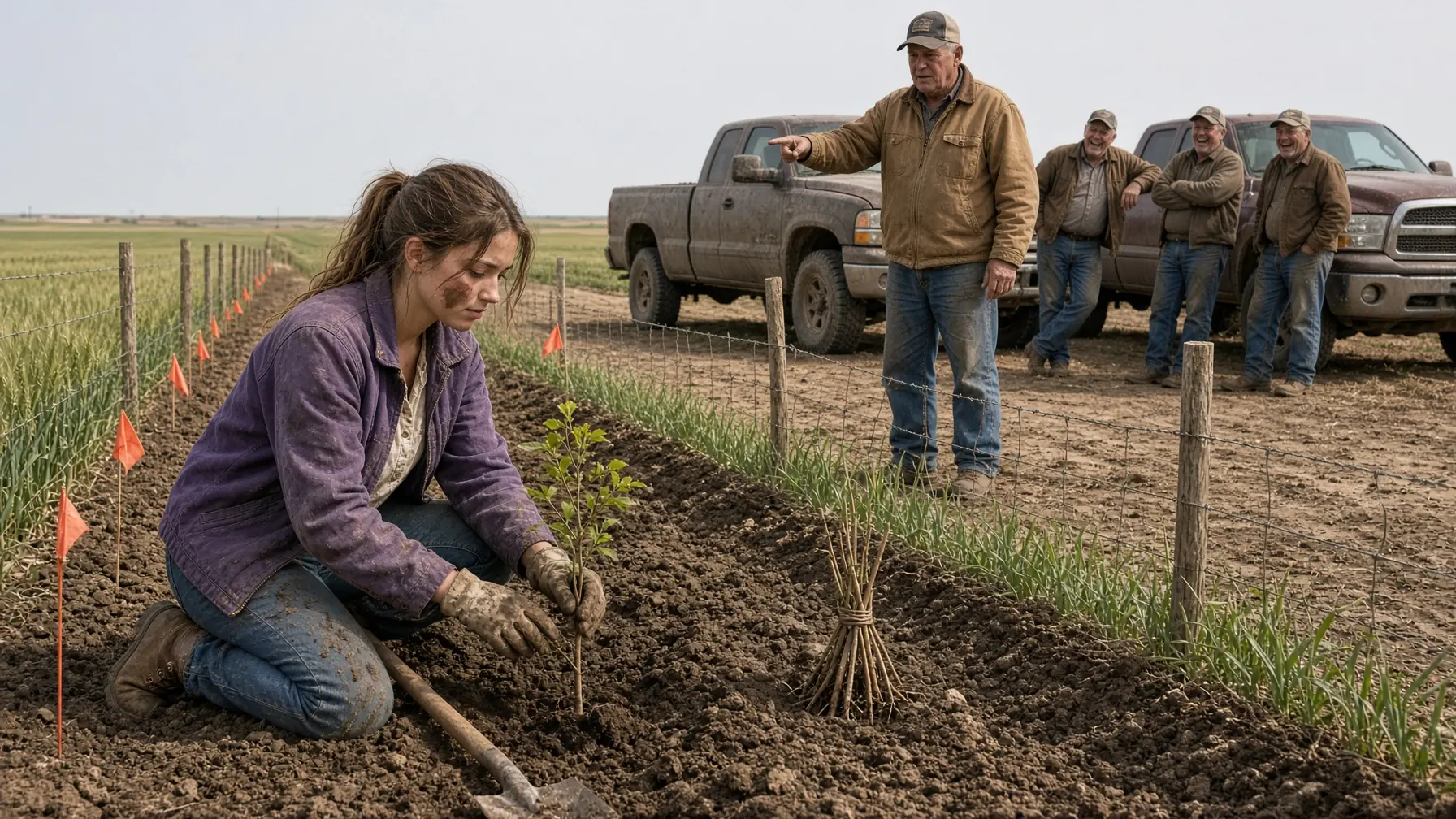
At twenty-two, Linnéa had recently returned to her family’s 340-acre wheat farm six miles northwest of Garden City, Kansas, after studying agronomy at Kansas State University. She was young, strikingly beautiful, and completely unlike the picture many older farmers carried in their heads when they imagined someone challenging forty years of accepted agricultural practice.
Her chestnut-brown hair was pulled into a loose ponytail. Dirt streaked one cheek. A faded purple work jacket covered a cream shirt, and her worn jeans were already stained at both knees from planting.
Beside her stretched a line of bright survey flags nearly a quarter mile long.
And beside those flags sat hundreds of young trees.
Osage orange.
Hedge apple.
Bois d’arc.
The kind of ugly, twisting, thorny tree that farmers across the Great Plains had spent decades removing.
The kind Linnéa intended to put back.
Calvin Mercer leaned against his pickup and pointed toward the saplings.
“You came home with a college degree just to waste good wheat ground planting worthless trees?”
Two men beside him laughed.
Linnéa drove the shovel into the earth.
“No.”
She pulled another scoop of soil free.
“I came home because forty years of your ‘efficient farming’ is blowing this county east one inch at a time.”
Calvin’s smile disappeared.
He walked toward her.
“Those hedges will steal moisture, shade your wheat, and cost you productive acres.”
Linnéa knelt beside the hole.
She carefully lowered the young tree into it.
Calvin continued.
“When your yields fall, don’t come asking the rest of us to save this farm.”
Linnéa pressed the soil firmly around the roots.
Then she stood and looked directly at him.
“Keep laughing, Calvin.”
Her voice was calm.
“When the southwest wind finally turns this county brown, we’ll see whose topsoil is still here.”
Nobody standing there that morning understood how literal those words would eventually become.
Eight years later, the sky answered for her.
The Dykstra farm had not always been open ground.
Linnéa’s great-grandfather, Pieter Dykstra, had arrived in western Kansas in 1903 with very little money and the stubborn belief that land could become a future if a person stayed long enough to understand it.
He started with 160 acres.
He planted wheat because nearly everyone did.
But Pieter also planted something along the western and northern boundaries.
Trees.
Long rows of Osage orange.
It was not decoration.
Early Plains farmers understood something modern machinery could make easy to forget: wind had weight.
Not weight you could place on a scale, but power accumulated across miles of open prairie.
Give a Kansas wind forty unobstructed miles and it could dry moisture from soil, flatten young plants, and carry the most fertile part of a field into the next county.
So farmers built windbreaks.
Pieter’s Osage orange rows grew dense and ugly.
Exactly as intended.
His son Willem maintained them.
Nobody calculated their annual return.
Nobody asked whether each tree occupied land that could have grown another bushel of wheat.
The hedgerows were treated the way a farmer treated fences, drainage ditches, or the roof over the barn.
Part of keeping the farm alive.
Then agriculture changed.
By the late 1960s and early 1970s, machines became larger.
Fields became wider.
Efficiency became the language of survival.
Every tree line was another place where a planter had to turn.
Every hedgerow interrupted a combine pass.
Every strip of shaded soil looked like acreage that was failing to produce.
Linnéa’s grandfather, Jared Dykstra, believed he was modernizing the farm.
In 1971, he brought in a dozer.
The Osage orange came out.
Roots.
Branches.
Everything.
Twenty additional acres became available for production.
For a while, Jared appeared to have been correct.
More wheat.
Cleaner field geometry.
Longer equipment passes.
Less time turning around.
By the time the farm passed to Linnéa’s father, Hendrick, in 1998, almost nobody questioned what had been lost.
Hendrick was a careful farmer.
He maintained machinery.
Watched rainfall.
Kept records.
Planted winter wheat in October.
Harvested in June.
Tilled because his father had tilled.
Managed the farm the way a good farmer was expected to manage it.
He was not foolish.
That distinction mattered deeply to Linnéa.
Her argument was never that her father or grandfather had been stupid.
They had made decisions based on the economics, machinery, and accepted knowledge of their eras.
But soil remembered decisions longer than people did.
By the time Linnéa was a teenager, she noticed something along the farm’s western edge.
The yields were weaker.
Not catastrophically.
Just gradually.
The kind of decline easy to explain away.
A dry year.
A hot spring.
Poor establishment.
Bad timing.
But Linnéa liked patterns.
At fifteen, she could read yield maps.
At eighteen, she left for Kansas State.
By twenty-two, she had learned how to ask a more dangerous question:
What if the weak western edge was not simply experiencing bad years?
What if the farm had been slowly losing the thing that made those yields possible?
Soil.
At Kansas State, Linnéa worked under Dr. Anita Reyes, a soil scientist studying wind erosion across the southern Plains.
Reyes did not romanticize windbreaks.
Trees had disadvantages.
They occupied acreage.
Their roots competed for moisture.
Their shade could reduce yields close to the rows.
But agricultural decisions were not supposed to be judged by one number.
They were systems.
The research Linnéa studied showed that fields protected by substantial windbreaks could lose dramatically less soil during major wind events than comparable open fields. Protection extended far beyond the trees themselves, and established rows could reduce wind speed over a broad area downwind.
Linnéa started researching her own farm.
She found old yield records.
Jared had kept more documentation than anyone realized.
She compared years before the hedgerows disappeared with later decades.
The twenty acres added to production after 1971 looked valuable at first.
But farther into the records, something changed.
The western fields began declining.
Slowly.
Persistently.
Exactly where exposure to the prevailing southwest wind was greatest.
Linnéa ran the numbers repeatedly.
Then she returned home with a notebook thick enough to irritate her father before she even opened it.