“I ordered them because your fear is killing this farm.”
Tyler Henderson slammed his palm onto the spotless white sales desk inside Heartland John Deere, making the electronic contract tremble beneath his hand. Behind him, two polished green 8R 370 tractors stood beneath the bright showroom lights, their enormous tires untouched by mud and their glass cabs shining like promises of a future he believed his father was too stubborn to accept. Tyler’s blue eyes burned with anger as he faced the sixty-eight-year-old man who had controlled Henderson Farms for nearly half a century.
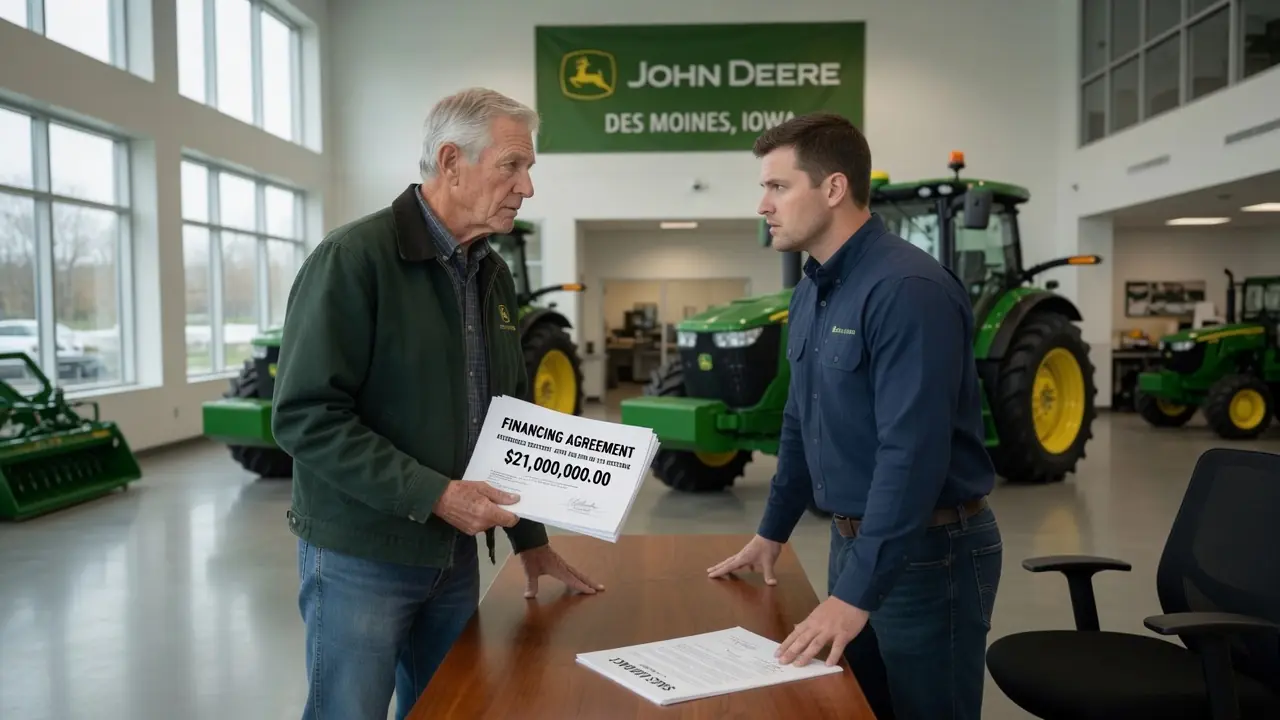
Robert Henderson lifted the financing papers between them. “You forged my name and gambled twenty-one million dollars of my land.”
“I didn’t forge anything,” Tyler snapped. “I used the farm account you gave me because you refuse to make a decision until every machine we own is rusting in a field.”
“You used an electronic signature that belonged to me.”
“I used the authority I should have had years ago.”
The dealership manager, Brad Mitchell, stood several feet away with two sales representatives, all three pretending not to hear a family confrontation involving the largest equipment order their dealership had ever processed. Fifty tractors had been gathered from distribution centers across three states. Delivery trucks had already been scheduled, financing had been approved, and the first machines were supposed to reach Henderson Farms within seventeen days.
Tyler stepped closer to his father. “Cancel it, and I walk while your machines rot.”
Robert did not raise his voice. “Cancel all fifty—and freeze every account you touched.”
The words landed harder than a shout.
Brad cleared his throat. “Mr. Henderson, an order of this size carries substantial cancellation penalties.”
Robert turned toward him. “How substantial?”
Brad hesitated before answering. “Potentially several hundred thousand dollars, depending on what corporate has already committed.”
“Then start calculating.”
Tyler stared at his father. “You would rather throw away hundreds of thousands than admit I’m right?”
“I would rather lose money once than surrender this farm for ten years.”
“You’re not saving it,” Tyler said. “You’re strangling it.”
Robert looked past him at the flawless green tractors. They were powerful, efficient, and beautiful in the way new machinery always was before debt attached itself to every hour of operation. He understood why Tyler wanted them. What his son did not understand was that Robert had once stood in another John Deere dealership, younger than Tyler was now, believing almost the same things.
“Brad,” Robert said, “freeze the delivery, financing, preparation, and registration. Nothing leaves this building under the Henderson name.”
Brad glanced at Tyler. “The order came from an authorized farm email.”
“That authorization is revoked.”
“You can’t do this,” Tyler said.
Robert folded the papers and placed them inside his jacket. “Watch me.”
Three days earlier, Robert had been standing in his kitchen at 6:47 in the morning when the dealership called to confirm delivery. Brad had sounded cheerful as he explained that fifty John Deere 8R 370 tractors were ready for staged shipment. Each machine included integrated guidance, automatic steering, premium cab packages, extended warranties, and nearly every available upgrade.
The final cost exceeded twenty-one million dollars.
The financing required monthly payments of approximately two hundred fourteen thousand dollars for ten years. Robert had asked Brad to repeat the number twice because his mind initially refused to accept it. Henderson Farms was profitable, but no farm was profitable enough to guarantee that kind of payment through droughts, floods, equipment failures, price collapses, or disease.
Robert knew only one person with access to the farm email and enough technical knowledge to complete the financing forms.
His thirty-three-year-old son.
Tyler had been running more of the operation each year. He supervised hired crews, managed precision planting data, coordinated fertilizer applications, and understood technologies Robert had never needed when he began farming in 1973. Robert respected his intelligence, trusted his work ethic, and planned to transfer the business to him gradually.
That trust was why the secret order felt like betrayal.
After leaving the dealership, Robert drove home alone. Tyler refused to ride with him and called one of the farm employees for transportation. Robert did not object because he knew neither of them could speak without making the conflict worse.
Henderson Farms covered 4,200 acres of central Iowa. Robert had inherited only 320 acres from his father, Walter, then expanded carefully over forty-eight years by buying neighboring land whenever he could afford it without threatening the original farm. Some years he purchased nothing. Other years he bought used machinery instead of land and spent winter evenings rebuilding engines in the farm shop.
The operation was large, but its size had never impressed Robert as much as the absence of crushing debt.
Tyler saw the matter differently.
To him, Henderson Farms was large enough to demand modern equipment. Their tractors averaged seventeen years old. Several lacked integrated guidance systems, and maintenance costs had risen above three hundred thousand dollars the previous year. During spring planting, a transmission failure had delayed eight hundred acres of corn by six days.
Tyler calculated that the delay alone had cost them more than one hundred thousand dollars in reduced yield.
He had shown those numbers to Robert repeatedly.
Each time, Robert said they would discuss upgrades after harvest.
After harvest became after taxes.
After taxes became after seed contracts.
Tyler eventually stopped believing the conversation would happen.
That did not justify signing his father’s name, but Robert knew the betrayal had grown inside years of being dismissed. By treating his son like a worker whenever the decisions became important, Robert had helped create the resentment now threatening their relationship.
When he reached the farm, Tyler was already inside the equipment barn, pacing between two aging tractors. One had a hydraulic leak, while another waited for a replacement sensor delayed by supply shortages. Tyler struck the tire with his boot when Robert entered.
“Look at this place,” Tyler said. “We lost nineteen working days to breakdowns last year.”
“We are replacing equipment.”
“When? After another planting season collapses?”
“We are not replacing it with fifty tractors financed for a decade.”
“We operate four thousand acres.”
“We do not need fifty new 8Rs.”
“We need enough capacity to stop working every machine until it dies.”
Robert removed his jacket and draped it over a chair. “Why fifty?”
Tyler opened a laptop on the workbench. “Fleet discount. Corporate gave us better terms at fifty units, and some would replace leased equipment used by our contract partners.”
“Partners who did not sign the debt.”
“They would pay usage fees.”
“During good years.”
Tyler’s jaw tightened. “Every decision contains risk.”
“Not every decision risks the deed.”
Tyler turned the screen toward him. A detailed spreadsheet showed repair costs, labor savings, projected fuel efficiency, reduced overlap from automatic steering, and estimated yield improvements from faster planting. The calculations were sophisticated and, under normal conditions, convincing.
According to Tyler’s model, the tractors could pay for themselves.
Robert studied the columns quietly.
Tyler mistook his attention for surrender. “You see it now.”
“I see that your model assumes normal yields.”
“It uses a ten-year average.”
“It assumes fuel stays within fifteen percent of current cost.”
“That’s reasonable.”
“It assumes our contract acreage remains stable.”
“We have loyal customers.”
“It assumes corn prices never fall beneath your minimum.”
Tyler exhaled sharply. “You can destroy every investment by imagining the worst possible outcome.”
Robert closed the laptop. “I don’t have to imagine it.”
That evening, he took Tyler into the farmhouse kitchen and placed an old manila folder on the oak table. Tyler had eaten at that table throughout childhood, but he had never seen the documents inside the folder. Robert had kept them hidden in the lowest drawer of his desk for nearly forty years.
The first paper was a John Deere purchase agreement dated March 1981.
At thirty-three—the same age Tyler was now—Robert had financed four new tractors after three profitable seasons. They had cost three hundred thousand dollars, a frightening amount for the time, but every projection suggested the farm could manage the payments. Commodity prices were strong, land values were rising, and bankers encouraged farmers to expand.
Robert believed newer equipment would let him cultivate more acreage and build a safer future for his growing family.
Then the drought came.
Corn yields fell to less than half of what he had budgeted. Soybeans performed even worse, crop insurance covered only a fraction of the loss, and the used-equipment market collapsed because every struggling farmer tried to sell at once. Within months, Robert owed more on the tractors than buyers were willing to pay.
He slid a bank statement across the table.
“Fourteen thousand dollars,” Tyler read.
“That was everything we had left by November.”
Robert placed three overdue notices beside it. “We missed payments. The bank prepared foreclosure documents. Your mother was pregnant with you, and we were three weeks away from losing the house and every acre your grandfather had spent his life protecting.”
Tyler stared at the papers. “How did you stop it?”
“Your grandfather loaned me eighteen thousand dollars.”
Robert unfolded a handwritten note from Walter Henderson. The paper had softened at the creases, and the ink had faded, but the final sentence remained readable.
Debt is a noose. The more you borrow, the tighter it gets.
Walter died of a heart attack six weeks later.
Robert and his wife repaid the money slowly to Walter’s estate, even during years when every two hundred dollars mattered. Robert kept the tractors because selling them would have left him with debt and no machinery. He survived through relentless work, help from neighbors, and enough luck to keep the bank from taking the farm.
“I stood in this kitchen on New Year’s Day in 1983,” Robert said, “and promised I would never finance equipment again.”
Tyler leaned back from the table. His anger had not disappeared, but uncertainty now moved beneath it. “That was forty years ago.”
“The dates changed. Debt did not.”
“We have better insurance now.”
“Insurance keeps you breathing. It does not guarantee profit.”
“We have reserves.”
“Not enough for fifty tractors during two failed seasons.”
Tyler looked again at the overdue notices. “You never told me.”
“I wanted you to love farming without carrying my fear.”
“Instead, you used that fear to reject every idea I brought you.”
The truth of the accusation settled heavily between them.
Robert nodded. “Yes.”
Tyler had expected another defense, and the admission disarmed him.
Robert continued. “I should have explained instead of simply saying no. But you should have confronted me, not signed my name.”
“I tried confronting you.”
“You stopped too soon.”
“You stopped listening years ago.”
Neither man spoke for nearly a minute.
Finally, Robert opened a newer folder. “I have been looking at replacements for six months.”
Tyler’s expression changed. “You were already planning upgrades?”
“Yes.”
“Then why didn’t you tell me?”
“Because I wanted a complete plan before we argued.”
Tyler gave a bitter laugh. “So we both worked secretly because neither trusted the other to listen.”
Robert could not deny it.
His plan replaced their eighteen oldest tractors with carefully selected used machines between eight and fifteen years old. He had tracked auctions, retirement sales, and private listings across seven states. Many units had low hours, strong maintenance histories, and prices less than one-third of comparable new equipment.
They could add modern guidance and automatic steering systems separately.
The estimated cost was 4.4 million dollars.
They could sell older equipment, use part of their reserves, and fund the remaining purchases through farm income without borrowing. The transition would take eighteen months, possibly longer if the right machines did not become available.
Tyler studied the listings. “This is too slow.”
“It is safe.”
“We cannot risk another planting season with the current fleet.”
“What do you propose?”
“Six months.”
Robert folded his arms. “That would require aggressive buying.”
“We know what we need. Sell the worst equipment now, travel to every strong auction, and inspect everything before we bid.”
“You think we can find enough quality machines?”
“I think we can if you let me manage the technology and you manage the mechanical inspections.”
It was the first suggestion that treated them as partners.
Robert extended his hand across the table. “Six months. Cash only.”
Tyler looked at the offered hand. “And I regain account access?”
“When I trust you again.”
His son almost argued, then stopped.
“That’s fair.”
The dealership charged Henderson Farms a cancellation penalty of two hundred eighty thousand dollars. Tyler offered to pay it from his future ownership share, but Robert refused. He said they would treat the loss as tuition for a lesson both men needed to learn.
Brad Mitchell tried to save part of the sale by offering ten tractors instead of fifty.
Robert declined.
Within weeks, father and son became relentless equipment hunters. They sold sixteen of their oldest tractors and several implements that had not been used in years. The auction raised almost 1.3 million dollars, giving them additional purchasing power without touching most of their reserves.
Their first major opportunity appeared in Nebraska, where a retiring farmer offered six John Deere 8295R tractors from 2011. The machines had complete service records, moderate hours, and cabs maintained with unusual care. Robert inspected engines, transmissions, hydraulics, and frames while Tyler downloaded diagnostic histories and evaluated the electronic systems.
When bidding began, Robert handed Tyler the number card.
“You decide the limit.”
Tyler calculated quickly. “Ninety-eight thousand each.”
“Do not cross it because you want to win.”
Tyler stayed calm while the price climbed. At ninety-seven thousand, the final competing bidder dropped out. Henderson Farms purchased all six for less than the price of two new 8R 370s.
On the drive home, Tyler looked through the sales documents repeatedly.
“We own them,” he said.
“Yes.”
“No monthly payment.”
“None.”
“If we have a bad year, nobody can repossess them.”
Robert glanced toward him. “Now you understand why cash changes the way machinery feels.”
They traveled to Kansas, South Dakota, Minnesota, and Illinois. Some trips produced nothing because Robert walked away from tractors that looked excellent but showed signs of poor maintenance. Tyler initially resented those lost days until an independent mechanic confirmed one machine had metal contamination inside the transmission.
At another sale, Tyler discovered altered engine-hour data before anyone else noticed.
They became better buyers because each man saw risks the other missed.
By August, they had purchased twenty-two tractors for slightly more than three million dollars. They installed guidance systems themselves inside the Henderson shop, Tyler handling software integration while Robert fabricated mounting brackets and repaired wiring.
Their conversations changed during those weeks.
Robert began asking Tyler’s opinion before making decisions.
Tyler began presenting risk scenarios instead of only optimistic projections.
Then the rain stopped.
At first, no one panicked. Iowa summers often included dry periods, and weather forecasts promised storms within days. The storms divided around central Iowa, producing rain north and south while Henderson Farms remained beneath a cloudless sky.
Corn leaves curled inward.
The soil hardened.
By late August, the drought had become severe.
Tyler updated yield projections each week. Expected corn production fell from 185 bushels per acre to 150, then 123, then 96. Soybean estimates followed the same downward path.
The farm’s projected revenue dropped by 2.8 million dollars.
One evening, Tyler sat at the kitchen table staring at his laptop. Robert recognized the pale expression because he had worn it himself in 1982.
“If we had taken the tractors,” Tyler said, “we would still owe two hundred fourteen thousand dollars this month.”
“And next month.”
“And every month after that.”
Robert sat across from him.
Tyler turned the laptop around. “After operating expenses, insurance, and reduced revenue, we would be short almost one and a half million dollars by the end of the year.”
“We would sell something.”
“The new tractors would be worth less than we owed.”
“Yes.”
“We would have to borrow against next year.”
“Yes.”
“And if next year were bad too—”
“The bank would begin looking at the land.”
Tyler closed his eyes. “I almost destroyed us.”
Robert did not offer false comfort. His son needed to feel the seriousness of what had happened without being crushed by it.
“You almost made a decision that could have destroyed us,” Robert said. “That is different from being a man who destroys things.”
“I thought the numbers made me smarter than you.”
“The numbers were useful. Your certainty was dangerous.”
Tyler looked toward the old folder containing the 1981 documents. “I understand now.”
“No,” Robert said. “You are beginning to understand. The full lesson takes years.”
Harvest was painful but manageable.
Their new used tractors performed reliably, and the added capacity allowed them to complete fieldwork during the narrow periods when conditions were favorable. They still lost money that year, but they owed no massive equipment payment and did not sell a single acre.
By December, Henderson Farms owned twenty-eight reliable tractors purchased for under four million dollars.
Every machine was paid for.
Tyler never complained that they lacked the newest cabs or luxury packages. Instead, he became proud of the fleet because each tractor represented a deliberate decision rather than a salesman’s promise.
Three years later, Robert transferred majority ownership of Henderson Farms to his son through a family LLC.
Before signing, he placed two folders on the kitchen table.
The first contained the 1981 purchase agreement that had nearly cost Robert everything.
The second contained the canceled twenty-one-million-dollar order.
“These stay with the farm,” Robert said.
Tyler opened the second folder and saw his electronic signature on the original documents. “As a warning?”
“As a memory.”
“Of my worst decision?”
“Of the decision you survived long enough to learn from.”
Tyler became a different kind of farm owner.
He still valued technology, efficiency, and good data, but he no longer confused the most advanced machine with the wisest investment. He established a replacement fund that received money after every profitable harvest and required any financed purchase to receive unanimous approval from the family board.
Most purchases remained cash transactions.
When neighboring farmers faced financial trouble after another downturn, Tyler sometimes invited them to the same kitchen table. He showed them both folders and explained how easily impressive projections could hide unacceptable risk.
One young farmer asked whether Tyler regretted canceling the fifty tractors.
“I regret ordering them,” Tyler said. “Canceling them saved this farm.”
Robert, now mostly retired, heard the answer from the doorway.
“You still think my fear was killing the operation?” he asked.
Tyler smiled. “Your fear kept it alive long enough for me to learn courage without stupidity.”
“That sounds almost respectful.”
“Don’t become difficult in retirement.”
“I was difficult before retirement.”
They walked outside together.
Across the equipment yard stood rows of tractors purchased from retiring farmers, estate auctions, and private sellers. Their paint was not identical, their model years varied, and visitors searching for showroom perfection might not have been impressed.
Tyler saw something else.
Every machine belonged to them.
No lender waited for a payment.
No financing company could take the tractors after one failed harvest.
No dealership controlled the future of the land through a contract signed during an optimistic season.
The fifty new John Deere tractors had never reached Henderson Farms, but their absence became one of the most valuable assets the family possessed. They represented the debt Robert had refused, the trust Tyler had been forced to rebuild, and the partnership both men discovered only after nearly losing it.
Years earlier, inside the bright dealership, Tyler had believed his father was canceling the farm’s future.
He finally understood that Robert had been protecting it.