Sergeant Dale Mercer tore through the red security seal with his thumb and unfolded the first page. His smug expression vanished before he reached the second line. Printed beneath the emblem of the United States Office of Inspector General were his full name, federal badge number, checkpoint assignment, and an order to preserve every recording connected to his unit. Raymond Cole stood beside the black SUV and watched Mercer discover that the document he had seized was evidence against him.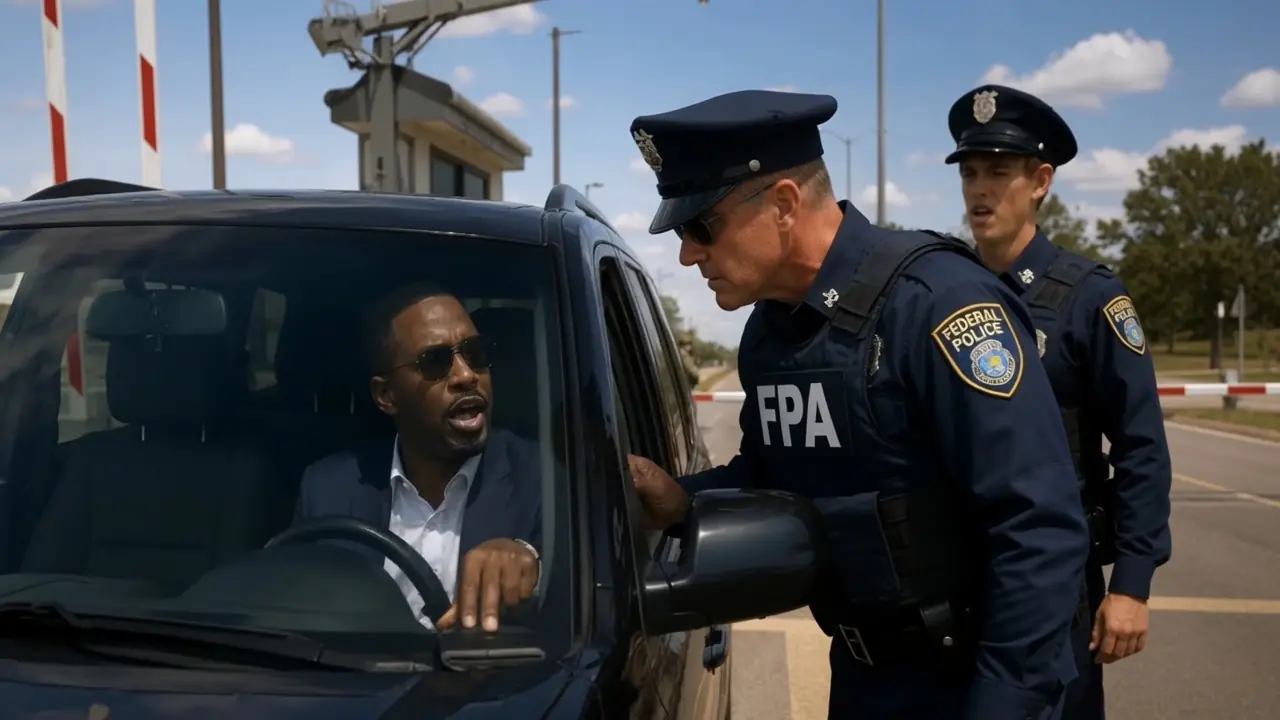
The checkpoint protected the Franklin Federal Records Center, a restricted complex outside Washington that stored classified court files, witness-protection records, and evidence from active corruption investigations. Tall concrete barriers divided the entrance lanes, while cameras hung from the inspection gantry above the road. Beyond the rising gate waited three dark tactical vehicles with their engines running. Mercer had assumed they belonged to a visiting security team and never considered that they had come for him.
“Give me that envelope,” Raymond said.
Mercer folded the page against his chest. “This proves nothing.”
“You broke a federal evidence seal after receiving a direct warning.”
“You drove into my checkpoint carrying a weapon.”
“My firearm was declared, licensed, and listed in the access authorization you refused to scan.”
Mercer stepped closer until their shoulders nearly touched. He was forty-eight, broad through the chest, with flushed fair skin, pale blue eyes, and short brown hair beneath a federal police cap. His dark tactical uniform carried the shoulder patch of the Federal Protective Service, a body camera, radio, and duty belt. He had spent nineteen years believing the badge gave him control over every person who entered his lane.
Raymond was forty-five, tall and powerfully built, with deep brown skin, a neatly shaped beard, and close-cropped black hair. His navy blazer had been pulled crooked where Mercer grabbed it, but his white shirt remained buttoned and his breathing remained slow. The leather credential wallet Mercer had slapped from his hand lay beside the yellow security line. Its metallic federal seal caught the sunlight whenever the gate moved above them.
Mercer pointed toward it. “Anybody can buy a fake badge.”
“You could have scanned it.”
“I don’t need a machine to recognize trouble.”
“You decided I was trouble before my window finished opening.”
The young federal officer behind Mercer shifted uncomfortably. Officer Noah Bennett had been assigned to the checkpoint for only six months, long enough to understand Mercer’s habits but not long enough to stop fearing him. He had watched Raymond arrive at the exact time listed on the access schedule. He had also seen the computer flash green before Mercer reached the SUV.
Mercer struck the hood anyway.
“Detain him,” Mercer ordered.
Noah looked toward the credential wallet. “Sergeant, his authorization cleared.”
“I said detain him.”
“On what charge?”
Mercer turned so sharply that Noah took one step backward. “Interference with federal security, possession of a weapon inside a restricted zone, and presentation of false credentials.”
Raymond looked toward the body camera on Mercer’s chest. “Your recording shows that you invented all three.”
Mercer covered the camera with his palm. “The camera malfunctioned.”
A woman’s voice came from beyond the gate.
“No, Sergeant. It transmitted perfectly.”
The barrier rose completely as Special Agent Mariah Grant led twelve federal investigators toward the checkpoint. She wore a charcoal jacket over body armor, with gold credentials clipped near her shoulder. Agents moved behind her in two controlled lines, securing the guard booth, traffic lanes, and access to Mercer’s patrol vehicle. None drew a weapon, but every movement showed they had planned for resistance.
Mercer released Raymond’s blazer.
“What is this?” he demanded.
Mariah stopped several feet away. “A federal evidence-preservation operation.”
“I am conducting an arrest.”
“No arrest occurred.”
“He refused to obey.”
Raymond answered without looking away from Mercer. “I lowered the window, kept my hands visible, declared my firearm, and asked him to verify my identification.”
Mariah extended her hand toward the torn envelope. “Return the document.”
Mercer hesitated.
His fingers tightened around the pages as though authority might remain inside them if he refused to let go. Behind him, Noah stood perfectly still while drivers in the neighboring lanes recorded through their windshields. A civilian contractor had raised her phone when Mercer first shouted the racial insult, capturing everything from a second angle.
“Sergeant,” Mariah repeated, “hand me the evidence.”
Mercer surrendered it.
She sealed the pages inside a clear protective sleeve and documented the torn red strip. Another agent photographed the scrape on Raymond’s wallet, the dent where Mercer struck the SUV, and the stretched fabric of Raymond’s blazer. Every detail Mercer would ordinarily have controlled through his own report was now being recorded by people outside his command.
Mariah faced him again. “Your weapon, radio, phone, body camera, and access card are being secured.”
“You cannot disarm a federal police officer at his own post.”
“I can execute a warrant signed by a federal judge.”
She handed him a copy.
Mercer scanned the first paragraph, then looked toward Raymond with disbelief. The warrant named Mercer as a subject in an investigation involving civil-rights violations, obstruction, theft of government property, evidence destruction, bribery, and unauthorized access to protected federal files. It also identified the Franklin checkpoint as a suspected site of coordinated misconduct. His unit had not been caught in one spontaneous failure.
They had been watched for eleven months.
“This is retaliation,” Mercer said. “He came here to provoke me.”
Raymond retrieved his credential wallet from the pavement and brushed away the dust. “I came here with valid authorization.”
“You concealed your position.”
“You knocked my identification away before reading it.”
“You knew I might react.”
“I knew you had reacted this way before.”
Mercer’s face hardened.
That single answer told him the investigation reached beyond the confrontation. Until that moment, he had believed complaints against him had disappeared inside internal reviews, just as they always had. Supervisors praised his instincts, camera files vanished, and frightened visitors accepted apologies rather than risk losing their clearances. He had mistaken institutional protection for innocence.
The first complaint came from Dr. Calvin Brooks, a Black cybersecurity engineer assigned to repair a classified network at the records center. Calvin arrived with a valid credential, government vehicle, and written authorization from the Justice Department. Mercer claimed the photograph on his badge did not resemble him and ordered him onto the pavement. When Calvin protested, Mercer accused him of attempting to breach a secure federal installation.
Calvin’s sealed computer case was opened beside the road.
The exposed equipment contained encryption components restricted to a secure laboratory. Mercer’s actions triggered a security incident, delayed the repair project, and placed Calvin under suspicion for weeks. Checkpoint footage that should have proved what happened disappeared before the first internal interview. Mercer reported that the cameras had suffered a storage failure.
Three months later, Assistant United States Attorney Lena Price was stopped at the same lane. Mercer questioned whether a Black woman could legitimately hold her level of clearance and demanded that she name every official she planned to meet. Lena refused to discuss a sealed grand jury investigation in public. Mercer detained her for fifty-three minutes and described her caution as evasive behavior.
She filed a complaint.
The local review concluded that Mercer’s questions fell within his discretion. His supervisor wrote that high-security environments required aggressive judgment. Lena’s allegation of discrimination was dismissed as a disagreement over communication style. Two weeks later, an anonymous accusation appeared questioning whether she had mishandled confidential documents.
The accusation was false.
It still delayed her promotion.
A third incident involved retired federal judge Nathan Cole, no relation to Raymond, who came to inspect historical records for a judicial commission. Mercer searched the elderly man’s briefcase, removed medication, and accused him of impersonating a former judge. Nathan suffered chest pain while waiting in the heat and was taken away by ambulance.
His missing gold watch was never recovered.
The property form stated that Nathan arrived without one.
By the time the Inspector General’s office became involved, twenty-seven complaints showed similar patterns. Black federal employees, immigrant contractors, junior officers, and visitors with foreign names were stopped longer and searched more aggressively. Their credentials were challenged even after the computer approved them. Valuable property vanished during inspections, while camera failures appeared whenever anyone complained.
Noah Bennett became the first officer inside the unit to preserve proof.
He copied access logs showing that Mercer overrode valid approvals manually. He also saved maintenance records confirming that no checkpoint camera had malfunctioned during the disputed dates. The footage had been deleted using an administrator account assigned to Mercer and his supervisor, Lieutenant Warren Pike.
Noah contacted the Inspector General through a protected channel.
Raymond was assigned to determine whether the misconduct continued when officers believed an arriving visitor lacked influence. His black SUV, travel route, firearm declaration, and access schedule were registered correctly. Installation leadership knew he was coming, but Mercer and the ordinary checkpoint staff were not told his identity.
The investigators expected questions.
They expected a secondary inspection.
They did not expect Mercer to slam the hood, call Raymond “boy,” threaten violence, knock away his credentials, or open the sealed case order bearing his own badge number.
Mercer had transformed a monitored inspection into direct evidence of assault and obstruction.
Mariah instructed two agents to enter the guard booth. Mercer moved toward them, but Raymond stepped into his path.
“Do not interfere.”
“This is my station.”
“It is now a federal crime scene.”
“You don’t give me orders.”
Raymond’s expression grew colder. “I gave you every opportunity to follow procedure before your name became the first page of that envelope.”
Mercer reached toward Raymond’s shoulder again.
Mariah seized his wrist before contact.
The movement was fast and controlled, turning him away from Raymond without forcing him to the ground. Two agents removed his sidearm and placed him against the side of the checkpoint booth. Mercer began shouting that he had been attacked, though cameras showed he initiated the movement.
“I want my supervisor,” he demanded.
Mariah looked toward the access road. “He is approaching.”
Lieutenant Warren Pike arrived in a black government SUV with lights flashing. He stepped out wearing the uniform of a senior federal police commander and immediately focused on Raymond instead of Mercer. His expression suggested he had already chosen whom to blame before hearing what happened.
“You entered a secure facility without cooperating with inspection,” Pike said.
Raymond held up his credential. “My access was approved.”
“You created confusion by withholding your title.”
“The computer confirmed my authorization.”
“That does not override officer judgment.”
“What did Sergeant Mercer observe that the scanner missed?”
Pike glanced toward the black SUV. “Possible behavioral indicators.”
“Name one.”
“He appeared unusually controlled.”
Raymond stared at him.
Pike had unintentionally said the quiet part aloud. Raymond’s calmness had been treated as evidence because Mercer expected fear. When Raymond did not become nervous, beg, or immediately announce his federal authority, the officers interpreted dignity as concealment. Their suspicion did not arise from his actions.
It arose from their inability to accept that he belonged there.
Mariah handed Pike another warrant.
His own name appeared on the first page.
The lieutenant stopped reading halfway down.
“This operation is unauthorized,” he said.
“The deputy attorney general approved it,” Mariah replied.
“I need to contact headquarters.”
“Your department phone is covered by the warrant.”
Pike moved toward his SUV.
Agents blocked the door.
Mercer looked from his supervisor to Raymond. “You told us this would never leave internal review.”
The words escaped before Pike could silence him.
Every investigator heard them.
Pike turned with fury. “Stop talking.”
Mariah’s gaze sharpened. “What would never leave internal review?”
Mercer realized his mistake and looked away.
Raymond stepped closer. “Keep speaking, Sergeant. This may be the first honest report you have ever given at this gate.”
Agents searched the booth while Mercer and Pike were separated. The computer contained two sets of inspection records. The official system listed ordinary credential checks and lawful property holds. A hidden folder recorded visitors chosen for what the officers called enhanced pressure.
The folder was titled Outliers.
Names were accompanied by racial descriptions, income estimates, employment positions, and guesses about whether a person would complain. Some entries included phrases such as no influence, nervous, easy settlement, and clearance dependent—will stay quiet. Property values appeared beside watches, cash, electronics, and jewelry removed during inspections.
Dr. Calvin Brooks’s missing watch appeared on the list.
Its estimated resale value was written beside his name.
Lena Price’s entry included a note instructing Mercer to “create professional doubt” if she escalated her complaint. Days later, the false security allegation had appeared in her personnel record. The timing was no coincidence.
The officers did more than steal.
They retaliated.
Investigators found draft anonymous complaints, manipulated incident summaries, and contact information for supervisors whose employees had challenged the checkpoint unit. Pike used the threat of clearance reviews to frighten contractors into silence. Visitors working on sensitive projects understood that even a baseless security question could destroy years of professional trust.
Mercer weaponized that fear.
The search extended to a locked cabinet beneath the communications console. Inside were confiscated credentials, watches, rings, prescription bottles, cash envelopes, and several encrypted drives. None appeared in the official evidence ledger.
One drive belonged to a federal witness-protection contractor.
Another contained procurement data from a Justice Department technology project.
Those discoveries changed the scope of the investigation immediately.
The officers had not merely abused visitors for personal satisfaction or stolen valuables for money. Sensitive information collected during unauthorized searches had been copied and passed to Sentinel Meridian, a private security company seeking federal contracts. Pike’s brother served as the company’s vice president.
Sentinel used the stolen information to underbid competitors and anticipate future security requirements. Mercer created exaggerated checkpoint incidents to make existing federal protection appear weak. Pike cited those incidents in reports recommending the government outsource more work to Sentinel.
The company paid them through consulting businesses registered to relatives.
Prejudice provided the victims.
Greed provided the structure.
Mercer chose people he believed decision-makers would distrust before believing them. A Black engineer accused of resisting, an immigrant contractor accused of confusion, or a junior employee accused of credential fraud could be turned into a statistic supporting expanded private security. Every manufactured threat made Sentinel’s proposal appear more necessary.
The black SUV confrontation had been intended to become another entry.
Mercer would describe Raymond as a suspicious civilian presenting false authority. Pike would approve the report, and footage would disappear. The sealed envelope might have been confiscated, copied, or destroyed before anyone outside the unit understood what it contained.
Instead, Mercer opened it in front of the Inspector General’s arrest team.
Lieutenant Pike attempted to erase the hidden folder remotely using a private tablet inside his SUV. Federal technicians had already mirrored the system. His deletion command became another obstruction charge.
Both officers were arrested before noon.
Mercer was handcuffed beside the lane where he had threatened to drag Raymond from the vehicle. He looked toward Noah and ordered him to explain that the whole incident had been misunderstood. The young officer remained near the booth with his hands at his sides.
“No, Sergeant.”
“You work for me.”
“Not anymore.”
Mercer’s face twisted. “You did this.”
Noah looked toward Raymond. “I reported what you did. You built the rest yourself.”
Federal agents searched Mercer’s home and discovered more stolen property in a locked storage room. He had kept photographs of visitors alongside personal notes insulting their race, accents, clothing, and professions. Several commendations hanging in his office were based on fake attempted-breach incidents created by his own reports.
His reputation for vigilance had been manufactured from people he falsely accused.
Pike’s financial records showed more than six hundred thousand dollars in hidden payments from Sentinel Meridian. The company won three contracts after receiving internal specifications found on confiscated drives. Prosecutors charged its executives with bribery, conspiracy, theft of government information, and procurement fraud.
The checkpoint unit was suspended during the investigation.
Every incident associated with Mercer and Pike was reopened.
Calvin Brooks returned to the facility nearly two years after his complaint had been dismissed. The government cleared his record, restored the promotion he had lost, and issued an apology. He accepted the correction but refused to pretend it returned the months he spent being treated as a security risk.
Lena Price’s personnel file was repaired.
Nathan Cole’s watch was recovered from Mercer’s storage room and returned to his family. Nathan had died eight months earlier, never knowing whether anyone believed his account. His daughter held the watch during a congressional hearing and described what it meant to receive proof after her father could no longer see it.
Raymond listened from the witness table.
His own encounter became the most widely viewed footage, but he refused to allow the investigation to center solely on him. During public testimony, legislators repeatedly called him the official who exposed the checkpoint scheme.
He corrected them every time.
“Noah Bennett preserved the first records,” Raymond said. “The victims filed complaints long before I arrived. My title merely made the institution respond quickly enough to witness what they had already described.”
A senator asked why Raymond had not announced that he was the Inspector General as soon as Mercer approached.
“Because I presented valid credentials.”
“You could have prevented escalation.”
“So could Sergeant Mercer, by reading them.”
“Were you testing him?”
“I was observing whether the checkpoint followed federal procedure.”
“You knew your identity would change his behavior.”
“That is precisely why it was not revealed immediately.”
The video showed that Mercer had multiple opportunities to stop. He could have scanned the credential, checked the firearm declaration, called the authorized contact, or waited for a supervisor. Instead, he treated Raymond’s race and composure as proof that every document must be fraudulent.
The title did not create the misconduct.
It prevented the misconduct from being hidden afterward.
Mercer went to trial the following year. His attorneys claimed he had responded to a legitimate security concern and that Raymond intentionally created tension. They emphasized the sensitivity of the records center and the danger federal police officers faced while guarding it.
Prosecutors played the complete checkpoint recording.
Jurors watched Mercer’s palm strike the hood before he asked a single question. They heard the racial insult, saw him slap the credential wallet away, and watched him grip Raymond’s blazer while threatening to break the supposed fake badge over his teeth.
They also heard Raymond’s warning about the sealed envelope.
Mercer opened it anyway.
The hidden records, stolen property, retaliatory complaints, bribery payments, and deleted videos made the roadside encounter impossible to explain as one bad judgment. It was simply the first time his usual conduct occurred before people he could not control.
Mercer was convicted of civil-rights violations, assault on a federal official, obstruction, evidence destruction, theft, bribery, conspiracy, and unauthorized possession of protected government information. Pike was convicted in a separate trial and received a longer sentence because he had designed the wider scheme.
Sentinel Meridian lost every federal contract.
Its executives were ordered to pay restitution to competing companies and government agencies harmed by the stolen information. The records center remained under outside oversight for three years while security procedures were rebuilt.
Credential scanners could no longer be overridden without a recorded explanation. Cameras uploaded continuously to an independent server, and deleting footage locally became impossible. Restricted documents could be opened only by two authorized officers inside a designated inspection room.
Property searches required complete video coverage.
Every confiscated item received a digital receipt visible to the visitor before they left the checkpoint. Complaints bypassed local commanders and went directly to an external review office.
Training changed too.
New federal police officers studied the recording of Raymond’s arrival. Instructors paused the footage before Mercer struck the hood and asked recruits what legitimate security concern they could identify.
There was none.
They paused again when the computer approved Raymond’s credentials.
The correct action was simple: acknowledge the authorization, verify the firearm declaration, and permit entry. Every decision after that came from Mercer’s determination to prove his first assumption correct.
Noah remained with the Federal Protective Service.
He received discipline for failing to report several earlier incidents immediately, but his cooperation and preserved evidence prevented dismissal. Years later, he became an investigator responsible for protecting employees who reported misconduct.
He kept a photograph of the checkpoint computer’s green approval screen inside his office.
It reminded him that the system had displayed the truth clearly.
People chose to ignore it.
Raymond returned to the Franklin Federal Records Center eighteen months after Mercer’s conviction. He drove the same black SUV, still carrying the shallow dent in its hood and the scrape along the driver’s door. A new federal police officer approached the window.
“Good morning, sir. Credentials and travel authorization, please.”
Raymond handed them over.
The officer scanned both documents, confirmed the declared firearm, and returned everything without asking Raymond to explain his clothing, vehicle, or right to enter. The process lasted forty-six seconds.
No armed team emerged.
No one bowed or apologized.
Ordinary professionalism was enough.
Mariah waited for him near the administration building. She noticed the dent and ran her fingers lightly above the damaged metal without touching it.
“You could repair that.”
“I could.”
“You keep it because of Mercer?”
“I keep it because of everyone before me.”
They looked toward the checkpoint, where vehicles passed beneath the inspection gantry one at a time. The facility appeared almost identical to the morning Mercer tore open the envelope. The difference lived in procedures people could no longer bend quietly.
Mercer believed the sealed document ended his career.
It did not.
The envelope merely contained the investigation his choices had already earned.
He could have scanned Raymond’s credentials. He could have followed the authorization on his screen, kept his hands off the driver, respected the evidence seal, and treated a Black visitor with the same procedure offered to anyone else.
He chose humiliation instead.
When he saw his badge number printed on the first page, it was already too late to change the record.
The federal credential inside Raymond’s wallet never created his right to dignity.
It only ensured that the police officer who denied it could no longer erase what the cameras had seen.