The rusted red dump truck stood beside Evelyn Carter’s fence with its steel bed raised toward the cloudy morning sky. Hundreds of fish heads, stripped carcasses, and wet coils of offal slid over the tailgate, crashing into the mud beside her vegetable field while gulls screamed overhead. Forty-two-year-old Evelyn stood several feet from the falling waste in a faded sage-green work jacket, blue jeans, thick leather gloves, and worn brown boots. Her chestnut-brown hair was tied into a low ponytail, but loose strands whipped across the beautiful face she kept turned toward Curtis Hale.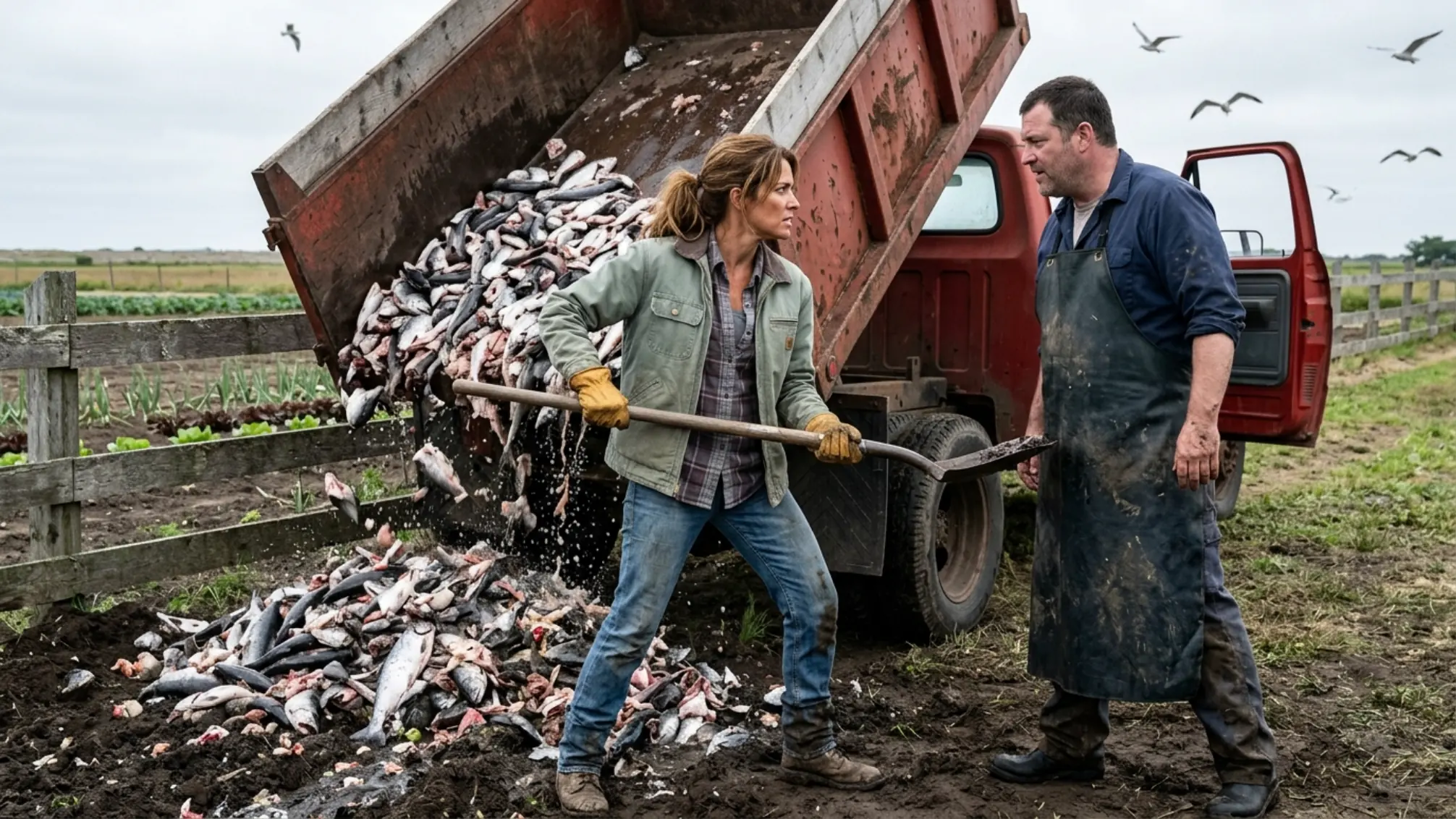
“Sell me this worthless land,” Curtis shouted over the truck’s rattling engine, “or I’ll bury your whole farm in rot.”
Evelyn lifted the long steel shovel across her body and pressed its wooden handle against his chest. “Dump one more load and see how close I come.”
The forty-seven-year-old fish-market owner stepped into her space, his stained rubber apron brushing against the shovel. “You’re one woman. I’ll make this place unlivable.”
Evelyn looked past him at the silver bodies pouring onto the soil. Something her grandmother had taught her many years earlier returned with such clarity that her anger briefly became calculation.
“Keep pouring, jackass,” she said. “You’re feeding the land that’ll destroy you.”
Curtis laughed because he believed it was desperation.
Evelyn knew it was a promise.
For twenty years, she and her husband, Thomas Carter, had worked the six-acre coastal property behind Hale’s Fish Market in the small American town of Bell Haven, Maryland. Their land was not a grand farm. It consisted of a white farmhouse, an aging barn, an orchard of twenty-eight apple trees, several vegetable beds, and a narrow field that sloped toward the tidal marsh.
Thomas had grown tomatoes, sweet corn, beans, squash, and pumpkins while Evelyn sold preserves and vegetables at the weekend market. They never became wealthy, but the farm paid its taxes and supplied enough food that they rarely worried about an empty pantry. More importantly, it belonged to them.
Thomas died three years before Curtis began dumping fish beside the fence.
A heart attack took him before sunrise while he was repairing an irrigation pump. Evelyn found him lying near the orchard with one hand still wrapped around a wrench. She buried his ashes beneath the oldest apple tree because he had once told her that if he could not remain beside her, he wanted to become part of something she could still watch grow.
After his death, the farm weakened with her.
Evelyn continued planting, but grief changed the way she moved through the seasons. She prepared smaller beds, repaired only the most urgent damage, and allowed weeds to claim the outer rows. The soil near the fish-market fence had become pale and exhausted after years of heavy use.
Curtis noticed.
His father, Samuel Hale, had operated the market when Thomas was alive. Samuel was loud, generous, and incapable of walking past the Carter fence without stopping to discuss tides, prices, or tomatoes. He sent over fresh fish whenever a storm damaged the local fleet’s catch and attended Thomas’s funeral wearing a suit that fit badly across his shoulders.
Samuel died two years later.
Curtis inherited the market but none of his father’s affection for the people around it. He replaced the painted wooden sign with bright metal lettering, expanded the parking lot, and began meeting with property developers from Baltimore. They wanted to transform the market and Evelyn’s farm into a waterfront commercial complex containing restaurants, vacation rentals, and boutique stores.
The project required both properties.
Curtis offered Evelyn twelve thousand dollars for her land.
The figure was insulting. Her waterfront acreage was worth many times that amount, even with the tired farmhouse and damaged barn. Curtis presented the offer as though he were saving a helpless widow from a burden she could no longer carry.
“You could move closer to town,” he told her at the kitchen table. “No more fighting broken equipment. No more trying to manage all this alone.”
Evelyn looked through the window at the apple tree beneath which Thomas’s ashes rested.
“No.”
Curtis smiled patiently. “Think about it.”
“I already did.”
The first load of fish waste appeared beside her fence four days later.
Evelyn smelled it before she reached the kitchen. The odor entered through the screens and settled against the back of her throat—thick, oily, and impossible to escape. When she went outside, she found buckets of heads, bones, scales, and entrails scattered along thirty feet of her property line.
Flies had already gathered.
Curtis claimed the market’s waste compactor was broken. He insisted the scraps had been placed on his side of the boundary, though several piles clearly crossed beneath the fence. When Evelyn demanded that he remove them, he suggested that the smell was another reason she should accept his offer.
The next morning brought more.
Then another load arrived after dark.
Curtis believed repetition would break her. He expected complaints from neighbors, inspections from the county, and perhaps pressure from Evelyn’s daughter, Natalie, who had spent months trying to convince her mother to sell and move into a smaller home.
Natalie called after hearing about the smell.
“Mom, you cannot fight a commercial business alone.”
“It is my land.”
“And it is making you sick.”
“It is making me angry.”
“That is not better.”
Natalie lived two hours away with a job, children, and a marriage that appeared stable whenever she spoke about it. She loved her mother, but fear had made her impatient. Every broken roof tile, missed phone call, or difficult winter became proof that Evelyn should abandon the place.
“Take the money,” Natalie pleaded. “Come closer to us.”
“Your father is beneath that apple tree.”
“He is not the dirt.”
“He chose it.”
“That does not mean you have to die beside it.”
Evelyn ended the call before grief turned their concern into cruelty.
That evening, she sat on the back steps watching gulls circle above the fish waste. The smell reminded her of summers spent with her grandmother, Martha Bell, on an impoverished coastal farm farther south. Martha raised seven children on land so sandy that rain passed through it before the roots could drink.
Yet her corn grew taller than every neighboring crop.
Each spring, Martha collected fish scraps from the docks, dug deep holes beneath the planting rows, and buried the waste beneath layers of leaves and soil. She always warned Evelyn never to leave it near the surface.
“Anything rots if you abandon it,” Martha used to say. “But bury it with purpose, and even waste remembers how to feed life.”
Evelyn stood from the steps.
She walked to the shed, found Thomas’s long-handled spade, and began digging a trench eighteen inches deep.
The work lasted until darkness.
She placed the fish scraps at the bottom, covered them with dry leaves, old straw, sawdust, and soil, then packed the surface firmly enough to discourage animals. The smell nearly disappeared once the final layer settled.
By dawn, the waste Curtis had intended as a weapon was hidden beneath the weakest vegetable bed.
He dumped another load that afternoon.
Evelyn buried that one too.
Within two weeks, she developed a system. She cut trenches before sunrise, dragged the scraps into them, balanced the rich fish material with dry plant matter, and covered everything deeply. She kept records of the location and date of each trench so she would not plant above material that had not decomposed fully.
Curtis saw only that his waste vanished.
He assumed Evelyn was exhausting herself hauling it away.
Because she stopped confronting him, he interpreted silence as surrender and increased the amount. Some nights, his workers delivered twice what the market produced naturally, including scraps collected from two smaller seafood counters in neighboring towns.
The young employee ordered to handle most of the dumping was seventeen-year-old Marcus Reed, a thin Black American boy with tired eyes and sneakers split near the toes. Evelyn first saw him carrying two leaking buckets along the fence after sunset. He froze when she stepped from the barn holding the shovel.
“I’m sorry,” Marcus said immediately. “Mr. Hale says I lose my job if I don’t do it.”
Evelyn studied him.
Her anger belonged to Curtis, not to a teenager trying to help his mother pay rent.
“Set them beside the open trench.”
Marcus blinked. “You want them?”
“I want him to stop treating my property like a dump. Since he won’t, I’ll decide what his garbage becomes.”
The boy placed the buckets down and looked at the dark mounds running along the fence.
“What are you doing?”
“Making soil.”
“With that?”
“Especially with that.”
Evelyn pushed the shovel into his hands. “You carried it here. You might as well learn to bury it properly.”
Marcus stayed until nightfall.
He returned the following evening without being asked.
Over lemonade on the back steps, Evelyn learned that Marcus’s mother worked overnight shifts cleaning medical offices. His father had left years earlier, and Curtis paid him minimum wage to clean floors, carry ice, and remove waste adults did not want to touch.
Older boys in Marcus’s neighborhood had begun offering him faster ways to make money.
“Fast money usually charges interest you cannot see,” Evelyn told him. “Work that grows something is slower, but it leaves you with more than money.”
Marcus looked toward the fresh trench.
“I never grew anything.”
“You started today.”
By autumn, the first buried section had changed. The soil darkened, softened, and began holding moisture longer than the untreated rows. Evelyn planted collards, turnips, and winter beans in the oldest bed.
The results frightened her at first.
The collard leaves opened broad and glossy. Turnips pushed from the earth with clean white shoulders, and the beans climbed above the fence as though trying to inspect the market that created them. Evelyn had farmed most of her adult life, but she had never touched soil with such richness.
Curtis noticed the greenery.
He appeared at the fence one January afternoon while Evelyn harvested collards.
“What are you growing?”
“Supper.”
“That waste is creating a health nuisance.”
“The waste you placed here?”
He ignored the question. “The county has rules.”
“Then invite them.”
A county inspector arrived the next week.
Curtis had reported improper animal-waste disposal, insect infestation, and groundwater contamination. The inspector entered expecting exposed rot. Instead, he found clean beds, no odor, no flies, and vegetables growing with unusual strength in the middle of winter.
He pushed a soil probe into the ground.
It sank easily.
“What did you add here?” he asked.
“Fish scraps buried with straw, leaves, and sawdust.”
He took three samples to the county agricultural extension office.
The results arrived twenty-one days later. Nitrogen, phosphorus, potassium, and organic matter measured far above the regional average, while harmful bacterial indicators remained within safe ranges because the scraps had been buried deeply and allowed to decompose before planting.
An extension specialist asked to visit.
Then a university soil professor requested samples.
Evelyn resisted attention, but Marcus urged her to speak with them.
“Mr. Hale wants everybody to think you’re crazy,” he said. “Show them what you made.”
“What we made,” she corrected.
That spring, Evelyn reopened every field Thomas had once planted. Marcus helped after work, and Natalie began visiting on weekends after seeing photographs of the winter harvest. The farm no longer looked like a dying property trapped between a market and a marsh.
It looked alive.
Evelyn found an old seed tin inside Thomas’s shed. It had belonged to Martha and contained carefully wrapped seeds from the vegetables her family had grown for generations: white corn, climbing beans, enormous orange tomatoes, and a thick-skinned pumpkin suited to coastal weather.
A handwritten note rested beneath them.
Feed the ground before asking it to feed you. Nothing the water returns is useless when buried with care.
Evelyn planted the seeds.
By midsummer, the tomato vines required reinforced stakes. The fruit grew heavy, irregular, and bright orange, with a flavor richer than anything sold in local stores. Marcus’s first pumpkin expanded until he could barely lift one end.
The county extension specialist entered Evelyn’s produce in the Bell Haven Agricultural Fair.
She won the tomato category.
Her collards placed first.
Marcus received a youth ribbon for his pumpkin.
A local newspaper published a photograph of Evelyn standing beside her harvest under the headline:
FARM WOMAN TURNS MARKET WASTE INTO COUNTY’S RICHEST SOIL
Curtis read the article behind his own counter.
Evelyn watched through her kitchen window as he lowered the newspaper and stared toward the fence. For months, he had believed each bucket made her property less valuable.
Instead, every load strengthened it.
The dumping stopped that day.
The silence beside the fence lasted less than a week.
Curtis entered Evelyn’s yard without permission and pointed toward the dark composting beds.
“That material belongs to my business.”
Evelyn leaned on her hoe. “You called it garbage.”
“I produced it.”
“You abandoned it on my property.”
“You have profited from my waste stream.”
“You dumped it at night to force me from my home.”
Curtis stepped closer. “I want compensation.”
Evelyn’s eyes narrowed. “You cannot call it poison while you’re attacking me and treasure when you realize I survived.”
“This is not over.”
“No,” she said. “The state fair is next year.”
His face reddened.
She had not planned to enter the state fair until that moment.
Now she intended to win it.
Curtis’s financial problems deepened while the farm expanded. He had borrowed money to remodel the market in preparation for the waterfront development, expecting Evelyn to sell. The developer raised its offer to ninety thousand dollars and gave her thirty days to accept.
Natalie arrived carrying the contract.
This time, her concern hid a personal crisis. She had lost her job, her marriage was failing, and her family’s mortgage payments were becoming impossible. The sale could help both of them.
Evelyn held her daughter at the kitchen table.
“We will find another way,” she said. “But I will not sell the only thing still growing.”
The deadline passed without her signature.
The development collapsed because the investors wanted one uninterrupted waterfront parcel. Curtis remained responsible for the loans he had taken in anticipation of the sale. His new refrigerated truck was repossessed, his suppliers shortened their payment terms, and customers began disappearing.
Evelyn expected satisfaction.
Instead, she felt tired whenever she saw him alone inside the darkened market.
Her grandmother’s lesson had never been about revenge. It was about transformation.
Four years after the first load of fish scraps hit her fence, Evelyn entered the Maryland State Agricultural Fair with Marcus, Natalie, and a truck carrying the farm’s best produce. Her grandmother’s orange tomatoes filled wooden boxes. Collards spread across the exhibition table, and the enormous pumpkin Marcus had helped cultivate required a reinforced platform.
Judges stopped when they reached Evelyn’s display.
They cut the tomatoes, tested the soil samples, studied the nutrient records, and asked about her composting process. One judge called two others from another section before making notes.
The pumpkin established a state record for its class.
The tomatoes won first place.
Then the judges awarded Evelyn the overall produce sweepstakes.
Under the bright exhibition lights, a blue-and-gold rosette was pinned to her sage-green jacket. Marcus cried openly beside her, while Natalie held Thomas’s old wedding ring inside her closed hand.
A reporter asked for Evelyn’s secret.
“Fish,” she answered. “An old lesson, a tired piece of ground, and a neighbor who thought he was throwing away something useless.”
The story spread across Maryland.
Visitors began driving to Bell Haven to see the farm described in the newspaper. They also stopped at Curtis’s market because it appeared in every article as the source of the scraps.
The market parking lot filled for the first time in months.
People bought shrimp, crab, and fish while asking whether Curtis was the man who had dumped the waste. Each question reminded him that the woman he tried to remove had become the reason his business still had customers.
Four evenings later, he came to Evelyn’s front door.
He wore no apron and carried no folder. His shoulders sagged, and gray had spread through his hair.
“I did something shameful,” he said.
Evelyn waited.
“I wanted your land. I thought if I made the smell bad enough, you would leave. My father would have hated what I became.”
“He would have.”
Curtis lowered his eyes.
“I’m losing the market.”
“I know.”
“The attention from your story is the only business I’ve had in months.”
“You came to ask me not to tell people the truth?”
“No.” He looked at her again. “I came because the truth is already everywhere, and I do not know what to do with it.”
Evelyn considered the man who had once stood beside a raised dump truck and promised to bury her farm in rot. Destroying him would have been easy now.
Growing something required more.
“Come inside,” she said. “Your father liked his coffee strong.”
At the kitchen table, beneath the state-fair ribbon, Evelyn proposed a partnership.
Curtis would deliver the market scraps openly through the gate instead of dumping them in darkness. Evelyn and Marcus would teach his workers how to combine the waste with leaves, straw, and sawdust, then age it safely.
What the farm did not need would become packaged fish compost.
The market would sell it to gardeners and small farmers, with part of every sale supporting the community garden Evelyn planned to create on a vacant lot nearby.
Curtis stared at her.
“After what I did?”
“I am not helping the man who threatened me,” she said. “I am protecting the market your father built, the employees who need their jobs, and the son who still deserves a better version of you.”
His face folded.
Curtis covered his eyes and wept at her table.
The following morning, he carried the first buckets through the gate himself.
Evelyn handed him a shovel.
“Deeper,” she ordered as he began the trench.
“You dumped it easily enough. Now learn to bury it right.”
Marcus laughed.
After several minutes, Curtis did too.
The fish compost became the product that saved Hale’s Market. Customers arrived from across the state carrying newspaper clippings and purchasing burlap sacks stamped with Marcus’s design:
HALE-CARTER COASTAL COMPOST
WHAT THE WATER RETURNS, THE GROUND REMEMBERS
Natalie used her accounting experience to manage orders and taxes. Marcus received a scholarship funded by the farm’s prize money and compost profits, allowing him to study agriculture at an American state university.
Curtis hired Marcus’s mother to manage the market office, giving her daytime work and steady benefits. He repaired his relationship with his own son and began bringing the boy to Evelyn’s farm on weekends.
The six acres remained Evelyn’s.
She placed the property in a conservation trust preventing future commercial development. The orchard, vegetable beds, and community compost site would continue after her death.
Every spring, Evelyn taught local children how to bury fish beneath corn and tomato rows. Most held their noses and asked why anyone would put something so disgusting into clean soil.
She always gave them Martha’s answer.
“Because waste is often only a gift nobody has understood yet.”
One morning, a little girl stood beside Evelyn holding a fish head between two gloved hands. The child looked toward the fence, where Curtis and his son carried fresh buckets through the gate in full daylight.
“Was that man mean to you?” she asked.
“He was.”
“Why do you let him help now?”
Evelyn pressed the shovel into the earth.
“Because the ground does not become rich by keeping only the pretty things.”
She helped the girl place the fish at the bottom of the hole and cover it with leaves. Beyond them, the market bell rang as the first customers entered, Marcus’s mother opened the register, and Natalie loaded compost orders into a truck.
Thomas’s apple tree moved softly in the coastal wind.
Four years earlier, Curtis believed he could bury Evelyn’s future beneath rot, humiliation, and a smell no one could endure.
He never understood that she came from women who knew how to place ruined things deep enough for the darkness to change them.
The fish disappeared.
The soil remembered.
And from everything intended to drive one beautiful farm woman away, Evelyn Carter grew a harvest large enough to save the land, restore a family, educate a boy, and teach the man who wronged her that nothing is permanently worthless—not soil, not scraps, and sometimes not even the person who threw them.