“You picked the wrong place to play hero, boy.”
Ray Mercer slammed Marcus Jackson against the wall of the Riverdale Community Center hard enough to shake the framed children’s drawings hanging beside the bulletin board.
A paper sunflower made by a seven-year-old slipped loose from its tape and fluttered to the floor.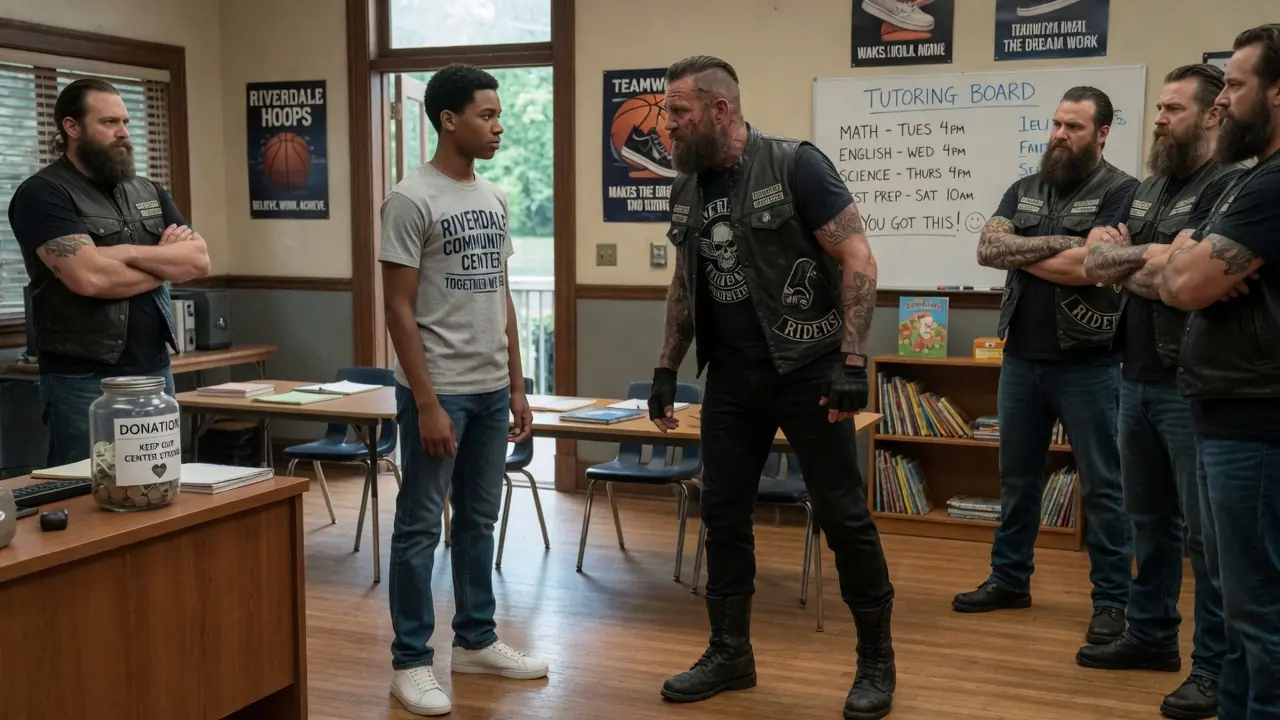
Marcus’s shoulder struck the plaster, but his face did not change.
He was sixteen years old, six foot one, lean from years of disciplined training, with dark eyes that did not widen, did not beg, and did not give Ray Mercer the fear he had come looking for.
The five massive Sovereign Riders circled him, leather vests creaking, steel-toed boots planted wide on the old wooden floor. Their faces were twisted with contempt, the kind of contempt men wear when they have confused size with authority and intimidation with respect.
Ray Mercer stepped closer.
He was the leader, broad across the shoulders, thick through the neck, with a gray-streaked beard, heavy rings, and tobacco breath hot against Marcus’s face.
“This center isn’t for your kind,” Ray said.
The words landed in the room like something rotten dropped on a clean table.
Behind Marcus, in the office doorway, ten-year-old Deshawn Garcia stood frozen with his backpack clutched to his chest. His eyes were wide, and his mouth trembled, but he did not make a sound.
Ray leaned in farther.
“Know your place.”
Marcus controlled his breathing.
Four counts in.
Four hold.
Four out.
His father’s training rose inside him like a hand placed firmly on his back.
Control the breath.
Control the response.
Control the outcome.
The biker mistook the stillness for fear.
That was his first mistake.
He laughed and shoved Marcus again, harder this time.
“What’s a boy like you going to do now?” Ray mocked.
Then he knocked the donation jar from the sign-in table with the back of his hand.
The glass jar hit the floor and cracked open. Coins exploded across the wood, rolling beneath tables, spinning near chair legs, scattering under the old radiator. It sounded like a hundred tiny hopes breaking loose at once.
Some of those coins had come from children.
Some from exhausted mothers.
Some from elderly neighbors who brought folded one-dollar bills and apologized that they could not give more.
Ray ground his boot heel into the scattered coins.
Marcus looked down at the money.
Then back up at Ray.
The room went still.
Ray Mercer had no idea this moment would echo through Riverdale forever.
He had no idea that trying to humiliate one teenage boy would expose the cowardice of grown men, the fear of a whole town, and the quiet power of a kind of strength he had never understood.
He had no idea that Marcus Jackson had been raised by a man who knew how to fight but had spent a lifetime teaching his son that the strongest person in the room was often the one who never threw a punch.
Riverdale’s community center had once been a forgotten municipal building on the edge of a cracked parking lot, behind the old pharmacy and across from a row of boarded storefronts.
For years, it had looked like a place the town had given up on.
The paint peeled in long strips from the siding. Two front windows were cracked. A gutter hung loose at one corner. The front sign had faded until Riverdale Community Center looked less like a promise and more like a warning.
Inside, the rooms smelled of dust, rusted radiators, old paper, and rainwater from a roof that had leaked for longer than anyone could remember.
But in the last year, something had changed.
The walls had been scrubbed and painted a hopeful blue.
The cracked windows had been replaced with donated glass from Henderson Hardware.
The broken tables had been repaired.
The back room had become a reading room.
The storage closet had become a food pantry.
The dead basketball court behind the building had been swept, repainted, and fitted with one working hoop.
And above the sign-in table, Marcus had taped a hand-lettered message in thick black marker.
You belong here.
Every weekday afternoon, children filled the rooms with laughter, arguments over homework, squeaking sneakers, and the determined scratching of pencils on paper.
Some came because they needed help with math.
Some came because their parents worked late.
Some came because home was too loud, too hungry, too crowded, or too heavy with problems children should not have to name.
At the center of the change stood Marcus Jackson, though he never claimed credit for any of it.
He was only sixteen, but hardship had given him a steadiness that made adults forget his age until they saw his face in the right light. He had his mother’s eyes, his father’s height, and a way of standing still that made loud people uncomfortable.
Marcus lived with his father, Michael Washington, in a small ranch house near the edge of town.
The difference in their last names confused people at first. Marcus carried his late mother’s last name, Jackson, because Sarah Jackson had raised him through the first half of his life while Michael was deployed again and again. After she died, Michael never asked Marcus to change it.
“Your mother gave you that name,” he had said. “Carry it with honor.”
Marcus did.
Sarah Jackson had been the kind of woman people remembered in quiet ways. She had run a literacy program in their previous town, teaching adults to read job applications, medicine labels, letters from their children, and sometimes entire books they had spent their lives pretending not to need.
She believed nobody should be ashamed of needing help.
When she died in a car accident five years earlier, the loss split Michael and Marcus open in different ways. Michael lost his wife and the career he had already been preparing to leave. Marcus lost the person who made the world feel gentle.
Michael Washington had served in Special Forces. In certain circles, his name meant something. In Riverdale, he had done everything possible to make sure it meant nothing at all.
He moved quietly.
He went to work quietly.
He used a cane when his injured leg stiffened in the cold.
He repaired old furniture in the garage.
He taught Marcus discipline before strength, patience before speed, and restraint before pride.
“Anyone can learn how to hurt someone,” Michael told him once. “That is not rare. The rare thing is learning when not to.”
When they moved to Riverdale three years earlier, Marcus noticed the community center almost immediately.
The first time he walked past, he saw three boys throwing rocks at a broken window and a girl sitting on the steps with a schoolbook in her lap because the library had closed early.
He did not know then that he would become part of the place.
At first, he only offered to clean it.
Then he fixed a table.
Then he helped one boy with fractions.
Then another child came.
Then a mother asked whether he could watch her son for twenty minutes while she picked up an extra shift.
Then Mrs. Wilson, the elderly woman who kept the center’s nearly empty donation ledger, asked if he could help organize the after-school schedule.
By winter, Marcus was there five days a week.
By spring, people had stopped asking who was in charge.
They looked for Marcus.
On the afternoon Ray Mercer first walked in, Marcus was sitting beside Deshawn Garcia at a folding table beneath a poster of the solar system.
“Great job, Deshawn,” Marcus said, pointing to the next problem on the worksheet. “You’re getting these fractions down perfectly.”
Deshawn’s face brightened.
It was a rare expression for him, and Marcus noticed every time it appeared.
Deshawn was ten years old, small for his age, quick with jokes when comfortable, silent when scared. His mother, Elena Garcia, worked double shifts at Mercy General Hospital, often leaving before sunrise and returning after dark. Deshawn had learned to be responsible too young. He stacked his papers neatly, tied his shoes without being asked, and never complained about waiting.
Children who waited often learned not to ask for much.
Marcus checked his watch.
Five o’clock.
Time to start closing.
Most of the children had left, picked up by parents, older siblings, or neighbors. Only Deshawn and two others remained in the main activity room.
“Miss Garcia running late again?” Marcus asked, though he already knew.
Deshawn nodded.
“She said she’d be here by five-thirty.”
He stacked his worksheet carefully.
“Can we shoot some hoops while we wait?”
Marcus smiled.
“Let me lock up the front first, then we’ll see.”
He never finished the sentence.
The center’s front door crashed open.
Five men strode in, leather boots heavy against the floor.
The Sovereign Riders.
The room changed immediately.
Every child felt it, even before they understood it.
The Sovereign Riders were not the largest biker club in the county, but in Riverdale they moved like a weather system. People planned around them. Business owners smiled when they walked in. Police officers drank with some of them on weekends. Town officials pretended their influence was just local history.
At the center of that influence was Ray Mercer.
Ray owned Mercer’s Auto and Towing on the east side of town. His father had owned it before him. His uncle had once sat on the town council. His cousin was close to the mayor. His family name appeared on old plaques, youth league banners, and one faded mural near the high school gym.
Ray believed history was ownership.
He surveyed the room with thinly veiled disgust.
Marcus positioned himself between the bikers and the children.
“We’re closing soon,” Marcus said. “Can I help you with something?”
Ray ignored the question.
He walked around the room, dragging his fingers across tabletops, examining the center’s modest resources. His gaze moved over the donated books, the chipped pencils, the repaired chairs, the corkboard covered with reading certificates and spelling lists.
“So,” Ray said, “this is where all the city council’s money is going these days.”
One of his men snorted.
“Interesting priorities.”
The other bikers spread out, filling the space with their bodies.
The children instinctively moved closer to Marcus.
“The center operates mostly on donations,” Marcus explained, keeping his voice even. “Private citizens who care about the community’s future.”
Ray laughed.
“That so? Heard differently. Heard my tax dollars are funding this place instead of fixing the roads my business depends on.”
He picked up a children’s book, flipped through it dismissively, then dropped it on the floor.
Marcus felt anger flash inside him.
He did not let it reach his face.
“Mr. Mercer,” he said, stepping forward to retrieve the book, “if you have concerns about the town budget, council meetings are every Tuesday evening. I’d be happy to help you find the reports.”
“You’d be happy to what exactly?”
Ray stepped into Marcus’s path.
“Tell me how things work in my own town? I’ve lived here thirty years, boy. My father before me.”
The children watched with wide eyes.
Marcus could feel their fear like a physical presence behind him.
A volunteer called from the side doorway.
“Mrs. Washington is here for Tamika and Jerome.”
Her voice shook.
She had seen the bikers.
Marcus did not break eye contact with Ray.
“Take them out the side door, please.”
The two children left quickly, their backpacks bouncing against their shoulders.
Now only Deshawn remained, shrinking behind a table with his worksheet clutched in one hand.
“This is a community space,” Marcus said. “Everyone is welcome during operating hours, but we’re closing now.”
“Everyone is welcome?” Ray repeated. “That right?”
He moved closer.
The other bikers formed a loose semicircle.
“Funny. Don’t remember seeing your face around here growing up. Where’d you come from exactly?”
Marcus recognized the implication.
He had faced versions of the same question his entire life.
Where are you from?
Why are you here?
Who let you in?
How long before you leave?
“I’ve lived in Riverdale for three years,” Marcus said. “My father moved us here after he retired.”
“Retired from what?” one biker asked. “Welfare office?”
The men laughed.
Marcus did not.
“Military,” he said. “Special Forces.”
Something flickered across Ray’s face.
Uncertainty, maybe.
It vanished quickly.
“Well, that’s perfect,” Ray said. “A military brat running the community center. Does the council know you’re letting these kids run wild here?”
From across the room, Deshawn spoke up.
“Marcus doesn’t let us run wild. He helps us with homework and teaches us respect.”
Ray’s head snapped toward him.
“Nobody asked you, kid.”
Deshawn flinched.
Marcus turned his head slightly.
“Deshawn, wait for your mom in the office.”
“But Marcus—”
“Now.”
His tone stayed gentle, but it left no room for argument.
Deshawn obeyed reluctantly.
When the office door clicked half-shut, Marcus faced Ray again.
“Mr. Mercer, I understand you have concerns, but this isn’t the way to address them.”
“Don’t tell me what’s what in my own town.”
Ray moved closer, invading Marcus’s space.
“You know what I see? I see an outsider trying to make a name for himself, taking resources that belong to people who’ve been here generations.”
People had gathered outside the windows.
Parents.
Neighbors.
Teenagers.
An elderly man from the art class.
They watched.
No one came in.
No one ever did when the Sovereign Riders were involved.
“My father always said fighting should be the last option, not the first impulse,” Marcus said quietly. “There’s nothing to be gained here.”
“Your father.”
Ray mocked the words.
“Tell me, what else did Daddy teach you? How to take over spaces that aren’t yours?”
The bikers laughed on cue.
Marcus remained still.
But something in his eyes changed.
A flicker of steel beneath the calm.
“This center is the only safe place some of these kids have,” Marcus said. “I can’t walk away and let you intimidate them.”
Ray stepped back, sizing him up.
“You talk big for someone standing alone. Where are all your supporters now? All these community members you claim to serve?”
Marcus glanced outside.
He saw good people.
Frightened people.
People who owed Ray money.
People whose cars depended on his towing business.
People whose sons had made mistakes and been protected by his silence.
People who knew he could make life difficult if crossed.
“They’re good people,” Marcus said. “They’re just afraid.”
“As they should be,” Ray replied. “That’s the difference between you and me. I understand this town. People here know their place.”
“And what place is that exactly?”
Ray’s smile thinned.
“The natural order. People like me built this town. People like you...”
He let the implication hang.
Marcus took a measured breath.
His father’s voice echoed in his mind.
Control the breath.
Control the response.
Control the outcome.
“The children who come here deserve better than fear,” Marcus said. “They deserve a chance to grow without limitations.”
Ray laughed, but there was something uncertain in it now.
The boy before him showed none of the fear he was used to creating.
“Big words,” Ray said. “But words are cheap.”
That was when Ray shoved him against the wall, knocked over the donation jar, and stepped on the coins.
That was when Marcus looked down at the scattered money and knew Ray had crossed from insult into desecration.
Outside, Elena Garcia arrived to pick up Deshawn.
She still wore scrubs under her coat. Her hair was pulled back in a tired bun, and there were dark circles beneath her eyes from too many night shifts. She stopped when she saw the bikers through the window.
Inside the office, Deshawn whispered, “Mom.”
Ray saw Elena through the glass and smiled as if a larger audience pleased him.
Marcus lowered his voice.
“Move your foot.”
Ray looked down, then back up.
“What?”
“Move your foot off the donations.”
One of the bikers shifted.
Ray’s grin hardened.
“Or what?”
Marcus did not answer.
He simply stepped forward.
Not fast.
Not dramatic.
Just one step.
But there was something in the movement that made Ray’s body react before his pride could stop it. Ray shifted back half an inch.
Only half an inch.
Enough.
Marcus saw it.
Ray saw Marcus see it.
Anger flashed across Ray’s face.
He leaned close.
“This isn’t finished.”
“No,” Marcus said. “It isn’t.”
Ray stared at him for another beat, then turned and strode toward the door.
His men followed.
When the door shut behind them, the room remained silent.
Then Deshawn came out of the office.
Elena rushed in and put both arms around her son.
Marcus crouched and began picking up the coins.
One by one.
Nickels.
Dimes.
Quarters.
A few pennies.
Deshawn knelt beside him.
Then Elena.
Then Mrs. Wilson came in from outside, trembling with fury and shame.
Soon half a dozen people were on the floor, gathering the scattered donations in silence.
Marcus placed the last quarter into the broken jar.
Mrs. Wilson touched his arm.
“I’m sorry,” she whispered.
Marcus looked at the people who had watched from outside.
He could have accused them.
He could have asked why no one came in.
Instead, he said, “We need a new jar before the fundraiser.”
Mrs. Wilson began to cry.
Three days later, the community center bustled with unusual activity.
The annual fundraiser was usually modest. Homemade cookies, a small silent auction, a donation table, and Mrs. Wilson guarding the cash box like it contained the crown jewels.
This year, the crowd was larger.
News of the confrontation had spread through Riverdale like wildfire.
Some came because they supported Marcus.
Some came because they were curious.
Some came because people in small towns often confuse witnessing with helping.
Marcus moved efficiently between tables, helping volunteers arrange donated items. There were quilts from the church ladies, a basket of canned peaches, a gift certificate from Henderson Hardware, two hand-painted birdhouses, and a used bicycle repaired by one of the teenagers from the center.
Despite the larger attendance, Marcus noticed the missing faces.
Families who benefited from the center but feared being seen there now.
Children who needed tutoring but had been kept home.
Mothers who had texted apologies with too many exclamation points.
Fear had a way of making people explain absence politely.
“We’ve already raised three hundred dollars more than last year,” Mrs. Wilson reported, beaming with pride. “People are showing up who’ve never set foot in here before.”
Marcus nodded.
“Let’s make sure they see the work, not just the gossip.”
A display board showcased photographs of the center’s programs.
Reading circles for elementary students.
Job application workshops for teens.
English classes for immigrant families.
Homework nights.
Basketball practice.
A picture of Deshawn holding up a reading certificate, trying not to smile too widely.
Each image represented lives being changed in small but significant ways.
Then the main door swung open with deliberate force.
Conversations faltered.
Ray Mercer entered, flanked by his usual entourage, plus several others Marcus did not recognize.
Leather vests stood in stark contrast to the casual clothes of parents, teachers, volunteers, and retirees.
Ray surveyed the room slowly.
His gaze landed on Marcus.
A smile spread across his face.
Not friendly.
Satisfied.
Like a predator who believed the trap had finally closed.
“Well, look at this,” Ray announced. “Quite the operation you’ve got here.”
Marcus set down the box he was carrying.
“Welcome to our fundraiser, Mr. Mercer. Donations are completely voluntary.”
Ray laughed.
“Oh, I’m not here to donate. I’m here to observe. Public space, right? Funded by taxpayers like me.”
“As I mentioned before, most of our funding comes from private donations.” Marcus gestured toward the tables. “Feel free to look around, but please respect our guests.”
“Your guests, huh?” Ray said. “Interesting how you talk like you own this place.”
He raised his voice.
“How many of you know that your community center is being run by someone who’s barely old enough to drive? Someone with no connection to Riverdale’s history?”
A few uncomfortable glances were exchanged.
Most people avoided eye contact.
“Marcus has done more for this community in one year than most do in a lifetime,” Mrs. Wilson said.
Her voice shook.
But she said it.
Ray turned to her with exaggerated politeness.
“With all due respect, ma’am, good intentions don’t equal qualifications. This town has real problems that need real solutions, not feel-good projects that drain resources.”
“The center operates on a balanced budget,” Marcus stated calmly. “Every dollar is accounted for. The books are open for any resident to review.”
“Books can be made to say anything,” Ray replied. “But actions speak louder. Tell me, what actual skills do you bring to this community? What life experience qualifies you to shape these kids’ futures?”
The question hung in the air.
Marcus felt the room watching him.
He took a measured breath.
“I bring dedication, consistency, and a belief that every person deserves respect regardless of circumstance.”
“Pretty words,” Ray smirked. “But this town wasn’t built on pretty words. It was built on hard work and proven ability.”
He turned to the crowd again.
“Folks, I’m not against community programs. I’m against unqualified leadership. I’m against outsiders who don’t understand our ways.”
Mr. Collins, an older man who rarely spoke at events, stepped forward.
“Ray, you’ve made your point. This is supposed to be a fundraiser.”
“Have I made my point?” Ray asked. “I don’t think our young friend here gets it yet. He talks about respect, but does he respect our traditions, our way of doing things?”
The room had grown painfully quiet.
Even the volunteers had stopped moving.
“If you have specific concerns about the center’s programs,” Marcus said, “I’m happy to discuss them professionally.”
Ray’s eyes narrowed.
“Professional, huh? Let’s talk professional. You claim to teach these kids discipline and respect. What do you actually know about those things?”
“More than you might think,” Marcus replied.
“Prove it.”
The challenge cut through the tension.
Ray smiled as if he had been waiting all evening for that word.
“Tomorrow,” he said. “Old factory lot. Noon. Simple demonstration. Strength. Endurance. Leadership. Let Riverdale see what their community center hero is actually made of.”
Murmurs moved through the room.
Marcus recognized the trap.
If he refused, Ray would call him weak.
If he accepted, Ray would claim authority he did not have.
But behind Marcus, Deshawn stood near the hallway, listening.
So did other children.
And Marcus knew children learned not only from what adults said, but from what they tolerated.
“I don’t need to prove anything to you,” Marcus said. “These kids and their families know who I am.”
“Do they?” Ray asked. “Or do they only know what you want them to see?”
He stepped closer and lowered his voice so only Marcus could hear.
“Afraid people might find out you’re not what you pretend to be?”
Marcus held his gaze.
“If it is so important to you,” Marcus said finally, “I’ll be there.”
Ray’s grin widened.
“But this ends tomorrow,” Marcus added. “One way or another.”
Ray turned toward the crowd.
“You heard him. Noon tomorrow. Old factory lot. Come see for yourselves.”
After the Sovereign Riders left, the fundraiser never fully recovered.
They raised money, yes.
More than usual.
But the air felt damaged.
People whispered in corners.
Some told Marcus he was brave.
Others told him to be careful.
A few said nothing at all, which told him enough.
After the last volunteer left, Marcus locked the front door and walked to his truck.
His phone rang before he reached the driver’s seat.
Dad.
Marcus answered.
“Hey.”
“You’re late,” Michael Washington said.
“I know.”
“Fundraiser?”
“Something like that.”
A pause.
Then Michael said, “Tell me.”
Marcus did.
He told the whole story, from Ray’s entrance to the challenge at the factory lot. He did not explain every insult. He did not have to. His father knew how words could carry more than their dictionary meaning.
When Marcus finished, Michael was silent for a long moment.
“And you accepted.”
“Yes, sir.”
“Why?”
Marcus sat behind the wheel, looking through the windshield at the dark street.
“Because the children were listening.”
That was enough to make Michael exhale slowly.
“I’ll have coffee ready.”
When Marcus arrived home, the kitchen lights were on.
Michael sat at the oak table with two mugs placed across from each other. His cane leaned against the chair. He wore a plain sweater and dark pants, but even in civilian clothes he carried himself like a man who had once commanded rooms where mistakes cost lives.
Marcus sat.
For a while, neither spoke.
Then Michael said, “You are angry.”
Marcus stared into the coffee.
“Yes.”
“You are afraid.”
Marcus’s jaw tightened.
“Yes.”
“Good. Fear and anger are honest. But they are poor commanders.”
Marcus looked up.
Michael reached for the old wooden box he kept on the shelf near the living room doorway. He set it on the table and opened it.
Inside were photographs, medals, unit patches, a folded flag, letters from Sarah, and a small bronze medallion on a chain.
Michael removed the medallion and placed it in Marcus’s palm.
It had belonged to Marcus’s grandfather.
A compass rose was carved on one side.
On the other side were the words:
Not all strength wears a uniform.
“Your grandfather carried that through two tours,” Michael said. “He said it reminded him that the point of strength was not domination. It was direction.”
Marcus ran his thumb over the inscription.
Michael continued.
“Ray expects you to respond to his world. His rules. His definition of power. If you step inside that definition, even if you win, he controls the meaning.”
“So I should walk away?”
“I didn’t say that.”
Michael leaned forward.
“What serves the mission?”
Marcus closed his hand around the medallion.
The mission.
Not pride.
Not reputation.
Not the need to prove himself.
The center.
The children.
The right of people to belong without asking permission from men like Ray Mercer.
“I need to show them something different,” Marcus said.
“Yes,” Michael replied. “And remember this. The whole town will not only watch what you can do. They will watch what you refuse to become.”
By eleven-thirty the next morning, the old factory lot had become a crude arena.
Cars and motorcycles lined the perimeter. Nearly a hundred people had gathered in loose clusters. Word had spread far beyond the community center.
The old factory itself stood behind them, broken windows staring out over the lot, rusted beams visible through gaps in the brick. A water tower rose near the back, its ladder corroded by years of neglect.
Ray Mercer and the Sovereign Riders had claimed the center of the space.
Their motorcycles were parked in a gleaming row.
A flatbed truck served as a makeshift stage.
Ray stood near it in his leather vest, black shirt, heavy boots, and a smile that said he believed the story had already been written.
Marcus parked at the far edge of the lot.
He stepped out wearing jeans, a plain gray T-shirt, and running shoes.
No special gear.
No performance.
Only the bronze medallion in his pocket and his father’s training in his body.
Conversations quieted as he walked through the crowd.
He saw Mrs. Wilson near the front, worry etched across her face.
Elena Garcia stood near the back with Deshawn.
Bill Henderson from the hardware store leaned against his truck.
Mr. Collins stood with folded arms.
Some teenagers from the center watched with tense eyes.
Others who had never set foot inside the building had come for the spectacle.
Ray raised his arms.
“Right on time,” he announced. “Wasn’t sure you’d show.”
Marcus stopped a few feet away.
“I said I would.”
“So you did.”
Ray turned to the crowd.
“Folks, today we find out whether this young man is qualified to lead anything in Riverdale.”
Marcus said nothing.
Ray gestured toward a stack of concrete blocks.
“First challenge. Physical fitness. Fifty push-ups, then move those blocks from point A to point B. Timed.”
Marcus understood immediately.
The test favored Ray’s size and raw strength.
“After you,” Marcus said.
Ray dropped to the ground and began.
His supporters counted loudly.
He performed the push-ups with practiced force, then rose and carried the concrete blocks one by one, grunting theatrically with each lift.
“Four minutes, twelve seconds,” one biker called.
Ray turned to Marcus.
“Your turn, boy.”
Marcus took his position.
His push-ups were not flashy.
They were perfect.
Back straight.
Breath even.
No wasted motion.
When he rose to move the blocks, he did not mimic Ray. He tested weight distribution, adjusted grip, used his legs, conserved energy, and moved each block with quiet efficiency.
Mrs. Wilson, who had appointed herself timekeeper, called out, “Three minutes, forty-seven seconds.”
A murmur moved through the crowd.
Ray’s confidence flickered.
“Beginner’s luck,” he said. “Endurance next.”
The second challenge was a run around the factory perimeter while carrying a weighted bag.
Ray ran first, hard and aggressive, spending energy like anger.
Marcus followed differently.
Measured pace.
Controlled breathing.
Efficient stride.
He finished faster.
And unlike Ray, he was not gasping when he stopped.
The crowd shifted again.
The energy changed from amusement to curiosity.
Ray felt it.
His face hardened.
“Final challenge,” he said. “Leadership. Quick decisions under pressure.”
He pointed toward the old water tower.
“Climb the ladder. Retrieve the flag tied to the platform.”
Marcus studied it.
The ladder was visibly unsafe. Several rungs were rusted nearly through. The bolts at the base had corrosion around them. The platform above leaned slightly from years of weather.
“You want someone to climb that?” Marcus asked.
“Leadership means risk,” Ray said. “Unless you’re afraid.”
Marcus walked to the ladder and examined it carefully.
He tested a lower rung with one foot.
The metal groaned.
He stepped back.
“This structure won’t safely support an adult’s weight,” he said. “The responsible decision is to secure it before anyone climbs.”
Ray laughed loudly.
“There it is. Faced with pressure, he backs down.”
Marcus turned toward the crowd.
“There is a difference between courage and recklessness,” he said. “I would not send a child up that ladder. I would not send a volunteer. I will not pretend a bad decision becomes brave because people are watching.”
An older construction worker nodded.
“Kid’s right. That ladder’s a death trap.”
A few more people murmured agreement.
Ray’s jaw tightened.
The contest began slipping away from him.
He tried to recover with a mock debate about community priorities.
Marcus answered calmly, acknowledging the town’s roads, business struggles, and aging infrastructure while explaining that children’s safety and education were also infrastructure.
Ray tried a test of influence, challenging Marcus to find volunteers for a cleanup project.
Marcus turned to the crowd and asked for five people willing to give one Saturday morning to repair the center playground.
Twelve hands went up.
Ray saw it.
Everyone saw him see it.
By then, the crowd was no longer asking whether Marcus belonged.
They were asking why Ray wanted so badly to prove he did not.
“This is ridiculous,” Ray snapped at last. “Enough of these Boy Scout games.”
He stepped forward.
Too close.
“Let’s make this real.”
He shoved Marcus hard.
The crowd froze.
Marcus stepped back half a pace.
Then centered himself.
“Don’t do this, Mr. Mercer,” he said quietly.
“What? This?”
Ray shoved him again.
Harder.
Marcus absorbed it.
Did not fall.
Did not raise his hands.
Ray’s voice rose.
“You think you’re tough because you can do some push-ups? Real leadership in this town is about strength. About putting people in their place.”
Marcus looked him directly in the eyes.
“Is that what you are doing? Putting me in my place?”
“Someone has to.”
Ray swung.
A heavy right hook aimed at Marcus’s face.
The crowd gasped.
The punch never landed.
Marcus moved.
Not wildly.
Not dramatically.
He simply was not where Ray expected him to be.
Ray’s fist cut through empty air. His own momentum pulled him forward and off balance.
He stumbled, recovered, and snarled.
“Lucky.”
He swung again.
And again.
Each time, Marcus moved just enough.
No blocking.
No striking.
No show.
Only distance, timing, balance, and control.
The crowd understood slowly.
Then all at once.
This was not luck.
This was training.
Real training.
Ray’s attacks grew faster and sloppier. His face reddened. Sweat ran down his temples. The more Marcus refused to hit back, the more foolish Ray looked.
“Stand still and fight!” Ray roared.
“This isn’t a fight,” Marcus said calmly. “This is a demonstration.”
The words hit harder than any punch.
Ray lunged again, wild now, desperate to reclaim the fear he had lost.
This time, Marcus stepped in.
One hand touched Ray’s shoulder.
Light.
Precise.
Barely a shove.
A redirection.
Ray’s own force betrayed him.
He stumbled forward and crashed into the dirt.
Hard.
Absolute silence fell over the factory lot.
No punch.
No throw.
No violence.
Just control.
Marcus stepped back immediately, hands open.
“Are you all right, Mr. Mercer?”
Ray lay in the dirt, wind knocked out of him, pride shattered before the town he had tried to command.
“Who the hell are you?” he gasped.
Marcus extended his hand.
“The same person I was yesterday,” he said. “Someone who cares about this community.”
Ray stared at the offered hand.
He did not take it.
Not yet.
A sharp rhythmic sound cut through the silence.
A cane tapping against concrete.
Heads turned.
Michael Washington stepped forward through the crowd.
Slow.
Measured.
Unmistakable.
Even with the limp, even in plain clothes, there was something about him that demanded attention.
“Dad,” Marcus said quietly.
Michael nodded, then turned toward the crowd.
“Seems I missed quite a show.”
Bill Henderson from the hardware store stared at him.
Then his eyes widened.
“Wait a minute,” Bill said. “Washington? Michael Washington?”
A ripple moved through the crowd.
Henderson stepped closer.
“Fifth Special Forces Group?”
Michael inclined his head.
“That was a long time ago, Bill.”
Henderson turned toward the others, voice rising.
“Do you people realize who this is? Captain Michael Washington. The Ghost of Fallujah. His unit saved my nephew’s entire platoon back in 2004.”
Whispers spread like sparks through dry grass.
Several veterans in the crowd straightened instinctively.
Ray froze.
Everything shifted.
Marcus had not simply been taught a few moves by a retired soldier. He had been raised by a man whose discipline, restraint, and skill had become legend among people who understood what true training looked like.
Michael raised a hand.
“I came to Riverdale for a quiet life. I did not come here for titles.”
He looked around the lot.
“A man should not be judged by what he was called years ago. He should be judged by what he does when someone vulnerable is standing behind him.”
The words settled over the crowd.
Ray pushed himself fully upright, dust covering his leather vest.
He looked at Marcus.
“You could have taken me apart,” he said, voice rough. “At any point.”
Marcus did not deny it.
“Why didn’t you?”
Marcus reached into his pocket and pulled out the bronze medallion.
He held it up.
The sunlight caught the inscription.
Not all strength wears a uniform.
“The uniform doesn’t make the soldier,” Marcus said. “The character does.”
The silence that followed was different.
Not tense.
Not fearful.
Reflective.
Marcus looked around at the people who had watched from windows, from sidewalks, from safe distances.
“When you stand up for others, you are never standing alone,” he said. “Even when it looks that way.”
His voice carried across the lot.
“The community center is not about me. It is about creating a place where everyone belongs. Where everyone has value. Where kids learn that fear is not the price of living in this town.”
Ray looked down.
Then up.
Something in his face had changed.
Not goodness.
Not yet.
But doubt.
Recognition.
The first crack in a wall he had spent decades building.
“Look,” Ray said slowly. “I still think this town has problems. Roads. Infrastructure. Businesses closing.”
Marcus nodded.
“Then come to the council meetings. Say it properly. Or better, come help at the center and see what we are actually doing.”
A voice came from the crowd.
Elena Garcia.
“The center helped my son improve two grade levels in reading this year,” she said. “He’s talking about college now. That is infrastructure too. Building futures.”
Another voice followed.
“My daughter got her first job because of the resume workshop.”
Then another.
“My mother takes English classes there.”
“My grandson stopped getting suspended after Marcus gave him responsibility.”
“My son eats there after school when I work late.”
The stories came one by one.
Not arguments.
Truth.
Ray listened.
For once, he was not talking.
The public confrontation he had created had turned into something he could not control. He had wanted Riverdale to judge Marcus. Instead, Riverdale was finally forced to judge what the center truly meant.
“Maybe we’ve been fighting the wrong battles,” Ray said quietly.
Even he looked surprised by his own words.
“This town needs fixing,” he added, “but not like this.”
Marcus extended his hand again.
“The door is open,” he said. “For you too.”
The pause lasted long enough for everyone to feel it.
Then Ray took Marcus’s hand.
It was not friendship.
It was not forgiveness.
Too much had happened for that.
But it was a beginning.
The crowd slowly dispersed, but nothing felt the same.
Something had shifted.
Quietly.
Permanently.
Mrs. Wilson hugged Marcus so tightly he could barely breathe.
Deshawn ran up to him, eyes wide with awe.
“Will you teach me how to fight like that?”
Marcus smiled.
“I’d rather teach you when not to.”
Deshawn frowned.
“That sounds harder.”
“It is.”
In the days that followed, Riverdale changed.
Not overnight.
Not completely.
But noticeably.
More people came to the community center.
Some came to volunteer.
Some came to apologize.
Some came because the spell of fear around Ray Mercer had cracked, and they no longer believed he was too powerful to be challenged.
Ray did not become a different man in one day.
People rarely do.
For the first week, he stayed away.
Then, one afternoon, he stood outside the center for nearly ten minutes before stepping inside.
He wore no leather vest.
Just a work shirt, jeans, and boots.
The room went quiet.
Children looked up from homework.
Mrs. Wilson froze near the sign-in table.
Marcus walked toward him.
Ray cleared his throat.
“I heard the basketball hoop out back is broken.”
Marcus waited.
“Figured I’d take a look,” Ray said gruffly.
Marcus studied him for a moment.
Then he picked up the tool box from beneath the table and handed it over.
“We’d appreciate that.”
Ray took it.
His hand paused on the handle.
“I was wrong,” he said.
Not loudly.
Not dramatically.
Enough.
Marcus nodded.
“That is a place to start.”
Ray went out back to fix the hoop.
Deshawn watched through the window.
“Is he good now?” the boy asked.
Marcus looked at Ray kneeling beneath the hoop, tightening bolts with hands that had once shoved him against a wall.
“No,” Marcus said. “People do not become good in one day.”
“Then what is he?”
Marcus thought about it.
“Trying.”
Deshawn nodded slowly.
“Is trying enough?”
“It is enough to begin.”
At the next city council meeting, Marcus stood at the front of the room with a proposal in his hands.
The room was packed.
People who had never come to council meetings before stood along the walls. Michael sat in the back row, cane resting against his knee, quiet pride visible in his eyes.
“The community center needs expanded programming,” Marcus said. “Tutoring is only one piece. We need vocational programs. Construction basics. Small engine repair. Resume workshops. Financial literacy. Food support. Mentorship.”
He turned a page.
“We also need to stop pretending youth programs and infrastructure are separate. Children are infrastructure. Skills are infrastructure. Safe spaces are infrastructure. If we do not build futures, we will spend the next generation repairing damage.”
Ray Mercer sat in the back corner.
Marcus glanced at him briefly.
“We have community members with skills to share,” Marcus continued. “Construction workers. Mechanics. Business owners. Retirees. Parents. Including motorcycle maintenance workshops for teenagers interested in transportation careers.”
Ray gave a small nod.
The council approved the proposal unanimously.
Outside, Marcus walked with his father to the truck.
“You did well,” Michael said.
Marcus shook his head.
“I didn’t win.”
Michael looked at him.
“You didn’t fight to win. You fought to build something.”
Marcus touched the medallion in his pocket.
“I think I finally understood.”
Michael smiled faintly.
“That is real strength.”
Months later, the center was busier than it had ever been.
The back room became a workshop twice a week.
Ray taught teenagers how to change oil, patch tires, understand engines, and respect machines enough not to be careless with them. At first, the kids were afraid of him. Then they became curious. Then they started asking questions. Ray answered gruffly, but he answered.
One day, Deshawn brought in a broken bicycle chain.
Ray fixed it.
The next week, he taught Deshawn how.
The week after that, Deshawn helped another boy fix his bike.
That was how change worked in Riverdale.
Not through one speech.
Not through one fall in the dirt.
Through repeated acts that slowly made fear less useful.
The Sovereign Riders still rode loud.
They still made people nervous sometimes.
But they stopped treating the community center like enemy territory. Some donated tools. Some repaired the fence. One of them, T-Bone, quietly began helping with the food pantry after his sister admitted she had used it during a hard winter years before.
A year after the confrontation, the community center held another fundraiser.
This time, the building was full before the event officially began.
The display board was twice as large. Photos showed reading programs, basketball games, resume workshops, English classes, and the new mechanical skills program. One picture showed Ray crouched beside a dismantled motorcycle engine while three teenagers looked on.
Another showed Marcus, Michael, Mrs. Wilson, Elena, Deshawn, and half the town standing beneath the sign:
You belong here.
During the speeches, Mrs. Wilson cried and lost her place twice.
Elena Garcia spoke about Deshawn’s reading scores.
Bill Henderson donated a wall of tools.
Then Ray Mercer stood up.
The room went quiet.
He looked uncomfortable, as if gratitude and humility were clothes that did not yet fit him.
“I used to think a town belonged to whoever had been here longest,” he said. “I was wrong.”
He looked at Marcus.
“A town belongs to whoever shows up to do the work.”
No one clapped at first.
The room needed a second to absorb the miracle of those words coming from that man.
Then Deshawn began clapping.
Others followed.
Ray sat down quickly, scowling to hide emotion.
Later that night, after the last chairs were stacked and the donation money locked away, Marcus stood alone in the main room.
The new donation jar sat on the sign-in table.
Thicker glass.
A metal lid.
Full of coins and folded bills.
Marcus looked down at the floor where Ray’s boot had once ground the donations into the wood.
The mark was gone.
But Marcus remembered.
Michael entered quietly behind him.
“Thinking too loud again,” he said.
Marcus smiled.
“Maybe.”
“About what?”
Marcus looked around the center.
The bookshelves.
The tables.
The children’s drawings.
The workshop sign-up sheet.
The basketball schedule.
The food pantry list.
“The first day Ray came in here, I thought the point was to stop him.”
“And now?”
“Now I think the point was to stop becoming him.”
Michael nodded.
“That is the harder victory.”
Outside, Riverdale settled into evening.
Cars passed.
A dog barked somewhere down the street.
The community center lights glowed through the windows, warm and steady against the dark.
It had once been a forgotten building.
Then it became a safe place.
Then it became a battleground.
Now it was something stronger than all of those things.
It was proof.
Proof that fear could be answered without hatred.
Proof that strength could stand still.
Proof that a sixteen-year-old boy could show grown men a better kind of courage.
Proof that belonging was not something Ray Mercer or anyone like him had the right to grant or deny.
Marcus locked the front door and stepped outside with his father.
Across the parking lot, Ray Mercer was tightening the new gate latch he had installed that afternoon.
“Gate’s fixed,” Ray said.
Marcus nodded.
“Thank you.”
Ray looked uncomfortable.
“Kids shouldn’t have to fight with a busted gate.”
“No,” Marcus said. “They shouldn’t.”
Ray wiped his hands on a rag.
“Thursday still good for the engine class?”
“Thursday is good.”
Ray nodded, climbed onto his motorcycle, and rode away.
Michael watched the taillight disappear down the street.
“Interesting town,” he said.
Marcus laughed softly.
“That is one word for it.”
The next afternoon, Deshawn arrived early with his backpack bouncing against his shoulders and a math worksheet in his hand.
“Marcus,” he said, breathless, “I got an eighty-eight.”
Marcus looked at the paper.
“Fractions?”
“Fractions.”
“See? I told you.”
Deshawn grinned, then glanced toward the back room where Ray was setting tools on a workbench.
“Do you think people can really change?”
Marcus looked at him carefully.
“Yes,” he said. “But only if they stop pretending they were never wrong.”
Deshawn thought about that.
Then he nodded.
“Can we do decimals next?”
Marcus laughed.
“One battle at a time.”
Soon, the room filled with children.
Pencils scratched.
Chairs scraped.
Someone argued about basketball.
Someone asked for help spelling precipitation.
In the back room, Ray Mercer explained the difference between a spark plug and a fuel line to teenagers who listened with open interest.
Mrs. Wilson counted donations.
Elena Garcia dropped off sandwiches from the hospital cafeteria.
Michael Washington arrived with a box of old books and pretended not to be pleased when three boys asked about his cane.
Riverdale was not fixed.
No town was fixed that easily.
Fear did not vanish in one afternoon.
Prejudice did not dissolve because one angry man fell in the dirt.
But something had shifted.
And sometimes that was how transformation began.
Not with a speech.
Not with a punch.
Not with one man proving he was stronger than another.
But with a sixteen-year-old boy standing between frightened children and five angry bikers, breathing through the fear, refusing to move, and teaching an entire town that real strength does not always raise its fist.
Sometimes it opens its hand.
Sometimes it protects.
Sometimes it waits.
And sometimes, when the whole world expects violence, it chooses restraint so powerfully that even the man who came to destroy it has to stop and reconsider who he has become.