The restored red 1948 Farmall sat beneath the fluorescent lights of Miller Equipment like a polished monument to failure.
Its body panels shone beneath layers of fresh paint. New wiring ran neatly along the frame, the chrome fuel cap reflected the ceiling lights, and the thick rear tires still carried the little rubber lines left by the factory. Nearly every visible bolt had been cleaned, plated, or replaced.
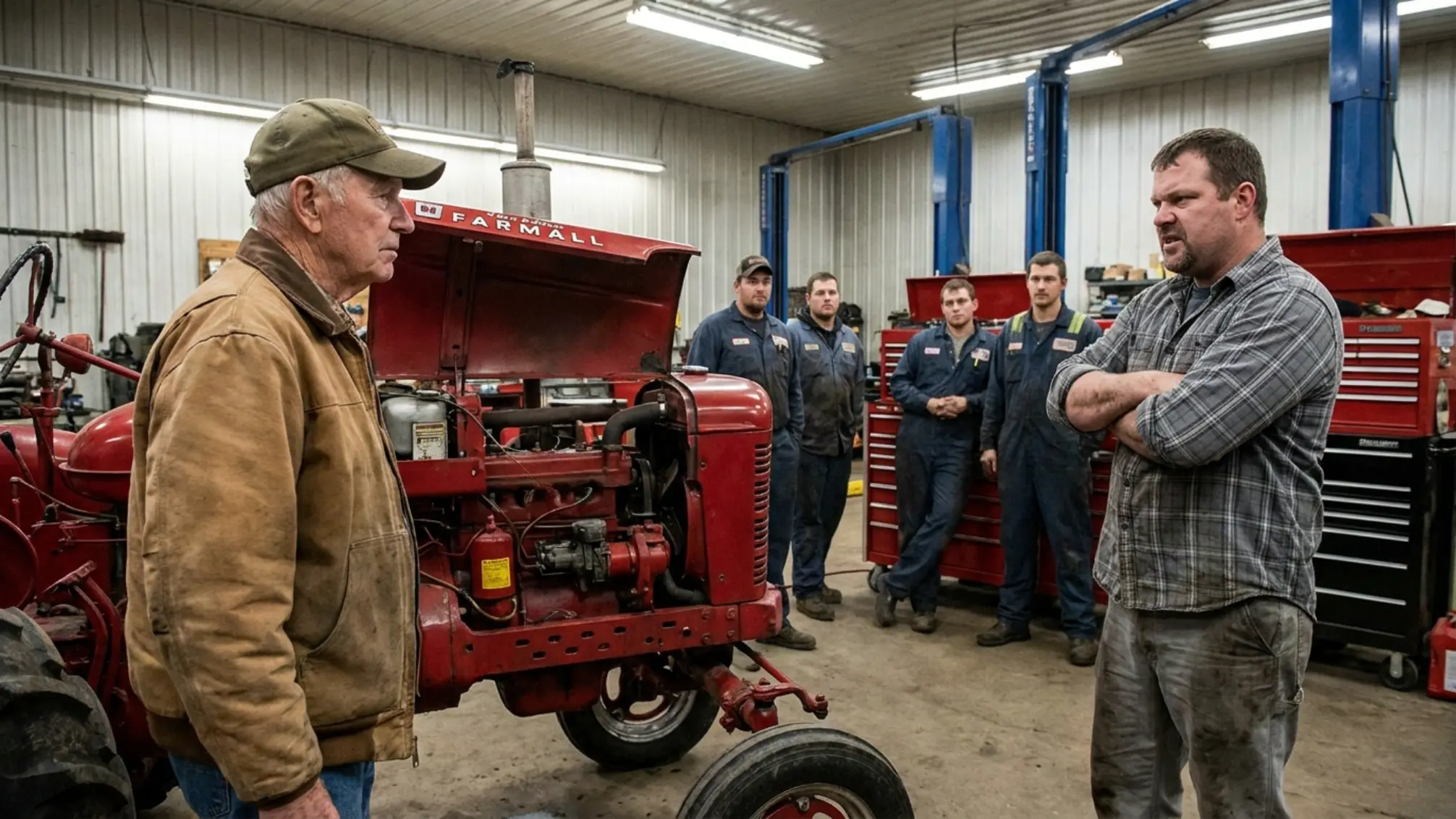
Yet the tractor could not stay alive for more than twelve seconds.
Five mechanics had worked on it over four days. They replaced the ignition coil, spark plugs, condenser, fuel line, carburetor float, and several sections of wiring. They adjusted the timing three times, checked compression twice, and removed the cylinder head after convincing themselves a valve must be sticking.
Nothing changed.
The engine would crank, cough, shudder violently, and die.
On Friday afternoon, shop owner Clay Miller stood beside the rear tire with both hands planted on his hips. He was forty-six, stocky, grease-stained, and exhausted from sleeping only a few hours since the tractor arrived.
Across from him stood Walter Hayes.
At seventy-nine, Walter appeared thin enough to disappear inside his faded brown work jacket. Deep lines covered his weathered face, and the old olive cap on his head had been repaired twice along the brim. He had entered the shop only to collect a mower blade, but the Farmall’s tortured coughing stopped him near the service counter.
Walter listened for ten seconds.
Then he said, “Your engine isn’t the problem.”
Clay’s expression hardened.
Five mechanics had spent nearly sixty combined hours on the tractor. Every man in the building had heard theories from customers who watched repair videos online and believed that made them experts.
Clay pointed toward the machine.
“Five men tore through this tractor, old man. If you came to waste my time, step away from my bay.”
Walter met his stare without raising his voice.
“You wasted your own time the second you started replacing parts without hearing what this tractor was begging to tell you.”
Clay stepped closer.
“You listened for ten seconds and think you know more than every mechanic in this shop?”
Walter turned toward the red tractor.
“Start it again—and when that missing breath exposes all five of you, don’t you dare call yourselves mechanics.”
Every tool in the building seemed to stop moving.
Sam Ortega, the senior engine specialist, looked up from a workbench. Luis Mercer lowered the impact wrench in his hand. Two younger mechanics emerged from behind the hydraulic lift, both waiting to see whether Clay would throw Walter outside.
Clay’s jaw tightened.
Before he could answer, another voice came from near the office.
“Start it.”
The tractor’s owner, Benjamin Rourke, stood beside the open door holding a cardboard box of old photographs. He was thirty-four, with tired eyes and a face that had not relaxed once during the four days his grandfather’s tractor had occupied the shop.
Clay turned toward him.
“Ben, we’ve already run it thirty times.”
“Then thirty-one won’t hurt.”
Clay looked back at Walter.
The old farmer had already moved beside the engine.
“Fine,” Clay said. “But when it dies again, he leaves.”
Walter rested one hand lightly on the Farmall’s hood.
“You won’t need to ask me twice.”
Ben placed the photographs on a nearby table and climbed onto the metal seat. He turned the fuel valve open, moved the throttle slightly forward, and pressed the starter.
The engine rotated.
One cylinder fired.
Then another.
The tractor coughed through the exhaust, shook hard enough to make the steering wheel jump, and struggled into an uneven idle.
Walter closed his eyes.
The mechanics watched him instead of the tractor.
Eight seconds passed.
Nine.
The engine gave a hollow pop and died.
Silence returned.
Clay spread his hands.
“There. You heard it.”
Walter nodded.
“I heard what wasn’t there.”
Luis gave an impatient laugh. “And what magical sound would that be?”
“The inhale.”
Sam frowned. “The what?”
Walter stepped toward the vertical air-cleaner pipe beside the hood.
“This old Farmall has an oil-bath air cleaner. When the engine pulls properly, you hear a tiny draw through the intake just before the cylinders catch. Not loud. More like someone sipping air through their teeth.”
Clay folded his arms. “There’s no intake leak.”
“I didn’t say there was a leak.”
“Then what are you saying?”
Walter pointed at the air cleaner.
“That engine is getting fuel and spark. Your compression is strong enough to shake the building. But it isn’t breathing.”
Clay looked toward Sam.
“We inspected the cleaner.”
“We cleaned it,” Sam replied. “New oil in the cup, mesh washed, pipe cleared.”
Walter crouched near the lower intake connection.
“Did you listen before replacing half the tractor?”
Clay’s anger returned. “We used gauges.”
“Gauges tell you what you choose to measure.”
“And ears tell old stories.”
Walter straightened.
“Sometimes old stories survive because they’re true.”
Ben climbed down from the seat.
“Can you prove it?”
Walter looked at him carefully. “Is this tractor important to you?”
“It belonged to my grandfather.”
“That wasn’t my question.”
Ben glanced toward the old photographs.
“He bought it used in 1956. My father learned to drive on it. So did I. Grandpa died last winter, and the last thing he asked was that we bring the Farmall to the Mason County Harvest Parade.”
Walter’s eyes moved across the restored machine.
“When is the parade?”
“Tomorrow morning.”
“And this is the lead tractor?”
“It was supposed to be.”
Ben opened the cardboard box. The first photograph showed a young farmer sitting on the same Farmall with two children balanced across his knees. Another showed the tractor pulling a wagon loaded with pumpkins. In a third, an older man stood beside it with one hand resting on the red hood.
“I spent nearly eighteen thousand dollars restoring it,” Ben said. “Not because it’s worth that much, but because Grandpa was.”
Clay looked away.
He knew how much the failure had cost Ben emotionally. That was why he had kept his crew late every night and refused to add several hours to the invoice.
Walter picked up the last photograph.
“Your grandfather was Earl Rourke?”
Ben stared at him. “You knew him?”
Walter smiled faintly.
“Everyone who farmed west of Mason City knew Earl. He could back a hay wagon through a barn door without turning his head.”
“He always said that.”
“He also cheated at cards.”
Ben laughed for the first time in days.
Walter returned the photograph.
“Your grandfather bought seed from my father. I probably rode beside him on this tractor before you were born.”
Clay exhaled sharply.
“This is touching, but it doesn’t diagnose the machine.”
Walter looked toward him.
“Loosen the intake coupling between the cleaner pipe and the carburetor.”
Sam shook his head. “That lets unfiltered shop air into the engine.”
“For ten seconds.”
“We just rebuilt the carburetor.”
“And I’m asking you to let it breathe around whatever all five of you missed.”
Clay stepped between Walter and the tractor.
“You do not direct my mechanics in my shop.”
Walter did not retreat.
“Then keep replacing parts until the parade is over.”
The two men stood less than a foot apart.
Clay was broader and twenty years younger, but Walter’s eyes remained perfectly steady. There was no need for him to prove strength. His confidence came from having repaired machinery in fields where no replacement parts, digital meters, or second chances existed.
Ben moved between them.
“Clay, loosen it.”
“This could change the mixture.”
“Good,” Ben replied. “Something needs to change.”
Clay stared at him, then turned toward Sam.
“Open the coupling.”
Sam selected a screwdriver and loosened the metal band clamping the air-cleaner tube to the carburetor inlet. He pulled the tube back half an inch, leaving a narrow gap through which the engine could draw air directly from the shop.
Walter stepped away.
“Now start it.”
Ben returned to the seat.
Clay stood beside the engine with his arms crossed. The other mechanics gathered around, their skepticism mixed with the uneasy possibility that the old farmer might be right.
Ben pressed the starter.
The Farmall turned twice.
Then the engine fired.
Not one weak cylinder followed by another, but all four joining in a steady mechanical rhythm. The tractor settled into a clean idle, each exhaust pulse landing with the confident beat of a machine awakening after decades of sleep.
Ben froze on the seat.
Sam stared at the open intake connection.
Luis whispered, “No way.”
The two younger mechanics stepped closer as though the engine might vanish if they blinked.
Walter listened calmly.
There it was.
A soft pulling hiss through the half-inch opening near the carburetor. The tiny sound the tractor had been unable to make through its assembled intake system.
Clay’s face went still.
Ben moved the throttle forward.
The engine responded immediately, rising smoothly instead of coughing and dying. The polished red hood vibrated with contained strength, and the entire shop filled with a sound preserved in Ben’s earliest memories.
His grandfather’s tractor was running.
Ben’s eyes filled.
He lowered the throttle and allowed the engine to idle again.
Clay reached forward and pressed the shutoff. The Farmall quieted, leaving the mechanics in stunned silence.
Walter looked toward him.
“Now you know where to search.”
Clay said nothing.
Sam removed the complete air-cleaner assembly. He separated the oil cup, inspected the lower chamber, and shone a flashlight through the vertical tube.
“Clear from here,” he said.
Walter pointed toward the curved section running beneath the hood.
“Check the elbow.”
Luis disconnected it from the carburetor. At first glance, the metal pipe appeared empty. He held it toward the ceiling light and frowned.
“I can’t see through it.”
Clay took the pipe and examined the opening.
Something dark was lodged several inches inside.
Sam pushed a flexible rod through from the opposite end. The obstruction resisted, then shifted. With another push, a black rubber disc dropped onto the workbench.
Everyone stared at it.
It was a temporary blasting plug.
During the restoration, the body shop had inserted rubber plugs into open tubes to prevent sand and paint from entering the engine system. Most had been removed before reassembly.
This one had been pushed deeper into the curved intake elbow, where it could not be seen from either end. A small tear through its center allowed just enough air for the engine to cough and run briefly, misleading the mechanics into believing the intake was functioning.
Clay picked up the plug.
The answer weighed less than an ounce.
Five mechanics had replaced hundreds of dollars in parts because of it.
Luis removed his cap and rubbed his forehead.
“We blew compressed air through that pipe.”
“The tear let air pass,” Sam said. “Probably made us think it was clear.”
Clay looked toward Walter.
“How did you know?”
“I didn’t know about the plug.”
“But you knew it was blocked.”
Walter rested his fingertips against the air-cleaner housing.
“My father owned a Farmall H. So did my uncle. I spent more hours behind those engines than I spent inside school. When one starts properly, the air cleaner makes a little whisper before the exhaust settles.”
He tapped the housing once.
“Your tractor was making every sound except the one proving air reached the carburetor.”
Clay set the rubber plug on the table.
“We tested fuel pressure, compression, voltage, spark intensity, and ignition timing.”
“You tested what instruments made easy.”
“That’s what professional diagnosis requires.”
Walter nodded. “It also requires paying attention before deciding what the problem must be.”
The words struck harder because Walter did not deliver them with triumph.
Clay looked at the new parts stacked near the workbench. The tractor’s original coil had tested within specification. So had the condenser. The first rebuilt carburetor likely had nothing wrong with it.
Each replacement had been based on the assumption that the engine itself must be failing.
Once that assumption took hold, every new symptom was interpreted as proof.
Clay had seen younger mechanics make that mistake.
He had never admitted how often experience made older ones more vulnerable to it.
Ben climbed down and walked toward Walter.
“You saved the parade.”
Walter shook his head. “I pointed toward a pipe.”
“You heard something five trained mechanics missed.”
“I heard something because I wasn’t trying to defend four days of work.”
Clay looked at him sharply.
Walter continued, “They’re good mechanics. That’s why it took so long.”
Luis frowned. “How does being good make us miss something obvious?”
“You know enough to imagine complicated failures.”
Walter held up the rubber plug.
“A farmer stranded in a field starts with three questions. Is it getting fuel? Is it getting fire? Can it breathe? You answered the first two and assumed the third.”
Sam leaned against the workbench.
“We inspected the cleaner.”
“You inspected pieces,” Walter replied. “The tractor doesn’t run as pieces. It runs as a path.”
Clay remained silent for several moments.
Then he extended his hand.
Walter looked at it.
“I was disrespectful,” Clay said. “You walked into my shop and I treated your age like evidence against you.”
Walter accepted the handshake.
“You were protecting your men.”
“I was protecting my pride.”
“That too.”
A few mechanics smiled.
Clay looked toward the tractor.
“Let’s put it back together.”
The crew cleaned the intake elbow again, verified the full passage, and reassembled the oil-bath air cleaner. Sam restored the original ignition components one at a time after testing them, while Luis adjusted the carburetor to the settings recommended in the old service manual.
Walter remained nearby but did not interfere.
When the work was finished, Ben climbed onto the seat once more.
This time, Clay stood beside Walter.
“Listen,” the old farmer said.
Ben pressed the starter.
A soft breath moved through the air cleaner.
Then the Farmall came alive.
The engine settled into an even rhythm so smooth that a cup of water placed on the hood barely trembled. Ben drove the tractor slowly through the open service door and into the afternoon sunlight.
The red paint gleamed.
Employees emerged from every corner of Miller Equipment to watch him circle the lot. Ben shifted into a higher gear, and the Farmall rolled forward with the confident pull of a machine built when repairs were expected to last for generations.
Walter stood beside Clay near the doorway.
“You hear it now?” he asked.
Clay listened.
Beneath the exhaust and mechanical ticking came the tiny intake whisper.
“I hear it.”
“You won’t forget it.”
“No.”
Ben stopped the tractor beside them and switched off the engine.
He climbed down, opened the cardboard box, and removed a smaller photograph in a cracked frame.
It showed Earl Rourke as a young man beside Walter’s father. Between them stood the same Farmall, its paint scratched and its tires covered with field mud.
Walter stared at the picture.
“I haven’t seen my father’s face that young in sixty years.”
Ben handed him the frame.
“You should keep it.”
“I can’t take your grandfather’s photograph.”
“There are three copies in the family album. That one belongs with someone who remembers the day.”
Walter studied the faded image.
Behind the two farmers was a field of oats and a wooden wagon leaning beneath the weight of grain. A teenage Walter stood partly hidden near the rear wheel.
He had forgotten he was in the photograph.
“I was fifteen,” he whispered. “That was the summer before the creek flooded.”
Ben looked toward the tractor.
“Grandpa said this machine helped three farms bring in crops that year.”
Walter nodded.
“Your grandfather lent it to anyone who needed it. Never charged fuel. Only asked that it came back before Sunday.”
“Why Sunday?”
“He washed it every Sunday afternoon.”
Ben smiled.
“That sounds like him.”
Clay walked into the office and returned with the repair invoice.
He tore it in half.
Ben stared at him.
“What are you doing?”
“You’re paying for the parts that were genuinely needed and the intake cleaning. Nothing else.”
“You had five men working for four days.”
“Five men were wrong for four days.”
“That isn’t free labor.”
Clay glanced toward Walter.
“Consider the rest tuition.”
Ben tried to object, but Clay refused.
The shop owner then turned toward his mechanics.
“Tomorrow morning, before anyone begins work, we’re having a diagnostic meeting.”
Luis groaned. “At what time?”
“Seven.”
“That’s before opening.”
“Exactly.”
Clay placed the rubber plug on the center of the workbench.
“This stays here.”
Sam picked it up.
“As a warning?”
“As a reminder,” Clay said. “Never let the cost of what you’ve already done decide what you believe next.”
Walter adjusted his cap.
“Now you sound like a farmer.”
Clay smiled. “Don’t insult me.”
The following morning, the Mason County Harvest Parade began beneath a clear blue sky.
Families lined Main Street while restored tractors waited in rows beyond the courthouse. There were green John Deeres, orange Allis-Chalmers machines, gray Fergusons, and several red Farmalls from different decades.
Ben’s 1948 tractor stood at the front.
A small wooden sign attached beside the seat read:
EARL ROURKE’S FARMALL
STILL BREATHING
Ben had asked Walter to drive.
The old farmer refused twice.
“It belongs to your family.”
“You were part of its family before I was born.”
Walter finally agreed on one condition.
Ben had to ride beside him.
They shared the wide metal seat as volunteers opened the parade route. Walter wrapped one hand around the steering wheel and placed the other near the throttle.
For a moment, he did not start the tractor.
His eyes moved across the red hood, past the courthouse, and toward something only memory allowed him to see.
His father in the oat field.
Earl Rourke laughing beside a wagon.
A fifteen-year-old boy learning that a machine had its own language if a person became quiet enough to hear it.
“You ready?” Ben asked.
Walter nodded.
He pressed the starter.
The air cleaner whispered.
The engine fired.
People along the street applauded as the Farmall rolled forward. Clay and all five mechanics stood outside Miller Equipment wearing clean work shirts for the occasion.
When Walter passed, he raised two fingers from the steering wheel.
Clay answered with the same gesture.
The rubber plug sat inside a small glass case near the shop’s front counter for years afterward. Beneath it, Clay placed a handwritten card:
THE PART FIVE MECHANICS COULDN’T FIND
BECAUSE WE HAD ALREADY DECIDED THE ENGINE WAS WRONG.
Customers often asked about it.
Clay told the story without hiding his own arrogance. He described the new parts, the repeated tests, the old farmer who listened for ten seconds, and the tiny intake sound nobody else noticed.
Some customers laughed.
Professional mechanics never did.
They understood how easily knowledge could become a wall. Once a person invested time, money, and pride in a theory, changing direction felt more painful than continuing to fail.
Walter never claimed he had defeated five mechanics.
Whenever someone told the story that way, he corrected them.
“The tractor defeated us all,” he said. “It kept telling the truth until somebody stopped arguing long enough to hear it.”
He visited Miller Equipment occasionally after that.
Clay kept a chair near the service bay for him, although Walter rarely sat. He wandered around the machines, listening to engines and asking younger mechanics why they believed what they believed.
He did not give answers quickly.
Usually, he asked them to start again from the beginning.
Fuel.
Fire.
Air.
Then everything connecting them.
Two years later, Walter died peacefully in the farmhouse where he had lived for more than half a century.
At his funeral, Ben arrived on the restored Farmall.
He parked it quietly near the cemetery road, beside rows of ordinary cars. Clay and the five mechanics stood together near the back of the gathering.
After the service, Ben climbed onto the tractor.
Before starting it, he looked toward Clay.
Both men waited.
The soft inhale came first.
Then the old red engine caught and settled into its steady rhythm.
The sound followed Walter Hayes to his final resting place—not roaring, not demanding attention, but breathing exactly as he had taught them to hear.
Five mechanics believed the tractor needed more parts.
Walter knew it needed one person willing to listen.
And the smallest missing sound became the loudest lesson Miller Equipment ever learned.