The restored 1948 Farmall sat in the middle of Miller Equipment like a red monument to failure.
Its fresh paint shone under the fluorescent lights, its tires were clean, and its chrome badges looked bright enough for a parade.
But every time someone pressed the starter, the engine coughed, kicked once, and died like it was refusing to be brought back to life.
Five mechanics had already tried to fix it.
By noon, the tractor had beaten every man in the shop.
Ryan Keller wiped grease from his hands and stared at the Farmall with open irritation.
He was the lead mechanic at Miller Equipment, forty-one years old, sharp-tongued, certified, and proud of every diagnostic tool hanging above his bench.
He had replaced the plugs, tested the coil, adjusted the points, swapped the condenser, checked the carburetor, and argued with two other mechanics about timing.
Nothing worked.
Every failed start made his face harder.
The shop smelled of gasoline, old oil, hot metal, and frustration.
Men stood around pretending to be busy while secretly watching the tractor embarrass the whole crew.
The owner, Steve Miller, leaned near the parts counter with his arms folded and his jaw tight.
The Farmall was not just another repair job.
It belonged to the county museum, and it was supposed to lead the Fourth of July heritage parade in three days.
The tractor had been donated by the late Harold Benson, a farmer who had driven it for forty years before his family restored it in his memory.
His widow had saved for two years to pay for the restoration.
The museum had advertised the parade around it.
Children were supposed to ride behind it on a hay wagon, veterans were supposed to walk beside it, and the town paper had already printed a photo of the red Farmall under the headline, “History Returns to Main Street.”
Now history would not start.
Ryan kicked a wrench lightly across the concrete floor.
“I’m telling you, Steve, something internal is wrong,” he said.
“We’ve replaced half the ignition system, cleaned the carb twice, and checked fuel delivery three times.”
Steve frowned and looked at the tractor as if disappointment could turn a crankshaft.
“It ran last week when they unloaded it,” he said.
Ryan shrugged.
“Then something broke after that.”
A younger mechanic named Tyler leaned over the hood and said, “Could be compression.”
Ryan shot him a look.
“We checked compression.”
Tyler lowered his eyes and backed away.
That was when Walter Hayes walked in.
He came through the side door slowly, wearing a faded brown jacket, worn boots, and an old cap pulled low over his white hair.
At seventy-nine, Walter moved carefully, but not weakly.
His shoulders were narrow now, his hands knotted with age, and his face carried the deep lines of a man who had spent more years in the weather than under a roof.
He had farmed outside Mason Ridge before most of the mechanics in that shop had learned to drive.
He had also run old Farmalls, Fords, and Allis-Chalmers machines long before repair manuals came with passwords.
Walter had come to pick up hydraulic fittings for his neighbor.
He did not enter the shop to interfere.
He only stopped because the sound of the Farmall coughing wrong reached him before the parts counter did.
He turned his head toward the red tractor and listened as Ryan hit the starter again.
The engine turned, stumbled, popped once, and died.
Walter’s eyes narrowed.
Ryan saw him watching and sighed loudly.
“Can we help you, Walter?”
Walter took a few steps closer.
“What’s wrong with the Farmall?”
Ryan gave a tired laugh.
“That’s what five certified mechanics are trying to figure out.”
A few men smiled.
Walter ignored the tone and looked at the tractor.
“Try it again.”
Ryan stared at him.
“What?”
Walter nodded toward the engine.
“Turn it over again.”
Ryan wiped his hands slowly, making a show of his irritation.
“Five certified mechanics couldn’t fix it, Walter, so don’t pretend your old ears know more than our tools.”
The shop went quiet.
Steve Miller looked uncomfortable, but he did not correct him.
Walter’s expression did not change.
He only stepped closer to the Farmall, leaned his head slightly, and said, “Your tools kept shouting at the wrong problem, boy, but that tractor has been whispering the truth all morning.”
Ryan laughed once, sharp and humorless.
“It’s a dead engine, old man, not some farm ghost begging you to listen.”
Walter placed one hand on the red hood, not touching it like a machine, but like something alive enough to answer.
“Then crank it.”
Ryan looked around at the others with a smirk.
“All right. Let’s give Grandpa ten seconds with the miracle ears.”
He turned the key.
The starter whined, the engine rolled, and the Farmall gave the same ugly cough.
Most of the men heard failure.
Walter heard absence.
There should have been a soft pull through the intake, a tiny gulp of air, a breath before the engine tried to catch.
But there was nothing there.
“Stop,” Walter said.
Ryan released the starter.
The shop fell silent except for the ticking of cooling metal.
Walter leaned closer to the intake side, his old eyes moving from the carburetor to the air cleaner pipe, then down toward the freshly painted elbow behind the hood panel.
He pointed beneath the intake with one crooked finger.
“Explain why nobody heard the missing breath before wasting half the shop replacing good parts.”
Ryan’s face tightened.
“What missing breath?”
Walter looked at him.
“The engine has spark. It has fuel. It has enough compression. But it isn’t breathing.”
Ryan scoffed.
“We cleaned the carburetor twice.”
“I didn’t say carburetor,” Walter said.
“I said breathing.”
Tyler looked toward the intake pipe.
Ryan snapped, “Don’t start.”
Walter crouched slowly beside the tractor, his knees stiff but his eyes focused.
“When you crank an old Farmall, you should hear the air pull before it coughs. This one is trying to drink through a cork.”
Ryan folded his arms.
“We checked the air cleaner.”
Walter tapped the metal pipe.
“You checked what was easy to reach.”
Ryan’s jaw worked.
“You think we left something obvious inside the intake?”
Walter stood again, his face calm.
“I think pride makes obvious things invisible.”
Steve Miller stepped closer.
“What do you want to check?”
Walter nodded toward the intake elbow bolted beneath the hood.
“Take that off.”
Ryan laughed.
“You want me to pull the intake elbow because you didn’t hear a noise?”
Walter looked straight at him.
“That tractor didn’t beat five mechanics. Your pride did.”
The words landed harder than a thrown wrench.
A few men looked down.
Ryan’s face flushed, but Steve Miller raised one hand before he could answer.
“Pull it off,” Steve said.
Ryan turned toward him.
“Steve, come on.”
“Pull it off.”
Ryan grabbed a socket wrench and moved with stiff anger.
He removed the bolts faster than necessary, muttering under his breath as he worked.
The metal elbow came loose with a dry crack of old gasket.
For a second, everyone saw nothing.
Then Tyler leaned in with a flashlight and froze.
“Ryan,” he said quietly.
Deep inside the intake tube, wedged tight where the bend hid it from casual inspection, was a faded blue shop rag.
It had been sucked inward and packed against the throat like a plug.
The rag was oily, stiff, and nearly invisible in the dark curve unless someone looked exactly where Walter had pointed.
No amount of new plugs, fresh points, or carburetor cleaning could make an engine run while its airway was blocked.
The tractor had not needed parts.
It had needed someone to listen.
Steve Miller stared at the rag.
“You’ve got to be kidding me.”
Tyler reached in with long pliers and pulled it free.
The rag came out slowly, stained with oil and bits of paint dust.
One of the older mechanics cursed under his breath.
Ryan stood completely still.
Walter looked at the rag, then at Ryan.
“Before painting, somebody stuffed that pipe to keep dust out.”
Tyler swallowed.
“And nobody pulled it after.”
Walter nodded.
“Then every man after that trusted the last man too much.”
Steve ran one hand over his face.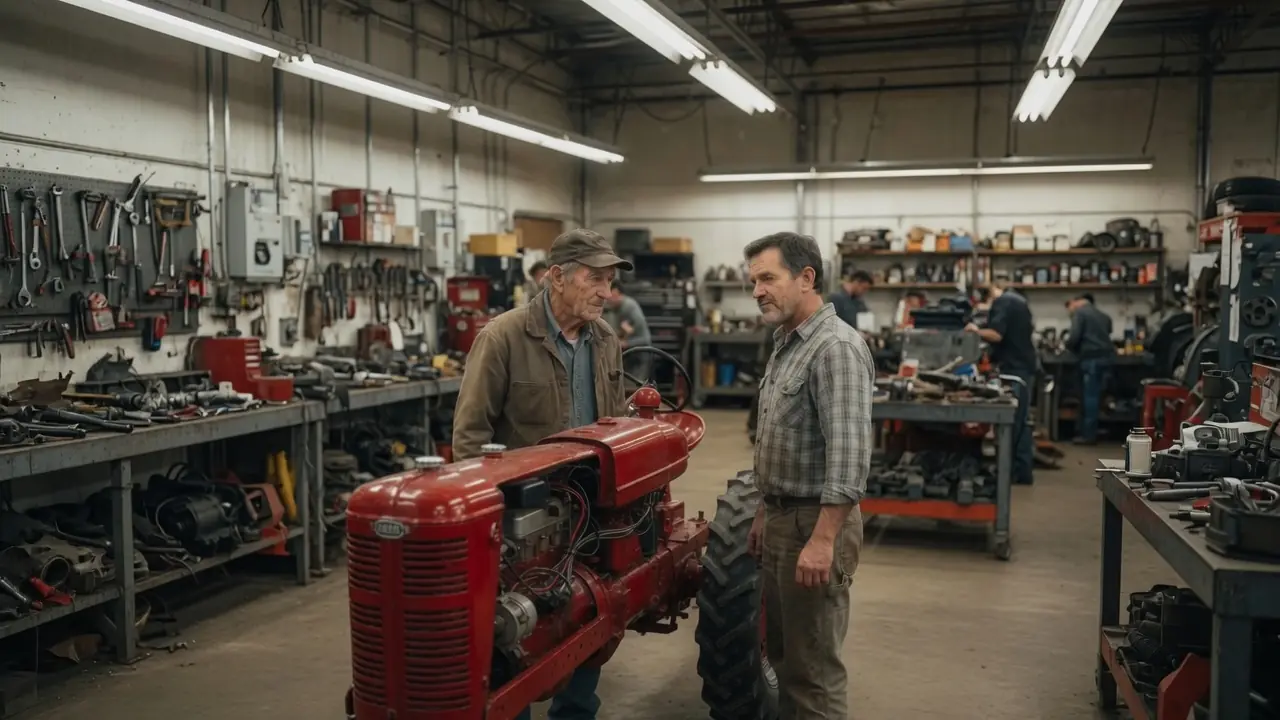
Ryan tried to recover.
“That still doesn’t mean it’ll run.”
Walter looked at him with tired patience.
“No. It means now it can breathe.”
Steve pointed toward the cockpit.
“Try it.”
Tyler replaced the intake elbow loosely, enough for the test.
Ryan hesitated near the starter, his confidence shaken but not fully gone.
The whole shop seemed to lean toward the tractor.
Walter stepped back, folded his hands over the top of his cane, and listened before anyone moved.
Ryan turned the key.
This time, the sound changed immediately.
The engine drew air with a clean little pull, coughed once, then caught.
The old Farmall shook hard, sputtered, spat a gray puff from the exhaust, and then settled into a deep steady rhythm that filled the shop from floor to ceiling.
The sound was not smooth like a modern engine.
It was older, rougher, and beautiful.
It was history breathing again.
Nobody spoke for several seconds.
Steve Miller’s mouth opened slightly as the tractor idled.
Tyler grinned despite himself.
The other mechanics stared at Walter with the stunned respect of men who had just watched ten seconds of listening defeat eight hours of labor.
Ryan stood beside the starter switch with his hand still hovering near the key.
His face had gone pale.
Walter stepped closer to the tractor and laid his palm on the hood.
The vibration moved through his fingers and up his arm, familiar as an old song.
He closed his eyes for a moment.
In that sound, he heard fields, dust, long rows of corn, his father calling from a fence line, and mornings when machines were not computers on wheels but stubborn partners you learned by touch.
Then he opened his eyes and looked at Ryan.
“You hear it now?”
Ryan swallowed.
“I hear it.”
“No,” Walter said.
“You hear it running. That’s not the same as hearing what it needed.”
Ryan lowered his eyes.
The engine kept idling, steady and forgiving in a way men often were not.
Steve Miller turned to Walter.
“How did you know?”
Walter looked toward the intake.
“I didn’t know at first.”
He tapped his ear.
“I listened.”
Ryan gave a bitter little laugh, trying to hide shame under sarcasm.
“So that’s the secret? Just listen?”
Walter’s face hardened.
“No, Ryan. The secret is believing an old machine might know something before you decide you know everything.”
The words silenced the shop again.
Ryan looked at the floor, grease on his hands, pride sitting heavy on his shoulders.
For the first time that day, he looked less like the lead mechanic and more like a man learning what his title could not teach him.
Steve shut the tractor down, and the sudden quiet felt almost disrespectful.
Then he turned to the crew.
“Finish the gasket, tighten the intake, check for leaks, and clean up the fuel line.”
He looked at Ryan.
“And write up exactly what happened.”
Ryan’s head snapped up.
“Write it up?”
“Yes,” Steve said.
“Every wrong part we replaced. Every hour billed. Every assumption made.”
Ryan’s face reddened.
“That’ll make us look bad.”
Walter picked up his fittings from the counter.
“Looking bad is cheaper than staying wrong.”
Steve nodded slowly.
“Put that on the wall.”
By late afternoon, the Farmall was running clean.
The mechanics changed the oil again, flushed the fuel bowl, sealed the intake properly, and polished fingerprints off the fresh red hood.
When Harold Benson’s widow arrived to check on it, she stood in the shop doorway with one hand over her mouth.
Her name was Ruth Benson, seventy-four years old, small, straight-backed, and wearing the same wedding ring Harold had bought her in 1968.
When the tractor started for her, tears filled her eyes.
“That sound,” Ruth whispered.
“I haven’t heard that sound since Harold was alive.”
Walter stood near the back, trying not to be noticed.
Ruth saw him anyway.
“Was it you?”
He shook his head slightly.
“Machine wanted to run. I just heard where it was hurting.”
Ruth walked over and took his hand.
“Then thank you for listening.”
Ryan watched from across the shop.
That moment embarrassed him more than Walter’s sharpest words.
Not because Walter was being praised, but because Ryan understood how close they had come to failing Ruth.
They had treated the tractor like a problem to conquer, not a memory someone had trusted them to protect.
He had mocked the only man in the room who cared enough to listen differently.
And the worst part was that Walter had not looked pleased when he was proven right.
He looked sad.
The next morning, Ryan arrived early.
The shop was quiet, the lights humming above the benches, the Farmall sitting near the door ready for parade transport.
Walter was already there, standing beside it with a cup of coffee Steve had given him.
Ryan stopped several feet away.
For once, he did not know how to begin.
Walter looked over.
“You come to tell me it was still a dead engine?”
Ryan flinched.
“No.”
He removed his cap and rubbed the back of his neck.
“I came to apologize.”
Walter waited.
Ryan took a breath.
“I was disrespectful. Not just wrong. Disrespectful.”
He looked at the tractor.
“I thought because I had the tools and the certifications, I had the answer before you had the right to speak.”
Walter sipped his coffee.
“That’s a dangerous habit.”
“I know.”
“No,” Walter said.
“You’re starting to know.”
Ryan nodded, accepting the correction.
“I should have listened.”
Walter looked at him for a long moment.
“Yes.”
Ryan glanced toward the intake where the rag had been hidden.
“How many times did you fix something by sound?”
Walter smiled faintly.
“Enough to know sound can lie too.”
That surprised Ryan.
Walter continued, “But silence tells the truth better than noise sometimes. Yesterday, that tractor wasn’t making the sound it should make. You boys kept chasing the sounds it did make.”
Ryan leaned against the workbench.
“We were focused on spark and fuel.”
“Because that’s what engines need.”
“Right.”
Walter nodded.
“But they need air too. And respect. Not the sentimental kind. The practical kind. Respect means you don’t skip the simple thing because your pride wants a complicated answer.”
Ryan stared at the tractor.
“I replaced a good condenser.”
“And good plugs,” Walter said.
“And a good coil, probably.”
Ryan grimaced.
Walter’s mouth twitched, almost a smile.
“Don’t worry. Parts drawers have survived worse men than you.”
For the first time, Ryan laughed softly without cruelty.
The Fourth of July parade came three days later.
Miller Equipment hauled the Farmall to Main Street before sunrise.
By nine o’clock, children lined the sidewalks with little flags, older men sat in folding chairs, and families gathered near the courthouse lawn.
Ruth Benson climbed onto the tractor seat with help from Steve Miller, while a museum volunteer sat beside her to steer if needed.
But Ruth placed both hands on the wheel like Harold had shown her years ago and nodded that she was ready.
Walter stood near the curb, trying to stay behind the crowd.
Ryan found him there.
“You should be up front,” Ryan said.
Walter shook his head.
“It’s Ruth’s day.”
Ryan looked at the red tractor waiting at the head of the parade.
“Still. It wouldn’t be running without you.”
Walter’s eyes stayed on the machine.
“It would have run eventually.”
“Not by Saturday.”
Walter did not argue.
The Farmall started with one clean turn.
Its engine settled into that steady old rhythm, and the crowd began to clap before it even moved.
Ruth Benson wiped her eyes with one hand and waved with the other as the tractor rolled forward, pulling a hay wagon full of children dressed in red, white, and blue.
The old machine moved down Main Street like a promise kept.
Walter watched in silence, his throat tight.
Ryan stood beside him and listened.
This time, he heard more than the engine.
He heard the small draw of air, the rhythm of old pistons, the gentle unevenness of a machine built before computers and still alive because somebody had cared.
He heard Ruth crying softly as she passed.
He heard children cheering for a tractor they did not yet understand.
And beneath it all, he heard Walter’s lesson working its way into him.
After the parade, Miller Equipment changed too.
Not overnight.
Pride never dies quickly.
But Ryan stopped mocking older farmers when they said a machine “felt wrong.”
He asked more questions before replacing parts.
He made younger mechanics crank engines with the hood open and listen before touching a wrench.
He even hung a small sign above the diagnostic bench, written in black marker on cardboard because Steve refused to let the lesson become too polished.
Listen before you prove how smart you are.
Some customers laughed at the sign.
Ryan did not.
Whenever someone asked where it came from, he pointed toward the photo Steve had taped beside it.
The photo showed Walter Hayes standing beside the red Farmall, one hand on the hood, eyes lowered like he was hearing something the rest of the world had missed.
Underneath, Steve had written: “The tractor did not beat five mechanics. Pride did.”
Months later, a young mechanic named Tyler struggled with an old Ford that would not idle.
Ryan watched him reach for a sensor tester, then stopped him.
“Wait.”
Tyler looked up.
“What?”
Ryan nodded toward the engine.
“Start it again. Don’t fix it yet. Listen first.”
Tyler smiled.
“You sound like Walter.”
Ryan gave him a sideways look.
“Best compliment you’ve given me all week.”
Then they both leaned close, and for ten seconds, the shop went quiet enough for the machine to speak.
Walter still came by Miller Equipment from time to time for fittings, belts, and coffee he pretended not to want.
The younger mechanics greeted him differently now.
Not loudly.
Not with fake respect.
They simply made room when he leaned toward an engine, and they stopped talking long enough for him to hear.
One afternoon, Ryan found him by the old Farmall, which had returned for winter storage after the parade season.
The tractor sat clean beneath a cover, repaired and respected.
Ryan stood beside Walter and said, “I used to think old farmers exaggerated how much they knew.”
Walter kept his eyes on the red hood.
“Some do.”
Ryan laughed.
Walter added, “Some young mechanics do too.”
Ryan nodded.
“That’s fair.”
For a moment, they stood together without speaking.
Then Walter placed one hand on the tractor and said, “Machines remember hands. You treat them rough, they tell on you. You listen to them, they’ll forgive a lot.”
Ryan looked at the old man’s hand, the scars, the bent fingers, the years written into the skin.
He understood then that Walter had not beaten him that day.
He had saved him from becoming the kind of mechanic who knew every tool and understood nothing.
The restored 1948 Farmall never became just another repair ticket again.
People told the story whenever someone wanted to replace parts before checking the simple thing.
They told how five mechanics had chased spark, fuel, timing, and compression while an old farmer heard the silence in the intake.
They told how a forgotten shop rag hidden deep in a pipe humbled a room full of certified men.
And they always repeated Walter’s line because it was too true to forget.
“That tractor didn’t beat five mechanics. Your pride did.”
Years later, when Ryan trained new mechanics, he started with that story.
He showed them the photo of Walter and the Farmall.
He told them tools mattered, training mattered, and technology mattered.
Then he leaned close, lowered his voice, and gave them the warning he had learned the hard way.
“Before you decide a machine is wrong,” he said, “make sure you are quiet enough to hear what it has been trying to tell you.”