Walter Hayes had owned the faded red Massey Ferguson longer than some of the mechanics laughing at it had been alive. The tractor had arrived on Hayes Farm in 1978, when Walter was twenty-six, his father was still strong enough to stack hay by hand, and the old red barn still wore fresh paint. Over the next forty-six years, the machine planted corn, pulled wagons, cleared snow, and carried thousands of round bales from the field. Walter had replaced nearly everything on it except the hydraulic pump buried beneath the transmission housing.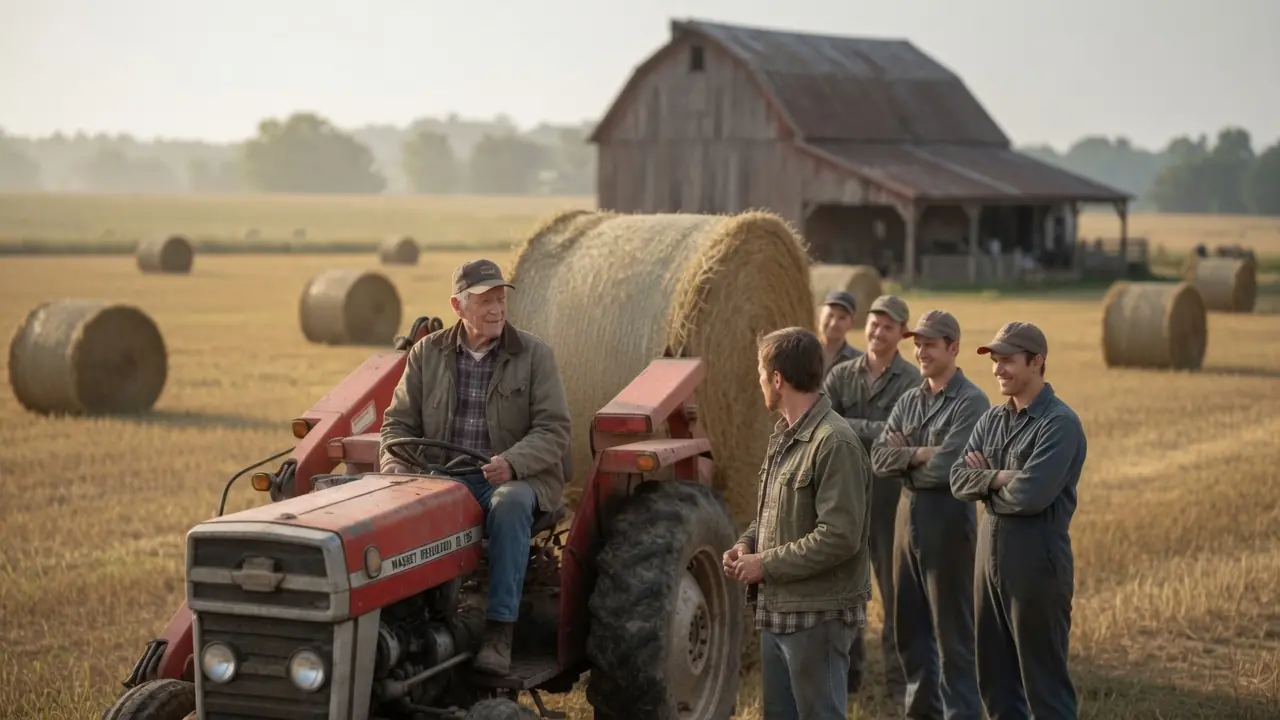
That pump had never been removed.
It had never needed to be.
The trouble began during the first hay cutting in June. Walter backed toward a heavy round bale, secured the rear spear, and pulled the hydraulic lever beside his seat. The three-point arms rose six inches, trembled beneath the weight, then slowly sank back toward the stubble while the engine continued running smoothly.
Walter tried again at higher engine speed. The bale lifted slightly farther but refused to clear the ground. When he released the lever, the arms dropped immediately instead of holding their position.
His grandson Noah stood beside the wagon and frowned. “Pump’s gone, Grandpa.”
Walter remained seated, listening to the faint hiss beneath the tractor seat. “Maybe.”
“That tractor is older than Dad.”
“So are plenty of useful things.”
Walter lowered the bale and drove slowly toward the machine shed. The hydraulic lift worked normally without weight, raising and lowering the empty arms without hesitation. It failed only when asked to carry pressure, a detail Walter noticed immediately and Noah dismissed as another symptom of a worn pump.
The nearest dealership had recently hired Mason Cole as its service manager. Mason was forty-two, confident, and known throughout the county for diagnosing equipment before customers finished describing the problem. He had certificates hanging behind his desk, a new service truck filled with electronic tools, and little patience for farmers who believed experience mattered more than formal training.
Mason arrived that afternoon wearing a gray work jacket despite the heat. He connected a pressure gauge to the hydraulic outlet, started the Massey, and moved the control lever several times. The needle climbed weakly, fluttered, and stopped far below the pressure Mason expected.
“The pump’s worn out,” he announced.
Walter leaned against the rear tire. “Could be the relief valve opening early.”
Mason shook his head. “That valve doesn’t suddenly lose half its setting.”
“It can if dirt gets beneath the seat.”
“The pressure reading tells the story.”
“It tells part of it.”
Mason removed his gloves. “Walter, I respect that you’ve run this tractor for decades, but hydraulic systems are my profession. The pump needs rebuilding.”
The estimate came to nearly twenty-eight hundred dollars after labor, seals, gaskets, and transport. Walter could have purchased another used tractor, but the Massey had belonged to his father during the final years of his life. Its steering wheel had been polished smooth by the hands of three generations, and Walter trusted its sounds more than he trusted newer machines filled with sensors.
He approved the work.
The dealership hauled the Massey away the following morning. Mason’s crew split the tractor, removed the hydraulic pump, replaced the internal seals, inspected the pistons, polished the valves, and installed several new components. Ten days later, the tractor returned to Hayes Farm with clean paint marks across bolts that had not moved since the Carter administration.
Mason demonstrated the repair using an empty three-point hitch. The arms rose quickly and held near the top.
“Good as new,” he said.
Walter attached the round-bale spear.
The tractor lifted the bale nearly one foot before the arms began trembling. A thin hydraulic whine came from beneath the seat, and the bale slowly returned to the ground.
Mason stared at it.
Walter shut off the engine. “Still think the pump told the whole story?”
“It may have air trapped in the system.”
“You ran it twenty minutes.”
“Old systems can be difficult to bleed.”
Mason promised to return after speaking with the dealership’s senior technician. Two days later, he arrived with Leonard Price, a mechanic who had repaired Massey Ferguson tractors since the early 1990s. Leonard repeated the pressure test, inspected the linkage, and agreed that the rebuilt pump was not producing enough force.
He believed Mason’s replacement seals might have been defective.
The tractor returned to the dealership.
Leonard removed the pump a second time. He installed another seal kit, checked the pump clearances, replaced two worn rings, and examined the housing for cracks. He found no obvious failure but assured Walter that rebuilding it correctly would restore full pressure.
Twelve days later, the Massey returned.
The lift performed better for several minutes. It raised an empty hay rake easily and carried a small square-bale platform across the yard. When Walter attached the large round bale, however, the arms stopped halfway and began sinking again.
Leonard stood beside the rear wheel with both hands on his hips. “That makes no sense.”
Walter pointed beneath the seat. “You hear that hiss?”
“All hydraulics make noise under load.”
“Not that noise.”
Leonard listened briefly but remained convinced the pump was bypassing internally. He suggested that the pump body itself might be worn beyond what new seals could repair. A replacement assembly would cost considerably more, but the dealership offered to credit part of the previous labor.
Walter declined.
“I’ve already paid to rebuild a pump that may never have been broken.”
Mason’s expression tightened. “The pressure is weak. Pressure comes from the pump.”
“Flow comes from the pump,” Walter replied. “Pressure comes when flow meets resistance.”
Several young mechanics near the service truck turned their heads. Mason noticed and lowered his voice.
“You’ve been reading repair forums?”
“I’ve been farming since before your mother met your father.”
That evening, Noah found Walter sitting at the kitchen table with the original Massey Ferguson service manual open beneath a yellow lamp. Handwritten notes filled the margins in Walter’s father’s narrow script. A parts diagram showed the pump, lift cylinder, control linkage, standpipe, relief valve, and internal passages.
Noah placed two cups of coffee on the table. “You don’t trust them anymore.”
“I trust that they believe what they’re saying.”
“That isn’t the same thing.”
“No.”
Walter traced one finger across the hydraulic diagram. A worn pump could create weak pressure, but the rebuilt unit had produced identical symptoms twice. The lift cylinder could leak internally, yet the arms held correctly when raised without weight. The system was losing pressure only under heavy demand, accompanied by a steady hiss from the right side of the housing.
Walter circled the relief valve.
The following week, a traveling mechanic named Calvin Reese visited the farm after hearing about the stubborn Massey at the feed store. Calvin had spent twenty-five years servicing older tractors from a truck and took pride in repairing machines that dealerships considered obsolete.
He performed his own pressure test and agreed the output was weak. Unlike Mason, he suspected the pump’s control valve was sticking under load. Reaching that valve required draining the oil, removing the top cover, and lifting the pump from beneath the transmission.
Walter asked whether Calvin had inspected the relief valve first.
Calvin laughed. “Every old farmer blames the relief valve because it’s cheaper.”
“Sometimes cheap parts fail.”
“And sometimes a worn pump is simply worn.”
Calvin removed the pump for the third time.
He cleaned the control valve, replaced a spring, installed another gasket set, and charged Walter less than the dealership had. For one afternoon, the Massey appeared repaired. It lifted a round bale high enough to clear the ground and carried it thirty yards toward the barn.
Then the arms dropped without warning.
The bale struck the field hard enough to split the outer layer of hay. Walter immediately disengaged the system and climbed down.
Calvin blamed contamination in the hydraulic oil. He argued that metal particles left from years of wear had entered the rebuilt pump and damaged the new components. Walter reminded him that the tractor’s oil and filters had been changed before the first repair.
“Then something remained in the housing,” Calvin said.
“Such as dirt beneath a relief valve?”
Calvin closed his toolbox. “You called me to repair it, Walter, not debate it.”
“I called you because I hoped you would inspect the whole system.”
The fourth mechanic was a hydraulic specialist named Dean Russell from Cape Girardeau. Dean did not work for a tractor dealership and claimed that agricultural mechanics often misunderstood hydraulic science. He arrived with precision gauges, a flow meter, infrared equipment, and enough hoses to surround the Massey like medical tubing.
Dean measured flow at several engine speeds. The pump moved nearly the correct amount of oil but failed to maintain pressure when the load increased. He explained that worn pump chambers could still produce flow while allowing internal leakage under resistance.
Walter asked the same question. “Did you test the relief valve?”
“The pressure loss pattern does not point there.”
“What does it point to?”
“Internal bypass inside the pump.”
Dean recommended machining the pump housing and fitting oversized components. The repair required removing the pump for the fourth time and sending it to a specialist shop. Walter reluctantly agreed only because Dean’s measurements appeared thorough.
The Massey remained disassembled for almost three weeks.
When the machined pump returned, Dean installed it himself. The system produced a stronger pressure reading than before, and the arms lifted the bale almost to transport height. Everyone watching believed the problem had finally been solved.
Then the hydraulic whine returned.
The gauge needle fell suddenly. The arms trembled, stopped, and lowered the bale onto the ground.
Dean checked his instruments twice. “There must be a crack in the lift cylinder.”
“A crack that disappears with no load?” Walter asked.
“Pressure opens it.”
“Then why is the noise coming from the other side?”
Dean did not answer.
By August, the story had spread across the county. Farmers gathered at cafés and equipment counters to discuss the red Massey that had defeated four mechanics. Some advised Walter to sell it for parts. Others believed the tractor had reached the end of its useful life and that his attachment to it was costing more than a replacement would.
Mason used the story during sales conversations.
“Old machines become money pits,” he told customers. “At some point, experience means knowing when to let go.”
Walter heard the comment from a neighbor but said nothing. He continued using a borrowed tractor for hay while the Massey sat beneath the machine-shed roof. Every few evenings, he started it, raised the empty lift arms, and listened to the sound beneath the seat.
The hiss always began when he held the lever against resistance.
The fifth mechanic arrived after harvest. His name was Blake Turner, a younger technician recently trained at an agricultural mechanics program. Blake had heard about the previous failures and saw an opportunity to succeed where older men had not.
He asked for the repair invoices before touching the tractor. Four different rebuilds had replaced nearly every internal pump component. Blake concluded that one of the mechanics must have assembled the unit incorrectly each time, perhaps following an outdated specification.
Walter almost sent him away.
Instead, he asked, “What will you inspect before removing it?”
Blake pointed toward the transmission housing. “Pump timing, linkage adjustment, and internal control travel.”
“And the relief valve?”
“If the valve were stuck open, it wouldn’t lift anything.”
“If it opens too early?”
Blake hesitated. “Possible, but unlikely.”
“Will you test it?”
“After I inspect the pump.”
Blake removed it for the fifth time.
The tractor sat split inside Walter’s barn while Blake measured control-fork alignment, lever movement, pump timing, and internal tolerances. He found small inconsistencies from previous repairs and corrected them carefully. He then reassembled everything without removing the pressure-relief valve.
Walter watched from a wooden chair near the wall.
“You rebuilt what four men already rebuilt,” he said.
“I corrected their mistakes.”
“Did you find enough mistakes to explain losing that much pressure?”
Blake tightened a bolt. “We’ll know when it runs.”
The Massey started late that afternoon. Several neighbors had gathered after hearing that another mechanic was testing it. Mason and Leonard also arrived from the dealership, curious whether the young technician had discovered what they missed.
Blake connected the round-bale spear and approached the largest bale in the field. The tractor lifted it higher than before, reaching almost three feet. Blake smiled toward the watching farmers.
Then the arms stopped.
The same hiss escaped beneath the seat. The bale lowered slowly until it rested against the ground.
Five mechanics had rebuilt the pump.
The problem remained.
Mason crossed his arms. “The whole hydraulic housing must be worn.”
Dean Russell, who had driven over after hearing about the test, suggested replacing the lift cylinder, standpipe, and control assembly. Blake insisted his pump adjustment was correct and blamed a defect elsewhere in the transmission.
Walter turned off the engine and climbed down.
“Are all of you finished?” he asked.
The mechanics fell quiet.
Walter removed his cap and wiped his forehead. “Five men pulled that pump out. Five men rebuilt it. Not one of you tested the part I asked about before the first bolt was loosened.”
Mason shook his head. “Walter, we explained why the relief valve isn’t the cause.”
“You explained why you didn’t want it to be.”
“You cannot diagnose a hydraulic system by listening to a hiss.”
“You diagnosed it by replacing the same part five times.”
Several farmers laughed. Mason’s face reddened.
Walter walked to his workbench and picked up the original service manual. A page was marked with a piece of baling twine. He handed the book to Blake and pointed toward the relief-valve testing procedure.
“The valve controls maximum pressure,” Walter said. “If the spring weakens or debris holds the seat open, oil returns to the sump before the lift reaches full force.”
Blake read the paragraph. “It would still lift without a heavy load.”
“Yes.”
“It might also create a constant bypass noise.”
“Yes.”
Dean stepped closer. “That valve is accessible through the side inspection plate.”
Walter looked at him. “Meaning the pump never needed to come out.”
No one spoke.
The inspection plate sat near the right side of the transmission housing, partly hidden behind the footrest. Walter placed a drain pan beneath the tractor, removed several bolts, and allowed enough oil to escape for safe access.
Mason stepped forward. “You should let a mechanic handle that.”
Walter looked over his shoulder. “Which one?”
The watching farmers laughed again, louder this time.
Walter removed the plate and reached carefully into the housing with a long bent wrench he had made the previous evening. His father had drawn the same tool in the manual’s margin decades earlier. After several attempts, Walter loosened the pressure-relief valve and pulled it through the opening.
The entire part fit inside his palm.
At first glance, it appeared undamaged. Blake cleaned it with solvent and examined the spring. The valve seat contained a tiny piece of hardened rubber lodged against one edge, no larger than a grain of corn.
Walter held it beneath the barn light.
“That came from an old hydraulic hose,” he said. “Probably broke loose when Noah replaced the remote line in May.”
The rubber prevented the valve from closing completely. At low demand, enough pressure remained to raise the empty arms. Under a heavy load, oil escaped continuously through the tiny opening and returned to the sump, creating the hiss Walter had heard from the beginning.
The pump had never failed.
Blake inspected the spring and discovered it had also weakened slightly with age. Walter had already purchased a replacement valve from a salvage supplier for forty-two dollars. He installed it through the inspection opening, replaced the side plate, and refilled the lost oil.
The entire repair took less than one hour.
No tractor splitting.
No pump removal.
No expensive rebuild.
By then, nearly twenty farmers had gathered near the barn. Someone called several others, and pickup trucks continued arriving along the field road. Mason remained because leaving before the test would look worse than staying.
Walter climbed onto the Massey and started the engine. The red tractor settled into its familiar steady idle. He backed toward the heaviest bale in the field, attached the spear, and moved the hydraulic lever.
The arms rose immediately.
The bale lifted one foot, then two, then four. The engine worked beneath the weight, but the hydraulic system made no desperate whine. Walter raised the bale to full transport height and held it there.
It did not sink.
The field became silent except for the tractor.
Walter lowered the bale, raised it again, and drove toward the barn. The arms remained steady across the uneven ground. He stopped beside the mechanics and shut off the engine with the bale still held above the stubble.
Mason stared at the small dirty valve resting on the workbench.
“That piece of rubber caused all of it?”
Walter climbed down. “That piece of rubber and five men who refused to look at it.”
Dean defended his measurements. “The readings were consistent with internal leakage.”
“They were internal leakage,” Walter replied. “Just not inside the pump.”
Blake removed his cap. Unlike the others, he did not search for an excuse.
“You told us from the beginning.”
“I asked from the beginning.”
“I should have checked.”
“Yes.”
Blake looked toward the tractor. “How did you know?”
Walter rested one hand on the faded red fender. “Because I knew what the machine sounded like before it was broken. The hiss was not coming from the pump, and the lift still moved fast without weight. That meant it had flow but lost pressure when the valve should have closed.”
Mason crossed his arms. “You make it sound obvious now.”
“It was not obvious. That is why diagnosis requires listening before replacing parts.”
“You approved the rebuilds.”
“I trusted the professionals I hired.”
The words carried more weight than anger would have.
Within days, video of Walter lifting the bale spread through local farming groups. One of Noah’s friends had recorded the test, including the moment Walter displayed the tiny rubber fragment and asked why five rebuilt pumps had not fixed a forty-two-dollar valve.
The video did not insult the mechanics. It did not need to.
The images told the story clearly: five repair invoices on a workbench, one small valve in Walter’s hand, and the old Massey holding a massive bale without dropping an inch.
Farmers began bringing their hydraulic problems to Walter for informal advice. He refused to call himself a mechanic, explaining that knowing one tractor did not make him an expert on every system. Instead, he encouraged them to record symptoms carefully, locate the sound, test inexpensive causes first, and demand evidence before approving major repairs.
Mason’s dealership faced several angry customers who questioned its diagnostic practices. Walter could have pursued a lawsuit or demanded every dollar returned. Instead, he arranged a meeting with the dealership owner.
“I don’t want revenge,” Walter said. “I want accountability.”
The dealership refunded most of the unnecessary labor and parts. It also changed its service procedure so technicians had to document pressure tests, flow tests, relief-valve inspections, and diagnostic reasoning before authorizing major hydraulic work.
Mason resisted the changes until the owner required him to attend additional training. For the first time in years, he sat in a classroom beside younger technicians and listened instead of teaching.
Blake returned to Hayes Farm several weeks later. He carried the forty-two-dollar replacement valve package, which Walter had left on the workbench, and a notebook filled with questions.
“You mind if I look at your service manual?” Blake asked.
“You planning to remove the pump again?”
“No.”
Walter smiled and opened the barn door.
They spent the afternoon reviewing hydraulic diagrams, old repair notes, and the differences between pressure loss, flow loss, cylinder leakage, and control-linkage problems. Walter did not pretend his experience replaced formal education. Blake did not pretend formal education replaced listening.
By spring, Blake had opened a small independent repair service. His first rule was written across the top of every work order:
Confirm the failure before replacing the part.
Mason visited Hayes Farm once more before planting season. He found Walter greasing the Massey beside the barn while Noah loaded seed bags onto a wagon.
“I owe you an apology,” Mason said.
Walter continued pumping grease into a fitting. “You already refunded the money.”
“I’m not talking about money.”
Walter stopped.
“I heard you describe the relief valve during my first visit,” Mason continued. “I decided you were wrong before checking because I did not want an old farmer telling me how to perform my job.”
“And the pump reading supported the answer you already wanted.”
“Yes.”
Walter wiped the fitting with a cloth. “Confidence saves time when you are right. It wastes everyone’s time when you stop asking questions.”
Mason nodded. “I’ve repeated that sentence to my technicians.”
“You should put it above your certificates.”
Mason almost smiled. “I might.”
The old Massey Ferguson returned to work that year. It lifted fertilizer spreaders, carried hay, raised heavy implements, and operated through another harvest without hydraulic trouble. Walter never removed the pump, because the pump had never been the problem.
The five rebuilds remained recorded in a folder of invoices inside the farmhouse office. Walter kept them not to remind himself how much money had been wasted, but to show Noah what could happen when people trusted authority more than evidence.
“Experts are useful,” Walter told him. “Good ones know what they know. Great ones also know what they have not checked.”
Noah glanced toward the red tractor. “And old farmers?”
“Old farmers make mistakes too.”
“You didn’t.”
“I approved five pump rebuilds.”
They both laughed.
Years later, farmers still repeated the story whenever a mechanic recommended an expensive repair too quickly. Details changed with every retelling. Some claimed six mechanics had rebuilt the pump. Others insisted Walter fixed it using nothing but wire and a pocketknife.
The truth was less exaggerated and more important.
Walter listened to his tractor. He noticed what changed under load, remembered where the sound originated, and kept asking about the simplest untested cause. The professionals ignored him because the answer seemed too small for a problem that had already become expensive.
Five mechanics removed and rebuilt the hydraulic pump.
The old farmer never removed it once.
He reached through a small inspection opening, replaced a forty-two-dollar relief valve, and lifted the heaviest bale in the field while every man who doubted him stood watching.
The Massey Ferguson had not been too old to work.
The mechanics had simply been too certain to listen.