The knocking began three days before harvest.
At first, it sounded like a loose wrench bouncing beneath the floorboard of Earl Dawson’s old John Deere 4020. The tractor still pulled, the oil pressure remained steady, and no smoke appeared from the exhaust, but every time Earl increased the throttle, a sharp metallic hammering echoed through the machine. By noon, the sound had become loud enough to frighten him into shutting the tractor down beside the cornfield.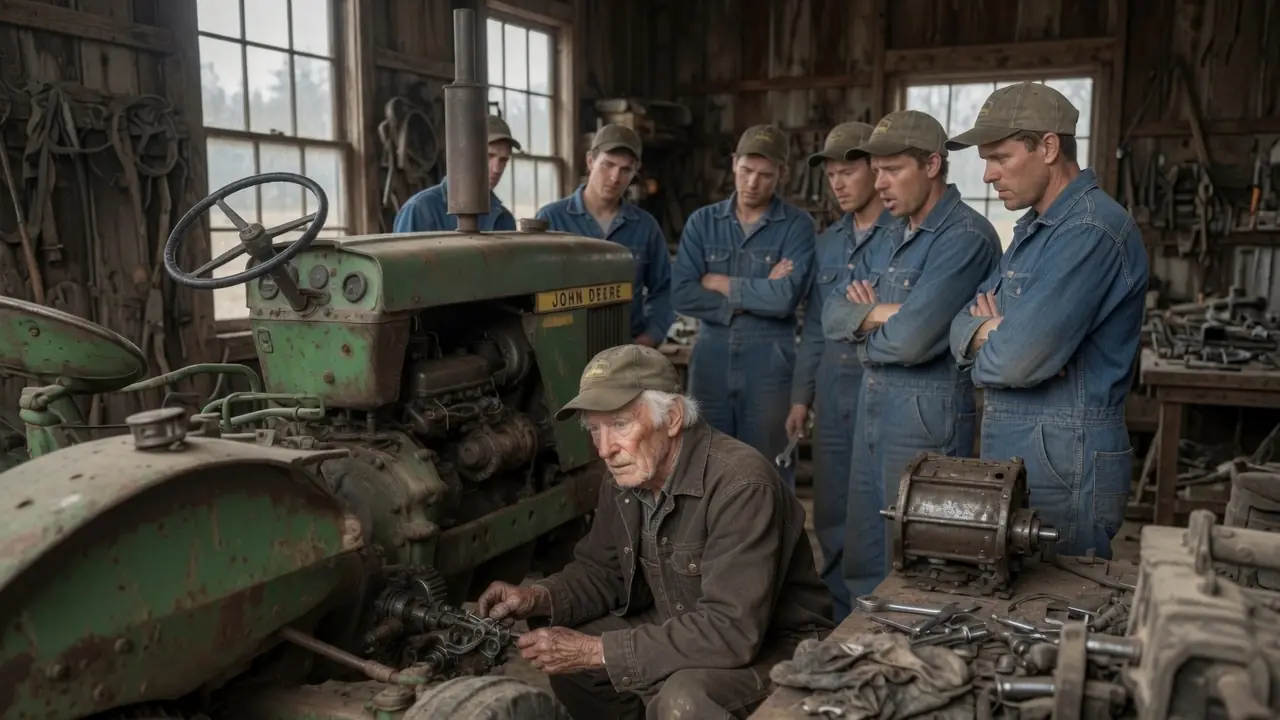
Earl owned six hundred acres outside Marshalltown, Iowa, and the 4020 was the only tractor he trusted to pull his grain wagons through wet ground. The newer machine he had financed two years earlier was powerful but heavy, and the forecast warned of rain arriving within five days. If the old Deere remained broken, Earl risked leaving half his corn in the field. He called Cole Agricultural Repair before the engine had cooled.
Travis Cole arrived in a service truck with two mechanics and enough confidence to make Earl feel relieved. At thirty-six, Travis had taken over the repair business from his father and expanded it into the largest independent equipment shop in the county. He owned electronic diagnostic tools, hydraulic test equipment, and a spotless building where farmers paid premium prices for fast work. When he listened to the tractor, he immediately declared the sound internal.
“That’s a rod knock,” Travis said.
Earl’s face tightened. “Oil pressure hasn’t moved.”
“It doesn’t have to. A bearing could be failing under load.”
The mechanics hauled the tractor to the shop that evening. By sunrise, Travis had assigned five men to the repair because Earl offered a large bonus if the machine returned before harvest. They removed the hood, drained the oil, inspected the filter, and opened the lower engine pan. Nothing inside appeared damaged.
There were no metal fragments in the oil.
The bearings showed normal wear for an old working tractor, but nothing explained the violent noise. Travis replaced two bearing shells anyway, convinced the failure had begun too recently to leave obvious evidence. The mechanics reassembled the lower engine, filled it with fresh oil, and started the tractor.
The knock returned immediately.
It struck three times at idle, disappeared briefly, then came back louder when Travis increased the throttle. Every mechanic in the shop turned toward the tractor. The sound appeared to come from deep inside the engine block, somewhere near the front cylinders. Travis shut it down and ordered the cylinder head removed.
By the second day, the John Deere no longer looked like a tractor.
Its hood leaned against the wall, the radiator sat on a pallet, and engine parts covered two workbenches. The mechanics tested injectors, inspected pistons, measured cylinder walls, and examined the crankshaft. They found worn components, but every measurement remained inside acceptable limits.
One mechanic suggested a damaged wrist pin.
Another suspected a cracked piston skirt.
A third believed the noise came from the timing gears. Travis listened to each theory, then ordered more parts removed. By afternoon, nearly every major engine component had been examined, and the cause remained hidden.
The repair estimate climbed past six thousand dollars.
Earl visited the shop shortly before closing and stood beside the dismantled machine without speaking. His father had purchased that tractor when Earl was eleven years old. Earl learned to drive it before his feet could comfortably reach the pedals, and after his father died, he continued using it through forty-seven harvests.
“Are you sure the engine is the problem?” Earl asked.
Travis wiped his hands on a clean shop towel. “The sound is coming from the engine.”
“But you haven’t found anything.”
“We will.”
Earl looked toward the separate piles of parts. “Will it be ready before the rain?”
Travis hesitated only a moment. “It will.”
That promise spread through the shop after Earl left. Travis told the mechanics nobody was going home early until they solved the noise. They stayed until nearly midnight, checking every surface and component twice.
The next morning, the tractor’s owner returned with Walter Hayes.
Walter was eighty years old, thin but strong, with deeply lined skin and white hair beneath a faded green cap. He wore a plaid shirt, brown overalls, and boots that had crossed more fields than any vehicle in Travis’s parking lot. His oil-darkened hands carried no modern diagnostic equipment, only a short screwdriver and a wooden cane he rarely used.
Travis knew him immediately.
Walter had repaired tractors from a small machine shed for nearly fifty years before retiring. Farmers still told stories about broken combines he revived using scrap metal, hydraulic hoses he repaired during snowstorms, and engine failures he diagnosed by placing one hand on the hood. Travis considered most of those stories exaggerated.
Earl stepped toward the dismantled John Deere. “Walter said he wanted to hear the noise.”
Travis laughed. “There isn’t enough tractor assembled to start it.”
“Then put it together enough for him to listen.”
One of the younger mechanics smiled at the others. Walter noticed but did not react. He slowly walked around the machine, studying the exposed engine, the removed radiator, and the parts arranged across the benches.
“How long did you run it before tearing it down?” Walter asked.
“Long enough to identify the area,” Travis replied.
“How long?”
“About three minutes.”
Walter nodded. “Did the noise change when you pressed the clutch?”
Travis paused. “We weren’t testing the transmission.”
“That wasn’t my question.”
The younger mechanics stopped smiling.
Travis folded his arms. “Five trained mechanics opened this engine. What could an old farmer possibly see that we missed?”
Walter looked at him without offense. “You searched where the noise echoed, not where it began.”
“If you know what it is, say it.”
“I haven’t heard it yet.”
Travis shook his head. “We already inspected every moving engine component.”
Walter reached toward the front frame and brushed his fingers across a thick layer of grease. “Then fixing one small thing to make it run shouldn’t be difficult.”
The mechanics spent two hours reassembling enough of the engine to start it safely. Travis complained throughout the process, certain the old man was wasting valuable time. He installed the radiator temporarily, connected the fuel lines, and checked the oil pressure system. When everything was ready, Walter stood several feet from the tractor rather than leaning over the open engine.
“Start it,” he said.
Travis turned the key.
The diesel engine fired, coughed once, and settled into an uneven idle. For several seconds, there was no unusual sound. Then the metallic knock struck from somewhere beneath the front of the tractor.
Clang.
Clang.
Clang.
Travis pointed at the engine. “There.”
Walter did not look at the engine.
He watched the front axle.
The old John Deere used a central pivot that allowed the axle to rock over uneven ground. Decades of fieldwork had worn the pivot pin and the mounting surfaces around it. The looseness was not obvious while the tractor sat still, but engine vibration caused the axle support to shift against the frame.
Walter walked to the front wheel and placed one boot against the tire.
The knock changed.
He removed his foot, and the original rhythm returned. Walter pressed again, applying pressure through the wheel, and the metallic hammering softened almost completely.
Every mechanic stared.
Travis lowered the throttle. “That doesn’t prove anything.”
Walter moved closer to the frame. “Increase it again.”
Travis did.
Walter touched the worn pivot housing with the tip of his screwdriver. The vibration traveled through the metal and into the wooden handle. He then touched the side of the engine block, listening through the same tool.
The sound appeared louder at the engine.
The vibration felt stronger at the axle mount.
“That’s why you tore into the motor,” Walter said. “The frame carries the noise backward and makes it sound like the front cylinder is knocking.”
One mechanic crouched beside him. “But why did it begin suddenly?”
Walter pointed toward a missing grease fitting on the axle support. The opening was packed with dried mud and metal dust. Without fresh grease, the already worn pin had heated and enlarged the space around it.
“It didn’t begin suddenly,” Walter explained. “It became loud enough for someone to notice.”
Travis shut off the tractor.
The silence felt heavier than the knocking.
Earl stepped forward. “Can it be fixed?”
Walter nodded. “Replace the pivot pin and bushings. Check the front support bolts while you’re there.”
“How long?”
“If the parts are in town, a few hours.”
Travis looked toward his parts manager. The man checked the inventory system and confirmed that another repair shop twenty miles away had the correct kit. A driver left immediately.
Walter turned to leave.
Travis blocked his path. “You got lucky.”
The mechanics looked at their boss.
Walter studied him for several seconds. “Luck is guessing correctly. I asked where the vibration changed.”
“You heard it for less than a minute.”
“I listened to the whole tractor.”
“We listened too.”
“No. You listened for an engine failure because that was what you had already decided to find.”
Travis’s jaw tightened. “These men know what they’re doing.”
Walter nodded toward the dismantled engine. “Then they should know a noise can travel.”
One of the mechanics tried to hide a smile.
Travis noticed. “Get back to work.”
The axle kit arrived shortly after noon. Walter had already left, but Earl remained near the doorway, unwilling to trust another promise. The mechanics supported the tractor’s front end, removed the worn pivot pin, and discovered exactly what Walter predicted.
The metal surface had become oval after years of wear.
One bushing was nearly destroyed.
Two front support bolts had loosened enough to allow additional movement. Each pulse from the diesel engine shook the worn assembly against the frame, producing a knock that traveled through the tractor’s heavy cast components.
The repair took three hours.
When Travis started the John Deere again, the engine ran with its familiar deep rhythm. No metallic strike echoed from the front. One mechanic increased the throttle, pressed the clutch, turned the steering wheel, and rocked the axle.
The strange noise was gone.
Earl climbed into the seat and listened.
His eyes closed briefly.
“That is how it sounded when my father owned it,” he said.
Travis presented the invoice near closing time. It included the axle kit, labor, oil, gaskets, bearings, and the many hours spent dismantling the engine. The total was more than seven thousand dollars.
Earl read every line.
“How much of this repaired the problem?”
Travis pointed toward the engine work. “Several worn parts needed attention.”
“Did any of them cause the noise?”
“No, but they could have caused trouble later.”
Earl placed the invoice on the counter. “I didn’t ask you to protect me from problems that didn’t exist.”
“You authorized diagnostic work.”
“I authorized you to find the knock.”
“And we did.”
“Walter found it.”
The mechanics became very quiet.
Travis lowered his voice. “My shop still performed the repair.”
“After an eighty-year-old farmer told you where to look.”
Earl refused to pay for the unnecessary engine work. Travis threatened to keep the tractor until the entire invoice was settled. Earl responded by calling his attorney and two neighboring farmers who had also experienced expensive repairs at Cole Agricultural.
The argument lasted nearly an hour.
Eventually, Travis removed most of the engine labor from the invoice. Earl paid for the axle repair, replacement gaskets, fresh oil, and the two bearing shells already installed. The total fell below eighteen hundred dollars.
Before leaving, Earl faced the five mechanics.
“I don’t blame you for being wrong,” he said. “I blame anyone too proud to stop being wrong after the evidence changes.”
Travis said nothing.
The tractor returned to the farm that evening. Earl attached it to a grain wagon and drove into the field before sunset. The John Deere pulled steadily through the dry rows, its engine sounding stronger than it had in years.
Word spread quickly.
By the following morning, farmers across Marshall County knew that five professional mechanics had torn apart Earl Dawson’s engine while Walter Hayes diagnosed the real fault without removing a single bolt. The story grew with every repetition. Some people claimed Walter identified the problem from the parking lot, while others said he heard it during a telephone call.
The truth was impressive enough.
At a diner near the grain elevator, farmers debated whether Travis should have recognized the worn pivot immediately. Several defended him, explaining how convincingly frame noise could imitate engine failure. Others shared stories about expensive repairs performed before simple causes were checked.
Walter ignored the attention.
He returned to his small farmhouse and spent the next morning repairing a fence. When Earl arrived with a pie and an envelope of cash, Walter refused both.
“You saved my harvest,” Earl said.
“I touched a tractor.”
“You stopped me from paying seven thousand dollars for the wrong repair.”
Walter looked at the pie. “What kind?”
“Apple.”
Walter accepted the pie.
He still refused the money.
Earl sat with him on the porch and asked how he knew to inspect the axle. Walter explained that he had heard a similar sound in 1978. A farmer had rebuilt an engine twice before discovering a loose front support. Walter never forgot the way the heavy frame carried the noise.
“That experience is worth something,” Earl said.
“Only if you remember it.”
“What happens when people like you are gone?”
Walter looked across the fields. “People make the same mistakes again.”
The words remained with Earl.
A week later, harvest began across the county. Earl’s John Deere ran twelve hours a day without trouble, hauling wagon after wagon to the grain bins. The rain arrived later than predicted, but by then most of his corn had been harvested.
Cole Agricultural Repair remained busy, though the atmosphere inside the shop had changed.
The mechanics began checking simple external components before assuming internal failures. One created a written diagnostic process that required testing engine mounts, frame bolts, axle pivots, clutches, and accessories before removing major parts. The form irritated Travis because it appeared designed around his public mistake.
Still, it prevented another one.
A month later, a farmer brought in a Massey Ferguson with a pounding noise that seemed to come from the transmission. Before opening the case, a young mechanic inspected the rear wheel and found loose rim bolts. The repair required twenty minutes.
Another tractor arrived with what sounded like a failed crankshaft bearing. The actual cause was a cracked exhaust bracket striking the hood. A third machine produced a rhythmic clatter from a loose hydraulic line touching the frame.
Each time the mechanics found a simple cause, someone mentioned Walter Hayes.
Travis became increasingly resentful.
His father, Henry Cole, noticed.
Henry had founded the repair shop inside a rented barn and spent decades building its reputation. He was seventy-two now and visited only occasionally, usually to drink coffee with old customers. When he heard the story, he came to the shop without warning.
“You charged Earl Dawson for tearing down a good engine?” Henry asked.
Travis looked toward the office door. “I reduced the bill.”
“That wasn’t my question.”
“The noise sounded internal.”
“Did you isolate it?”
“We inspected the engine.”
“That means no.”
Travis leaned back in his chair. “You weren’t there.”
“I was somewhere exactly like it a hundred times.”
Henry reminded his son that machinery rarely cared about a mechanic’s reputation. A noise did not become an engine failure because an expert declared it one. The purpose of diagnosis was not to prove the first theory correct.
It was to eliminate every reason it might be wrong.
“You built this shop into something bigger than I ever managed,” Henry said. “But bigger tools don’t make better judgment.”
Travis looked away.
“You owe Walter an apology.”
“I owe him nothing.”
“You owe yourself one, then.”
Henry left before Travis could answer.
Winter arrived early that year. Snow covered the repair yard, and business slowed after harvest. One afternoon, Walter entered the shop carrying an old generator carburetor inside a paper bag.
The mechanics recognized him immediately.
Travis remained inside his office.
Walter placed the carburetor on the counter. “Need a gasket kit.”
The parts manager located one in storage. While he searched, the younger mechanics gathered near Walter and asked questions about unusual noises they had encountered.
Walter answered without showing off.
He explained how cracked flywheels could imitate bearing failures, how exhaust pulses could travel through loose brackets, and how hydraulic pressure could create noises only when a tractor stood at a particular angle. He told them to touch components carefully, compare vibrations, and change one condition at a time.
“Never listen only with your ears,” he said. “Watch what moves. Feel where the rhythm changes.”
Travis stepped out of the office.
“Giving lessons now?”
Walter turned. “They asked questions.”
“My mechanics don’t need stories from forty years ago.”
One of the men spoke before thinking. “His stories saved Earl’s tractor.”
The room froze.
Travis stared at him. “Get back to your station.”
Walter collected the gasket kit. “You have good mechanics.”
“I know.”
“They’ll become better when they stop being afraid to disagree with you.”
Travis’s face reddened. “You think one lucky diagnosis makes you smarter than everyone here?”
“No.”
“Then what do you think?”
Walter placed the money for the gasket on the counter. “I think a man who needs to be the smartest person in the room eventually becomes the only person nobody can teach.”
He walked out.
The words angered Travis because they were true.
During the following weeks, he began noticing how often his employees waited for him to speak before offering ideas. When he proposed a diagnosis, they agreed immediately, even when their expressions suggested doubt. He had mistaken obedience for respect.
Then a serious mistake nearly occurred.
A large combine arrived with low hydraulic pressure. Travis blamed the main pump and quoted a repair costing more than twelve thousand dollars. Before he ordered the replacement, one mechanic quietly inspected the reservoir and found a collapsed suction hose restricting fluid flow.
The hose cost eighty-seven dollars.
Travis stood beside the machine, remembering the dismantled John Deere.
“Why didn’t you tell me sooner?” he asked.
The mechanic hesitated. “I wasn’t sure you wanted another opinion.”
That answer changed him more than Walter’s public correction had.
Travis replaced the hose, charged the farmer only for the actual work, and called a meeting with the entire shop. He admitted that his pride had begun influencing their diagnoses. He introduced a rule requiring every major repair estimate to receive a second independent inspection.
No mechanic would be punished for questioning a conclusion.
A week later, Travis drove to Walter’s farmhouse.
Walter was inside the machine shed adjusting the carburetor on the old generator. He looked up when Travis entered but did not appear surprised.
“I came to apologize,” Travis said.
“For what?”
“You know.”
“I want to hear whether you do.”
Travis removed his cap. “I decided the noise was inside the engine before testing the rest of the tractor. Then I kept removing parts because every hour of work made it harder to admit the first decision might be wrong.”
Walter waited.
“I also mocked you because accepting your answer meant admitting experience mattered more than the equipment in my shop.”
“Experience doesn’t always win.”
“It did that day.”
Walter nodded toward an overturned bucket. “Sit down.”
They spoke for two hours.
Travis asked Walter to visit the repair shop once a week as a diagnostic consultant. Walter refused the title, the salary, and the office Travis offered. He eventually agreed to spend Thursday mornings there in exchange for coffee and access to the shop’s heated welding area.
The mechanics called those mornings Walter School.
He never delivered formal lectures. He walked between machines, asked questions, and allowed younger men to discover answers themselves. When someone suggested opening an engine, Walter usually asked what they had tested before reaching it.
“Expensive tools are fine,” he often said. “Just don’t use them to avoid thinking.”
Over the next three years, Cole Agricultural’s reputation changed. The shop became known not only for repairing equipment but for refusing unnecessary work. Farmers sometimes arrived expecting enormous bills and left after a mechanic tightened a bracket or replaced a worn mount.
The business earned less from individual repairs.
It gained more customers than ever.
Travis eventually placed a framed photograph in the front office. It showed the five mechanics standing around Earl Dawson’s dismantled John Deere while Walter crouched near the worn axle pivot. Beneath it was a small brass plate.
LISTEN TO THE WHOLE MACHINE.
Earl’s tractor continued working for another decade. When he finally retired it from heavy field use, he did not sell it. He restored the paint and parked it inside a clean shed, where his grandchildren learned to drive.
Walter lived long enough to see one of those grandchildren bring the tractor back to Cole Agricultural for a minor fuel problem. The young mechanic assigned to it was an apprentice who had never heard the famous knock in person.
Before replacing anything, he inspected the lines, mounts, linkages, and frame.
Then he found a cracked rubber fuel hose pulling air into the system.
The repair cost less than twenty dollars.
When Walter heard, he smiled.
Five mechanics had once torn an old tractor apart because they trusted the location of a sound more than the behavior of the machine. An eighty-year-old farmer never opened the engine. He simply watched, touched, listened, and remembered.
He did not prove that education was useless or that modern mechanics knew nothing.
He proved something far more important.
Knowledge begins with what a person has learned.
Wisdom begins when that person is willing to question it.