At 6:14 on a gray Tuesday morning, the first call came from County Road 7 in rural Missouri. A fully loaded yellow semi carrying nearly ninety thousand pounds of steel and cargo had slipped off the pavement during the night and buried itself in the shoulder so deeply that the rear axles had disappeared past the hubs. The cab leaned at an ugly angle toward the drainage ditch, and every few minutes the saturated ground seemed to swallow another fraction of the truck. By sunrise, the driver understood that this was no ordinary roadside recovery.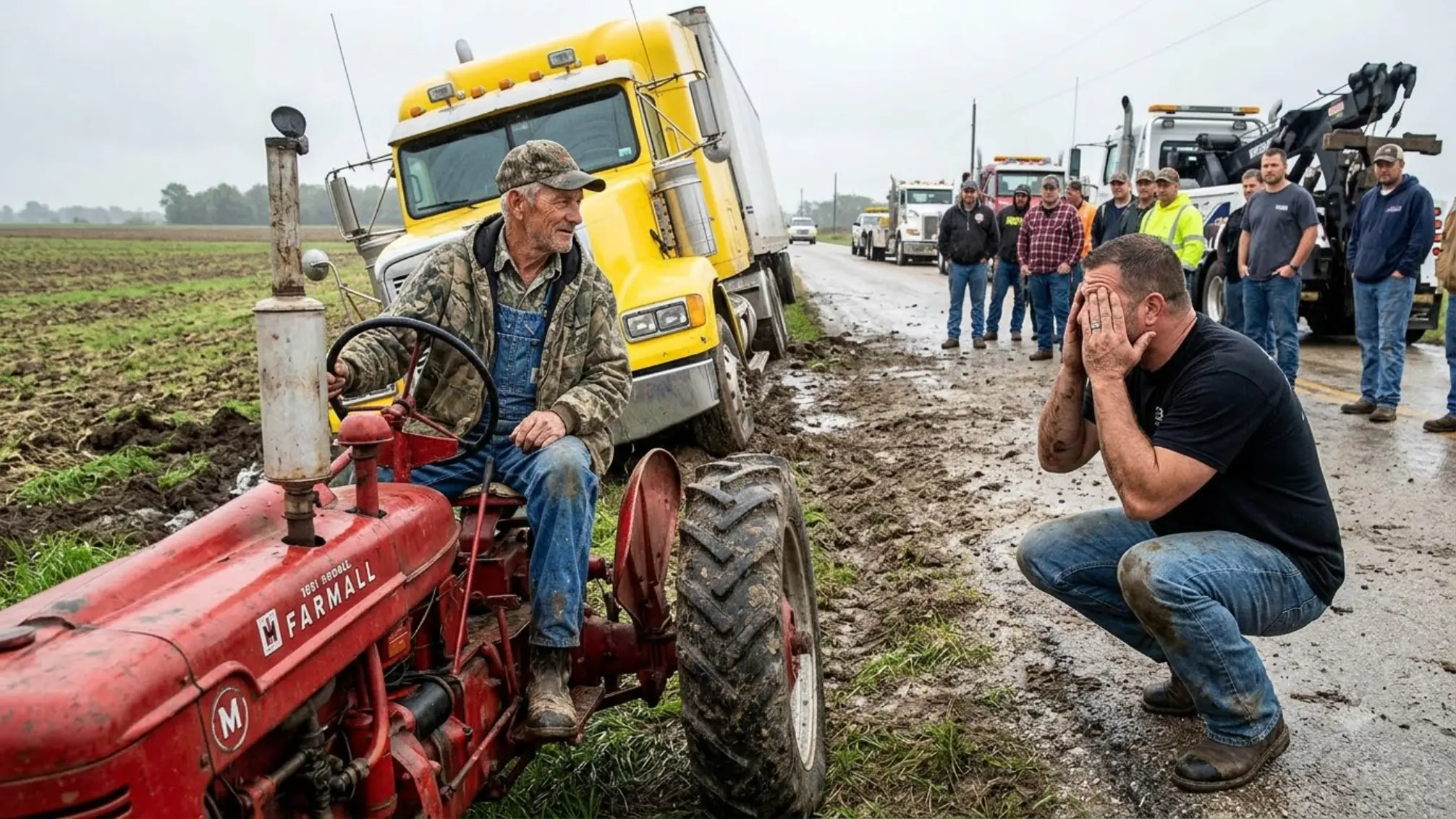
His name was Marcus Hale, twenty-five years old and only eight months into driving full-time for his uncle’s transport company. He stood beside the road gripping a paper coffee cup with both hands while staring at the machine that represented his income, his reputation, and more money than he could imagine replacing. The truck had not rolled, nobody was injured, and the cargo remained secure, but Marcus knew enough to understand that every hour mattered. If the frame twisted or the trailer shifted, a terrible morning could become a catastrophic one.
The first recovery company arrived shortly after seven. Its operator walked around the truck, kicked the shoulder twice, then called for a larger rig before even unloading his chains. Less than an hour later, a seventy-five-ton rotator arrived, polished and enormous, carrying the kind of equipment normally used to recover jackknifed tractor-trailers from interstate medians. The crowd gathering along County Road 7 relaxed when they saw it. Surely that machine could move anything.
The operator rigged to the semi’s frame with practiced precision. Heavy cables tightened, the rotator settled against its outriggers, and everyone stepped back as hydraulic power came alive. Marcus climbed into the cab under instruction and kept the transmission neutral while the recovery operator applied tension. For several seconds, nothing happened.
Then the earth moved.
The truck did not.
Mud bulged outward from the drive axles like thick batter pressed beneath a spoon. The rear of the semi sank another two inches, and the recovery operator immediately released tension. He walked toward the buried wheels, stared at the ground, and swore quietly.
“This isn’t normal mud.”
That became the sentence of the morning.
By nine, a second recovery company arrived with an underlift system. Their plan was straightforward: raise the rear axles enough to reduce ground pressure, then drag the truck toward pavement. Steel chains were placed, hydraulic arms lifted, and for a few hopeful seconds the rear suspension rose.
Then the front steering axle began sinking.
The entire cab leaned farther toward the ditch.
Someone in the crowd gasped.
The operator dropped the truck immediately.
For forty-five frightening seconds, Marcus thought he was going to watch his cab roll onto its side.
The second crew stopped.
A third company tried recovery mats, laying thick steel plates ahead of the buried tires to provide a stable climbing surface. The first mat disappeared into the mud almost as quickly as the tire touched it. They tried another. Same result.
Marcus sat on the guardrail with both hands over his face.
“What is happening?” he whispered.
Nobody had an answer.
By ten o’clock, five professional recovery rigs were lined along the county road. Heavy wreckers, winches, recovery mats, hydraulic equipment, and enough combined pulling power to move structures sat around a truck that seemed determined to become part of the Missouri landscape. Locals parked along the shoulder to watch. One child climbed onto a fence rail while his mother repeatedly told him to get down.
Then an old green pickup appeared around the bend.
Few people noticed it at first.
The pickup was towing a narrow rusty trailer.
On the trailer sat a faded red 1951 Farmall M tractor.
Someone laughed.
The old machine looked almost comical beside the modern wreckers. Its paint was scarred, its metal hood faded by decades of sun, and its narrow front wheels looked impossibly small compared with the buried semi. It had no computer, no massive hydraulic boom, no GPS system, and barely forty horsepower.
The driver of the pickup parked away from the crowd.
Earl Briggs climbed out.
At seventy-two, Earl had a deeply weathered face, gray hair beneath an old camouflage cap, rough stubble, and hands shaped by five decades of farm work. He wore denim overalls beneath a faded work jacket and muddy boots that looked older than Marcus. Earl did not greet anyone.
He simply walked toward the semi.
One of the tow operators glanced toward the Farmall and laughed.
“Sir, you might want to save yourself the embarrassment and turn that antique around.”
Earl did not respond.
He walked past the man.
Then he stopped at the edge of the shoulder and pressed his boot into the mud.
Once.
Twice.
He crouched near the ditch.
His fingers touched the soil.
The tow operator frowned.
“What are you doing?”
Earl looked toward the field east of the road.
“When did they drain the upper field?”
Silence.
The recovery boss folded his arms.
“The what?”
Earl nodded slowly.
That answer told him everything he needed.
He walked back toward his pickup and began unloading the Farmall.
The crowd laughed again.
Marcus did not.
There was something about the old farmer’s expression that made him follow.
“Sir?”
Earl continued loosening the trailer chains.
Marcus stepped closer.
“Do you think that tractor can pull my truck out?”
Earl finally looked at him.
“No.”
Marcus’s face fell.
Then Earl added, “Not yet.”
Earl Briggs had farmed the land beside County Road 7 for more than fifty years. His grandfather first worked nearby fields before World War I, and his father expanded the family acreage through years when machinery was repaired instead of replaced and debts were settled through labor when money disappeared. Earl grew up understanding drainage before he understood algebra. He knew where water moved under those fields because he had watched it happen through droughts, floods, frozen winters, and wet springs.
The twelve-acre upper field beside the road contained an old network of underground drainage tiles. Some had been installed by Earl’s grandfather, others replaced by his father, and several sections repaired personally by Earl in 1981. The drainage system carried groundwater toward the ditch, keeping the field usable and preventing the road shoulder from remaining saturated after heavy weather. For generations, somebody in the Briggs family had checked those outlets.
Three weeks earlier, Earl noticed something strange.
The outlets stopped running.
He had walked the field and discovered that several drainage exits had been capped.
Not damaged.
Capped.
Someone had deliberately blocked them.
Earl intended to investigate but harvest preparation distracted him. Then the ninety-thousand-pound semi slid onto the exact portion of shoulder sitting above decades-old drainage lines.
Now Earl understood.
The truck was not stuck because the soil was merely wet.
It sat above a trapped pocket of groundwater.
Every massive pull compressed saturated soil around the axles, making the earth tighten instead of release.
The stronger the wreckers pulled, the deeper the truck settled.
One of the recovery operators approached Earl.
“You saying there’s water underneath us?”
Earl nodded.
“There’s always water underneath you.”
The man frowned.
“Then what’s different?”
“It usually has somewhere to go.”
The operator looked toward the buried semi.
Earl pointed toward the upper field.
“Now it doesn’t.”
A fourth recovery company had already attempted a complicated multi-point pull earlier that morning. Four lines were connected across the truck’s frame to spread the load evenly. For a few seconds, the method seemed successful. The semi moved fourteen inches.
People cheered.
Then the left side collapsed almost eight inches into another hidden saturated pocket.
The crowd went silent.
That failure convinced most professionals that excavation was the only remaining option.
A site engineer arrived with a one-hundred-ton crane crew shortly afterward. He probed the ground, reviewed the position, checked the cargo weight, and calculated what full recovery would require. His estimate began at seventy-five thousand dollars, possibly more once excavation and cargo offloading were included.
Marcus sat down again.
His uncle’s company did not have that kind of money easily available.
The truck represented nearly everything they owned.
Earl stood beside him.
“You’re going to be okay.”
Marcus looked up.
The old man did not sound encouraging.
He sounded certain.
“How can you know that?”
Earl looked toward the field.
“Because I know what’s holding it.”
Then he walked away.
Earl drove the Farmall off the shoulder and into his field.
His fourteen-year-old grandson Caleb, who had ridden with him that morning, followed carrying a tile spade. Earl stopped nearly sixty yards from the truck and drove the spade into the earth. Nothing.
He moved ten feet.
Again.
Nothing.
The third hole produced damp soil.
The fourth filled slowly with dark water.
Earl smiled.
“There you are.”
Caleb stared into the hole.
“What now?”
“Give it somewhere else to go.”
Earl had brought a length of corrugated flex pipe and an improvised pump arrangement connected to the Farmall’s hydraulic system. The recovery men watched with skeptical expressions as he assembled it. Compared with their enormous winches, the setup looked primitive.
One operator muttered, “This is ridiculous.”
Another stopped him.
“Let him work.”
Earl connected the pipe and opened the valve.
The Farmall’s engine settled into a patient mechanical rhythm.
Water began moving.
Not dramatically.
No giant fountain.
No violent suction.
Just a steady dark stream flowing toward the drainage ditch.
Approximately forty gallons each minute.
For five minutes, nothing visible happened.
Then ten.
A recovery operator crouched near the semi.
“Look.”
The color of the mud around the rear axle was changing.
Water stopped shimmering at the surface.
The soft ripples that had appeared whenever tension was applied disappeared.
Fifteen minutes passed.
Then twenty.
Earl shut off the pump at twenty-two.
He walked back toward the semi.
The recovery boss stepped into his path.
“You honestly believe your tractor can pull ninety thousand pounds?”
Earl looked at him.
“No.”
“Then what exactly are we doing?”
“The truck can move itself.”
The man laughed.
“It couldn’t three hours ago.”
“Three hours ago, the earth was holding it.”
Earl climbed onto the Farmall.
The recovery boss shook his head.
“Five heavy wreckers couldn’t move that rig. Turn your antique around before you embarrass yourself.”
Earl placed both hands on the steering wheel.
“You’ve spent all morning pulling the truck.”
He looked toward the semi.
“Not one of you asked what was holding it.”
The recovery boss stepped closer.
“That’s ninety thousand pounds buried past the axles. You think forty horsepower is going to teach us our job?”
Earl started the Farmall.
“No.”
He looked toward the drying ground.
“The land is.”
Earl positioned the tractor ahead of the semi and connected a heavy chain to a suitable front recovery point. The chain was not meant to drag the entire truck like the wreckers had attempted. It was there to guide and maintain steady tension while Marcus used the semi’s own power.
Earl climbed down and walked to Marcus’s door.
“Put it in drive.”
Marcus swallowed.
“Okay.”
“Barely touch the throttle.”
“What if it sinks again?”
“Then stop.”
Marcus nodded.
Earl returned to the Farmall.
The chain tightened slowly.
The old tractor’s rear tires pressed into the firmer field.
Marcus touched the accelerator.
For one second, nothing happened.
Then came a deep sucking sound.
The semi moved.
Not violently.
Not dramatically.
One inch.
Then three.
The crowd fell silent.
The front wheels began climbing the shoulder.
Earl maintained steady tension without jerking.
Marcus kept the truck barely above idle.
The buried rear axles rose from the mud with a long groan as the earth released them.
The semi moved another foot.
Then another.
The steering tires reached gravel.
The drives followed.
Suddenly the truck was moving continuously.
People began shouting.
Marcus kept his hands locked on the wheel.
Earl guided the Farmall forward.
Seconds later, all the semi’s wheels reached solid roadway.
The cab straightened.
The trailer leveled.
The truck stopped.
Free.
For several seconds, nobody reacted.
Then the crowd erupted.
Marcus climbed from the cab and stared back at the hole where his truck had been.
Then he looked at Earl.
Then the seventy-five-year-old tractor idling quietly beside five modern wreckers.
Marcus laughed once.
Then his eyes filled.
He walked toward Earl and held out his hand.
“How much?”
Earl looked confused.
“For getting me out.”
Earl shook his head.
“Nothing.”
“Sir, you just saved my truck.”
“Then don’t put it in that shoulder again.”
Marcus laughed.
The recovery men gathered around Earl.
Nobody joked about the Farmall anymore.
The site engineer approached slowly.
“I was wrong.”
Earl shook his head.
“No.”
The engineer frowned.
“You said excavation wasn’t necessary.”
“You weren't wrong about the truck.”
Earl pointed toward the ground.
“You just didn't know the field.”
That distinction mattered to him.
Earl never believed his experience made professional recovery crews incompetent. They understood machinery better than he did. What they lacked was seventy years of local knowledge about water moving beneath twelve acres of Missouri soil.
Then Earl noticed the man in the pressed polo shirt.
He had been standing thirty feet from the recovery operation all morning.
While everyone watched the truck, the man watched Earl.
His name was Derek Colton, regional land acquisitions manager for Meridian Infrastructure Partners.
Earl knew him.
Meridian wanted to build a pipeline corridor through the eastern side of the county. During the previous two months, Colton had contacted eleven property owners and offered generous prices for narrow strips of land.
Ten were negotiating.
Earl had never answered.
His twelve-acre upper field sat directly across Meridian’s preferred route.
Without it, the company would need to redesign the corridor at enormous additional cost.
Colton approached.
“Mr. Briggs.”
Earl looked at him.
“We should talk.”
“No.”
Colton stopped.
“I think there may have been some misunderstanding involving our survey crews.”
Earl’s eyes narrowed.
“Your crews?”
Colton hesitated.
Earl pointed toward the drainage outlets.
“Did your people cap those?”
“We conducted temporary soil testing.”
“That wasn’t my question.”
Colton looked toward the crowd.
Then answered quietly.
“Yes.”
Earl’s expression became cold.
“You entered my field?”
“Our survey team believed preliminary access had been coordinated.”
“With who?”
Colton had no answer.
Earl reached inside his jacket.
He removed an old folded document.
The paper was worn along the edges, but the county certification remained visible.
Earl opened it.
“What is that?” Colton asked.
“1947 water agreement.”
Colton took the document.
His eyes moved across the language.
The agreement gave the Briggs family perpetual control over drainage access along the eastern shoulder and restricted permanent utility installations within forty feet without written owner approval.
Colton’s face changed.
“My grandfather signed that.”
Earl pointed toward the capped tiles.
“My father honored it.”
He looked toward the ruined shoulder.
“I honored it.”
Then toward Colton.
“You didn’t.”
Colton folded the paper carefully.
“We can resolve this.”
“No.”
“We’re prepared to make you a substantial offer for the pipeline easement.”
“I’m not selling.”
“You haven't heard the number.”
Earl stared at him.
“My father farmed that field.”
Colton remained silent.
“I farm it.”
Earl pointed toward Caleb.
“My family will farm it after me.”
He took the document back.
“That’s not a negotiation.”
Colton’s jaw tightened.
“Everything has a price.”
Earl folded the agreement.
“That’s something people with money tell themselves.”
Within days, Meridian’s attorneys found the 1947 agreement.
Then they discovered another problem.
Capping the drainage system had been done without Earl’s authorization and may have directly contributed to the shoulder failure that trapped Marcus’s semi. The five recovery companies began documenting their costs.
The trucking company documented its losses.
County officials began asking why Meridian crews entered Briggs land without confirmed permission.
The pipeline project suddenly became far more complicated.
Meridian attempted negotiation.
Earl refused.
Then it increased the offer.
He refused again.
Six weeks later, the company announced a route redesign.
The new corridor bypassed the Briggs field.
The change reportedly cost millions and delayed construction for months.
Earl did not celebrate.
He simply reopened every drainage outlet and repaired the damage.
Water began flowing again.
By November, the shoulder had dried and stabilized.
The upper field looked ordinary.
That was how Earl preferred it.
The Farmall returned to its shed.
Marcus visited twice that autumn.
The second time, he brought Caleb a scale model of the yellow semi.
Earl laughed when he saw it.
“You trying to remind us?”
Marcus smiled.
“I’m trying to remember.”
He looked toward the old tractor.
“I thought that thing was a joke.”
Earl nodded.
“So did everybody.”
“You knew it could pull me out.”
“No.”
Marcus frowned.
“You didn't?”
“I knew why you were stuck.”
Earl leaned against the Farmall’s hood.
“That’s different.”
At the end of harvest, Caleb finally asked the question he had been holding for months.
They stood beside the upper field while cold November wind moved through dry grass.
“Grandpa?”
“What?”
“How did you know what to do when five recovery companies couldn’t figure it out?”
Earl considered the boy.
“I didn’t know it would work.”
Caleb looked surprised.
“But you acted like you did.”
“I knew the problem.”
“That’s not the same thing?”
“No.”
Earl pointed toward the drainage ditch.
“Those men knew how to pull.”
Then toward the field.
“I knew what was holding.”
Caleb looked toward County Road 7.
The shoulder showed almost no sign that a ninety-thousand-pound truck had once disappeared into it.
Earl continued.
“If you understand a problem all the way down, you don’t need to overpower it.”
Caleb nodded slowly.
“You change what’s causing it.”
“Exactly.”
The boy looked toward the Farmall sitting inside the barn doorway.
“So the tractor wasn't stronger than the tow trucks.”
Earl laughed.
“Not even close.”
“Then why does everyone tell the story like it was?”
“Because that makes a better story.”
Caleb smiled.
“What’s the real story?”
Earl looked across land his family had watched for generations.
“The real story is five companies tried moving something before anybody asked why it wouldn’t move.”
He put one rough hand on his grandson’s shoulder.
“Remember that.”
Caleb nodded.
Earl started walking toward the barn.
The old Farmall sat in the doorway, faded red paint catching the morning light.
It had never needed to prove it was stronger.
It only needed a farmer who understood what the ground was trying to tell him.
And County Road 7 never looked quite the same to anyone who had watched that ninety-thousand-pound semi finally rise from the mud.
Because after that morning, every person there understood the same thing Earl Briggs had learned during a lifetime of farming:
Sometimes the answer is not more horsepower.
Sometimes you stop pulling.
You listen.
You find what is holding the problem in place.
And only then do you move it.