“Get out of this seat—you don’t belong here, trash.”
The words tore through the private cabin with enough force to silence every conversation. Claire Mercer stood beside seat 1A, one arm extended toward the open aircraft door, her polished finger pointing as though she were removing an intruder from her home.
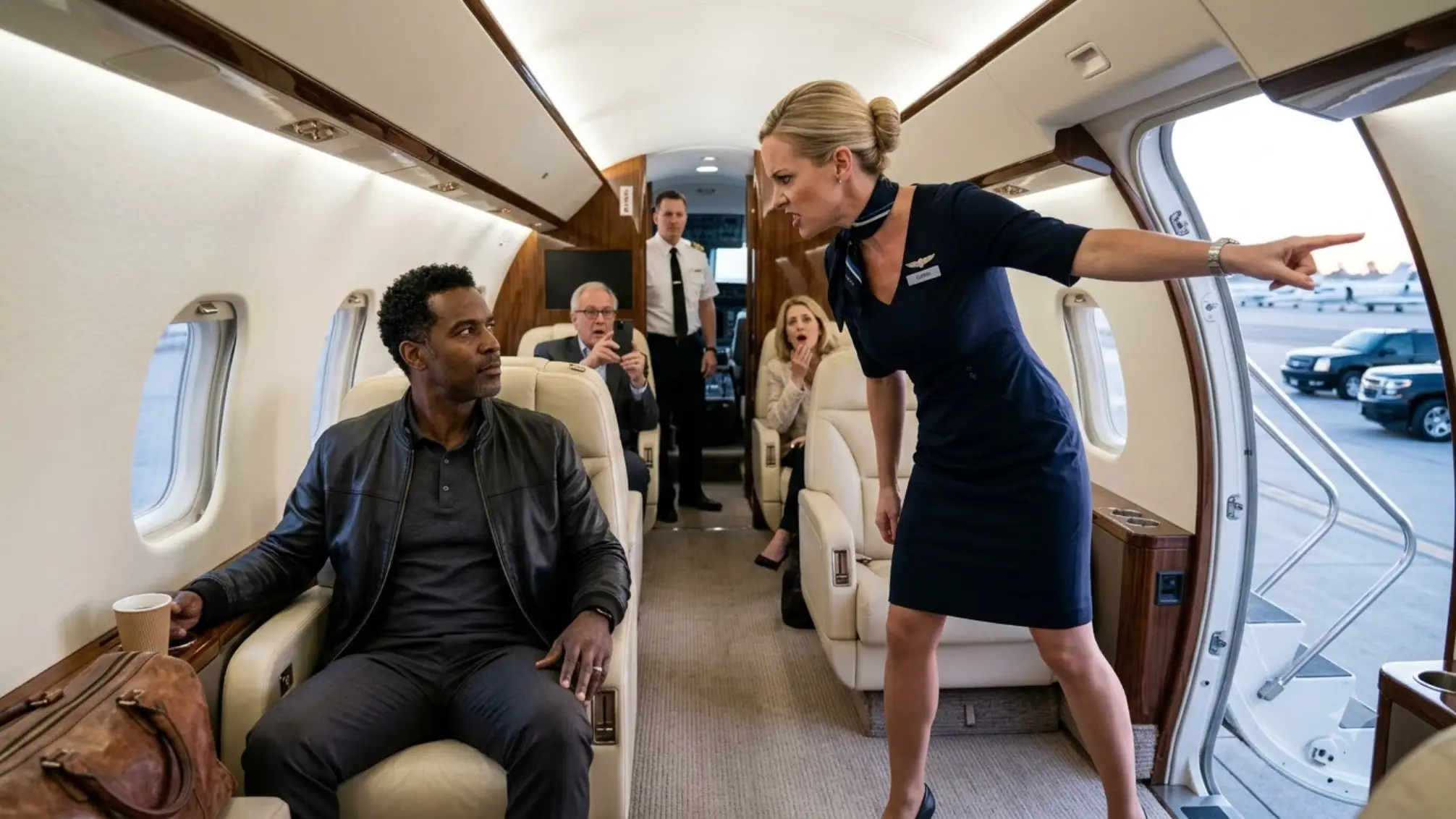
Darius Vale looked up from the cream leather seat. “My name is on the manifest, so either verify it or stop making a fool of yourself.”
Claire stepped closer, her blue eyes narrowing. “I’ve served real billionaires, and they don’t look like you. Grab your little bag and get off my jet.”
Darius held her stare. “Touch me again, and you’ll spend tomorrow begging for the career you just threw away.”
The cabin of the sixty-eight-million-dollar jet seemed to contract around them. Walnut panels reflected the warm ceiling lights, gold fixtures gleamed beside wide leather seats, and fresh coffee rested untouched on polished tables. Several wealthy passengers watched from farther back, but none of them moved to interfere.
One man had raised his phone halfway. He hesitated when Claire glanced in his direction, then lowered it toward his lap while keeping the camera pointed forward.
Beyond the windows, gray morning light spread across the wet tarmac at Van Nuys Airport. Ground workers in orange vests moved between parked aircraft while fuel trucks crawled through the mist. Two black SUVs had just entered the far end of the private terminal, but Claire had not noticed them.
Her full attention remained fixed on the Black man in seat 1A.
Darius Vale was forty-seven years old, broad-shouldered, handsome, and quietly composed. Gray touched the edges of his short black hair and close-trimmed beard. He wore a dark brown leather jacket over a charcoal polo, tailored trousers, and an old silver watch whose scratched face had belonged to his father.
Nothing on him carried a visible luxury logo.
His only luggage was a weathered leather bag resting beside his leg.
That was enough for Claire to decide he was poor.
It was also enough for her to believe he could be humiliated safely.
Twenty minutes earlier, Darius had entered the private terminal alone. No executive assistant walked beside him, no security detail announced his arrival, and no ground manager hurried forward with champagne. He handed his identification to the receptionist, received a boarding confirmation, and walked across the tarmac like any ordinary charter passenger.
That anonymity was deliberate.
Darius was the founder and controlling owner of Vale Aviation Group, the company operating the aircraft. He owned twenty-three private jets, four maintenance facilities, and charter contracts across the United States and Europe. The jet parked outside belonged directly to a subsidiary he controlled.
For six months, complaints had been reaching his office.
Passengers described selective service, humiliation, racial profiling, and crew members who decided who deserved courtesy based on clothing, accent, luggage, or skin color. Several reports mentioned Claire by name, but each internal review ended with the same conclusion: misunderstanding, difficult passenger, insufficient evidence.
Darius did not trust the reports anymore.
So he boarded without warning.
Only three people knew he would be on the flight: the chief operating officer, the head of legal compliance, and the senior investigator leading a confidential review of cabin service. The crew manifest displayed his full legal name, seat assignment, identification status, and ownership authorization.
Claire had access to all of it.
She simply never checked.
She saw him entering the cabin and moved quickly into the aisle.
“Sir, this aircraft is private.”
“I’m aware.”
“I don’t think you are.”
Darius showed her the electronic boarding confirmation on his phone. Claire glanced at it for barely a second.
“That doesn’t mean anything to me.”
“It should.”
She looked past him toward the open door, expecting a caterer or ground worker to appear and claim responsibility for allowing him inside.
“Are you cleaning the aircraft?”
“No.”
“Delivering something?”
“No.”
“Then you need to leave.”
“My name is on the manifest.”
Claire gave a short laugh. “People find screenshots online every day.”
“Call operations.”
“I don’t need operations to tell me who belongs in my cabin.”
Darius had repeated the final two words quietly.
“My cabin?”
It was a warning, though Claire heard only insolence.
She moved closer and lowered her voice. “Listen carefully. I have served celebrities, royalty, and actual billionaires. They do not board alone carrying old luggage and wearing department-store jackets.”
Darius looked down at the leather sleeve. “This jacket was made for my father in 1989.”
“That doesn’t make it valuable.”
“It makes it mine.”
Claire folded her arms. “Get out.”
When he refused, she raised her voice so every passenger could hear. Her purpose was no longer to verify his right to board. It was to make his dignity surrender before her authority.
“Get out of this seat—you don’t belong here, trash.”
Now the accusation hung in the cabin.
A pilot stood in the cockpit doorway, his expression tense. Captain Michael Reeves had flown for Vale Aviation for nine years. He recognized the name on the manifest, but he had never met the owner in person and did not connect the quietly dressed passenger with the corporate photographs he had seen years earlier.
Still, he knew Claire was violating procedure.
“Claire,” he said carefully, “we should confirm with operations.”
She turned sharply. “I’m handling the cabin.”
“The passenger has documentation.”
“He has a screenshot.”
Darius reached toward the side table where he had placed his identification wallet. “Captain, you may verify it.”
Claire slapped his hand away.
The movement shocked even her.
For half a second she stared at her own fingers, as if the contact had happened independently of her decision. Then pride pushed her forward.
“Do not reach for anything.”
Darius slowly returned his hand to the armrest. “You just touched a passenger after he offered identification.”
“You made a threatening movement.”
“I moved toward a table.”
“I decide what is threatening in this cabin.”
Darius glanced toward the cockpit. “Captain Reeves, is the cabin camera active?”
Claire’s face changed.
Private aircraft did not always record passenger areas continuously, but this jet had recently been fitted with a secure safety system after valuables disappeared during a charter. The forward cabin camera stored encrypted footage accessible only to legal compliance.
Reeves answered honestly. “Yes.”
Claire stepped between Darius and the camera. “Security footage cannot be used without authorization.”
Darius looked at her. “Whose authorization?”
“The company’s.”
“I see.”
That calm response made her angrier than shouting would have.
She reached for the collar of his leather jacket. “Stand up.”
Darius did not resist when her hand closed around the fabric, but he did not rise either.
“Remove your hand.”
“You are leaving.”
“Remove it.”
Claire pulled hard.
The collar tightened against his neck, and one passenger gasped. Captain Reeves moved forward, but Claire released the jacket before he reached her.
“You touched me again,” Darius said.
“You refused a crew instruction.”
“A crew instruction must have a lawful and operational basis.”
She smiled cruelly. “You people always know just enough language to make trouble.”
The words changed the room.
The passenger recording from the rear raised his phone fully now. A woman seated across the aisle looked openly disgusted. Even the first officer standing behind Captain Reeves lowered his eyes.
Darius remained still.
“What do you mean by ‘you people’?”
Claire realized she had gone too far, but instead of retreating she chose attack.
“People who enter places they cannot afford and expect everyone else to pretend.”
“My seat is confirmed.”
“You do not belong in it.”
“My name is on your manifest.”
“That can be investigated after you leave.”
“You had the opportunity to investigate before insulting me.”
She leaned close enough that her perfume overwhelmed the smell of coffee. “I said get out.”
Darius did not move.
Her palm struck his face.
The slap cracked through the cabin.
The espresso cup beside him trembled against its saucer. One passenger shouted, “What is wrong with you?” Captain Reeves rushed from the cockpit, while the man recording stood and aimed his phone directly at Claire.
Darius slowly touched his jaw.
There was no fear in his eyes now.
Only certainty.
“You just lost everything,” he said.
Claire laughed, though her face had begun to pale. “Important people don’t scare me.”
Darius looked through the window.
The first black SUV stopped beside the aircraft stairs.
“Good,” he replied. “Then repeat what you called me when they come inside.”
The cabin door remained open.
A tall Black woman in a charcoal suit climbed the stairs first. She was Simone Carter, Vale Aviation’s chief operating officer. Behind her came general counsel William Hart, director of compliance Elena Ruiz, and two airport security supervisors.
Simone entered the cabin and saw Darius’s reddened cheek.
She stopped.
“Mr. Vale?”
Claire looked from Simone to the seated passenger.
Captain Reeves turned toward Darius with sudden recognition.
The passengers began whispering.
Claire’s hand lowered to her side. “Mr. Vale?”
Darius rose calmly from seat 1A. “Good morning, Simone.”
The chief operating officer looked toward Claire. “What happened?”
Claire recovered enough to step forward. “There was a passenger-security issue. This man entered using questionable documentation, refused lawful crew instructions, and became confrontational.”
Darius picked up the boarding confirmation and handed it to Simone.
She examined it.
Then she looked at Claire. “This confirmation was issued by my office.”
Claire’s mouth opened.
Simone continued, “His identification was verified before he entered the terminal. His name appears first on the manifest because he owns the aircraft.”
The cabin became completely silent.
Claire looked toward Captain Reeves as though expecting him to rescue her account.
He did not.
“I recommended that we call operations,” he said. “She refused.”
Claire’s voice sharpened. “You did not tell me he was the owner.”
“I didn’t know.”
“That proves how unusual the situation was.”
Darius faced her. “What was unusual?”
She looked at his jacket, his bag, and his face, but no answer could be spoken without exposing the truth.
Simone glanced toward the passengers. “Was physical force used?”
The man holding the phone raised it. “She grabbed his collar and slapped him.”
Another passenger spoke. “She called him trash.”
A woman near the rear added, “She said real billionaires don’t look like him.”
Claire turned toward them. “You did not hear the entire interaction.”
“The camera did,” Darius said.
Elena Ruiz, the compliance director, removed a sealed evidence drive from her case. “Captain, no one is to access, delete, restart, or overwrite the cabin recording. The aircraft is grounded until the footage is preserved.”
Claire’s confidence disappeared.
“Grounded? We have passengers.”
“They will be transferred to another aircraft.”
“This flight is my responsibility.”
“No,” Simone said. “It was your responsibility.”
Darius picked up his old leather bag.
“Claire Mercer, you are suspended effective immediately. You will surrender your crew badge, company phone, airport access card, and all flight documents.”
Claire stared at him. “You cannot fire me over one misunderstanding.”
“I have not fired you.”
Relief flashed across her face.
“Not yet,” he finished. “You will receive the investigation you denied me.”
Airport security escorted Claire from the cabin.
On the stairs, she turned toward Simone. “I have worked here for fourteen years. I have served the most important clients this company has.”
Darius appeared in the doorway behind her.
“You were serving the most important client this company has the moment I entered.”
Claire looked toward him.
He continued, “Not because I own the jet. Because every passenger matters before you learn their title.”
Her face collapsed.
The flight was delayed ninety minutes while the passengers transferred to another aircraft. Darius did not board the replacement. He remained at the terminal to provide a statement, undergo medical documentation, and ensure that every recording was preserved before anyone could shape the evidence.
The cabin footage was clear.
Claire blocked him before requesting identification.
She barely looked at the confirmation.
She refused three requests to call operations.
She mocked his appearance, used racially charged language, grabbed his collar, struck his hand, and slapped his face.
Her written incident report told a different story.
She claimed Darius entered without authorization, behaved aggressively, reached toward a concealed object, and threatened her employment. She omitted the word “trash,” the statement about Black men on expensive aircraft, and every opportunity she had to verify him.
The report was submitted thirty-seven minutes after she was removed.
By then, she knew who he was.
The lie became as important as the assault.
Investigators reviewed her previous complaints. There were nineteen over five years, not the four listed in executive summaries. Fifteen had been closed by Claire’s direct supervisor, cabin services manager Patricia Lowe.
A Nigerian technology investor reported being directed toward the crew galley because Claire assumed he was catering staff. A Latino surgeon said she demanded additional financial verification before allowing him to board with his family. A Black entertainment attorney described being ignored for an entire flight while white passengers received continuous service.
Each complaint had been reframed.
Sensitive client.
Communication difficulty.
Crew discretion.
Cultural misunderstanding.
In two cases, cabin footage had existed when the complaints were submitted. Patricia Lowe allowed the system to overwrite both recordings before the reviews concluded.
Emails showed that Claire produced high gratuities from wealthy repeat customers. Management protected her because those clients praised her ability to anticipate their preferences.
No one measured how many customers never returned.
Darius ordered a complete audit.
The company compared complaints, booking histories, gratuities, internal notes, and passenger demographics. Claire had created unofficial labels inside customer profiles.
“Unpolished.”
“Watch closely.”
“Possible staff.”
“May exaggerate status.”
Those labels appeared disproportionately beside Black, Latino, Middle Eastern, and younger passengers. Some were multimillionaires. Others were professionals using shared-charter memberships. Their wealth did not matter.
The labels affected seating, service speed, baggage scrutiny, and how quickly staff believed their complaints.
Claire had not acted alone.
Her behavior was the visible edge of a culture that rewarded employees for pleasing familiar wealth while allowing them to punish anyone who did not perform affluence correctly.
Patricia Lowe was suspended.
Three supervisors were placed under investigation.
The company’s board requested that Darius distance himself from disciplinary decisions because he was the direct victim. He agreed immediately and appointed an outside law firm, a passenger-rights expert, and an independent labor representative to lead the review.
Claire’s attorney argued that she had been placed in an unusual security situation. He claimed private aviation required heightened caution and said Darius intentionally concealed his identity to test employees unfairly.
The independent panel rejected that argument.
Darius concealed his ownership.
He did not conceal his identification.
He provided every document required of an ordinary passenger.
At Claire’s hearing, the cabin footage played without interruption.
“Get out of this seat—you don’t belong here, trash.”
“My name is on the manifest.”
“I’ve served real billionaires, and they don’t look like you.”
Then came the slap.
Claire looked down as the sound echoed through the hearing room.
Her attorney claimed she had reacted instinctively to Darius reaching toward his bag.
The video showed the bag remained untouched.
A crew member testified that Claire privately called certain passengers “charity flyers” and “upgrade actors.” Another admitted that employees learned to avoid challenging her because Patricia Lowe always supported her reports.
Naomi Davis, a former flight attendant who had resigned two years earlier, provided the most damaging testimony.
She described a charter on which Claire refused to serve dinner to a Black family until their payment status was checked twice. Naomi complained afterward and was assigned fewer flights.
Her complaint never appeared in the official system.
Patricia had placed it inside an informal coaching file.
Claire’s fourteen-year career ended twenty-four hours after the incident. She was dismissed for passenger assault, discriminatory conduct, falsifying an incident report, refusing required verification procedures, misuse of authority, and repeated violations of service policy.
Patricia Lowe was terminated weeks later for suppressing complaints and allowing evidence to be overwritten. Several managers lost bonuses or supervisory authority after the audit revealed that revenue had mattered more to them than passenger treatment.
Vale Aviation introduced immediate reforms.
No employee could mark a passenger profile with subjective status judgments. Crew members were required to verify manifests before challenging authorization. Physical removal requests needed cockpit confirmation except during immediate safety threats.
Cabin recordings linked to complaints were automatically preserved. Direct supervisors could no longer close allegations involving discrimination or force. Passengers received independent reporting access that bypassed local management.
Darius also changed how the company trained private-flight crews.
The old training focused heavily on recognizing luxury brands, prominent families, and demanding clients. It taught employees how to anticipate wealth.
The new program taught them to stop guessing.
At the first company-wide session, Darius placed his father’s leather jacket and old travel bag on a table.
“These were treated as proof that I did not belong,” he said. “They belonged to a mechanic who worked sixteen-hour days so his son could build something larger than either of us imagined.”
He looked across the room.
“A uniform does not make you the owner of the space you serve. A passenger should not need diamonds, an entourage, or my last name before you offer basic dignity.”
The video leaked months later through a passenger who had recorded the slap. News outlets focused on the dramatic reversal: flight attendant humiliates unknown man, discovers he owns the jet.
Darius disliked that framing.
During his only public interview, he corrected it.
“The problem was not that she failed to recognize the owner,” he said. “The problem was that she believed disrespect became safe when she thought I was powerless.”
Vale Aviation offered compensation to passengers whose previous complaints had been mishandled. Several accepted refunds. Others requested only written acknowledgment that they had told the truth.
Naomi Davis returned to the company in a senior training role with independent authority to report retaliation.
One year after the incident, Darius boarded the same aircraft again.
The cream seats had been reupholstered, but the walnut walls and gold fixtures remained. A new flight attendant greeted him at the door without knowing who he was.
“Good morning, sir. May I confirm your name?”
“Darius Vale.”
She checked the manifest.
“Welcome aboard, Mr. Vale. Seat 1A is ready.”
That was all.
No dramatic recognition.
No apology based on status.
No need for a title before courtesy appeared.
Darius sat down and placed the old leather bag beside him. An espresso arrived moments later, served exactly as requested but without performance or fear.
Outside, ground workers prepared the aircraft for departure.
Inside, the cabin felt quiet again.
Claire Mercer had believed fourteen years around wealthy people made her an expert at recognizing who mattered. She looked at a Black man in an old jacket and decided he was trash before reading the name directly in front of her.
Her mistake did not cost her career because she insulted a billionaire.
It cost her career because she assaulted a passenger, rejected clear evidence, lied afterward, and revealed what she did whenever she believed no powerful person was watching.
She had been wrong about one thing most of all.
Darius was never the only owner in that cabin.
Every passenger owned the right to be treated like a human being.