“Get your dirty monkey hands off that compartment, boy.”
Flight attendant Rebecca Thornton’s face contorts with pure hatred. 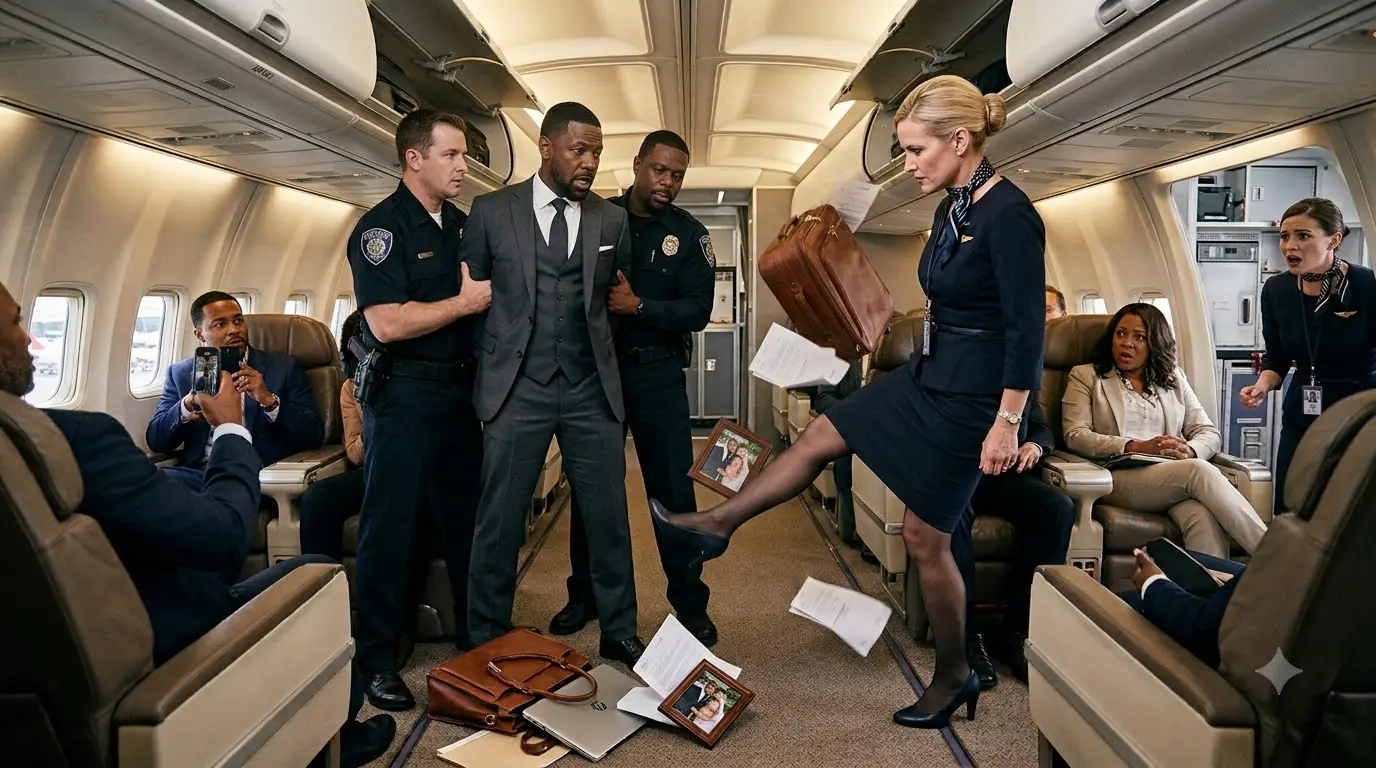
She drives her foot viciously into the expensive leather suitcase, sending it exploding to the floor. Government contracts worth millions scatter like trash.
Rebecca snatches Daniel’s family photo and waves it mockingly.
“Look at this. Trying to pretend you have a real family. Pathetic.”
She tears the photo in half and drops the pieces on his head.
Daniel Washington, in his immaculate suit, kneels among the destruction. His hands tremble as passengers gasp in horror around him.
Rebecca plants her heel on his scattered business documents and grinds them into the carpet.
“This is what happens when welfare rats try to play dress-up in first class. You people never learn your place, do you?”
She kicks his laptop under the seats and crosses her arms smugly.
Have you ever seen a single phone call destroy someone’s entire career? Because what happened next would end 20 years of airline service in 60 seconds.
The alarm buzzes at 5:30 a.m. in Daniel Washington’s penthouse apartment. Floor-to-ceiling windows reveal Atlanta’s skyline bathed in golden morning light. The scent of fresh coffee drifts from the kitchen, where his housekeeper has already prepared his usual breakfast.
Daniel adjusts his silk tie in the mirror. At 42, he carries himself with the quiet confidence of someone who built an empire from nothing. His tailored suit fits perfectly across his broad shoulders. The platinum watch on his wrist cost more than most people’s cars.
His phone rings.
Maria, his personal assistant, sounds excited.
“Mr. Washington, the Seattle contract is confirmed. $500 million. The government is ready to sign tomorrow.”
Daniel smiles, running his fingers over the leather briefcase containing the final documents. Fifteen years ago, he started Washington Tech Solutions in his garage after being laid off from a company that promoted everyone except him.
Now his cybersecurity firm employs 12,000 people across six countries.
“Book me a commercial, Maria. First class on Delta.”
“Sir, your private jet is ready. Why commercial?”
Daniel gazes out at the city below.
“Sometimes I need to remember what regular people go through. Keeps me grounded.”
His driver, James, a 60-year-old man who’s worked for Daniel for eight years, loads the briefcase into the black Mercedes. The leather interior smells like success and expensive cologne.
“Mr. Washington,” James says, catching his eye in the rearview mirror, “sometimes success doesn’t protect you from ignorance. Just be careful out there.”
Meanwhile, across town, Rebecca Thornton slams her apartment door.
The paint peels around the edges. Dirty dishes pile in the sink. Bills scatter across her kitchen table like accusations.
Twenty-two years with Delta Airlines, and she’s still struggling. Her ex-husband stopped paying child support six months ago. Her teenage daughter won’t speak to her. Her son needs money for college she doesn’t have.
Rebecca stares at her reflection in the cracked bathroom mirror. Her blonde hair shows gray roots she can’t afford to touch up. Crow’s feet etch deeper around her eyes each year.
At 45, she feels invisible except when she’s wearing her uniform.
The Delta uniform gives her power. Real power.
She arrives at Hartsfield-Jackson Airport and badges into the crew area. The fluorescent lights buzz overhead. The smell of industrial cleaning solution burns her nostrils.
“Morning, Rebecca,” says Sarah, a 28-year-old new hire with bright eyes and naive optimism.
Rebecca sneers.
“Another day of dealing with entitled passengers who think money makes them special.”
Sarah shifts uncomfortably.
“The diversity training last month was actually pretty helpful. Made me think about—”
“Diversity training?”
Rebecca’s voice drips venom.
“Political correctness garbage. Some people need to learn their place, and it’s my job to teach them.”
The crew briefing reveals Flight 447 is completely sold out. 396 passengers, several VIPs in first class.
Rebecca’s supervisor assigns her to the premium cabin.
“Perfect,” she mutters, “where I can make a real difference.”
Rebecca begins her pre-flight inspection with surgical precision. She arranges the first-class cabin like a general preparing for battle. Every napkin folded perfectly. Every seat positioned exactly.
This is her domain.
The first passengers begin boarding. Rebecca watches with hawk-like intensity as each person approaches.
She serves champagne to the elderly white businessman in 2A with a warm smile. The young white couple in 3B receives extra peanuts and friendly conversation.
Then she sees him.
Daniel Washington walks down the jet bridge with quiet dignity. His expensive suit screams money. His confident stride suggests someone accustomed to respect.
His dark skin makes Rebecca’s jaw clench with familiar rage.
He approaches seat 1A with his leather briefcase and carry-on suitcase. The overhead compartment directly above his purchased seat beckons like an invitation.
Rebecca feels her blood pressure spike.
Not today. Not on her aircraft.
She watches Daniel place his briefcase in the space beneath the seat in front of him. Standard procedure. Nothing wrong.
But when he reaches for the overhead compartment for his suitcase, something inside Rebecca snaps.
This is her moment. Her chance to remind someone exactly who holds the power 35,000 feet above the ground.
The cabin fills with the usual boarding chaos. Conversations blend together. Children cry. Passengers shuffle past each other in the narrow aisles. The air recycling system hums steadily overhead.
Daniel opens the overhead compartment with practiced ease. His movements are calm, respectful. He’s clearly traveled first class many times before.
Rebecca approaches like a predator stalking prey.
Daniel lifts his suitcase toward the overhead compartment. The leather handle feels smooth in his grip. Around him, passengers settle into their seats with the usual boarding shuffle. The cabin smells of recycled air and someone’s expensive perfume.
“Excuse me?”
Rebecca’s voice cuts through the ambient noise like a blade.
“That compartment is reserved for crew items only.”
Daniel pauses, suitcase halfway to the bin. He turns with polite confusion.
“I’m sorry, but this is directly above my seat. I have first-class boarding privileges.”
He reaches into his jacket pocket and produces his boarding pass. The gold Delta medallion catches the cabin light. Seat 1A, premium passenger status clearly displayed.
Rebecca doesn’t even glance at the ticket. Her eyes narrow with contempt.
“I don’t care what your little piece of paper says. Some people need to learn aircraft etiquette.”
The words hang in the air like poison gas.
Nearby passengers begin to notice the tension. Conversations quiet to whispers. Heads turn slowly toward the confrontation.
Daniel maintains his composure despite the obvious hostility.
“Ma’am, I’ve flown Delta for 15 years. I understand the protocols completely. This is my designated overhead space according to Federal Aviation guidelines.”
“Your designated space?”
Rebecca’s laugh sounds like breaking glass.
“Listen carefully, boy. On this aircraft, I decide what belongs where, and you clearly don’t belong in first class.”
The racial undertone hits Daniel like a physical blow. His jaw tightens imperceptibly, but his voice remains perfectly steady.
“I’d like to speak with your supervisor immediately, please.”
“I am the supervisor on this aircraft.”
Rebecca steps closer, deliberately invading his personal space. Her breath smells of stale coffee and barely contains rage.
“And you’ll follow my rules or find yourself permanently banned from flying Delta.”
Daniel continues placing his suitcase in the overhead bin. His movements remain calm and deliberate despite the escalating hostility. He refuses to be intimidated by her aggressive posturing.
“Sir, you need to stop what you’re doing right now.”
Rebecca commands, her voice rising to ensure other passengers can hear every word.
Other first-class passengers pretend to read magazines while straining to catch every detail. The tension crackles through the cabin like electricity before a thunderstorm.
Rebecca’s face twists with uncontrolled rage.
Without warning, she drives her foot into the suitcase with vicious, calculated force.
Crash.
The expensive leather case explodes from the compartment like a bomb detonating.
Government contracts worth millions of dollars scatter across first class like confetti in a hurricane. Daniel’s platinum laptop skitters under passenger seats with a grinding scrape of metal against carpet.
His family photos flutter through the air like dying birds before landing face down on the wine-stained floor.
The cabin erupts in shocked gasps.
Phone cameras emerge like flowers after rain. Passengers instinctively document the unfolding disaster. Whispered conversations buzz with disbelief and horror.
Daniel drops to his knees among the destruction. His expensive suit is now wrinkled and stained. His hands shake visibly as he gathers the scattered remnants of his professional life.
The leather portfolio containing his Seattle presentation lies torn and trampled.
Months of preparation destroyed in seconds.
Rebecca towers over him like a conquering general. Her blonde hair is severe under the harsh cabin lights.
“Ladies and gentlemen, we have someone here who thinks rules don’t apply to them.”
She addresses the cabin with theatrical authority, gesturing dramatically toward Daniel’s kneeling form.
“This individual refused direct crew instructions and demonstrated clear aggressive behavior toward airline personnel.”
Jennifer Martin, a 35-year-old civil rights attorney in seat 2C, pulls out her legal pad and begins writing furiously. Her pen scratches against paper with urgent intensity, documenting every word and action.
Robert Brooks, a 50-year-old tech executive in 3A, recognizes Daniel from industry conferences but remains frozen in his seat. His mouth opens slightly in recognition and mounting horror.
A young mother in 4B covers her children’s eyes, shielding them from the ugly scene unfolding before them.
Rebecca calls toward the galley with manufactured urgency.
“Sarah, contact security immediately. We have an aggressive passenger refusing to comply with federal aviation regulations.”
Sarah, the young flight attendant, hesitates at the galley entrance. Her face shows clear confusion and discomfort with the situation.
“Ma’am,” Daniel says quietly, still kneeling among his scattered documents, “I was simply using my designated overhead space according to standard first-class protocols. I haven’t been aggressive toward anyone.”
“Don’t you dare lie to these passengers.”
Rebecca’s voice booms through first class like a foghorn.
“I personally witnessed you threaten crew safety and refused direct lawful orders from airline personnel.”
She turns to address the other passengers like a prosecutor presenting damning evidence to a jury.
“You all witnessed him ignore my safety instructions and behave aggressively toward crew members, didn’t you?”
Most passengers stare in uncomfortable silence, their faces showing obvious distress.
A few elderly passengers nod uncertainly, intimidated by Rebecca’s authoritative presence. Others exchange worried glances, sensing something deeply wrong.
Two TSA officers board the aircraft through the jet bridge.
Mike Patterson, a burly man in his 40s with tired eyes, enters first. Behind him follows Janet Cole, a serious-looking woman with sharp features and a no-nonsense expression born from years of airport security work.
Rebecca rushes to meet them, her face transformed into a mask of practiced distress.
“Officers, thank God you’re here. This passenger verbally abused me and made direct threats against crew safety.”
Mike looks at Daniel, still kneeling among his scattered papers and broken belongings.
“Sir, we need you to stand slowly and provide identification.”
Daniel rises with deliberate care, brushing dust and debris from his expensive suit.
“Certainly, officers. I’m Daniel Washington.”
He reaches for his wallet with slow, non-threatening movements designed to avoid any misunderstanding.
Rebecca intercepts his identification before he can hand it to the waiting officers.
“Let me verify this documentation is legitimate. We’ve had significant problems with fraudulent identification recently.”
She examines his driver’s license with exaggerated suspicion, holding it up to the light like a jeweler inspecting a questionable diamond.
“Hmm. This address seems awfully expensive for someone like you.”