Arthur Bennett had crossed the Atlantic during thunderstorms, landed aircraft with failed instruments, and once guided two hundred passengers safely through an emergency descent over Colorado.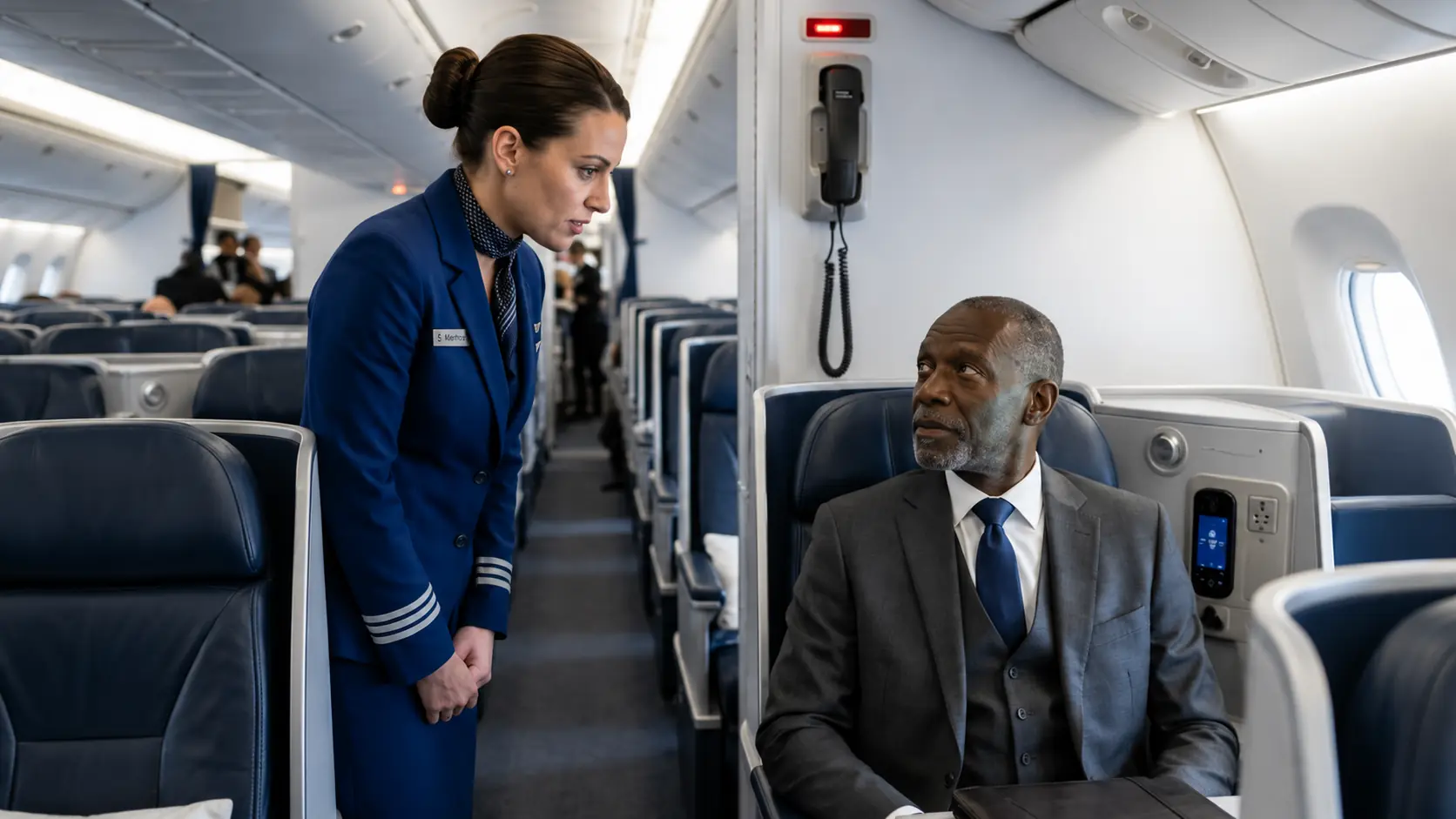
Yet on a clear Monday morning at John F. Kennedy International Airport, the greatest obstacle between him and the cockpit was a flight attendant who refused to believe he belonged in first class.
Arthur was sixty-eight years old, with deep-brown skin, short gray-black hair, and a neatly trimmed gray beard. His charcoal suit fit him perfectly, his navy tie was carefully knotted, and his polished shoes carried only a few drops of rain from the ramp outside.
Nothing about him appeared hurried.
That was partly because Arthur had spent forty-four years learning that panic never improved a difficult situation.
The flight to Los Angeles was scheduled to depart at 9:10 a.m. The original captain had experienced chest pain during the preflight medical check and had been transported to a nearby hospital. Airline operations immediately called Arthur, who had been attending a safety conference in another terminal.
Arthur was more than an ordinary replacement pilot.
He was one of Meridian Atlantic Airlines’ most experienced check captains, responsible for evaluating pilots, reviewing emergency procedures, and determining whether senior crew members remained qualified to command commercial aircraft.
He had trained half the captains working the airline’s wide-body fleet.
Because the departure was already delayed, operations instructed him to board immediately through a secure ramp entrance. His uniform was inside a garment bag being brought from the airline’s operations center, while his flight credentials and updated dispatch papers were stored inside the black leather folder beside him.
The gate manager directed Arthur to seat 1A while the cockpit paperwork was being revised.
“You can wait there until your uniform arrives,” she told him. “First Officer Nolan is completing the exterior inspection.”
Arthur thanked her, placed his garment bag reservation tag in the overhead compartment, and sat beside the window.
He closed his eyes for less than a minute.
That was when Rebecca Sloan entered the cabin.
Rebecca had worked for Meridian Atlantic for seventeen years. At forty-two, she had become the senior flight attendant on several transcontinental routes and took pride in running a disciplined cabin.
She wore a fitted royal-blue uniform, silver-striped cuffs, a patterned scarf, and a polished name badge. Her dark-brown hair was secured in a tight bun, and every movement suggested that she expected immediate compliance.
Rebecca stopped when she saw Arthur.
She checked the seat number.
Then she looked at him again.
“Excuse me.”
Arthur opened his eyes.
“Yes?”
Rebecca remained in the aisle.
“This section is for confirmed passengers only.”
Arthur glanced around the nearly empty first-class cabin.
“I know what cabin I’m sitting in.”
Rebecca’s expression tightened.
“I need to see your boarding pass.”
“My documents are in that folder.”
He nodded toward the leather portfolio beside him.
Rebecca did not reach for it.
“Your boarding pass should be in your hand before you enter this cabin.”
“I did not board through the passenger gate.”
“That is another problem.”
Arthur studied her face.
“I entered through airline operations.”
Rebecca gave a short, humorless laugh.
“Passengers cannot board through operations.”
“I am aware of that.”
“Then stand up and come with me.”
Arthur remained seated.
“Before issuing another order, you may want to check the crew manifest.”
Rebecca folded her arms.
“I do not need a passenger telling me how to manage my cabin.”
Arthur looked toward the blue curtain separating first class from the forward galley.
The cockpit interphone had begun ringing.
Rebecca ignored it.
“I am not trying to manage your cabin,” Arthur said. “I am asking you to verify information before making a mistake.”
“You are sitting in a premium seat without a boarding pass.”
“This seat was assigned to me by operations.”
“What name is the reservation under?”
“Arthur Bennett.”
Rebecca checked the tablet attached to her service cart. She entered the name, waited several seconds, then turned the screen away from him.
“There is no first-class passenger named Arthur Bennett.”
“I never said I was a passenger.”
Rebecca stared at him.
The interphone rang again.
A younger flight attendant named Olivia Grant stepped from the galley.
“Rebecca, the cockpit is calling.”
“I’ll handle it.”
Rebecca did not move.
Olivia looked at Arthur, then at the leather flight folder beside him. A Meridian crew credential was partially visible beneath the folder’s clasp.
“Sir, are you traveling as crew?” Olivia asked.
Arthur nodded.
“I am.”
Rebecca shot Olivia a warning look.
“He claims operations placed him here.”
Olivia reached toward the folder.
“We can verify his identification.”
“No.”
Rebecca’s answer came so quickly that even Arthur raised an eyebrow.
“No?” Olivia repeated.
“I am dealing with it.”
Arthur leaned back.
Rebecca pointed toward the aisle.
“Stand up now, or security will drag you off.”
Several passengers had begun entering first class.
A middle-aged businessman stopped beside seat 2C. A woman holding a designer handbag paused near the galley. Both watched the confrontation without speaking.
Arthur slowly rose.
He was taller than Rebecca expected.
Standing upright, he carried the disciplined posture of someone accustomed to command, though his voice remained calm.
“Touch me,” he said, “then explain why you removed your captain.”
The cabin became silent.
Rebecca blinked.
“My what?”
Arthur picked up the leather folder and opened it.
Inside was a Federal Aviation Administration airline transport pilot certificate, Meridian Atlantic crew identification, Department of Homeland Security flight credentials, and the revised dispatch release bearing his name.
CAPTAIN IN COMMAND: ARTHUR J. BENNETT.
Olivia read the page first.
Her eyes widened.
“Rebecca.”
Rebecca barely glanced at it.
“That could be outdated.”
Arthur’s expression changed for the first time.
Not anger.
Disappointment.
“The dispatch release was printed twelve minutes ago.”
Rebecca lifted her chin.
“Even pilots are required to identify themselves properly.”
“I identified myself.”
“You said you were crew.”
“I told you to check the crew manifest.”
“You refused to provide a boarding pass.”
“Because flight crews do not board using passenger boarding passes.”
The interphone rang a third time.
Olivia answered.
“Forward galley.”
A man’s anxious voice came through the receiver.
“Has Captain Bennett boarded yet? Operations says he entered five minutes ago.”
Olivia looked directly at Arthur.
“Yes, First Officer Nolan. He is standing in first class.”
“Why isn’t he in the cockpit?”
Olivia glanced toward Rebecca.
“There has been a misunderstanding.”
Arthur extended his hand.
Olivia gave him the receiver.
“This is Bennett.”
Relief flooded the first officer’s voice.
“Captain, thank God. Dispatch is holding the final release, and maintenance needs your approval on the hydraulic inspection.”
“I’ll be there momentarily.”
“Is everything all right?”
Arthur looked at Rebecca.
“That depends on what happens next.”
He returned the receiver.
Rebecca’s face had lost some of its color, but she had not stepped aside.
“You should have worn your uniform.”
“My uniform is being brought from operations because your scheduled captain was taken to the hospital.”
“How was I supposed to know that?”
“You were supposed to read the crew update sent to your tablet.”
Rebecca checked the screen.
A red notification had been sitting unopened for eleven minutes.
URGENT CREW CHANGE: CAPTAIN ARTHUR BENNETT REPLACING CAPTAIN HARRIS.
The message included Arthur’s photograph.
Olivia saw it over Rebecca’s shoulder.
Rebecca immediately locked the tablet.
Passengers continued boarding behind them, forcing the line to stop. The businessman in seat 2C raised his phone slightly, recording the exchange.
Rebecca noticed.
“Sir, recording crew members is prohibited.”
“No, it isn’t,” Arthur said.
She turned toward him.
“I am trying to maintain order.”
“You created the disorder.”
Rebecca took a breath.
“Captain Bennett, I apologize for the confusion.”
Arthur closed the folder.
“This was not confusion.”
“I did not recognize you without your uniform.”
“You did not attempt to recognize me at all.”
Rebecca glanced toward the waiting passengers.
“Can we discuss this privately after departure?”
“No.”
Her eyes hardened.
“Excuse me?”
“We will discuss it before departure because I will not command an aircraft while unresolved hostility exists among the crew.”
The businessman lowered his phone.
Olivia looked concerned.
Rebecca stepped closer and lowered her voice.
“You would delay three hundred passengers over a seating disagreement?”
Arthur held her stare.
“I would delay three hundred passengers over a crew member who ignored identification, refused verification, threatened security, and attempted to remove the captain from his own aircraft.”
“I was protecting first class.”
“From what?”
Rebecca did not answer.
Arthur continued.
“What exactly did you see when you looked at me?”
“A passenger without documentation.”
“My documentation was beside me.”
“You did not present it immediately.”
“You refused to examine it.”
Rebecca looked away.
The gate manager, Sarah Mitchell, hurried through the forward door carrying Arthur’s black garment bag.
“Captain Bennett, I’m sorry. Operations had trouble locating the correct uniform jacket.”
She stopped when she saw the gathered passengers.
“What happened?”
Olivia answered quietly.
“Rebecca tried to remove Captain Bennett from first class.”
Sarah stared at Rebecca.
“Why?”
“He was not listed as a passenger.”
“He is not a passenger.”
“I know that now.”
Sarah placed the garment bag beside Arthur.
“I personally seated him here.”
Rebecca looked at her.
“You should have notified me.”
“I did.”
Sarah pointed toward the tablet.
“The crew update was sent before he boarded.”
Rebecca crossed her arms.
“The situation could have been avoided if he had simply explained himself.”
Arthur’s voice remained even.
“I explained myself four times.”
The first officer appeared from the cockpit.
Daniel Nolan was thirty-six, with short brown hair and a captain’s training pin on his white uniform shirt. Arthur had evaluated him the previous year.
“Captain, maintenance is waiting.”
Then Daniel noticed Rebecca’s expression.
“Is there a problem?”
Arthur looked around the cabin.
“Yes.”
He asked Sarah to pause boarding temporarily.
Passengers who had already entered were allowed to take their seats, while those on the jet bridge waited outside. The cabin doors remained open.
Arthur carried his uniform into the cockpit changing area. When he returned five minutes later, he wore four gold captain’s stripes on each sleeve, gold wings above his breast pocket, and his identification clipped visibly to his jacket.
Rebecca looked at him differently.
That difference told Arthur more than any apology could have.
Nothing about his identity had changed.
Only the uniform had.
Arthur addressed Sarah.
“I want a replacement senior flight attendant assigned before departure.”
Rebecca’s head snapped toward him.
“You cannot be serious.”
“I am.”
“I made one mistake.”
“You made a series of choices.”
“I apologized.”
“You apologized after the cockpit confirmed my authority.”
Rebecca’s cheeks flushed.
“You are punishing me because I questioned you.”
“I am removing a crew member whose judgment I cannot trust during an emergency.”
The words landed harder than any shout.
Flight attendants were not merely servers. They were safety professionals responsible for evacuations, medical events, fires, decompression, passenger conflicts, and emergency commands.
Arthur treated their role with deep respect.
That was why Rebecca’s conduct concerned him.
“Captain,” she said, “my safety record is excellent.”
“This conversation is part of your safety record now.”
“I was protecting unauthorized access to first class.”
“Your responsibility was to verify, not assume.”
Rebecca lowered her voice.
“You think this was about race.”
Arthur did not answer immediately.
“I think you should ask yourself whether you would have treated every sixty-eight-year-old man in a tailored suit the same way.”
Several passengers looked toward Rebecca.
She shook her head.
“That is unfair.”
“Was it fair to threaten me with security before opening the folder beside my hand?”
“You were being difficult.”
“I remained seated and spoke calmly.”
“You challenged my authority.”
Arthur nodded.
“There it is.”
Rebecca fell silent.
Sarah contacted airline operations. Within twelve minutes, another senior attendant named Linda Park arrived from a nearby gate. Linda reviewed the crew assignment, greeted Arthur by name, and immediately entered the cockpit for the required briefing.
Rebecca was instructed to leave the aircraft.
She stood near the forward door holding her service bag.
“You are ending my career over this.”
Arthur adjusted the dispatch folder beneath his arm.
“I have not ended anything.”
“You removed me from the flight.”
“I made a safety decision.”
Rebecca looked toward the passengers.
“This is public retaliation.”
Arthur met her eyes.
“Accountability often feels like retaliation to people who expected no consequences.”
Sarah escorted Rebecca onto the jet bridge.
Boarding resumed.
Arthur entered the cockpit and placed the dispatch paperwork between himself and Daniel. The hydraulic inspection was approved after maintenance confirmed that a sensor warning had resulted from a loose electrical connector rather than a system failure.
Arthur reviewed the weather, fuel load, alternate airports, and departure route.
His hands remained steady.
Daniel watched him for a moment.
“Are you all right?”
“Yes.”
“You don’t look angry.”
“I am.”
Daniel looked surprised.
Arthur fastened his shoulder harness.
“Anger does not need to control the aircraft.”
Before closing the cockpit door, Linda asked Arthur whether he wanted the passengers informed about the delay.
“Tell them we experienced a crew reassignment.”
“That’s all?”
“That’s all they need for the flight.”
Arthur did not want applause, public sympathy, or an announcement turning the cabin into a stage.
He wanted a safe departure.
At 9:46 a.m., the aircraft pushed away from the gate.
Arthur guided it through the taxiways beneath a clear blue sky. When air traffic control cleared them for takeoff, he advanced the throttles and felt the enormous aircraft gather speed beneath him.
“Eighty knots,” Daniel called.
“Checked.”
“V1.”
“Rotate.”
Arthur drew back gently on the controls.
The aircraft lifted from the runway and climbed above Queens, carrying 312 passengers toward Los Angeles.
For the next five hours, the flight remained ordinary.
That was exactly what Arthur wanted.
Behind the cockpit, however, passengers were discussing the confrontation. The businessman from seat 2C had uploaded part of his recording after landing. By the time the aircraft reached California, the video had spread across social media.
It showed Rebecca standing over Arthur.
“This section is for confirmed passengers only.”
It showed Arthur calmly identifying himself.
It captured Rebecca threatening to have security drag him from the aircraft.
The final seconds showed him rising.
“Touch me, then explain why you removed your captain.”
News outlets contacted Meridian Atlantic before the aircraft landed.
The company released a brief statement confirming that an employee had been removed from duty pending investigation. It emphasized that Arthur had commanded the flight safely and that the airline did not tolerate discrimination.
Arthur read the statement inside the crew lounge at Los Angeles International Airport.
He disliked it immediately.
“This makes it sound like one employee had a bad morning,” he told Chief Operating Officer Michael Price over the phone.
“We are investigating.”
“Investigate the system that allowed it.”
“What do you mean?”
“Rebecca received an urgent crew update and ignored it. Boarding continued even while the forward cabin was blocked. No one intervened until my rank was confirmed.”
“Olivia attempted to verify your identity.”
“And was overruled because Rebecca had seniority.”
Michael remained silent.
Arthur continued.
“The problem is not simply that she was wrong about me. The problem is that every safeguard failed until someone powerful entered the conversation.”
The airline opened a wider review.
Investigators examined previous passenger complaints involving Rebecca. They found nine incidents in which Black or Latino travelers had been questioned about premium seating after their boarding passes had already been scanned.
One Black physician had been asked to show identification twice while seated in business class.
A Latino software executive had been directed toward economy despite holding a first-class ticket.
An elderly Black couple had been accused of entering the wrong boarding group until another employee checked their names.
Each complaint had been classified as a misunderstanding.
Arthur reviewed the reports as part of the airline’s safety committee.
“The word misunderstanding is doing dangerous work here,” he said.
Michael looked across the conference table.
“None of these incidents resulted in physical harm.”
“Safety failures begin long before physical harm.”
Arthur placed Rebecca’s unanswered crew notification on the screen.
“She became so certain about who belonged in first class that she stopped processing contradictory information. That is not only a customer-service problem. It is a cockpit and cabin safety problem.”
“What corrective action do you recommend?”
“Independent complaint reviews, bias training based on actual crew decisions, and a rule that any identity dispute involving airline personnel must be verified before security is called.”
The committee approved every recommendation.
Rebecca attended a formal disciplinary hearing two weeks later.
She insisted she had acted according to procedure.
Arthur participated by video.
The investigator asked why she refused to inspect his credentials.
“He was dismissive,” Rebecca said.
“What did he say?”
“He told me to check the manifest.”
“Was that information correct?”
“Yes.”
“Did you check it?”
“Not immediately.”
“Why?”
Rebecca looked toward Arthur’s image on the screen.
“Because I believed I already understood the situation.”
Arthur spoke for the first time.
“That belief is the entire issue.”
Rebecca was suspended for three months and removed permanently from senior cabin authority. Returning to work required extensive retraining, supervised flights, and a formal evaluation.
The airline did not fire her.
Arthur supported that decision.
He believed accountability should protect people and change behavior, not merely satisfy public anger.
Several months later, Rebecca requested a meeting.
She arrived at Arthur’s office without her uniform.
For the first time, she appeared uncertain.
“I watched the video again,” she said.
Arthur waited.
“I kept thinking you should have explained yourself better.”
“I did explain.”
“I know.”
She looked down.
“I think I needed that to be true because the alternative was admitting I saw you and decided you couldn’t belong there.”
Arthur leaned back.
“What changed?”
“During retraining, they showed us my previous complaints.”
“You had seen them before.”
“I saw them separately. I called each one a misunderstanding.”
“And together?”
“They were a pattern.”
Rebecca’s voice became quieter.
“I am sorry, Captain Bennett.”
Arthur studied her.
“Are you sorry because I was the captain?”
“No.”
She took a breath.
“I’m sorry because it should not have mattered.”
Arthur nodded once.
“That is where the work begins.”
A year later, Arthur commanded his final commercial flight before retiring from regular service.
The route was the same, New York to Los Angeles.
Olivia Grant served as senior flight attendant.
Before boarding, she entered the cockpit carrying the passenger manifest.
“Captain, we have an elderly gentleman in 2A traveling without his printed pass. The gate confirmed him electronically.”
Arthur smiled.
“And?”
“And nothing. His identity is verified, his seat is confirmed, and he asked for black coffee after takeoff.”
“Sounds manageable.”
Olivia smiled and returned to the cabin.
Arthur looked through the cockpit window at the aircraft waiting beneath the morning sky.
The uniform he wore had forced Rebecca to see his authority.
But authority had never been the real lesson.
Arthur had deserved respect before she saw the captain’s stripes.
He deserved it while sitting quietly in a charcoal suit.
He deserved it before opening the flight folder, before the cockpit called, and before anyone important confirmed his name.
The aircraft did not become his only after Rebecca learned who he was.
He had been the captain from the moment he boarded.
She had simply allowed her assumptions to keep her from seeing it.