“I don’t know where you stole this ticket, but Skyline Elite doesn’t fly charity cases in first class. Security.”
The words sliced through the ambient noise of LAX Terminal 2 like a blade through silk, sharp, deliberate, and designed to wound.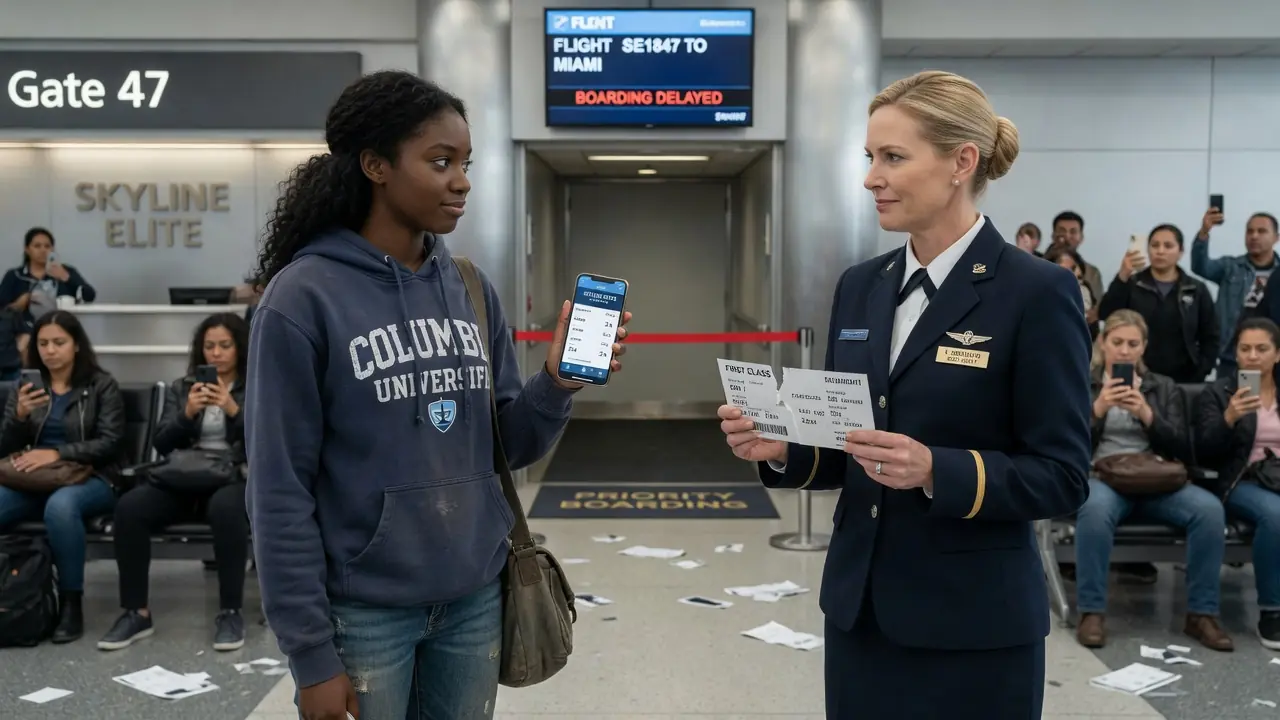
Victoria Brennan stood behind Gate 47’s pristine counter, holding the shredded remains of a boarding pass above her head like a trophy. The torn pieces fluttered to the polished floor like confetti at a twisted celebration.
The young woman standing before her did not flinch.
Zara Mitchell, twenty-two years old, wearing a faded Columbia University hoodie and worn jeans, simply stared at the fragments of her ticket scattered across the gray terminal carpet. Her canvas sneakers, scuffed from three years of law school, remained planted firmly on the priority boarding carpet.
“That was my boarding pass,” Zara said quietly, her voice steady despite the chaos erupting around her. “Seat 2A. First class.”
Victoria’s perfectly manicured hand smoothed her blond hair, which was pulled back in a bun so tight it stretched the skin around her temples. Her Skyline Elite uniform was pressed to military precision, every crease sharp enough to cut paper.
She looked down at Zara with the kind of smile that never reached the eyes.
“Sweetheart,” Victoria said, her voice dripping with false concern, “I’ve been working this gate for eighteen years. I know what a first-class passenger looks like.”
She gestured toward Zara’s outfit with barely concealed disdain.
“And they don’t look like they just rolled out of a college dormitory.”
The gate area, packed with delayed passengers from Flight SE1847 to Miami, had gone completely quiet. Conversations stopped mid-sentence. Newspapers lowered. Children stopped running between the leather seats. Even the constant hum of CNN from the overhead monitors seemed to fade into background static.
Diego Rodriguez, the junior gate agent, shifted nervously behind his computer terminal. His dark eyes darted between Victoria and Zara, then toward the growing crowd of onlookers. His fingers hovered over his keyboard, uncertain whether to intervene or retreat.
“Ma’am,” Diego said softly, stepping forward, “maybe we should just scan the—”
“Diego.”
Victoria’s voice cracked like a whip.
“I’ll handle this. Get back to the computer.”
Zara reached into the front pocket of her hoodie and pulled out her phone. The screen displayed her mobile boarding pass, the QR code dark and clear against the white background.
“I have a digital copy,” she said, holding it toward Victoria. “You can scan it right here.”
Victoria did not even glance at the phone. Instead, she crossed her arms and shook her head with theatrical disappointment.
“Digital passes can be photoshopped, honey. Any college student with basic computer skills could fake one of those.”
She turned toward the passengers in the priority boarding line, playing to her audience.
“You’d be amazed what people will try these days.”
A murmur rippled through the crowd. An elderly man in a business suit frowned. A mother pulled her teenage daughter closer. Near the back of the line, Amanda Foster, a social media influencer with perfectly styled brown hair and designer luggage, quietly activated her phone’s camera.
“This is happening right now,” Amanda whispered to her phone, keeping it low but pointed toward the confrontation. “LAX, Terminal 2. This is actually happening.”
The boarding announcement chimed overhead, a pleasant electronic melody that seemed almost mocking in the tense atmosphere.
“Ladies and gentlemen, Skyline Elite Flight SE1847 to Miami is now boarding first-class passengers and Diamond Club members. Please have your boarding passes ready.”
Zara stepped forward, back straight, eyes calm.
“I’m first class. Seat 2A. I’d like to board now.”
Victoria’s face flushed red beneath her foundation. She stepped out from behind the counter, her heels clicking aggressively against the polished floor.
“You know what? I’m tired of this game.”
She positioned herself directly in front of Zara, blocking her path to the jet bridge.
“You’re not boarding this aircraft. Period.”
“On what grounds?” Zara asked.
“On the grounds that I said so,” Victoria snapped, her voice rising loud enough for the entire gate area to hear. “I am the senior gate agent for this flight, and I determine who boards and who doesn’t. And I’m determining that you—”
She pointed a perfectly manicured finger at Zara’s face.
“Don’t belong in first class.”
The silence that followed was absolute. Even the ambient airport noise seemed to pause.
Security cameras mounted on the walls captured every angle of the standoff. The departure board above their heads flashed the updated boarding time in bold red letters.
Zara looked around at the sea of faces staring at her. Business travelers in expensive suits. Families clutching boarding passes. Airport staff watching from behind nearby counters. All waiting to see what would happen next.
She turned back to Victoria, her voice still calm, still steady.
“You’re going to regret this.”
Victoria laughed, a sharp, brittle sound that echoed off the terminal’s high ceiling.
“Is that a threat?”
“It’s a fact.”
The confrontation at Gate 47 had roots deeper than anyone watching could imagine.
Zara Mitchell had been flying since she was old enough to walk, but never like this. Never as the target. Never as the problem.
Growing up as the daughter of Marcus Mitchell, CEO and founder of Skyline Elite Airways, meant growing up in two worlds. There was the world of corporate boardrooms and charity galas where her father was respected, admired, even revered as the man who built a luxury airline from nothing.
Then there was the world outside those boardrooms, where a young woman in casual clothes was just another person who did not quite fit the expected profile.
Marcus had worked deliberately to ensure Zara understood both worlds. From the time she was twelve, he had insisted she fly commercial whenever possible, usually in economy, sometimes in business class, rarely in first.
“I didn’t build this company so you could float above everyone else,” he had told her during one of their long talks in his office overlooking the Los Angeles skyline. “I built it so everyone could fly with dignity.”
That philosophy had shaped every aspect of Zara’s education.
Columbia Law School, where she had just finished her final exams three days earlier. The small, cluttered apartment she shared with two roommates in Morningside Heights, paid for with her own work-study earnings and academic scholarships. The wardrobe of thrift store finds and campus bookstore hoodies that made her blend in with every other graduate student scraping by on ramen noodles and caffeine.
She had been awake for seventy-two hours straight, fueled by espresso shots and determination, grinding through constitutional law and corporate ethics exams that would determine her class ranking. When she finally submitted her last paper at six that morning, her first thought had not been sleep.
It had been home.
Her father did not know she was coming. The trip was meant to be a surprise, a long weekend to decompress before summer internship interviews began. She had used her employee family discount to book the ticket online, selecting seat 2A almost as an afterthought.
First class seemed appropriate after three years of red-eye flights in middle seats, studying for exams with her laptop balanced on a fold-down tray.
Now, standing in the middle of LAX with her boarding pass in pieces on the floor, Zara realized her father’s lessons about dignity were about to be tested in ways she had never imagined.
Victoria Brennan, meanwhile, had built her entire identity around being the gatekeeper of Skyline Elite’s standards.
At forty-five, she had worked her way up from a baggage handler at a regional airline to senior gate agent at one of the most exclusive carriers in the industry. It had taken eighteen years, three airline mergers, and countless nights away from home. But she had finally reached a position where she controlled something important.
Gate 47 was not just her assignment.
It was her kingdom.
Victoria had developed what she called her quality-control instincts. Over nearly two decades in aviation, she believed she could spot a problem passenger from fifty feet away.
The nervous fidgeting that suggested someone flying on a stolen credit card. The overly expensive clothes on someone who could not meet her eyes, suggesting they were flying on an upgrade they could not really afford. The awkward body language that revealed someone trying to pass for something they were not.
Those instincts, in Victoria’s mind, had served her well. She had caught actual fraudsters, prevented countless boarding disputes, and maintained the exclusive atmosphere that Skyline Elite passengers paid premium prices to experience.
Management praised her attention to detail. Colleagues respected her experience. Passengers might not always like her methods, but they could not argue with her results.
The company’s recent internal memo about maintaining brand standards had only reinforced what Victoria already believed. Skyline Elite was not just another airline. It was a luxury experience.
That meant curating not just the service, but the clientele. Making sure the right people sat in the right seats. Ensuring that everyone who entered the first-class cabin contributed to the ambiance that justified the premium pricing.
Victoria’s mental checklist for first-class passengers was detailed, and she believed it was accurate.
Designer luggage, not canvas bags.
Polished shoes, not sneakers.
Tailored clothing, not college sweatshirts.
Confident posture, not the slightly hunched shoulders of someone who was not sure they belonged.
Zara Mitchell failed every single criterion.
Victoria had noticed her immediately when she settled into the priority boarding area thirty minutes earlier. A young woman in clothes that belonged at a campus library, not in a first-class cabin. She had been typing on a cracked smartphone, occasionally glancing up at the departure board with the kind of nervous energy Victoria associated with inexperienced flyers.
Everything about the situation screamed upgrade scam to Victoria.
She had seen it dozens of times before. College students who somehow got their hands on a first-class boarding pass through a computer glitch, a travel agent’s mistake, or outright theft. They would act casual, trying to blend in until they could slip aboard and enjoy a luxury experience they had not paid for.
But this girl was different.
She was not nervous in the right way.
When Victoria had first approached her, demanding that she move from the priority seating area, the girl had looked her directly in the eyes.
No fidgeting. No stammering excuses. Just a calm, almost challenging stare that said she belonged exactly where she was.
That confidence irritated Victoria more than obvious guilt would have. It suggested that this particular scammer thought she was smarter than the system, that she could outsmart an eighteen-year veteran with nothing more than a fake boarding pass and attitude.
Victoria was about to prove her wrong.
Diego Rodriguez watched the standoff from behind his computer terminal, his stomach tight with anxiety.
At twenty-eight, he had been working for Skyline Elite for just over two years. Long enough to understand the company culture, but not long enough to feel secure challenging it.
He had seen Victoria in action before. Her methods were harsh, sometimes embarrassing for passengers, but they were usually effective. Fraudsters backed down when confronted directly. People trying to sneak upgrades typically retreated to their assigned seats without causing a scene.
The rare passenger who pushed back usually revealed themselves to be exactly the kind of problem customer Victoria suspected them to be.
But something about this situation felt different.
The young woman was not backing down, but she was not escalating either. She answered Victoria’s challenges with facts, not emotions. She produced documentation without defensive explanations. Everything about her behavior suggested someone who genuinely believed she belonged in first class.
Diego glanced at his computer screen, cursor hovering over the passenger manifest. It would take thirty seconds to verify the booking. Less than that to scan the digital boarding pass she had shown Victoria.
Company policy actually required verification before denying boarding to any passenger with proper documentation.
But Victoria was his supervisor.
Questioning her judgment in front of passengers would undermine her authority and potentially cost him his job. The airline industry was notoriously unforgiving toward employees who could not follow the chain of command.
Still, watching the crowd grow around Gate 47, seeing passengers pull out phones and begin recording, Diego could not shake the feeling that this confrontation was about to spiral completely out of control.
The departure board updated again.
Flight SE1847 to Miami now boarding all passengers.
The jet bridge stood empty, waiting. The aircraft sat at the gate, fueled and ready for departure. But nothing was going to move until Victoria Brennan decided who belonged in first class.
“Ma’am, I’m going to need you to step back from the boarding line,” Victoria announced, her voice carrying across the gate area with practiced authority.
She moved with deliberate precision, each step calculated to demonstrate control.
“The first-class section is currently boarding, and you’re disrupting the process for our premium passengers.”
Zara stood her ground, her canvas bag hanging from her shoulder.
“I am a premium passenger. I have a first-class ticket to Miami.”
“Sweetie, I understand there might be some confusion about your seat assignment, but premium cabin service requires certain standards. I’m sure there’s been a mistake with your booking.”
“There’s no mistake,” Zara replied, her voice level, though her grip on her phone tightened slightly. “I can show you my confirmation number, my boarding pass, whatever you need to verify.”
“What I need,” Victoria said, stepping closer and lowering her voice to what she imagined was a helpful tone, “is for you to understand that first class isn’t just about having a ticket. It’s about maintaining an environment that our paying customers expect.”
The words hung in the air like smoke.
Several passengers in the boarding line turned to stare. An elderly woman in a Chanel suit raised her eyebrows. A businessman in a tailored coat shook his head and returned to his newspaper, clearly assuming the situation would resolve itself quickly.
Amanda Foster, standing near the back of the priority line, shifted her phone to a better angle. Her followers were already commenting on the live stream.
This is so uncomfortable to watch.
Why is this taking so long?
Just let her board.
“Are you suggesting I don’t belong in first class because of how I’m dressed?” Zara asked.
Victoria’s smile became strained.
“I’m suggesting that there are standards, dear. Expectations. Our first-class passengers pay premium prices for a premium experience, and that includes—”
She gestured vaguely at Zara’s appearance.
“A certain level of presentation.”
“Since when does Skyline Elite have a dress code for passengers?”
“It’s not an official dress code,” Victoria replied quickly, realizing she had ventured into potentially problematic territory. “It’s about comfort. Making sure all our passengers feel comfortable with their fellow travelers.”
Diego watched from behind his computer, his fingers dancing nervously across his keyboard.
The passenger manifest showed seat 2A as occupied by Z. Mitchell, with a full first-class fare payment. No upgrade. No special code. No notation suggesting anything irregular about the booking.
He cleared his throat softly.
“Victoria, maybe we should—”
“Diego, please handle the general boarding announcement,” Victoria cut him off without turning around. “I’ll manage this situation.”
Zara pulled her phone from her pocket and opened her airline app. The boarding pass appeared on screen, crisp and clear.
Skyline Elite Flight SE1847.
LAX to MIA.
Seat 2A.
Boarding Group One.
“Here’s my boarding pass. Digital confirmation. Would you like me to show you the credit card I used to purchase it?”
Victoria glanced at the phone screen, then away immediately.
“Digital confirmations can be manipulated, sweetie. College students are very clever with technology these days.”
She turned toward the other passengers in line.
“I apologize for the delay, folks. We’ll have this sorted out momentarily.”
A man in an expensive Italian suit stepped forward.
“Excuse me, but is there a problem? My connecting flight is tight, and we’re already running late.”
“No problem at all, sir,” Victoria assured him. “Just verifying some documentation. We’ll begin boarding first class in just a moment.”
“Her documentation looks fine to me,” the man said, glancing at Zara’s phone. “I can see the boarding pass from here.”
Victoria’s cheek muscles twitched.
“Sir, I appreciate your concern, but airline security requires that I personally verify all travel documents. Company policy.”
Zara spoke up.
“Then verify it. Scan the QR code. Check your computer. Do whatever company policy requires.”
“Company policy,” Victoria said, her voice rising slightly, “also requires that I use my professional judgment to ensure passenger safety and comfort. And in my professional judgment, there are questions about your documentation that need to be resolved before you board this aircraft.”
The gate area had grown noticeably quieter. Conversation stopped. Passengers pretended to read their phones while actually listening to every word.
The air conditioning hummed overhead. Someone’s rolling suitcase clicked rhythmically as they walked past toward a different gate.
“What questions?” Zara asked. “I have a valid ticket, proper identification, and I’m here on time for boarding. What exactly is the question?”
Victoria’s facade of helpful concern began to crack.
“The question, young lady, is whether you actually purchased this ticket or whether you’re trying to take advantage of some system error or travel-voucher situation to upgrade yourself into a cabin you can’t afford.”
Gasps rippled through the crowd.
Amanda Foster’s phone captured the moment, her live viewer count climbing toward five hundred. Comments flooded her screen.
Did she just say that?
This is blatant discrimination.
Someone call corporate.
Zara’s expression remained calm, but her voice carried a new edge.
“Are you accusing me of fraud?”
“I’m not accusing anyone of anything,” Victoria backtracked quickly. “I’m following procedures to ensure—”
“You just accused me of using a system error to steal an upgrade. That’s fraud.”
“I said there were questions that needed to be resolved.”
“Then resolve them. Scan my boarding pass.”
Victoria looked around the gate area, suddenly aware of how many people were watching, phones pointed in her direction, passengers whispering to each other. Even airport staff from other gates had begun to notice the commotion.
She had handled dozens of similar situations before, but something about this one felt different. The girl was not backing down. The crowd was not dispersing. The questions Zara was asking were making Victoria realize she had ventured into territory that might be difficult to defend.
But backing down now, in front of all these people, would undermine her authority. It would make her look weak, ineffective, the kind of gate agent who could be intimidated by anyone with enough confidence to push back.
Victoria straightened her shoulders and made her decision.
“Ma’am, I’m going to ask you one more time to step aside and allow our confirmed first-class passengers to board. If you refuse to cooperate, I’ll have no choice but to call airport security.”
“Fine,” Zara said, reaching into her back pocket. “I have a printed boarding pass as well. Physical copy, just like you requested.”
She pulled out a folded piece of paper and handed it to Victoria.
The boarding pass was pristine white card stock with Skyline Elite’s signature gold foil strip along the top edge. The printing was crisp, the barcode dark and clear.
Seat 2A was printed in bold letters next to First Class and Priority Boarding.
Victoria took the boarding pass with two fingers, holding it like it might contaminate her. She examined it under the fluorescent lights, turning it over, running her thumb across the gold foil, checking the perforated edges.
“The printing quality is quite good,” she said loudly enough for nearby passengers to hear. “Very professional looking.”
“Because it’s real,” Zara replied.
“That’s what we’re determining.”
Victoria walked over to Diego’s station and held the boarding pass under his desk lamp.
“Diego, what do you think? Does this look authentic to you?”
Diego glanced at the boarding pass, then at his computer screen, then back at Victoria with obvious confusion.
“It looks standard to me. Same stock we’ve been using for six months.”
“Look closer,” Victoria insisted. “Sometimes the counterfeits are very sophisticated.”
Diego took the boarding pass and examined it carefully. The paper weight felt correct. The gold foil reflected properly under the light. The barcode was the right size and format. The confirmation number matched the pattern used by their reservation system.
“Victoria, this looks legitimate. I think we should just scan it and—”
“I’ll decide what we should do,” Victoria snapped, snatching the boarding pass back. “You handle the computer. I handle passenger verification.”
She returned to Zara, holding the boarding pass at arm’s length.
“The thing about counterfeits these days is that they’re getting very sophisticated. College students have access to high-quality printers, specialty paper, even holographic foils that can mimic authentic airline documents.”
A woman in the boarding line spoke up.
“Excuse me, but this is ridiculous. Just scan the thing and let her board.”
Victoria turned to address the woman with a plastic smile.
“Ma’am, I understand your impatience, but airline security is nothing to take lightly. Would you want someone with fraudulent documents sitting next to you at thirty thousand feet?”
“I’d want you to do your job efficiently instead of harassing a young woman who clearly has a valid ticket.”
Victoria’s smile faltered.
“I’m trying to do my job, which involves ensuring the safety and security of all passengers. That means verifying documentation when questions arise.”
“What questions?” the woman pressed. “She has a boarding pass. She has ID. She’s here on time. What’s the question?”
Victoria looked back at Zara’s boarding pass, realizing she was running out of excuses not to scan it.
“The question is whether this document is authentic. And frankly, there are several red flags that concern me.”
“Such as?” Zara asked.
Victoria hesitated, then pointed to the confirmation number.
“This number sequence doesn’t follow the pattern I’m familiar with from our reservation system.”
Diego looked over from his computer.
“Victoria, that’s the new format they implemented last month. Remember the memo about the updated confirmation codes?”
Victoria shot him a sharp look.
“Diego, please focus on your assigned tasks.”
She turned back to Zara, her voice taking on a lecturing tone.
“Additionally, the timing of your booking raises questions. First-class seats on this route typically sell out weeks in advance, especially on Friday evening flights. The fact that you have seat 2A, our premium seat, suggests either a very recent cancellation or a booking irregularity.”
“Or I booked early,” Zara said simply.
“When did you book this flight?”
“Two weeks ago.”
“Two weeks ago,” Victoria repeated with obvious skepticism. “And you just happened to get seat 2A, the most expensive seat on the aircraft, as a college student?”
“Yes.”
“How did you pay for it?”
The question hung in the air like an accusation.
Other passengers shifted uncomfortably. Amanda Foster’s live-stream comment section exploded with outrage.
This is none of her business.
Who is this lady?
Someone needs to report this.
Zara stared at Victoria for a long moment.
“How I paid for my ticket is none of your business.”
“Actually, it is my business if there are questions about the validity of your payment method. Credit card fraud is a serious issue in the airline industry.”
“Are you accusing me of credit card fraud?”
“No, I’m asking legitimate questions about a suspicious booking pattern.”
“What’s suspicious about booking a flight two weeks in advance?”
Victoria realized she was digging herself deeper into a hole, but she could not back down now. Not with dozens of people watching. Not with phones recording her every word. Not when admitting she was wrong would mean admitting she had been wrong from the very beginning.
“What’s suspicious,” she said, raising her voice slightly, “is a college student in a hoodie and sneakers claiming to have paid full price for seat 2A on a Friday evening flight to Miami. What’s suspicious is someone who doesn’t fit the profile of our typical first-class passengers insisting they belong in the premium cabin. What’s suspicious is the attitude I’m getting from someone who should be grateful that I’m taking the time to resolve this situation diplomatically instead of immediately calling security.”
The words came out harder and harsher than Victoria intended.
She had crossed a line from professional skepticism into something that sounded personal, discriminatory, and wrong.
The gate area went completely silent.
Even the ambient airport noise seemed to fade.
Passengers stared in shock. Children stopped playing. Business travelers looked up from their phones with expressions of disbelief.
Diego stood frozen behind his computer, his mouth slightly open. He looked at the boarding pass in Victoria’s hand, then at his screen showing the valid reservation, then back at Victoria with dawning horror.
Amanda Foster spoke directly to her phone camera.
“Y’all, this is absolutely insane. This woman is openly profiling this girl right in front of everyone.”
Zara looked around the gate area at all the faces staring at her. Some sympathetic. Some uncomfortable. Some angry on her behalf.
She turned back to Victoria, her voice still calm but carrying a new weight.
“Scan my boarding pass.”
“I don’t think—”
“Scan it now.”
Victoria looked down at the boarding pass in her hand.
It felt heavier than it should have, like it was made of lead instead of paper.
She could scan it. It would take thirty seconds. The computer would either confirm or deny the reservation. But if the reservation was valid, if the boarding pass was real, if this girl actually belonged in seat 2A, then everything Victoria had said in the last ten minutes would be revealed as exactly what it was.
Prejudice masquerading as procedure.
Victoria made her choice.
“Ma’am, I’ve explained my concerns about the authenticity of this document. Until those concerns are resolved to my satisfaction, I cannot allow you to board this aircraft.”
She folded the boarding pass in half.
Then she tore it in half.
The sound of ripping paper cut through the terminal like a gunshot.
The torn pieces of boarding pass fluttered to the floor like wounded birds. Victoria held the remaining fragments in her fists, pieces of white card stock with gold foil edges scattered around her feet like confetti.
“There,” she said, her voice carrying a note of finality that suggested the matter was now settled. “Problem solved.”
The gate area erupted.
“Oh my God!” Amanda Foster gasped into her phone camera. “She just ripped up her boarding pass. This is actually happening.”
Other passengers began talking at once, their voices overlapping in a chorus of disbelief.
“Did she just destroy a passenger’s ticket?”
“Is she allowed to do that?”
“This is insane.”
“Someone call the police.”
“Where’s a manager?”
Diego shot up from behind his computer terminal.
“Victoria, you can’t just—”
“Diego.”
Victoria’s voice cracked like a whip.
“Not another word. Get back to your station and handle the boarding announcement.”
Zara stared down at the pieces of her boarding pass scattered across the polished floor. White card stock with her name printed clearly.
Mitchell, Zara.
Seat 2A.
First Class.
The gold foil caught the fluorescent lights, creating tiny flashes of light among the debris.
She knelt down and began collecting the pieces.
“Leave it,” Victoria commanded. “Airport maintenance will clean that up. You need to exit the boarding area immediately.”
Zara continued gathering the torn fragments, placing them carefully in her palm.
When she stood back up, she held the pieces of her destroyed ticket like evidence at a crime scene.
“You just destroyed my boarding pass,” she said quietly.
“I disposed of fraudulent documentation,” Victoria replied, straightening her blazer, “which is exactly what company policy requires me to do when passengers attempt to board with suspicious documents.”
A man in the boarding line stepped forward, his face red with anger.
“That’s not company policy. That’s destruction of property.”
Victoria turned to face him with a condescending smile.
“Sir, I appreciate your concern, but airline security procedures are quite complex. As a senior gate agent with eighteen years of experience, I’m qualified to make these determinations.”
“You’re qualified to rip up someone’s ticket without even scanning it first?”
“I’m qualified to protect this flight and its passengers from potential security threats.”
“Security threats?” the man said, his voice rising in disbelief. “She’s a college student with a boarding pass.”
“She was a person with suspicious documentation making unreasonable demands about premium seating.”
Amanda Foster moved closer, her phone capturing every word. Her live viewer count had passed a thousand, with comments streaming faster than she could read.
This is going viral for sure.
Save this video.
What’s the airline’s handle?
Someone needs to tag them.
An older woman with silver hair and an expensive handbag spoke up from the middle of the line.
“Young lady,” she said to Victoria, “I’ve been flying for forty years, and I’ve never seen a gate agent behave this way. You should be ashamed of yourself.”
Victoria’s face flushed red beneath her foundation.
“Ma’am, I understand this situation may appear unusual to passengers who aren’t familiar with security procedures, but I can assure you that every action I’ve taken is within company guidelines and federal aviation regulations.”
“Which regulation allows you to destroy a passenger’s boarding pass?” Zara asked.
Victoria faltered for a moment, then recovered.
“The regulation that allows airline personnel to confiscate fraudulent or suspicious documents.”
“You never determined my boarding pass was fraudulent. You never scanned it. You never ran the confirmation number. You just destroyed it.”
“I used my professional judgment based on years of experience.”
“Your professional judgment told you to destroy valid documentation without verification.”
Victoria realized she was trapped in a corner of her own making. She had destroyed the evidence that would have proven her wrong, but admitting that now would mean acknowledging that she had acted improperly from the beginning.
“Miss,” she said, her voice taking on an official tone, “I’m going to ask you one final time to leave the boarding area. You no longer have valid documentation to fly on this aircraft. If you refuse to comply, I’ll have no choice but to call airport security and have you removed.”
Zara held up her phone, the digital boarding pass still visible on the screen.
“I still have my electronic ticket.”
Victoria barely glanced at it.
“Electronic tickets can be easily manipulated. The physical copy was our only way to verify authenticity, and that document raised too many red flags to accept.”
“The document you destroyed without scanning.”
“The document I disposed of following proper procedures.”
“Show me the procedure manual that says you can destroy a passenger’s boarding pass without verification.”
Victoria’s jaw clenched.
“I don’t have to justify my actions to someone who’s trying to board with invalid documentation.”
A businessman near the front of the line pulled out his phone and began dialing.
“I’m calling Skyline Elite customer service. This is absolutely unacceptable.”
Victoria spun to face him.
“Sir, making false reports to customer service is a serious matter. I’d advise you to reconsider.”
“False reports? I’m reporting what I’m witnessing. A gate agent destroying a passenger’s ticket and refusing to verify their reservation.”
Victoria felt the situation spiraling completely out of her control. The crowd was turning against her. Passengers were filming everything. Someone was calling customer service. The boarding process had ground to a complete halt.
She needed to regain control, to reassert her authority, to prove that she was right and everyone else was wrong.
“Ladies and gentlemen,” she announced loudly, addressing the entire gate area, “I apologize for the delay in our boarding process. We have encountered a passenger attempting to board with questionable documentation, and I am following company security protocols to ensure everyone’s safety.”
She turned back to Zara.
“Ma’am, you have repeatedly refused to accept my professional determination regarding your documentation. You have been disruptive and argumentative. You have delayed our boarding process and inconvenienced our legitimate passengers. I am now asking airport security to escort you from the gate area.”
Victoria picked up the phone at her station and dialed airport security.
“This is Victoria Brennan at Gate 47. I need security personnel to remove a passenger who is refusing to comply with boarding procedures.”
Diego watched in horror from behind his computer.
The passenger manifest was still open on his screen, clearly showing Mitchell, Zara in seat 2A with a valid first-class reservation. The booking showed full payment, no special codes, no irregularities whatsoever.
He could end this entire situation with three keystrokes. He could pull up the reservation, show Victoria the confirmed booking, and prove that Zara belonged exactly where she claimed to belong.
But challenging Victoria directly in front of all these passengers, after she had already called security, would be career suicide.
Airlines valued loyalty and chain of command above almost everything else. Subordinates who undermined their supervisors’ authority, even when those supervisors were wrong, rarely kept their jobs.
Diego looked at Zara, standing calmly in the middle of the chaos Victoria had created, still holding the pieces of her torn boarding pass.
He looked at the crowd of passengers, many of them filming with their phones, capturing every moment of what was rapidly becoming a public-relations disaster.
He looked at Victoria, red-faced and defiant, doubling down on a position that was becoming more obviously wrong with every passing second.
And he made his choice.
Diego cleared his throat.
“Victoria.”
She spun to face him, her eyes blazing.
“Diego, I told you to handle the boarding announcement.”
“Victoria, I need to show you something.”
“Not now.”
“It’s about Miss Mitchell’s reservation.”
Victoria’s expression shifted from anger to concern.
“What about it?”
Diego turned his computer screen so she could see it. The passenger manifest was displayed clearly, showing seat 2A occupied by Mitchell, Zara, with full payment confirmed and no irregularities noted.
Victoria stared at the screen for a long moment, her face growing pale.
“That... that must be a mistake,” she stammered. “A computer error. Someone with the same name.”
“It shows full first-class fare payment,” Diego said quietly. “Booked two weeks ago. Confirmation number matches the boarding pass you—”
He stopped himself.
“The boarding pass she showed you.”
Victoria looked from the computer screen to Zara to the crowd of passengers staring at her with growing understanding.
The truth was becoming impossible to deny.
But instead of admitting her mistake, Victoria made the worst decision possible.
“Computer errors happen all the time,” she said loudly. “Someone could have hacked into the system, used stolen credit card information, created a false reservation. The fact that there’s a computer record doesn’t mean the passenger is legitimate.”
The businessman who had been calling customer service held up his phone.
“I’ve got customer service on the line. They want to speak with you immediately.”
Victoria refused to take the phone.
“I don’t answer to customer service in the middle of a security situation. I answer to my supervisor and airport security.”
As if summoned by her words, two airport security officers appeared at the gate.
Officer Martinez, a veteran security supervisor with twenty years of experience, and Officer Williams, a newer employee who looked deeply uncomfortable with the situation.
“Ma’am,” Officer Martinez said to Victoria, “we received a call about a passenger disturbance.”
Victoria straightened her shoulders and pointed at Zara.
“Yes. This individual has been attempting to board with fraudulent documentation. She’s refused repeated requests to leave the boarding area and has been disruptive to our legitimate passengers.”
Officer Martinez looked at Zara, then at the crowd of passengers, many of whom were still holding up phones.
“Ma’am,” he said to Zara, “can I see some identification?”
Zara pulled out her driver’s license and handed it to him.
Clean record. Current address. No warrants or flags in the system.
“And your boarding pass?”
“She destroyed it,” Zara said, holding up the torn pieces.
Officer Martinez looked at Victoria with raised eyebrows.
“You destroyed a passenger’s boarding pass?”
“I disposed of suspicious documentation following company security protocols.”
“Did you scan it first?”
Victoria hesitated.
“I used my professional judgment to determine that scanning wasn’t necessary.”
Officer Martinez had been working airport security long enough to recognize a situation that was about to explode. He had seen videos of airline incidents go viral. He had watched careers end in real time when employees made bad decisions under pressure.
“Miss,” he said to Zara, “do you have any other documentation for this flight?”
Zara held up her phone showing the digital boarding pass.
Officer Martinez looked at Victoria.
“Can you verify this reservation in your system?”
Victoria glanced nervously at Diego, who was still standing behind the computer with the passenger manifest clearly visible on his screen.
“Computer records can be manipulated,” she said weakly.
Officer Martinez followed her gaze to Diego’s screen. He walked over and looked at the display.
“Valid reservation. Full payment. Seat 2A. No irregularities.”
He turned back to Victoria, his expression grim.
“Ma’am, this appears to be a legitimate passenger with a valid reservation. Why exactly are you refusing to allow her to board?”
Victoria felt every eye in the gate area focused on her. The businessman was still on the phone with customer service. Amanda Foster was still live streaming to over fifteen hundred viewers. Diego was staring at her with obvious disappointment.
She had two choices.
Admit she had been wrong from the beginning, or double down one final time.
Victoria chose to double down.
“Officer, this passenger doesn’t fit the profile of our typical first-class customers. She’s dressed inappropriately. She’s argumentative, and she’s caused a significant disruption to our boarding process. Even if her documentation is technically valid, I have serious concerns about her behavior and attitude.”
The words fell like stones into a still pond, creating ripples of shocked silence that spread across the entire gate area.
Officer Martinez stared at her in disbelief.
“Ma’am, are you denying boarding to a passenger with valid documentation because of how she’s dressed?”
Victoria realized too late that she had crossed a line that could not be uncrossed.
“What I’m saying,” Victoria stammered, trying to backtrack from the precipice she had just walked herself onto, “is that airline personnel have the authority to make decisions about passenger suitability based on multiple factors, including behavior, attitude, and presentation.”
Officer Martinez crossed his arms.
“Ma’am, what specific behavior or attitude has this passenger displayed that would justify denying boarding?”
Victoria looked around desperately.
“She’s been argumentative. Confrontational. She refused to accept my professional assessment of her documentation.”
“Because you destroyed her boarding pass without verification,” Officer Williams pointed out.
“I disposed of suspicious documentation.”
“That your own computer system shows was valid,” Officer Martinez added.
The businessman with customer service on the line spoke up again.
“The representative wants to know why a passenger with a confirmed first-class reservation is being denied boarding. They’re asking for your employee ID number.”
Victoria’s face went ashen.
“I don’t have to provide my employee information to—”
“RH4478,” Diego said quietly from behind his computer. “Victoria Brennan, senior gate agent.”
Victoria spun around to stare at him in shock and fury.
“Diego.”
“They asked for your employee ID,” he said simply. “It’s public information.”
Amanda Foster continued her live commentary for her growing audience.
“Y’all, customer service is getting involved now. This lady is about to lose her job over this.”
The crowd of passengers had grown larger as delayed travelers from other gates came over to see what was causing the commotion. Word was spreading through the terminal.
There was some kind of discrimination incident at Gate 47.
A gate agent was refusing to let a young woman board.
Someone was getting fired in real time.
Officer Martinez pulled out his radio.
“This is Martinez at Gate 47. I need a supervisor down here immediately. We’ve got a potential discrimination situation that needs management attention.”
Victoria felt panic rising in her chest. This was not how it was supposed to go. She was supposed to be the professional, the authority figure, the one protecting the airline’s standards and reputation.
Instead, she was being investigated by security, reported to customer service, and filmed by dozens of passengers for what was clearly becoming a viral social media incident.
“Officer,” she said, trying to regain control of the situation, “I think there may be some misunderstanding about the scope of my authority here. As a senior gate agent, I have both the right and the responsibility to make determinations about passenger fitness to travel.”
“Based on what criteria?” Officer Martinez asked.
“Safety. Security. The comfort and well-being of other passengers.”
“What safety or security concerns does this passenger present?”
Victoria looked at Zara, who was standing quietly in the middle of the chaos, still holding the pieces of her boarding pass, still maintaining the same calm dignity she had shown from the beginning.
“She’s... she’s been disruptive.”
“How specifically has she been disruptive?”
“She refused to accept my determination about her documentation.”
“The documentation that was valid.”
“She argued with me when I tried to explain company policy.”
“The company policy that allowed you to destroy valid boarding passes without verification?”
Victoria realized she was drowning. Every answer she gave only made the situation worse. Every attempt to justify her actions only highlighted how unjustifiable they were.
But admitting she was wrong now would mean acknowledging that she had been wrong about everything. That she had discriminated against a passenger based on appearance. That she had abused her authority. That she had created a public-relations nightmare for her employer.
Instead, she decided to escalate.
“Officer, I am requesting that this passenger be removed from the gate area immediately. She has no valid documentation to board this flight. She has been disruptive and argumentative, and her presence is preventing our legitimate passengers from boarding on schedule.”
Officer Martinez looked at her in amazement.
“Ma’am, her documentation is valid. Your own computer system confirms her reservation.”
“Computer systems can be compromised.”
“Are you claiming the airline’s reservation system has been hacked?”
Victoria hesitated.
Claiming a computer breach would trigger a federal investigation. It would ground the flight indefinitely. It would cost the airline hundreds of thousands of dollars and create a security incident that would make national news.
But backing down now would mean admitting she had been wrong from the beginning.
“I’m saying that I have concerns about the integrity of this particular reservation, and until those concerns are resolved by proper authorities, I cannot allow this passenger to board.”
Zara finally spoke up.
“What authorities would those be?”
Victoria turned to face her.
“Airline security. Federal aviation officials. Law-enforcement personnel trained to investigate potential fraud and identity theft.”
“Are you accusing me of identity theft?”
“No, I’m saying that questions have been raised that require investigation by appropriate authorities.”
Officer Martinez stepped between them.
“Ladies, let’s take this down a notch. Miss,” he said to Zara, “can I see your driver’s license again?”
Zara handed it over.
He examined it carefully under his flashlight, checking for signs of forgery or tampering. The license was legitimate, current, and matched her appearance perfectly.
“And the boarding pass on your phone?”
Zara opened the airline app and displayed her electronic boarding pass. The QR code was clear. The confirmation number was visible. The flight details were correct.
Officer Martinez turned to Victoria.
“Ma’am, I need you to explain to me exactly what makes you think this passenger’s documentation is fraudulent.”
Victoria felt trapped.
She could not explain her suspicions without revealing that they were based entirely on assumptions about Zara’s appearance and perceived economic status. She could not justify destroying the boarding pass without admitting she had acted impulsively and unprofessionally. And she could not continue refusing to board a passenger with valid documentation without creating legal liability for herself and the airline.
“Officer,” she said, her voice taking on a desperate edge, “sometimes experience tells you things that computers can’t verify. I’ve been doing this job for eighteen years. I know when something doesn’t feel right.”
“What doesn’t feel right about a college student flying first class?”
The question hung in the air like an accusation.
Victoria realized too late that she had walked into a trap of her own making.
“It’s not about being a college student,” she said quickly. “It’s about inconsistencies in the booking pattern. Unusual payment methods. Suspicious timing.”
“What payment method did she use?” Officer Martinez asked.
Victoria looked at Diego, hoping he might have that information on his screen.
Diego scrolled through the reservation details.
“Credit card payment. Full fare. Paid in advance two weeks ago.”
“What’s suspicious about paying with a credit card two weeks in advance?” Officer Martinez asked.
Victoria felt sweat forming under her uniform. Every question exposed another hole in her reasoning. Every answer made her sound more discriminatory and less professional.
“Officer, I understand this situation may seem complicated to someone without airline industry experience, but trust me when I say that I know a problem passenger when I see one.”
The businessman with customer service still on the line held up his phone again.
“Customer service says they need to speak with your manager immediately. They’re escalating this to corporate security.”
Victoria’s stomach dropped.
Corporate security getting involved meant an official investigation. Employee discipline. Possible termination. All because she could not admit she had been wrong about a college student in a hoodie.
Officer Martinez’s radio crackled.
“Martinez, this is Supervisor Johnson. I’m en route to Gate 47. ETA two minutes.”
“Copy that,” he responded.
He turned back to Victoria.
“Ma’am, my supervisor is coming down. You’re going to need to explain to him exactly why you’re denying boarding to a passenger with confirmed documentation.”
Victoria looked around the gate area.
The crowd had grown to nearly fifty people, many of them filming with phones. Airport staff from other gates had gathered to watch. Even some pilots and flight attendants from other airlines had come over to see what was happening.
She was at the center of a public spectacle that was being broadcast live to thousands of people on social media. Every word she had spoken, every decision she had made, every justification she had offered had been captured and was probably already being shared across multiple platforms.
In her eighteen-year career, Victoria had prided herself on maintaining order, on controlling situations, on protecting the airline’s reputation and standards.
Now, she was single-handedly creating the biggest public-relations disaster in the company’s history.
And instead of cutting her losses and admitting her mistake, Victoria Brennan decided to make one final stand.
“Officer,” she said, raising her voice so everyone in the gate area could hear her, “I am the senior gate agent for this flight. I have eighteen years of experience in the airline industry. I have successfully handled thousands of passenger situations without incident. When I tell you there are serious questions about this passenger’s documentation and fitness to travel, I expect that assessment to be respected and supported by airport security.”
The gate area went completely silent.
Even the background noise of the terminal seemed to fade.
Everyone was staring at Victoria, waiting to see how far she would push her authority against all evidence and common sense.
Officer Martinez stared at her for a long moment, then keyed his radio.
“Johnson, this is Martinez. We’re going to need additional personnel at Gate 47, and you might want to contact airline management. We’ve got a situation that’s going to require some serious damage control.”
Victoria realized that her career was probably ending in real time, broadcast live to the internet, all because she could not bring herself to scan a boarding pass and admit that a young woman in casual clothes belonged in first class.
But even with that realization dawning, even with security supervisors on the way and customer service demanding explanations, even with her eighteen-year career circling the drain, Victoria Brennan could not force herself to back down.
The next few minutes would prove that sometimes the biggest disasters begin with the smallest acts of prejudice, and sometimes the people who should know better choose to know worse instead.
Supervisor Johnson arrived at Gate 47 like a man walking into a hurricane.
He was a twenty-five-year veteran of airport security with gray hair and the tired eyes of someone who had seen every possible kind of human behavior. He surveyed the scene with professional assessment.
Fifty-plus passengers clustered around the gate.
Multiple phones recording.
One very red-faced gate agent and one remarkably calm young woman at the center of it all.
“Martinez. What’s the situation?” he asked quietly.
Officer Martinez pulled him aside and gave a rapid briefing.
“Gate agent destroyed a passenger’s boarding pass, claiming it was fraudulent. Passenger has valid ID, confirmed reservation in the computer system, and hasn’t displayed any problematic behavior. The gate agent is refusing to board her and insisting we remove her from the area.”
Supervisor Johnson looked over at Victoria, who was standing rigid behind her station, and then at Zara, who was still holding the torn pieces of her boarding pass.
“Has anyone scanned the passenger’s electronic boarding pass?”
“Gate agent refuses to scan it. Claims electronic passes can be manipulated.”
Supervisor Johnson rubbed his forehead.
In twenty-five years of airport security, he had seen discrimination disguised as procedure more times than he cared to count. Usually, it was subtler than this. Usually, the employees involved had enough sense to back down when their prejudices were exposed.
This situation had clearly moved far beyond subtle.
“Officer Martinez, please go speak with the passenger. Get her side of the story. I’ll talk to the gate agent.”
He approached Victoria’s station.
“Ms. Brennan, I’m Supervisor Johnson. Can you explain to me exactly what’s happening here?”
Victoria straightened her shoulders, seeing his arrival as validation of her authority.
“Supervisor Johnson, thank you for responding. We have a passenger attempting to board with questionable documentation. She’s been disruptive and argumentative when I’ve tried to follow proper security protocols. I’ve requested that she be removed from the boarding area so we can proceed with our flight.”
“What made you question her documentation?”
Victoria glanced around at the crowd of passengers still watching, still recording. She was acutely aware that every word she spoke was being captured and would likely be analyzed, shared, and scrutinized by thousands of people.
“Several factors,” she said carefully. “The passenger doesn’t fit the typical profile for first-class travel. Her booking pattern raised questions. Her attitude, when questioned, was argumentative and suspicious.”
“What do you mean by doesn’t fit the typical profile?”
Victoria felt herself walking into the same trap that had caught her with Officer Martinez, but she could not see a way around it.
“Our first-class passengers are typically business travelers, executives, people accustomed to premium service. This passenger is different.”
“Different how?”
Victoria looked at Zara standing twenty feet away, still wearing her Columbia hoodie and canvas sneakers, still maintaining the same quiet dignity she had shown from the beginning.
“She’s dressed inappropriately for first class. She appears to be a college student. She’s not the type of passenger who typically purchases premium tickets.”
Supervisor Johnson’s expression did not change, but Victoria could see something shift in his eyes.
“Ms. Brennan, are you denying boarding to a passenger because she’s young and casually dressed?”
“I’m denying boarding because of legitimate security concerns about her documentation.”
“What security concerns? Your computer system shows a valid reservation.”
“Computer systems can be compromised.”
“Are you reporting a computer breach? Because that would require us to ground this flight and launch a federal investigation.”
Victoria felt the trap closing around her.
“I’m not reporting a breach. I’m expressing concerns about this specific reservation.”
“Based on what evidence?”
Victoria looked around desperately. The businessman was still on the phone with customer service. Amanda Foster was still live streaming. Diego was still standing behind his computer, looking increasingly mortified by his supervisor’s behavior.
“Based on my professional experience and judgment,” she said finally.
Supervisor Johnson nodded slowly.
“I see. And that professional experience tells you that young women don’t belong in first class.”
The question cut through the air like a blade.
Gasps rippled through the crowd. Amanda Foster’s phone captured every reaction. The comment section of her live stream exploded with outrage and disbelief.
Victoria’s face went white.
“That’s not... I never said anything about race.”
“You didn’t have to,” Supervisor Johnson replied quietly. “Your actions spoke for you.”
He turned away from her and walked over to where Officer Martinez was speaking with Zara.
“Miss, I’m Supervisor Johnson. I apologize for this situation. Can you show me your identification and boarding pass?”
Zara handed over her driver’s license and opened her phone to display the electronic boarding pass.
Supervisor Johnson examined both carefully.
“Columbia Law School, I see. Congratulations. That’s quite an achievement.”
“Thank you.”
“Flying home for a visit?”
“Yes, sir. Just finished finals.”
“And you booked this ticket yourself?”
“Yes, sir. Two weeks ago.”
Supervisor Johnson looked at the boarding pass on her phone, then walked over to Diego’s computer station.
“Son, can you pull up this passenger’s reservation?”
Diego quickly navigated to Zara’s booking.
“Yes, sir. Full first-class fare paid by credit card, booked fourteen days ago. No irregularities, no special codes, no flags of any kind.”
“Scan her electronic boarding pass.”
Diego looked nervously at Victoria, who was watching from behind her station with growing alarm.
“Sir, Ms. Brennan instructed me not to.”
“I’m instructing you to scan it now.”
Diego took Zara’s phone and scanned the QR code.
The computer system beeped acceptance immediately.
Green light.
Valid pass.
Seat assignment confirmed.
“Boarding pass is authentic,” Diego announced. “Passenger is confirmed for seat 2A, first class.”
Supervisor Johnson turned back to Victoria, who was now standing alone behind her station, isolated and exposed.
“Ms. Brennan, you destroyed a valid boarding pass and attempted to deny boarding to a passenger with confirmed documentation. Can you explain to me why?”
Victoria felt every eye in the gate area focused on her. The phones recording her every word. The customer service representative still waiting for answers. Her eighteen-year career hanging in the balance.
She had one chance to salvage the situation. One opportunity to admit her mistake, apologize, and hope that humility might save her job.
Instead, Victoria Brennan chose pride over wisdom.
“Supervisor Johnson, I understand this situation may look problematic to an outside observer, but I want to remind everyone that airline personnel have broad discretionary authority to ensure passenger safety and comfort. I made a judgment call based on multiple factors, and I stand by that decision.”
The gate area fell silent.
Even Amanda Foster stopped her live commentary, stunned by Victoria’s refusal to back down.
Supervisor Johnson stared at her in amazement.
“Ms. Brennan, you just heard your colleague confirm that the passenger’s documentation is valid. You just watched me verify her identification. You have no evidence of wrongdoing, no security concerns, and no justification for your actions. Are you seriously telling me that you stand by your decision to discriminate against this passenger?”
Victoria felt the word discriminate hit her like a physical blow.
Once that word was used officially by airport security in front of witnesses, her career was over. Not just at this airline, but in the entire industry.
But she had gone too far to retreat.
“No, I’m telling you that I used my professional judgment to make a difficult decision in a challenging situation. I may have made mistakes in how I handled the process, but my intentions were to protect the safety and security of this flight.”
“By denying boarding to a passenger because she’s .”
The accusation hung in the air like smoke.
Victoria felt her world collapsing around her.
“That’s not... I never... This has nothing to do with race.”
“Then what does it have to do with?” Supervisor Johnson asked. “Explain to me exactly what made you suspicious of this passenger.”
Victoria looked around the gate area one final time, at the passengers still recording with their phones, at Diego staring at her with obvious disappointment, at Zara, who had maintained her composure throughout the entire ordeal while Victoria had descended into unprofessional chaos.
She could end it right now.
Apologize. Admit she was wrong. Take responsibility for her actions and face the consequences with whatever dignity she had left.
Instead, Victoria Brennan decided to burn every bridge she had.
“What made me suspicious,” she said, her voice rising to carry across the entire gate area, “was a young woman dressed like she was going to class, not flying first class. What made me suspicious was someone who didn’t look like she belonged in a premium cabin making demands and causing a scene. What made me suspicious was the attitude I got from someone who should have been grateful for the extra attention I was giving her situation instead of acting entitled to service she clearly couldn’t afford.”
The words came out in a rush.
Eighteen years of buried prejudices finally exposed to the light.
Victoria had meant to defend herself, but instead she had confessed to exactly what everyone had suspected from the beginning.
Supervisor Johnson looked at her with something approaching pity.
“Ms. Brennan, you just admitted to discriminating against a passenger based on her appearance and your assumptions about her economic status in front of fifty witnesses while being recorded by multiple passengers.”
Victoria finally realized what she had done.
The words she had spoken could not be taken back. The admissions she had made could not be denied. The career she had built over eighteen years had just ended in a spectacular public meltdown.
But even then, facing the ruins of her professional life, Victoria Brennan could not bring herself to apologize.
“I was doing my job,” she said weakly.
“No,” Supervisor Johnson replied. “You were doing exactly the opposite of your job.”
He turned to address the crowd of passengers.
“Ladies and gentlemen, I apologize for this situation.”
Then he looked at Zara.
“Ms. Mitchell, you are confirmed for first-class boarding. Officer Martinez will escort you to the aircraft personally to ensure there are no further delays.”
He pulled out his radio.
“This is Johnson at Gate 47. I need airline management down here immediately, and contact corporate security. We have an employee situation that requires immediate attention.”
Victoria stood behind her station, watching her world collapse in real time, broadcast live to thousands of viewers, witnessed by dozens of passengers, documented by multiple recordings.
All because she could not accept that a young woman in a college hoodie belonged in first class.
All because she chose prejudice over procedure, assumption over evidence, pride over professional responsibility.
In eighteen years of airline employment, Victoria Brennan had never made a mistake this big.
In the next five minutes, she was about to discover just how big that mistake really was.
Amanda Foster’s live stream had started as casual airport content for her twelve thousand followers. Travel tips. Flight delays. The usual complications of Friday evening air travel.
She had been documenting her trip to Miami for a weekend getaway. Nothing special. Nothing that should have gone viral.
Now, her viewer count was approaching three thousand and climbing exponentially. Comments were flooding in faster than the screen could display them.
This is absolutely insane.
Someone get this trending.
What airline is this? They need to see this.
I’m crying. This is so wrong.
That lady needs to be fired immediately.
This poor girl. She’s handling this so well.
Amanda had been recording for twenty-seven minutes, capturing every moment from Victoria’s first confrontation through Supervisor Johnson’s arrival. Her phone’s battery was at fifteen percent, but she was not about to stop.
This was the kind of content that could change careers, expose injustice, and create real consequences for bad behavior.
“Y’all,” she whispered to her camera, keeping her voice low while the security supervisor spoke with Zara, “this is the most openly discriminatory thing I’ve ever witnessed in person. This gate agent literally ripped up this girl’s boarding pass just because she didn’t think she looked like she belonged in first class.”
The businessman who had been on the phone with customer service finally hung up and approached Amanda.
“Excuse me. Are you recording this?”
“Yes, I’m live streaming.”
“Good. Customer service told me they’ve escalated this to corporate headquarters. Apparently, this video is already being shared internally at the airline. Someone in their social media department saw it and alerted management.”
Amanda’s eyes widened.
“It’s already reached the airline?”
“Twenty minutes ago. They’re sending executives down from the corporate office. That lady—”
He gestured toward Victoria.
“Is about to get fired in real time.”
Amanda turned back to her camera.
“Did y’all hear that? The airline already knows about this. Corporate is coming. This is about to get very real very fast.”
Other passengers had begun their own documentation efforts.
Dr. Sarah Chen, a physician traveling to a medical conference, had been discreetly recording with her tablet from the beginning. Her footage captured different angles, clearer audio, and Victoria’s facial expressions during her most damaging statements.
“I’ve never seen anything like this,” she said to her husband via FaceTime. “I’m watching someone destroy their career in real time over pure prejudice. It’s like watching a car crash in slow motion.”
A family with three children had been trying to shield their kids from the confrontation, but the parents were both recording.
“We want our children to see this,” the mother explained to another passenger. “To understand what discrimination looks like, how it happens, and how important it is for good people to speak up when they witness injustice.”
The father nodded.
“This young woman is handling herself with such grace. She’s going to be a lawyer someday. I hope our kids remember this moment when they’re older.”
Near the gate’s customer service counter, Marcus Williams, a corporate trainer specializing in diversity and inclusion, was frantically typing on his laptop. He had been documenting quotes, timestamping Victoria’s most problematic statements, creating a real-time case study of workplace discrimination that he knew would be used in training programs for years to come.
His social media thread had already gained hundreds of reposts.
“Watching obvious discrimination unfold at LAX Gate 47. Gate agent has destroyed passenger’s boarding pass, refused to verify documentation, made statements about passenger not fitting the profile of first class. This is textbook bias.”
Another update followed.
“Security supervisor on scene. Gate agent just admitted she targeted passenger based on appearance and attitude. Literally confessed to discrimination while being recorded. This is going to be huge.”
And then another.
“Airline management en route. This employee’s career is over. But this young woman has shown incredible composure and dignity. She’s going to make an amazing lawyer.”
The viral spread was accelerating beyond Amanda’s initial stream. Passengers were uploading their footage to TikTok, Instagram, X, and Facebook. Multiple angles of the same incident created a comprehensive record that would be impossible to deny or spin.
Skyline scandal was beginning to trend.
Skyline Elite’s mentions were flooding with outraged customers demanding explanations. The airline’s stock price had already dropped two percent in after-hours chatter as news of the incident spread through financial social media networks.
Elena Rodriguez, a social media manager for a Fortune 500 company, was on the phone with her husband while watching the confrontation unfold.
“Honey, I’m witnessing a master class in how not to handle a PR crisis. This airline is about to learn a very expensive lesson about training their employees.”
She had already screenshotted Victoria’s most damaging quotes and was preparing a LinkedIn post about unconscious bias in customer service. Her professional network included thousands of executives, HR directors, and corporate trainers who would see this as a perfect case study.
“The scariest part,” she told her husband, “is that this woman genuinely believes she was doing the right thing. She’s not evil. She’s just completely blind to her own prejudices, which makes this even more dangerous because she’s probably not the only employee who thinks this way.”
As word spread through the terminal, passengers from other gates began migrating toward Gate 47. The crowd had grown to nearly seventy people, creating a semicircle around the confrontation zone.
Airport staff were trying to maintain normal operations, but the spectacle was too compelling to ignore.
Flight attendants from other airlines watched with professional horror.
“There but for the grace of God,” one airline employee murmured to her colleague. “We’ve all had passengers who didn’t fit our expectations. But actually denying boarding over appearance? That’s career suicide.”
A Delta captain in uniform approached Amanda during a brief lull in her streaming.
“Miss, are you recording this for news purposes?”
“Just live streaming to social media, but yes, it’s being documented.”
“Good. This industry needs accountability. That gate agent has brought shame on all of us with her behavior. I hope your video helps ensure there are real consequences.”
The captain’s words were picked up by Amanda’s microphone, adding professional credibility to the recording.
Comments flooded in.
Even other airline employees are speaking out.
The whole industry is watching this.
She’s done for.
Meanwhile, Victoria remained behind her station, increasingly isolated. As the truth of her situation began to penetrate her defensive fog, she could see passengers pointing at her, whispering to each other, shaking their heads in disgust.
She could hear fragments of conversations.
“Eighteen years, and she throws it away over this.”
“That poor girl. Can you imagine being humiliated like that?”
“I hope she sues the airline for everything they’re worth.”
“This is exactly why we need better training programs.”
Diego had abandoned any pretense of supporting his supervisor. When passengers asked him questions, he answered honestly.
“Miss Mitchell’s reservation is completely valid. She’s confirmed for seat 2A, first class. There was never any reason to question her documentation.”
His responses were being captured by multiple phones, creating additional evidence of Victoria’s professional misconduct. Diego knew he was essentially testifying against his supervisor, but he also knew that trying to cover for her now would destroy his own career.
As more passengers learned the details of the confrontation, the mood in Gate 47 shifted from confusion to outrage to something approaching civic duty.
People who had been strangers an hour ago were now united in witnessing and documenting an injustice.
“We can’t let this slide,” said Margaret Thompson, a retired teacher from Portland. “This young woman deserves better. We all deserve better. This kind of behavior can’t be tolerated.”
She had been discreetly recording with her phone while texting her daughter, a civil rights lawyer in San Francisco.
“Honey, I’m watching something at the airport that you need to see. This could be a lawsuit, and this girl is going to need representation.”
The response came back immediately.
“Mom, send me everything you’ve got. If this is what it sounds like, we’ll take her case pro bono.”
Word of potential legal action spread through the crowd, adding another layer of consequences to Victoria’s rapidly expanding crisis. What had started as a simple boarding dispute was now becoming a potential civil rights case with dozens of witnesses and comprehensive video documentation.
Amanda looked directly into her camera, her voice serious despite her exhaustion.
“Y’all, I want you to understand what you’re witnessing here. This isn’t just about one rude employee. This is about how quickly everyday prejudice can escalate when it’s backed by institutional authority. This is about what happens when good people stay silent while injustice unfolds in front of them.”
She panned the camera across the crowd of passengers, all watching, all recording, all bearing witness.
“But this is also about what happens when people refuse to stay silent. When they document injustice, when they speak up, when they make sure there are consequences for discrimination.”
The viewer count passed four thousand.
Comments were coming in from around the world. News outlets were beginning to reach out to Amanda through direct messages.
This was no longer just a travel incident. It was becoming a national conversation about prejudice, privilege, and the power of social media to expose and combat discrimination.
And somewhere in the growing crowd, Zara Mitchell stood quietly in the center of the storm, still holding the pieces of her torn boarding pass, still maintaining the dignity and composure that had turned her from a victim into a symbol.
The whole world was watching now, and Victoria Brennan was about to discover just how quickly eighteen years of professional reputation could vanish when captured in high definition and broadcast to millions.
Zara looked down at the torn pieces of her boarding pass, fragments of white card stock with gold foil scattered across her palm like confetti from a celebration gone wrong.
She had been patient. She had been respectful. She had followed every instruction, answered every question, provided every piece of documentation requested.
And still, she was standing in the middle of LAX Terminal 2, surrounded by strangers with phones, while a woman with eighteen years of airline experience insisted she did not belong in first class.
It was time to make a phone call.
Zara pulled out her iPhone and opened her contacts. She scrolled past dozens of law school classmates, study group partners, and internship supervisors until she found the contact she needed.
The name on the screen read simply:
Dad — Personal.
She glanced around the gate area one final time.
Amanda Foster was still live streaming to thousands of viewers. Dr. Chen was still recording with her tablet. Supervisor Johnson was speaking quietly with Officer Martinez, probably planning their next steps for handling Victoria’s increasingly obvious discrimination.
Victoria herself stood behind her station, watching Zara with a mixture of defiance and growing uncertainty. The confident authority she had displayed thirty minutes ago was beginning to crack around the edges.
“Officer Martinez,” Zara called out, “I’d like to make a phone call.”
“To your lawyer?” Victoria interrupted sarcastically. “Good luck finding someone willing to take a fraud case.”
Zara did not respond to the taunt.
She simply tapped the contact and selected FaceTime video call.
The phone rang once.
Twice.
On the third ring, the screen connected, and a face appeared that made several passengers near Zara gasp in recognition.
Marcus Mitchell looked exactly like his corporate headshot, though perhaps slightly more tired than usual. He was in his corner office on the fortieth floor of the Skyline Tower in downtown Los Angeles, still wearing the charcoal Armani suit he had put on for that morning’s board meeting.
The city skyline twinkled behind him through floor-to-ceiling windows.
“Zara, sweetheart,” his voice boomed from the phone’s speaker, warm with paternal affection. “You should be boarding by now. The flight’s been delayed, but they called first class twenty minutes ago. Are you having trouble finding the gate?”
Zara turned the phone so the camera showed her face clearly.
“Hi, Dad. I’m at the gate. Gate 47. But I’m having a little problem with one of your employees.”
Marcus’s expression shifted from casual concern to focused attention.
“What kind of problem?”
“The gate agent ripped up my boarding pass. She says I don’t belong in first class.”
The silence on the other end of the phone was absolute.
Marcus Mitchell did not speak for nearly ten seconds, but his expression underwent a transformation that made several passengers step back involuntarily.
Warmth disappeared, replaced by something that looked like controlled fury.
“She did what?”
His voice was quiet.
Dangerous.
“She tore it up right in front of everyone. She said I was trying to steal an upgrade and that I didn’t fit the profile of first-class passengers.”
Marcus’s jaw tightened visibly.
“Put her on speaker, Zara. Loudspeaker.”
Zara tapped the speaker button.
Marcus’s voice filled the gate area, clear and commanding enough to make conversation stop in mid-sentence.
“This is Marcus Mitchell, CEO and founder of Skyline Elite Airways. To whom am I speaking?”
Every phone in the area was now pointed at Victoria, who had gone completely white beneath her makeup. Her hands began to shake as she realized who was on the other end of the call.
“Mr. Mitchell,” she stammered. “Sir, this is Victoria Brennan, senior gate agent at LAX. There’s been some kind of misunderstanding.”
“There has been no misunderstanding, Ms. Brennan,” Marcus interrupted, his voice carrying the authority of someone accustomed to being obeyed without question. “You ripped up my daughter’s boarding pass. Explain to me why.”
Victoria looked around desperately at the crowd of passengers, all staring at her with expressions ranging from shock to anticipation.
Amanda Foster had moved closer, her phone capturing every word for more than five thousand viewers.
“Sir, I... the passenger didn’t appear to match the profile of our typical first-class clientele, and I had concerns about the authenticity of her documentation.”
“Stop talking,” Marcus commanded. “Did you scan her boarding pass before destroying it?”
“Sir, I used my professional judgment to determine—”
“Did you scan it? Yes or no?”
Victoria’s voice became almost a whisper.
“No, sir.”
“Did you verify her reservation in your computer system?”
“Sir, there were other factors that suggested—”
“Yes or no, Ms. Brennan?”
“No, sir.”
The gate area was so quiet that the air conditioning vents overhead sounded like wind turbines. Even the ambient terminal noise seemed to fade as hundreds of people found themselves drawn to the conversation playing out over Zara’s phone speaker.
“So you destroyed valid documentation belonging to a confirmed passenger without any verification or evidence of wrongdoing,” Marcus summarized, his voice deadly calm.
“Mr. Mitchell, if I could explain the full context—”
“The full context, Ms. Brennan, is that you saw a young woman in casual clothes and decided she didn’t belong in first class. That’s not security. That’s not procedure. That’s prejudice.”
Victoria felt the accusation hit her like a physical blow.
“Sir, this has nothing to do with race.”
“It has everything to do with race, Ms. Brennan. You profiled my daughter based on her appearance, destroyed her valid documentation, caused a public scene, involved airport security, and created a viral social media incident that is currently damaging my company’s reputation in real time.”
Marcus paused, and when he continued, his voice carried the weight of absolute finality.
“Diego Rodriguez, are you there?”
Diego jumped at his name being called.
“Yes, sir. Mr. Mitchell.”
“Diego, please confirm for everyone listening. Does Zara Mitchell have a valid reservation for seat 2A on Flight SE1847?”
“Yes, sir. Full first-class fare. Booked two weeks ago. No irregularities.”
“And is her electronic boarding pass authentic?”
“Yes, sir. I scanned it. The system confirmed validity immediately.”
Marcus turned his attention back to Victoria.
“Ms. Brennan, what is your employee identification number?”
Victoria’s voice cracked as she answered.
“RH4478, sir.”
“RH4478. Victoria Brennan. Eighteen years of service.”
Marcus’s voice carried no emotion whatsoever.
“Effective immediately, you are terminated. Security will escort you from the premises. You will turn in your badge, your access cards, and any company property. Your final paycheck will be mailed to your address on file.”
The words fell like stones into still water, creating ripples of stunned silence across the gate area.
Amanda Foster’s comment section exploded with reactions.
Oh my God.
He just fired her on live stream.
Justice.
This is the best thing I’ve ever watched.
Victoria stood frozen behind her station, still processing what had just happened.
“Mr. Mitchell, please. I have eighteen years with this company. My pension. My benefits. This was just a misunderstanding.”
“It was not a misunderstanding, Ms. Brennan. It was a choice. You chose to discriminate against my daughter. You chose to abuse your authority. You chose to embarrass my company and endanger our employees’ jobs with your prejudiced behavior.”
Marcus’s voice softened slightly, but only to make his words more devastating.
“And now I’m choosing your consequences. Security will escort you out. You will not board the aircraft you were supposed to work. You will not return to any Skyline Elite property. Your employment ends today.”
Victoria looked around the gate area one final time, seeing her eighteen-year career scattered on the floor like the pieces of Zara’s boarding pass she had torn up.
Passengers were staring at her with mixtures of satisfaction, pity, and shock. Airport security was approaching. Diego was already moving to take over her station.
“Ms. Brennan,” Marcus continued, “you destroyed my daughter’s boarding pass. She destroyed your career. I’d say that’s proportional justice.”
Supervisor Johnson approached Victoria’s station.
“Ma’am, I need your badge and access cards now.”
With shaking hands, Victoria unclipped her Skyline Elite badge and handed it over.
Eighteen years of professional identity gone in thirty seconds.
Marcus was not finished. His voice carried across the gate area one final time.
“Ladies and gentlemen, I apologize to every passenger who witnessed this incident. This employee’s behavior does not represent the values or standards of Skyline Elite Airways. Diego Rodriguez will now handle your boarding process personally, and I will be implementing companywide changes to ensure nothing like this ever happens again.”
He paused, looking directly into the camera through Zara’s phone.
“To anyone watching this on social media, you’ve just witnessed both the problem and the solution. The problem is that prejudice still exists in positions of authority. The solution is that there are always consequences when that prejudice is exposed to the light.”
Amanda Foster whispered to her camera.
“Y’all, I can’t believe what we just watched. This man just fired his own employee live on air for discriminating against his daughter. This is the most incredible thing I’ve ever captured.”
Marcus turned his attention back to Zara.
“Sweetheart, are you okay?”
“I’m fine, Dad. Just ready to come home.”
“Good. Diego will handle your boarding personally. And Zara?”
“Yes?”
“I’m proud of how you handled yourself today. You showed them exactly who you are.”
The call ended, leaving the gate area in stunned silence.
Zara looked around at the crowd of strangers who had just witnessed her father fire an employee with eighteen years of experience live on social media, broadcast to thousands of viewers.
Victoria was being escorted away by security, her career ending not with a quiet termination meeting but with a very public reckoning for very public discrimination.
And Zara Mitchell, the college student in a Columbia hoodie who supposedly did not belong in first class, was about to board the aircraft owned by her father’s company while the world watched justice unfold in real time.
The silence following Marcus Mitchell’s call lasted exactly twelve seconds before the gate area erupted in spontaneous applause.
Passengers who had been strangers an hour earlier were now unified in witnessing justice delivered swiftly and publicly. Amanda Foster’s live-stream comment section scrolled too fast to read, filled with celebration, shock, and disbelief.
“Y’all,” Amanda said into her camera, her voice hoarse from two hours of continuous streaming, “I cannot believe what we just witnessed. That was the most savage justified firing I’ve ever seen in my life.”
Diego Rodriguez stood behind the gate counter, still processing the fact that his supervisor of two years had just been terminated in front of him. His hands shook slightly as he picked up the microphone for the boarding announcement.
“Ladies and gentlemen,” he began, his voice carrying new authority, “I sincerely apologize for the delay in our boarding process. We will now begin boarding Flight SE1847 to Miami. Miss Mitchell, would you please approach the counter?”
Zara walked toward the gate, still carrying the torn pieces of her original boarding pass.
The crowd of passengers parted for her like a red-carpet arrival, some nodding respectfully, others smiling, a few offering quiet words of support.
“You handled that beautifully.”
“I’m so sorry that happened to you.”
“Your father is incredible.”
“That lady had it coming.”
When Zara reached the counter, Diego was already pulling up her reservation on his screen.
“Miss Mitchell, I want to personally apologize for what happened today. Your reservation is completely valid, and you should never have been treated that way.”
“Thank you, Diego. I appreciate you speaking up when it mattered.”
Diego scanned Zara’s phone, and the computer beeped its approval immediately.
Green light.
Seat 2A confirmed.
“Welcome aboard Skyline Elite Airways, Miss Mitchell.”
Diego continued, “Mr. Mitchell asked me to inform you that the flight crew has been briefed on the situation. You’ll receive our premium service, and if there’s anything at all you need during your flight, please don’t hesitate to ask.”
Behind her, Zara could hear Supervisor Johnson dealing with the aftermath of Victoria’s termination. Two additional security officers had arrived to escort Victoria from the premises, but she seemed to have disappeared into herself, moving like a sleepwalker through the terminal.
“Her badge, access cards, and company phone have been surrendered,” Supervisor Johnson reported into his radio. “Subject is being escorted to the parking garage. No further incidents.”
Meanwhile, corporate crisis management was already in motion.
James Patterson, Skyline Elite’s vice president of operations, had arrived at LAX within forty minutes of receiving the first social media alert. He approached Diego’s station with the purposeful stride of someone accustomed to handling emergencies.
“Diego Rodriguez?” he asked.
“Yes, sir.”
“I’m James Patterson from corporate headquarters. Mr. Mitchell asked me to personally ensure that this boarding process proceeds smoothly. How can I assist?”
Diego gestured toward the line of passengers waiting to board.
“Sir, everyone’s been very understanding, but they’ve been delayed for nearly an hour. Should I make an announcement about compensation?”
Patterson nodded.
“Absolutely.”
He turned toward the passengers.
“Attention, passengers. Due to the unfortunate incident this evening, every passenger on Flight SE1847 will receive a full travel voucher equal to the value of their ticket, plus upgrades on their next Skyline Elite flight. Our customer service team will process these automatically within twenty-four hours.”
The announcement triggered another round of applause mixed with surprised murmurs. A full ticket voucher plus upgrades was compensation worth thousands of dollars for some passengers.
Dr. Chen approached Patterson with her tablet still recording.
“Sir, I’m Dr. Sarah Chen, and I documented this entire incident. Will the company be conducting a full investigation?”
“Doctor, thank you for your question. Yes, we will be conducting a comprehensive review of our training procedures, hiring practices, and passenger service protocols. This incident has revealed gaps that require immediate attention.”
Patterson’s response was clearly crafted for the multiple cameras still recording, but his sincerity seemed genuine.
“We are also implementing mandatory bias training for all customer-facing employees within thirty days.”
Amanda Foster, whose live stream had now reached eight thousand viewers, managed to catch Patterson for a brief interview.
“Sir, can you comment on how this incident reflects on Skyline Elite’s corporate culture?”
“Ma’am, what you witnessed tonight was the behavior of one individual who violated every principle our company stands for. Mr. Mitchell’s response demonstrates our commitment to treating every passenger with dignity and respect, regardless of age, race, or appearance.”
The soundbite was designed for social media sharing, but the speed of the corporate response was genuinely impressive.
Most airlines would have spent weeks crafting carefully worded statements. Skyline Elite was handling the crisis in real time with accountability and transparency.
As passengers began boarding the aircraft, many stopped to speak with Zara.
“Young lady, you’re going to make an amazing lawyer.”
“Your composure was inspirational.”
“That woman picked the wrong person to mess with.”
“Your father raised you right.”
Marcus Williams, the diversity trainer who had been live posting about the incident, approached with his business card.
“Miss Mitchell, I work in corporate training. Would you be willing to speak about this experience at conferences? Your story could help prevent this from happening to others.”
Zara accepted the card gratefully.
“I’d be honored to help.”
The businessman who had been on the phone with customer service stopped to shake her hand.
“Miss, I’ve been flying for thirty years, and I’ve never seen someone handle discrimination with such grace. You turned an ugly situation into a teaching moment for everyone watching.”
As Zara walked down the jet bridge, she could hear Diego making announcements to the remaining passengers.
“Ladies and gentlemen, I want to personally thank you for your patience this evening. As many of you witnessed, our company takes discrimination very seriously. The employee responsible has been terminated, and we are implementing new training procedures immediately.”
Inside the aircraft, the flight crew had clearly been briefed on the situation.
Captain Rodriguez, no relation to Diego, personally greeted Zara at the entrance.
“Miss Mitchell, welcome aboard. I want you to know that every member of this crew is committed to ensuring you have an excellent flight experience.”
The head flight attendant, Maria Santos, showed Zara to seat 2A.
“Miss Mitchell, if there is anything at all you need during the flight, please press your call button immediately. We’re honored to have you aboard.”
The first-class cabin was spacious and elegant, with wide leather seats that converted to fully flat beds. Seat 2A was the most premium location on the aircraft, with extra leg room and privacy.
It was exactly the kind of seat Victoria had insisted Zara did not deserve.
As other first-class passengers settled into their seats, several introduced themselves.
“I’m Robert Kim, federal judge from the Central District of California. I wanted to tell you how impressed I was with your composure tonight.”
“Susan Williams, CEO of Williams Tech. Young lady, you have a bright future ahead of you.”
“Dr. Michael Torres, chief of surgery at Cedars-Sinai. Your father should be very proud.”
The premium passengers who had witnessed the confrontation were not treating Zara like a curiosity or a victim. They were treating her like a peer, someone who belonged exactly where she was sitting.
Captain Rodriguez’s voice came over the intercom as the aircraft pushed back from the gate.
“Ladies and gentlemen, this is your captain speaking. We’re currently second for departure with an estimated flight time of four hours and thirty-seven minutes to Miami. I want to personally apologize for our delayed departure this evening and thank our passengers for their patience during an unusual situation at the gate.”
He paused, clearly choosing his words carefully for an announcement he knew would be recorded and shared.
“At Skyline Elite, we believe that every passenger deserves to be treated with dignity and respect. Tonight, we failed to meet that standard, but we are committed to doing better. Thank you for flying with us, and we hope to earn your trust with excellent service throughout this flight.”
As the aircraft lifted off from LAX, climbing into the clear night sky over Los Angeles, Zara looked out her window at the city lights spreading to the horizon.
Somewhere down there, Victoria Brennan was driving home from the airport, her eighteen-year career ended, facing the reality of unemployment and industry-wide listing.
Somewhere else in the city, Marcus Mitchell was probably dealing with phone calls from board members, lawyers, and crisis-management consultants, managing the aftermath of firing an employee on live social media.
And here, at thirty-five thousand feet, Zara Mitchell was finally heading home, having learned that sometimes justice arrives not through long court battles or lengthy investigations, but through immediate consequences for immediate wrongs.
The flight attendant brought her a glass of sparkling water and the premium dinner menu.
“Miss Mitchell, anything at all you need, please let us know.”
Zara smiled, settling into the seat Victoria had insisted she did not deserve.
“Thank you. I’m just happy to be going home.”
Below them, the lights of America stretched from coast to coast. Somewhere in that vast country, millions of people were watching videos of the night a college student in a hoodie reminded everyone that dignity does not depend on designer clothes, and justice does not always take decades to arrive.
Sometimes it takes exactly one phone call to Dad.
Marcus Mitchell did not sleep that night.
By the time Flight SE1847 touched down in Miami the next morning, he had already spent twelve hours in emergency meetings with his executive team, legal department, and crisis-management consultants.
The Victoria Brennan incident had exploded across social media platforms, generating millions of views, thousands of news articles, and political attention.
But Marcus was not interested in damage control.
He was interested in fundamental change.
“Ladies and gentlemen,” he began, addressing his senior staff in the conference room overlooking Los Angeles, “what happened last night wasn’t a public-relations problem. It was a company-culture problem. And we’re going to fix it completely.”
James Patterson, the vice president of operations, pulled up presentation slides showing the social media analytics.
“Sir, the incident has generated over twelve million views across all platforms. Skyline scandal is trending in fifteen countries. We’ve received over eight thousand customer inquiries in the past eighteen hours.”
“What’s the sentiment analysis?” Marcus asked.
“Surprisingly positive toward the company,” Patterson replied. “Customers are praising your immediate response and accountability. Stock chatter actually moved in our favor this morning on speculation that we’ll become the industry leader in anti-discrimination practices.”
Marcus nodded.
“Good, because that’s exactly what we’re going to become.”
He stood up and walked to the whiteboard, picking up a marker.
“I’m announcing the Mitchell Protocol, a comprehensive overhaul of every customer-facing procedure in this company.”
Over the next two hours, Marcus outlined changes that would transform Skyline Elite’s operations.
The first change was an employee training revolution. Every customer-service employee would receive forty hours of bias recognition and cultural competency training annually. Not the standard four-hour online modules most companies used, but intensive in-person workshops led by civil rights experts and psychology professors.
“I want our people to understand not just what discrimination looks like,” Marcus explained, “but why it happens. How unconscious bias affects decision-making. How to recognize it in themselves and interrupt it before it becomes harmful action.”
The second change was authority and accountability.
No single employee would ever again have the authority to deny boarding to a passenger with valid documentation without supervisor approval and computer verification. Every passenger interaction involving questioned documentation would be automatically recorded and reviewed.
“Victoria Brennan destroyed Zara’s boarding pass because she believed no one was watching,” Marcus said. “From now on, someone is always watching.”
The third change was promotion and hiring standards.
All supervisory positions would require demonstrated experience in diversity and inclusion. Employee evaluations would include specific metrics for respectful customer treatment across demographic lines. Promotion to senior positions would be impossible without excellent scores in bias-awareness assessments.
The fourth change was customer feedback integration.
A new mobile app feature would allow passengers to rate their service experience in real time, with automatic alerts to management for any discrimination-related complaints. Comments mentioning race, gender, age, or appearance would trigger immediate investigation.
The fifth change was industry leadership.
Skyline Elite would share its new training protocols with other airlines free of charge. Marcus wanted to change not just his company, but the entire industry.
Sarah Kim, the company’s chief legal officer, raised a concern.
“Sir, this level of transparency and accountability is unprecedented in aviation. Are you sure we want to set this standard? It could expose us to increased litigation if employees make mistakes.”
Marcus’s response was immediate and firm.
“Sarah, hiding behind legal protection is what allowed last night’s incident to happen. I’d rather face a hundred lawsuits for being too accountable than face one more viral video of our employees discriminating against passengers.”
Within forty-eight hours, the Mitchell Protocol was being implemented across all Skyline Elite locations.
The airline industry watched with fascination and concern as Marcus essentially rewrote the playbook for passenger service. Other airline executives privately worried about the precedent. If Skyline Elite’s new standards became public expectations, every carrier would be forced to implement similar measures.
The cost would be enormous.
The liability exposure would be unprecedented.
But customers loved it.
Booking requests flooded in from passengers who wanted to fly with the airline that actually fired discriminatory employees. Social media campaigns praised Marcus’s leadership. Business schools began using the Victoria Brennan incident as a case study in corporate crisis management.
The changes were not just performative.
Within thirty days, three more Skyline Elite employees were terminated for bias-related incidents that would not have been noticed under the old standards. Each termination was swift, well documented, and publicly acknowledged.
“We’re not looking to punish people,” Marcus explained in a widely viewed interview with 60 Minutes. “We’re looking to change behavior. But if people won’t change their behavior, they can’t work for us.”
The interview, which aired three weeks after the incident, featured Zara as well. She spoke thoughtfully about the experience.
“People ask me if I was angry,” Zara said. “And honestly, I wasn’t. I was disappointed. I was tired. But I wasn’t surprised. This happens to people who look like me every day. The difference was that this time there were witnesses. This time there were consequences. This time my father was in a position to create change instead of just demanding apologies.”
The interviewer pressed.
“Some critics say your father’s response was extreme. Eighteen years of employment ended in thirty seconds. Was that proportional?”
Zara’s response became one of the most shared quotes of the year.
“Eighteen years of employment built on eighteen years of treating passengers like Victoria treated me. She didn’t become discriminatory that night. She just got caught.”
Marcus appeared on the same segment.
“People want to know if I would have fired Victoria if she discriminated against someone else’s daughter. The answer is absolutely yes. The difference is that other passengers might not have had the platform to hold us accountable. That’s exactly why these changes are necessary.”
The industry transformation accelerated when Congresswoman Maria Rodriguez, chairwoman of the House Transportation Committee, announced federal hearings on airline discrimination. She had seen Amanda Foster’s live stream and was determined to turn viral justice into legislative action.
“The Brennan incident proves that discrimination in transportation isn’t rare,” Rodriguez said in her opening statement. “It’s just rarely documented. We’re going to examine whether federal oversight is necessary to ensure all airlines meet the standards Skyline Elite has set voluntarily.”
The hearings drew testimony from civil rights advocates, industry executives, and discrimination victims. Marcus testified as well, describing the Mitchell Protocol and challenging other airlines to adopt similar standards.
“Change is expensive,” he acknowledged. “Training costs money. Accountability measures cost money. But discrimination costs more. It costs in customer trust, employee morale, legal liability, and basic human dignity. The math isn’t complicated.”
Other airlines began implementing their own versions of the Mitchell Protocol, though most were less comprehensive than Skyline Elite’s original.
American Airlines announced mandatory bias training for all employees. United created a passenger advocacy office. Delta implemented real-time discrimination reporting measures.
The Victoria Brennan incident had become a catalyst for industry-wide change, proving that social media accountability could drive corporate responsibility more effectively than years of traditional advocacy.
Six months after that night at LAX, Marcus received a letter that he kept framed in his office. It was from Dr. Chen, the physician who had recorded the incident.
Dear Mr. Mitchell,
I wanted to update you on an interesting development. I’ve been using the footage I captured that night in my medical school lectures about implicit bias in healthcare. Your daughter’s composure and your swift response have become teaching tools for the next generation of doctors.
We’re showing medical students how unconscious bias affects patient care and how institutional accountability can prevent discrimination. Your family’s experience is helping train healthcare providers to recognize and interrupt their own prejudices.
I thought you’d like to know that Zara’s dignity that night is still teaching people to do better.
Respectfully,
Dr. Sarah Chen
Marcus shared the letter with Zara during one of their regular dinners.
“Sweetheart, you’ve become a case study.”
Zara laughed.
“Better than becoming a victim.”
The changes at Skyline Elite had become permanent parts of the company culture. Employee satisfaction surveys showed dramatic improvements in workplace inclusivity. Customer-service ratings reached record highs.
Most importantly, there had not been a single discrimination incident serious enough to warrant investigation since the new protocols were implemented.
Other companies beyond aviation began adopting elements of the Mitchell Protocol. Hotels. Restaurants. Retail chains. Any business with customer-facing employees found value in the comprehensive approach to bias prevention.
Victoria Brennan, meanwhile, had discovered the long-term consequences of viral infamy.
Despite multiple attempts to find employment in customer service, her name was too recognizable, her behavior too well documented. She moved to a small town in Oregon and took work in a warehouse, far from any customer interaction.
The lesson was clear.
In an age of social media documentation, prejudice had consequences that extended far beyond the immediate incident.
Marcus often reflected on how quickly everything had changed.
One phone call had ended an eighteen-year career. That same phone call had launched a companywide transformation that was changing an entire industry.
“The amazing thing,” he told his board of directors during their year-end meeting, “is that we’re not spending more money on customer service. We’re spending money more effectively. Training employees to treat everyone with respect costs less than defending discrimination lawsuits. Hiring people committed to equality costs less than firing people who create viral incidents.”
The Mitchell Protocol had become more than a set of policies.
It had become proof that companies could change quickly when leadership demanded it, that accountability could drive transformation, and that justice did not always have to wait for courts and legislation.
Sometimes it just needed a young woman with a torn boarding pass, a father with the power to create consequences, and an audience willing to bear witness to both the problem and the solution.
Six months after that night at LAX, Zara Mitchell walked across the stage at Columbia Law School to receive her Juris Doctor degree, summa cum laude.
The graduation ceremony was held in the university’s historic Low Library, with family members filling the audience and pride radiating from every corner of the magnificent space.
Marcus Mitchell sat in the front row wearing his best suit and fighting back tears as his daughter accepted her diploma. Next to him sat Zara’s mother, Dr. Angela Mitchell, a pediatric surgeon who had flown in from a conference in London specifically for this moment.
“That’s our girl,” Marcus whispered to his wife as Zara shook the dean’s hand and posed for the official photo.
“Our brave, brilliant girl,” Angela agreed.
The incident at Gate 47 had become part of Zara’s law school legend. Professors used it in constitutional law classes to discuss civil rights and corporate responsibility. Students referenced it in essays about justice and accountability.
The video had been viewed over twenty million times across all platforms, making Zara one of the most recognizable civil rights figures of her generation. But she wore that recognition lightly, focusing instead on her studies and her future career in civil rights law.
After the graduation ceremony, Marcus surprised Zara with a special celebration dinner at their favorite restaurant overlooking the Hudson River.
As they sat watching the sunset paint the water gold and orange, Marcus raised his glass of sparkling water.
“To my daughter,” he said, his voice thick with emotion, “who showed the world what dignity looks like under pressure.”
“Dad,” Zara said, clinking her glass against his, “you taught me that dignity. You and Mom. Everything I did that night, I learned from watching you two handle difficult situations with grace.”
Marcus smiled.
“You know, people ask me if I regret firing Victoria so publicly. If I think the punishment was too severe.”
“And what do you tell them?”
“I tell them that discrimination thrives in darkness and dies in light. Victoria had probably treated hundreds of passengers badly over the years, but no one with power was watching. No one with authority was paying attention. The moment someone was watching, the moment there were real consequences, the behavior stopped.”
Zara nodded.
“Do you think she learned anything from it?”
Marcus considered the question carefully.
“I hope so. But honestly, my responsibility wasn’t to educate Victoria. It was to protect every passenger who would fly with us after that night. To make sure no other twenty-two-year-old ever gets their boarding pass ripped up because they don’t look like someone’s idea of a first-class passenger.”
The conversation was interrupted by Marcus’s phone buzzing with a text message. He glanced at it and smiled.
“What is it?” Zara asked.
“Amanda Foster just got hired by CNN as a correspondent. Apparently, her live streaming that night launched her journalism career.”
Zara laughed.
“That’s wonderful. She was really brave to keep recording when things got tense.”
“Speaking of careers,” Marcus said, pulling an envelope from his jacket pocket, “I have something for you.”
Zara opened the envelope to find a formal letter on law-firm letterhead.
Congratulations. We are pleased to offer you a position as an associate attorney with the Civil Rights Division of Morrison, Chen & Associates.
“Dad,” Zara gasped. “This is the firm I interviewed with last month. How did you—”
“I didn’t do anything,” Marcus said quickly. “They called me to verify your employment references, and I told them exactly what I told the Columbia admissions committee three years ago. You’re the most principled person I know. You handle pressure better than most senior executives, and any organization would be lucky to have you.”
Zara read through the offer letter, tears forming in her eyes.
Morrison, Chen & Associates was one of the most prestigious civil rights firms in the country, representing victims of discrimination and fighting for legislative change.
“There’s more,” Marcus continued. “Dr. Chen, the physician who recorded the incident, she’s Sarah Chen’s sister. Sarah Chen is a partner at Morrison. When they saw how you handled yourself that night, they knew they wanted you on their team.”
The connection brought everything full circle.
The passengers who had witnessed discrimination and documented it were now providing opportunities for Zara to fight discrimination professionally.
“I’m proud of you, sweetheart,” Marcus said. “Not because of what happened at the airport, but because of who you’ve become. You’re going to help a lot of people who don’t have fathers who own airlines.”
Zara wiped her eyes and smiled.
“I love you, Dad.”
“I love you too.”
As they finished dinner, Marcus’s phone chimed with a news alert. He glanced at it and frowned.
“What’s wrong?” Zara asked.
“Victoria Brennan. She gave an interview to a local newspaper in Oregon.”
Marcus showed Zara the headline.
Former Gate Agent Speaks Out: “I Lost Everything Over One Mistake.”
Zara read the article quickly. Victoria was working in a warehouse, living in a small apartment, unable to find employment in customer service due to her viral notoriety. She maintained that she had not intended to discriminate, that she had simply made a professional judgment call that was misunderstood.
“How do you feel about that?” Marcus asked.
Zara thought for a moment.
“I feel sad for her. I never wanted to destroy her life. But I also think she’s still missing the point. It wasn’t one mistake. It was a pattern of thinking that led to discriminatory behavior. Until she understands that, she’ll keep making the same mistakes.”
Marcus nodded.
“The Mitchell Protocol isn’t about punishing people like Victoria. It’s about preventing the next Victoria, creating a culture where those patterns of thinking are interrupted before they become harmful actions.”
The changes at Skyline Elite had indeed become a model for the industry. Other airlines had adopted similar protocols. Customer satisfaction had reached record highs. Employee diversity had improved dramatically.
Most importantly, there had not been a single viral discrimination incident at any major airline since the protocols were implemented.
“Do you think it’s really changed things?” Zara asked.
“I think it’s changed some things,” Marcus replied carefully. “Discrimination still exists. Prejudice still exists. But now there are more people watching, more people documenting, and more companies realizing that accountability isn’t just morally right. It’s good business.”
As they left the restaurant, Marcus put his arm around his daughter’s shoulders.
“You know what I’m most proud of?”
“What?”
“That night at the airport, when Victoria was humiliating you in front of all those people, you never lost your composure. You never raised your voice. You never stopped believing you belonged exactly where you were. That’s not something I could teach you. That came from inside.”
“I learned it from watching you and Mom handle difficult situations. From watching you build a company based on treating people with respect.”
Marcus smiled.
“Then I guess we did something right.”
Six months later, Zara graduated summa cum laude from Columbia Law School. She accepted a position at a premier civil rights firm specializing in corporate discrimination cases. Her first case involved another airline passenger who had been wrongfully removed from a flight.
The precedent set by her father’s swift action at Skyline Elite had created a legal framework that protected countless travelers who might otherwise have suffered in silence.
Victoria Brennan never worked in aviation again.
The viral video followed her to every job interview, every application, every attempt to rebuild her life. She had torn up more than a boarding pass that day. She had torn up her own future.
Meanwhile, Diego Rodriguez thrived as senior gate agent, implementing the respectful customer service protocols that became the industry standard.
When asked about that day at LAX, Zara always said the same thing.
“My father didn’t save me. My dignity saved me. My education saved me. The witnesses who filmed and spoke up saved me. That’s how change really happens. When good people refuse to stay silent.”
And somewhere in the sky above America, planes flew a little more justly because one young woman in a college hoodie refused to move to the back of any line ever again.