“Enjoy your meal—and remember, passengers who don’t belong in first class shouldn’t complain.”
Victoria Sterling placed the white porcelain plate in front of James Washington with a smile polished enough to fool anyone who had not heard the contempt beneath her words. Between two slices of pale bread sat turkey, lettuce, cheese, and a dark green patch of mold spreading across one corner. James looked at the spoiled sandwich, then slowly raised his eyes toward the blonde flight attendant leaning over his seat.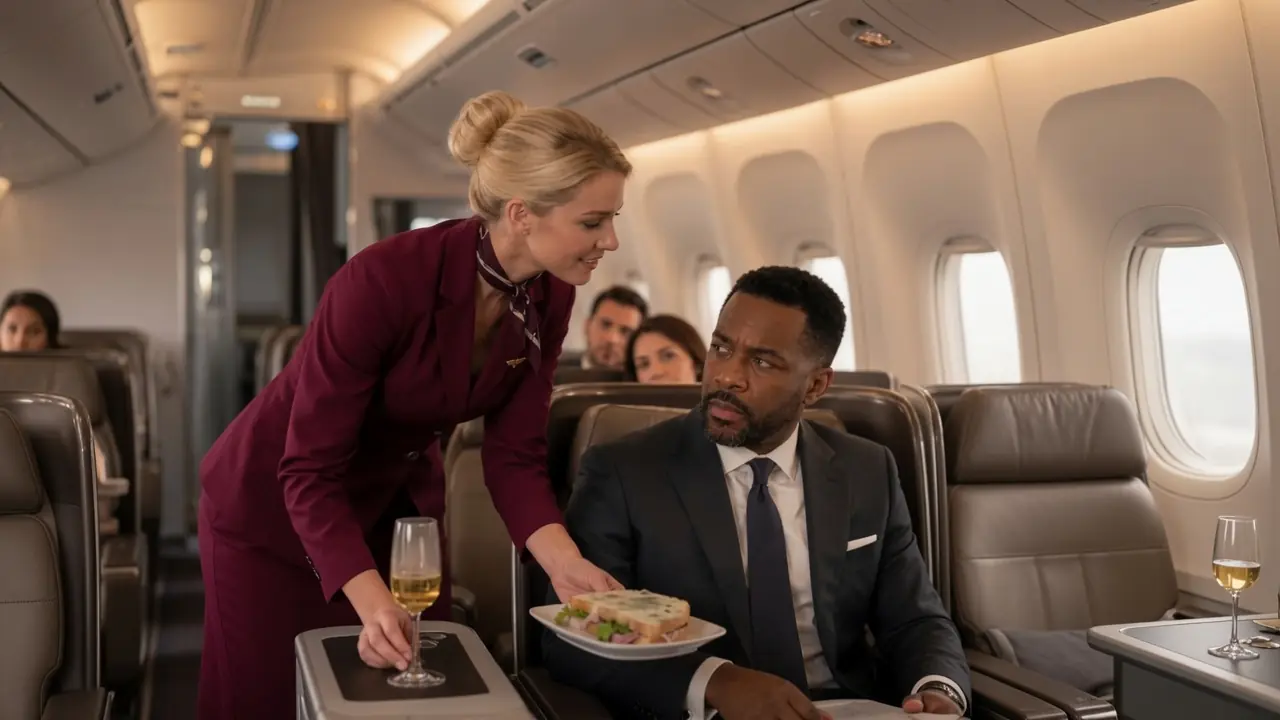
“You deliberately chose spoiled food,” he said, lifting his phone from the armrest, “and I recorded every second.”
Victoria’s smile barely moved. “No one here will believe your little video over my report.”
James pressed the call button above his seat. “Then explain it to the senior purser—and to the man who owns this airline.”
The expression on Victoria’s face changed for less than a second. It was not fear yet, only confusion, as though James had spoken a sentence too ridiculous to deserve serious thought. Around them, the first-class cabin of Skylux Flight 892 fell silent, leaving only the low hum of the engines and the soft rattle of glassware against serving carts.
James Washington was forty-four years old, tall, broad-shouldered, and dressed in a charcoal suit tailored so precisely that it looked simple rather than expensive. His deep-brown skin, neatly trimmed beard, and calm dark eyes gave him the composed appearance of a man accustomed to listening before deciding whether someone deserved an answer. Nothing about him suggested nervousness, despite the fact that nearly every passenger nearby was watching.
Victoria straightened and lowered her voice. “You need to stop creating a scene.”
“I didn’t create one,” James replied. “I ordered lunch.”
A gray-haired businessman across the aisle studied the sandwich and quietly moved his own plate away. Behind James, a married couple exchanged worried glances, while another passenger lifted her phone as if preparing to record whatever happened next. Victoria noticed and stepped closer to block their view.
“You boarded late,” she said sharply. “Your reservation was flagged, you refused my instructions, and now you’re making accusations.”
“My boarding pass scanned correctly.”
“You acted as though you were entitled to special treatment.”
“I sat in the seat I purchased.”
Victoria leaned down again, her perfume mixing unpleasantly with the smell of spoiled food. “Men like you always think a suit makes people forget where you came from.”
James’s expression remained still, but something in his eyes hardened. “Men like me?”
Before Victoria could answer, the navy curtain separating first class from the forward galley opened. Senior Purser Elena Morales entered with quick, controlled steps, followed by a younger flight attendant named Daniel Cho.
Elena had worked for Skylux Airlines for twenty-one years and was known among crews for handling difficult situations without raising her voice. She looked first at James, then at Victoria, and finally at the sandwich resting untouched on the tray. Her professional expression tightened.
“What happened here?” Elena asked.
Victoria answered immediately. “This passenger became aggressive after I served his meal. He is falsely accusing me of tampering with it and trying to intimidate me by claiming he owns the airline.”
“I said I have a recording,” James corrected.
Elena turned toward him. “Sir, may I see it?”
Victoria stepped between them. “There is no need to encourage this. He probably filmed me without permission and edited something.”
James unlocked his phone. “The video is continuous.”
He tapped the screen and held it where Elena could see. The recording had begun seven minutes earlier, after James noticed Victoria behaving strangely near the galley. He had initially turned on the camera because she had twice removed his sealed meal from the service cart while whispering to another attendant.
The video showed Victoria opening a refrigeration drawer and selecting a sandwich wrapped in plastic. She inspected it, noticed the visible mold, and smiled. Then she removed the wrapper, arranged the sandwich on a clean first-class plate, added garnish, and carried it toward James’s seat.
Her voice could be heard clearly before she left the galley.
“Let’s see if Mr. Important still feels first class after this.”
Daniel appeared in the corner of the video, staring at her. “Victoria, that meal is spoiled.”
“He won’t eat it,” she replied. “He’ll complain, I’ll document him as disruptive, and security can deal with him when we land.”
The recording ended only after she arrived beside James.
Elena watched the video twice.
When she looked up, Victoria’s face had lost all color. “That is not what it looks like.”
“It looks like you knowingly served contaminated food,” Elena said.
“I was making a joke.”
“You placed it on a passenger’s tray.”
“He was rude to me before takeoff.”
James folded his hands. “I asked why you checked my boarding pass three times after allowing every other first-class passenger through.”
Victoria turned toward him. “You had a last-minute ticket.”
“So did the man in seat 2A.”
The gray-haired businessman across the aisle raised one hand. “He is correct. I booked this morning. She welcomed me by name and offered champagne before checking anything.”
Elena looked toward Daniel. “Did you witness what happened in the galley?”
Daniel hesitated.
Victoria stared at him with an unmistakable warning. She was senior to him, had helped train him, and often decided which crew members received favorable reports after long-haul flights. Speaking against her could affect his schedule, evaluations, and career.
Daniel swallowed. “Yes.”
Victoria’s head snapped toward him.
He continued, “I told her the food was spoiled. She served it anyway.”
A heavy silence settled over the cabin.
Elena removed the plate using two napkins and placed it inside an empty service container. “Victoria, step into the galley.”
“You are going to believe them without hearing my side?”
“I heard your side.”
“You don’t understand what happened before the recording.”
“Then explain it in the galley, away from the passengers.”
Victoria did not move. “He threatened me.”
James lifted his eyebrows. “When?”
“When you said you owned the airline.”
“That came after you served the food.”
“You wanted to scare me.”
“I wanted you to understand the seriousness of your decision.”
Victoria gave a short, bitter laugh. “You expect everyone here to believe that you own Skylux?”
James glanced at Elena. “Would you like confirmation?”
The senior purser’s eyes moved toward the gold initials engraved on the edge of his phone case: J.W. She studied his face again, and recognition slowly appeared.
“James Washington,” Elena said quietly.
Victoria rolled her eyes. “He already told us his name.”
Elena ignored her. “Washington Meridian Group?”
James nodded.
The gray-haired passenger across the aisle sat straighter. Several other passengers began searching the name on their phones. Within seconds, whispers spread through the cabin.
Washington Meridian Group was a private investment company known for purchasing struggling transportation businesses and rebuilding them without publicly replacing their original brands. Six months earlier, the company had acquired a major interest in Skylux Airlines after years of declining service and internal complaints.
James had intentionally remained out of press photographs connected to the agreement. His business partner served as the public face of the acquisition, while James conducted quiet inspections of routes, employees, and customer experiences. Only senior executives and board members had met him directly.
Elena lowered her voice. “Mr. Washington is the co-chairman of our ownership group.”
Victoria looked from Elena to James. “That doesn’t prove he controls my employment.”
“No,” James said. “Your actions control your employment.”
He did not sound pleased or triumphant. That frightened Victoria more than anger would have.
Two hours earlier, James had entered the Skylux premium check-in area at Chicago O’Hare wearing the same charcoal suit and carrying a single leather bag. He was traveling to New York for a board meeting, but he had booked under his own name without adding the internal designation that would alert employees to treat him as an executive.
He wanted to see the airline the way an ordinary passenger saw it.
The first employee who greeted him was professional and kind. The security process was uneventful, and the gate agent welcomed him without hesitation. James began believing the cultural problems described in employee reports might have been exaggerated.
Then Victoria arrived at the boarding door.
She greeted the white passenger ahead of James with a bright smile. “Welcome aboard, Mr. Langley. We’re delighted to have you.”
When James presented his boarding pass, her expression changed.
“This line is for first class.”
“I know.”
“You may want the general boarding line.”
“My seat is 1C.”
Victoria scanned the pass and frowned when the system accepted it. She examined his name, then looked him over from his shoes to his face.
“Did someone else purchase this ticket for you?”
James held her gaze. “Does that affect whether it is valid?”
“I’m making sure you understand the fare restrictions.”
“What restrictions?”
She offered no answer, only scanned the pass again and allowed him through.
Inside the aircraft, Victoria stopped him near seat 1C and requested identification. When he asked why, she claimed his name did not match the passenger manifest. James gave her his driver’s license, and she compared it for nearly thirty seconds before returning it.
The passenger in 1A, a white software executive named Charles Langley, watched with visible discomfort. Victoria had not requested identification from him.
James sat down without complaining.
His purpose was observation, not confrontation.
During predeparture service, Victoria offered champagne to every passenger in the cabin except James. When Daniel noticed and attempted to bring him a glass, Victoria stopped him and whispered that James had declined.
“I didn’t decline,” James said.
She turned with a cold smile. “Perhaps I misunderstood.”
He accepted water instead.
The airplane departed on schedule. Once the seat-belt sign was turned off, Victoria distributed printed menus. She handed James a menu last, even though he occupied the first row.
When she returned for meal orders, he chose the turkey sandwich and soup.
“That item is popular,” she said. “I’m not sure we have enough.”
Daniel checked the cart. “We have three.”
Victoria glared at him. “I said I’m not sure.”
James closed the menu. “Then soup is fine.”
“No,” Daniel said. “There are enough sandwiches.”
Victoria wrote down the order without looking at James. “We will see what remains after serving the other passengers.”
That was when James began paying closer attention.
He noticed Victoria moving his sealed meal aside, speaking quietly to Daniel, and searching through a separate refrigeration drawer. He placed his phone upright against a glass, started recording, and waited.
Now the recording had exposed more than poor service.
It showed deliberate humiliation, discrimination, retaliation, and an attempt to create a false safety report against a passenger who challenged her authority.
Elena escorted Victoria into the galley while Daniel replaced the contaminated tray with a sealed meal. James declined the food and requested only bottled water.
“I’m very sorry,” Daniel said.
“You tried to stop her.”
“I should have stopped her more firmly.”
“You were afraid of retaliation.”
Daniel looked toward the closed galley curtain. “She has written negative evaluations on people who disagree with her.”
“Has anyone reported that?”
“Yes.”
“What happened?”
“Nothing.”
James absorbed the answer without commenting.
Across the aisle, Charles Langley leaned toward him. “You handled that better than I would have.”
James looked at him. “You saw how she treated me during boarding.”
Charles’s face tightened. “I did.”
“You said nothing.”
“I wasn’t sure what was happening.”
“You became sure before the food arrived.”
The businessman looked down at his hands. “You’re right.”
James did not shame him further. “Next time, speak before someone needs a recording.”
Charles nodded slowly. “I will.”
Inside the galley, Victoria tried several explanations.
She claimed James had insulted her, though no passenger or crew member heard it. She said the sandwich was part of a training demonstration, despite placing it on his tray. Then she accused Daniel of planting the meal to damage her career.
Elena documented every statement.
“We are landing in ninety minutes,” she said. “You are relieved of service duties until the captain and ground management review this.”
“You cannot suspend me.”
“I can remove you from the cabin.”
Victoria folded her arms. “James Washington set me up.”
“He booked a seat.”
“He filmed me.”
“Because your behavior gave him reason to.”
“He wants to make an example of me.”
Elena studied her. “You made an example of yourself.”
Victoria was instructed to remain in a crew jump seat for the rest of the flight. Another attendant took over first-class service, and Daniel completed his duties under Elena’s supervision.
James spent the remaining flight reviewing internal documents on his laptop. He did not call the chief executive or demand immediate punishment. He had learned that powerful people often corrupted investigations by announcing the desired outcome before all evidence was collected.
He wanted the process to work correctly.
When Flight 892 landed at John F. Kennedy International Airport, two airline security officers, a union representative, and Skylux’s regional operations director waited at the gate. Passengers were asked to remain seated briefly while the crew secured the contaminated food and copied the recording.
Victoria stood near the aircraft door with her chin raised.
“This is a misunderstanding,” she told the operations director. “The passenger is abusing his position.”
The director looked at James, clearly recognizing him. “Mr. Washington, I apologize on behalf of Skylux.”
“Do not apologize until you understand how long this has been happening.”
The man’s expression changed.
James turned toward Daniel and Elena. “Make sure both of their statements are protected from retaliation.”
“Yes, sir.”
Victoria laughed bitterly. “So they get rewarded for lying while I’m destroyed?”
James faced her. “You selected spoiled food, placed it on my tray, tried to provoke a complaint, and planned to label me disruptive. Which part is a lie?”
“You embarrassed me.”
“I showed what you did.”
“You don’t know what it’s like serving people who treat us like servants.”
“No passenger’s arrogance gives you permission to poison or discriminate against someone else.”
“It was only mold. You were never going to eat it.”
“You did not know that.”
Victoria looked around for support but found none.
The passengers departed one by one. Several gave statements voluntarily, including Charles Langley, who admitted he witnessed different treatment from the moment James boarded. The woman behind James provided her own video showing Victoria’s comments at his seat.
By the time James entered the terminal, the case no longer depended on his authority.
It depended on evidence.
The formal investigation began that afternoon.
Human resources discovered fourteen previous complaints involving Victoria. Six passengers said she questioned whether they belonged in premium cabins. Three Black passengers reported repeated ticket checks that white companions were not required to undergo.
Two junior flight attendants said Victoria punished them with poor evaluations after they challenged discriminatory behavior.
Most complaints had been closed as misunderstandings.
One internal reviewer had written that Victoria’s “strong personality” could be misinterpreted by sensitive passengers. Another recommended customer-service coaching but never confirmed whether she attended it.
James read every file.
The problem was no longer one hostile flight attendant.
It was an organization that had trained employees to believe documentation mattered less than seniority, reputation, and convenience.
At the board meeting the next morning, several executives expected James to focus only on Victoria. Instead, he placed a thick folder in the center of the table.
“This employee was reported fourteen times,” he said. “Why was she still in a position to retaliate against passengers and junior crew?”
The vice president of cabin operations adjusted his tie. “Most complaints lacked independent evidence.”
“Three contained witness statements.”
“They were considered subjective.”
“One involved a junior attendant who reported food tampering.”
The room became quiet.
James opened the file. Two years earlier, a trainee accused Victoria of intentionally giving a passenger a meal containing an ingredient listed in his allergy notes. The passenger noticed before eating it, and the report was quietly closed after Victoria claimed confusion.
“Who reviewed this?” James asked.
A senior manager raised her hand.
“Why was there no follow-up?”
“Victoria had excellent performance scores and strong passenger reviews.”
“From which passengers?”
The manager did not answer.
James continued, “An employee can provide exceptional service to people she respects and still be dangerous to people she does not.”
By noon, the board authorized an independent review of all discrimination, retaliation, and food-safety complaints from the previous five years. Anonymous reporting protections were strengthened, and junior crew evaluations could no longer be controlled by a single senior attendant.
Victoria’s employment was terminated after the investigation confirmed deliberate food tampering and dishonesty during questioning.
She appealed through her union.
The union representative reviewed the video and declined to contest the termination beyond ensuring her contractual rights were followed.
Daniel received no promotion or bonus for speaking up. James insisted that honesty should not require a reward to become expected behavior. However, the false negative evaluations Victoria had placed in his file were removed, and he was invited to help redesign the reporting system for junior crew members.
Elena became part of the airline’s new passenger dignity and safety council.
Three weeks later, James returned to Flight 892’s route.
This time, the crew knew who he was before boarding. He disliked the attention but understood that another anonymous inspection would now feel staged.
At the gate, Daniel greeted him professionally.
“Welcome aboard, Mr. Washington.”
James handed over his pass. “Check it as many times as necessary.”
Daniel smiled. “Once should be enough.”
Inside first class, Charles Langley occupied seat 1A again by coincidence. He stood when James approached.
“I spoke up last week when another passenger was treated differently at a hotel,” Charles said.
James placed his bag overhead. “What happened?”
“The manager corrected it.”
“Then the outcome was better because you didn’t wait.”
Charles nodded. “I remembered what you said.”
After takeoff, Daniel approached with the meal cart.
“We have turkey sandwiches,” he said. “Fresh ones.”
James examined him seriously. “Are you certain?”
Daniel’s face fell before he noticed the slight smile beneath James’s beard.
“Yes, sir. I inspected every corner.”
“Then I’ll have one.”
The sandwich arrived on a white plate with fresh bread, crisp lettuce, and no hidden insult attached to it. James ate quietly while the cabin continued around him.
Skylux issued no dramatic advertisement about the incident. James refused to turn discrimination into public relations material or use Victoria’s termination as proof that the entire company had changed.
Instead, the airline published transparent complaint data, improved independent reviews, and created a policy requiring immediate preservation of video evidence when passengers reported misconduct. Within a year, unresolved discrimination complaints declined sharply because managers could no longer dismiss them without documenting the investigation.
The story still reached the public.
A passenger uploaded part of the confrontation, and millions watched Victoria push the moldy sandwich toward James while telling him he did not belong. Many viewers focused on the twist that the humiliated passenger owned part of the airline.
James thought they misunderstood the most important point.
He deserved safe food and respectful service before anyone knew his name.
The next Black passenger should not need to be a CEO.
The next traveler should not need a hidden camera, boardroom authority, or powerful attorneys before an employee’s cruelty was taken seriously. A first-class ticket did not create human dignity, just as an expensive suit did not prove it.
Months later, James visited Skylux’s training center and spoke to a room filled with newly hired attendants.
He showed them the moldy sandwich video.
Most watched Victoria.
James asked them to watch Daniel instead.
They saw the young attendant recognize the wrongdoing, speak once, become intimidated, and then remain silent until the senior purser directly questioned him.
“Courage rarely arrives as a perfect moment,” James told them. “Usually it arrives as ten uncomfortable seconds when you decide whether another person will face cruelty alone.”
A trainee raised her hand. “Would you have fired Victoria if she had not known who you were?”
James looked around the room.
“That question is why the airline had a problem.”
The trainee lowered her hand, understanding.
James continued, “Who I was should never have determined whether the food was safe, whether the report was believed, or whether her conduct mattered.”
On his way out, Elena met him near the training-room door.
“Do you think the airline has changed?” she asked.
“It is changing.”
“That sounds less optimistic.”
“It is more honest.”
They walked through the corridor beneath photographs of Skylux aircraft from different decades. The company had survived bankruptcies, mergers, labor disputes, and management failures.
James understood that changing a logo or removing one employee was easy.
Changing what people believed they could get away with required constant attention.
Before Flight 892, Victoria believed passengers could be divided into two groups: those whose complaints mattered and those whose complaints could be turned against them. She mistook authority for protection and silence for agreement.
Then she placed a moldy sandwich in front of the wrong person.
Not because James Washington owned the airline.
Because he had learned long ago that when someone smiles while humiliating you, the truth sometimes needs a camera.
Her final mistake was believing the phone would reveal only her behavior.
Instead, it exposed every manager who had ignored the warnings, every report quietly closed, and every witness who had chosen comfort over courage.
The spoiled meal was removed within minutes.
The culture that served it took much longer to clean.