A teenage boy boarded first class, quiet, respectful.
Minutes later, a flight attendant slapped his hand, accused him of lying, and forced him to the back of the plane.
What she did not know was that he was the son of a billionaire.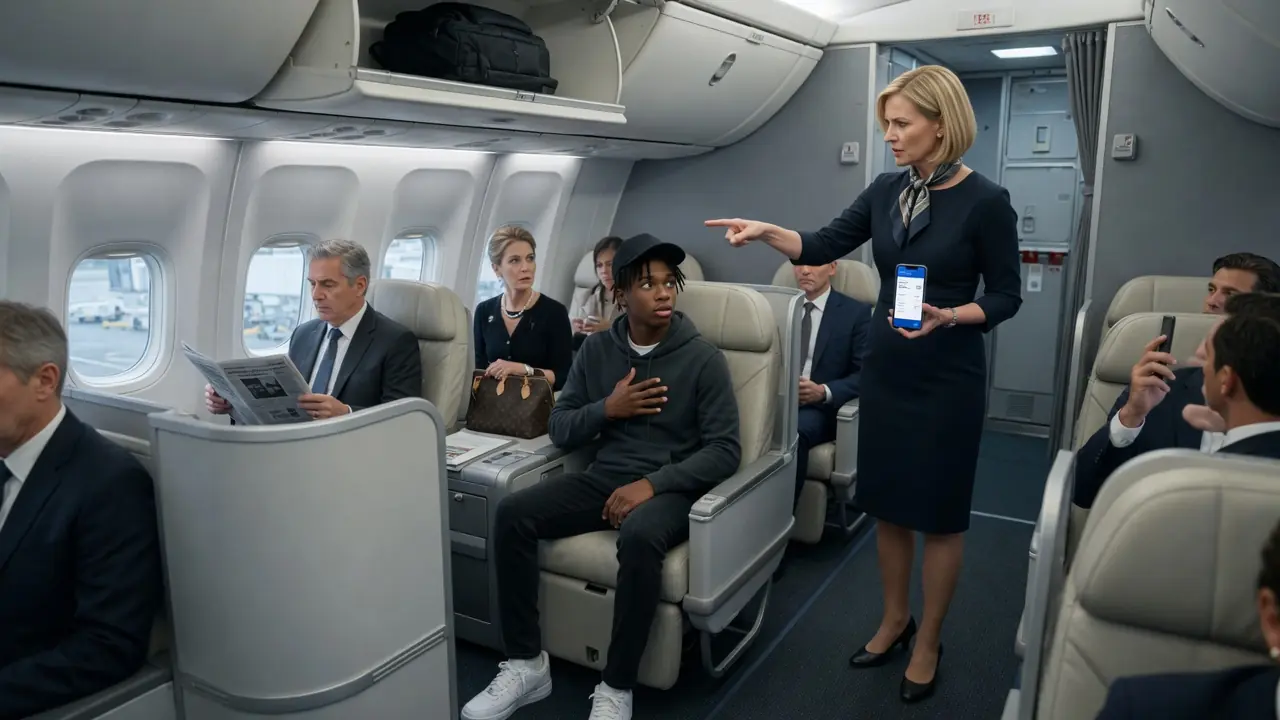
And with just one text, he stopped the entire aircraft from taking off.
What happened next forced an airline and every passenger on that flight to face a truth many people pretend not to see.
He walked through Gate 17 of JFK International Airport without making a sound.
His footsteps were soft against the sterile tile floor. His hoodie was drawn up, his face half hidden in the shadow of his cap. No entourage. No flashing cameras. No security team walking beside him.
Just a seventeen-year-old boy traveling alone.
To most of the world, he looked like a quiet teenager who might have been lucky to fly standby. A kid with long limbs, sharp eyes, and the kind of polite stillness adults often mistook for uncertainty.
No one noticed when he passed beneath the gold-lettered first-class sign.
No one questioned him when he stepped onto the jet bridge.
Not yet.
Jaylen Monroe knew this routine well.
He did not flaunt his name in public. Especially not here. Especially not now. He preferred stillness. Silence. The kind of calm that came from being underestimated.
That was when people told on themselves.
That was when you learned the truth.
Inside the aircraft, the smell of citrus cleaner and recycled air clung to every surface. A flight attendant in her early forties stood near the entrance, greeting each passenger with the same mechanical smile.
But when her eyes met his, something shifted.
Her name badge read Deborah.
Her smile paused mid-formation.
She tilted her head slightly, assessing him.
A flicker of doubt crossed her face.
A boy.
A hoodie.
Alone.
First class.
Jaylen offered a soft nod and walked past her without waiting for permission.
Seat 1C.
Aisle.
He liked the aisle. It made it easier to see everything.
He stowed his backpack in the overhead bin, careful not to disturb anyone, then sat down with quiet precision.
No one looked twice.
The man across from him adjusted his watch. The woman to his left clutched a designer purse and glanced at her phone. Jaylen opened a book, but he felt the moment before it arrived.
The shift.
The pause.
The sound of footsteps returning.
“Excuse me,” Deborah said, her voice just loud enough to claim the space around him. “I need to check your boarding pass.”
Jaylen looked up, startled but not confused.
“It’s right here,” he said, offering the digital pass on his phone screen.
She did not look at the screen.
Not really.
She looked at him.
Then at the pass.
Then at him again, as if the math did not add up.
“This is for first class,” she said flatly.
“Yes,” Jaylen replied, calm as breath.
Deborah crossed her arms.
“And you’re flying alone?”
“Yes.”
Her tone shifted, sharper now.
“Who bought your ticket?”
Jaylen blinked, still seated.
“Does it matter?”
A long one.
A few passengers turned their heads, sensing something off.
Deborah did not flinch. She stepped closer, violating the quiet zone of civility passengers expected around them.
“I need to verify this with the gate. This seems irregular.”
Jaylen did not move.
“You’re welcome to verify,” he said. “I’ll wait.”
But Deborah did not go to the gate.
She did not call a supervisor.
She stayed there, as if the seat itself was somehow in danger because he was sitting in it.
Then she did something no one expected.
She reached across him, snatched the phone from his hand, and in the motion, slapped the side of his fingers.
The sound, a sharp stinging pop, cracked through the cabin.
A few people gasped.
The man in 1A looked up from his newspaper.
The woman with the designer bag stared.
But still, no one said a word.
Jaylen recoiled, not in pain, but in disbelief.
“That wasn’t necessary,” he said quietly.
“You need to come with me,” Deborah snapped.
He stood slowly.
He collected his backpack and walked the walk he had seen too many others take.
The long, humiliating aisle through whispers and averted eyes.
No one stopped her.
No one stopped him.
Even those who knew something was wrong said nothing because they did not want to get involved. Because maybe they thought she was right. Because maybe they told themselves it was a misunderstanding.
Jaylen did not cry.
He did not raise his voice.
He simply took an empty seat in the last row, shoved between two strangers, the engine hum his only companion.
Then he reached into his backpack and pulled out his second phone.
The one she had not managed to take.
He typed one line of text.
She slapped my hand. I’m in the back.
He hit send.
Somewhere miles above the city skyline in a mirrored tower in Chicago, a different kind of storm began to gather.
The message was read almost instantly.
The man reading it did not hesitate.
His name was Elijah Monroe, founder of five global technology companies, a quiet, deliberate billionaire whose fingerprints were woven into the digital infrastructure of half the country.
He was also Jaylen’s father.
And in that moment, he became something more.
He became still.
Then he made one call.
And the plane stopped moving.
The flight, only moments from taxiing, froze on the tarmac.
The crew was instructed to delay departure. A code was entered into the gate system, triggering a cascade of alerts.
Inside the cockpit, the captain received a message he had not seen in fifteen years of flying.
Hold at gate. Executive override. Do not depart.
The captain, puzzled, looked over at his co-pilot.
“Executive override?”
“Yeah,” the co-pilot replied, eyes wide. “From corporate. Something serious.”
And it was.
Back in the last row, Jaylen closed his eyes, letting the sound of the engines fade into the background.
He did not smile.
He did not fume.
He waited.
He knew his father would not let this sit.
Up front, Deborah stood near the galley, confused by the sudden halt in activity.
A younger attendant approached her.
“We just got word we’re being held,” she whispered.
Deborah frowned.
“Why? Weather’s clear.”
The younger attendant shrugged.
“I don’t know. Something from the top. You might want to talk to the captain.”
For the first time that morning, Deborah felt a tremor ripple down her spine.
A tightening in her chest.
A realization.
Slow.
Sharp.
Irreversible.
She had not just kicked a boy out of a seat.
She had humiliated the wrong person.
And the seat belt sign had not even turned off yet.
The silence in the last row of the aircraft was thick, but it was nothing compared to the quiet storm behind Jaylen’s composed exterior.
The low thrum of the engines had become background noise, a kind of emotional static that echoed the distance he now felt. Not just from his seat in first class, but from the dignity stripped from him without a word of protest from anyone around.
Jaylen had never needed a crowd.
He did not need affirmation.
He had been raised to lead with presence, not noise.
But this was not about ego.
This was about a moment that kept repeating itself in his mind.
The slap.
The stare.
The command to move.
It was not the physical sting that stayed with him. It was the disbelief. The certainty in Deborah’s voice. The entitlement in her eyes. The absolute conviction that he did not belong.
She did not ask.
She decided.
Now, as the plane sat motionless, suspended between protocol and consequence, Jaylen felt every second tick by like a reckoning taking shape.
In the cockpit, the captain received a second update.
It was short and direct.
Executive contact: Elijah Monroe. Full authority granted. Immediate compliance expected.
The captain did not ask questions.
He had flown planes for nearly two decades, but he knew when to recognize gravity, and not just the kind that pulled metal birds from the sky.
He turned to his co-pilot and muttered, “That boy in 1C.”
“The one they moved?”
The co-pilot nodded.
“Apparently, he’s the reason we’re grounded.”
In the cabin, whispers began to bubble beneath the polished surface of luxury travel.
A woman in pearls leaned toward her husband and murmured, “I heard she slapped him.”
“That’s what delayed the flight?”
The husband, a man with thinning gray hair and a pressed blazer, shook his head slowly.
“Unbelievable.”
Back in the galley, Deborah felt her certainty beginning to crack.
Her hands were folded, but her knuckles had turned white.
She had operated on instinct.
Years of subtle cues, silent judgments, glances she never second-guessed. It was never direct. Never loud. That was the danger of it.
It dressed itself in procedure and called itself experience.
But she knew now, deep in her gut, that something had shifted. Something she could not smooth over with an apology and a napkin.
And she had not even asked his name.
Back in 39F, Jaylen’s phone vibrated.
A message from his father.
They know now. Stay seated. Don’t speak. Don’t move unless asked. Let the silence teach them.
Jaylen read it twice.
Elijah Monroe did not speak often, but when he did, he was precise.
Power, Jaylen had learned, was not in volume.
It was in patience.
In the ability to make others listen without needing to shout.
In seat 3A, a man tapped nervously on his armrest. He had watched the boy get moved. He had seen the flight attendant’s tone, her posture, the way she had not checked anyone else’s boarding pass.
He had said nothing.
Now that silence was burning in his throat.
When he turned back to look down the aisle, the boy was not looking at anyone.
Just forward.
Still.
Like someone used to waiting for the world to catch up.
Suddenly, the intercom pinged.
“Ms. Deborah Lanning, please report to the cockpit.”
The voice was calm.
Too calm.
Deborah flinched.
The younger flight attendant beside her glanced over.
“You okay?”
Deborah nodded too fast, then stepped forward, trying to mask the fear clawing its way up her spine.
As she approached the front, she noticed the man in 1A lower his newspaper. His gaze followed her.
The cockpit door opened before she knocked.
The captain’s expression was unreadable.
“Close the door,” he said.
The moment it clicked shut, he spoke again.
“We’ve been contacted by Mr. Elijah Monroe’s office. That boy, Jaylen, is his son.”
Deborah’s mouth opened, but nothing came out.
“You did not follow boarding verification protocol,” the captain continued. “You made assumptions. You touched him. And now we’re grounded.”
She tried to explain.
“It wasn’t meant—”
“It doesn’t matter what you meant,” the captain interrupted, his voice cold. “It matters what you did. Mr. Monroe has requested that you apologize in front of the cabin, publicly, or you will be escorted off this flight immediately.”
Her breath caught.
“In front of the passengers?”
“Yes,” the captain said. “All of them.”
Back in row 39F, Jaylen did not move.
His phone buzzed again.
Another message from his father.
She’s about to walk that aisle. Watch her, but don’t say a word.
He slid the phone into his pocket and exhaled.
The sound of slow footsteps echoed in the cabin as Deborah returned.
Passengers turned their heads.
The atmosphere shifted like a sudden draft through still air.
She walked slowly, her composure cracked like porcelain.
When she reached the final row, she stopped and forced herself to meet his eyes.
“Mr. Monroe,” she said, her voice quieter than before. “I want to apologize. I misjudged you, and I acted inappropriately. I hope you’ll accept my sincere apology.”
Jaylen did not blink.
He did not flinch.
He did not rise.
Instead, he simply looked at her with a calm so rooted it made her knees feel unsteady.
“I accept your apology,” he said after a moment. “But you didn’t just misjudge me. You made a decision about who belonged and who didn’t.”
She swallowed hard.
“I hope,” he continued, “you think about who else you’ve done that to. People who didn’t have someone powerful to call. People who had to sit in silence.”
The words were not cruel.
They were measured.
And they landed like weight on her shoulders.
Deborah nodded once and turned to leave, her figure smaller now beneath the scrutiny of those once too silent to speak.
As she walked past the front rows, a few passengers lowered their eyes. Some watched with approval. One even gave a slow, solemn nod.
Back in his seat, Jaylen rested his head against the window.
This was not about revenge.
It never had been.
This was about exposure.
And exposure, when earned, does not require volume.
It only requires that the world stop pretending not to see.
At thirty-six thousand feet, where the clouds looked soft but the truths felt sharp, the cabin of Flight 421 settled into a disquieting stillness.
Drinks were being served. Seat belts remained fastened. The hum of the engines blended with the quiet rustle of pages turning and screens flickering.
But beneath it all was the altitude of consequence, where the air was thin and accountability traveled faster than sound.
Jaylen sat in 39F, still as ever, his profile cast in the dim light filtering from overhead.
He had not moved since Deborah’s apology.
He had barely spoken.
But his silence was not avoidance.
It was presence.
A kind of unshakable steadiness that unnerved those who had watched the earlier confrontation unfold and said nothing.
There is something unsettling about watching a person you dismissed suddenly command a room with nothing but silence.
That was what Jaylen had become.
A mirror they could not look away from.
Three rows ahead, a woman who had once looked at him with suspicion now glanced back with something else.
Guilt, maybe.
Or self-awareness.
She had not joined the murmur of defense or dissent. She had not offered an apology either. She had simply watched.
And watching, as it turned out, was no longer passive.
Back in the galley, Deborah stood pressed against the wall near the coffee station, her hands clasped tightly. The shake in her fingers betrayed the tight-lipped composure she fought to maintain.
The paper she had signed, the preliminary removal order, felt heavier than it looked.
Taylor, quiet and observant, stood nearby, offering neither comfort nor condemnation.
“You okay?” Taylor asked gently, though she already knew the answer.
Deborah did not reply at first.
Then she said, “I’ve flown this route for twelve years, and I don’t think I’ve ever felt this small.”
Taylor did not respond.
Some things were not meant to be fixed with words.
Not anymore.
In the cockpit, the captain received the latest communication from corporate.
The official inquiry had been initiated. Statements would be gathered upon landing. The CEO himself had requested an internal review of boarding procedures and in-flight conduct.
This is a turning point, the message read.
And it was.
Because high above the earth, the truth was beginning to descend with gravity.
The passengers could feel it.
The weight of being witnesses.
The discomfort of their silence now echoing louder than any engine.
Jaylen was not looking for anyone to speak.
He had stopped expecting it a long time ago.
But something was shifting.
The eyes that once scanned him with suspicion now lingered longer, unsure how to meet his gaze, uncertain what they would find if they did.
He took a slow breath, watching the condensation on his glass of water.
That glass, filled politely by Taylor earlier, had been more than refreshment.
It had been a gesture of restoration.
One small action trying to balance a scale too often left tilted.
Across the aisle, a man in a navy suit leaned toward him. His voice was low, tentative.
“I didn’t say anything earlier. I should have. I’m sorry.”
Jaylen looked at him calmly.
“Why didn’t you?”
The man exhaled.
“Because I didn’t think it would make a difference. And that’s not an excuse. It’s just the truth. I didn’t want to make it worse.”
“It was already worse,” Jaylen replied. “Silence doesn’t make things safer. It just makes the damage quieter.”
The man sat back slowly, absorbing the words.
No defensiveness.
Just reckoning.
Farther back, two younger passengers shared a phone screen, watching a video silently uploaded by a traveler in the middle cabin.
It showed the moment Deborah had approached Jaylen.
Her voice.
Her tone.
Her posture.
It was all there.
The slap itself had not been caught on camera, but the humiliation was unmistakable.
The video had already been viewed twelve thousand times in under an hour.
And it was still climbing.
Meanwhile, Jaylen’s father, Elijah Monroe, was on a call with the airline’s board of directors.
He was not threatening legal action.
Not yet.
He was not interested in making headlines or demanding firings for the sake of appearances.
He wanted change.
He wanted systemic acknowledgment that what had happened to his son was not isolated.
“This is not about one attendant,” he said calmly. “It is about a pattern. And you do not get to fix this with public relations. You fix it by unlearning what you thought professionalism looked like.”
Back on the plane, Jaylen shifted in his seat for the first time in nearly an hour.
He opened his phone, not to scroll, but to read the latest message from his father.
They’re listening. Keep your head up.
Jaylen typed one line in return.
I don’t want them to be afraid. I want them to be aware.
At that same moment, Taylor re-entered the cabin with a tray of drinks. Her steps were steady, but her heart was not.
She passed Jaylen, paused briefly, and leaned down.
“They’re starting to understand,” she said softly.
Jaylen nodded.
“Some will.”
“The rest?”
He did not finish the sentence.
He did not need to.
Awareness does not reach everyone at once.
But once it starts, it spreads quietly, powerfully, like cabin pressure shifting slowly until you cannot ignore the change in your breathing.
As the aircraft soared above the clouds, something else was rising too.
Consequence.
Not just for Deborah, but for every passenger who sat in that first-class cabin and watched a boy be stripped of dignity, only to realize too late that they had been sitting on the wrong side of history.
And history, like altitude, has a way of revealing who you are when the air gets thin.
The wheels touched down on the tarmac with a soft jolt.
But for Jaylen Monroe, it did not feel like arrival.
It felt like exposure.
As the aircraft slowed to a crawl, he looked out the window at the city skyline beyond, familiar and indifferent. The landing gear had done its job, but inside the cabin, the air still felt thinner than it should have.
The kind of air you breathe when you know all eyes are about to turn your way and none of them quite know what to say.
Flight 421 had become more than a journey.
It had become a memory none of them would leave behind.
Not because of turbulence or a missed connection, but because of a moment that had peeled back the illusion of comfort and revealed something raw and unsettling beneath it.
Jaylen sat quietly in seat 39F, watching the terminal lights blur through the window.
He was not thinking about headlines or consequences.
He was thinking about how silence felt heavier than confrontation.
About how even when things are handled, something inside you still hurts where the bruise does not show.
The captain’s voice broke through the quiet.
“Ladies and gentlemen, welcome to Denver International. We ask that you remain seated as ground crew prepares the aircraft for arrival. There will be a brief delay before deboarding. We appreciate your patience.”
But patience was not what filled the cabin.
It was tension.
Awareness.
The kind that lingers in rooms where injustice has unfolded and no one quite knows how to move forward without stepping on the shame left behind.
In the galley, Deborah stood stiffly, arms crossed, eyes on the exit.
Her uniform felt too tight now.
Her badge felt heavier than before.
She had said her apology. She had walked him back. But none of that had undone what came before.
And worse, she knew it would not.
Taylor approached her with a folded paper from the captain.
A final directive from corporate.
“You are to remain on board until escorted by airline management. Please surrender your crew badge before leaving the aircraft.”
Deborah read the sentence once.
Then twice.
As if disbelief could delay reality.
She did not speak.
She just unpinned the metal badge and dropped it into Taylor’s open hand.
The weight of it landed with a soft clink.
But the sound echoed through her.
“I didn’t mean—” Deborah began.
Taylor cut her off with a look.
Not cruel.
Not angry.
Just done.
“You didn’t have to mean it,” Taylor said. “You just had to stop it before it happened.”
Deborah looked away, her eyes unfocused.
She was not thinking about protocol anymore.
She was remembering Jaylen’s face when she slapped his hand. How composed he had been. How much smaller she had felt the moment she realized who he was.
Not just a teenage boy in a hoodie.
Someone with power.
But now she saw what she had not before.
Even if he had not had that last name, that connection, that reach, it still would have been wrong.
And that was what haunted her most.
In the cabin, the flight attendants moved through the aisles slowly, as if unsure how to end a journey that had changed in the middle.
Passengers fidgeted, checked their phones, and cast glances toward the back, where Jaylen remained still.
Unbothered on the surface.
Etched with something deeper beneath.
A woman in row 37 leaned toward her husband.
“You think the airline will make a statement?”
“I hope they do,” he whispered back. “But I think he already made the louder one.”
Jaylen did not respond to the quiet murmur around him.
He felt it all, but let none of it move him.
He was waiting.
Not for an apology.
Not for validation.
For something else.
Something that might never arrive.
Understanding.
The door to the aircraft finally opened with a soft hiss, and a uniformed gate supervisor stepped inside.
Behind him stood a man in a navy blazer and a woman holding a clipboard, her expression unreadable.
They did not walk directly to first class as they usually did.
Instead, they paused, glanced toward the back of the plane, and waited.
“Passenger Monroe,” the supervisor said. “You’re invited to disembark last, per request of corporate.”
Jaylen stood slowly, nodded once, and grabbed his backpack.
As he moved through the aisle, every passenger who had once stared in silence now made space.
Not just with their legs.
With their eyes.
They saw him now.
Not as the boy in row 39F, but as the person who had shifted something in them, however uncomfortably.
One by one, as he passed, heads turned.
A few mouths opened, unsure of the words.
One man whispered, “Thank you.”
A woman touched her chest lightly.
Another offered a small nod.
Not validation.
Not pity.
Just acknowledgment.
That was all he had ever wanted.
At the front of the aircraft, the airline representative stepped forward, voice quiet.
“We’re deeply sorry, Mr. Monroe. Our CEO would like to meet with you if you’re open to it. We’re committed to doing better.”
Jaylen paused before answering.
“Then don’t start with a meeting,” he said. “Start with the people you hire. Train them to see passengers, not problems.”
The man nodded slowly, words failing him.
As Jaylen stepped off the plane, the morning light outside met him like a reckoning.
The world had not changed while he was in the air.
But something inside him had.
And maybe, just maybe, something inside those who had watched had changed too.
Deborah sat alone in the rear jump seat, waiting.
The cabin was empty now.
The silence no longer felt comforting.
Only echoing.
For the first time in her career, the ground did not feel safe.
Because now, for the first time, it was asking her to answer for something she could not outrun.
Not a delay.
Not a protocol error.
A choice.
And choices, once exposed, leave footprints that never fade.
Jaylen walked through the terminal the way he had done so many times before.
But today, the floor beneath him felt different.
Not just harder or colder, but real in a way that demanded presence.
The crowd moved around him, unaware of what had happened only moments earlier inside that plane. Yet behind him trailed an invisible thread woven with glances, whispers, and a silence that had spoken louder than any announcement over the intercom.
Waiting at the gate was a sleek SUV flanked by two figures in tailored suits, their faces marked with a politeness that had nothing to do with hospitality and everything to do with control.
One of them stepped forward and introduced himself as Andrew Holt, senior executive liaison for the airline.
His voice was even, respectful, but it could not mask the weight of corporate discomfort.
“We’d like to offer a formal apology, Mr. Monroe,” he began, “and open the door for any further dialogue you’d be willing to have with our leadership team.”
Jaylen paused, his hands still resting on the strap of his bag.
“Dialogue isn’t what matters right now,” he said calmly. “Change does.”
They exchanged glances, then nodded.
Words were easy.
What came next would not be.
Jaylen stepped into the car without looking back.
The leather interior was cool against his skin, but it did not ease the restlessness inside him.
He thought about the woman who had struck his hand.
About the passengers who had watched.
About the people who would see the video and feel something.
Rage.
Shame.
Maybe reflection.
But he also thought about Taylor.
She had not spoken at first, but when she finally did, it had not been scripted.
It had been human.
Sometimes, one honest voice mattered more than a room full of polite ones.
As the car pulled away from the curb, his phone buzzed with another message from his father.
Media inquiries are surging. We’ll control the narrative. You did what needed to be done.
Jaylen did not reply immediately.
He stared out the window as the city blurred past.
A thousand strangers were going about their day, unaware they had just inherited a story that would stretch beyond the flight, beyond the gate, and into something larger.
Not every moment demands a revolution.
Sometimes it only takes a refusal.
A refusal to be invisible.
A refusal to be dismissed.
A refusal to be silenced.
At headquarters later that week, the airline released a statement that was not filled with vague regrets or empty language.
It contained clear directives.
Mandatory anti-bias training.
New boarding verification protocols.
A public apology addressed not just to Jaylen, but to every passenger who had ever been treated as less than.
It did not fix everything.
It could not.
But it started something.
Jaylen did not go on camera.
He did not give interviews.
But he did meet with youth organizations across the country, sharing not his family name, but his experience.
He taught others how to stand without shouting.
How to let dignity carry the weight that anger sometimes cannot.
The flight was over.
But the impact had only just begun.
Because what landed that day was not just a plane.
It was a truth.
And truth, once seen, never goes back to sleep.
Jaylen Monroe never set out to make a statement.
He boarded that plane like any other passenger.
Quiet.
Respectful.
Just trying to get from one place to another.
He did not expect the judgment.
He did not expect the slap.
And he certainly did not expect to become the center of a lesson the entire cabin, and soon the entire country, would be forced to witness.
What happened in seat 1C was not just a misunderstanding.
It was not a case of mistaken identity.
It was something more insidious.
A reflection of a truth many people experience every day, but rarely have the platform to challenge.
Jaylen was judged not for what he said.
Not for what he did.
But for how he looked.
For daring to exist in a space where someone like him was not expected.
But unlike so many who face that moment alone, Jaylen had something else.
Not just privilege.
Not just access.
A voice backed by clarity.
And a father who knew how to turn power into accountability.
In that moment, when Jaylen refused to cause a scene and instead sent a single message, he shifted the entire dynamic.
The slap meant to shame him only amplified the injustice because this time someone was watching.
This time, silence did not win.
The flight was delayed.
The story unraveled.
The truth spread faster than turbulence.
Passengers who had sat in stunned silence began to reflect.
Flight attendants who once followed procedure without question began to question the system.
An airline that had brushed aside countless smaller indignities was forced to listen because the voice they ignored came backed by someone they could not ignore.
But the real power in this story was not Jaylen’s wealth.
It was not his family name.
It was the way he held his dignity when others tried to strip it away.
The way he sat back down after being forced out of his rightful seat.
Not with vengeance.
With quiet purpose.
He reminded every witness on that plane that justice does not always need a microphone.
Sometimes it only needs to stand its ground.
From the first cold glance to the final apology, this was not just a personal moment.
It was a public reckoning.
And the question it leaves behind is simple.
How often do people watch something wrong and say nothing?
How often do they justify their silence by hoping someone else will speak up?
The lesson was not only about race.
It was about recognition.
It was about remembering that presence matters, and dignity should never come second to prejudice.
It was about understanding that when someone is forced to the back, literally or otherwise, others have a responsibility to notice, to speak, and to shift the story.
It starts small.
Look closer.
Do not assume.
When someone is treated unfairly, do not look away.
Power is not always required to make a difference.
Sometimes courage begins with seeing clearly.
Jaylen’s story became a reminder that silence can be broken.
That even quiet resistance can roar.
That dignity does not need to scream to demand respect.
It only needs to stand.
Some flights change more than destinations.