Along the barren eastern fence line of a 128-acre family farm in Callaway County, Missouri, twenty-eight-year-old Claire Moss knelt in the stripped topsoil and pressed another hawthorn sapling into the ground. Her fair skin was warm from the afternoon sun, her vivid green eyes were narrowed with concentration, and thick auburn hair had escaped from the loose ponytail hanging against her red plaid work shirt. Mud covered the knees of her faded denim overalls, while blisters burned beneath her leather gloves.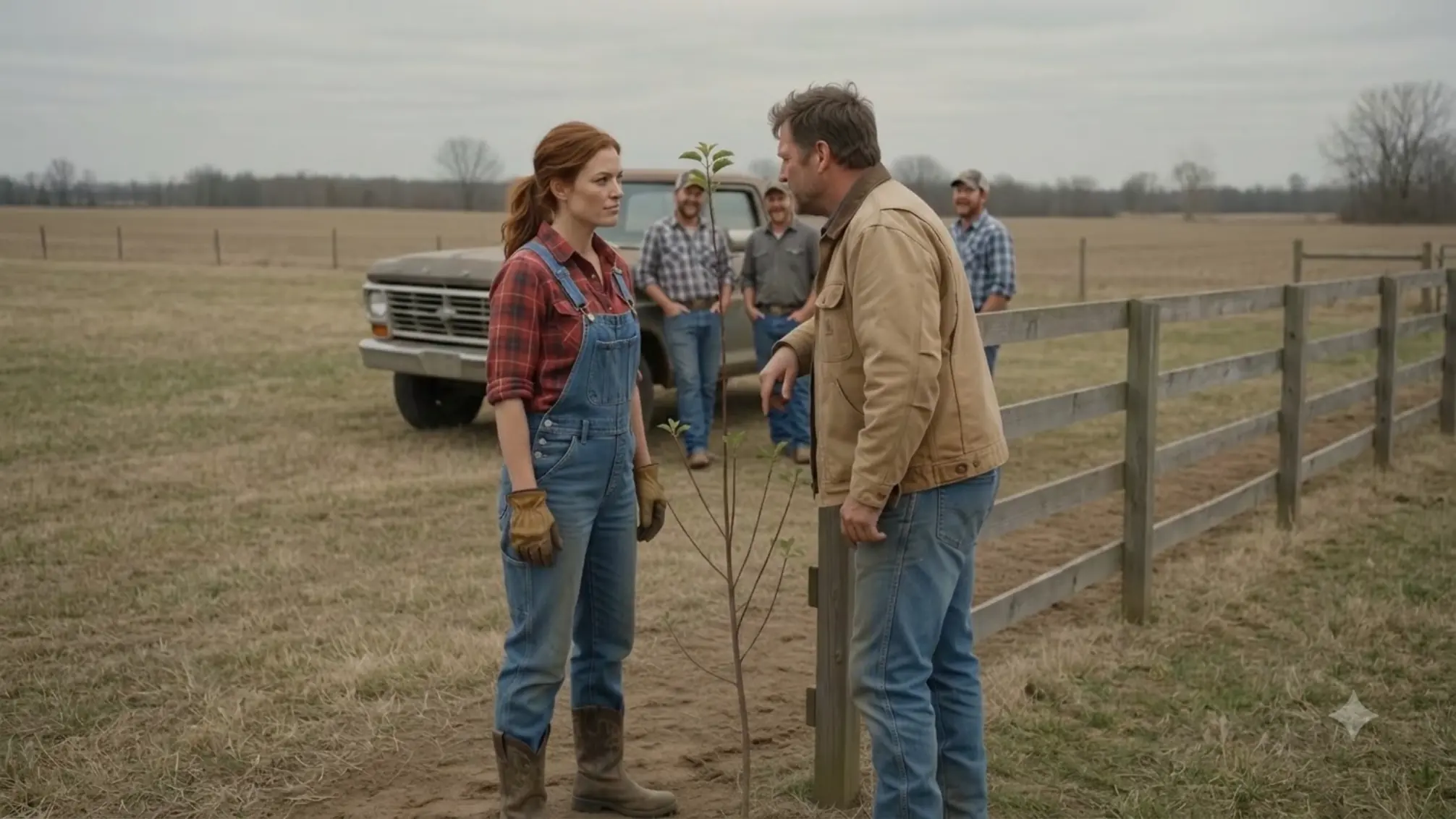
The three men behind Brad laughed louder, but Claire returned to her work.
She did not explain that the strip beneath their boots was not her best soil. Thirty years of unobstructed eastern wind had stripped nearly six inches from the edge of the field, carrying away organic matter and leaving pale, compacted ground that dried faster than the center rows. Her father had planted crops to the fence every year because that was how his father had farmed before him.
Each harvest produced the same result.
The first forty feet of the east field grew shorter, weaker plants. Fertilizer washed or blew away, young vegetables leaned beneath spring winds, and summer heat pulled moisture from the exposed ground. Every season, Claire’s mother spent money planting rows that rarely covered their own cost.
The Moss farm had belonged to the family for three generations. Claire’s father, Henry, left in 2014 after accepting a management job with a large agricultural supplier in another state. He promised the move would last only two years, but he gradually stopped calling the farm home.
Ruth Moss remained.
For eight years, Claire’s mother ran 128 acres almost entirely alone. She hired seasonal workers when she could afford them, repaired equipment with secondhand parts, and kept the property from falling into foreclosure during two disastrous seasons.
Claire studied agroforestry at the University of Missouri. After graduation, she worked with conservation projects across the Midwest, helping landowners combine trees, crops, and livestock instead of treating each as a separate system. She planned to build a career away from Callaway County.
Then Ruth injured her shoulder lifting a damaged irrigation pipe.
Claire returned expecting to stay for one planting season.
She stayed because the farm looked exhausted.
The center fields still produced, but their input costs climbed each year. Wind carried loose soil into drainage ditches. Pollinators had nearly disappeared from the eastern boundary, and birds nested only near the distant creek.
Ruth found Claire standing at the fence line during her first morning home.
“You always stared at that edge as a child,” she said.
“It keeps shrinking.”
“It has always been thin.”
“That doesn’t mean it has to stay thin.”
Ruth followed her daughter’s gaze across the exposed boundary. “Your father planted soybeans all the way to those posts.”
“And lost money on the first twelve rows.”
“He said empty ground earned nothing.”
Claire crouched and pushed two fingers into the soil. The top layer crumbled like dust, while the ground beneath it felt hard and dry.
“It doesn’t need to be empty,” she said. “It needs protection.”
Claire contacted James Reed, the county extension agent who had spent four years promoting windbreak systems without convincing a single local farmer to install one. James arrived forty minutes after her call, carrying soil maps, wind data, and a folder full of program information.
He was fifty-three, thin, patient, and accustomed to being ignored.
Claire walked him along the east fence.
“I want to plant native trees,” she said. “Not one decorative row. A working windbreak.”
James stopped beside a place where the soil had blown away from an old fence post. “How many acres are you willing to remove from production?”
“Less than the amount already failing.”
That answer made him smile.
They designed a mixed line of native hawthorn, wild plum, and serviceberry. The species would tolerate Missouri winters, support pollinators and wildlife, soften the wind, and improve biological activity along the damaged boundary.
Claire ordered 340 saplings.
The total cost was $680, almost every dollar she had saved after returning home.
When the bundles arrived, each tree was barely more than a narrow stem with a small root system wrapped in damp material. Ruth looked at the pile beside the barn.
“You spent nearly seven hundred dollars on that?”
“Yes.”
“They look dead.”
“They’re dormant.”
Ruth picked up one sapling. “Your father would laugh.”
Claire accepted it from her. “I know. That’s why I’m planting them anyway.”
The work lasted three days.
Claire measured spacing, dug each hole, loosened the damaged soil, and pressed the roots carefully into place. She drove support stakes beside the most exposed trees and built temporary guards where deer might browse.
Brad Cole appeared on the first morning.
His property bordered the Moss farm to the east, and his cornfields stretched across nearly three hundred acres. Brad was forty-five, broad, loud, and respected because he owned large machinery and spoke with the certainty of a man who considered doubt a weakness.
He brought three neighbors with him on the second morning.
They watched from the fence while Claire planted.
“Plant crops to the edge,” Brad called. “Every foot of ground should pay you.”
Claire kept digging.
“A degree doesn’t make you a farmer,” another man said.
“No,” Claire replied. “Working the land does.”
Brad laughed. “Pretty answer from a pretty girl.”
Claire drove the shovel into the earth. “You came here three mornings in a row to watch me work. Maybe you’re the one with time to waste.”
His friends laughed at him that time.
Brad’s smile vanished.
“You think those sticks will save this farm?”
“I think they’ll protect the soil.”
“Trees steal water.”
“Poorly placed trees can.”
“They shade crops.”
“Not when designed correctly.”
“You’ll learn.”
Claire looked at him across the fence. “So will you.”
By the end of the third day, all 340 saplings stood in the eastern boundary.
From a distance, they appeared insignificant. The line was thin, uneven, and hardly tall enough to rise above the fence grass. Brad drove past slowly that evening and shook his head.
Claire began recording.
Every Monday morning, she measured soil moisture at fixed points along the edge and in the field center. She collected soil samples, photographed erosion patterns, and mounted simple wind gauges at different distances from the tree line.
James helped her establish baseline data.
“You may not see a yield difference for several years,” he warned.
“I know.”
“Some of these trees will die.”
“I know.”
“People will use every dead tree as proof that the whole system failed.”
Claire looked toward Brad’s property. “I know that too.”
The first winter killed twenty-three saplings.
Deer damaged fourteen more. A mower operated by a temporary worker destroyed seven before Claire could stop him.
Brad noticed every gap.
“Your forest is disappearing,” he called from his truck one morning.
Claire replanted without answering.
By spring, the surviving trees produced new leaves. Some grew only a few inches, but roots were spreading beneath the soil. Grasses began collecting around the tree guards, and insects appeared among the young branches.
The first year brought no dramatic harvest.
The eastern rows still underperformed the field center, but wind measurements dropped slightly near the fence. After heavy spring gusts, Claire found less soil collected against the western drainage ditch.
She recorded the difference.
Ruth watched her enter numbers into a notebook after supper.
“Does writing it down make the trees grow faster?”
“No.”
“Then why do it every week?”
“Because memory changes when people want to be right.”
Ruth considered the answer. “You mean Brad.”
“I mean all of us.”
During the second year, the trees reached three to five feet. Their branches began linking sections of the windbreak, creating resistance instead of allowing wind to cross the field without interruption.
The effect remained invisible to passing drivers.
Claire could feel it.
On windy mornings, the eastern rows no longer shook as violently. Soil moisture remained higher for longer after irrigation. Young plants near the boundary suffered less leaf damage.
James brought a university soil scientist named Dr. Melissa Grant to evaluate the project. She collected samples from the fence edge, the protected rows, and the open field center.
Three weeks later, she returned with the results.
Organic matter at the edge had increased. Moisture retention was twenty-three percent higher than the original baseline, and biological activity near the trees had begun improving.
Ruth placed the report on the kitchen table.
“Is that good?”
“It means the worst soil on the farm is beginning to recover.”
“Because of the trees?”
“Because the trees changed what happens around them.”
Claire showed her mother the darkening ground beneath the windbreak. Fallen leaves and small branches were decomposing, insects worked beneath the surface, and roots opened channels through soil that had once been compacted.
The fence line was no longer wasted space.
It had become part of the farm’s infrastructure.
Brad came over that autumn while Claire repaired an irrigation valve.
“I hear the university people have been walking around your trees.”
“They tested the soil.”
“Universities can make numbers say anything.”
Claire looked up. “You asked what they were doing. I told you.”
“You still lost planting rows.”
“They were failing rows.”
“They could have produced something.”
“They are producing something.”
Brad looked at the thin trees. “I don’t see fruit.”
“They’re producing protection.”
He shook his head. “You cannot sell protection.”
Claire returned to the valve. “You buy crop insurance.”
Brad had no answer to that.
By year three, the tallest trees reached eight feet.
Their protection extended nearly forty feet into the east field. Claire’s measurements showed lower wind speed, reduced evaporation, and more stable soil temperatures within the sheltered zone.
The crop rows nearest the trees began outperforming the field center.
Not slightly.
By thirty-one percent per acre.
Claire checked the numbers twice, then asked James to verify the harvest weights independently. He brought calibrated equipment and repeated the calculations.
The result remained the same.
“You were right,” he said.
Claire looked toward the tree line. “The system was right.”
James wrote about the project in a regional agricultural bulletin. The article attracted the attention of Diana Park, a buyer for an organic food network supplying restaurants and grocery stores across several states.
Diana called James first.
“Are the numbers real?”
“Come see.”
She drove four hours to the Moss farm.
Diana was forty-two, sharply dressed, and too experienced to be impressed by presentation. She walked the fields for nearly two hours without speaking, occasionally kneeling to examine soil or rubbing leaves between her fingers.
Claire allowed the silence.
At the eastern boundary, Diana looked toward the native trees.
“You planted these for yield protection?”
“And soil recovery.”
“No chemical drift from the neighboring side?”
“Less since the windbreak thickened.”
“Wildlife pressure?”
“Manageable.”
“Input reduction?”
“Increasing every season.”
Diana closed her notebook. “I’ll offer you a three-year premium purchasing contract.”
Ruth, standing several feet away, covered her mouth.
Diana continued. “Twenty-six percent above market for qualifying organic produce. One condition.”
Claire waited.
“The agroforestry system remains in place, and you expand it where appropriate.”
The trees had become part of the contract’s value.
The ground Brad called wasted was now one reason a major buyer wanted the farm’s produce.
Claire signed after an attorney reviewed the agreement.
The contract changed the Moss farm’s financial position almost immediately. Predictable pricing allowed Claire to plan crops without gambling against the weekly market. She repaired irrigation equipment, hired two permanent workers, and paid off the farm’s remaining short-term debt.
Ruth no longer had to choose between replacing machinery and purchasing seed.
Brad returned late that autumn.
He stood at the fence for a long time before calling Claire over. The trees reached above his head now, branches carrying berries and autumn leaves.
“I heard about the contract,” he said.
“News travels.”
“Twenty-six percent.”
“Yes.”
Brad stared into the field. “Those edge rows really produced thirty-one percent higher?”
“James verified the weights.”
“How?”
“Lower wind stress, better moisture, improved soil.”
He rubbed a hand across his jaw. “I want to do this on my north boundary.”
Claire studied him.
Three years earlier, he had brought men to laugh while she planted. Now he stood alone.
“You’ll need a different design,” she said.
“Why?”
“Your prevailing wind, slope, and crop layout are different.”
“I thought trees were trees.”
“They’re not.”
Brad looked embarrassed. “Will you show me?”
Claire could have repeated his insults. She could have made him apologize in front of the same men who had laughed beside him.
Instead, she opened the gate.
“Bring your property map tomorrow.”
During the fourth year, the Callaway County agricultural office published its annual yield report.
Claire’s east field produced the highest per-acre organic vegetable yield recorded in county history.
The announcement reached the co-op before Claire saw the document. Trucks began appearing on the road outside the farm, slowing near the tree line exactly as they had during the planting.
Brad drove past once.
Then twice.
On the third pass, he did not stop.
On the fourth, he pulled into the driveway.
Claire was loading produce crates when he approached with the report in his hand.
“You broke the county record.”
“The field did.”
“You planted those trees while we stood there laughing.”
“Yes.”
“I thought you were trying to make the farm look pretty.”
Claire lifted another crate. “They do look pretty.”
Brad glanced at the long line of hawthorn, wild plum, and serviceberry. “I owe you more than an apology.”
“You don’t owe me anything.”
He frowned. “I mocked you for three days.”
“You did what farmers often do. You watched and waited until you saw proof.”
“Four years is a long time to wait.”
Claire looked toward the trees moving gently in the wind.
“They didn’t mind.”
James framed the county report and gave Claire a copy. She hung it inside the barn rather than the house, above the workbench where soil notebooks and pruning tools were stored.
The record mattered.
The process mattered more.
James later explained that Claire’s original planting might have qualified for conservation cost-share assistance. A federal program could have covered much of the installation expense if she had applied before beginning.
Claire stared at him.
“You knew about that?”
“I did not realize you were paying the entire cost yourself until afterward.”
“My six hundred eighty dollars could have been closer to one hundred seventy?”
“Possibly.”
She pointed toward him. “Tell the next farmer before the trees arrive.”
James raised both hands. “I will.”
Brad planted 180 saplings the following spring. James helped him complete the paperwork, and conservation funding reduced his personal cost dramatically.
Brad called Claire after receiving approval.
“I spent less than fifty dollars.”
“You’re welcome.”
“That sounds like bitterness.”
“It is bitterness.”
He laughed. “Fair.”
Within six years, windbreaks began appearing on several farms across Callaway County. Some protected vegetable fields. Others reduced drifting snow near livestock areas or sheltered soil vulnerable to erosion.
Not every planting succeeded.
Some farmers chose unsuitable species. Others placed trees too close to drainage systems or failed to protect young saplings from cattle. Claire helped repair what she could and told the truth when a plan required redesign.
She never claimed trees solved every problem.
She showed that the right trees could become working parts of a farm.
By the time Claire’s original windbreak reached eleven feet, the protected zone extended nearly sixty feet into the east field. Soil organic matter near the boundary had increased dramatically from the damaged baseline, while annual fertilizer, water, and erosion-related costs fell.
The farm’s total input expenses dropped by more than twenty thousand dollars a year.
Ruth walked the tree line each morning.
Age had slowed her steps, but she still ran one hand across the bark as she passed. She remembered the fragile sticks Claire pressed into bare soil and the laughter carrying across the fence.
One morning, she found her daughter pruning a damaged branch.
“Your father called yesterday,” Ruth said.
Claire continued cutting.
“He read the county article.”
“What did he say?”
“He said he always knew you would do something clever.”
Claire laughed once. “He would have told me to plant crops to the fence.”
“I told him that.”
“What did he say?”
“That he might have been wrong.”
“Might?”
Ruth smiled. “Your father changes more slowly than trees.”
They stood together beside the windbreak.
Birds moved among the branches. Pollinators gathered near serviceberry flowers, and dark soil remained cool beneath leaf litter. Beyond the trees, rows of healthy crops stretched toward the center field.
“What do you think your legacy will be?” Ruth asked.
Claire looked surprised. “I’m thirty-four.”
“That wasn’t an answer.”
“The farm, I suppose.”
“Land is inherited.”
Claire rested her gloved hand against the trunk of the first hawthorn she had planted.
“Legacy isn’t inherited,” she said. “It’s planted.”
Years later, visitors who came to study the Moss system often assumed the eastern windbreak had always existed. The trees looked permanent now, their roots deep and their branches woven into a living barrier.
Claire kept photographs from the first week.
In one, she knelt beside a sapling no taller than her shovel while four men laughed across the fence. The ground behind her was pale, dry, and nearly bare.
She never displayed the photograph to embarrass Brad.
She showed it to young farmers who expected meaningful work to look impressive immediately.
The record-setting harvest was not created during its fourth season.
It began when Claire sacrificed several weak crop rows, spent her savings on 340 fragile trees, and continued planting while everyone watching confused small beginnings with foolish ones.
Brad believed productive land was the ground carrying crops that year.
Claire understood that truly productive land also included whatever protected the next harvest.
The men saw sticks.
She saw roots, moisture, shelter, and time.
Four years later, the east field answered them for her.