The laughter inside the Red Oak Hollow auction hall shook dust from the exposed ceiling beams. Clara Holt stood alone beside the bidding table, her two chestnut braids resting against faded denim overalls while nearly every adult man in the room treated her like the entertainment between serious properties. A dented shoebox sat open before her, revealing stacks of small bills and rolled coins totaling exactly $4,216. She had earned every dollar herself, and now she intended to spend all of it on forty acres that the county had officially classified as commercially useless.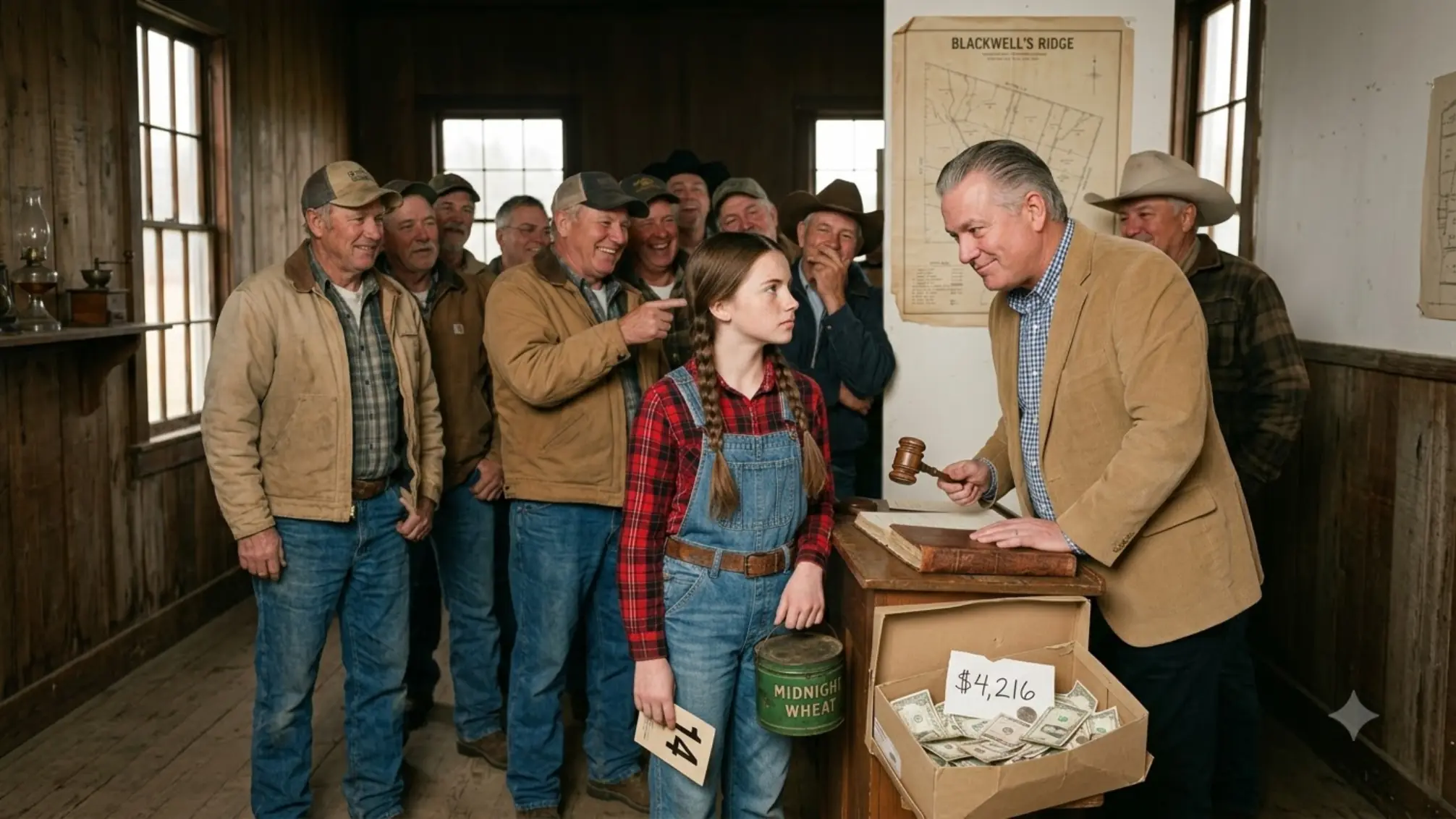
Blackwell’s Ridge had been abandoned for eleven years. Three previous owners had tried corn, soybeans, and sorghum, using increasingly expensive fertilizer to force life from gray soil poisoned by decades of careless monoculture. One man lost his marriage, another lost his machinery, and the last owner disappeared overnight after leaving his tractor keys in the ignition. By the time Clara raised bidder card number fourteen, the farm had become a warning told at feed stores whenever someone proposed an idea considered too hopeful.
The auctioneer, Leonard Price, examined the money as though it had appeared through some mistake. “Your mother authorized this?”
“My mother knows I’m here.”
“That wasn’t my question.”
“The county advertised a public auction. I’m the only qualified bidder.”
A low murmur moved through the room. Leonard looked toward County Commissioner Gerald Pritchard, the seventy-two-year-old rancher who controlled more land than anyone within thirty miles. Gerald sat in the front row with his arms folded, his weathered face twisted into a smile that carried no kindness.
“Take the girl’s money,” Gerald said. “A lesson that expensive may save her from a worse one later.”
Clara looked directly at him. “You had eleven years to buy it.”
Gerald’s smile disappeared.
Leonard struck the gavel. “Sold.”
The sound changed Clara’s life.
Her mother, Rebecca Holt, waited outside in an old Ford pickup with both hands locked around the steering wheel. She had worked double shifts at a Tulsa hospital for nearly a decade and understood what four thousand dollars represented in groceries, rent, school supplies, and emergencies. When Clara climbed into the passenger seat carrying the deed, Rebecca did not congratulate her.
“You spent everything.”
“I have four dollars and thirty-seven cents left.”
“That isn’t funny.”
“I wasn’t joking.”
Rebecca pulled away from the auction house. “That land has ruined grown men with equipment, credit, and forty years of experience.”
“They planted the wrong thing.”
“You are fourteen.”
“I know.”
“You should be thinking about high school, friends, and whether you want to join band.”
“I’m thinking about whether we can keep Grandpa’s house.”
Rebecca’s anger weakened.
Elijah Holt had raised Clara from the age of four while Rebecca worked in Tulsa. His death six months earlier left unpaid taxes, medical debt, and a farmhouse Rebecca planned to sell because they could not afford to maintain it. Clara’s purchase appeared reckless, but her mother knew the money had not come from the family.
Clara saved birthday checks, mowed lawns, sold eggs, and worked twelve-hour summer shifts removing tassels from commercial corn. She had collected every dollar over six years. What Rebecca did not know was why Clara had chosen Blackwell’s Ridge.
The answer waited inside an old green coffee tin beneath Clara’s feet.
Three months before the auction, she had found a wooden chest in Elijah’s attic. It contained journals written by her great-great-grandmother, Esther Holt, beginning during the Dust Bowl. Esther described a heritage grain the family called Midnight Wheat because its mature heads appeared nearly blue beneath moonlight.
Unlike modern commercial varieties, its roots reached far below exhausted topsoil. The grain survived drought, resisted fungal disease, and gradually restored damaged fields by drawing contaminants into stalk tissue that could be removed after harvest. Esther had preserved the seed through the 1930s, but later generations abandoned it when industrial suppliers promised higher yields.
Her final journal entry contained precise instructions.
Three pounds remain inside the pantry wall. If the land ever forgets how to feed itself, plant its memory back into the ground.
Clara tore away the loose board that afternoon.
The coffee tin remained exactly where Esther had hidden it in 1962.
Blackwell’s Ridge appeared beyond the windshield as a pale scar across the Oklahoma landscape. The rusted gate hung from one hinge, the farmhouse leaned toward its collapsing porch, and the barn stood without a door. Forty acres of gray earth stretched beneath the sun, broken only by thistle and weeds.
Rebecca stopped the truck. “This is what you bought.”
Clara climbed down.
Hot wind carried dust across the driveway. She walked to the nearest field, dropped to her knees, and pushed her fingers into the ground. The top three inches crumbled like ash, but beneath the dead layer she found darker soil holding faint moisture.
The land was wounded.
It was not dead.
“We need compost,” Clara said.
Rebecca stared at the ruined house. “We need a bulldozer.”
“And a plow.”
“We don’t own one.”
“I’ll borrow one.”
“From whom?”
“Someone who likes proving everybody wrong.”
Nobody volunteered.
Gerald Pritchard arrived two days later on an ATV with two ranch hands following him. Clara stood inside the nearest field using a shovel nearly as tall as she was. She had removed rocks from less than one-tenth of an acre, yet sweat had already soaked through her red plaid shirt.
Gerald stopped beside the fence. “Enjoying your purchase?”
“I will after you leave.”
One ranch hand laughed.
Gerald spat tobacco juice into the dust. “That soil has aluminum toxicity three feet down. Its acidity will kill roots before they establish.”
“Then I’ll plant something with deeper roots.”
“There isn’t a crop in Oklahoma built for that ground.”
“There was before farmers replaced everything they couldn’t patent.”
His face hardened. “Books make children dangerous because they confuse reading with experience.”
“And experience makes old men lazy when they stop testing their beliefs.”
The ranch hands went quiet.
Gerald dismounted the ATV and crossed the fence line. He towered over Clara, expecting his size and reputation to force an apology. She continued digging.
“Do you know what happens when this fails?”
“I learn.”
“You lose every dollar you own.”
“Money returns.”
“Your mother loses patience.”
“That’s between us.”
“You become the county’s biggest joke.”
Clara finally looked up. “I already bought the title from you at the auction.”
Gerald’s face turned dark red.
He climbed back onto the ATV and spun the tires deliberately, spraying dirt across Clara’s shirt and face. She wiped her eyes, waited for the machines to disappear, and returned to the shovel.
The next six weeks became the hardest period of her life.
Clara traded labor for equipment. She cleaned horse stalls in exchange for aged manure, sorted recycling at the county landfill for access to compost, and repaired fencing for a retired farmer who allowed her to borrow a smoking rototiller. Every morning began before sunrise and ended after dark.
Rebecca refused to help initially.
She drove Clara to the property, left water on a fence post, and watched from the farmhouse porch. Her silence was not cruelty. She feared encouraging her daughter toward a failure that could permanently wound her confidence.
Yet Clara continued.
She worked the first two acres by hand and machine, turning gray earth until darker soil appeared beneath it. She mixed compost, manure, limestone, and organic matter according to measurements copied from Esther’s journals. Instead of treating all forty acres, she concentrated every resource on a small test plot.
People in town watched.
At the feed store, the owner, Doris Miller, sold Clara a bag of bone meal but shook her head while accepting payment. “I’ve known you since you were in diapers. I can’t pretend this makes sense.”
“Then don’t pretend.”
“You cannot repair poisoned soil with stubbornness.”
“No. That’s what the compost is for.”
At the diner, three farmers discussed her loudly enough to be heard.
One said she should burn the four thousand dollars because at least the ashes might improve the dirt. Another predicted the county would regain the property before Christmas. The third suggested Rebecca should be investigated for allowing a child to make financial decisions.
Clara finished her water and walked out.
The comments that hurt most came from Uncle Ray, Rebecca’s older brother. He arrived in a new pickup wearing clean khaki pants and examined the farm as though evaluating a failed investment. As a real-estate agent, he saw greater value in dividing the land into cheap rural lots than restoring it.
“I’m listing the property,” he announced.
“You don’t own it.”
“Your mother has authority over you.”
“The deed is in my name through the custodial agreement Grandpa created.”
“You manipulated a legal technicality.”
“I used the rules.”
Ray crouched to look Clara in the eye. “There is no magical seed.”
“It isn’t magic.”
“Your great-grandmother was not a scientist.”
“She paid attention.”
“Clara, listen carefully. Adults have tested this soil. Universities examined it. Farmers with generations of experience abandoned it.”
“They all tried the same crops.”
“Because those crops make money.”
“Not here.”
Ray stood. “You’re destroying your future.”
Clara picked up her shovel. “Then stop blocking my sunlight.”
He left furious.
That evening, Rebecca finally entered the field. She wore old jeans and work gloves purchased from Doris’s store.
“I have tomorrow off,” she said.
Clara stared at her.
“Tell me where to start.”
They completed the final rows together.
On the first night of June, Clara carried the green coffee tin into the field. Moonlight illuminated the prepared ground while Rebecca held a flashlight from the fence. Clara opened the lid and revealed three pounds of seed, black-brown and hard from sixty years of storage.
She planted every kernel by hand.
The work took six hours.
At midnight, the tin was empty.
Clara stood before the completed rows with shaking legs and cramped fingers. “It’s in the ground.”
Rebecca placed an arm around her shoulders. “Now what?”
“We wait.”
Nothing emerged during the first week.
The second week passed beneath temperatures nearing one hundred degrees. Gerald’s commercial wheat began showing heat stress despite irrigation. Blackwell’s Ridge remained gray and silent.
On the fifteenth day, Clara dug carefully into one row.
The seed had swollen but not sprouted.
On the eighteenth day, some kernels showed small white roots.
By the twenty-second day, still nothing had broken the surface.
Doris called and offered to connect Rebecca with a scrap buyer who might purchase the rototiller. Uncle Ray sent boarding-school information. Gerald drove past without stopping, his expression suggesting the lesson was nearly complete.
Clara began questioning Esther’s journals.
Perhaps the seed had died decades earlier. Maybe the deep roots and disease resistance had become exaggerated family stories. She had risked everything on handwriting left by someone who could no longer answer questions.
At dawn on the twenty-third day, Clara walked into the field expecting more silence.
A dark-green line crossed the first row.
She ran toward it.
The shoots were thicker than commercial wheat and so deeply colored that they appeared blue at certain angles. More emerged in the second row, then the third. By sunrise, hundreds of seedlings stood above ground that experts declared incapable of supporting them.
Rebecca reached the field while Clara was laughing and crying at once.
“It grew.”
“No,” Clara said, touching a leaf gently. “It remembered.”
By July, the wheat reached Clara’s waist.
The plants grew unevenly, with variations in height, leaf width, and color that commercial farmers considered undesirable. Yet each difference represented genetic diversity preserved through generations. Some plants tolerated heat better, others developed thicker stalks, and several resisted insects entirely.
The soil changed beneath them.
Clara removed one plant for examination and found roots stretching downward through the damaged layer. Earthworms returned around the root zone, and dark organic material began replacing gray dust. Laboratory samples sent anonymously to Oklahoma State showed reduced surface toxicity and increased microbial activity.
The county began paying attention.
Cars slowed near the property. Farmers who once laughed stood outside the fence without introducing themselves. Gerald drove by almost daily, studying the dark crop while pretending he was merely using the road.
A young ranch hand named Thomas eventually entered with a toolbox.
“Your northern fence is falling.”
“I noticed.”
“I can repair it.”
“What does Gerald want?”
“He doesn’t know I’m here.”
“Then why help?”
Thomas examined the wheat. “My grandmother raised six children from a garden everybody said wouldn’t grow.”
Clara handed him a hammer.
They worked without further explanation.
The disaster arrived in August.
Stem rust appeared first sixty miles north, spreading through genetically uniform wheat fields with terrifying speed. Orange-red fungus covered leaves and stalks, reducing strong crops to brittle waste within days. Fungicides slowed it briefly, but the disease adapted faster than chemical companies could respond.
Gerald lost one hundred acres in a week.
The Miller brothers lost almost everything.
The Oklahoma Department of Agriculture ordered emergency monitoring across the county. Blackwell’s Ridge stood directly in the projected path of airborne spores.
Officials advised Clara to destroy the field.
Dr. Elena Vargas from Oklahoma State arrived with two graduate researchers and a county representative. She examined the crop from outside the fence before approaching Clara.
“This variety is undocumented.”
“My family documented it.”
“In journals, not scientific records.”
“The plants didn’t ask which kind mattered.”
Dr. Vargas ignored the remark. “If your crop becomes infected and supports a resistant strain, it could threaten surrounding counties.”
“Esther’s wheat survived rust in 1935.”
“This is not 1935.”
“The plant doesn’t know the year.”
Rebecca touched Clara’s shoulder. “They may be right.”
Clara looked across the dark field. Burning it would satisfy the county, protect her from legal threats, and erase the only living supply of Midnight Wheat known to exist.
She refused.
“You have forty-eight hours,” the county representative warned. “After that, we may seek an emergency destruction order.”
The rust arrived that night.
Orange spores appeared along the northern edge by morning. Clara found infected leaves, photographed them, and called Dr. Vargas herself. The scientists returned expecting rapid spread.
Instead, the lesions stopped.
Microscopic testing revealed that compounds produced by the wheat disrupted spore germination. The crop’s genetic diversity also prevented the fungus from moving uniformly between plants. Some stalks showed minor damage, but the field as a whole suppressed the disease.
Dr. Vargas repeated the tests three times.
Then she stood before Clara holding a sealed sample bag.
“This wheat is not merely resistant.”
“What is it?”
“It’s actively hostile to the fungus.”
The county representative stared across the field. “What does that mean?”
“It means this fourteen-year-old girl may possess the most valuable grain genetics in the state.”
News traveled beyond Oklahoma within days.
Researchers photographed the wheat, mapped its traits, and requested seed for controlled trials. Agricultural companies called Rebecca offering contracts containing words neither she nor Clara fully understood. One corporation proposed purchasing the entire harvest and exclusive genetic rights for two hundred thousand dollars.
Clara refused.
A lawyer representing another company arrived with an offer of one million dollars.
She refused again.
“You may never receive another offer like this,” he warned.
“Then you should have offered one that didn’t steal my family’s seed.”
The harvest began in September.
Clara did not own a combine, and commercial equipment risked mixing the seed with other varieties. She, Rebecca, and Thomas cut the wheat by hand using sharpened scythes. Volunteers eventually joined after seeing the work.
They harvested twelve thousand pounds.
Laboratory analysis found unusually high protein, deep-root characteristics, drought tolerance, and resistance to the rust that had destroyed millions of dollars in crops. Bakers paid premium prices for limited grain, while research institutions purchased small seed samples under agreements preserving Clara’s ownership.
She sold carefully.
Every buyer received restrictions against patenting the genetics or preventing farmers from saving seed. Lawyers called the conditions childish. Agricultural historians called them revolutionary.
Gerald arrived in November.
The rancher who had sprayed dust across Clara’s face now sat inside his truck beyond the gate. His fields were empty, his wheat destroyed, and his bank demanding answers.
Clara approached without speaking.
“I need seed,” he said.
“You said it would rot.”
“I was wrong.”
“You said I thought books made me smarter than farmers.”
“You remembered every word.”
“I wrote them down.”
Gerald removed his hat. “I have farmed fifty-two years. I believed experience meant I could recognize every useful idea before someone younger did.”
Clara waited.
“I need enough seed for fifty acres.”
“You’re not getting fifty acres’ worth.”
His face tightened, but he controlled himself. “What can you spare?”
“Enough for five test acres.”
“That won’t save my operation.”
“It may save your soil.”
“I’ll pay whatever you ask.”
Clara looked toward the damaged fields beyond his property. She could humiliate him, refuse completely, or charge a price designed to punish him. Instead, she opened a folder.
“You receive seed at cost.”
Gerald stared at her.
“You follow the soil-restoration plan. You share data with the university. You cannot patent, resell, or claim ownership of the strain.”
“Why help me?”
“Because your workers’ families shouldn’t lose their incomes because you were arrogant.”
Gerald lowered his eyes.
“And,” Clara added, “you apologize to my mother.”
Rebecca stood near the barn.
Gerald walked to her, removed his hat, and admitted he had mocked her daughter publicly. He did not soften his words or blame the crowd. Rebecca accepted the apology without offering friendship.
Clara supplied the seed.
Within two years, Midnight Wheat grew across carefully managed test plots throughout Oklahoma. Its roots helped rehabilitate damaged acreage while its disease resistance reduced chemical dependence. Clara’s harvest contracts, research licensing, and specialty-grain sales eventually generated millions, but she refused to sell Blackwell’s Ridge.
The county’s deadest farm became an agricultural research center.
Clara restored the farmhouse, rebuilt the barn, and created a seed library inside the room where Esther’s journals were stored. Farmers could access limited quantities under agreements requiring them to preserve genetic diversity and return part of each harvest.
She remained in school.
Rebecca insisted on that condition.
Clara completed assignments at the farmhouse table, attended classes three days per week, and spent the rest working with researchers, soil specialists, and farmers. By sixteen, she understood both the science Esther lacked vocabulary for and the traditional knowledge modern institutions had dismissed.
Leonard Price, the auctioneer, visited during the second harvest festival.
He stood beside the field holding the original sale ledger.
“I almost refused your bid.”
“You laughed first.”
“I did.”
“Why are you here?”
“The county wants the ledger displayed in its agricultural museum.”
Clara examined the page showing her $4,216 purchase.
“No.”
Leonard blinked. “It’s public history.”
“It’s my receipt.”
She framed it inside the seed library instead.
Beneath it, she placed the green coffee tin and Esther’s final journal. Visitors came from universities, farming cooperatives, and agricultural agencies to study the grain that returned from sixty years of darkness.
Gerald continued farming his test acres.
His first harvest was modest, but the soil beneath it improved. He stopped treating every problem with more chemicals and began asking younger farmers what they observed instead of explaining what they should believe.
One afternoon, he found Clara examining earthworms inside a restored section of Blackwell’s Ridge.
“You were right,” he said.
“About what?”
“The land was special.”
Clara stood and brushed soil from her hands.
“No,” she replied. “The land was injured. Calling it special would make what happened sound like a miracle.”
“What should we call it?”
“Repair.”
Gerald looked across the dark wheat moving beneath the wind.
Clara had not saved the farm because she possessed magical seed, unusual beauty, or impossible luck. She saved it because she read forgotten evidence, tested the soil beneath the obvious damage, and continued working while people with greater authority waited for her failure.
At fourteen, she entered an auction hall carrying everything she owned inside a shoebox.
The men laughed because they saw a child purchasing poisoned land.
Clara saw roots waiting beneath three inches of dead soil.
They believed Blackwell’s Ridge had destroyed every farmer who touched it.
She understood that those farmers had all demanded the same answer from the land.
The Midnight Wheat survived because it carried generations of different answers within every row.
When disease arrived, diversity saved it.
When drought came, deep roots saved it.
When the county tried to bury Clara beneath ridicule, evidence saved her.
The harvest did not merely silence the men who laughed.
It forced them to admit that the youngest farmer in the room had been the only one old enough in wisdom to listen.