Holly Whitaker laughed when Danielle Tucker raised the phone to her ear. She folded her arms across the pale-blue Crestline Airways uniform stretched over her shoulders and stood directly between the seventeen-year-old girl and the open jet bridge. Around them, passengers remained frozen with boarding passes in their hands, watching Danielle’s school identification, medical card, scholarship letter, and printed itinerary settle among coffee cups and food wrappers inside the trash bin. Holly looked confident because she believed the worst consequence she faced was another passenger complaint she could quietly close herself.
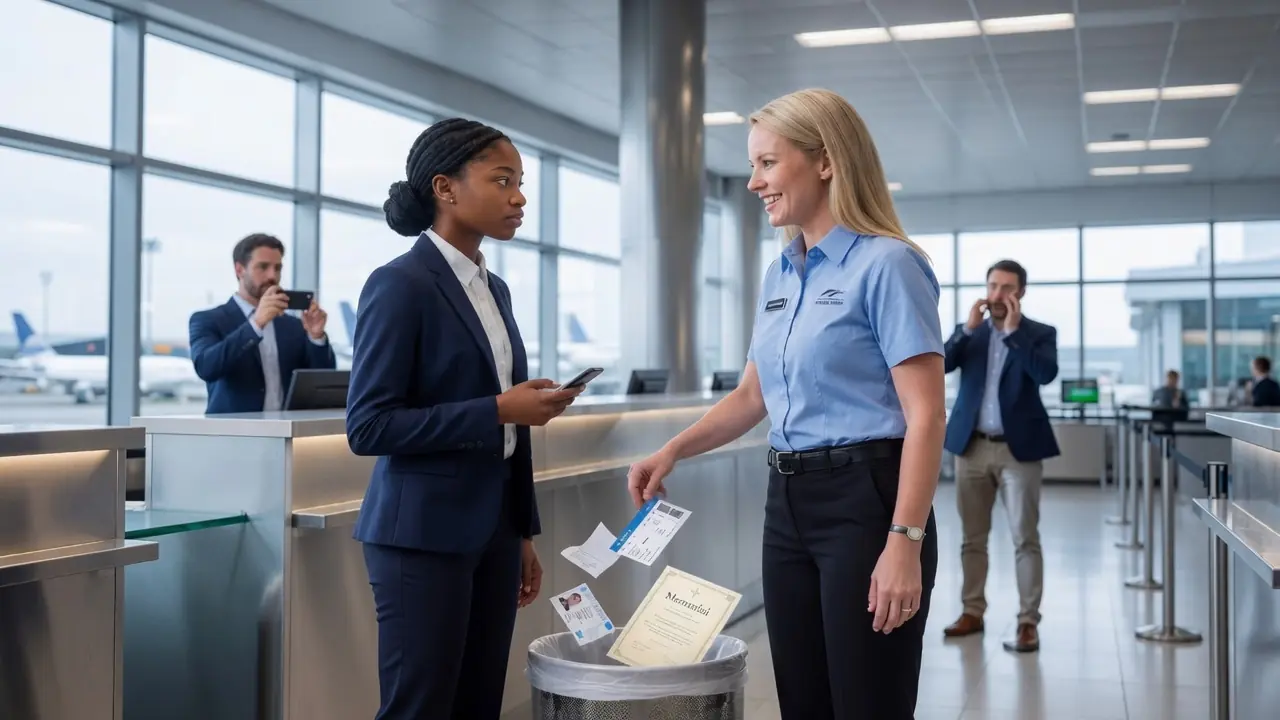
Danielle did not cry, reach into the bin, or beg again. Her long braids remained gathered neatly behind her head, her navy blazer was still buttoned, and her hand did not shake as the call connected. She had spent years competing in debate tournaments where opponents tried to provoke emotion whenever they could not defeat her argument. Holly mistook that discipline for helplessness.
“Grandma,” Danielle said, keeping her eyes on the gate agent. “I’m at Gate B22 in Charlotte. The agent confiscated my identification, threw my documents away, and is refusing to scan my boarding pass.”
A pause followed.
Then Eleanor Tucker’s voice became sharp enough that Danielle lowered the phone slightly.
“Do not touch the trash,” Eleanor said. “Do not leave the gate. Ask whether the boarding system is recording the refusal code.”
Danielle looked toward the computer beside Holly. “Is the system recording why you denied me?”
Holly’s smile faded. “Put the phone away.”
“Please answer the question.”
“I don’t have to explain internal procedures to a child.”
Eleanor heard every word through the phone. “Ask for her full name and employee number.”
Holly reached toward Danielle’s phone, but Danielle stepped back. Several passengers raised their own devices, no longer pretending they were not watching.
“My name is on my badge,” Holly snapped. “And if you keep filming employees, security will remove you.”
Danielle read it aloud. “Holly Whitaker.”
Behind the counter, the aircraft door remained open. A flight attendant stood at the end of the jet bridge, looking toward the confrontation but receiving no instruction to intervene. The departure screen showed twelve minutes until the gate was scheduled to close.
Danielle was traveling from Washington, D.C., to Atlanta for the final interview of the Robinson-Clark Aerospace Scholarship. The scholarship would cover four years of tuition, laboratory fees, and a summer research placement. Her interview began at two that afternoon.
Missing the flight would mean missing the interview.
Missing the interview would mean losing the opportunity she had worked toward since middle school.
Holly knew none of that when Danielle approached the counter. She saw a Black teenager traveling alone and decided the documents had to be suspicious before touching a single one.
Danielle had already passed identity screening in Washington. The boarding pass had scanned successfully at security, her government-issued identification had been verified, and her connection remained confirmed in Crestline’s mobile application. Holly could have scanned the pass in less than two seconds.
Instead, she stared at Danielle’s face, then at the photograph on the identification card.
“This doesn’t look like you.”
“It was taken last year.”
“The hair is different.”
“It’s braided in both pictures.”
Holly tilted the card beneath the overhead light as though performing an examination. She asked for a second identification document, then a third. Danielle provided her school identification and debit card.
Holly placed all three on her side of the counter.
“You people think a matching name makes anything legitimate,” she said quietly.
Danielle heard her.
So did the businessman standing next in line.
He looked down at his shoes.
When Danielle reached toward the documents, Holly recoiled dramatically and shouted, “Don’t touch my counter!”
The entire gate area fell silent.
Danielle’s fingertips had barely crossed the edge.
Holly called her supervisor, Greg Sutton, who arrived from the operations office with a coffee in one hand. He glanced at Danielle, glanced at the documents, and listened while Holly claimed the girl had become aggressive after being questioned about fraudulent identification.
Danielle interrupted once.
“Sir, I have not raised my voice or threatened anyone. Please scan the boarding pass.”
Greg did not inspect the card closely. He did not ask to see the successful security verification connected to Danielle’s reservation. He simply handed the identification back to Holly and said, “Use your judgment.”
Then he walked away.
Those three words transformed Holly’s suspicion into permission.
She demanded a letter from Danielle’s parents authorizing solo travel, even though Crestline allowed passengers over fifteen to travel independently. Danielle explained that her grandmother was her legal guardian and offered the emergency contact information already attached to the reservation.
Holly refused to call it.
Instead, she picked up the full travel folder with two fingers, carried it toward the trash bin, and dropped everything inside.
That was when Danielle called Eleanor.
What Holly did not know was that Eleanor Tucker had spent thirty-one years hearing cases involving federal agencies, transportation access, civil rights, and administrative misconduct. Retirement had removed her from the bench but not from the network of inspectors, attorneys, and commissioners who trusted her judgment.
Eleanor did not threaten Holly.
She asked for facts.
“What time did the employee discard the documents?”
“Eleven twenty-seven.”
“Are there cameras?”
“Two above the counter and one near the jet bridge.”
“Are witnesses filming?”
“Yes.”
“Is your medical card in the trash?”
“Yes.”
Danielle’s peanut allergy required her to carry emergency medication and a medical-information card listing the dosage, physician, and treatment instructions. Holly had discarded that card with the rest of the folder.
Eleanor’s voice became colder.
“I’m making three calls. Keep your phone on. Record only what happens in front of you. Do not argue with her.”
Holly pointed toward the waiting area. “You are no longer a ticketed passenger at this gate. Leave immediately.”
Danielle remained where she stood. “My reservation still shows confirmed.”
“I canceled it.”
“You canceled a verified minor’s ticket without identity review?”
“I canceled a suspicious booking.”
A man near the window spoke for the first time. “She passed security.”
Holly turned on him. “This does not concern you.”
“It became my concern when you threw her identification into garbage.”
Another passenger stepped closer. She was a nurse traveling home after a conference and had filmed the documents falling. “The girl never touched you.”
Holly reached for the gate microphone.
“Airport security to B22. Disruptive passenger refusing removal.”
Danielle looked at the departure board.
Nine minutes remained.
Eleanor’s first call went to Marissa Cole, regional director of the Federal Aviation Compliance Office. Eleanor did not ask her to punish anyone. She reported the destruction of verified travel documents, denial of boarding without review, disposal of medical information, possible discrimination, and an imminent attempt to remove a minor before surveillance footage could be preserved.
Marissa requested the gate number again.
“B22.”
There was a pause.
“That gate appeared in two complaints last month.”
Eleanor’s second call went to Crestline Airways’ general counsel. The airline had already received eleven complaints involving Holly Whitaker and Greg Sutton, including allegations that passengers were denied boarding after questioning, forced to pay rebooking fees, and threatened with arrest when they requested written explanations.
Most complaints had been closed as customer misunderstandings.
Greg had reviewed seven of them himself.
Eleanor’s third call went to Danielle’s scholarship coordinator in Atlanta. She explained that Danielle was being unlawfully prevented from boarding and requested a remote interview if the flight was missed.
The coordinator answered immediately.
“Tell Danielle the interview will wait.”
At Gate B22, two airport security officers arrived.
Holly rushed toward them before they could speak to Danielle.
“This passenger presented fraudulent documents, became aggressive, and refused to leave after I canceled her ticket.”
Officer Caleb Brennan looked at Danielle.
He recognized her.
Hours earlier, while assigned temporarily to the Washington transfer-screening unit, Caleb had checked the same identification during a coordinated staffing rotation. He remembered Danielle because she had told him about the aerospace scholarship after he asked where she was traveling.
“I verified her this morning,” he said.
Holly blinked. “You couldn’t have.”
“I scanned that identification personally.”
“It may have been replaced.”
Caleb looked into the trash bin. Danielle’s government identification rested faceup beside the scholarship letter.
“You discarded a passenger’s identification?”
“She threw it there.”
“No, she didn’t,” the nurse said, holding up her phone. “I recorded the whole thing.”
Holly’s face tightened.
Greg Sutton returned when he saw security at the gate. He ordered Caleb to remove Danielle so boarding could finish.
Caleb refused.
“Until her documents are recovered and the denial is reviewed, nobody is touching her.”
Greg lowered his voice. “This is airline business.”
“This is now an airport security matter.”
The gate computer emitted a sharp tone.
Holly looked at the screen.
A red banner had appeared across the reservation system:
FEDERAL PRESERVATION HOLD — DO NOT MODIFY GATE B22 RECORDS.
The boarding scanner locked automatically.
Every passenger still waiting in line became unable to board.
Greg reached across the counter and attempted to close the alert. The system rejected his credentials.
“What did you do?” he demanded.
Danielle held the phone against her ear. “I made one call.”
The airport operations director arrived less than four minutes later with a compliance attorney and two technology specialists. Marissa Cole appeared through a secure video link on the gate monitor.
She instructed airport staff to retrieve Danielle’s documents using clean gloves, photograph their condition, and place them inside an evidence envelope. She ordered preservation of surveillance footage, microphone recordings, scanner logs, reservation changes, and every message exchanged by Holly and Greg during the previous hour.
Holly’s confidence disappeared.
“This is an overreaction,” she said. “I was protecting the flight.”
Marissa’s face remained still on the monitor. “From what?”
“A fraudulent passenger.”
“What part of the identification was fraudulent?”
“The photograph did not match.”
“Did you use the document scanner?”
“No.”
“Did you call airport identity verification?”
“No.”
“Did you compare the reservation’s security confirmation?”
“No.”
“Did you contact the listed guardian?”
“No.”
“Then what exactly did you verify?”
Holly looked around for support.
Greg stepped backward.
She pointed at Danielle. “Her behavior confirmed my suspicion.”
Danielle’s expression did not change. “My behavior was asking you to scan my boarding pass.”
Marissa instructed the airport to remove Holly and Greg from operational duty immediately. Holly refused to surrender her badge at first, claiming only Crestline could suspend her. The airport attorney explained that her access credential belonged to the airport authority and could be disabled without airline approval.
The badge stopped working before she reached the office door.
Danielle’s flight departed without her.
She stood at Gate B22 watching the aircraft push away while the scholarship letter rested inside a clear evidence sleeve. For the first time since the confrontation began, her composure cracked.
She did not cry because Holly had insulted her.
She cried because the plane was leaving.
Caleb sat beside her while airport staff searched for another connection. Every remaining flight to Atlanta was full or delayed beyond the interview time. The scholarship coordinator called Danielle personally and moved the interview to an encrypted video meeting that afternoon.
The airport provided a conference room.
Danielle entered the interview wearing the same navy blazer, but without her printed notes because they remained sealed as evidence. She answered questions about propulsion efficiency, materials science, and aircraft-emission reduction from memory.
When one committee member asked how she handled pressure, Danielle paused.
“I separate what I can control from what someone else is trying to make me feel,” she said. “Then I solve the part in front of me.”
The committee offered her the scholarship before the call ended.
But the investigation at Gate B22 had only begun.
Federal inspectors compared Danielle’s case with earlier complaints. They discovered twenty-nine passengers denied boarding by Holly during the previous two years. Eighteen were Black or Latino. Six were young people traveling alone. Four were immigrants whose documents were later verified as valid.
Every case included vague language such as suspicious behavior, document concerns, or failure to cooperate.
No case included a completed fraud-referral form.
That mattered because genuine document fraud required formal reporting. The documents had to be scanned, preserved, and transferred to trained investigators. Holly had done none of that.
She did not believe the documents were fake.
She used the accusation as a tool.
Passengers she targeted were removed from flights, charged new fares, or told to purchase additional identification services through a contractor called PassengerSure Verification.
The company charged up to three hundred dollars for expedited reviews.
Greg Sutton’s brother owned PassengerSure.
Bank records showed that Holly received monthly payments from the contractor under the description customer-risk consulting. The more travelers she referred, the more money she earned.
Discrimination selected the victims.
Fraud generated the profit.
The airport’s role was even worse.
Internal emails revealed that senior operations managers knew complaints were increasing. Instead of investigating, they allowed Greg to review cases involving his own employees. When an internal auditor questioned the referral payments, her access was revoked and her position eliminated.
Security footage was routinely overwritten after seven days, even when passengers requested preservation.
Danielle’s grandmother had called before the footage could disappear.
Inspectors then found falsified training certificates for dozens of contract gate agents. The airport had reported that every employee completed annual identity-verification and civil-rights training. Records showed many sessions never occurred.
Holly’s certificate had been signed by Greg on a day both were on vacation.
The airport authority had received federal funds based partly on those false compliance reports.
Marissa Cole issued an emergency order restricting the airport’s boarding operations. International departures and unaccompanied-minor transfers were suspended first. Airlines were required to move specific services to neighboring airports until independent staff could verify procedures.
The airport did not lose its full operating certificate because one employee threw documents away.
It lost the privilege of operating under its existing passenger-processing license because the incident exposed systemic fraud, false training records, destroyed complaints, medical-safety violations, and discriminatory boarding practices protected by management.
The restriction cost millions each day.
Only then did executives who had ignored passengers begin demanding answers.
Holly tried to blame Greg.
Greg blamed Crestline.
Crestline blamed the airport authority.
The records blamed all of them.
Holly’s messages showed she had written about Danielle before the girl reached the counter. A camera near the waiting area captured Holly watching her read alone beside the window.
She sent Greg one sentence:
Another solo one. I can probably convert her.
“Convert” meant forcing the passenger into PassengerSure’s paid verification process.
When Danielle resisted, Holly canceled the reservation and discarded the documents to make the girl appear unprepared.
Greg replied:
Push hard. Flight is full anyway. We can resell the seat after closing.
Crestline had sold Danielle’s seat to a standby passenger at a higher last-minute fare.
The scheme combined referral payments, rebooking fees, and resold seats. Travelers who appeared least likely to challenge authority were selected because management expected them to disappear quietly.
Danielle had not disappeared.
Criminal charges followed against Holly, Greg, and PassengerSure’s owner. Prosecutors charged them with wire fraud, destruction of identification documents, conspiracy, falsification of transportation records, and financial exploitation through discriminatory practices.
Airport executives who approved false training reports faced separate proceedings.
The terminated auditor, Melissa Grant, returned as a protected witness. She brought copies of spreadsheets showing complaint rates by race, age, language, and travel status. Managers had seen the disparities clearly and described them as profitable friction.
That phrase appeared repeatedly during hearings.
Danielle testified six months later.
Holly’s attorney suggested that the teenager had misunderstood a stressful boarding interaction and used her grandmother’s influence to create a national scandal.
Danielle looked directly at him.
“My grandmother did not put my documents in the trash.”
The attorney asked whether Danielle believed Holly should lose her entire future over one mistake.
“She did not make one mistake,” Danielle replied. “She made a decision, her supervisor protected it, the company profited from it, and the airport erased the people who complained before me.”
The hearing room became silent.
Danielle continued.
“The call did not create what they did. It stopped them from deleting it.”
Holly and Greg were convicted after financial transfers, messages, security footage, system logs, and witness statements established the full scheme. PassengerSure was dissolved, and seized assets funded restitution for affected travelers.
Passengers received refunds for replacement fares, missed work, legal costs, and fraudulent verification charges. Several people whose employment or immigration appointments had been damaged received additional settlements.
Crestline permanently removed employees connected to the system and accepted independent oversight.
The airport’s restricted license remained in place for eight months.
To regain authority, it had to replace senior compliance leadership, create an outside complaint portal, preserve disputed boarding footage automatically, and prohibit airlines from investigating their own civil-rights complaints.
Gate agents could no longer deny boarding for suspected document fraud without scanning the document and involving trained verification staff.
Medical cards, passports, identification, and legal papers had to be handled as protected property.
Passengers received immediate written reasons for every denial.
Most importantly, no employee or supervisor received financial benefit from identity-verification referrals.
Danielle began college the following fall.
She used part of her scholarship research grant to study airport boarding systems that could reduce human bias during identity review without removing necessary security checks. Her project proposed automatic preservation of records whenever a passenger challenged a denial.
The system recorded who made the decision, which verification steps were completed, what evidence supported the action, and whether the passenger’s documents were returned intact.
Charlotte’s airport became the first test site after its license was restored.
Danielle returned to Gate B22 one year after the incident.
The metal trash bin had been removed from beside the counter. In its place stood a locked document-preservation box marked:
DISPUTED TRAVEL DOCUMENTS — NEVER DISCARD.
Caleb Brennan met her near the window. He had been promoted to passenger-protection supervisor after his refusal to remove her became part of the federal review.
“Flying to Atlanta?” he asked.
“Giving a presentation.”
“Still aerospace?”
“Always.”
A new gate agent scanned Danielle’s boarding pass. The machine flashed green.
No suspicion.
No performance.
No special treatment because people now recognized her name.
The process simply worked as it should have worked the first time.
Before entering the jet bridge, Danielle looked back at the gate where Holly once told her nobody would believe her. The airport had not changed because one powerful grandmother frightened it.
It changed because witnesses recorded the truth, investigators followed the money, whistleblowers preserved records, and a teenager refused to accept prejudice disguised as procedure.
Holly had thrown Danielle’s documents into the trash because she believed the girl’s future could be discarded just as easily.
She was wrong.
The papers were recovered.
The scholarship was protected.
The victims were repaid.
And the operating license returned only after the airport proved that no passenger’s dignity would ever again depend on whether someone important answered the phone.