She was 7 years old, cast on her arm, walking toward the biggest, most feared men she had ever seen, and every adult who watched held their breath, waiting for someone to stop her, to pull her back, to explain to her what these men were.
But no one moved because Lily Hargrove had already made up her mind. She walked to the chain-link gate, opened it, stepped onto the sidewalk, and looked up at the man on the motorcycle.
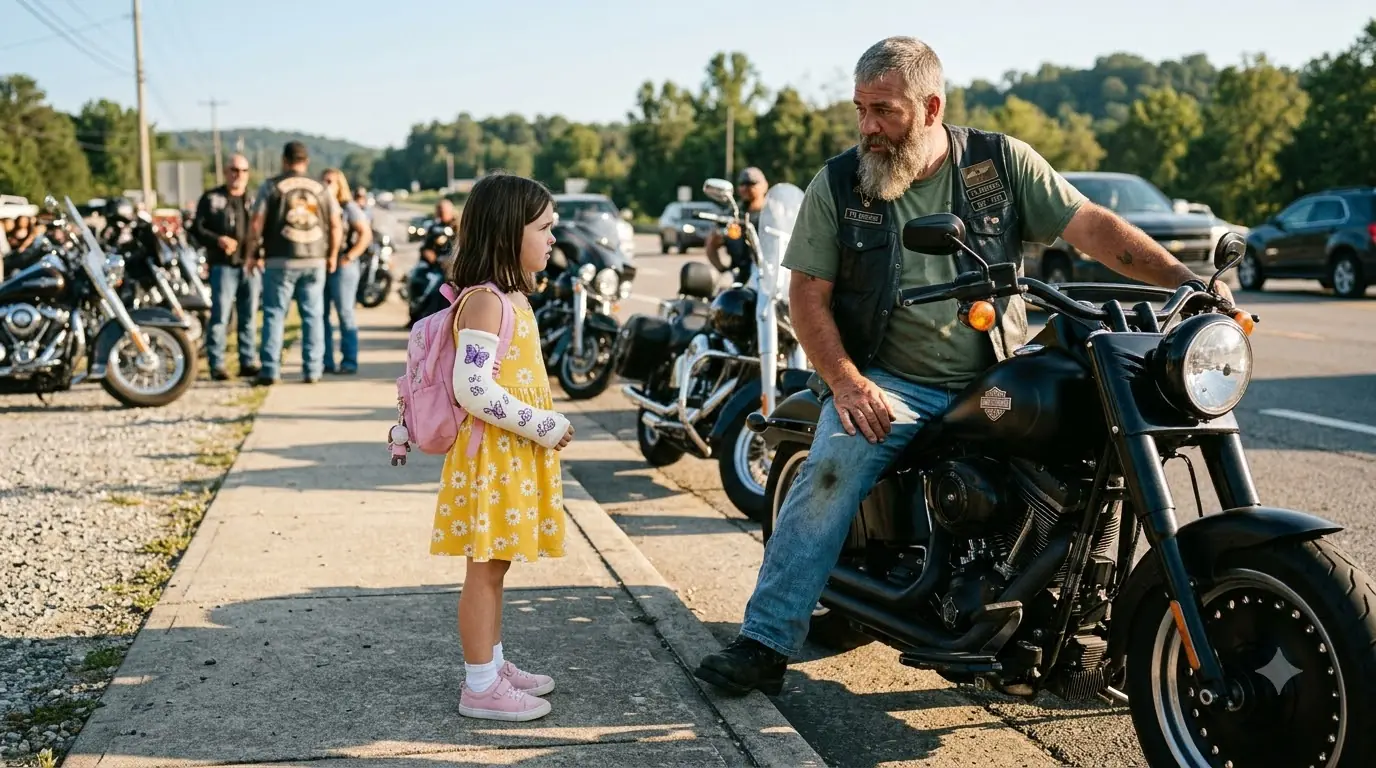
What she asked him next would change the lives of 72 strangers, and no one saw it coming.
The August heat settled over Millbrook, Tennessee, like a wool blanket that nobody had asked for. By 8:00 in the morning, the asphalt in the school parking lot of Jefferson Elementary was already shimmering, sending up thin waves of distortion that made the yellow buses look like mirages.
Parents dropped their children off quickly, eager to get back to their air-conditioned cars, and the kids spilled onto the sidewalk in walking clusters, loud, sun-kissed, certain of their place in the world.
Lily Hargrove stepped out of a rusted 2003 Honda Civic with a pink backpack that was slightly too big for her frame.
Her mother, Sandra, leaned across the passenger seat and called after her, “Have a good day, baby. I’ll be here at 3:00.”
Lily turned and gave a small wave with her left hand. Her right arm was wrapped in a white fiberglass cast that went from her wrist to just below her elbow, decorated with two purple butterflies she had drawn herself the night before with a marker.
She had fallen off a jungle gym 3 weeks ago at the neighborhood park, a clean fracture, the doctor had said, nothing that wouldn’t heal. But in the social arithmetic of second grade, a cast was either a magnet or a wall, and for Lily, it had become the latter.
She was small for 7, with dark brown hair cut just below her ears, and large eyes the color of chestnuts. She wore a yellow dress with white daisies on it because her mother said yellow was the color of people who weren’t afraid, and Lily had been trying very hard to believe that.
Jefferson Elementary had 412 students across kindergarten through fifth grade. Lily knew this because she had heard Principal Owens say it at the beginning-of-year assembly, and Lily remembered things like that.
Numbers, dates, the exact shade of the sky on important days.
What she was less skilled at was the fluid, unconscious language of belonging that other kids seemed to speak without effort, the way they folded into groups at recess, the shorthand of shared jokes, the ease of simply sitting next to someone and knowing you were welcome.
She had transferred to Jefferson in January, halfway through first grade, when her mother’s job at the textile distribution center in Nashville had fallen through, and they had relocated to Millbrook to live with Sandra’s sister, Pam, while Sandra found new work.
By the time Lily had learned the layout of the school, which bathroom had the broken soap dispenser, which lunch table was claimed by the third grade girls who traded holographic stickers, the school year had ended.
Second grade was supposed to be a fresh start.
She found her classroom, room 114, Mrs. Karen Sutton, and slid into a desk near the window.
Mrs. Sutton was a tall woman in her late 30s, with reading glasses perpetually perched on her forehead, and a genuine warmth that filled the room like the smell of coffee.
She noticed Lily immediately and smiled.
“Good morning, Lily. Love the butterflies on that cast.”
“Thank you,” Lily said. “I drew them myself.”
“I can tell.”
The compliment landed softly and then dissolved. Around her, kids were already talking about summer, about a birthday party at the splash pad, about a video game that Lily didn’t have.
She opened her pencil case and arranged her pencils by color, a habit she had developed as a way of looking busy when she didn’t know how to begin.
Recess came at 10:15. The playground of Jefferson Elementary was a wide, sunny expanse of rubber mulch and metal equipment behind the school building, bordered on one side by a chain-link fence, and on the other by a row of oak trees whose roots had begun pushing up through the sidewalk.
Most of the second graders moved in packs toward the swings or the climbing structure. Lily drifted toward the oak trees, where a wooden bench offered shade.
She had been sitting there for perhaps 5 minutes when Trevor Moss appeared. Trevor was 8, a year older than most of his classmates, with a gap between his front teeth, and the particular confidence of a boy who had never been told no by anyone he respected.
He was not cruel in the calculated way that older children sometimes were. He was simply careless, the way a kid is careless when he has never had to think about how his words land.
“Why are you sitting by yourself again?” he said, stopping in front of her bench. Two other boys hovered behind him, uninterested but present.
“I’m just sitting,” Lily said.
“You always sit by yourself.” He looked at her cast.
“Does your arm still hurt?”
“A little.”
“My cousin broke his arm, and he cried for a whole day.”
“I cried, too,” Lily said simply. She didn’t think this was something to be ashamed of.
Trevor seemed momentarily thrown by her honesty. Then he shrugged.
“Nobody wants to play with you because you’re weird,” he said, not with particular malice, but with the flat certainty of someone stating a fact.
He turned and ran toward the climbing structure, and the two boys followed him without looking back.
Lily sat very still for a moment. The oak tree above her moved in a slight breeze, sending a pattern of light and shadow across her knees.
She looked at the butterflies on her cast.
That afternoon, Sandra picked her up at 3:00 as promised. Lily climbed into the passenger seat and buckled her seatbelt.
“How was your day?”
“Fine,” Lily said. Then, after a pause, “Mom, how do you make friends?”
Sandra glanced over at her daughter. The question was so direct and so quiet that it sat in the car like something fragile.
“You just talk to people,” Sandra said, though she heard how thin that sounded even as she said it. “You find things you have in common.”
Lily nodded and looked out the window. They passed the gas station on Route 9, and then the feed store, and then the long stretch of road that curved toward the edge of town where the old grain silos stood.
And there, parked in the gravel lot of a roadside diner called Patty’s Place, Lily saw them. Motorcycles.
Dozens of them, gleaming in the late afternoon sun, chrome and leather, and the low rumble of engines that she could feel in her chest even through the car window.
And the men who owned them, big, broad-shouldered, wearing black vests covered in patches. She pressed her face lightly against the glass.
“Who are they?” she asked.
Sandra glanced over. Her grip on the steering wheel tightened slightly.
“Motorcycle club,” she said.
“Hells Angels, I think. They pass through town sometimes.”
“They look scary,” Lily said.
“Some people think so,” Sandra said.
Lily kept watching until they turned the corner and the diner disappeared from view. She sat back in her seat and was quiet for the rest of the drive home, turning something over in her mind the way she turned a smooth stone over in her pocket, slowly, carefully, to learn every surface.
2 weeks passed. School settled into its rhythms, spelling tests on Fridays, library on Wednesdays, the particular silence of a classroom during a math quiz.
Lily was not unhappy, exactly. She was careful in the way that children are careful when they have learned that the world requires it of them.
Mrs. Sutton noticed her quietness.
She paired students for a reading project and deliberately placed Lily with a girl named Cora Daniels, who had red hair and a loud laugh, and seemed incapable of long silences.