Thunder crashed outside like cannon fire as nine leather-clad bikers appeared beyond the rain-streaked windows of Mama Ruth’s Kitchen.
It was nearly midnight in Memphis, and seventy-three-year-old Ruth Washington stood frozen behind the counter, her heart pounding against her ribs.
Heavy jackets gleamed with rain. Water ran from thick beards and soaked through worn denim. Tattooed arms disappeared beneath dark leather sleeves.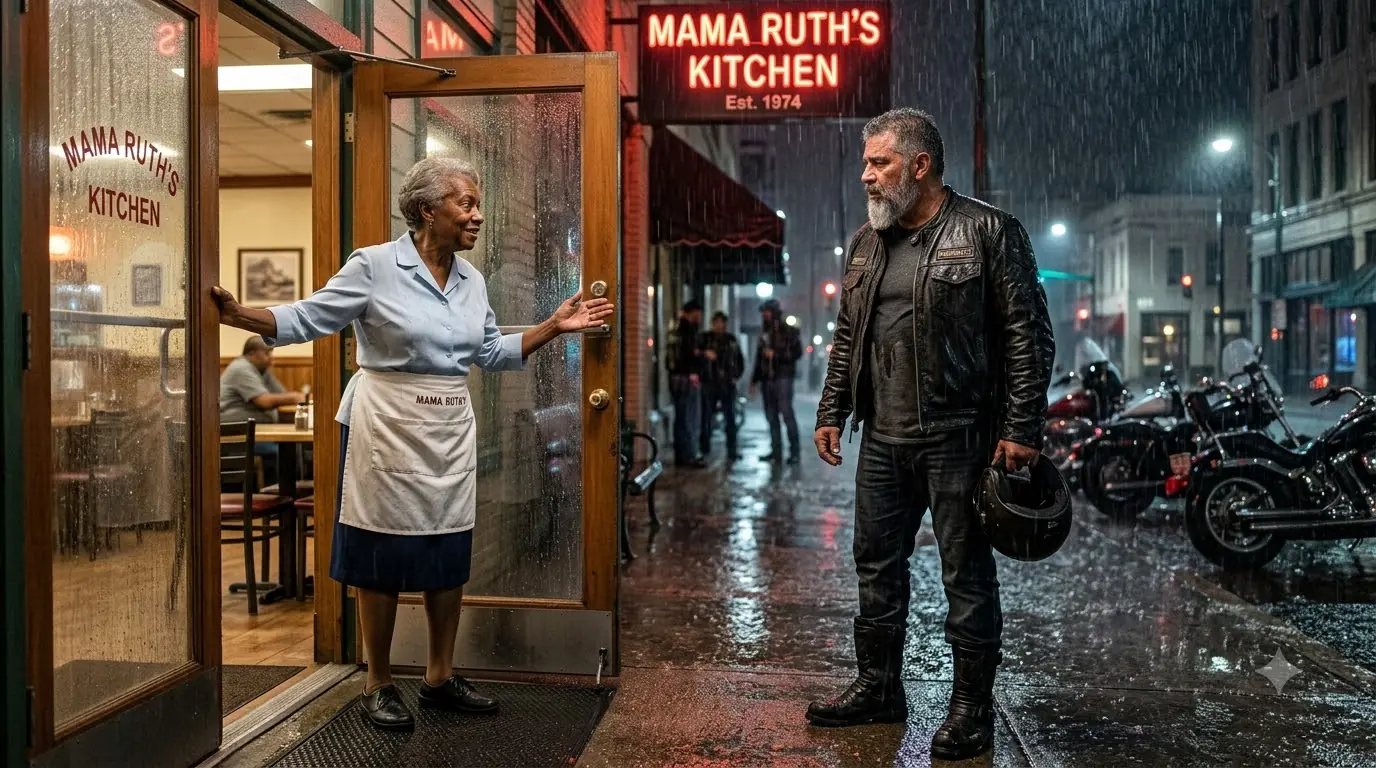
Ruth’s hand hovered over the telephone.
Every instinct told her to lock the door, call for help, and stay away from the men standing outside. Every frightening story she had ever heard about motorcycle clubs rushed into her thoughts. She was alone, an elderly woman in a nearly empty diner, facing nine strangers who looked capable of intimidating almost anyone.
Then she saw their eyes.
What she saw was not menace.
It was desperation.
Ruth could not have known that the large man with the weathered face standing closest to the door was more than he appeared to be, or that the young rider his companions were trying to support would connect this stormy night to a forgotten act of kindness from years before.
To understand why Ruth eventually opened that door, though, you had to understand who Ruth Washington was long before the motorcycles arrived.
At five every morning, while most of Memphis still slept, Ruth’s old 1992 Honda coughed to life in the darkness.
She had driven the same route for nearly forty years. Same streets. Same turns. Same quiet determination. And lately, the same fear that each morning might be the one when she finally could not afford to continue.
Mama Ruth’s Kitchen sat at the corner of Elm and Third inside a faded green building that had seen better decades. Paint peeled from the siding. The old neon OPEN sign flickered uncertainly in the front window, blinking pink letters that sometimes disappeared completely before buzzing back to life.
Ruth unlocked the front door and stepped into the only world she had ever really wanted.
The smell greeted her first.
Bacon grease.
Old coffee.
Cornbread.
Soap.
Forty years of meals and memories seemed to live inside those walls.
Mama Ruth’s Kitchen was not merely a diner. It was Ruth’s entire adult life compressed into nine hundred square feet of checkered linoleum, cracked vinyl booths, mismatched chairs, framed photographs, and a counter worn smooth by thousands of elbows.
She turned on the lights.
Six seats had OUT OF ORDER signs because the upholstery had torn so badly that she could no longer pretend repairs could wait.
The coffee machine wheezed when she switched it on.
Ruth patted its metal side affectionately.
“Come on, baby. Give me one more day.”
Then came the part of her morning she hated.
The bills.
She opened the register.
One hundred twenty-seven dollars from the previous day.
On the counter beside it sat three months of overdue rent notices, an electricity warning printed in red, and a letter from her food supplier refusing another delivery until she paid at least part of her balance.
Ruth did the arithmetic in her head.
The numbers never changed enough to matter.
She opened the refrigerator.
Half a gallon of milk nearing its expiration date.
A few eggs.
Leftover meatloaf.
Some vegetables.
A pan of cornbread.
Ruth had become an expert at stretching everything. She made smaller portions without making them look smaller. She turned leftovers into specials. She ate very little herself on the days when customers needed more than they could afford.
At six fifteen, the bell above the door jingled.
Mr. Jenkins shuffled inside counting quarters in one weathered palm.
He was eighty-seven, lived alone three blocks away, and depended almost entirely on Social Security.
“Morning, Mama Ruth.”
“Morning, Mr. Jenkins.”
“Coffee and toast.”
“You want butter on that toast?”
He smiled.
“You know I do.”
Ruth knew something else, too.
Mr. Jenkins had exactly seventy-five cents.
The coffee and toast should have cost twice that amount.
Ruth brought him both anyway.
The coffee cup was slightly fuller than usual.
“What do I owe you?”
“Seventy-five cents is just fine.”
Mr. Jenkins carefully placed three quarters on the counter.
Ruth pretended not to notice the relief in his eyes.
That was Ruth Washington.
A woman giving away things she could barely afford to lose.
The breakfast rush consisted of four people.
Later, Maya stopped by with her eight-year-old twins before going to her cleaning job downtown. The children settled into Table Six with worksheets and pencils while Maya checked her watch nervously.
Ruth placed a cookie in front of each child.
“Fifty cents.”
Maya looked at her.
“Ruth, these cost more than that.”
“Not today.”
“I get paid Friday. I can pay you then.”
“Hush, baby. Those children need their snacks.”
Maya placed two quarters on the table anyway.
By noon, Ruth had served twelve people.
She had taken in eighty-three dollars.
She had spent ninety-five.
Another losing day.
Still, she could not bring herself to close.
The diner was not merely a failing business.
It was one of the last pieces of the old neighborhood still standing.
Near the front window sat a glass trophy case. Behind the dusty glass were items Ruth cared about far more than money.
Samuel Washington’s military commendations.
A Purple Heart.
A Bronze Star.
A photograph of Samuel in uniform.
Their wedding photograph from 1972.
Samuel had been gone for years, but Ruth still talked to him most days.
Beside his medals sat another photograph that almost nobody asked about.
A thin sixteen-year-old boy sat at the diner counter, his face exhausted and frightened.
On the back Ruth had written in careful handwriting:
Tommy. Hope you made it home safe.
She touched the edge of the frame.
“Samuel, I don’t know how much longer I can do this.”
The diner had been their dream.
Samuel worked construction during the day. Ruth served tables at night. For ten years, they saved almost every extra dollar until they finally had enough to buy the place.
“We’re going to feed the whole neighborhood,” Samuel used to say.
Ruth would laugh.
“We can’t afford to feed the whole neighborhood.”
“We’ll figure it out.”
“And if they can’t pay?”
“Then they pay when they can.”
“What if they never can?”
Samuel would grin.
“Then at least they ate.”
For decades, the diner became exactly what they imagined.
Birthday parties filled the back booth.
New jobs were celebrated over coffee and pie.
Teenagers who had nowhere else to go sat at the counter receiving free meals and unwanted but usually useful advice.
Families going through hard times knew that Ruth would never let their children leave hungry.
Then the neighborhood changed.
Families moved away.
Small businesses disappeared.
Developers arrived.
New buildings rose.
The community that once kept the diner full slowly scattered.
But some people remained.
Maya still needed somewhere her children could sit safely before school.
People still needed the comfort of knowing one familiar door would open for them every morning.
Ruth reached into her purse.
Forty-three dollars.
That was nearly everything she had left.
Then she looked at her wedding ring.
It was probably the only object she owned worth selling.
She turned it slowly around her finger.
“Not yet, Samuel.”
She looked toward his picture.
“I’m not giving up on our dream yet.”
Outside, the afternoon sky had darkened.
The radio behind the counter interrupted an old soul song with a weather alert.
Severe thunderstorms were moving toward Memphis. Flash flooding was possible. Residents were advised to avoid unnecessary travel and seek shelter.
Ruth listened carefully.
Then she made the kind of decision Samuel would have predicted.
She decided to stay open late.
If the weather became dangerous, someone might need somewhere warm.
By nine that evening, Memphis looked as though the sky had cracked open.
Rain battered the diner windows.
Lightning flashed white across the street.
Thunder shook the old building.
Ruth should have been home in her small apartment above the grocery store.
Instead, she was wiping tables that did not need wiping and brewing fresh coffee nobody seemed likely to drink.
The weather service repeated its warnings.
Flash flooding.
Dangerous travel.
Possible tornado activity.
Stay indoors.
Ruth looked through the window.
Somewhere out there, she knew, someone was stuck.
Samuel used to joke about that instinct of hers.
“Ruth, you’d open the door for the devil himself if he showed up cold and hungry.”
Maybe tonight she was about to discover whether he had been right.
Around eleven thirty, she heard something beneath the thunder.
Engines.
More than one.
The unmistakable rumble grew louder.
Ruth stopped cleaning the grill.
Through the rain, headlights appeared.
One.
Then another.
Then several more.
Motorcycles moved through the storm in a loose formation before stopping near the diner.
The engines shut down one after another.
Nine motorcycles.
Nine men climbing off.
Ruth moved toward the window.
Her hand found the telephone.
Then she noticed the patches on their jackets.
Her fear deepened.
She almost dialed immediately.
But something about their movements stopped her.
They were not spreading out around the building.
They were gathering around someone.
Protecting him.
Holding him upright.
The largest biker approached the door.
He had massive shoulders, a salt-and-pepper beard, and old tattoos covering his arms. Rain poured from his jacket.
His expression was serious.
But his eyes were frightened.
He pressed one palm against the glass.
Ruth stared at him.
He mouthed a single word.
“Please.”
Not an order.
A plea.
Behind him, the other bikers were supporting a young man whose head hung weakly to one side.
The large biker knocked.
“Ma’am!”
Ruth could barely hear him through the storm.
“We’re not looking for trouble. We’ve got a man hurt.”
Ruth stepped closer.
“Roads are flooded,” he called. “We can’t get him to the hospital. We just need somewhere dry until we can get help.”
Ruth looked at the injured rider.
He appeared to be in his twenties.
His face had gone pale, and one leg of his jeans was badly torn and stained from the accident.
Ruth’s fear remained.
But another instinct became stronger.
Someone needed help.
She walked toward the door.
Her fingers trembled around the deadbolt.
For one moment, she looked toward Samuel’s photograph.
“I hope you’re watching me.”
Then she unlocked the door.
Wind and rain rushed inside.
The nine bikers stared at her.
“Bring him in,” Ruth said.
Nobody moved for half a second, perhaps surprised she had actually opened the door.
Then Ruth pointed toward a booth.
“Come on. Hurry.”
They carried the injured man inside.
Rainwater covered the floor.
Heavy boots moved across the old linoleum.
Wet leather and motor oil filled the room.
Ruth’s heartbeat remained fast.
Then something happened she had not expected.
The large biker removed his helmet.
“Thank you, ma’am.”
Another nodded.
“Much obliged.”
A third said, “We appreciate this.”
Every one of them addressed her respectfully.
Ruth forced herself to focus.
“Put your friend right here.”
They laid him carefully across the booth.
Ruth grabbed clean towels.
“What’s his name?”
“Tommy,” the large biker answered. “His name is Tommy.”
The name touched something in Ruth’s memory.
But she had no time to think about it.
“What happened?”
“Bike lost traction a few miles back. He hit the roadside barrier.”
Ruth examined Tommy carefully.
He was conscious but weak.
The injury needed professional treatment, yet Ruth could at least keep him stable until they could reach medical help.
“Tommy, baby, can you hear me?”
His eyes opened.
Blue.
Tired.
For one strange second, Ruth felt as if she had seen them before.
“I’m sorry,” he whispered.
“For what?”
“Bothering you.”
“Hush.”
Ruth began cleaning and covering the injury as carefully as she could.
“You are not bothering anybody.”
She looked around at the others.
“Move those tables back. Give us room.”
The men responded immediately.
“You, get clean towels from the kitchen. Not those ones. The white ones on the shelf.”
One biker headed toward the kitchen.
“You,” Ruth pointed toward another, “hold his shoulders steady.”
Within minutes, something remarkable had happened.
The seventy-three-year-old woman who had been terrified to unlock the door was directing nine intimidating bikers around her diner as if they were boys helping at a church supper.
The leader watched her work.
“What’s your name?” Ruth asked him.
“They call me Captain.”
“I didn’t ask what they call you.”
For the first time, he smiled.
“Michael.”
“Michael what?”
“Michael Rodriguez.”
“Well, Michael Rodriguez, you boys did right getting him somewhere dry.”
Michael nodded.
“We can pay you something for all this.”
“I don’t want your money.”
Ruth checked Tommy again.
Then she looked at the group.
“You hungry?”
The question caught them off guard.
One of the men actually looked behind himself as though she might have been speaking to someone else.
“We don’t want to impose.”
“You are already dripping all over my floor.”
A few of them smiled.
Ruth stood.
“I’ve got leftover meatloaf. Cornbread from yesterday. Green beans. Coffee’s probably too strong by now, but it’s hot.”
She looked at them sternly.
“Sit down.”
The strangest dinner service of Ruth Washington’s life began shortly before midnight.
Nine bikers sat in her nearly bankrupt diner, eating leftover meatloaf and day-old cornbread.
They spoke quietly.
They used napkins.
They said please.
They said thank you.
When one man absentmindedly started resting a boot against an empty chair, another nudged him until he put his foot down.
Ruth noticed everything.
“These are the best green beans I’ve had in months,” one of them said.
“You need to eat in better places.”
Michael shook his head.
“No, ma’am. He means it.”
“You boys are being polite because I fed you.”
“It isn’t just the food.”
Michael looked around the little diner.
“People see our jackets and decide what we are before we say anything.”
Ruth poured him more coffee.
“You do look scary.”
Several men laughed.
Michael smiled.
“That’s fair.”
“But scary-looking people still get hungry.”
Michael’s expression changed.
Ruth continued.
“Everybody’s human, honey.”
Something behind his eyes softened.
As the night passed, Ruth continued checking Tommy.
Around three in the morning, she became concerned.
His condition was worsening.
He needed a doctor.
“We’re going to the hospital.”
Michael shook his head.
“Roads are still bad.”
“I didn’t ask about the roads.”
“Ma’am, ambulances are having trouble getting through.”
“Then we get him there ourselves.”
Michael stared at her.
“You’re serious.”
“I am not losing this boy in my diner.”
Outside, the rain had weakened but water still covered parts of the street.
They worked out the safest way to move him.
Ruth refused to stay behind.
Michael protested.
“You’ve already done enough.”
“Enough is when he’s in a hospital.”
Eventually, Ruth climbed onto the back of Michael’s motorcycle, nervous but determined, while the group carefully transported Tommy with support from the others.
Eight motorcycles surrounded them during the slow ride through the storm-damaged streets.
Ruth had never ridden a motorcycle before.
Under different circumstances, she might have been terrified.
That morning, she had only one thought.
Get Tommy to the hospital.
At Memphis General, Ruth stayed.
Doctors treated Tommy’s injury and started medication.
Ruth sat beside him.
She held his hand.
She called him baby and honey as naturally as if he were one of the children who had grown up eating cookies in her diner.
The bikers waited in the lobby.
Their leather jackets and worn boots looked wildly out of place beneath fluorescent hospital lighting.
Eventually, a doctor approached Ruth.
“Your grandson is going to be all right.”
Ruth almost corrected him.
Then she did not.
Tonight, Tommy could be her grandson.
Tonight, those nine men could be her boys.
Family, Ruth believed, sometimes simply meant whoever showed up when things became difficult.
By seven in the morning, the storm had moved away.
Memphis looked washed, battered, and strangely beautiful beneath the returning sunlight.
Tommy was stable.
Michael approached Ruth in the waiting room.
“Ma’am, we owe you more than I know how to say.”
“You don’t owe me anything.”
He reached into his jacket.
For the briefest second, Ruth tensed.
Then he pulled out a thick roll of cash.
“This is for you.”
Ruth stared.
There were thousands of dollars.
More than enough to pay several overdue bills.
Enough to buy supplies.
Enough to repair part of the diner.
Possibly enough to keep her business alive a little longer.
She pushed his hand away.
“No.”
Michael blinked.
“Ma’am.”
“I said no.”
“You need this.”
“My business is my responsibility.”
“You fed nine people. You stayed with Tommy. You helped us through the storm.”
“And I’d do it again.”
Michael tried once more.
“At least let us pay for the food.”
“Leftovers.”
“The coffee?”
“Would’ve gone down the drain.”
One of the other riders shook his head in disbelief.
Michael lowered his voice.
“We saw the notices on your counter. We saw the broken seats.”
Ruth’s back straightened immediately.
“My business troubles are my business.”
Michael knew better than to push further.
Then Tommy spoke from the hospital bed.
“Mama Ruth?”
The name caught her attention.
She walked over.
“What do you need?”
Tommy reached toward the silver chain around his neck.
A small cross hung from it.
He removed it and held it toward her.
“My grandmother gave this to me when I was little.”
Ruth shook her head.
“No, baby.”
“She died when I was thirteen.”
“Then you keep it.”
“She was like you.”
His voice grew emotional.
“She helped people when she couldn’t afford to.”
He placed the chain in Ruth’s palm.
“I want you to have it.”
Ruth looked down at the worn silver cross.
It carried something money could not measure.
“Tommy…”
“She would’ve liked you.”
Ruth finally allowed him to fasten it around her neck.
The cross rested against her chest.
Michael handed her something else.
A business card.
Plain white.
Heavy paper.
Only a company name and telephone number.
“If you ever need anything, call.”
Ruth studied it.
Rodriguez Enterprises.
“What kind of motorcycle club has corporate business cards?”
Michael smiled.
“We have our hands in a few businesses.”
“What kind?”
“Manufacturing. Logistics. Import and export.”
That seemed an unusual answer.
Ruth decided not to pry.
These men had respected her.
She could respect whatever parts of their lives they chose not to explain.
Before leaving, each biker approached Ruth individually.
Helmets came off.
Heads nodded.
“Thank you, ma’am.”
“Much obliged.”
“You’re something special, Mama Ruth.”
Michael was last.
“We won’t forget this.”
Ruth smiled.
“Just ride safer next time.”
She stayed with Tommy a few more minutes.
“You’ve got good friends.”
“They’re family.”
“Family’s important.”
“Yes, ma’am.”
Again, Ruth felt that strange familiarity.
But the moment passed.
She kissed Tommy’s forehead and left.
As she stepped into the Memphis sunlight, she touched the silver cross at her throat.
She was tired.
Her diner was still nearly bankrupt.
Her bills still existed.
But for one morning, she felt useful again.
She had helped someone when they needed it.
That feeling lasted only a few days.
The rumors began almost immediately.
Mrs. Patterson stopped Ruth outside the grocery store.
“Ruth, honey, I heard about those motorcycles.”
“They needed shelter.”
“You know who those men were?”
“People caught in a storm.”
“People say they were dangerous.”
Ruth adjusted her grocery bag.
“They were polite in my diner.”
“But everybody saw them.”
“So?”
Mrs. Patterson lowered her voice.
“People are talking.”
By Tuesday, Ruth’s already-small breakfast crowd had dropped by half.
Mr. Jenkins still came.
Maya did not bring her twins.
Several construction workers who usually stopped for lunch walked past instead.
Wednesday brought only three customers.
Ruth sat behind the counter watching familiar faces approach, hesitate, then continue walking.
She heard pieces of conversation outside.
“She’s mixed up with bikers.”
“Something strange is happening there.”
“My wife told me not to eat there anymore.”
Thursday’s earnings were twenty-eight dollars.
Friday brought nineteen.
Ruth stared into the nearly empty register.
Then the strange deliveries began.
A large bouquet of expensive flowers arrived.
The card contained only a short message of gratitude.
Ruth immediately became suspicious.
Were they payment?
A signal?
The next day brought premium coffee beans.
No sender.
The delivery driver only knew that the order had been paid online.
Then came strange telephone calls.
People asked for Captain.
Others asked whether they had reached the Memphis location.
Whenever Ruth said they had the wrong number, callers hung up quickly.
A black sedan also began appearing across the street.
Sometimes morning.
Sometimes afternoon.
Always the same car.
Ruth thought she saw someone photographing the building.
Finally, she pulled Michael’s card from her purse and called.
A polished recording answered.
“You’ve reached Rodriguez Enterprises. Please leave a detailed message.”
Ruth slowly lowered the phone.
“Rodriguez Enterprises?”
She looked toward the window.
“What exactly did I let into my diner?”
By Friday evening, her fear had become desperation.
An eviction notice had arrived.
She owed forty-eight hundred dollars.
Fifteen days.
Her savings had dwindled almost completely.
Ruth sat alone after closing, touching the silver cross.
Then she opened the trophy case and removed the old photograph of the runaway teenager.
Tommy.
Thin.
Frightened.
Sixteen.
She stared at the eyes.
Something about them reminded her of the young biker from the storm.
“Samuel,” she whispered, “I think I might have gotten myself into something bigger than I understand.”
Outside, the black sedan drove past again.
Two weeks after the storm, Ruth reached what she believed was the end.
It was three in the afternoon.
An eviction notice remained taped to the front window.
The deadline had arrived.
Nineteen dollars sat in the register.
The coffee machine had finally stopped working.
The refrigerator sounded as though it might fail next.
Ruth walked through Mama Ruth’s Kitchen one last time.
Her fingers brushed the counter.
Table One.
Table Two.
The old booth where Samuel used to sit after construction shifts.
The back booth where frightened teenagers sometimes slept when they had nowhere else to go.
She touched Samuel’s photograph.
“Looks like we tried.”
Then she picked up the telephone.
She was going to call the landlord.
She would surrender the keys.
Her finger moved toward the number.
Then she heard it.
Motorcycles.
Ruth froze.
The rumble grew rapidly.
Not nine motorcycles.
Far more.
The windows began vibrating.
Ruth moved toward the front.
A long procession filled the street.
Motorcycles stretched down the block.
Behind them came black SUVs.
Cars.
News vans.
Neighbors emerged from nearby buildings.
Mrs. Patterson stood on the sidewalk clutching her purse.
Ruth’s fear returned full force.
“What in heaven’s name…”
Then she saw the lead rider.
Michael.
He removed his helmet.
Behind him, men stepped from the SUVs wearing expensive suits.
Camera crews unloaded equipment.
A reporter began speaking into a microphone.
Ruth gripped the edge of the counter.
Whatever was happening, it seemed enormous.
Michael approached the door.
Ruth reluctantly unlocked it.
“Mama Ruth.”
“Michael, what have you done?”
“I owe you an explanation.”
He entered.
Other bikers followed.
Then businessmen.
The little diner suddenly contained an impossible mixture of leather jackets, tailored suits, cameras, and executives.
Ruth stared at him.
“I’ve lost almost every customer I have. People think I’m involved in something criminal. Someone’s been watching me. Strange deliveries show up. People keep calling this restaurant looking for you.”
Michael’s expression became serious.
“We know.”
“You know?”
“Yes, ma’am.”
Ruth crossed her arms.
“Then start talking.”
Michael nodded.
“My full name is Michael Rodriguez.”
“I already know that.”
“I’m the chief executive of Rodriguez Manufacturing.”
Ruth stared.
Michael continued.
“One of the largest motorcycle and automotive parts manufacturers in the country.”
Ruth blinked.
“CEO?”
“Yes, ma’am.”
“But you…”
She gestured toward his leather jacket.
“You’re a biker.”
Michael smiled slightly.
“That too.”
A second man stepped forward and removed his motorcycle jacket, revealing an expensive suit underneath.
“David Parker, ma’am. I oversee logistics operations for Michael’s company.”
Another introduced himself as a regional director.
Another owned several dealerships.
Several of the riders were veterans.
Others were executives, engineers, and business owners who rode together regularly.
Ruth looked from face to face.
Then another man entered.
Tailored suit.
Clean-shaven.
Healthy.
Ruth stared at him.
Tommy.
He no longer resembled the injured young rider lying weakly in her booth during the storm.
Now he looked like a successful businessman.
Still, something about his eyes pulled Ruth backward through time.
Tommy stepped closer.
“Mama Ruth, do you remember a sixteen-year-old kid who slept in your back booth because he had run away from home?”
Ruth’s hand rose to her mouth.
The old photograph.
Those eyes.
“Tommy?”
His eyes filled.
“Yes, ma’am.”
Ruth stepped closer.
“Little Tommy?”
He nodded.
“Thomas Rodriguez.”
Ruth looked toward Michael.
“This is my son,” Michael said.
For several seconds, Ruth could not speak.
Michael’s voice became quieter.
“Years ago, Thomas disappeared after we had a terrible argument.”
Thomas looked down.
“I thought my father didn’t understand me. I thought leaving would solve everything.”
Michael continued.
“For nearly two weeks, I didn’t know where my son was. Police were looking. Private investigators were looking. I called anyone I thought might know something.”
Ruth remembered.
A hungry teenage boy appearing at her diner.
Too proud to admit he had nowhere to sleep.
She had fed him.
Then fed him again.
Eventually, she let him sleep in the back booth.
He had told her about his father.
“He said you two had been fighting,” Ruth whispered.
Thomas nodded.
“I thought I was disappointing him.”
“You told me you weren’t good enough.”
“I remember.”
Ruth’s eyes filled.
“I told you running away doesn’t solve anything.”
“You made me call home.”
Michael swallowed.
“When Thomas returned, he told me about an angel running a little diner in Memphis.”
Ruth shook her head.
“I’m no angel.”
“You were to us.”
Michael looked around the aging diner.
“I tried to find you afterward. We had only fragments. A first name. A diner. Memphis. By the time I had people searching properly, Thomas couldn’t remember the exact address.”
Thomas gave an embarrassed smile.
“I was sixteen and terrified. I barely knew where I was.”
Michael continued.
“When we ended up at your door during that storm, none of us realized who you were.”
Thomas looked at Ruth.
“Not until the hospital. You kept calling me Tommy. You said things exactly the way I remembered.”
Ruth touched the silver cross around her neck.
“And the necklace?”
Thomas nodded.
“My grandmother really did give it to me.”
Ruth understood.
“That photograph.”
She rushed toward the trophy case.
She pulled it out.
Thomas stared at his sixteen-year-old face.
“You kept it.”
“Of course I kept it.”
Ruth turned toward Michael.
“What about the black car?”
“We were confirming records.”
“You were following me?”
“We were trying to be certain before approaching you.”
“The flowers?”
“From us.”
“The coffee?”
“Also us.”
Ruth shook her head.
“You scared half the neighborhood away.”
Thomas’s face fell.
“We know.”
“We thought we were helping quietly,” Michael said. “Instead, we made people suspicious.”
Ruth sat down.
“I lost everything.”
Michael turned immediately toward one of the suited men.
“Contact her landlord. Back rent gets paid today.”
Ruth looked up.
“No.”
“Utilities too.”
“Michael.”
“Suppliers. Repairs. Everything.”
“I told you before I don’t want charity.”
“And I told you before this is not charity.”
Thomas sat across from her.
“Mama Ruth, every good thing that happened in my life after sixteen traces back to you making me call my father.”
He opened his phone.
Graduation photographs.
A wedding.
Two children.
A home.
A business award.
Ruth stared at each image.
Thomas pointed toward one of the children.
“That’s my daughter.”
Ruth smiled despite herself.
“She has your eyes.”
“She knows about you.”
“What?”
“My kids grew up hearing about Mama Ruth.”
Ruth covered her mouth.
Thomas’s voice trembled.
“You fed a runaway teenager when you had no reason to care. You gave me somewhere safe to sleep. You listened when I was angry. Then you told me something nobody else could get through my head.”
“What did I say?”
“That running away from people who love you doesn’t make the pain smaller. It just makes the distance bigger.”
Ruth remembered.
“I did say that.”
“You saved my relationship with my father.”
Michael nodded.
“And during the storm, you saved him again.”
The diner became quiet.
Then Michael opened a tablet.
Architectural renderings appeared.
Ruth leaned closer.
The drawings resembled Mama Ruth’s Kitchen.
But larger.
Restored.
Sixty seats.
A modern kitchen.
New equipment.
Fresh floors.
Yet the counter remained recognizable.
Samuel’s photograph wall remained untouched.
Even the old color scheme remained.
“What is that?”
“Mama Ruth’s Kitchen,” Michael said.
“No.”
“The version that doesn’t fall apart around you.”
Ruth stared.
Thomas smiled.
“We want to renovate this location completely.”
David opened a folder.
“The projected initial renovation is approximately two hundred thousand dollars.”
Ruth looked alarmed.
“Two hundred thousand?”
“Kitchen equipment could add another hundred fifty thousand.”
Ruth almost laughed.
“You people have lost your minds.”
David continued.
“All outstanding rent and utilities would be cleared immediately. There would also be a fifty-thousand-dollar operating reserve for staff, inventory, supplies, and reopening expenses.”
Ruth stood.
“I cannot take that much money.”
Michael shook his head.
“You wouldn’t be taking it.”
“What do you call it?”
“Investment.”
Ruth stared at him.
“In what?”
“You.”
Thomas leaned forward.
“We want Mama Ruth’s Kitchen to become the first location in a new network of community-centered restaurants.”
Ruth looked between them.
“Mama’s Kitchens.”
Thomas nodded.
“Places that feed people, employ locally, provide job training, and become safe spaces for families and young people.”
Michael added, “Exactly what this place already does.”
“You want to copy my diner?”
“No,” Michael said. “We want to build around its values.”
David slid documents toward her.
“You would remain the owner of this location.”
Ruth frowned.
“I keep it?”
“Yes.”
“And you own the rest?”
“You become a founding partner in the larger company.”
Ruth sat again.
David continued explaining.
She would receive income from her location.
She would hold an ownership share tied to future Mama’s Kitchen restaurants.
She would advise on menus, hospitality policies, and community programs.
She would have veto authority over major changes that violated the mission.
Michael looked at her.
“You would not work for us.”
He smiled.
“We would work with you.”
Ruth looked toward Samuel’s photograph.
“This was his dream.”
“Then help us grow it.”
Thomas pointed toward another section of the proposal.
“Every new location would include a youth program.”
“What kind?”
“Job training. Scholarships. Emergency assistance for teenagers who don’t have stable homes.”
Ruth looked at him.
“Like you.”
“Exactly like me.”
His voice broke slightly.
“We create places where another sixteen-year-old doesn’t have to depend on luck to find someone like you.”
That sentence reached Ruth differently than all the financial projections.
David explained the support system.
Professional accounting.
Supply-chain management.
Hiring assistance.
Legal services.
Marketing.
Business consulting.
“You focus on people,” Michael said. “Let us help with everything that has been exhausting you.”
Ruth stared at the architectural drawings.
“What happens to Mr. Jenkins?”
Thomas smiled.
“What do you mean?”
“His breakfast costs seventy-five cents.”
“Then it costs seventy-five cents.”
“Maya’s children?”
“Still get cookies.”
“What if people can’t pay?”
Michael answered immediately.
“We build a community meal fund into every location.”
Ruth looked at him sharply.
“You already thought about that?”
“Thomas insisted.”
Thomas shrugged.
“I know the rules.”
Ruth almost laughed.
She studied the documents again.
“What if you make this place too fancy?”
“That’s why you have control.”
“What if somebody wants to change Samuel’s wall?”
“You say no.”
“What if some corporate person tells me my portions are too big?”
Michael smiled.
“You tell them to leave your kitchen.”
For the first time, Ruth laughed.
Then Thomas showed her another photograph.
His children again.
“Mama Ruth, these are part of what you helped build.”
Ruth touched the screen.
“I didn’t do anything special.”
“Yes, you did.”
“I fed a hungry boy.”
“You saw him.”
Thomas looked into her eyes.
“That was the special part.”
Ruth was silent.
Michael stood.
“You don’t have to decide today.”
“Good.”
“Take your time.”
“I intend to.”
“We’ll still pay the rent we caused you to lose.”
Ruth frowned.
“That’s different.”
Michael smiled.
“Yes, ma’am.”
Ruth spent three days thinking.
She prayed.
She sat in the empty diner at night.
She talked to Samuel’s picture.
“You always wanted to feed everybody.”
She laughed softly.
“Looks like you finally figured out how.”
On the third day, she called Michael.
“I have conditions.”
“I expected conditions.”
“Mr. Jenkins never pays more than seventy-five cents.”
“Done.”
“Children don’t go hungry.”
“Done.”
“Nobody gets treated badly because they look poor.”
“Done.”
“Samuel’s wall stays.”
“Forever.”
“And if one of your executives comes into my kitchen telling me how much gravy I’m allowed to put on somebody’s meatloaf…”
Michael laughed.
“I’ll personally escort them outside.”
Ruth smiled.
“Then we’ve got a deal.”
Three months later, construction began.
Ruth watched workers carefully dismantle parts of the old diner.
Samuel’s photographs were removed one at a time, cataloged, wrapped, and stored safely.
Nothing important disappeared.
During construction, Ruth operated from a temporary food truck provided by Rodriguez Manufacturing.
Mr. Jenkins arrived the first morning.
“Coffee machine work?”
“Brand new.”
“Toast?”
“Still seventy-five cents.”
He smiled.
“Good. Was worried success might make you greedy.”
“Get in line, old man.”
Local news learned the story.
A seventy-three-year-old diner owner had sheltered strangers during a Memphis storm only to discover one of them was the same runaway teenager she had once helped return home years earlier.
The story spread.
Reporters asked Ruth why she had opened the door.
“He needed help.”
“Weren’t you afraid?”
“Terrified.”
“Then why do it?”
Ruth shrugged.
“Fear doesn’t tell you whether something is right.”
During the renovation, Ruth traveled.
She visited community restaurants in Atlanta that employed people rebuilding their lives.
She visited a Detroit program providing job training to teenagers.
She toured a Phoenix café that doubled as a neighborhood resource center.
Every trip reinforced the same belief she had carried for decades.
People needed more than food.
They needed dignity.
They needed somewhere they were not treated like a burden.
Six months after construction began, Mama Ruth’s Kitchen reopened.
The building was transformed.
Sixty comfortable seats replaced the cramped dining room.
The kitchen gleamed.
New equipment worked quietly.
The refrigerator no longer sounded as though it might expire during lunch.
Yet the heart of the place remained unmistakable.
Samuel’s wall occupied its old position.
The counter remained.
Some of the original booths had been professionally restored instead of replaced.
And the sign above the entrance still said:
ALL WELCOME.
The grand opening drew hundreds.
The mayor came.
Reporters filled the sidewalk.
Michael and Thomas stood beside Ruth during the ribbon cutting.
Ruth smiled for photographs because everyone insisted.
But the moment she cared about came the following morning.
Six o’clock.
The bell jingled.
Mr. Jenkins shuffled inside.
He sat at the counter and placed three quarters beside his usual seat.
“Coffee and toast.”
Ruth filled the same old chipped mug she had saved from the original diner.
“Butter?”
“You know it.”
Ruth slid his breakfast across the counter.
“Seventy-five cents.”
Mr. Jenkins smiled.
“Now it feels like home.”
Within months, the effects began spreading through the neighborhood.
A retired teacher opened a small bookstore nearby.
A grocery cooperative provided affordable produce.
An after-school program opened two blocks away.
Mama Ruth’s Kitchen created jobs.
The youth program started placing teenagers in paid apprenticeships.
As property values began rising, Ruth became one of the loudest voices demanding protections for longtime residents.
“I did not spend forty years feeding people just to watch success chase them out of their homes.”
Nobody at Rodriguez Enterprises argued.
The next Mama’s Kitchen opened in Atlanta.
It was run by a retired social worker named Grace who had once experienced homelessness herself.
Detroit followed.
Then Phoenix.
Each location was different.
Each reflected its neighborhood.
But every location followed Ruth’s basic rules.
Feed people.
Treat them with dignity.
See the person before the problem.
Give second chances.
Ruth became financially secure for the first time in her adult life.
She replaced the 1992 Honda with a newer used Honda because she refused Michael’s suggestion of anything expensive.
“I need transportation, not a parade.”
Her apartment above the diner was renovated.
She hired enough staff that she could occasionally take an afternoon off.
Yet Ruth’s generosity only expanded.
The scholarship program sent young people to college.
Emergency assistance helped families avoid eviction.
Teenagers learned cooking, accounting, customer service, and management.
People who needed second chances found jobs.
Michael’s motorcycle group still visited.
Their monthly rides sometimes ended at Ruth’s diner.
Leather jackets hung beside backpacks.
Executives ate meatloaf next to construction workers.
Business discussions took place over cornbread while Mr. Jenkins interrupted with unsolicited opinions.
Ruth liked it that way.
Awards began arriving.
The mayor honored her.
Then the state.
Eventually, national organizations recognized the project.
Ruth insisted Michael and Thomas stand beside her.
“This didn’t happen because of me.”
Thomas would always correct her.
“It started because of you.”
Ruth agreed to participate in one documentary about second chances.
She refused several others.
Any money from the project went into programs for runaway and homeless youth.
Within two years, six Mama’s Kitchen locations were operating.
Dozens of teenagers completed training programs.
Families received emergency help.
Scholarships sent students to college.
Through it all, Ruth continued visiting each location.
Her favorite lesson for new owners never changed.
“See people as somebody’s child.”
She would point toward Thomas.
“This one walked into my diner hungry and angry when he was sixteen. I could have seen a problem.”
Thomas usually smiled.
“She definitely saw a problem.”
Ruth gave him a look.
“I saw a hungry boy first.”
Then she would tell the trainees:
“That’s the order. Person first. Problem second.”
A national magazine eventually placed Ruth on its cover.
The headline celebrated the grandmother who turned kindness into a growing community enterprise.
Ruth framed the issue.
Then she hung it in the office where very few people could see it.
The front wall remained reserved for Samuel and the people the diner had served.
Around Ruth’s neck, Tommy’s silver cross remained.
Over time, two more small charms joined it.
A tiny motorcycle from one location.
A miniature diner from another.
Each represented another community that had joined the growing family.
Reporters often asked Ruth whether kindness had made her rich.
She disliked the question.
“Kindness isn’t charity,” she told one reporter. “It’s investment in people.”
The interviewer smiled.
“And the return?”
Ruth looked toward a group of teenagers working the lunch shift.
“Sometimes you don’t see the return for ten years.”
Exactly one year after the night Michael and the riders first arrived, another severe storm warning reached Memphis.
Rain began pounding the city.
Lightning crossed the sky.
Thunder shook windows.
This time, however, Mama Ruth’s Kitchen was not empty.
As the weather worsened, families began arriving.
People knew the diner would remain open.
Maya came with her twins.
Mr. Jenkins took his regular seat.
A young mother arrived carrying two frightened toddlers.
An elderly couple found a corner table.
A group of workers entered soaked from the rain.
The diner had become something more than a restaurant.
During emergencies, it became the neighborhood’s unofficial shelter.
Ruth moved from table to table pouring coffee.
“More?”
The young mother hesitated.
“I can’t really pay tonight.”
Ruth filled the cup.
“Storm nights are on the house.”
“I can come back Friday.”
“Honey, drink your coffee.”
The bell over the door rang again.
Michael and Thomas walked inside wearing rain-soaked coats.
Ruth looked toward them.
“What are you two doing here?”
Thomas smiled.
“Looking for shelter.”
Michael added, “Heard this place takes in suspicious strangers.”
Ruth laughed.
“Only the scary-looking ones.”
They hung their jackets beside a row of school backpacks.
Ruth brought coffee.
For the first time in nearly an hour, she allowed herself to sit.
“You know what I was thinking?”
Thomas looked at her.
“What?”
“That first night.”
Michael smiled.
“We frightened you.”
“You scared me half to death.”
“You hid it well.”
“No, I didn’t.”
Thomas laughed.
Ruth looked around the crowded diner.
Children.
Workers.
Retirees.
A CEO.
A single mother.
Teenagers.
People with money and people without it.
All sharing the same shelter while rain hammered the windows.
“Samuel used to tell me angels sometimes show up disguised as the people you’re most afraid of.”
Michael raised an eyebrow.
“You saying we’re angels?”
“Don’t get carried away.”
They laughed.
Then the door opened once more.
A teenage girl stepped inside.
She was soaked.
Thin.
Carrying an old backpack.
Her expression told Ruth immediately that the storm outside was probably not the only thing she was trying to escape.
Ruth stopped laughing.
She recognized that look.
She had seen it in Thomas years ago.
She had seen it in hundreds of young people since.
Ruth stood.
The girl looked toward the crowded room nervously.
“I’m sorry. I just needed somewhere dry.”
Ruth walked over.
“You hungry?”
The girl hesitated.
“I don’t have money.”
Ruth smiled.
“I didn’t ask about money.”
She took a clean towel from the counter and handed it to her.
“Come on, honey. Get yourself dried off.”
The girl looked uncertain.
“Can I stay until the rain slows down?”
“You can stay until we figure out what you need.”
Ruth guided her toward an empty seat.
“Whatever’s chasing you can wait outside for a little while.”
From across the diner, Thomas watched.
He looked at Michael.
“Some things never change.”
Michael smiled.
“Thank God.”
Ruth placed a bowl of hot food in front of the girl.
Ten years earlier, she had done the same thing for a frightened boy.
One storm ago, she had opened her door for nine men she was afraid to trust.
Neither moment had felt extraordinary when it happened.
There had been no business plans.
No architectural renderings.
No television cameras.
No franchise agreements.
Only someone standing on one side of a door who needed help, and Ruth standing on the other side deciding whether fear would be stronger than compassion.
The restaurant empire, the scholarships, the youth programs, the renewed neighborhood, the new opportunities, and even Thomas’s family had grown from moments that initially looked small.
A plate of food.
A place to sleep.
A telephone call home.
An unlocked door during a storm.
Ruth understood now what Samuel had always meant when he said their little diner could feed more than a neighborhood.
People rarely know how far a small act of dignity will travel.
Sometimes the person you feed today becomes the person who returns years later capable of feeding thousands.
Sometimes the stranger who frightens you is simply someone who needs shelter.
Sometimes a struggling diner is not a failed business.
It is a seed waiting for the right moment to grow.
Ruth Washington never became kind because success rewarded her.
She had been kind when kindness cost her money she did not have.
She had been generous when generosity threatened her own survival.
She had opened her door before she knew who stood behind it.
That was why the success meant something.
Not because compassion made her wealthy.
Because money finally gave her the ability to do on a larger scale what she had always done when she had almost nothing.
Feed people.
Protect them.
Listen.
Treat them like they belonged.
Outside, thunder rolled across Memphis.
Inside Mama Ruth’s Kitchen, nobody was alone.