“Excuse me. I live here. Could you open the gate, please?”
The guard did not look up.
He spit near Fletcher’s tire.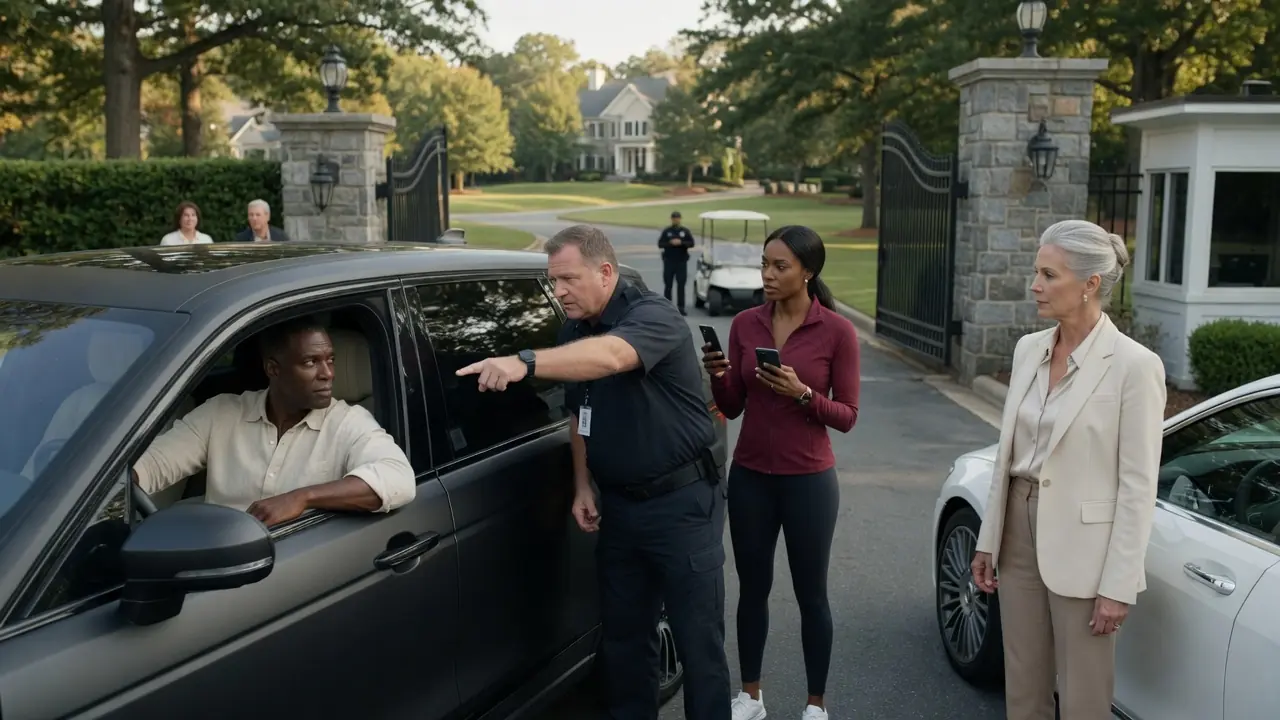
Craig Sutton laughed right in his face.
“You live here?” he said. “I’ve seen every resident in this community. None of them look like you. Turn this thing around before I call the real police.”
The woman pulled out her phone and started recording.
Nobody said a word.
Nobody stepped in.
Just one man standing alone against all of them.
But here was the thing none of them knew.
That one phone call Fletcher Owens was about to make would end careers, destroy reputations, and leave every single person at that gate begging for his forgiveness.
Before that phone call, the morning had started beautifully.
That made everything that happened next so much worse.
It was a Saturday morning in late September in Charlotte, North Carolina.
The air was thick and warm, Southern heat sitting on the skin like a damp cloth. Sunlight poured through the oak trees. Somewhere in the distance, a church bell rang slow and steady.
Fletcher Owens stepped out of his front door at 7:30.
His house sat at the end of a private cul-de-sac inside Greystone Estates.
Twelve thousand square feet.
Limestone columns.
A circular driveway with a marble fountain in the center.
The largest property in the entire community.
Paid for in cash eighteen months earlier.
But that morning, no one would have guessed any of that by looking at him.
Cream linen shirt.
Gray joggers.
White sneakers.
No watch.
No jewelry.
No driver.
He grabbed the keys to his Range Rover and pulled out of the driveway himself.
His destination was a barbershop twenty minutes away in a predominantly neighborhood on the west side.
Supreme Cuts.
Small place.
Cracked leather chairs.
The smell of aftershave and hot lather filling every corner.
A basketball game played on a dusty TV above the mirror. Electric clippers buzzed beneath the laughter.
Here, nobody called him Mr. Owens.
He was just Fletch.
Same chair.
Same jokes.
Same fifty-dollar tip every time.
He had been coming there for fifteen years, long before the billions.
This was the one place where nothing changed.
He sat for forty-five minutes, talked about the Panthers game, laughed about somebody’s cousin who fell through his own roof, then said goodbye and headed home.
He had no idea what was waiting at that gate.
Greystone Estates was not just a neighborhood.
It was a character in this story.
Thirty-six homes tucked into wooded hills just outside Charlotte. Every house sat on at least two acres. Long driveways. Tall fences. Silence so complete it felt expensive.
Average home value: four to eight million dollars.
Old money.
Corporate executives.
Retired surgeons.
Families wealthy for generations.
Almost entirely white.
Fletcher Owens was the only homeowner.
The only one.
Three weeks earlier, the HOA had switched to a new security company, Sentinel Shield Services.
The head of security was Craig Sutton.
Fifty-two years old.
Thick neck.
Crew cut.
A man who ran the front gate like a military checkpoint.
Some residents complained he was overly thorough, but HOA president Victoria Ashford shut that down.
She said Craig had a firm hand, and that was exactly what the community needed.
Here was what mattered.
Victoria personally approved the resident list sent to Sentinel Shield.
Every name.
Every photo.
Every vehicle.
Including Fletcher Owens.
She knew exactly who lived in that community.
Fletcher had been overseas for a month closing an acquisition in London. The new security team had never seen him in person, but they had his file, his name, his photo, and his plate number.
Before leaving for London, Fletcher’s assistant had emailed both the HOA and the security company.
The message was simple.
Mr. Owens returns Saturday, September 28. Please ensure gate access.
That email was sent.
Received.
And completely ignored.
At 9:45 a.m., Fletcher’s Range Rover rolled up to the front gate of Greystone Estates.
The morning sun hung bright and heavy in the sky. Its light bounced off the tall iron bars of the gate, throwing long, thin shadows across the pavement like prison lines.
Freshly trimmed hedges lined both sides of the entrance.
A stone pillar on the left read Greystone Estates, Private Community in polished brass letters.
The air carried the smell of cut grass, warm asphalt, and magnolia blossoms from the trees just inside the wall.
Everything about the entrance said the same thing.
You had better belong here.
The guard booth sat just inside the gate.
Small.
White.
Air-conditioned.
A single window faced the driveway.
Through the tinted glass, Fletcher could see a figure rise slowly from behind a desk.
The man took his time.
No welcome.
Craig Sutton stepped out into the sunlight.
He did not walk to the car the way someone greets a neighbor coming home.
He walked the way a man approaches a problem.
Shoulders squared.
Chest out.
Wide stance.
His boots hit the pavement hard and deliberate with each step.
One hand was raised flat in a stop gesture, palm out, fingers stiff like a traffic cop halting a suspicious vehicle.
The other hand rested low on his belt beside a canister of pepper spray and a heavy flashlight.
He reached Fletcher’s window and planted himself there.
Feet apart.
Arms thick.
He did not smile.
Did not nod.
He leaned his upper body down and looked past Fletcher, scanning the back seat first, then the passenger side, then the floor mats, then the dashboard.
His eyes moved slowly and deliberately, like he was cataloging evidence before a single word had been spoken.
A full five seconds of silence passed.
Fletcher waited.
Then Craig spoke.
“Can I help you?”
Not good morning.
Not welcome home, sir.
Not even a casual hello.
Just those four flat, cold words, clipped at the edges.
The tone of a man who had already decided who he was talking to.
Fletcher kept both hands on the steering wheel.
Relaxed.
Visible.
Open.
He had learned a long time ago what a man needed to do with his hands when someone in a uniform was watching.
“Good morning,” Fletcher said. “Fletcher Owens. I live at 1 Greystone Lane.”
He said it clearly and politely, the way he had said it a hundred times before to a hundred different people.
Craig’s expression did not change.
Not a muscle.
Not a flicker.
He straightened up slowly, pulled the clipboard from under his arm, and made a show of running his finger down a printed list of names.
He went slowly, top to bottom, then bottom to top again, taking his deliberate time.
The clipboard was angled away from Fletcher so he could not see it.
Finally, Craig looked up.
“I don’t see that name here.”
“It should be there. I’ve lived here for eighteen months.”
Craig stared.
The kind of stare that was not looking for information.
It was delivering a message.
“I’m going to need to see some ID.”
Fletcher reached calmly into the center console, pulled out his wallet, removed his North Carolina driver’s license, and handed it through the window without a word.
No hesitation.
No attitude.
Just calm, clean cooperation.
Craig took the license and held it up between two fingers.
He looked at the photo.
Looked at Fletcher.
Looked at the photo again.
Tilted the card in the sunlight like he was checking for a watermark.
Then, without saying anything, he turned and walked back to the guard booth.
Slow.
Unhurried.
Like Fletcher’s time meant absolutely nothing.
Through the booth window, Fletcher could see Craig pick up a radio handset.
He heard the faint crackle of static, then Craig’s muffled voice, too low to make out the words.
The call lasted about ninety seconds.
Then Craig set down the radio and just stood there inside the booth, looking at something on a screen, or pretending to.
A minute later, a white golf cart appeared from behind the booth.
Dennis Harlow was driving.
Younger than Craig.
Thinner.
Patchy beard.
Mirrored sunglasses pushed up on his forehead.
He pulled the cart around and parked it at an angle directly behind Fletcher’s Range Rover.
Close.
Deliberately close.
Then he stepped off, crossed his arms, and leaned against the cart, watching.
Now there were two of them.
One in front.
One behind.
Craig finally walked back to the driver’s window.
He held Fletcher’s license between two fingers, low and loose, like he was carrying a piece of trash to a bin.
He handed it back without making eye contact.
“So here’s the thing,” Craig said. “This address you’re giving me, it doesn’t match anything in our system. I’m going to need to verify this with the actual homeowner before I can let anyone through.”
Fletcher took his license back, slid it into his wallet, and kept his voice steady.
“I am the actual homeowner.”
Craig tilted his head slightly and let out a small, slow breath through his nose.
Almost a laugh.
Almost a snort.
The kind of sound a man makes when he thinks someone is lying to his face but finds it more amusing than threatening.
“Sir,” he said, dragging the word out. “I’ve been working this gate every single day for three weeks. I know every resident in this community. Every face. Every car. Every family. And I can tell you right now, you are not on my list.”
Fletcher did not blink.
“Call the HOA president, Victoria Ashford. She can verify who I am.”
Craig shook his head slowly, like he was explaining something simple to a child.
“It’s Saturday morning. I’m not going to bother Mrs. Ashford on her personal time because some guy showed up at the gate with a story.”
Some guy.
Not a resident.
Not a homeowner.
Some guy.
“Then let me show you the property deed.”
Fletcher picked up his phone and opened the saved document.
The deed was right there on the screen.
His name.
The address.
The county seal.
The purchase date.
Everything clear as daylight.
He held the phone toward Craig.
Craig glanced at the screen for less than one second, then looked away.
“I can’t verify digital documents. Anybody can fake something on a phone. You know that.”
He stepped back from the window, creating distance.
“Here’s what I’d suggest. Come back Monday during business hours. Bring your real paperwork, the originals, and we’ll get this sorted out then.”
Come back Monday.
To his own house.
Two hundred feet away.
The house he could probably see from where he was sitting if the hedge were a little thinner.
Fletcher held still for a moment.
Then he spoke, low and controlled.
“I’d like your full name and badge number, please.”
Craig’s arms crossed over his chest.
His jaw shifted.
“Craig. That’s all you need.”
“Your last name.”
“I said that’s all you need.”
His tone dropped into a warning.
Behind the Range Rover, Dennis shifted his weight. He had not said a single word that entire time, but he had repositioned the golf cart even closer now.
If Fletcher tried to reverse, he would have to stop and ask Dennis to move.
A small thing.
A quiet thing.
The kind of move designed to make a man feel boxed in without leaving a mark.
Then came a new sound.
Tires on smooth pavement coming from behind.
Fletcher glanced in his rearview mirror.
A silver BMW was approaching the gate.
Inside was a white couple.
The man wore a pastel polo shirt.
The woman held a coffee cup.
They pulled up behind the golf cart and waited casually.
Craig turned around, saw the BMW, and everything about him changed.
His shoulders dropped.
His jaw unclenched.
He smiled.
Actually smiled.
Wide and warm, like he was greeting old friends at a backyard cookout.
He lifted one hand in a lazy, familiar wave and strolled to the driver’s side of the BMW.
“Morning, folks. Good to see y’all. Beautiful day, huh?”
He did not ask for ID.
Did not check the clipboard.
Did not look at a license plate.
Did not ask a single question.
He just turned, walked into the booth, and pressed the button.
The iron gate slid open with a smooth electric hum.
The BMW rolled through without stopping.
The woman in the passenger seat did not even look up from her phone.
The gate closed again.
Heavy.
Final.
Fletcher watched the entire thing in his mirror.
Every second.
The smile.
The wave.
The open gate.
The ease of it.
The effortless, unquestioned welcome.
Then silence.
He turned back to Craig, who was already walking toward him again.
Arms crossed.
Face reset to stone.
“You just let them through,” Fletcher said.
His voice was quiet.
Almost gentle.
“No ID. No verification. No questions. Nothing.”
Craig shrugged with one shoulder, barely a movement.
“They’re residents. I recognize them.”
The words floated in the warm September air, heavy and still, like smoke that would not clear.
I recognize them.
Meaning I do not recognize you.
Meaning they look right, and you do not.
Fletcher sat with that for a moment.
The cicadas buzzed in the oak trees above. His engine idled low and steady. The leather seat creaked softly as he shifted his weight.
Then Craig stepped close again.
Closer than before.
He leaned his forearm on the edge of Fletcher’s open window and lowered his voice.
Quiet now.
Almost personal.
Like he was doing Fletcher a favor.
Man to man.
“Look, buddy, I’m going to level with you. I don’t know who you’re trying to visit. I don’t know what you’re doing out here. But these people…”
He pointed one thick finger toward the mansions behind the gate.
“These people pay a lot of money to live in a place where they feel safe. Where their kids play in the street and their wives go for walks at night. And my job, my only job, is to make sure nothing threatens that. You understand what I’m saying?”
Fletcher understood exactly what he was saying.
Every word.
Every implication buried beneath it.
He looked Craig in the eyes one last time.
Then he reached for his phone.
Craig stepped back and smirked.
“Go ahead. Call whoever you want. The police, the mayor, the president, I don’t care.”
He tapped his own chest with two fingers.
“I answer to the HOA, not to you.”
Fletcher did not respond.
He did not need to.
He just started dialing.
But Fletcher did not call his lawyer.
Not yet.
He called Brenda.
The phone rang once.
She picked up instantly.
He could hear the television playing softly in the background, the clink of a coffee mug being set down.
“Hey,” he said. “I’m at the gate. They won’t let me in.”
The silence on the other end lasted exactly two seconds.
Then Brenda’s voice came through low and sharp, like a blade pulled from a drawer.
“What do you mean they won’t let you in?”
“New security. They don’t recognize me. Won’t look at my license. Won’t look at the deed. Told me to come back Monday.”
“I’m coming down there right now.”
She hung up before he could respond.
Fletcher set the phone in his lap and waited.
The engine hummed.
The gate stayed shut.
Craig stood a few feet away, arms still crossed, watching Fletcher like a store detective watching a shoplifter decide whether to run.
Then came the sound of another car.
A white Mercedes-Benz S-Class turned the corner and approached the gate from outside.
It moved slowly, elegantly.
The kind of car that announces itself before it arrives.
The morning light reflected off its polished hood like a second sun.
Behind the wheel sat Victoria Ashford.
Sixty years old.
Silver hair pinned neatly in a French twist.
Pearl earrings.
A cream-colored blazer over a silk blouse.
She was returning from a garden club brunch at the country club, the same brunch she attended every Saturday at eight.
She slowed to a stop behind Fletcher’s Range Rover and lowered her window.
She looked at the scene in front of her.
A man in a parked car.
Two security guards flanking the vehicle.
The gate locked.
Craig walked over to her immediately.
His posture changed the moment he recognized the Mercedes.
Softer.
Respectful.
Almost deferential.
“Morning, Mrs. Ashford. Sorry about the holdup. This gentleman here claims he’s a resident, says he lives at 1 Greystone Lane, but I can’t find him in the system, and he can’t provide proper verification.”
Victoria nodded slowly.
She turned her head and looked directly at Fletcher through his open window.
Their eyes met.
Here was what mattered about that moment.
Victoria Ashford knew exactly who Fletcher Owens was.
She had signed his HOA welcome letter eighteen months ago.
She had approved his dues payments every single quarter.
Three weeks earlier, she had personally reviewed and signed off on the master resident list, complete with names, photos, and vehicle descriptions, then sent it to Sentinel Shield Services herself.
Fletcher’s face was on page two of that list, right next to a photo of the same matte Range Rover she was now staring at.
She knew.
Without question.
Without doubt.
She knew.
But she turned back to Craig and said, “Well, if he’s not in the system, then you’re doing the right thing, Craig. That’s what we pay you for.”
Then she turned to Fletcher and smiled, the kind of smile that does not reach the eyes, the kind made of porcelain and practiced in mirrors.
“Sweetie, if there has been some kind of mix-up, maybe a delivery or a service call, I can point you to the service entrance around back. It’s just past the south wall.”
Sweetie.
Service entrance.
The words landed one by one, like drops of acid on a clean surface.
Fletcher studied her face.
The pearls.
The silk.
The careful blankness in her expression.
He spoke quietly.
No anger.
No volume.
Just facts.
“Mrs. Ashford, you know exactly who I am.”
Victoria’s smile twitched.
Just for a fraction of a second.
A tiny crack in the porcelain.
Then it reset.
“I’m sorry,” she said. “I don’t believe we’ve met.”
She held his gaze for one more second, then turned away and pressed a button on her steering wheel to roll up her window.
Conversation over.
Craig opened the side lane for her Mercedes.
She drove through without looking back.
The gate closed behind her with a heavy metal clang.
Three minutes later, Brenda appeared.
She came on foot, walking fast down the long tree-lined road from inside the estate.
Her sneakers hit the pavement hard.
Her jaw was set.
Her eyes were locked on the gate like she was ready to tear it apart with her bare hands.
She reached the guard booth and did not stop walking until she was face-to-face with Craig.
“My name is Brenda Owens,” she said. “I live at 1 Greystone Lane. That man in the car is my husband. Open this gate now.”
Craig looked at her.
Then at Fletcher.
Then back at her.
He shifted his weight but did not move toward the booth.
Victoria, who had parked just inside the gate and was now standing on the sidewalk watching, stepped forward.
“Ma’am, let’s all calm down. We have protocols here. We can’t just open the gate because someone walks up and says they live here.”
Brenda stared at her.
“I’m not someone. I’m a resident here.”
She reached into her back pocket and pulled out her Greystone Estates resident ID badge.
Laminated.
Photo on the front.
Name printed clearly.
She held it up in front of Craig’s face.
Craig took it, looked at it, flipped it over, and held it up to the light like he had held Fletcher’s license earlier.
“This could be expired.”
“It’s not expired. The date is printed right there.”
Craig said nothing.
He handed the badge back and looked at Victoria, waiting for direction, like she was his commanding officer.
Victoria smoothed the front of her blazer.
“Let’s not make a scene, shall we? We’re all just trying to keep everyone safe here.”
Brenda turned to Victoria.
Her voice dropped.
Not louder.
Sharper.
“Victoria, you know my husband. You sent us a welcome basket when we moved in eighteen months ago. You stood on our porch and told me how lovely the hydrangeas were. You remember that?”
Victoria’s lips pressed together into a thin white line.
Her fingers tightened on her handbag strap.
“I send a lot of baskets. I can’t be expected to remember every face.”
Every face.
Not every resident.
Every face.
The word choice said everything she would not.
That was when Craig made his next move, emboldened and backed up by the HOA president herself.
He turned to Fletcher and straightened to his full height.
“All right. I’ve been patient. I’ve been professional. But I have reasonable concern about this vehicle, and I’m going to need you to step out so I can do a quick visual inspection.”
Fletcher’s hands stayed on the wheel.
“You have no legal authority to search my vehicle.”
“On this property, I have every authority I need.”
“No, you don’t.”
Craig took a step closer.
“Step out of the car, sir.”
Behind them, Dennis had his phone to his ear.
He was speaking quietly into it, one hand cupped around the mouthpiece.
He was calling the Charlotte-Mecklenburg police non-emergency line, reporting, in his own words, a suspicious individual refusing to cooperate with security at a private residential gate.
Brenda saw Craig stepping toward Fletcher’s door.
She pulled out her phone and hit record.
The red dot blinked on.
The camera was steady, pointed directly at Craig.
Craig noticed it immediately.
His eyes flicked to the screen.
His jaw tightened.
“Ma’am, you need to put that phone away. This is private property. You do not have permission to film here.”
Brenda did not lower the phone.
Not one inch.
“Actually,” she said, her voice calm and clear as courtroom testimony, “I absolutely can.”
Victoria noticed the camera.
Her eyes darted to the phone, then away.
She took a half step back and adjusted her sunglasses.
But she still said nothing.
She still did not confirm Fletcher’s identity.
The one sentence that could end all of this, He lives here, stayed locked behind her teeth.
Twelve minutes later, a Charlotte-Mecklenburg police cruiser pulled up to the gate.
Blue and white.
No sirens.
No lights.
But the engine was loud enough to turn every head.
A single officer stepped out.
Mid-thirties.
Professional haircut.
Calm demeanor.
He adjusted his body camera, looked at the scene, a man in an SUV, two guards, two women, one phone recording, and approached the driver’s side of the Range Rover.
“Good morning, sir. I got a call about a disturbance at this gate. Can I see your license and registration?”
Fletcher handed them over without a word.
Same license.
Same calm hands.
Same steady eyes.
The officer walked back to his cruiser, ran the plates, ran the license.
Everything came back clean.
No warrants.
No flags.
No history.
Nothing.
He returned to Fletcher’s window and handed the documents back.
“Everything checks out on my end.”
He turned to Craig.
“Sir, I’m not seeing any issue here.”
Craig stepped forward and pointed at Fletcher.
“Officer, this man is not on our resident list. I’ve been doing this job for three weeks. I know who lives here. He could be casing the neighborhood. He could be scoping out houses while people are away. We’ve had break-ins.”
Victoria appeared at the officer’s side.
Her voice was soft now.
Concerned.
Motherly.
“Officer, I’m Victoria Ashford. I’m the president of the homeowners association here. We’ve had incidents in the past. We just want to be careful. I’m sure you understand.”
The officer looked from Victoria to Craig to Fletcher.
He was caught.
Professional instinct told him there was no issue, but two white residents and two security guards were telling him otherwise.
He turned back to Fletcher.
“Sir, would you mind waiting here for a few minutes while we get this sorted out?”
Would you mind waiting at your own front gate while strangers decide if you are allowed to go home?
Fletcher looked at the officer.
Then at Craig.
Then at Victoria, who was already walking away, phone to her ear, pretending to take a call.
He said nothing.
He just sat there in his own car, two hundred feet from his own house, waiting for permission to exist in a place he owned.
Forty-five minutes.
That was how long Fletcher Owens had been sitting at the gate of his own home.
Forty-five minutes of being questioned, dismissed, insulted, blocked, and investigated by police, all while the woman who could have ended it with three words stood ten feet away and said nothing.
Forty-five minutes.
Then Fletcher picked up his phone one more time.
But this call was not to Brenda.
It was not to the HOA.
It was not to the police.
He dialed Terrence Baldwin.
Terrence was a partner at one of the most powerful law firms in Charlotte.
Harvard Law.
Fifteen years of civil litigation.
The kind of attorney whose name alone made corporate legal teams lose sleep.
He had been Fletcher Owens’s personal counsel for the last nine years.
The phone rang twice.
“Terrence, it’s Fletcher.”
“What’s going on?”
Fletcher’s voice was low and calm.
Almost soft.
The same tone he used in boardrooms right before he dismantled someone’s entire position.
“I’m sitting at my own gate. Security won’t let me in. They’ve rejected my license, refused to look at my deed, and called the police on me. And the HOA president, Victoria Ashford, is standing right here. She knows exactly who I am. She’s pretending she doesn’t.”
A pause on the other end.
One second.
Two.
“Say that last part again.”
“Victoria Ashford is here. She looked me in the face and told me she’s never met me. Brenda confronted her. Victoria doubled down. She has been backing the guards the entire time.”
Another pause.
Shorter this time.
When Terrence spoke again, his voice had changed.
It was not casual anymore.
It was operational.
“Don’t say another word to anyone. Don’t leave. Don’t move. I’m making three calls right now: the CEO of Sentinel Shield Services, the other board members of the HOA, and the office. Fletcher, we’re drafting tonight.”
The line went dead.
Fletcher set the phone on his lap, placed both hands back on the steering wheel, and waited.
The same way he always waited.
Patient.
Still.
Like a man who knew exactly what was coming and had all the time in the world.
Craig was leaning against the guard booth, talking to Dennis in a low voice, laughing about something.
Relaxed.
Confident.
Like this was just another Saturday morning.
Just another trespasser turned away at the gate.
Victoria stood near her parked Mercedes inside the gate, scrolling through her phone.
Calm.
Composed.
Not a hair out of place.
None of them noticed the shift.
None of them felt the air change.
Eight minutes passed.
Then Craig’s radio crackled.
He reached for it casually and brought it to his ear.
“Sutton here.”
The voice that came through was not Dennis.
It was not a colleague.
It was the CEO of Sentinel Shield Services, and he was not calling to chat.
The voice was loud enough that Fletcher could hear fragments through the static.
Brenda, still recording, caught every word.
“Open that gate immediately. Do you hear me? Open it right now.”
Craig’s smile disappeared.
His hand tightened around the radio.
“Sir, I was just following proto—”
“You are suspended, effective immediately. Do not speak to Mr. Owens. Do not speak to his wife. Do not speak to anyone. You will wait at that booth until your relief arrives. Is that understood?”
Craig’s face drained.
The color left his cheeks like water pulling back from a shore.
His mouth opened.
Closed.
Opened again.
Nothing came out.
Dennis, standing three feet away, heard every word through the static.
His eyes went wide.
He did not wait for instructions.
He jogged to the gate mechanism and hit the manual release with both hands.
The iron bars shuddered once, then began to slide open.
Slowly.
Heavily.
The metal groaned against the track.
At the same moment, Victoria’s phone buzzed.
She glanced at the screen.
Her face changed.
She answered quickly, turning away and pressing the phone tight to her ear.
It was another board member.
The first words out of his mouth were, “Victoria, I just got a call from Terrence Baldwin, Fletcher Owens’s attorney. Do you want to explain to me why you were standing at that gate and didn’t confirm a resident’s identity?”
Victoria’s mouth moved, but no sound came out at first.
Then she stammered.
“There was… it was a confusing situation. I wasn’t entirely sure.”
“You signed the resident list yourself, Victoria. His photo was on page two.”
Silence.
Her phone buzzed again.
Another board member.
Then another.
One after another, the calls stacked up.
Her screen lit up like a switchboard.
The gate was now fully open.
Fletcher put the Range Rover in drive.
Slow.
Smooth.
No rush.
He rolled through the gate without looking at Craig, without looking at Dennis, without looking at Victoria.
The police officer, still standing by his cruiser, watched the scene unfold.
He walked quickly to Fletcher’s window before the car passed.
“Sir, I owe you an apology. I should have handled this differently.”
Fletcher looked at him and nodded once.
Polite.
Measured.
“You responded to a call that should never have been made. Your body camera recorded everything. That’s all I’ll say.”
The officer stepped back and said nothing more.
Brenda kept her phone raised.
The camera caught Victoria’s face as the Mercedes-driving, pearl-wearing, welcome-basket-sending HOA president stood frozen on the sidewalk.
The polished smile was gone.
The porcelain mask had cracked wide open.
What remained underneath was pale, shaking, and raw.
Fletcher pulled into his driveway, the largest house on the street.
Twelve thousand square feet.
Limestone columns glowing in the late morning sun.
Visible.
Clearly, unmistakably visible from the front gate.
He turned off the engine, stepped out, walked to his front door, and went inside.
He never looked back.
Not once.
The dominoes started falling before the sun went down.
By Saturday afternoon, less than six hours after Fletcher drove through that gate, the CEO of Sentinel Shield Services had made his decision.
No internal review.
No hearing.
No second chances.
Craig Sutton was fired.
Not suspended.
Not reassigned.
Terminated.
His badge deactivated.
His uniforms were to be returned by end of day.
His access to every Sentinel Shield property in North Carolina was permanently revoked.
Dennis Harlow received the same call thirty minutes later.
Same result.
Same finality.
He said, “Yes, sir,” three times and hung up.
By evening, a formal written apology was delivered to Fletcher and Brenda by courier.
Two pages.
Company letterhead.
Signed by the CEO personally.
The letter called the incident an inexcusable failure of judgment and professionalism.
Fletcher read it at his kitchen table, set it down, and said nothing.
Brenda read it next, folded it carefully, and placed it in a file folder.
She already knew that letter would become evidence.
Sunday evening, 6:30 p.m., Greystone Estates Community Clubhouse.
Eight board members sat around a long oak table.
The room smelled like old carpet and lemon furniture polish.
The overhead lights buzzed faintly.
No one smiled.
No one made small talk.
Victoria Ashford sat at the head of the table.
Navy blazer.
White silk scarf.
Hands folded.
Chin up.
Still performing composure.
But her eyes moved too fast.
Darting from face to face.
Searching for an ally.
She did not find one.
Board chair Douglas Brennan opened his laptop and pressed play.
First, the gate security footage.
High angle.
Wide shot.
Timestamp in the corner.
Fletcher’s Range Rover arriving.
Craig’s aggressive stance.
The white couple waved through without a question.
Dennis blocking the vehicle with the golf cart.
Then the moment Victoria’s Mercedes pulled up.
The camera caught her walking to the gate, looking directly at Fletcher through his window, and choosing to say nothing.
Douglas paused the footage.
Then he played Brenda’s phone recording.
Closer.
Sharper.
With audio.
Craig’s voice.
Victoria’s voice.
The service entrance comment.
Brenda confronting Victoria about the welcome basket.
Victoria’s response.
“I send a lot of baskets. I can’t be expected to remember every face.”
The recording ended.
Silence.
“Victoria,” Douglas said, “would you like to explain what we just watched?”
She straightened her scarf.
“It was a confusing situation. I hadn’t seen Mr. Owens in months. He was dressed casually. I wasn’t sure it was him.”
Douglas laid a printed document across the table.
“This is the welcome letter you personally signed and sent to the Owens family eighteen months ago.”
He slid a second document forward.
“This is the resident list you approved and sent to Sentinel Shield three weeks ago. Page two. Fletcher Owens. Photo included. Your signature on the cover page.”
Victoria looked down.
Her lips parted.
No sound came out.
Her fingers pressed flat against the wood.
Her rings clicked softly on the table.
She had no answer.
Because there was no answer.
Douglas called the vote.
Should Victoria Ashford be removed as HOA president?
Eight in favor.
One against.
Victoria voted for herself.
The only hand she had left.
The board then voted unanimously to terminate the Sentinel Shield contract entirely.
Victoria stood, gathered her handbag, and walked out without a word.
The door clicked shut behind her.
Nobody followed.
That same night, Craig sat at his computer, furious.
He posted a long statement on social media.
The headline read, Fired for Doing My Job Protecting the Community.
He described himself as a dedicated veteran punished for following protocol.
The post went live at 9:15 p.m.
By 9:45, it had been screenshotted and shared across local news forums.
Commenters found the developing story within minutes and tore his post apart line by line.
By midnight, Craig deleted it.
But the screenshots were already everywhere.
Dennis took a different approach.
He called Fletcher’s corporate office Monday morning wanting to apologize personally.
The receptionist transferred him to legal.
A paralegal answered with four words.
“All communication through counsel.”
The line went dead.
Dennis sat in his apartment, phone in hand, staring at the wall.
Thirty-four years old.
No degree.
No savings.
And as of seventy-two hours ago, no job.
But he had not seen anything yet.
None of them had.
Because the real consequences had not even started.
Tuesday morning, two days after the gate incident, Brenda Owens sat in her home office with her phone in one hand and a business card in the other.
The card belonged to Nancy Whitfield, investigative reporter, Channel 9 News, Charlotte.
Brenda had met her two years ago at a wrongful conviction fundraiser.
They had exchanged numbers, but never followed up.
Until now.
Brenda called.
Nancy picked up on the second ring.
Brenda explained what happened.
Then she sent the video.
Nancy watched it three times.
Then she called her producer.
By five that evening, her team was already editing the segment.
Wednesday night, primetime, the segment aired under the title, “Blocked at His Own Gate: CEO Denied Entry to Multi-Million Dollar Estate.”
The footage was devastating.
Clear.
Steady.
Unshakable.
Every moment captured in sharp detail.
Craig’s aggressive posture at the window.
His refusal to look seriously at the license.
The white couple in the BMW waved through with a smile and a wave.
Dennis blocking the Range Rover from behind.
Victoria stepping out of her Mercedes, looking directly at Fletcher, and choosing silence.
But the clip that broke the internet, the one that got shared four million times in forty-eight hours, was six seconds long.
Fletcher’s voice, calm and clear.
“Mrs. Ashford, you know exactly who I am.”
Victoria’s response, smooth and cold.
“I’m sorry. I don’t believe we’ve met.”
Six seconds.
That was all it took.
The clip hit every national outlet by Thursday morning.
Cable news.
Morning talk shows.
Social media feeds from coast to coast.
The hashtag #SheKnew trended for three consecutive days.
The following Monday, Terrence Baldwin filed the lawsuit.
The complaint named four defendants.
Sentinel Shield Services.
Craig Sutton personally.
Victoria Ashford personally.
And the Greystone Estates Homeowners Association.
The allegations were severe.
Racial discrimination.
Unlawful detention.
Fletcher had been physically blocked from entering his own property for over forty-five minutes.
Conspiracy to deny housing rights.
Violation of the Federal Fair Housing Act.
The lawsuit alone would have been enough to make headlines, but it was the discovery phase that truly shattered what remained of the defendants’ credibility.
First came Craig’s text messages.
Subpoenaed phone records revealed a text conversation between Craig Sutton and Dennis Harlow from four days before the incident.
Craig had texted Dennis about the large estate at the end of the cul-de-sac.
The message read, “Some rapper or athlete probably bought that place. Keep an eye out.”
Dennis had responded with a laughing emoji.
Nothing else.
That single text proved what Craig denied on every camera and in every statement.
His suspicion of Fletcher Owens was not based on protocol.
It was based on race.
Before he ever met Fletcher, he had already decided what kind of person lived in that house.
Second came Craig’s negligence.
The HOA had emailed Sentinel Shield the complete master resident list three weeks before the incident.
Names.
Photos.
Addresses.
Vehicle makes and models.
License plates.
The email was sent directly to Craig’s work inbox.
Investigators confirmed the email had been delivered and received.
Craig never opened the attachment.
Not once.
In three weeks on the job, he had never bothered to learn who actually lived in the community he was hired to protect.
Third, and most damning of all, came Victoria’s emails.
During discovery, Terrence Baldwin’s legal team subpoenaed Victoria Ashford’s personal email account.
What they found was a pattern that stretched back months before the gate incident.
In one email to a fellow Greystone resident, Victoria wrote, “The neighborhood is changing. I don’t know what the previous board was thinking when they approved certain buyers.”
In another, sent just two weeks before the incident, she wrote, “I didn’t move here for this. If I wanted diversity, I would have stayed in the city.”
I didn’t move here for this.
Those six words proved everything.
Victoria’s actions at the gate were not confusion.
Not a momentary lapse.
They were the culmination of months of quiet, deliberate resentment toward a family she never wanted in her neighborhood.
The trial began on a gray Tuesday morning in Mecklenburg County Superior Court, Judge Carolyn Spencer presiding.
The courtroom was packed.
Local press in the first two rows.
National correspondents in the back.
Cameras outside the building.
Craig Sutton took the stand first.
He sat straight, jaw tight.
He told the jury he was a professional, a veteran, a man who treated every person the same regardless of race.
Then Terrence played the footage split-screen.
On the left, Fletcher Owens being questioned, blocked, and investigated for forty-five minutes.
On the right, the white couple in the BMW waved through the same gate in eight seconds.
No ID.
No questions.
No clipboard.
The jury watched in silence.
One woman in the back row shook her head slowly.
Craig had no response.
His attorney asked for a recess.
Then Victoria Ashford took the stand.
She wore a dark gray suit.
Her hands rested in her lap.
She spoke softly and carefully.
Every word measured and rehearsed.
Under cross-examination, Terrence read her emails aloud, word by word.
“The neighborhood is changing.”
“Certain buyers.”
“I didn’t move here for this.”
Victoria’s chin trembled.
She claimed the emails were taken out of context, that she was referring to property values and architectural standards, not race.
Never race.
Terrence let her finish.
Then he asked one question.
“Mrs. Ashford, on the morning of September 28, when you stood at that gate and looked directly at Fletcher Owens through his car window, did you recognize him?”
The courtroom went still.
No coughing.
No rustling.
No movement.
Victoria’s mouth opened.
Closed.
Her eyes dropped to her lap.
Her fingers twisted together.
Five seconds of silence.
Ten.
Then, barely above a whisper, she said, “Yes.”
Her own attorney dropped his head into his hands.
The jury deliberated for less than four hours.
Liable on all counts.
Sentinel Shield Services was ordered to pay 2.8 million dollars in damages.
Craig Sutton was ordered to pay 150,000 dollars personally and was permanently barred from working in private security anywhere in North Carolina.
Victoria Ashford was ordered to pay 500,000 dollars in personal damages for her deliberate and knowing role in the discrimination.
The Greystone Estates HOA was ordered to implement mandatory anti-discrimination training for all staff and residents and to establish an independent oversight committee.
The fallout was swift and permanent.
Craig Sutton’s security career was over.
His deleted social media post was entered as evidence during the trial, proof of his refusal to accept responsibility.
No security firm in the region would touch him.
Sentinel Shield Services lost fourteen contracts across the Carolinas within six weeks.
Their Charlotte office closed permanently by the end of the year.
Victoria Ashford put her Greystone home on the market within three months.
She sold it at a loss.
Former friends on the board publicly distanced themselves.
Her name became something people said as a warning.
On social media, “Don’t pull a Victoria Ashford” briefly became shorthand for someone who could have stopped injustice with one word and chose silence instead.
And Fletcher Owens?
He took every dollar of that settlement, every single cent, and donated it to Brenda’s nonprofit.
The organization that fought to overturn wrongful convictions.
The organization his wife had built with her own hands.
He did not keep a penny.
He did not need to.
The money was never the point.
Fletcher Owens remained the CEO of Pinnacle Dynamics, still running a fourteen-billion-dollar company, still living at 1 Greystone Lane.
The same house.
The same gate.
The same driveway.
During the weeks the story dominated the news cycle, Pinnacle Dynamics stock did not drop.
It rose.
Investors rallied behind him.
Clients called to reaffirm partnerships.
The company’s brand became synonymous with dignity under pressure.
Wall Street analysts said Fletcher’s composure during the incident demonstrated exactly the kind of leadership that builds trust.
He was invited to speak before the North Carolina State Legislative Committee on housing discrimination.
He sat at a long table in Raleigh, microphone in front of him, cameras rolling, and told the story.
Not with anger.
Not with bitterness.
Just facts.
Dates.
Details.
What happened.
What was said.
What was not said.
His testimony helped advance a new bill that strengthened fair housing protections specifically within gated and private residential communities.
The bill required mandatory anti-discrimination training for all contracted security personnel and established independent oversight boards for HOA governance.
The bill passed six months later.
It became known as the Owens Housing Equity Act.
Brenda’s nonprofit, the one she built to overturn wrongful convictions, saw a wave of support after the story broke.
Donations tripled in the first quarter alone.
Volunteer applications flooded in from law students across the Southeast.
Two new offices opened.
One in Atlanta.
One in Richmond.
Every dollar of the settlement money went straight into that nonprofit.
Every single dollar.
Fletcher and Brenda did not keep a cent for themselves.
And in Fletcher’s home office, on the wall behind his desk, there was a small framed photograph.
It was a still image from Brenda’s phone video.
It showed the iron gate of Greystone Estates, closed and locked, sunlight reflecting off the bars.
Underneath the photo, in Fletcher’s own handwriting, a single line read:
They built the gate to keep people out. I bought the house to prove they can’t.
This story was not only about Fletcher.
It was about a pattern.
A pattern that repeats in ways many people never see.
homeowners questioned in their own driveways.
executives stopped in their own parking garages.
families having the police called on them for moving into a new house, for sitting in a coffee shop, for barbecuing in a park, for existing in a space someone else decided they did not belong in.
And sometimes the most dangerous form of discrimination is not the loud kind.
It is not Craig Sutton shouting at the gate.
That kind is ugly, but it is visible.
You can point at it.
You can name it.
The most dangerous kind is the quiet kind.
The Victoria Ashford kind.
The kind where someone has the power to stop an injustice with a single sentence, “He lives here,” and chooses silence instead.
That kind hides behind manners.
Behind protocol.
Behind “I can’t be expected to remember every face.”
It wears pearl earrings and silk scarves and smiles that do not reach the eyes.
And it does just as much damage.
Sometimes more.
As long as stories like this keep happening, they need to be told.
The Fletchers of this world deserve to be heard.
The Craigs need to be exposed.
And the Victorias, the silent ones, the ones who look away, need to know they are seen too.