“Excuse me. I live here. Could you open the gate, please?”
The security guard barely looked up. Craig Sutton stood near Fletcher Owens’s Range Rover as if the vehicle itself offended him. Then he gave a dismissive laugh.
“You live here?”
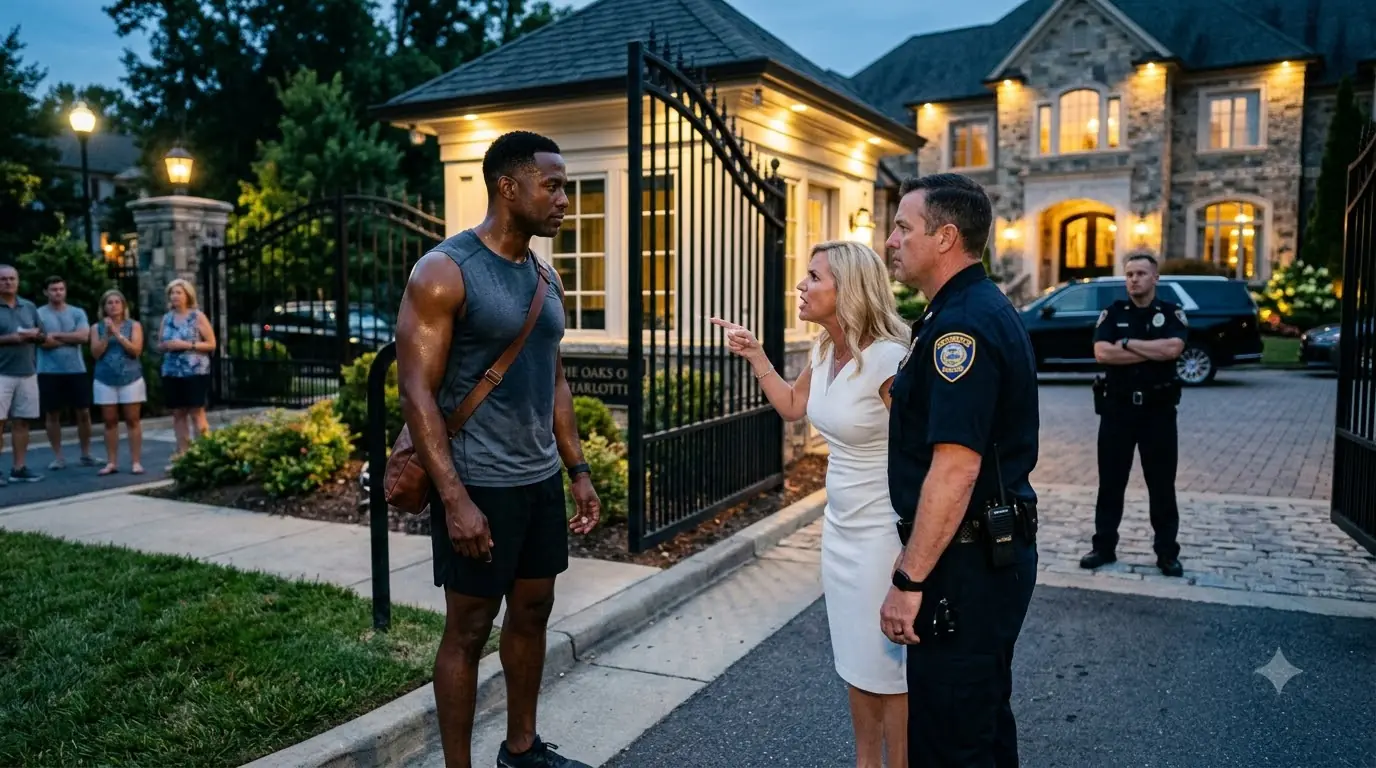
Craig glanced toward the mansions beyond the iron gate.
“I’ve seen the residents in this community. You don’t look like anyone who belongs here.”
Fletcher said nothing.
Craig stepped closer.
“Turn the vehicle around before I call the police. Go back wherever you came from.”
A woman nearby pulled out her phone and began recording.
Nobody said anything.
Nobody intervened.
Just one Black American man sitting inside his own vehicle while strangers decided whether he deserved access to the neighborhood where he owned the largest house.
What none of them understood was that Fletcher Owens was about to make one phone call.
That call would end careers, expose reputations, dismantle an HOA leadership structure, and leave the people standing around that gate scrambling to explain decisions they had made with complete confidence only minutes earlier.
But that phone call came later.
The morning had started beautifully.
That was what made everything that followed feel even worse.
It was a Saturday in late September outside Charlotte, North Carolina.
The air was thick and warm, the kind of Southern humidity that settled against the skin. Sunlight filtered through the enormous oak trees lining the private roads of Greystone Estates. Somewhere in the distance, a church bell rang slowly.
Fletcher Owens stepped outside his home at 7:30 that morning.
His property sat at the end of a private cul-de-sac inside Greystone Estates.
Twelve thousand square feet.
Limestone columns.
A circular driveway.
A marble fountain in the center.
The largest property in the entire development.
Fletcher had purchased it eighteen months earlier and paid cash.
But looking at him that morning, nobody would have guessed any of that.
He wore a cream linen shirt, gray joggers, and clean white sneakers.
No expensive watch.
No jewelry.
No driver.
No entourage.
He grabbed the keys to his Range Rover and drove himself toward a barbershop twenty minutes away on Charlotte’s west side.
Supreme Cuts was small and old-fashioned.
Cracked leather chairs.
The smell of aftershave and hot lather.
A basketball game playing on a dusty television above the mirrors.
Clippers humming beneath laughter.
Inside that barbershop, nobody called him Mr. Owens.
He was simply Fletch.
Same chair.
Same jokes.
Same generous tip every visit.
He had been going there for fifteen years, long before anyone connected his name to billions of dollars.
It was one of the few places in his life where success had changed almost nothing.
He spent forty-five minutes talking about football, laughing at a story about somebody’s cousin falling through his own roof, and arguing over whether the Panthers had any chance that season.
Then Fletcher said goodbye and headed home.
He had no idea what was waiting for him at the gate.
Greystone Estates consisted of thirty-six homes tucked into wooded hills outside Charlotte.
Every property sat on at least two acres.
Long driveways disappeared behind trees.
Tall fences separated one estate from another.
The silence itself felt expensive.
Homes regularly sold for anywhere from four to eight million dollars.
Many residents came from old money.
Others were corporate executives, retired surgeons, lawyers, investment managers, or families whose wealth had existed for generations.
The community was overwhelmingly white.
Fletcher Owens was the only Black homeowner.
Three weeks earlier, the HOA had replaced its security contractor.
The new company was Sentinel Shield Services.
The man placed in charge of the main gate was Craig Sutton.
Craig was fifty-two, broad through the shoulders, with a close crew cut and a habit of treating the entrance like a military checkpoint.
Several residents had already complained that he was overly aggressive about routine access.
HOA president Victoria Ashford dismissed those concerns.
Craig had a “firm hand,” she said.
That was precisely what the neighborhood needed.
There was one detail that would later become extremely important.
Victoria had personally approved the master resident list sent to Sentinel Shield.
Every name.
Every address.
Every photograph.
Every primary vehicle.
Fletcher Owens was on that list.
So was his Range Rover.
Fletcher had spent the previous month in London closing a major corporate acquisition. Because the new security team had been hired while he was away, several guards had never met him in person.
But they had his information.
His name.
His photograph.
His vehicle.
Before Fletcher returned from Europe, his executive assistant had even sent an email to the HOA and Sentinel Shield.
The message was simple.
Mr. Owens returns Saturday, September 28. Please ensure gate access is current.
The email had been delivered.
It had been received.
And apparently, it had been ignored.
Most residents at Greystone knew very little about Fletcher beyond the fact that he ran a large company.
In reality, Fletcher Owens was the founder and CEO of Pinnacle Dynamics, a technology conglomerate valued at more than fourteen billion dollars.
The company appeared regularly in major business publications.
Fletcher had been featured on the cover of Forbes twice.
He had not inherited his money.
He grew up on Chicago’s South Side sharing a bedroom with two brothers.
His family relied on reduced-price school meals.
His mother worked long shifts in a hospital laundry department.
Fletcher earned a full academic scholarship to Northwestern and later completed an MBA at Wharton.
Then he built Pinnacle Dynamics almost from nothing.
People who negotiated against Fletcher learned one thing quickly.
He almost never raised his voice.
Not in hostile acquisitions.
Not during lawsuits.
Not in boardroom confrontations.
Fletcher believed anger could be useful, but visible anger often gave the other side information.
His wife, Brenda Owens, understood that philosophy better than anyone.
Brenda had spent years as a civil-rights attorney before creating a nonprofit focused on wrongful convictions and access to legal representation.
She was sharp, direct, and fearless.
Where Fletcher preferred patience, Brenda preferred precision.
Together, they made a formidable pair.
At 9:45 that morning, Fletcher’s Range Rover rolled toward the front gate of Greystone Estates.
The sun was bright now.
Light reflected from the tall iron bars and stretched thin lines across the pavement.
Freshly trimmed hedges bordered the entrance.
A stone pillar displayed polished brass lettering.
GREYSTONE ESTATES
PRIVATE COMMUNITY
The smell of cut grass mixed with hot asphalt and magnolia blossoms.
Everything about the entrance communicated exclusivity.
The guard booth stood just inside the gate.
Small.
White.
Air-conditioned.
One tinted window faced the driveway.
Fletcher stopped at the normal entry point.
Through the glass, he watched a figure rise slowly from behind the desk.
Craig Sutton stepped outside.
He did not approach like a security officer greeting a returning resident.
He approached like a man confronting a problem.
Shoulders squared.
Chest forward.
Heavy deliberate steps.
One hand was raised in a rigid stop gesture.
The other remained close to his belt.
Craig reached Fletcher’s open window and stopped.
He looked past Fletcher first.
Back seat.
Passenger seat.
Floorboard.
Dashboard.
The inspection lasted several seconds before he said anything.
Finally:
“Can I help you?”
Not good morning.
Not welcome back.
Just four cold words.
Fletcher kept both hands visible on the steering wheel.
“Good morning. Fletcher Owens. I live at 1 Greystone Lane.”
Craig’s expression did not move.
He took a clipboard from beneath his arm and slowly ran one finger down the printed resident list.
Top to bottom.
Then back again.
The clipboard was angled away from Fletcher.
Finally Craig looked up.
“I don’t see that name.”
“It should be there. I’ve lived here eighteen months.”
Craig stared at him.
“I need identification.”
Fletcher reached slowly toward the center console.
He removed his wallet.
Pulled out his North Carolina driver’s license.
Then passed it through the window.
No argument.
No sarcasm.
No sudden movement.
Craig held the license between two fingers.
Looked at the photograph.
Looked at Fletcher.
Then back at the photograph.
He tilted the card toward the sunlight as though examining whether it was genuine.
Without explanation, he turned and walked back to the booth.
Fletcher waited.
Through the glass, he saw Craig pick up a radio handset.
There was static.
Craig spoke too quietly for Fletcher to understand.
The conversation lasted roughly ninety seconds.
Then Craig placed the radio down.
He remained inside another minute.
A white golf cart appeared from behind the booth.
Dennis Harlow was driving.
Dennis was younger than Craig, thin, with a patchy beard and sunglasses pushed onto his head.
He parked the cart behind Fletcher’s Range Rover.
Close.
Too close.
Then he climbed out and folded his arms.
Now there was a guard in front of Fletcher and another behind him.
Craig eventually returned.
He held Fletcher’s license loosely between two fingers.
“So here’s the problem.”
He passed it through the window.
“This address doesn’t match anything I can verify in our system. I’ll need to confirm with the actual homeowner before I let anyone through.”
Fletcher placed the license back inside his wallet.
“I am the actual homeowner.”
Craig tilted his head.
A faint sound escaped his nose, almost a laugh.
“Sir.”
He stretched the word.
“I’ve worked this gate every day for three weeks. I know the residents here. I know the regular vehicles. And I’m telling you that you’re not showing up the way you should.”
Fletcher remained calm.
“Call Victoria Ashford.”
Craig said nothing.
“She’s the HOA president. She knows me.”
Craig shook his head.
“It’s Saturday morning. I’m not bothering Mrs. Ashford on her personal time because someone shows up with a story.”
Someone.
Not a homeowner.
Not a resident.
Someone.
Fletcher picked up his phone.
“Then I’ll show you the deed.”
He opened the saved property record.
His name.
1 Greystone Lane.
County information.
Purchase date.
Everything visible.
Fletcher held the screen toward Craig.
Craig looked at it for less than a second.
“I don’t verify documents from phones.”
“It’s the recorded deed.”
“Anything digital can be altered.”