“You’re going in cuffs.”
Bill Walker stared at Officer Kurtz, trying to understand how a conversation about his daughter’s purse had reached this point.
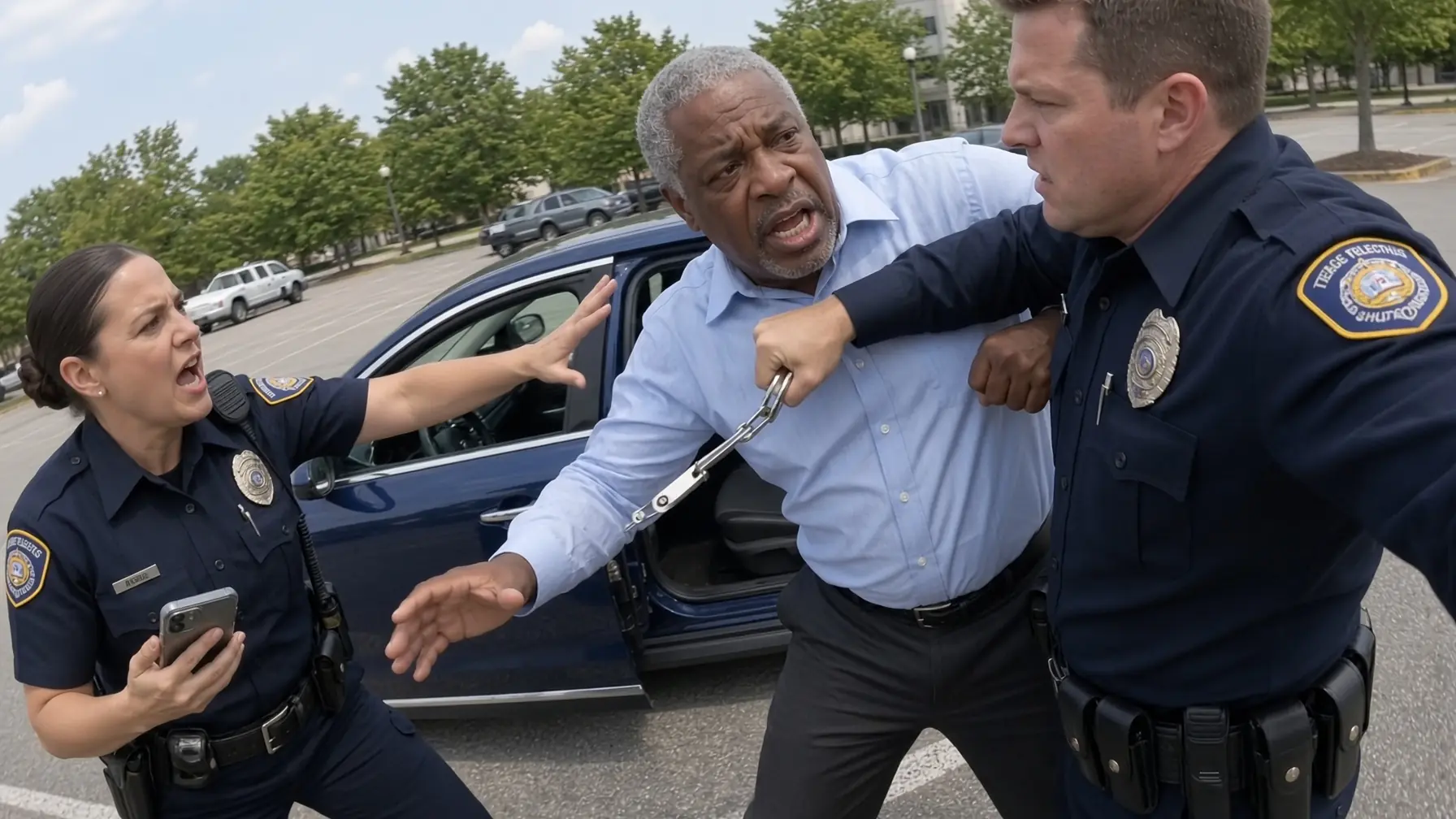
Behind the officer stood the blue Cadillac. Beyond it, a tow truck waited in the parking lot Walker owned.
“I asked for your sergeant,” Walker said. “That’s what I asked you.”
“Turn around.”
A woman called the officer’s name. Another voice told everyone to calm down, but Kurtz had already reached for Walker’s arm.
The cuffs closed behind his back.
Walker looked toward the building, where an employee had come outside after hearing the shouting. For a moment, the employee stood still, taking in the police vehicles, the tow truck, and the man being pushed toward a patrol car.
Then he moved forward.
“Wait a minute,” Walker said. “Don’t take my money.”
Several people began speaking at once.
Within seconds, another confrontation broke out beside the patrol car. Someone shouted for the employee to back up, hands reached between bodies, and the employee went to the ground.
The parking lot filled with voices.
Walker had spent years dealing with public officials. He had served in the Arkansas legislature, led a college, and worked on the airport commission.
None of those experiences had prepared him for standing handcuffed on his own property while his daughter was being taken for medical care.
Somewhere across the city, a supervisor was already driving toward him.
She had no idea how much had changed since the call requesting her presence.
Officer Kurtz believed he was finishing a traffic stop.
By the time she arrived, there were two detained men, a divided crowd, and a phone call from the chief she had not yet been able to answer.
The questions would no longer concern only the Cadillac.
They would concern every decision made around it.
Earlier that day, Kurtz had been driving through Little Rock when a motorist flagged him down.
The man rolled down his window and said a woman was chasing him through traffic. Kurtz looked toward the road and saw a blue Cadillac moving into the wrong lane.
He later described a dangerous sequence.
According to him, the Cadillac crossed into oncoming traffic, came close to other vehicles, and continued while people were nearby. He activated his emergency lights near Daisy Bates and Broadway.
The Cadillac did not immediately stop.
It continued for several blocks before turning into the Premier Center parking lot near Daisy Bates and Ringo.
That was where the situation acquired a family, a property owner, and a history that none of the officers approaching the car could see from the street.
The driver was Walker’s daughter.
The parking lot belonged to him.
Those facts did not resolve what Kurtz said he had witnessed on the road. They did, however, mean the people around the car were not strangers gathering simply to interfere with a stop.
They were a family responding to someone they believed needed help.
Walker came outside and tried to learn what was happening.
He saw his daughter, the Cadillac, and officers asking questions. The mood at first did not resemble what it would become later.
In Walker’s account, Kurtz initially approached him politely.
The officer was concerned about his daughter. Walker understood that there was an issue involving her license and that it needed to be addressed.
His daughter believed she had already taken steps to resolve it. She said she had an email indicating that the problem had been dealt with.
Kurtz’s information showed the license was suspended.
That disagreement remained unresolved at the scene.
Walker did not pretend a parking lot conversation could change the licensing record. He said he would help make sure the matter was taken care of.
What he remembered clearly was the officer’s initial position on the Cadillac.
Kurtz, Walker later told the sergeant, had said he should tow it but would not.
Walker thanked him.
At that point, his attention was on his daughter.
Medical personnel were expected. Her mother arrived, and the family began arranging for her to go to the hospital.
The car stood parked on private property.
Walker believed the immediate situation was settling down.
Then officers returned.
He would later describe the change as the moment the whole encounter became difficult to understand.
One conversation had left him thinking the vehicle could remain. Another began with the insistence that it could not.
Kurtz explained that towing was required under departmental policy because of the suspended license and the seriousness of the driving he had reported.
“I’m going to get in trouble with my job if I don’t do it,” he said.
He wanted the keys.
Someone said the keys had already been handed over. Another person pointed toward the car, and the exchange became tangled almost immediately.