The wagon from the rail stop came up the Roan Fork road a little before noon, and Wesley Tate did not go out to meet it.
He stood in the doorway of the ranch house with his hat in one hand and a knot in his chest he did not care to name. Dust rolled behind the wagon in a pale brown cloud.
The horses moved slowly, heads low from the heat. The whole ranch seemed to pause with him, from the hands leaning near the corral to the cookhouse boy pretending not to stare from beside the water barrel.
Wes had been expecting a bride.
That was what the letter had promised.
A wife willing to come west. A woman who understood work. A woman who could keep a ranch house, cook for hired men, and maybe, if God was feeling generous, bring some warmth into a place that had been built for family but had only ever held loneliness.
The letter had been written in a clean, careful hand.
My name is Cora Halloran. I am thirty-two years of age. I have worked kitchens, laundries, sickrooms, and boardinghouses. I have a daughter, Ruth, age seven. I do not ask for ease. I ask for honest terms.
Wes had read that line more than once.
Honest terms.
He had liked the sound of it.
But now, standing in the doorway while the wagon stopped in front of his house, he realized that somewhere between the letter and the road, he had pictured someone else.
He could not have said who exactly.
Younger, maybe.
Softer.
A woman whose face had not already been taken in hand by grief and weather.
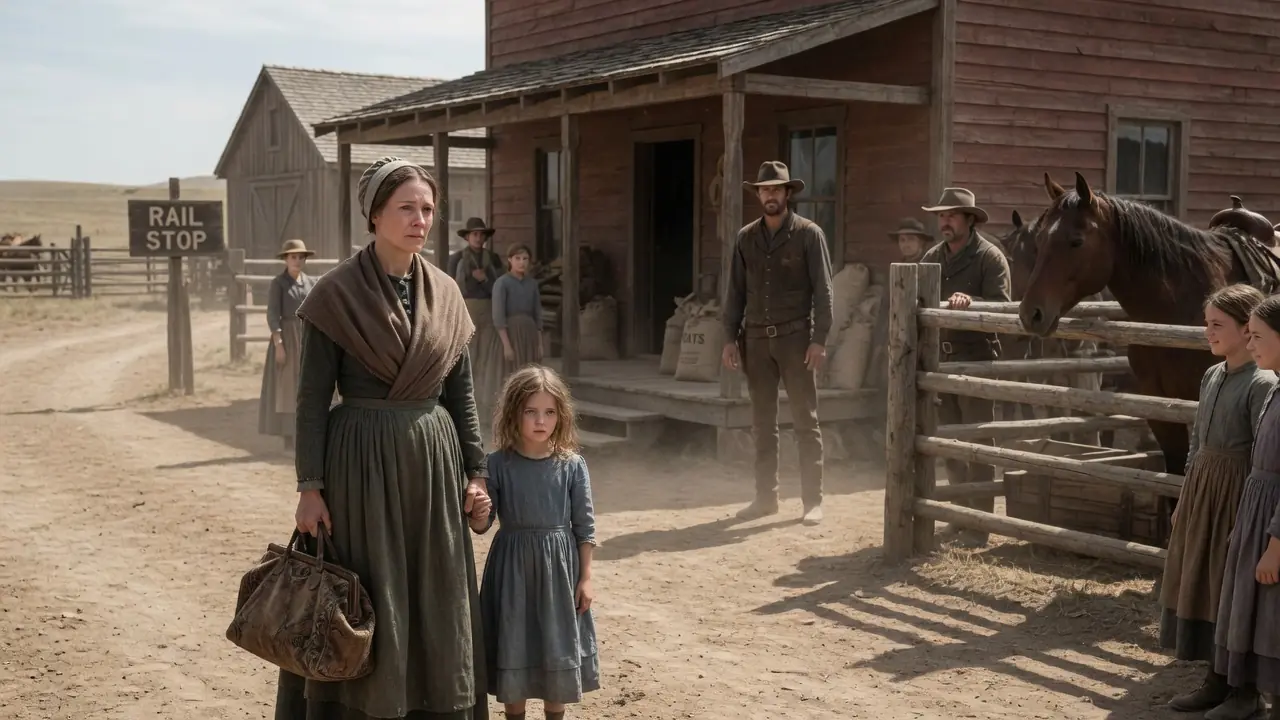
The woman who climbed down from the wagon was plain as a cedar post.
Her brown hair was pulled back hard beneath a bonnet gone gray along the brim. Her traveling dress was mended at the cuffs, not badly, but carefully, with stitches so small a man would have to know to look for them. She carried a worn carpetbag in one fist and held a little girl’s hand in the other.
The child was thin and watchful.
She had large dark eyes and the stiff posture of a child who had learned not to ask for too much space in the world.
The woman set the carpetbag down in the dust the way a person sets down something they have carried a long way with both hands and a kind of care. Then she straightened her back, looked at the ranch house, then at Wes, and did not look away.
Wes felt his throat tighten.
He should have stepped down from the porch.
He should have taken the bag.
He should have said welcome.
But surprise held him still one second too long, and one second can be enough to make a woman understand she is not what a man hoped for.
Cap Reeves, the wagon boss, leaned against the top rail of the corral with a dead cigarette between two fingers. He was a lean, sour man with sunken cheeks, a lazy eye, and the kind of confidence that came from being feared by younger men and tolerated by older ones.
He looked Cora over once, slow and insulting.
“That the wife?” he called, loud enough for everyone to hear. “Thought you sent off for a cook, Wes. Not somebody’s tired aunt.”
Two of the younger hands laughed before they knew better.
One stopped quickly when Wes turned his head.
Cora did not flinch.
The little girl pressed closer against her skirt, but Cora only rested a hand on the child’s shoulder and kept her eyes on Wes.
For a moment, there was no sound but a horse stamping near the trough and the wind moving through the dry grass beyond the yard.
Wes stepped down from the porch at last.
“Mrs. Halloran?”
“Miss Halloran,” she said. “Cora is fine if you prefer it. This is my daughter, Ruth.”
Her voice was low, tired, and steady.
Wes nodded to the girl.
“Ruth.”
The child did not answer.
Cora looked toward Cap, then back at Wes.
“I take it I was expected.”
Wes heard the sharpness beneath the polite words.
“Yes, ma’am.”
“But not wanted.”
The words landed hard because they were true in ways he had not meant and could not deny quickly enough.
Wes took a breath.
“You came a long way. I should have met the wagon.”
“Yes,” Cora said. “You should have.”
A few hands shifted uneasily.
Wes felt heat rise at the back of his neck. He was thirty-four years old, owner of Tate Ranch, and had faced storms, rustlers, drought, debt, and dying cattle. Yet this plain woman standing in his yard with dust on her hem made him feel like a boy caught stealing sugar.
He reached for the carpetbag.
“Let me carry that.”
Cora hesitated.
Not dramatically.
Not proudly.
Just long enough to show him that taking help from a stranger required a decision.
Then she released the handle.
“It has my daughter’s books in it,” she said. “Please don’t throw it.”
“I won’t.”
Cap chuckled.
“Books,” he said. “Well, ain’t we fancy.”
Wes turned fully toward him.
“That’ll do, Cap.”
Cap’s smile thinned, but he lifted both hands as if innocent.
“Just making talk.”
“Make less.”
The yard fell quiet again.
Cora watched the exchange, but her expression did not soften.
Wes carried the bag toward the porch.
“You’ll have the downstairs room off the kitchen for now,” he said. “It’s clean. I had Mrs. Bell from town come make it up.”
“For now?” Cora asked.
Wes stopped.
The question should not have surprised him. He had written for a wife, not a servant, but seeing her there with a child and a guarded face had made all his thoughts crowd together.
“I mean until we speak proper,” he said. “I reckon there are arrangements to discuss.”
“Arrangements,” Cora repeated.
“Yes, ma’am.”
Her eyes moved to the hired men, then the house, then the cookhouse.
“And the work?”
Wes swallowed.
“Our cook left three weeks ago. Men have been taking turns. It hasn’t gone well.”
“That I can smell from here,” Cora said.
One of the hands laughed once, then hid it behind a cough.
Even Wes nearly smiled.
Cap did not.
Wes turned back to her.
“You said in your letter you worked kitchens.”
“I did.”
“Can you cook for a whole outfit?”
The question came out rougher than he intended.
Cora looked at him for a long moment.
Then she turned her head and studied the ranch yard.
The cookhouse stood to the left of the main house, its roof sagging near the chimney. Three men leaned in the shade, boots dusty, faces curious. A stack of unwashed pots sat on a bench near the door. A barrel of flour had been left open, and flies circled it like they owned the place.
Cora looked back at Wes.
“I fed forty railroad men for five months with one cracked stove, two sacks of beans, and a butcher who cheated the weight,” she said. “I cooked through cholera in Abilene, a blizzard outside Cheyenne, and three weeks in a mining camp where the men thought whiskey was breakfast. I can cook for your outfit.”
Her eyes moved to Cap Reeves.
“But I do not feed disrespect. If a man wants my food, he keeps a civil tongue in his head. If he cannot manage that, he can eat dust and pride.”
Nobody laughed this time.
The young hands stared.
Cap’s mouth opened, then closed.
Wes felt something shift in his chest.
It was not affection.
Not yet.
It was recognition.
This woman had come into a yard full of strangers, already judged and found lacking, and she had still planted her feet like a fence post driven into hard ground.
Wes nodded once.
“Fair terms,” he said.
For the first time, something flickered in Cora’s eyes.
Not warmth.
Not trust.
But perhaps the smallest sign that she had heard her own words returned to her and found them remembered.
“Then show me the kitchen,” she said.
The kitchen was worse than Wes had admitted.
Cora stood in the doorway for a full ten seconds without speaking.
Ruth stood behind her, peering around her skirt.
The stove was blackened and uneven. The floor had flour ground into the cracks. The shelves were a confusion of salt pork, dried apples, coffee, beans, onions, cornmeal, and mouse droppings. A sour pan sat in the corner beneath a rag that had once been white. Someone had hung a saddle blanket near the back window, though no one seemed able to explain why.
Cora set her bonnet on a peg.
“Mr. Tate.”
“Wes,” he said, then immediately felt foolish.
She ignored the correction.
“Do you intend for men to survive eating here?”
“They have so far.”
“That is not an answer. That is a miracle.”
A hand named Jimmy snorted from the doorway.
Cora turned.
“You.”
Jimmy straightened.
“Ma’am?”
“Do you know where the ash bucket is?”
“Yes, ma’am.”
“Take it out. Empty it properly. Bring it back clean.”
Jimmy blinked.
“I was just passing by.”
“Then pass by useful.”
He looked at Wes.
Wes folded his arms.
“You heard her.”
Jimmy took the ash bucket.
Cora pointed at another man.
“You. Open that window. Not halfway. All the way. If it falls off, tell me before it kills someone.”
The man obeyed.
Within three minutes, Cora had given orders to four grown men, moved Ruth onto a chair in the corner with a book, tied on an apron from her bag, and begun stripping the kitchen down like a general taking command of a battlefield.
Wes stood by the door, useless and fascinated.
Cora did not ask where anything was. She found it, judged it, moved it, cleaned it, or threw it out. She tossed a moldy sack of meal onto the porch, ordered one of the hands to burn it, and told another that if he ever put a wet spoon in the sugar again, she would make him drink coffee without any for a month.
By late afternoon, the kitchen smelled different.
Soap.
Onions.
Cornbread.
Coffee.
Something frying in fat.
The men drifted toward the cookhouse as if pulled by rope.
Cap came last, leaning in the doorway with a smirk.
“What’s all this fuss? Thought we hired a bride, not a captain.”
Cora did not look up from the skillet.
“You hired neither. Mr. Tate sent for a woman under terms not yet settled. Until those terms are settled, I am the cook. And while I cook, I captain the kitchen.”
Cap’s smile soured.
Wes, standing at the far end of the porch, watched without interfering.
He had learned more in one afternoon than he had expected.
Cora did not need him to speak for her every time a man tried his luck.
But he also understood something else.
If he let disrespect take root now, it would grow.
At supper, the men sat at the long table outside because the evening was clear and the cookhouse was still drying from Cora’s assault on dirt.
She served beans with salt pork and onion, biscuits, fried potatoes, and cornbread cut into thick squares. It was simple food. Ranch food. But the biscuits rose high, the beans had flavor down to the bottom of the pot, and the cornbread disappeared so quickly that men began eyeing one another’s plates.
Caleb Dunn, Wes’s foreman, was the first to speak.
“Ma’am,” he said carefully, “that is the best meal we’ve had in a month.”
“Then you’ve had a bad month,” Cora replied.
The men laughed, but kindly this time.
Ruth sat beside her mother, eating slowly, watching everything.
Wes noticed the child kept one hand near a small cloth bundle in her lap. Later, he learned it held two pencils, a slate, a comb, and a button shaped like a bird. Her treasures.
Cap ate without compliment.
Afterward, he shoved his plate away and said, “Could use more salt.”
Cora looked at his empty plate.
“You found your way through it.”
A few men coughed to hide laughter.
Cap’s jaw tightened.
Wes watched him.
That night, after the hands dispersed, Wes found Cora washing dishes alone. Ruth had fallen asleep in a chair near the stove, her cheek pressed against her folded arms.
“You should have asked someone to help with those,” Wes said.
Cora did not turn around.
“I did.”
“Who?”
“The girl.”
Wes looked at Ruth.
“She’s seven.”
“She dries better than most men wash.”
He stepped closer.
“I’ll do it.”
That made her turn.
“You?”
“Yes.”
“Do you know how?”
“I reckon soap is involved.”
For the first time, Cora almost smiled.
Almost.
“Soap is involved,” she said. “So is not breaking the plates.”
Wes rolled up his sleeves.
The first plate slipped from his hand and knocked against the side of the wash basin.
Cora took it from him.
“Gently, Mr. Tate. It is a plate, not a calf.”
“Yes, ma’am.”
They washed in silence for a while.
It was not comfortable silence, but it was not hostile either.
Finally, Wes said, “I owe you an apology.”
Cora’s hands slowed.
“For not meeting the wagon?”
“For that. And for standing there like a fool when Cap opened his mouth.”
“He is your man.”
“Yes.”
“Then he learned his manners from somewhere.”
Wes accepted the strike because it landed true.
“My father hired him. I kept him because he knows cattle.”
“Men often excuse meanness when it comes with skill.”
“They do.”
She looked at him then.
Again, that faint surprise.
“You agree too easily.”
“I don’t see much use in arguing when a person is right.”
Cora returned to the dishes.
“That habit may make people suspicious of you.”
“It already has.”
Ruth stirred in the chair.
Cora dried her hands quickly and went to the child, touching her shoulder with a tenderness so careful it made Wes look away.
“Come, bird,” she whispered. “Bed.”
Ruth opened her eyes and leaned into her mother.
Wes cleared his throat.
“The room is ready. I had a small cot brought in for her.”
Cora lifted the girl into her arms, though Ruth was almost too big to be carried easily.
“She can walk.”
“She’s tired.”
Wes picked up the carpetbag.
Cora looked as if she might object, then did not.
The downstairs room was plain but clean, with a bed for Cora, a cot for Ruth, a washstand, two hooks on the wall, and a small window facing east. Wes had placed fresh quilts at the foot of each bed because Mrs. Bell had insisted a woman coming west should at least have clean bedding.
Cora looked around.
“It’s more than I expected.”
Wes did not know whether to be glad or ashamed.
“I hope it suits.”
“It will do.”
Ruth was already half asleep when Cora laid her down.
Before Wes left, Cora turned to him.
“Mr. Tate.”
“Yes?”
“You sent for a wife.”
The words entered the room quietly and changed the air.
Wes held his hat tighter.
“I did.”
“Did you read my letter yourself?”
“Yes.”
“All of it?”
“Yes.”
“Then you knew I had a child.”
“I did.”
“And you knew my age.”
“I did.”
“But still, when I arrived, you looked at me as if I had cheated you.”
Wes felt the truth of it like a hard hand against his chest.
“I had expectations I didn’t know I was carrying,” he said. “That was my failure, not yours.”
Cora’s face remained still, but her eyes searched his.
“I am not young,” she said. “I am not pretty in the way men usually mean. I cannot give you softness I do not have. If you want to send us back, say it plainly. I have survived worse than a refused bargain.”
Wes looked at the sleeping child.
Then at Cora.
“I won’t send you back.”
“Pity is not a foundation for marriage.”
“No.”
“Need is not either.”
“No.”
“What, then?”
Wes had no answer ready.
He had sent for a wife because the ranch needed a cook and the house needed a woman’s hand, because loneliness had been growing inside him like winter grass, because every evening he sat at a table built for more people than one and felt the emptiness of it.
But none of those reasons seemed worthy of the woman standing before him.
“I don’t know yet,” he said honestly. “So we won’t marry yet.”
Cora blinked.
“We won’t?”
“Not until you choose it. Not because a letter was sent and a wagon arrived.”
She stared at him.
In her life, arrangements had usually been made over her head and called mercy.
“What are you offering, then?” she asked.
“Work. Wages. Room and board for you and Ruth. Respect, if I can make the men learn it and myself remember it. If, after time, you want to leave, I’ll pay your fare wherever you want to go. If you want to stay, we’ll discuss what staying means.”
Cora’s mouth parted slightly.
For once, no immediate answer came.
Then she looked down at Ruth.
“And if people talk?”
“They will.”
“That does not trouble you?”
“It troubles me less than forcing a woman to marry before she has decided whether I’m worth the risk.”
Her eyes lifted.
Something moved there.
Not trust.
But the first tired lowering of a shield.
“Fair terms,” she said softly.
“Fair terms,” Wes answered.
The first week was hard.
Not because Cora could not manage the work. She managed it too well. By the third day, the ranch ran differently. Breakfast came on time. Coffee stayed hot. Supplies were counted. Dirty dishes no longer multiplied like rabbits. Men who tried slipping into the kitchen for extra biscuits without asking found themselves chased out with a wooden spoon and public shame.
The difficulty was not the work.
It was the watching.
Everyone watched Cora.
The men watched because she was new, because she was a woman, because some expected her to fail and others hoped she would not. Ruth watched everything because children who have known uncertainty learn to read rooms before they learn multiplication. Wes watched because he could not stop himself, though he tried to make it less obvious.
Cora moved through the ranch like a person used to making herself useful before anyone could decide she was unwanted. She rose before dawn, baked before sunrise, fed twelve men by six, cleaned by seven, started beans or stew for noon, mended a torn curtain in the afternoon, and still found time to teach Ruth reading at the kitchen table.
Wes saw the child tracing letters on a slate one evening.
Ruth wrote slowly, her tongue caught between her teeth.
Cora sat beside her, shelling peas.
“That says rain,” Cora told her.
Ruth frowned.
“It looks like ruin.”
“Sometimes it does.”
Wes stood just outside the door, smiling before he realized it.
Ruth looked up and froze.
He stepped into view.
“Didn’t mean to interrupt.”
Cora’s expression became guarded at once.
“You’re the owner of the house. I suppose you can interrupt where you like.”
“I can also choose not to.”
Ruth stared at his boots.
Wes crouched, though his knees protested.
“What are you learning?”
Ruth held the slate closer to her chest.
“Words.”
“Good thing to learn.”
She said nothing.
“I know a few,” Wes added.
Cora looked at him.
“Do you?”
“Some practical ones. Fence. Drought. Debt. Mule, when spoken with feeling.”
Ruth’s mouth twitched.
It was the first almost-smile he had seen from her.
Cora noticed too, though she pretended not to.
Over the following days, Wes tried little things.
He fixed the loose window in their room without making a speech about it. He had one of the hands build Ruth a small shelf for her books. He brought in a crate of apples from town because Cora had mentioned, only once, that Ruth liked them when she was sick.
Cora noticed all of it.
She thanked him for none of it at first.
Not because she was rude, but because gratitude had often been used against her. People gave a woman like Cora something small and expected her to lower her eyes forever after.
Wes was learning.
Slowly.
Cap Reeves did not learn.
He resented Cora from the start.
Before her arrival, Cap had held a certain power on the ranch. He was not foreman, but younger hands listened when he spoke because he had driven cattle before half of them had grown whiskers. He knew storms, trails, water holes, and every dirty joke in three territories. Wes kept him because he was useful.
Cora offended Cap in a way he could not explain.
She did not giggle at him.
She did not fear him openly.
She did not give him extra coffee after he insulted her.
Worst of all, the other men started listening to her in the kitchen.
One morning, Cap came in late for breakfast and found the biscuits gone.
“Where’s mine?” he demanded.
Cora was wiping the counter.
“Breakfast was at six.”
“I was checking the east pasture.”
“Then the east pasture should feed you.”
A hand named Tommy laughed.
Cap turned on him.
“You find that funny?”
Tommy looked down.
Cora set a bowl of beans on the counter.
“There is food left. It is not hot.”
Cap glared.
“You holding back the good stuff now?”
“No. You arrived after the good stuff was eaten.”
“You got a mouth on you.”
“I have ears too,” Cora said. “Both are tired.”
Wes entered the cookhouse in time to hear the last line.
Cap looked at him.
“You going to let her talk like that?”
Wes poured coffee.
“If she cooks like that, I’m liable to let her sing.”
The men laughed.
Cap did not.
Cora looked down, but Wes saw the corner of her mouth move.
That evening, he found her cutting biscuit dough.
“Cap may become trouble,” he said.
“He already is.”
“I’ll speak to him.”
“You have before.”
“Not plain enough.”
Cora pressed the cutter into the dough.
“Men like Cap don’t hear plain. They hear consequence.”
Wes leaned against the doorframe.
“You’re probably right.”
“I usually am.”
This time, he smiled openly.
“Yes, ma’am.”
Summer settled hard over Roan Fork.
The grass turned brittle. Dust coated everything. The cattle moved slowly in the heat. Men came in sunburned and short-tempered. Cora kept vinegar water in a crock by the door and made them drink before they dropped. She soaked cloths for the horses’ necks. She learned who liked coffee black, who would lie about being sick, who was hiding blisters, and who needed feeding twice because he was still growing.
By August, the ranch hands no longer called her the bride.
They called her Mrs. Cora when she could hear and the General when they thought she could not.
Ruth changed too.
The first weeks, she stayed near Cora’s skirt, quiet as a mouse in a church wall. Then she discovered the chickens. After that, the barn cats. Then the old mare in the west paddock, a patient gray creature named Dinah.
Wes found Ruth brushing Dinah one afternoon with both small hands.
“You like horses?”
Ruth looked at him warily.
“She doesn’t ask questions.”
Wes nodded.
“Good quality in a horse.”
Ruth returned to brushing.
After a while, she said, “Are you going to marry Mama?”
The question struck him so hard he nearly dropped the bridle he was holding.
“I don’t know.”
Ruth looked up.
“Do you not like her?”
“I like her very much.”
“Then why don’t you know?”
Wes crouched by the fence.
“Because liking someone isn’t enough. Your mother has to choose. So do you.”
Ruth blinked.
“Me?”
“You came with her.”
“Mama says children don’t get to choose much.”
“Maybe not often. But on my ranch, a child gets a say in whether she stays.”
Ruth studied him carefully.
“What if I say no?”
“Then I would be sad,” Wes said. “But I would still help you both go where you wanted.”
The girl’s face tightened in confusion.
She did not yet understand kindness without a trap.
That made Wes hate the world a little.
Ruth looked back at Dinah.
“I don’t say no.”
It was not exactly acceptance.
But it was something.
The first crisis came in September.
A fever swept through the hands after three men returned from town. At first it looked like ordinary sickness. Headache. Sweat. Chills. Then Tommy collapsed near the water trough, and by evening five men were down.
Wes sent for the doctor, but Dr. Marlow was thirty miles away delivering a baby near Stone Creek.
Cora took command before anyone asked.
She turned the parlor into a sickroom, boiled linens, made willow bark tea, cooled foreheads, and forced broth into men too weak to argue. Ruth carried water under her direction, serious and silent. Wes rode messages, hauled wood, and did exactly what Cora told him because he had sense enough to recognize competence.
For three nights, she barely slept.
On the second night, Wes found her in the kitchen gripping the edge of the table, eyes closed.
“You need rest,” he said.
“So do they.”
“You’ll fall over.”
“Then pick me up and set me back down where I was working.”
“Cora.”
Her eyes opened.
They were red with exhaustion.
“Don’t use that tone unless you have a better plan.”
He had none.
So he made coffee and stood beside her while she drank it.
By the fourth day, the fever broke.
No one died.
When Dr. Marlow finally arrived, he looked over the sickroom and shook his head.
“Who did all this?”
Wes looked toward Cora, who was sitting in a chair with Ruth asleep against her lap.
“She did.”
The doctor removed his hat.
“Then she likely saved half your outfit.”
The men heard about that.
Respect changed shape after the fever.
Before, they respected Cora’s food.
Afterward, they respected her hands, her judgment, and the steel in her spine. Cap still muttered, but even he did it softer.
Wes changed too.
He had admired Cora from almost the beginning. Then he had relied on her. During the fever, watching her move from man to man without fear, hearing her murmur comfort to men who had once mocked her arrival, seeing her carry exhaustion like another bucket of water, he understood something deeper than admiration.
He loved her.
Not because she was useful.
That would have been the old mistake.
He loved the person who remained when all usefulness had been wrung out of her and she still chose mercy.
He did not tell her then.
A woman half-dead with fatigue should not be asked to carry a man’s heart too.
Two weeks after the fever, Cora found a ledger on the kitchen table.
Not Wes’s ranch ledger.
A smaller one.
On the first page, written in his hand, were wages paid to Cora Halloran. Underneath was the amount he had promised, plus extra for the fever days, plus a line marked Ruth’s schooling.
She carried it to him in the barn.
“What is this?”
Wes looked up from repairing a harness.
“A ledger.”
“I know what a ledger is.”
“Then why ask?”
“Because this says you paid money into an account for Ruth.”
“I did.”
Cora’s face went still.
“Without asking me?”
Wes set the harness down carefully.
“You’re right. I should have asked.”
That stopped some of her anger.
But not all.
“I won’t have you buying my daughter’s loyalty.”
“I’m not.”
“How do I know that?”
“Because the money is in her name, and if you leave tomorrow, it goes with her.”
Cora stared at him.
He continued.
“I paid it because you worked through fever while I had men alive because of you. I paid it because Ruth carried water until her arms shook. I paid it because wages should reflect work done. But I should have told you first.”
Her grip on the ledger loosened.
“You make it difficult to stay angry.”
“I don’t do it on purpose.”
“That may be worse.”
He smiled faintly.
Cora looked away toward the barn doors.
“Thank you,” she said, so quietly he almost missed it.
“You’re welcome.”
She stayed there a moment longer.
Then she said, “Ruth asked me if you were kind.”
Wes swallowed.
“What did you tell her?”
“I told her I was watching.”
“And?”
Cora looked at him.
“I am still watching.”
He nodded.
“That is fair.”
The second crisis came from Cap.
It happened after payday, when whiskey and resentment mixed in town and rode back to the ranch in the dark.
Cap returned late, drunk enough to be meaner than usual and sober enough to aim it. Cora had left a covered plate for him because she fed men even when she disliked them. He stumbled into the kitchen, knocked the plate onto the floor, and laughed when it broke.
Ruth woke from the noise and appeared in the hallway in her nightdress.
Cora stepped between them at once.
“Go back to bed, Ruth.”
Cap looked at the child.
“She yours, girl? Skinny little thing.”
Cora’s voice sharpened.
“Do not speak to her.”
Cap grinned.
“Or what? You’ll hit me with a spoon?”
Wes came in from the back porch, having heard the crash.
The room went cold.
Cap turned.
“Evening, boss.”
“You’re drunk,” Wes said.
“Off duty.”
“You’re in my house.”
Cap pointed loosely toward Cora.
“She ain’t your wife yet. Though maybe that’s because you finally took a good look.”
Wes crossed the room so fast that Cap’s grin vanished.
He did not strike him.
That would have been too easy.
Instead, Wes stopped inches away and spoke in a voice low enough that every word carried more danger than shouting.
“You will saddle your horse at first light and leave this ranch.”
Cap’s face twisted.
“You firing me over a woman?”
“I’m firing you because you came drunk into my house, frightened a child, insulted the woman who kept you alive during fever, and broke what wasn’t yours.”
“I’ve worked cattle longer than you’ve owned boots.”
“And tomorrow you can do it somewhere else.”
Cap looked around, expecting the hands gathered near the doorway to support him.
None did.
Caleb stepped forward.
“I’ll see he packs.”
Cap’s eyes burned.
“You’ll regret this, Wes.”
“I already regret keeping you too long.”
By noon the next day, Cap was gone.
Cora found Wes by the corral after the dust from Cap’s horse had disappeared down the road.
“You did not have to do that for me.”
“I didn’t do it only for you.”
“For Ruth?”
“For her. For the men. For the ranch. For myself.” He looked at her. “I should have done it sooner.”
Cora studied him.
“You are learning.”
“I’m trying.”
“That matters.”
He wanted to say more.
He did not.
Not yet.
Winter came early that year.
The first storm rolled across Roan Fork in November, turning the sky iron-gray and the wind sharp enough to cut through wool. Snow was uncommon but not unheard of, and that year it came hard, wet, and dangerous.
The herd was caught farther north than Wes liked.
He rode out with six men before dawn to move cattle closer to shelter. Cora packed food for them before anyone asked. Biscuits wrapped in cloth. Dried beef. Coffee grounds. Cornbread dense enough to travel. She placed a small packet in Wes’s saddlebag last.
“What’s this?”
“Extra.”
“For me?”
“For whoever is foolish enough not to eat until he falls over.”
He looked at her.
“I’ll eat.”
“No, you’ll say you will. Then you’ll forget. Then you’ll come back looking like death and expect me not to scold you.”
“That sounds unpleasant.”
“Then eat.”
He smiled.
“Yes, ma’am.”
The storm worsened by noon.
By evening, only three men had returned, half-frozen and missing Wes, Caleb, and two others. One horse had gone lame. Cattle had scattered near the north ridge. Snow came slanting out of the dark so hard the lantern light looked broken.
Cora listened to the report without panic.
Then she began issuing orders.
“Get blankets warmed. Boil water. Keep coffee going. Ruth, bring the dry socks from the line. Jimmy, saddle the mare.”
Caleb was not back.
Wes was not back.
Fear moved through her, cold and sharp, but she did not give it her hands.
The men wanted to ride out immediately, but the wind had erased the trail. Cora sent two to the barn, one to the loft to watch for lanterns, and one to heat stones by the stove.
“You ever been in weather like this?” one hand asked.
“Yes,” Cora said. “Cheyenne. Men freeze faster when everyone starts shouting.”
Near midnight, the watcher called down.
“Light!”
The yard erupted.
Cora grabbed a lantern and went out before anyone could stop her. Ruth stood in the doorway, wrapped in a blanket, eyes huge.
Through the snow, four shapes emerged.
Caleb first, leading two horses.
Then Wes, half-supporting a young hand named Peter, whose face was gray with cold. The last man stumbled behind them, cursing weakly.
Cora reached Wes.
His hat was gone. Ice clung to his coat. His lips were pale.
“You ate?” she demanded.
He blinked.
“What?”
“Did you eat?”
For one absurd second, Wes almost laughed.
Then his knees buckled.
Cora and Caleb caught him together.
They got them inside.
The next hours blurred into heat, steam, wet wool, and command. Cora stripped frozen gloves from stiff fingers, wrapped feet, forced hot broth into mouths, packed warmed stones near blankets, and rubbed circulation back into Peter’s hands while he cried from pain and shame.
Wes woke near dawn in the parlor, wrapped in quilts.
Cora sat beside him, hair loose from its pins, face pale with exhaustion and anger.
“You didn’t eat,” she said.
His throat hurt.
“I forgot.”
“I told you not to.”
“Yes.”
“You nearly froze.”
“Yes.”
“You are the most aggravating man God ever set upright.”
“I believe Cap might argue.”
“Cap is gone. Do not distract me.”
Wes smiled weakly.
Cora’s eyes filled suddenly.
She turned her face away.
His heart tightened.
“Cora.”
“No.”
He reached for her hand, then stopped before touching.
“May I?”
She looked at him.
The question did something to her expression.
She placed her hand in his.
His fingers closed around hers.
“I was afraid,” she said.
“I’m sorry.”
“I did not like it.”
“I don’t imagine fear asks permission.”
She looked down at their joined hands.
“I have lost too much already.”
Wes’s voice was rough.
“I know.”
“No,” she whispered. “You don’t.”
He waited.
Cora stared toward the stove.
“My husband died in Kansas,” she said. “His name was Daniel. He was not cruel, but he was weak. Cards. Drink. Bad debts. He left me with Ruth and creditors before fever took him. After that, people looked at me like I had failed at marriage and motherhood both. Every job came with a warning. Every kindness came with a cost.”
Wes listened without moving.
“I answered your notice because it said honest terms. I thought maybe honest was enough to start with. Then I arrived and saw your face, and I thought I had been a fool again.”
Wes closed his eyes.
“You weren’t.”
“I might have been.”
“No,” he said. “I was the fool.”
Cora looked at him.
He squeezed her hand gently.
“I pictured wrong. Not because you were lacking. Because I was small in my thinking. I asked for a woman who could work, then nearly missed the woman who could stand. I asked if you could cook for an outfit when I should have asked whether this outfit was worthy of you.”
Tears slipped down her face.
She did not wipe them away.
“Wes.”
“I love you,” he said.
The words came out plain.
No poetry.
No polished speech.
Just truth, finally tired of waiting.
Cora’s fingers tightened around his.
“I am afraid of needing you.”
“I am afraid of failing you.”
“That is not comforting.”
“No. But it is honest.”
She let out a broken laugh.
Then she leaned forward and pressed her forehead lightly against his hand.
“I love you too,” she whispered.
They did not marry the next day.
Cora would not allow fever, fear, and near-death to make decisions for her. Wes agreed, though Caleb told him later that if he moved any slower, the wedding would be attended by their grandchildren.
The wedding took place in March, when the grass had just begun to green along the creek and the air smelled of mud, cattle, and early spring.
It was not grand.
Cora wore a blue dress Mrs. Bell altered for her, with tiny stitches at the cuffs. Ruth wore a white ribbon in her hair and stood beside her mother holding a small bouquet of wildflowers. Wes wore his best suit and looked so nervous that three hands placed bets on whether he would drop the ring.
He did not.
When the preacher asked who gave the woman, Cora lifted her chin.
“I give myself.”
The church went silent.
Then Mrs. Bell nodded firmly from the front pew, as if daring anyone to object.
Wes looked at Cora with so much pride he forgot to breathe.
Afterward, the whole outfit ate in the ranch yard beneath long tables made from boards and barrels. There was beef, beans, pies, biscuits, coffee, and cornbread in great golden pans.
Caleb raised his cup.
“To Mrs. Tate,” he said, “who saved our stomachs, our manners, and some of our lives.”
The men cheered.
Ruth beamed.
Cora shook her head like she disapproved of the fuss, but her eyes shone.
Wes leaned close.
“Can you cook for a whole outfit?” he murmured.
Cora looked at him sideways.
“Still asking foolish questions?”
“Only that one.”
She smiled.
“Yes, Mr. Tate. I can cook for a whole outfit.”
Then she looked out over the tables, over the men who now stood when she entered a room, over Ruth laughing with a barn cat in her lap, over the ranch that had once met her with dust and insult and now held her name with respect.
“But I told you once,” she added. “I do not feed disrespect.”
Wes took her hand beneath the table.
“No, ma’am,” he said. “Not in this house.”
Years later, people in Roan Fork still told the story of the day Cora Halloran arrived at Tate Ranch.
Some told it as a romance.
A lonely rancher sent for a bride, and love came down the road in a dusty wagon.
Some told it as a lesson.
A plain woman with a child stepped into a yard full of men who did not want her and taught them manners with coffee, cornbread, and a spine made of iron.
But Wes knew the truth was deeper than either telling.
Cora had not become worthy because the ranch learned to value her.
She had arrived worthy.
She had arrived tired, guarded, and dust-covered, but worthy all the same. The ranch had simply needed time to understand what had stepped down from that wagon.
As for Ruth, she grew strong under that wide western sky.
She learned horses from Wes, baking from Cora, numbers from Caleb, and sharp-eyed caution from a childhood that had ended too early. By fourteen, she could ride better than most boys in the county. By sixteen, she managed the ranch accounts with a clean hand and a sharper mind than any clerk Wes had ever hired.
And every year on the anniversary of the day Cora arrived, Wes asked the same question at supper.
“Can you cook for a whole outfit?”
The first time, Cora threatened to hit him with a spoon.
The second time, she laughed.
By the tenth, she only shook her head and placed cornbread in front of him.
“Eat before it gets cold,” she said.
And Wes always did.
Because he remembered the first answer.
He remembered the dust, the mockery, the little girl’s watchful eyes, and the woman who stood in his yard unwanted but unbroken.
He remembered how a ranch could be fed by food, but changed by dignity.
And he never again mistook plainness for weakness, silence for surrender, or a woman’s worn dress for the measure of her worth.