Marcus could see his phone from the pavement.
It lay face up on the sedan’s hood, close enough that he could have reached it if he had been standing. Sunlight reflected from the glass, hiding the screen whenever he shifted his head.
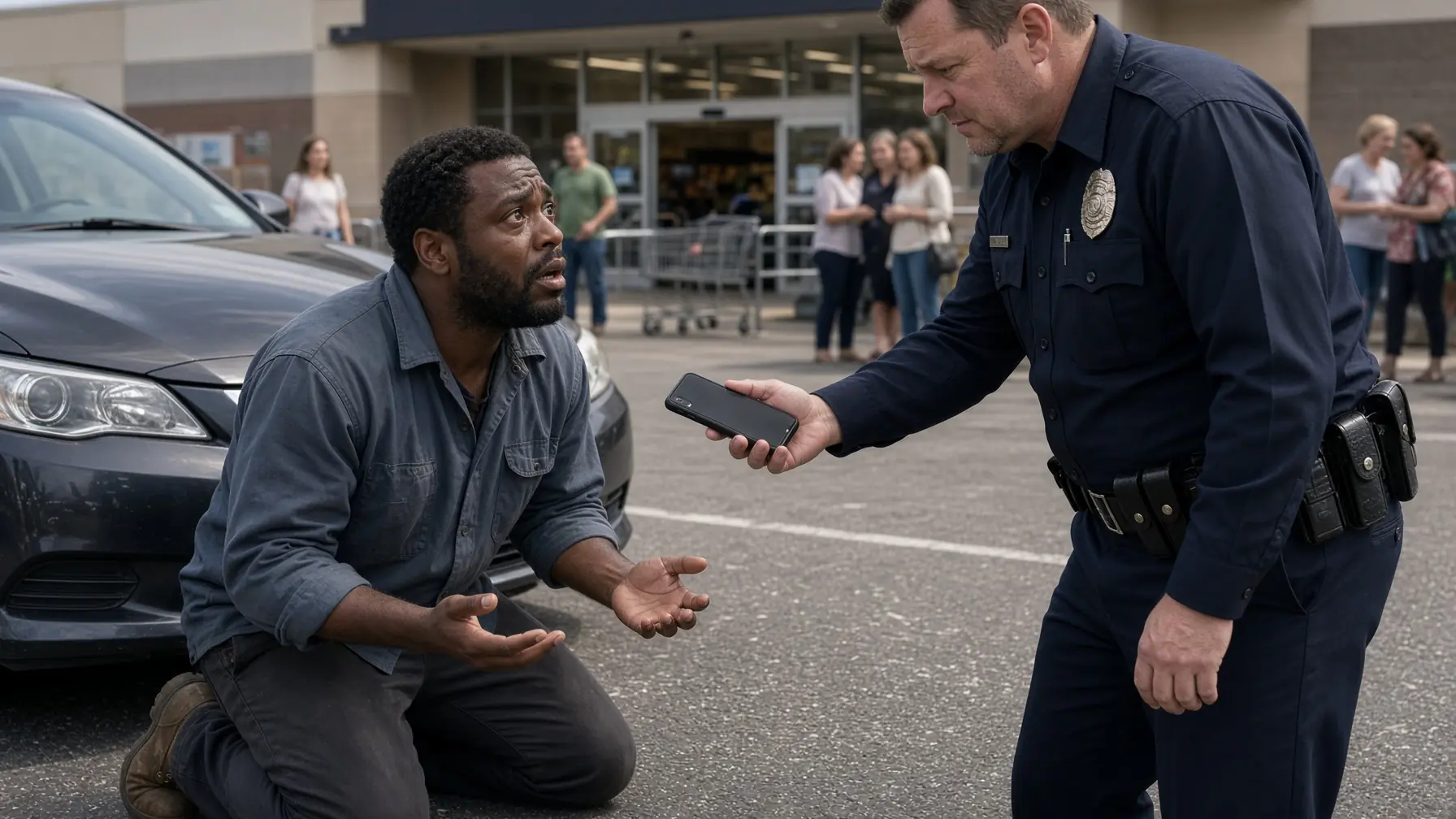
Officer Bradley Miller pulled his arm farther behind him.
Marcus lowered himself onto both knees.
The pavement was warm through his charcoal trousers. A small piece of gravel pressed into his right knee, sharp enough to register even through everything else happening to him.
“Please, let me go,” he said. “My mother needs to get to the emergency room. She’s waiting for me.”
Miller leaned over him.
His grip tightened.
“You’re staying right here until I’m finished.”
Marcus looked toward the supermarket entrance.
People were still coming out with groceries.
Somewhere behind him, shopping carts knocked together inside the return.
His mother was waiting.
That morning, she had called to ask whether he was already at work.
He had been standing in his kitchen with one boot on, trying to find the other beneath a chair he did not remember moving.
“Almost.”
“That means no.”
“It means almost.”
“I only need a few things.”
Marcus put the phone on speaker and set it beside the coffee maker.
“Send me the list.”
“I can tell you.”
“If you tell me, I’ll forget something.”
“You’re thirty-five.”
“Which is old enough to know I’ll forget something.”
She laughed.
It was a small laugh, half breath and half surrender, and he smiled while searching beneath the table.
His mother had never liked making a task out of asking for help.
She could turn a request for three grocery items into an explanation of why she would ordinarily get them herself, why the timing was inconvenient, and why he should not rearrange his whole day.
Marcus had learned to interrupt gently.
“Mom. The list.”
“All right.”
His phone vibrated a moment later.
He glanced at the message.
Milk.
Bread.
Tea.
Then, beneath those, a second message.
The bread with the blue label.
He found his boot.
“Anything else?”
“No.”
“Sure?”
“Don’t start buying things.”
“I wasn’t going to.”
“You always say that.”
He pictured the cupboard beside her stove, the one where she kept tea on the second shelf because she claimed the first shelf made it too easy for visitors to help themselves.
He had pointed out that visitors generally asked before taking tea home.
She had told him that was not the point.
He still did not know what the point had been.
Now, kneeling beside the sedan, he could remember the exact sound of her laugh.
He wished he had stayed on the phone longer.
He wished he had asked a different question, though he could not have said what that question should have been.
Miller shifted his hold.
Pain moved down Marcus’s arm.
He stopped thinking about the kitchen.
“Please,” he said again.
The word seemed smaller each time he used it.
Miller looked toward the phone but did not reach for it.
Marcus kept his free hand open where the officer could see.
He had been trying to do everything visibly.
Move slowly.
Speak clearly.
Stop when told.