Wallace Reed held it out with two trembling fingers, the small brass key hanging from a cracked leather tag so old the writing had almost disappeared. Caleb Turner looked from the key to the rusted Mustang sitting half-buried in weeds beside the leaning barn, then back to the old farmer’s face. The car looked like it had been forgotten by the whole world, its faded red paint swallowed by rust, its hood covered in hay, and its tires sunk deep into Tennessee mud. But something in Wallace’s voice made Caleb feel like he was not buying a car at all.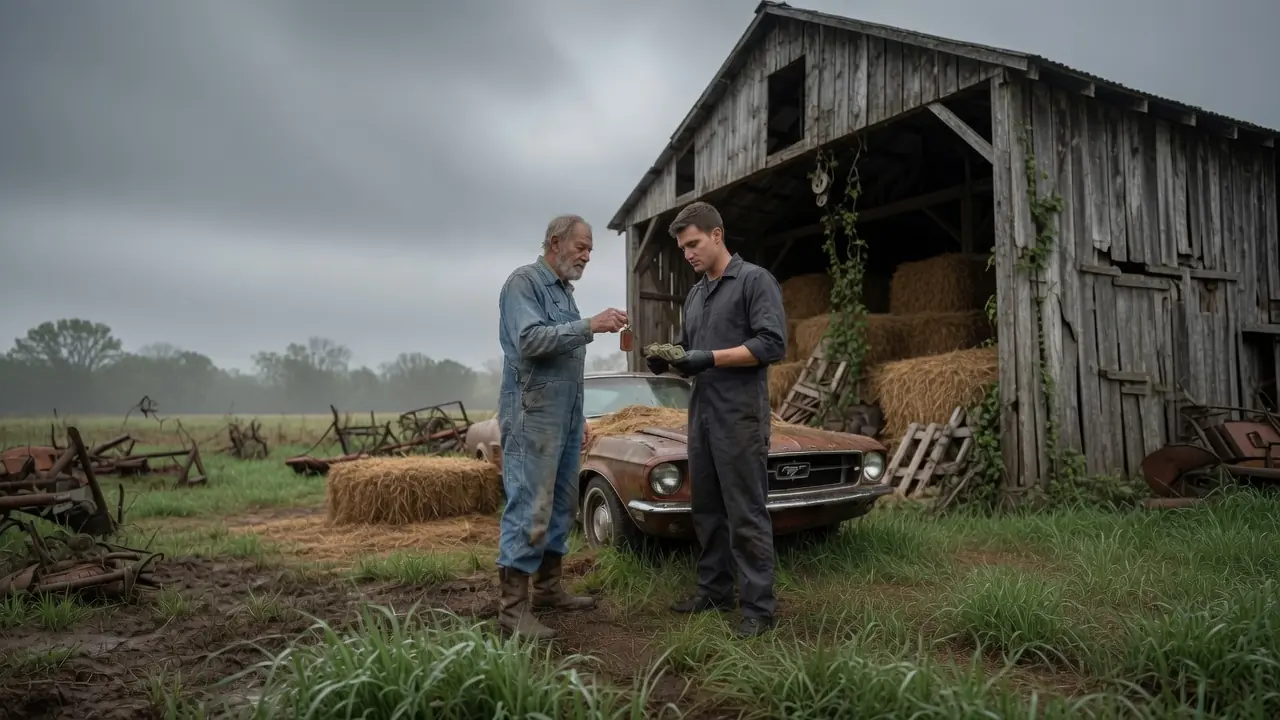
He was accepting a memory.
Caleb was twenty-seven, a quiet mechanic who owned a small repair garage outside Lewisburg, Tennessee. He fixed farm trucks, old tractors, worn-out engines, and anything else people dragged through his doors with more hope than money. He had never been rich, but he had good hands and the kind of patience old machines seemed to understand. When Wallace called and said he had an old Mustang he wanted gone before the barn came down, Caleb expected a parts car at best.
Still, the moment he saw it, he stopped walking.
The Mustang sat beside the barn like a wounded animal that had crawled there years ago and never moved again. The front grille was dull, the chrome was pitted, and the windshield wore a thick coat of dust. Hay had fallen across the hood from the broken loft above, and the left fender looked like it had been kissed by every season since the late 1960s. Anyone else would have seen only rust, rot, and trouble, but Caleb saw the long hood, the old badge, and the shape beneath the damage.
“How much were you wanting for it?” Caleb asked.
Wallace rubbed his thumb across the key tag. “Three hundred.”
Caleb blinked. “Sir, even in this shape, it’s worth more than that in parts.”
Wallace looked toward the barn with tired eyes. “Maybe. But every man who came before you laughed and told me I’d have to pay them to haul it away.” He swallowed, and his hand shook slightly as he held the key higher. “My wife loved that car once. I don’t want it crushed by men who don’t know how to speak gently around old things.”
Caleb lowered the stack of bills in his hand.
A younger man stood near the barn door, arms crossed, face tight with impatience. Wallace’s nephew, Darren, had been the one pushing to clear the property. He wanted the barn down, the land cleaned, and the old Mustang gone before winter. He looked at Caleb like a fool for paying anything.
“You’re wasting your money,” Darren said. “That thing hasn’t moved in thirty years.”
Caleb didn’t answer him. He stepped closer to the Mustang and brushed hay from the hood with his gloved hand. Beneath the dust and rust, a thin stripe of faded paint appeared, not bright anymore, but still holding a ghost of its old color. Something about the car felt wrong in a way that caught his attention.
Not bad wrong.
Important wrong.
“Why did she stop driving it?” Caleb asked.
Wallace looked down. “After she got sick, she couldn’t handle the clutch anymore. I parked it in the barn thinking I’d fix a few things and keep it nice for her. Then life got quiet. Then the barn roof started leaking. Then years went by faster than a man wants to admit.”
Caleb nodded. He knew how machines disappeared under grief. One year became five, five became twenty, and suddenly a whole chapter of someone’s life was buried under dust. He counted out three hundred dollars and placed it carefully in Wallace’s hand. Wallace closed his fingers around the money, but he kept looking at the car.
“You’ll do right by it?” the old man asked.
“I’ll try,” Caleb said. “I can’t promise what it’ll become.”
Wallace gave him the key. “Then promise you won’t let it become scrap.”
Caleb looked at the key in his palm. “That I can promise.”
Getting the Mustang out was harder than buying it. The tires were flat, the brakes were stuck, and the earth had gripped the wheels like the land itself wanted to keep the car. Caleb brought his flatbed, a winch, boards, chains, and more patience than Darren thought any rusted car deserved. Wallace stood by the barn the whole time, leaning on a cane, watching every movement with a strange mixture of pain and hope.
When the Mustang finally rolled free, one wheel screamed against the mud, and a shower of old hay slid from the hood. Caleb winced, but the frame held. The car looked worse in daylight, but also more interesting. The faded side stripes, though almost invisible, did not look like something added by a teenager with paint and a dream.
Darren laughed under his breath. “Congratulations. You bought a headache.”
Caleb wiped sweat from his forehead. “Maybe.”
Wallace stepped closer and touched the roof with two fingers. “Her name was June,” he said quietly. “My wife. She said this car made her feel like the whole road belonged to her.”
Caleb looked at the old farmer’s hand resting on the car. “Then I’ll remember that.”
He hauled the Mustang back to his garage just before dusk. Rain began tapping the windshield of his truck as he pulled into the lot behind Turner Auto Repair. His shop was small, with two bays, one office, and a hand-painted sign his father had made before he passed. Most days, Caleb fixed whatever paid the bills, but that evening, he backed the Mustang into the corner bay like it was something sacred.
His friend Marcus came by after closing, carrying a paper bag of burgers. He stopped in the doorway and stared.
“You paid money for that?”
“Three hundred,” Caleb said.
Marcus slowly looked at him. “You paid three hundred dollars for a rust garden?”
Caleb opened the driver’s door carefully. The hinges groaned, and the smell of old vinyl, dust, mice, and history rolled out. “I’ve bought worse.”
“You’ve fixed worse. That’s different.”
Caleb smiled faintly and leaned into the cabin. The seats were cracked, the carpet was ruined, and the dash was dusty. But the steering wheel was original, the gauges were still in place, and a few small details made him pause. The shifter, the trim, the old fasteners, the way certain pieces had not been swapped or touched.
Marcus saw his expression change. “What?”
“I don’t know yet.”
“That’s mechanic talk for I’m about to lose sleep.”
Caleb didn’t argue. After Marcus left, he stayed late and began cleaning the car by hand. He removed hay from the hood, vacuumed the interior, and checked the VIN plate near the windshield. The numbers were hard to read under grime, so he cleaned them slowly with a cloth and a light touch.
When the digits appeared, Caleb wrote them down.
Then he wrote them down again.
His heart began to beat faster.
He went to the office, pulled out his old Mustang reference books, and started checking. The code did not match what he expected for an ordinary car. He checked the door tag, then the engine bay, then crawled under with a flashlight to look for hidden stampings. Each number raised a new question.
By midnight, he was no longer thinking about sleep.
The next morning, he called an older man named Frank Bell, a retired Ford mechanic who had once restored classic Mustangs before arthritis slowed his hands. Frank came by after lunch, grumbling that Caleb was too young to know what a real barn find looked like. But when he saw the numbers Caleb had written down, his grumbling stopped.
“Where did you get this car?” Frank asked.
“Old farm outside town.”
“How much?”
“Three hundred.”
Frank stared at him. “Don’t say that too loud, or someone’s going to accuse you of stealing luck.”
Caleb led him to the car. Frank walked around it slowly, bending closer despite his stiff knees. He checked the badges, the brackets, the interior trim, the engine bay, and the old paperwork Caleb had found in the glove box. Most of the papers were damaged, but one folded dealer receipt still showed a special-order note from 1967.
Frank exhaled through his nose. “This isn’t just a Mustang.”
Caleb’s throat tightened. “What is it?”
Frank looked at him. “Maybe nothing. Maybe somebody dressed it up years ago. Or maybe…” He tapped the fender gently. “Maybe you bought one of the rarest cars this county has ever forgotten.”
Caleb did not say anything for a long moment.
He had dreamed about finding something valuable before. Every mechanic did. But dreams were easy when they stayed in your head. Standing beside a rusted car that might be worth more than his entire garage made him feel less excited than afraid.
“What do I do?” Caleb asked.
Frank pointed at him. “First, you don’t brag. Second, you document everything. Third, you call someone who can verify it properly. And fourth, you do not sell it to the first smiling man who walks in here with a checkbook.”
By the end of the week, word had leaked anyway.
A customer saw Frank examining the Mustang. Another saw Caleb photographing numbers. Someone else heard Marcus joke at the diner that Caleb had bought a $300 Mustang that might buy him a new life. By Friday, men who had laughed at the car began stopping by the shop “just to look.”
One of them was Darren.
He walked into the garage wearing a clean jacket and a nervous smile, the same man who had called the Mustang a headache three days earlier. Caleb was under the hood, carefully removing a part for inspection, when Darren stepped into the bay.
“Heard you found something interesting,” Darren said.
Caleb kept working. “I found a car that needs a lot of work.”
Darren laughed too loudly. “Come on, man. No hard feelings. My uncle didn’t know what he had.”
Caleb straightened. “Your uncle knew it mattered. That was enough.”
Darren’s smile faded. “He sold it too cheap.”
“You were there.”
“He’s old. He doesn’t understand value.”
Caleb wiped his hands on a rag. “He understood value better than you did. He asked me not to scrap it.”
Darren stepped closer. “I want to buy it back.”
“It’s not for sale.”
“Everything is for sale.”
Caleb looked at the Mustang, then back at Darren. “Not this.”
Darren’s face hardened. “You think you’re better than us because you got lucky?”
“No,” Caleb said. “I think you called it junk until you heard it might be worth money.”
The words landed hard. Darren left angry, and Caleb knew the trouble had only started. That night, he drove to Wallace’s farm with copies of the photos and numbers in a folder. He found the old farmer on the porch, wrapped in a sweater, watching the road.
Wallace looked worried before Caleb even spoke. “Darren came here.”
“I figured.”
“He says you tricked me.”
Caleb sat on the porch step and handed him the folder. “I didn’t know what it was when I bought it. I knew it deserved better than scrap. That’s all.”
Wallace opened the folder with careful hands. Caleb explained the VIN, the special-order notes, the rare factory options, and the possibility that the car might be worth a fortune if verified. Wallace listened without interrupting, his eyes growing wet as Caleb spoke.
When Caleb finished, Wallace touched one of the photos. “June always said that car was special.”
“It looks like she was right.”
Wallace let out a small laugh that turned into a cough. “What happens now?”
Caleb took a breath. He had thought about this all day. Legally, the car was his. He had paid for it. Wallace had signed the bill of sale. But the image of the old man handing over the key stayed with him, and so did the way he had said his wife’s name.
“If it turns out to be what Frank thinks,” Caleb said, “I want to restore it right. Then I want to sell it at a proper auction.”
Wallace nodded slowly. “That sounds wise.”
“And when it sells, I want you to take part of the money.”
Wallace looked up sharply. “No.”
“Yes.”
“I sold it to you.”
“You sold me a car because everyone told you it was worthless. I’m not everyone.”
Wallace’s hands trembled on the folder. “A deal is a deal, son.”
Caleb leaned forward. “Then make a new deal with me. Let me keep enough to save my garage and do the restoration right. But let me give June’s car back to you in the only way I can.”
For a long time, Wallace said nothing. Then he looked toward the empty space where the Mustang had sat for so many years. “She wanted a proper headstone,” he whispered. “I never could afford the one she picked.”
Caleb’s chest tightened. “Then that’s the first thing we do.”
The verification took months. Experts came. Photos were taken. Factory records were checked. Old dealer paperwork was traced. Each step felt like standing at a door waiting to hear whether the world would open or slam shut.
The Mustang was confirmed as a rare special-order 1967 model with factory performance options, original drivetrain components, and a documented history that made collectors pay attention. It was not just valuable because it was old. It was valuable because it had survived mostly untouched, hidden under hay while other cars were modified, wrecked, or lost.
Caleb did not rush the restoration. He cleaned, preserved, repaired, and replaced only what had to be replaced. He kept the rust scars where they told the truth and saved every original part he could. Frank helped when his hands allowed, and Marcus spent long evenings holding lights, fetching tools, and making jokes whenever the pressure got too heavy.
Wallace came every Saturday.
At first, he sat in a chair near the bay door and watched quietly. Then he began telling stories about June. How she drove too fast on empty roads. How she kept a scarf in the glove box. How she once told him the Mustang sounded like freedom with wheels.
Caleb started writing the stories down.
One afternoon, Wallace brought an old black-and-white photo. It showed June standing beside the Mustang in 1968, young and laughing, one hand on the roof, hair blowing across her face. Caleb framed a copy and kept it on the workbench for the rest of the restoration. From then on, nobody in the shop called it the Mustang.
They called it June’s car.
The day the engine started for the first time, Wallace was there. Caleb checked everything twice, then turned the key. The engine cranked, coughed, and roared awake with a sound that filled the garage and seemed to shake years of silence from the walls.
Wallace put one hand over his mouth.
Caleb looked at him. “You okay?”
The old farmer nodded, tears running down his weathered face. “I haven’t heard her laugh in twenty years.”
Nobody spoke after that.
The auction was held in Nashville the following spring. Caleb had never been in a place like that, surrounded by polished floors, bright lights, collectors, cameras, and men who discussed cars in numbers big enough to make his hands sweat. June’s car sat under the lights, restored but not erased, shining with a deep red finish that looked close to what it had been before time and grief covered it.
Wallace wore his best shirt and sat beside Caleb in the front row. Darren came too, standing in the back with a stiff face and no smile. Caleb noticed him but refused to let him ruin the moment.
When the bidding started, the first number was already more than Caleb had ever held in his life.
Then it climbed.
Fifty thousand. One hundred thousand. Two hundred. Three.
Caleb stopped breathing normally somewhere around four hundred thousand. Wallace gripped the armrest of his chair. The auctioneer’s voice rolled fast and bright across the room, but Caleb heard only pieces of it, numbers flying like sparks from a grinder.
At six hundred thousand, Darren walked out.
At seven hundred fifty thousand, Wallace whispered, “June, what did you do?”
The final hammer fell at eight hundred and ten thousand dollars.
The room erupted in applause, but Caleb could not move. He sat staring at the car, the car everyone had called worthless, the car an old man had sold for three hundred dollars because he only wanted it treated with respect. Wallace began to cry openly, and Caleb put a hand on his shoulder.
Later, in a quiet office, after papers were signed and hands were shaken, Caleb slid an envelope across the table to Wallace. It was not a small envelope. Wallace looked at it and shook his head immediately.
“No, Caleb.”
“Yes.”
“I can’t take that.”
“You can,” Caleb said. “And you will.”
Wallace’s voice broke. “You bought it fair.”
Caleb leaned closer. “You handed me more than a car. You handed me your wife’s memory. I made money because you trusted me with something sacred. I won’t walk away acting like that trust was just good business.”
Wallace opened the envelope with trembling hands and saw the amount. He lowered his head and wept.
That summer, June Reed received the headstone she had once chosen. White stone, simple lettering, and a small carved Mustang beneath her name. Wallace stood beside Caleb at the cemetery, hat in hand, eyes fixed on the marker. He did not speak for a long while.
Finally, he said, “She would have liked you.”
Caleb smiled softly. “I would have liked her.”
The money changed Caleb’s life, but not in the way people expected. He paid off his garage, replaced the leaking roof, bought better tools, and hired Marcus full-time. He did not buy a mansion, did not move to Nashville, and did not become the kind of man who forgot where he learned the value of rust.
He added a new sign above the second bay: Turner Restoration and Repair.
Under it, in smaller letters, he painted: Old Things Still Have Stories.
Wallace came by often after that. He sat near the office window, drank coffee, and watched Caleb work on cars other people had nearly given up on. Sometimes customers came in with rusty trucks, old tractors, or faded classics and said, “It probably isn’t worth fixing.”
Caleb would look at Wallace.
Wallace would smile.
Then Caleb would say, “Let’s find out before we bury it.”
Years later, people still talked about the $300 Mustang that sold for a fortune. They talked about luck, rarity, hidden numbers, and auction lights. But Caleb never told the story that way.
To him, the fortune was not the money.
The fortune was an old farmer who refused to let his wife’s memory go to scrap. It was a key handed over with trembling fingers. It was a car that waited thirty years for someone to look past the rust. And it was the lesson Caleb carried into every repair after that.
Worth is not always loud.
Sometimes it sits quietly in the weeds, covered in hay, waiting for one person to believe the story is not over.