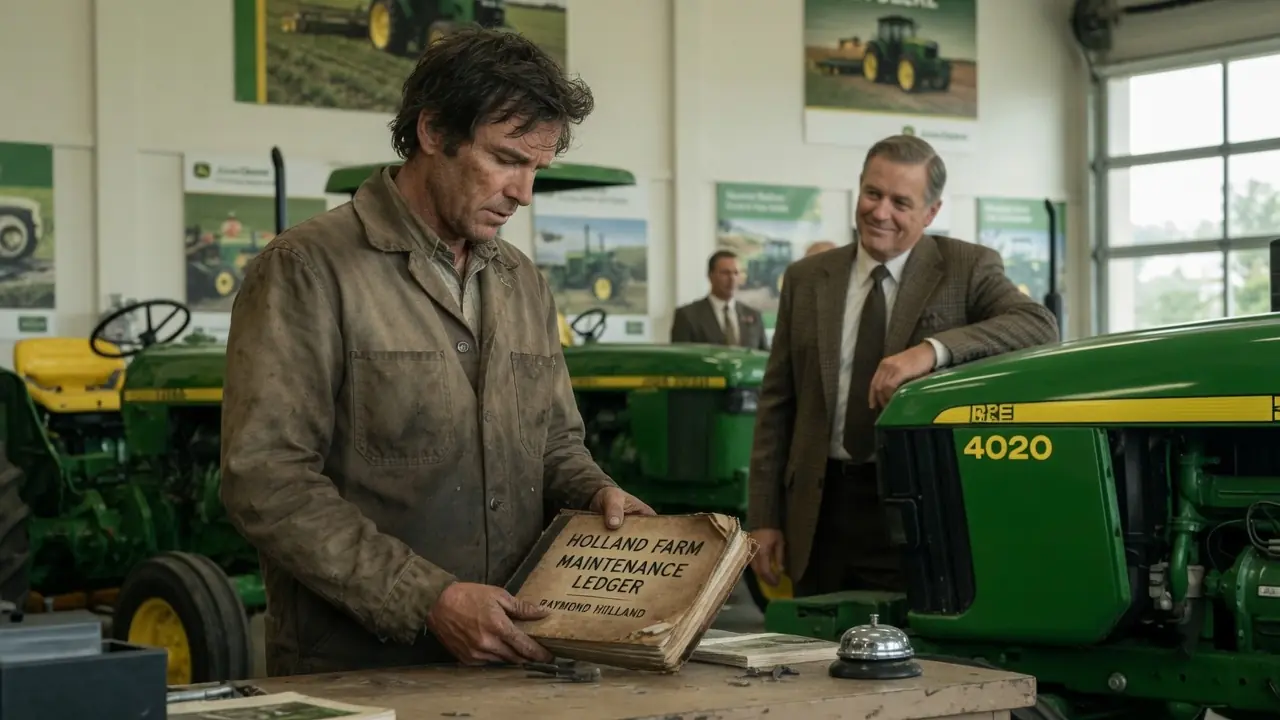
Garrett Holland pushed open the glass door of the Mineral County John Deere dealer with his father’s green maintenance ledger tucked under one arm and three dollars in his pocket. The showroom smelled of new rubber, fresh paint, machine oil, and coffee that had been sitting too long on a hot plate behind the counter. Bright green tractors stood in neat rows beneath hanging dealer signs, their clean hoods shining like promises Garrett could not afford. He paused just inside the entrance, suddenly aware of the grease on his cuffs, the dust on his boots, and the fact that every machine in that room looked newer than the future his father had left him.
His father, Raymond Holland, had been dead for three weeks. Heart attack in the south pasture, the doctor said, though Garrett kept thinking of it less as a medical event and more like the land had finally taken back the man who had given it everything. The funeral had been small, filled with men who said little but shook Garrett’s hand with the quiet pressure of people who knew grief better than comfort. Afterward, Garrett returned to the farm he had left at eighteen and found two tractors waiting in the barn: a John Deere 4020 and a faded blue Ford 5000.
At first, he thought that was the whole inheritance. Two aging machines, a farmhouse with peeling white paint, a barn full of labeled parts, and seven hundred twelve acres that made no sense without the equipment to work them. The bank account held forty-seven dollars and sixteen cents. The land was real, the mortgage papers were real, but so were the men already circling the property like coyotes at the edge of a campfire.
Ed Proser had come first, driving a red Ford pickup too clean for February mud. He offered twelve thousand dollars for the North 80, the parcel bordering his own land, then smiled like he was doing Garrett a favor. “You’re not going to farm that place with museum pieces,” Ed had said. “Your daddy was stubborn, and look where that got him.” Garrett had told him he was not ready to sell, and Ed’s smile vanished just long enough to reveal the hunger beneath it.
Now the John Deere’s transmission was slipping, and Garrett had come to the dealer because pride did not turn gears. The 4020 still started, still pulled, still sounded strong when the engine settled, but the shifts had begun grinding hard enough to make his stomach drop. Raymond’s ledger had a note written in the margin from two summers earlier: transmission rebuild soon, kit needed before harvest. Garrett did not know whether his father had bought that kit, ordered it, or only wished he could.
The parts counter sat at the back of the showroom, where an older man with white hair and square glasses studied invoices under a lamp. His name tag read Warren Hale, and Garrett remembered him vaguely from childhood, a man who always smelled like diesel and peppermint gum. Warren looked up, then down at the ledger, then back at Garrett’s face. “You’re Raymond Holland’s boy,” he said.
“Garrett,” he answered. “I need parts for a 4020 transmission.”
Warren’s expression softened. “Your father kept that machine running longer than most men keep promises.”
Garrett set the ledger on the counter. “It’s slipping bad. I need to know what a rebuild kit costs.”
Before Warren could answer, a laugh came from near the display tractor. Garrett turned and saw Ed Proser leaning against a brand-new John Deere, one boot crossed over the other, one hand resting on the polished green hood like he owned the building. Two salesmen stood nearby, pretending not to listen. Ed’s eyes moved from Garrett’s worn coat to the ledger on the counter and then to the parts shelves behind Warren.
“You came into a John Deere dealer with no money, asking for parts for that old 4020,” Ed said. “You still think your daddy’s rusted machine can save stolen land?”
The showroom went quiet in a way Garrett had already begun to recognize. It was the silence people made when an old rumor walked into the room and everyone pretended it was history instead of cowardice.
Garrett laid one hand flat on the ledger. “My father kept cleaner records with two old tractors than your family kept with forty years of lies.”
Ed’s mouth tightened. He pushed off the tractor and walked closer, boots loud against the polished floor. “Careful, Holland. This county remembers things.”
“So do ledgers.”
Ed leaned over the counter, close enough that Garrett could smell tobacco on his breath. “Sell me the North 80. Walk out with cash before this whole county watches you fail like Raymond did.”
Warren Hale looked sharply at Ed, but Garrett answered first. His voice surprised him with how steady it sounded. “No. Today I rebuild the tractor. And when harvest comes, every acre you called stolen will answer louder than you ever could.”
A salesman near the new cultivators stopped pretending to stack brochures. Warren removed his glasses and wiped them slowly, as if giving the room time to understand that something had shifted. Ed gave a short laugh, but it did not carry the confidence he wanted it to.
“You don’t even know what your father was hiding,” Ed said.
Garrett opened the ledger to a page marked with a faded red string. “I know what he wrote down.”
“Numbers don’t clear a family name.”
“No,” Garrett said. “But they show who was honest enough to keep them.”
Warren turned the ledger toward himself and began reading. The pages were filled with Raymond Holland’s tight handwriting: oil changes, clutch adjustments, tire patches, fuel consumption, yield per acre, seed varieties, field rotations, and repair notes stretching back years. On one page, Garrett had found a list of land parcels with purchase dates and old document numbers. The North 80 had a notation beside it: Ezra purchase, 1941, tax transfer and deed, witnessed by M. Krueger.
Warren’s finger stopped on that line. His face changed.
“What is it?” Garrett asked.
Warren did not answer right away. He looked toward the office door behind the counter, then back at the ledger. “My father owned this dealership before me,” he said carefully. “Before that, it was a machinery and feed office. Folks brought paperwork here sometimes because we had the only safe in town besides the bank.”
Ed’s face lost color so quickly that Garrett saw it before he understood why.
Warren closed the ledger gently. “Garrett, wait here.”
He disappeared into the back office.
No one spoke while he was gone. Garrett could hear a wall clock ticking above the oil filters and the faint buzz of fluorescent lights. Ed shifted his weight once, then folded his arms as if still in control. But his eyes stayed on the office door.
Warren returned carrying a flat metal file box covered with dust. He set it on the counter and opened it with a small key from his pocket. Inside were old dealer invoices, faded envelopes, repair orders, and farm equipment documents tied with brittle string. He removed one envelope marked Holland-Krueger, 1941.
Garrett felt his heart begin to pound.
Warren opened the envelope carefully and pulled out two yellowed pages. “This was left here for safekeeping,” he said. “I remember seeing the name when I cleaned the old records years ago, but I never knew it mattered.”
Ed stepped forward. “That’s private property.”
Warren looked at him coldly. “It’s a witnessed copy of a land sale. If your family wanted privacy, they should not have spent four decades calling another family thieves.”
Garrett stared at the paper as Warren turned it toward him. The document listed Ezra Holland as buyer and Martin Krueger as seller. Eighty acres. Fair price paid in full. Taxes assumed. Witnessed by two men, including Warren’s father. The signature at the bottom was clear, faded but unmistakable.
Martin Krueger had sold the land willingly.
Garrett reached for the counter to steady himself.
The old accusation, the stain that had followed his grandfather, then his father, then him, sat undone beneath the dealer’s fluorescent lights.
Ed stared at the document, jaw clenched. “That doesn’t prove anything about what happened after.”
Warren lifted the second page. “Receipt of payment. Same date. Same parcel. Same signatures.”
The older man’s voice became harder. “Your uncle lied, Ed. Or your family chose to believe the version that made losing land feel better.”
The words hit the room like a hammer on steel. Ed looked toward the salesmen, then back at Garrett, and for once he seemed aware that witnesses were not on his side. Garrett expected triumph to rise in him, but what came instead was grief. His father had spent seventeen years proving with sweat what one forgotten envelope had already known.
Garrett touched the old paper but did not pick it up. “Did my father know this was here?”
Warren’s expression softened. “I don’t think so.”
The answer hurt more than Garrett expected. Raymond had worked seven hundred acres with two old tractors, keeping every receipt, every yield note, every maintenance record, because he believed proof had to be earned season by season. And all along, proof had been sitting in a dusty file box behind a parts counter.
Ed cleared his throat. “I’ll be leaving.”
Garrett looked at him. “You still want the North 80?”
Ed’s face hardened, but the old confidence was gone. “No.”
“Good,” Garrett said. “Because it is not for sale.”
Ed walked out without another word. The glass door swung shut behind him, and the showroom remained silent for a few seconds afterward. Then Warren folded the documents back into the envelope and slid them toward Garrett. “You need copies. Certified if we can manage it. I’ll call the county clerk.”
Garrett nodded, unable to speak. His father’s ledger lay open on the counter beside the old deed, two generations of proof finally meeting in one room. One was legal. One was lived. Both mattered.
Warren tapped the ledger. “Now, about that transmission.”
Garrett swallowed hard. “I don’t have much money.”
“I didn’t ask if you did.”
Garrett looked up.
Warren walked to the back shelf and pulled down a thick parts catalog. “Raymond ordered a rebuild kit two years ago. Paid for it in full. Never picked it up.”
Garrett blinked. “What?”
“It got stored in the back after shipment. I remember because your father said he’d collect it after harvest, then he never came. I should have called again.”
Warren looked ashamed, but Garrett shook his head. “He hid things from everybody.”
“That he did,” Warren said. “But he paid for the kit. It is yours.”
They found the crate in the warehouse behind the dealer, still marked with Raymond Holland’s customer number. Garrett ran his hand across the stenciled letters and felt something inside him tighten. His father had known the tractor would fail. He had prepared for it, quietly, carefully, without saying a word.
Warren loaded the crate into Garrett’s old pickup with the help of one salesman. Then he handed Garrett a service manual with grease on the edges. “This belonged to the shop. Bring it back when you’re done.”
Garrett gave a tired smile. “You think I can rebuild it myself?”
Warren looked at him the way men look at sons when they are trying not to say too much. “Raymond learned because he had to. You can too.”
Garrett drove home with the crate in the truck bed and the deed envelope on the seat beside him. The Kansas wind hit the windshield hard enough to shake the glass, and fields rolled past on both sides, flat and brown beneath the late winter sky. For the first time since the funeral, the farm did not look like a burden waiting to crush him. It looked like a question his father had trusted him to answer.
That night, Garrett sat at the kitchen table and read the deed three times. Then he read Raymond’s ledger until the yellow light over the table blurred. Every number felt different now. Not defensive. Not desperate. Honest.
The next morning, he pulled the John Deere into the barn and began the rebuild. He spread clean tarps on the floor, arranged coffee cans for bolts, and labeled each part the way his father would have. He followed the manual step by step, slower than any professional mechanic, but with the patience of a man who had finally understood the lesson hidden in old iron. Machines did not forgive shortcuts. Neither did land. Neither did reputation.
The work took three weeks. His hands cracked from cold and grease. His back ached from leaning over the frame. Some nights he fell asleep at the kitchen table with the service manual open beneath his elbows. Twice, he thought he had ruined the whole thing and had to walk away before frustration made him careless.
The Ford handled the light field work while the John Deere sat opened in the barn like a patient under surgery. Neighbors drove by slowly, some curious, some disappointed that Garrett had not quit yet. One man stopped and asked if he wanted to sell the broken tractor for parts. Garrett wiped grease from his hands and said, “It is not broken. It is becoming mine.”
By late March, the transmission was back together. Garrett filled it with fresh oil, checked every bolt, and climbed into the seat. The engine turned over, coughed once, then settled into the familiar deep sound that seemed to fill the barn with Raymond’s presence. Garrett pressed the clutch, shifted into gear, and waited for the grind.
None came.
The tractor moved forward cleanly.
Garrett laughed once, breathless and almost shocked by the sound.
That spring, he worked the land the way Raymond’s ledger instructed. Wheat in the north section, milo west, cover crop on the tired ground, careful rotation across the parcels. He learned how the 4020 pulled differently in heavy soil and how the Ford handled lighter work better than pride wanted to admit. He began to understand that his father had not been poor in knowledge, only cash.
The drought came anyway. By May, the sky stayed empty too long. By June, the wheat curled at the edges, and dust lifted from the fields in sheets. Garrett watched the crops struggle and understood why older farmers spoke of weather with both hatred and prayer. The land owed no man fairness.
He irrigated what he could from the creek, dragged hoses in the dark, rationed fuel, and slept in pieces. The old tractors kept running. The 4020 pulled through long days with the rebuilt transmission holding steady, and each time it shifted cleanly under load, Garrett felt his father standing somewhere near the barn door.
He lost acres that year. There was no pretending otherwise. But he did not lose the farm. At harvest, the yield was low but real. The wheat that survived filled the hopper, load by load, and Garrett hauled it to the elevator with dust in his hair and grease under his nails.
Men in town watched him differently after that. Some nodded. Some looked away. The story from the dealer had already spread, carried by salesmen, clerks, and anyone who had heard Ed Proser leave without saying goodbye. The old Krueger accusation had begun to rot in public daylight.
In November, Garrett saw Ed outside the hardware store. Ed looked older, though only one hard season had passed. He stopped Garrett near the door and stood with his hands in his coat pockets.
“Heard you brought in a crop,” Ed said.
“Enough.”
“Heard the 4020 runs clean.”
“It does.”
Ed looked down the street. “My family was wrong about yours.”
Garrett did not answer.
Ed swallowed. “I’m not saying that because it sounds good. I saw the papers. Warren showed copies to the clerk. My uncle spent years repeating a lie because he could not accept that his father sold land he later regretted losing.”
Garrett waited.
Ed finally looked at him. “Your father should have known.”
“Yes,” Garrett said.
“I’m sorry he didn’t.”
Garrett looked toward the grain elevator at the far end of town, then back at Ed. “So am I.”
That was all. No embrace, no grand forgiveness, no easy ending wrapped in apology. But the old grudge cracked that day, and sometimes cracked is where healing begins.
Years passed, and Garrett stayed. He rebuilt the Ford’s engine, paid off the remaining mortgage, and kept both tractors running with the kind of care Raymond had taught through notes instead of conversation. Younger farmers began stopping by to ask how he managed seven hundred acres without drowning in debt. Garrett showed them maintenance logs, crop rotations, and the crate where his father had stored spare parts before he knew his son would come home.
He never replaced the 4020. He could have, eventually. By 1975, there was enough money in the bank to buy newer equipment, but Garrett found he did not want a machine that had not earned its place. The John Deere was more than steel and paint. It was the witness that had survived Raymond’s silence, Ed’s accusation, and Garrett’s doubt.
One evening, years later, Garrett drove the 4020 past the North 80 at sunset. Wheat moved in the field like a slow green tide, and beyond the fence, Proser land began without bitterness. The old rumor no longer lived there. It had been plowed under by deed, ledger, harvest, and time.
Garrett stopped the tractor at the fence line and shut off the engine. The sudden quiet rang in his ears. He climbed down, rested one hand on the warm green hood, and thought of his father standing in that same field alone, carrying a burden he should never have had to carry.
“You were right,” Garrett said softly, though no one stood there to hear him. “The land was worth saving.”
The wind moved through the wheat.
And behind him, the old John Deere waited, ready for another season.