The hallway on the seventh floor of the Marlowe Hotel in downtown Portland, Oregon, was too quiet for what was happening inside my chest.
The carpet was soft under my shoes. The ice machine hummed at the end of the corridor. Somewhere behind a closed door, a television murmured low enough that I could not make out the words.
A housekeeping cart stood near the corner with folded towels stacked in neat white squares, as if the world had not tilted under my feet.
The small American flag outside the hotel entrance still flashed in my mind from when I walked in carrying a dozen red roses like a fool.
I had told myself the whole drive across the Burnside Bridge that I was wrong.
I told myself the hotel confirmation I found on Elena’s tablet was a misunderstanding. I told myself Room 750 was for one of her friends. I told myself the charge on our shared card was innocent. I told myself my wife of eleven years was exactly where she said she was.
A girls’ trip.
That was what she called it.
She said she and three old college friends were spending the weekend in Cannon Beach, eating seafood, drinking wine, walking along the beach, and laughing about life before mortgages, children, parent-teacher meetings, and school fundraisers.
She said she needed a little space to breathe.
She said she loved us, but she wanted one weekend where nobody called her Mom, nobody asked what was for dinner, and nobody needed her to remember which child had soccer practice.
I believed her.
Worse than that, I helped her.
I folded the blue sweater she loved.
I tucked her hairbrush into the side pocket.
I zipped the suitcase while she stood beside me smiling like a woman who had nothing to hide.
Before she left, she kissed my cheek and said, “Don’t wait up, Adrian. I’ll text when we get there.”
She never texted.
At first, I blamed the highway.
Then bad service.
Then excitement.
Then anything except the one thing my mind kept trying to show me.
By midnight, her location still showed Portland.
By morning, it disappeared.
I spent most of Saturday pretending not to know what that meant.
Our kids, Ava and Noah, were at my sister’s house for the weekend. Elena had said the trip would be good for us both. She could reconnect with friends, and I could take the kids to my sister’s place, get a little rest, maybe catch up on things around the house.
She had framed it like a gift to everyone.
I had almost thanked her for being thoughtful.
That is the kind of detail that returns later and cuts deeper than the obvious ones.
The main betrayal is the knife.
The small kindnesses around it are the twist.
My name is Adrian Morales.
I was thirty-nine years old when I stood outside Room 750 holding roses, still hoping I was wrong.
I worked as a civil engineer for a transportation firm in Portland. My job was practical, detailed, and mostly invisible to people unless something went wrong. Bridges, street improvements, drainage plans, traffic flow, structural reports. I had spent my adult life trusting measurements, plans, loads, lines, stress points.
Marriage, I thought, worked the same way.
Build carefully.
Inspect what weakens.
Repair early.
Do not ignore cracks.
But love is not concrete, and some people learn to hide fractures behind fresh paint.
Elena and I had met at a community volunteer event twelve years earlier. She was helping organize school supply donations, bossing around a room full of adults with a clipboard in one hand and a roll of tape in the other. She had long dark hair, sharp brown eyes, and a laugh that made people turn toward her without knowing why.
I fell for her competence first.
Then her warmth.
Then the way she made ordinary rooms feel like something might happen.
We married a year later in a small church outside Beaverton. We bought our townhouse three years after that. Ava came first, then Noah, and suddenly our life became daycare pickups, late-night fevers, grocery runs, mortgage payments, soccer cleats, lost permission slips, and the particular exhaustion of two working parents trying to stay in love while always being tired.
I thought we were still in love.
Maybe not dramatically.
Not like the beginning.
But deeply.
Practically.
The kind of love that knows which side of the bed you prefer and how you take coffee. The kind that remembers to buy the cereal the kids like, checks the tire pressure before a road trip, and says, “Text me when you get there,” because getting there safely still matters.
I did not know Elena had started confusing familiarity with emptiness.
I did not know she had begun telling someone else that I was good but distant.
Reliable but not exciting.
Present but not attentive enough.
The first sign came three months before Room 750, though I did not understand it at the time.
Elena began guarding her phone.
Not obviously.
Not like a guilty person in a cheap movie.
Subtly.
Face down on the counter.
Always in her pocket.
A laugh at a message that vanished when I asked what was funny.
Longer errands.
More work dinners.
More “just tired” evenings when she went upstairs early and stayed awake behind a closed door.
I noticed.
Then I explained it away.
That is how betrayal survives in decent homes.
Not because the betrayed person sees nothing, but because love offers innocent explanations faster than fear can offer ugly ones.
One Thursday night, she came home from a fundraiser almost an hour later than she said she would. I was sitting at the kitchen table with Noah’s science worksheet in front of me and Ava’s hair tie around my wrist because she had asked me to hold it and then forgotten it existed.
Elena came in smelling faintly of rain and perfume.
“You’re up,” she said.
I looked at the clock.
“I was waiting.”
Her smile tightened.
“You didn’t have to.”
“I know. I wanted to make sure you got home safe.”
For some reason, that seemed to bother her.
She took off her earrings and dropped them into the little ceramic bowl by the door.
“I’m not a child, Adrian.”
“I didn’t say you were.”
“You don’t have to monitor me.”
“I wasn’t monitoring you.”
She sighed, the kind of sigh that made me feel as if I had failed a test I did not know I was taking.
“I just had a long night.”
So I let it go.
That became our rhythm.
I let things go.
She called it peace.
Later, I realized she had been counting on that peace to make her secrets comfortable.
Just after lunch that Saturday, a reservation notification appeared on the tablet Elena had left charging in the kitchen.
The Marlowe Hotel.
Room 750.
Two guests.
Late checkout.
I stared at it for so long the screen dimmed in my hands.
The kitchen around me seemed to lose sound. The dishwasher hummed. A clock ticked above the pantry. Somewhere outside, a neighbor’s dog barked twice. Normal life kept moving, rude and indifferent.
I tapped the screen again.
There it was.
Not Cannon Beach.
Not seafood with friends.
Not the rented beach house she had described so casually.
Portland.
Downtown.
Two guests.
Late checkout.
I should have called her.
I should have demanded answers.
I should have taken screenshots, called a lawyer, and stayed calm.
Instead, I bought roses.
I still do not fully understand why.
Maybe because some broken part of me wanted to give the truth one last chance to be kinder than suspicion. Maybe I wanted to walk up to that door and find Elena alone, crying, overwhelmed, needing space but not betraying everything we had built. Maybe I wanted to believe that if I arrived as a husband instead of an accuser, I might receive a wife instead of a stranger.
So I drove downtown with roses on the passenger seat and a speech in my head about forgiveness I was not even sure I believed.
The woman at the flower shop smiled when I bought them.
“Special occasion?” she asked.
I looked at the roses.
“I hope not,” I said.
She laughed because she thought I was joking.
I was not.
When I reached the Marlowe Hotel, my hands were already shaking. The lobby was polished and warm, all marble floors, soft chairs, gold lights, and travelers moving through with weekend bags and paper coffee cups. I had never felt more out of place in my own city.
The front desk clerk greeted me.
“Checking in?”
“No,” I said. “I’m visiting someone.”
He glanced at the roses and smiled politely.
I hated that smile.
The elevator ride took forever.
A couple stood beside me holding hands, talking about dinner reservations. A child in a raincoat pressed every lit button until his mother whispered his name sharply. I stared straight ahead at the silver doors and watched my reflection hold flowers like hope had become embarrassing.
When the elevator opened on the seventh floor, the hallway seemed too long.
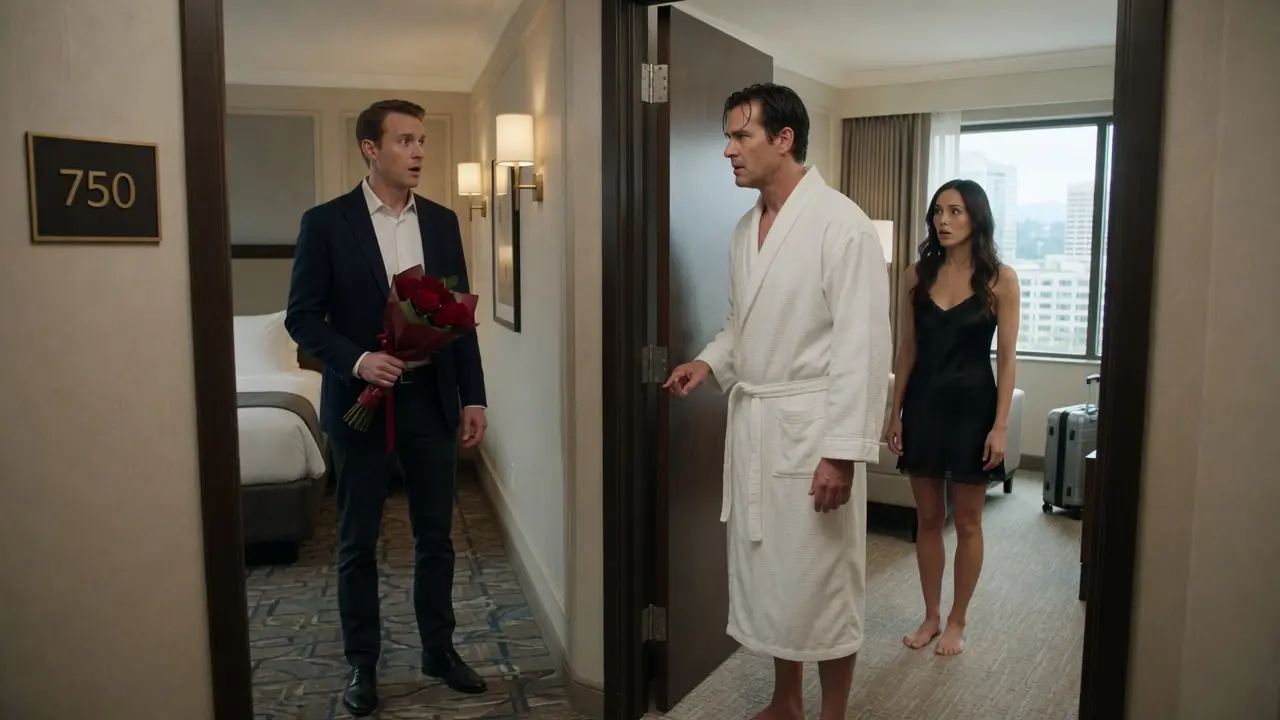
Room 750 was at the far end.
I walked slowly.
The numbers on the doors passed in order.
Then 750.
I stood outside it for almost a full minute before knocking.
Once.
Then again.
There was movement inside.
A low male voice.
A laugh that was not Elena’s.
Then the lock clicked.
The door opened, and a barefoot man in a white hotel robe looked at me like I was the interruption.
He was not surprised enough.
That was the first thing I noticed.
Not the robe.
Not his damp hair.
Not the careless confidence in his face.
He was not surprised enough to see a stranger holding roses outside that room.
His name, I would learn later, was Ryan Pierce.
At that moment, he was simply the man standing where my wife’s loyalty should have been.
He was probably early forties, taller than me, with wet dark hair combed back by his fingers and a narrow silver watch on his wrist. He had the look of someone who believed he could talk his way out of anything if given thirty seconds and a mirror.
Before I could speak, Elena’s voice floated from the bathroom, light and familiar and careless enough to cut through me.
“Babe, did you order room service?”
The man’s expression changed.
Only then.
Only when he realized I was not hotel staff.
Only when he understood the roses were not part of the evening.
I looked past his shoulder.
There, near the foot of the bed, stood the suitcase I had packed with my own hands. The blue sweater was folded over the handle. The tiny luggage tag still had our home address in Beaverton written on it.
For a second, everything inside me went silent.
Then I lowered the roses.
My voice came out calmer than I felt.
“Tell Elena her husband is here.”
Ryan stepped back like he suddenly remembered doors could become traps.
Inside the bathroom, the water turned off.
For the first time since she left for her so-called girls’ trip, my wife had nowhere left to hide.
The room smelled of hotel soap, wine, and betrayal.
There were two glasses on the desk.
One half empty.
One with lipstick on the rim.
Elena’s black shoes were near the bed. A man’s dress shirt hung over the back of a chair. Her phone was charging on the nightstand. My wife’s purse lay open beside it, the same purse she had carried when she kissed Ava and Noah goodbye on Friday afternoon.
I stood in the doorway because I refused to step fully inside.
That mattered to me, though I did not know why at the time.
Maybe some part of me understood that the room belonged to their lie. I would not enter it as if I were a guest.
Elena appeared from the bathroom wrapped in a towel.
Her hair was wet.
Her face was bare.
Her eyes met mine, and the color drained from her skin so quickly I thought she might fall.
“Adrian.”
Just my name.
Not an explanation.
Not an apology.
Just my name, as if saying it might rewind the last five seconds.
I held up the roses slightly.
“I brought these.”
Her eyes dropped to them.
Then to the suitcase.
Then back to me.
“Adrian, I can explain.”
I almost smiled.
That sentence belongs in every betrayal because people reach for it before they understand what it demands.
Explain.
Not excuse.
Not delay.
Not soften.
Explain.
I looked at Ryan.
“Does he know I packed that suitcase?”
Ryan swallowed.
Elena clutched the towel tighter.
“Please don’t do this here.”
“Where would you prefer?” I asked. “The beach house that doesn’t exist?”
She flinched.
Ryan finally spoke.
“Look, man, this is between you two.”
I turned to him.
“No. It became between us when you opened the door wearing a hotel robe in a room paid for with my shared credit card.”
His jaw tightened, then loosened. Men like Ryan know when another man is not bluffing. I was not yelling. That made him careful.
“I didn’t know everything,” he said.
Elena turned sharply.
“Ryan.”
There it was.
His name.
Ordinary.
Known.
A name she had probably typed hundreds of times while sitting beside me on the couch.
I looked at her.
“Ryan.”
She closed her eyes.
“How long?”
Her mouth trembled.
“Adrian…”
“How long?”
She looked toward Ryan as if he might help.
He did not.
“Six months,” she whispered.
The hallway seemed to tilt behind me.
Six months.
Half a year.
Half a year of goodnight kisses.
School pickups.
Bills paid.
Conversations about summer camps.
Grocery lists.
Her hand in mine at Noah’s birthday party while Ryan existed somewhere in her phone, waiting.
“Was Cannon Beach ever real?”
She looked down.
“No.”
“Were your friends ever part of this?”
“No.”
I nodded.
“Do they know you used them?”
She did not answer.
“Of course.”
I placed the roses on the small table just inside the door.
Not gently.
Not dramatically either.
I simply set them down.
“They’re for the woman I thought I was married to.”
Elena began crying.
“Please, Adrian. Let me get dressed. We can talk.”
“No.”
Her head lifted.
“No?”
“No. We are not having the first honest conversation of our marriage in his hotel room.”
Ryan muttered, “I should leave.”
I looked at him.
“Yes. You should.”
Elena snapped, “Ryan, wait.”
That hurt more than I expected.
Even then.
Even in front of me.
Her first instinct was to keep him from leaving.
Not to reach for me.
Not to explain.
Not to apologize.
To keep him.
Ryan looked between us, then grabbed his clothes from the chair and disappeared into the bathroom. A few minutes later, he came out dressed badly and fast, shoes in one hand, hair still damp. He would not look at me as he passed.
But I looked at him.
“Did you know she had children?”
He stopped.
Elena made a small sound.
Ryan’s face told me the answer before he spoke.
“She said things were complicated.”
That phrase should be banned from the mouths of cowards.
“Names,” I said.
“What?”
“Do you know their names?”
He looked at Elena.
Then back at me.
“No.”
I laughed once.
It was not humor.
“My daughter is Ava. She is nine. My son is Noah. He is seven. Their mother told them she was going to the beach.”
Ryan looked genuinely uncomfortable then.
Good.
“Leave,” I said.
He did.
The door closed behind him.
Elena and I stood in the silence he left behind.
For a few seconds, I could hear the plumbing in the walls and the low murmur of traffic seven floors below.
She sat on the edge of the bed, still wrapped in the towel.
“I’m sorry,” she whispered.
I looked at the suitcase.
The blue sweater.
The luggage tag.
The proof of my own trust standing in the middle of the room.
“You let me pack for this.”
She covered her face.
“I know.”
“You stood in our bedroom and watched me fold that sweater.”
“I know.”
“You kissed our children goodbye.”
Her shoulders shook.
“I know.”
“No,” I said. “You knew then. You know now only because I’m standing here.”
She looked up, crying harder.
“It wasn’t supposed to happen this way.”
That was the first true thing she said.
Not because she regretted the affair.
Because she regretted the discovery.
I took out my phone and photographed the room.
The suitcase.
The glasses.
The roses.
The reservation screen still visible on her tablet because I had taken a picture before leaving home.
Elena stood quickly.
“What are you doing?”
“Documenting.”
Her face changed.
Fear replaced tears for a second.
“Adrian, don’t.”
“That reaction tells me I should.”
“This is private.”
“No. Private is a conversation between spouses. This is deception using marital money and a fake story involving our children.”
She stepped toward me.
“Please.”
I stepped back.
“Get dressed. Come home tomorrow or don’t. I will be at the house tonight packing some things for the kids. Do not show up while I am there unless you want this conversation to continue in front of my sister.”
Her eyes widened.
“You told Camila?”
“Not yet.”
“You don’t have to.”
“I know.”
That frightened her more than if I had threatened it.
Because I was no longer asking permission to respond.
I turned to leave.
“Adrian.”
I stopped but did not turn around.
“I still love you.”
Those words nearly broke something in me.
Not because I believed them.
Because I remembered when I did.
I looked back.
“No, Elena. You love what you thought I would never find out.”
Then I walked out of Room 750.
The elevator ride down felt longer than the climb up.
This time, I was alone.
No couple.
No child pressing buttons.
No illusion that I might still be wrong.
I stepped into the lobby carrying nothing. The roses stayed upstairs. I had bought them for hope, and hope had no use for them anymore.
Outside, Portland rain fell steadily over the hotel entrance. People hurried past under umbrellas. Cars hissed along the wet street. The American flag moved in the wind above the entrance, bright under the lights.
I stood beneath the awning for a moment, breathing like someone who had just reached the surface of deep water.
Then I called my sister.
Camila answered on the second ring.
“Hey. Everything okay?”
I tried to speak.
No sound came.
Her voice changed immediately.
“Adrian?”
I swallowed.
“I need you to keep Ava and Noah one more night.”
“What happened?”
I looked back through the hotel glass, toward the elevators, toward the seventh floor.
“Elena lied about the trip.”
Silence.
Then Camila said softly, “Oh, Adrian.”
That was all it took.
The first tear fell.
I wiped it away angrily.
“I can’t do this right now.”
“You don’t have to do all of it right now. Just tell me what you need.”
“I need the kids safe.”
“They are. They’re watching a movie with Mateo. They think it’s a sleepover.”
“Good.”
“Do you want to come here?”
I looked at my car.
Then at the hotel.
“No. I need to go home first.”
“Adrian, do not do anything reckless.”
“I won’t.”
“I mean it.”
“I know.”
“Then come here after.”
I closed my eyes.
“Okay.”
The drive home blurred.
I crossed the Burnside Bridge again, the city lights broken across the river. Hours earlier, I had crossed it with roses and a speech about forgiveness. Now I crossed it with evidence on my phone and a marriage ending behind me.
Our townhouse in Beaverton looked warm when I arrived.
That almost angered me.
Porch light on.
Curtains drawn.
Ava’s sidewalk chalk still faintly visible near the front steps.
Noah’s scooter tipped beside the garage.
Inside, the house smelled like laundry detergent and the lavender candle Elena liked to burn after cleaning. The kitchen was exactly as we had left it. Two coffee mugs in the sink. A drawing from Noah on the fridge. Ava’s spelling list under a magnet shaped like a strawberry.
A home does not know betrayal has entered it.
It keeps holding your things until someone decides what must be removed.
I went upstairs.
The bedroom looked normal. Elena’s side of the bed was neat. Her jewelry tray sat on the dresser. A framed photo from our tenth anniversary trip to Bend stood near the lamp. In the photo, we were laughing in front of a waterfall, my arm around her shoulders, her face turned toward mine.
I took the frame down and set it face down in the drawer.
Then I began packing.
Not angrily.
Carefully.
Clothes for Ava.
Clothes for Noah.
Their school bags.
Favorite pajamas.
Ava’s stuffed fox.
Noah’s dinosaur book.
Medication.
Chargers.
Documents from the file cabinet.
Passports.
Birth certificates.
Mortgage papers.
Recent bank statements.
My hands stayed steady.
That frightened me a little.
When I finished, I sat on the edge of our bed and listened to the quiet.
There is a kind of silence that belongs to peace.
This was not that.
This silence was evidence.
At midnight, Elena called.
I let it ring.
She called again.
Then texted.
Please answer.
I need to explain.
I made a mistake.
Please don’t tell the kids.
I looked at the last message for a long time.
Please don’t tell the kids.
Not Are they okay?
Not I am ashamed.
Not I know I hurt them too.
Please don’t tell the kids.
Even then, part of her was managing the story.
I replied with one sentence.
We will speak through a counselor or an attorney. Do not come to the house tonight.
She called immediately.
I turned the phone off.
Then I drove to Camila’s house.
My sister met me at the door in sweatpants and an old University of Oregon hoodie. She took one look at my face and pulled me into a hug.
I did not cry loudly.
Just enough that my body stopped pretending it had not been hit.
Ava and Noah were asleep upstairs in the guest room. I stood in the doorway looking at them. Ava curled on her side, one hand under her cheek. Noah sprawled sideways, half off the blanket, mouth open.
They looked so small.
That was when anger finally arrived fully.
Not for me.
For them.
For the fact that Elena had taken something adult and selfish and laid it like a crack beneath their childhood.
Camila stood beside me.
“What are you going to do?”
“I don’t know.”
“Yes, you do.”
I looked at her.
“You’re going to protect them,” she said. “And yourself. In that order.”
I nodded.
The next morning, Elena came to Camila’s house.
I had told her not to.
She came anyway.
That told me something important.
She knocked at 8:10, wearing jeans, a sweater, and swollen eyes. She looked exhausted, frightened, and smaller without the secrecy that had been holding her up.
Camila opened the door but did not let her in.
“Elena.”
“I need to see Adrian.”
“He said not here.”
“My children are here.”
“They are asleep.”
“They’re my children.”
Camila’s expression hardened.
“Then you should have thought of them before lying about a girls’ trip.”
Elena flinched.
I came to the door before Camila said more.
“Do not wake them,” I said.
Elena’s eyes filled.
“Adrian, please. I need to talk to you.”
“Not here.”
“Then where?”
I stepped onto the porch and closed the door behind me.
The morning air was cold.
“Elena, answer one question.”
She nodded quickly.
“Was Ryan the only one?”
Her face froze.
That was answer enough.
My stomach dropped anyway.
“Who else?”
“No one else. I mean…”
I stared at her.
“It wasn’t like that.”
I laughed once.
Quietly.
“I am learning that when you say that, it means it was exactly like that but worse in a different category.”
She began crying.
“Ryan was the only physical affair.”
“How long was the emotional part?”
She looked down.
“Almost a year.”
Almost a year.
While I packed lunches.
Paid bills.
Sat through school events.
Took Noah to urgent care when he had a fever.
Helped Ava build a cardboard model of the solar system.
Slept beside a woman who had already begun giving parts of herself to someone else.
“Did your friends know?”
“No.”
“Did you use their names before?”
Silence.
“Elena.”
“Yes.”
I looked away.
The neighborhood was waking up. A man walked a dog across the street. Someone’s garage door opened. Ordinary Saturday sounds, surrounding a conversation that would divide the rest of my life.
“You need to leave,” I said.
“Please don’t do this.”
“I am not doing this. I am responding to what you did.”
“I love you.”
“You said that last night.”
“Because it’s true.”
“No. It may be a feeling you have. But love is not just what you feel when consequences arrive.”
She reached for my hand.
I stepped back.
“Do not touch me.”
Her face crumpled.
“I made a mistake.”
“No,” I said. “A mistake is getting lost on the way to Cannon Beach. You booked a hotel in Portland, packed a suitcase I helped you zip, lied to our children, stayed with a man, and called him babe while I stood outside the door holding roses.”
She covered her mouth.
I continued.
“You do not get to shrink that into a mistake because the full size makes you ashamed.”
She sobbed then.
I let her.
Not to punish her.
Because comforting her was no longer my job.
That afternoon, I contacted an attorney.
Her name was Diane Moretti, recommended by Camila’s husband, Mateo. Diane had a calm voice, precise questions, and no tolerance for emotional fog pretending to be strategy.
“Do you want reconciliation or protection?” she asked.
The question caught me off guard.
“I don’t know.”
“Then we begin with protection. Reconciliation without protection can become surrender.”
I sent her the screenshots, reservation notice, photos from the room, and bank records. She advised me not to drain accounts, not to block Elena from seeing the children, not to post anything publicly, and not to allow private conversations without documentation.
“Infidelity is painful,” she said. “But custody, finances, and stability will matter more in the next thirty days than your anger.”
“My anger is not the problem.”
“No,” she said gently. “But it will be used against you if you mishandle it.”
That sentence stayed with me.
I became careful.
Elena became frantic.
Over the next week, she moved between apology, explanation, panic, blame, and bargaining.
She said she felt lonely.
She said motherhood had swallowed her identity.
She said Ryan made her feel seen.
She said I was a good man but had stopped noticing her.
She said she never meant to hurt the kids.
She said she had planned to end it after the weekend.
Then she said she had not known how to end it.
Then she said Ryan pressured her.
Then she said she loved him only in a confused way.
Each version contradicted the last.
That was how I knew none of them were the full truth.
Ryan disappeared quickly.
The moment Elena’s marriage became real rather than theoretical, his devotion began to thin. He sent her a message she later showed me while trying to prove she had been manipulated.
I can’t be involved in your family drama. You said you had things handled.
There it was.
You said you had things handled.
I was apparently the thing she had promised to manage.
Not husband.
Not father of her children.
Obstacle.
Practical matter.
Eventually, Elena admitted Ryan worked with a nonprofit consulting group her company had hired. They met at a fundraiser, started messaging, then lunches, then drinks, then hotel rooms. He knew she was married. He knew she had children. He did not know their names because he had not cared to ask, and she had not cared enough to make that matter.
That detail became one of the hardest for me to forgive.
Not that he did not know Ava and Noah.
That Elena allowed a man into her life deeply enough to break their home while keeping her children abstract enough for him not to feel guilty.
The first conversation with the kids happened in Diane’s office, with a family counselor present.
Elena and I sat side by side but not close.
Ava looked between us immediately.
She knew something was wrong.
Noah held his dinosaur book on his lap and kicked his feet against the chair.
The counselor, Dr. Helen Park, spoke gently.
“Your parents are going through a very hard time, and for a while, they will not be living together in the same way.”
Ava’s eyes filled.
“Are you getting divorced?”
Elena made a small sound.
I looked at my daughter.
“We don’t know everything yet. But things are changing.”
“Did we do something?”
“No,” I said firmly. “Never.”
Noah looked confused.
“Is Mom in trouble?”
Elena began crying.
I closed my eyes briefly, then opened them.
“Mom and Dad are dealing with grown-up problems,” I said. “You are loved. You are safe. That part does not change.”
Ava looked at Elena.
“Were you really at the beach?”
The room went still.
Elena covered her face.
I answered because silence would have been another lie.
“No.”
Ava’s face changed.
Not fully understanding.
Understanding enough.
Noah asked, “Then where were you?”
Elena whispered, “I was in Portland.”
“Why did you say beach?”
Elena cried harder.
Dr. Park stepped in gently, but the damage had already entered the room.
Children do not need details to understand trust has been broken.
They feel the floor move.
For months afterward, Ava became quiet. Too quiet. She checked my location when I went to the grocery store. She asked Elena where she was going even when the answer was simple. Noah became clingy, especially at bedtime. He would ask, “Are you going to be here in the morning?” even when I had nowhere else to be.
That was the part I wish Elena had seen before Room 750.
Not my pain.
Theirs.
The divorce did not happen immediately.
For three months, we tried structured separation. Elena moved into a short-term rental near the kids’ school. We attended counseling separately. Then together twice. She claimed she wanted to repair the marriage. I wanted to believe repair was possible because accepting the end felt like stepping off a ledge.
But every time I looked at her, I saw the hotel door.
The robe.
The suitcase.
The roses.
And heard her voice from the bathroom.
Babe, did you order room service?
Memory can be cruelly specific.
During our second joint session, Dr. Park asked Elena, “What do you believe Adrian lost?”
Elena said, “Trust.”
The answer was not wrong.
Only too small.
I looked at her and said, “I lost the version of my life where packing your suitcase was an act of love instead of evidence.”
Elena broke down.
I did not comfort her.
That was when I knew.
Divorce became less a decision than an admission.
The marriage had ended before I knocked on the door. Room 750 had only shown me where.
Diane filed the paperwork in January.
The process was painful but not vicious. Elena did not fight custody aggressively. I think even she understood the children needed stability more than she needed control. We agreed to shared custody with the kids primarily in the townhouse during the school year. Elena took an apartment ten minutes away.
The townhouse remained mine after refinancing and settlement.
Not because I wanted to win.
Because Ava and Noah needed one place that still felt like home.
Elena cried the day she moved her last boxes out.
The blue sweater was in one of them.
I saw it folded on top.
For one second, I hated that sweater more than any object deserved.
Then I turned away.
Some things do not need symbolic destruction.
They only need removal.
The first year after divorce was not heroic.
I did not become instantly stronger.
I did not start running marathons or rebuild myself through dramatic speeches. I learned to cook five meals the kids would eat. I learned which mornings Ava needed silence and which mornings Noah needed jokes. I learned how to braid hair badly, then better. I learned that grief comes in waves even when you are sure you made the right choice.
Some nights, after the kids were asleep, I sat in the kitchen and stared at the place where Elena used to stand while telling stories about her day.
I missed her.
That truth embarrassed me at first.
Then my counselor told me missing someone does not mean they were safe.
That helped.
Camila helped too.
So did Mateo.
So did time, though I dislike saying that because time alone heals nothing. Time only gives you room to do the work without bleeding through every shirt.
There were hard mornings.
The first Christmas after the separation, Ava asked if we could still use the ornaments Elena had bought.
I said yes.
Then I went into the garage and stood there for five minutes because the box of ornaments had Elena’s handwriting on it.
Kitchen lights.
Silver stars.
Kids’ handmade ones.
Her writing was still part of the house.
Noah made a paper angel at school and asked if he should make one for Mom’s apartment too.
I said yes.
Then I helped him glue the wings on straight.
There were parent-teacher conferences where Elena and I sat in chairs too small for adults, pretending not to notice how strange it was to discuss spelling tests and reading levels while our family existed in two separate homes.
There were custody exchanges in parking lots that felt polite and awful.
There were birthday parties where we both sang and neither of us looked at each other during the word dear.
There were nights when Noah forgot his favorite pajamas at Elena’s and sobbed like the missing fabric represented everything he could not name.
There were moments when Ava said something sharp to her mother, then looked guilty immediately, because children often punish the parent who feels safer to wound.
Elena took it.
Sometimes she cried afterward.
Sometimes she called me from her car and said, “I don’t know how to fix what I did to them.”
And I would say, “You don’t fix it by asking them to stop hurting. You fix it by becoming consistent enough that the hurt has somewhere safe to land.”
I do not know where those words came from.
Maybe from my own counselor.
Maybe from exhaustion.
Maybe from the part of me that was learning fatherhood after betrayal was mostly about becoming steady without becoming hard.
Elena changed too, though not quickly.
She stayed in counseling. She apologized to Ava and Noah in age-appropriate ways without blaming me, Ryan, stress, or loneliness. She showed up on time. She answered the phone when the children called. She stopped asking me to reassure her that she was still a good mother and started proving she intended to become a better one.
That mattered.
It did not restore our marriage.
It helped restore some peace around the children.
Two years after Room 750, Ava had a school concert.
She was eleven then, standing on a riser in a white blouse and black skirt, singing with a seriousness that made me proud and sad. Noah sat beside me, fidgeting with the program. Elena sat on his other side.
We were not together.
But we were present.
After the concert, Ava ran to us, flushed and happy.
“Did you hear the high note?”
“I heard it,” I said.
“It was almost good.”
“It was fully good,” Elena said.
Ava smiled at both of us.
For the first time in a long time, I saw her receive love from both sides without bracing for impact.
That felt like progress.
Outside the school, Elena stopped me near the parking lot.
“Adrian.”
I looked at her.
She seemed nervous but calm.
“I wanted to tell you something. Not to change anything. Just because I should have said it clearly a long time ago.”
I waited.
“What I did was not because you failed to love me. I told myself that for a while because it made me feel less selfish. But you loved me. You loved our family. I wanted attention without consequences, and I made all of you pay for it.”
The cold air moved between us.
I did not know what to say at first.
Then I said, “Thank you for telling the truth.”
She nodded, eyes shining.
“I am sorry about the suitcase.”
That detail.
Of all details, she chose the right one.
I looked away.
“So am I.”
“I think about it often,” she said. “You packing for me. Me letting you.”
I nodded once.
“That was the part that taught me how far away you already were.”
She accepted that without defense.
That was new.
“I hope you’re happy someday,” she said.
“I’m getting there.”
She smiled sadly.
“Good.”
We walked to our separate cars.
Not forgiven fully.
Not restored.
But no longer standing inside the first explosion.
Three years after the divorce, I went back to downtown Portland for a work conference.
The closing reception was held two blocks from the Marlowe Hotel.
I saw the sign from across the street.
For a moment, my body reacted before my mind did. Heart quickening. Hands tightening. A brief flash of hallway carpet, roses, a white robe, Elena’s voice.
I stood under a streetlight and let the feeling pass.
Then, because healing sometimes requires strange little acts of defiance, I walked into the hotel lobby.
It looked almost the same.
Marble floors.
Soft chairs.
Gold lights.
Travelers moving through with bags and coffee.
The front desk clerk was different. Of course he was. The building had no memory of me. Only I did.
I did not go to the seventh floor.
I did not need to.
Instead, I sat in the lobby for ten minutes and ordered coffee from the small bar.
A woman nearby laughed at something on her phone. A couple checked in with a sleepy toddler. A man in a suit argued quietly about a reservation.
Ordinary life.
That was all it was now.
A hotel.
Not a shrine to betrayal.
Not a room that owned me.
Just a hotel.
When I left, I passed a flower cart near the corner.
Red roses in a bucket.
I stopped.
The vendor looked up.
“Need flowers?”
I almost said no.
Then I bought a single white rose.
Not for Elena.
Not for the marriage.
For the man who had stood outside Room 750 holding a dozen red ones, still hoping he was wrong.
He deserved something gentler than humiliation.
I carried the white rose back to my car and set it on the passenger seat.
Years earlier, that seat had held a dozen roses and my last argument with denial.
Now it held one flower and silence that did not hurt.
That night, Ava called to ask if she could dye the ends of her hair blue.
Noah texted me a picture of a Lego spaceship that looked structurally unsound.
Life had moved forward.
Not perfectly.
Not without scars.
But forward.
Ava eventually stopped checking my location every time I left the house.
Noah eventually stopped asking if I would be there in the morning.
Elena and I became the kind of co-parents who could sit beside each other at school events without making the children feel responsible for our history.
That was not the ending I had wanted when I married her.
But it was better than teaching my children that love meant swallowing lies to preserve appearances.
One summer evening, five years after Room 750, Noah found an old photo album in the closet and brought it downstairs.
He was twelve then, tall for his age, still curious in the way that made him ask questions at inconvenient times.
“Dad,” he said, turning a plastic-covered page, “do you ever get sad when you look at these?”
I looked over.
It was a photo from the beach when Ava was four and Noah was two. Elena sat in the sand holding him, laughing as Ava tried to bury my feet with a plastic shovel.
“Yes,” I said.
Noah looked up.
“Because of Mom?”
“Because that day was real.”
He frowned slightly.
“I thought you’d say because it was fake.”
“No,” I said, sitting beside him. “That’s the hard part. Good memories don’t become fake because something bad happened later. They stay good. They just hurt differently.”
Noah considered this.
Then he nodded slowly.
“Do you hate her?”
“No.”
He looked surprised.
“Really?”
“Really.”
“Why not?”
I looked at the photo for a long time.
“Because hate would keep me living in the worst part of the story. I don’t want to live there anymore.”
Noah leaned against my shoulder.
We sat like that quietly, the photo album open between us, the past no longer sharp enough to cut through everything.
I used to think the worst moment of my life was when the barefoot man opened the door.
It was not.
The worst moment was hearing Elena’s voice from the bathroom, casual and bright, calling another man babe while my roses hung uselessly in my hand.
That was the second I understood betrayal was not only what people do in secret.
It is how carelessly they live inside the secret while you are still loving them in the open.
But I survived that moment.
I walked out of that hotel.
I protected my children.
I told the truth carefully.
I lost a marriage, but not myself.
And years later, I can say this without my voice breaking:
I was not a fool because I bought roses.
I was a husband making one last offering to the life I believed I had.
The fact that Elena did not deserve them does not make the love behind them shameful.
It only makes the truth clearer.
I stood outside Room 750 holding roses, still hoping I was wrong.
A barefoot man opened the door.
My wife’s voice called from the bathroom, “Babe, did you order room service?”
I looked past him, saw the suitcase I had packed for her girls’ trip, and said, “Tell Elena her husband is here.”
That was the day my marriage ended.
But it was also the day I stopped helping a lie carry my name.