Officer Thomas Ryker held the bag beneath the patrol lights and told David Caldwell that his career was over. By morning, the arrest photograph was on television, the police union was demanding answers, and David had been placed on leave from the office where he prosecuted men like Ryker. The officer believed he had controlled every angle of the search. He had forgotten that somebody else had been standing beside him.
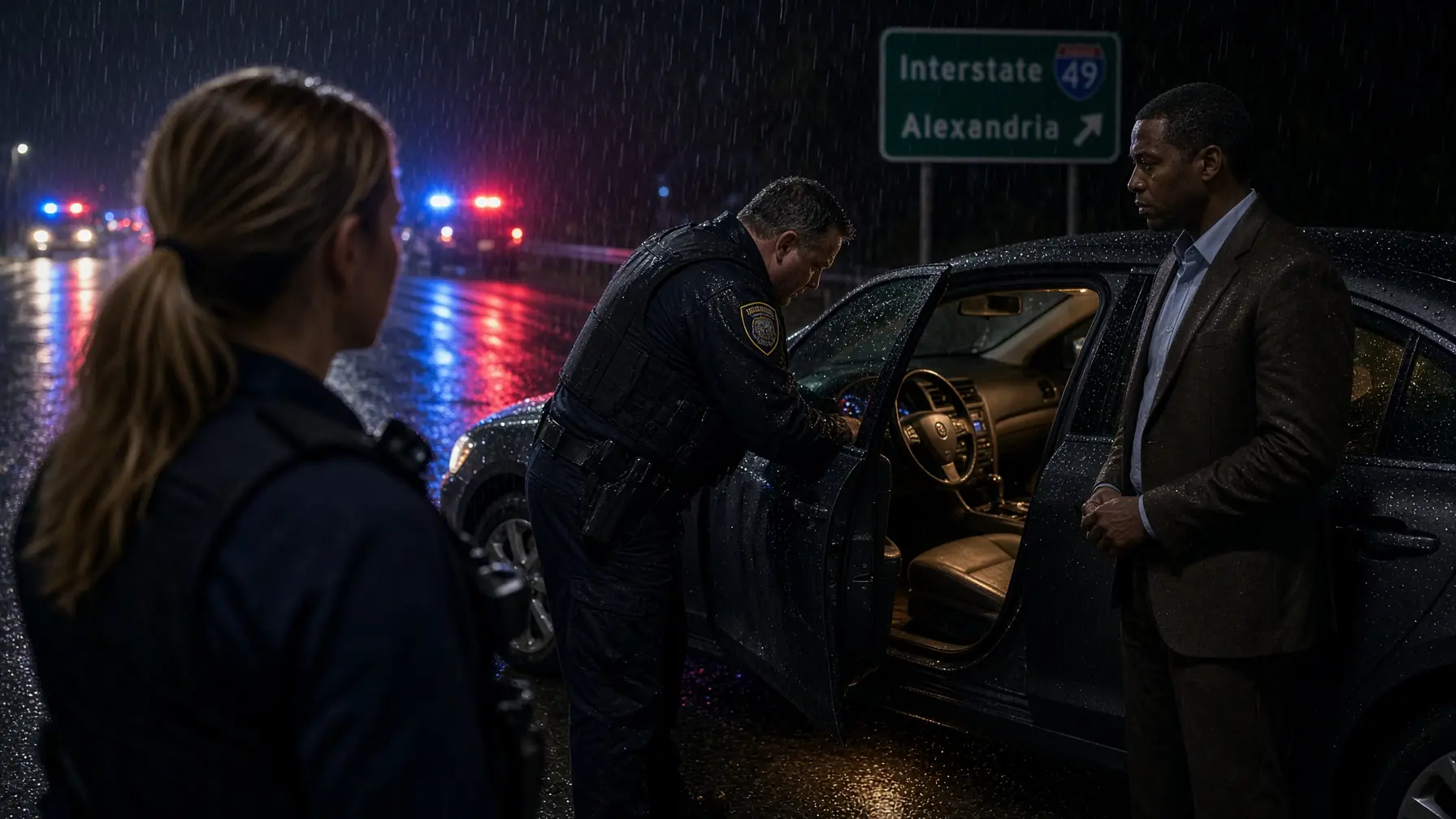
The rain struck David’s windshield hard enough to make the highway seem smaller than it was.
Beyond the reach of his headlights, Interstate 49 disappeared into darkness. Water gathered in shallow depressions and flashed silver as his sedan passed over them, while the wipers moved at their highest setting without quite clearing the glass.
He had left work after midnight.
Again.
A folder sat on the passenger seat beneath his coat, its edges worn from being opened too many times. He had spent the evening comparing statements that should have agreed and did not.
One officer had described a search beginning before another officer arrived. A separate report placed both men at the scene from the start. The discrepancy looked minor until it was set beside the camera timestamps.
Then it became a question neither report answered.
David had written that question down before leaving.
At thirty-four, he had developed a reputation for asking questions people preferred not to hear. In Monroe County, some officers called him relentless. Others used less flattering words.
For fourteen months, he had been building cases against the Seventh Precinct narcotics unit.
Perjury.
Extortion.
Evidence tampering.
Civil rights violations.
Three officers had lost their badges after he stopped treating police reports as unquestionable accounts and began examining them as sworn statements that could contain lies.
He had not enjoyed discovering the lies.
That was something his critics never seemed to understand.
A dishonest officer did more than compromise one prosecution. He damaged every case he touched, every witness who relied on him, and every person whose word might later be measured against his.
David wanted evidence he could stand behind.
The work had made him one of the county’s most feared prosecutors.
It had also made him unpopular in places where people believed a badge should settle an argument.
He glanced at the dashboard clock, then back at the road.
Home was not far now.
Two lights appeared in his mirror.
At first, he thought another vehicle was approaching quickly through the rain. Then red and blue flashed against the rear window.
An unmarked police car.
David lifted his foot from the accelerator.
He checked the lane ahead, signaled, and moved toward the shoulder without making a sudden correction. The rain had softened the edge of the pavement into a dark strip of water and gravel.
He stopped where the road was wide enough.
The police vehicle stopped behind him.
David put the sedan in park.
Before anyone reached the door, he switched on the dome light. Then he lowered every window and placed both hands firmly on the steering wheel.
Rain entered immediately.
It dotted the inside of the door, cooled his sleeve, and began darkening the shoulder of his suit.
He left the windows down.
He wanted the interior visible.
He wanted his movements visible.
And when the officer approached, he announced what he had done.
“The engine is off. My hands are on the wheel.”
The flashlight beam crossed the dashboard, the passenger seat, and his face.
Then David recognized the man holding it.
Thomas Ryker.
Twenty years in the Seventh Precinct.
Two of David’s convictions had involved officers Ryker called his brothers.
David knew that because Ryker had said it outside a courtroom, loud enough to be heard by people standing several feet away.
The officer stopped at the window.
“Long night, Caldwell?”
David kept his eyes on him.
“Officer Ryker.”
“Been working late?”
“Why was I stopped?”
Ryker angled the flashlight toward the wet roadway.
“Drifting between lanes.”
“I stayed in my lane.”
“That’s not what I saw.”
David looked through the windshield.
The rain was severe, but he had been attentive to the lane markings. He had driven the last several miles more slowly than usual precisely because visibility was poor.
He could not know every thought in Ryker’s head.
He knew enough about their history to understand that the encounter was unlikely to remain about lane position.
“Is your camera recording?” he asked.
Ryker smiled slightly.
“You worried about cameras?”
“I’m asking whether this is being recorded.”
A second officer approached the passenger side.
She was younger, her uniform still carrying the careful look of someone who had not yet stopped checking every detail before a shift. A body camera sat high on her chest.