“Cover that trash before I rip your inspection badge off myself.”
The words cut across the Texas motor pool louder than the hydraulic tools whining inside the maintenance bay. Major Brent Cavanaugh, forty-four, broad-shouldered and sunburned beneath a shaved head, stood less than a foot from Rebecca Hale, pointing directly at the faded tattoo exposed beneath the sleeve of her gray polo shirt. Two younger soldiers behind him had been smiling only seconds earlier, but neither looked amused anymore.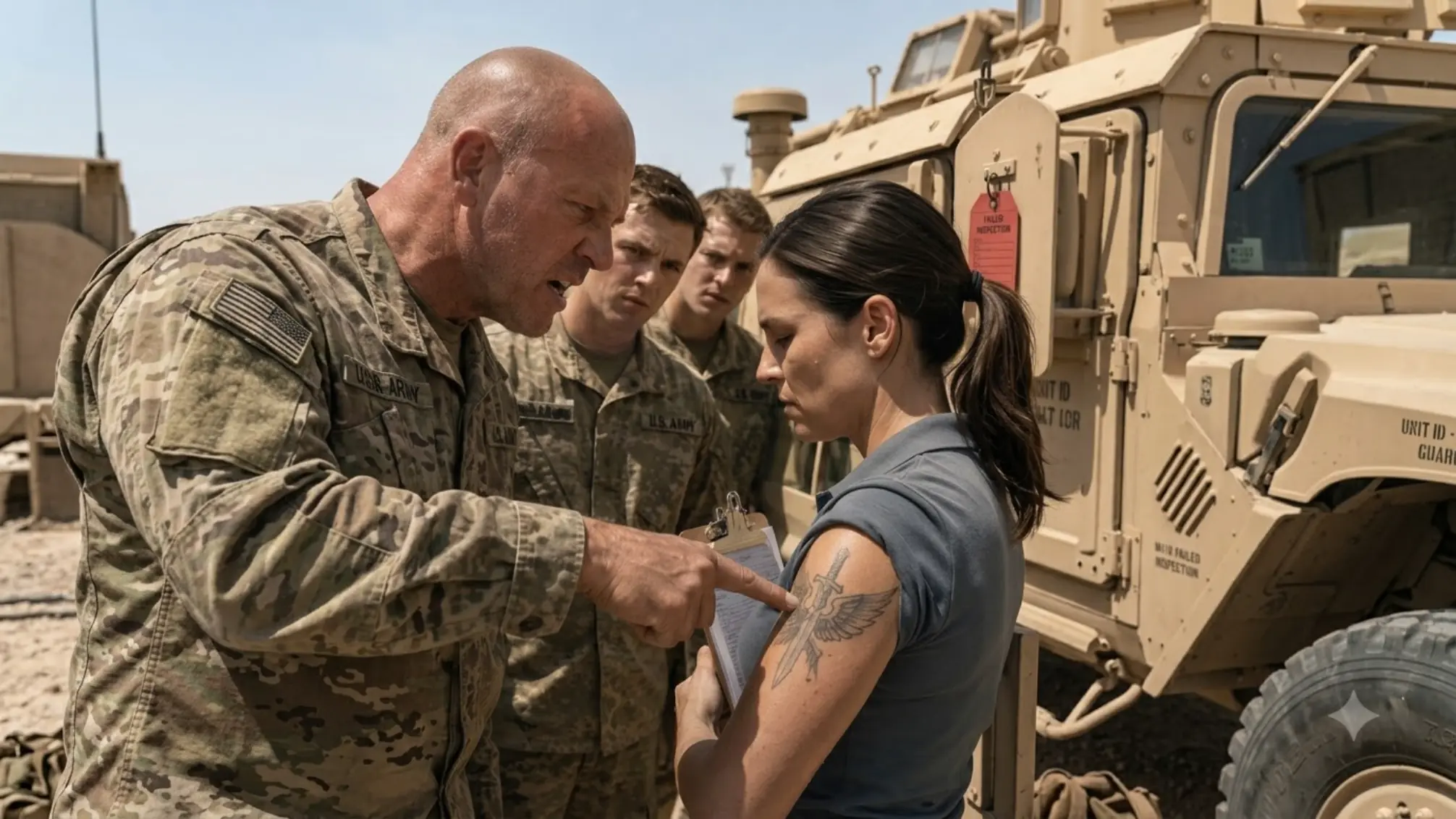
Rebecca did not move.
At thirty-six, she had learned that anger was most useful when nobody could see it.
She pressed a bright red inspection tag against the armored vehicle beside them, clipped it firmly onto the door handle, and looked straight at Cavanaugh.
“Try it,” she said. “Your whole fleet stays parked.”
Cavanaugh’s smile vanished.
The two younger soldiers exchanged a glance.
Behind Rebecca, the tan armored vehicle sat halfway through an inspection lane surrounded by tool carts, diagnostic equipment, and maintenance crews sweating beneath the brutal Texas afternoon. Rebecca had already found excessive play in the steering assembly, hydraulic contamination in one subsystem, and a hairline fracture beginning around a suspension mounting point.
The vehicle was not moving anywhere.
Cavanaugh stepped closer.
“You’re a civilian.”
Rebecca kept the clipboard against her chest.
“One call and you’re finished.”
She looked past his shoulder.
A black command vehicle had just rolled through the motor-pool gate.
Two staff officers stepped out first.
Then came the man wearing three stars.
Rebecca’s expression did not change, but something tightened behind her ribs.
She recognized him immediately.
So did almost everyone else.
Lieutenant General Marcus Vale moved through the motor pool with the quiet authority of a man who never needed to announce that other people should make room.
Conversations stopped.
Tools lowered.
Postures straightened.
Cavanaugh noticed the sudden silence but still did not understand.
Rebecca met his eyes.
“Make the call,” she said. “Then turn around and ask that three-star general why he’s rolling up his sleeve.”
Cavanaugh frowned.
“What?”
Vale was already twenty feet away.
He had been speaking with one of his staff officers when his attention landed on Rebecca’s exposed upper arm.
He stopped.
Not dramatically.
One missed step.
One brief pause.
But Rebecca saw it.
Thirteen years disappeared.
Texas sunlight became darkness.
Diesel fumes became damp stone.
The clatter of tools transformed into distant impacts against a mountainside.
Vale looked at the tattoo again.
A fractured wing wrapped around a narrow blade.
Uneven lines.
Faded black ink.
Nothing about it looked professional.
That had been the point.
Cavanaugh noticed the general staring and immediately moved to control the story.
“General Vale, sir. We’re handling a civilian contractor issue.”
Vale did not look at him.
His eyes remained on Rebecca.
“Where did you get that?”
Her throat tightened.
“Thirteen years ago, sir.”
Vale looked into her eyes.
Rebecca saw recognition arrive completely.
The general slowly removed his jacket.
Then he unbuttoned the cuff of his left sleeve.
Nobody spoke.
Cavanaugh glanced toward the younger soldiers as though one of them might explain what was happening.
Vale rolled his sleeve upward.
Past the wrist.
Past the forearm.
Then stopped above the elbow.
A faded tattoo appeared.
Fractured wing.
Narrow blade.
Different imperfections.
Same symbol.
Cavanaugh went pale.
One of the younger soldiers whispered, “What the hell?”
Vale finally turned toward him.
The young man snapped upright.
“Sorry, sir.”
Rebecca’s fingers tightened around the clipboard.
Vale touched his own tattoo once.
“You kept yours.”
Rebecca gave a small nod.
“You told us not to erase the ugly parts.”
For the first time, something almost like a smile moved across Vale’s face.
“I said that?”
“You said nobody had a steady enough hand to improve them.”
Vale looked at the faded lines.
“That sounds more accurate.”
Cavanaugh stared between them.
“Sir, I wasn’t aware—”
Vale’s expression changed instantly.
The warmth disappeared.
“That much is obvious.”
Cavanaugh swallowed.
“Sir, I was only questioning whether a civilian inspector had authority to ground operational vehicles.”
Rebecca looked toward the red tag.
Vale did too.
“Did she fail the vehicle?”
“Yes, sir.”
“Then why are you discussing her tattoo?”
Cavanaugh opened his mouth.
Nothing came.
Rebecca could have enjoyed the silence.
She did not.
The tattoo had never been intended to win arguments.
Thirteen years earlier, it had meant something entirely different.
Vale turned toward Rebecca.
“What did you find?”
She handed him the inspection sheet.
“Steering linkage outside tolerance. Contamination in the hydraulic circuit. Beginning structural fatigue around the left suspension mount.”
Vale read the notes.
“Safe to operate?”
“No.”
“Repairable?”
“Yes.”
“How long?”
“If maintenance has the replacement assembly and nobody pressures them to rush the structural inspection, forty-eight hours.”
Vale handed the sheet back.
“Then it stays parked.”
Cavanaugh stepped forward.
“Sir, those vehicles are scheduled for field certification tomorrow.”
Vale looked at him.
“Then certification changes.”
“We’ll lose the training window.”
“Better a training window than a vehicle.”
Cavanaugh’s jaw tightened.
Rebecca saw anger flash behind his eyes.
Not because the decision was difficult.
Because it had been made in front of witnesses.
Cavanaugh had treated the inspection dispute as a contest of authority.
Now the highest-ranking man in the motor pool had ended it with three sentences.
Vale turned toward the maintenance chief.
“Pull the remaining vehicles from that batch.”
The chief blinked.
“All of them, sir?”
“All.”
Cavanaugh’s face changed.
“General—”
Vale raised one hand.
“If this failure exists in one vehicle, I want to know whether it exists in six.”
Rebecca looked toward the remaining line.
That was exactly what she had been requesting since morning.
Cavanaugh had refused because the inspection schedule would fall behind.
Vale looked back at Rebecca.
“You’re leading the expanded inspection.”
“Yes, sir.”
Then his eyes returned to her tattoo.
“Afterward, we talk.”
Rebecca nodded.
Cavanaugh said nothing.
But as General Vale walked away, Rebecca felt his stare.
The confrontation was not finished.
It had merely changed rooms.
Three hours later, the first result came back.
A second vehicle showed the same early-stage fracture.
The maintenance chief called Rebecca over.
“Look.”
He pointed beneath a cleaned mounting plate.
There it was.
Smaller.
Almost invisible beneath grime.
Rebecca crouched beside the vehicle.
“Photograph it before anything moves.”
The chief nodded.
Another inspection followed.
Then another.
Vehicle number four showed hydraulic contamination.
Number five had abnormal wear but no fracture.
Number six revealed a fastener problem suggesting somebody had recently completed maintenance without following the correct torque sequence.
Rebecca’s concern grew.
This was no longer about one failed vehicle.
It was a pattern.
At 6:40 p.m., she carried the documentation into the maintenance office.
Cavanaugh was waiting.
The younger soldiers were gone.
So was his earlier swagger.
He stood beside the desk with his arms folded.
“You made your point.”
Rebecca placed the files down.
“This isn’t about a point.”
“General Vale pulls one sleeve up and suddenly you think you own the motor pool.”
Rebecca stared at him.
“You still think this is about the tattoo?”
“I think you enjoyed embarrassing me.”
“You did that yourself.”
His eyes hardened.
“Careful.”
“No.”
Rebecca stepped closer.
“You be careful.”
The office became quiet.
She tapped the inspection files.
“Two structural issues. One contaminated hydraulic system. One improperly serviced assembly. Your unit was going to certify these tomorrow.”
“We have maintenance problems. It happens.”
“You also have documentation problems.”
That stopped him.
Rebecca opened another folder.
“Vehicle Six supposedly received its suspension service nine days ago.”
“Yes.”
“The torque log is signed.”
“So?”
“The values written on the sheet are identical across every fastener.”
Cavanaugh frowned.
“That proves nothing.”
“It proves somebody copied numbers.”
He looked at the paperwork.
“Maybe the technician has consistent technique.”
Rebecca almost laughed.
“Not within one-tenth across twelve fasteners.”
Cavanaugh’s expression shifted.
“Who signed it?”
“Sergeant Daniel Morrow.”
“I’ll handle him.”
Rebecca closed the folder.
“No.”
Cavanaugh stared.
“This needs formal review.”
“You’re telling me how to run my unit now?”
“I’m telling you evidence exists that maintenance records may have been falsified.”
His face became colder.
“You don’t know what pressure this unit is under.”
“I know exactly what pressure failed components operate under.”
“That’s not what I meant.”
“I know.”
Cavanaugh stepped around the desk.
“You people arrive with clipboards, find one thing wrong, and suddenly everyone who has to actually keep operations moving becomes incompetent.”
Rebecca held his gaze.
“Safety doesn’t become optional because the schedule is inconvenient.”
“Easy for you to say.”
“No.”
Her voice lowered.
“It isn’t.”
For a second, something in her expression made Cavanaugh hesitate.
Rebecca noticed.
Perhaps he finally understood that her calmness was not academic.
Before he could respond, General Vale appeared at the doorway.
Neither had heard him approach.
“Continue,” Vale said.
Cavanaugh straightened.
“Sir.”
Vale looked at Rebecca.
“What did you find?”
She explained.
No embellishment.
No accusation beyond what the records supported.
Vale listened.
Then he turned toward Cavanaugh.
“Who supervises vehicle certification?”
“I do, sir.”
“Who signs readiness?”
“I do.”
“And who ordered this inspection shortened?”
Cavanaugh’s face tightened.
Rebecca had not mentioned that.
Vale already knew.
“Sir, we were behind schedule.”
“That wasn’t my question.”
“Yes, sir. I ordered it.”
Vale stepped inside.
“Why?”
“To meet the field certification date.”
Vale nodded slowly.
“Did anyone advise you against it?”
Cavanaugh said nothing.
Vale looked at Rebecca.
“Did you?”
“Yes, sir.”
“When?”
“10:12 this morning. Email. I also documented it in the inspection record.”
Vale turned back.
“Major?”
“Yes, sir.”
Rebecca watched Cavanaugh’s confidence collapse in pieces.
Not because he had been caught insulting a civilian.
Because the insult had exposed something larger.
Vale reached for the folder.
“We freeze certifications until this review is complete.”
Cavanaugh stared.
“Sir, that could affect the entire battalion.”
“Then the battalion will be affected.”
“General—”
Vale stepped closer.
“Major, equipment does not become safe because a calendar says tomorrow.”
The room went silent.
Cavanaugh lowered his eyes.
“Yes, sir.”
Vale looked at Rebecca.
“My office. Twenty minutes.”
Then he left.
Rebecca waited until his footsteps disappeared.
Cavanaugh remained beside the desk.
Finally he said, “Who are you?”
Rebecca picked up her clipboard.
“Today?”
He looked up.
“Civilian vehicle-safety inspector.”
She walked out.
General Vale’s temporary office overlooked the motor pool.
Rebecca entered at 7:15.
Vale had removed his uniform jacket.
His tattoo remained exposed.
For several seconds neither spoke.
Then Vale said, “Sit down, Rebecca.”
She did.
Using her first name changed everything.
Thirteen years ago, he had called her Hale.
Everyone had.
She had been twenty-three then.
Young.
Overconfident.
Certain she understood fear because she had trained for difficult situations.
Then came the cave.
The operation was never the legendary secret people later imagined.
It had been an evacuation gone catastrophically wrong.
A convoy carrying communications specialists and engineering personnel had been forced off its planned route after repeated attacks damaged the main road.
A small mixed group sheltered inside an abandoned mountain storage tunnel while waiting for extraction.
Among them were Rebecca, then a technical specialist, Captain Marcus Vale, and three others.
For eighteen hours, nobody knew whether support would reach them.
One man was badly wounded.
Another had lost most of his equipment.
Rebecca had been terrified.
Not movie terrified.
Not screaming.
The quieter kind.
The kind where hands refuse fine movements and every sound feels like it might become the last sound.
During those hours, one of the trapped men, Sergeant Luis Ortega, began talking about the fractured-wing symbol his grandfather used to draw.
A broken wing still flew, Ortega said.
Not well.
Not gracefully.
But enough.
Someone found a needle from a repair kit.
Ink came from improvised material.
The tattoos were terrible.
That became part of why they mattered.
Five frightened people marked themselves in bad light because none wanted the others forgotten if they did not leave together.
They did leave together.
Ortega survived the evacuation.
He died years later from illness.
The five never spoke publicly about the tattoo.
It was theirs.
Vale sat across from Rebecca now.
“You disappeared.”
Rebecca looked toward the window.
“I left service.”
“I know that.”
“You mean afterward.”
“Yes.”
She exhaled.
“I didn’t want the mark becoming a story.”
Vale nodded.
“Neither did I.”
“People always want to make survival sound impressive.”
“You never liked impressive.”
“No.”
Vale smiled faintly.
“You were difficult at twenty-three.”
“I improved.”
“That’s debatable.”
Rebecca almost smiled.
Then Vale became serious.
“What happened today?”
She knew he was no longer asking about the inspection.
“Cavanaugh saw the tattoo.”
“And?”
“He decided it meant I hadn’t earned the right to stand there.”
Vale’s jaw tightened.
“Did he touch you?”
“No.”
“Threaten your credential?”
“Yes.”
“Witnesses?”
“Two.”
Vale nodded.
“That will be reviewed separately.”
Rebecca looked at him.
“I don’t want revenge.”
“Neither do I.”
“He’s arrogant.”
“Yes.”
“But the maintenance problem matters more.”
Vale leaned back.
“That’s why you’re here.”
She nodded.
“The falsified log is the real issue.”
They spent the next hour reviewing documents.
What emerged during the following three days was worse than expected.
Sergeant Morrow had copied inspection values.
But not entirely by choice.
Interview records showed that maintenance teams had repeatedly been pressured to clear vehicles faster than required inspections realistically allowed.
Technicians had complained.
Supervisors had minimized the concerns.
One email from Cavanaugh read:
I need green boxes, not essays. Find a way to make the fleet ready.
That sentence became central to the review.
Another email instructed leaders to “stop treating minor discrepancies like catastrophic failures.”
Rebecca read it twice.
The structural fractures discovered in two vehicles were exactly the kind of “minor discrepancy” that could become catastrophic under load.
Cavanaugh was temporarily removed from readiness certification authority.
He was not arrested.
He was not dramatically marched away.
Real consequences were usually more administrative than theatrical.
His evaluations were reviewed.
His leadership decisions were investigated.
Sergeant Morrow received disciplinary action for falsifying records but also became a key witness explaining how schedule pressure had distorted maintenance reporting.
Two other supervisors admitted knowing the problem existed.
General Vale ordered independent inspections across the broader vehicle pool.
Rebecca’s team found seven additional maintenance discrepancies requiring repair.
None had caused an accident.
That fact mattered.
The system had been corrected before the price became injury.
Two weeks later, Cavanaugh requested a meeting with Rebecca.
She almost declined.
Then accepted.
They met in an empty conference room.
He looked different.
Not physically.
Quieter.
He placed something on the table.
A printed photograph.
Rebecca recognized it.
The tattoo on her arm.
Someone had taken the picture during the inspection.
“I wanted to apologize.”
She said nothing.
Cavanaugh continued.
“I thought your tattoo was pretending to represent something.”
“It does represent something.”
“I know.”
“No.”
Rebecca looked directly at him.
“You know someone important has the matching one.”
He stopped.
“That isn’t the same thing.”
Cavanaugh looked down.
“No.”
She continued.
“If General Vale had never appeared, would you regret what you said?”
The question landed harder than anger.
Cavanaugh took several seconds.
“I don’t know.”
Rebecca nodded.
“Then that’s where you start.”
He looked at her.
“I was wrong.”
“Yes.”
“I was also wrong about the inspections.”
“Yes.”
He almost smiled.
“You don’t make this easy.”
“I’m not required to.”
“No.”
He folded the photograph.
“General Vale told me the tattoo wasn’t an award.”
Rebecca’s expression changed.
“He shouldn’t have told you anything else.”
“He didn’t.”
Good.
Cavanaugh stood.
“For what it’s worth, I’m sorry.”
Rebecca nodded once.
That was all.
Months later, she returned to the Texas facility for another inspection cycle.
The atmosphere had changed.
Maintenance schedules included protected inspection time.
Technicians had a direct reporting channel for safety concerns.
Certification documents required secondary verification on critical systems.
Rebecca noticed the reforms before anyone mentioned them.
That pleased her more than Cavanaugh losing authority ever could have.
During the second afternoon, a young mechanic noticed her tattoo.
He looked at it.
Then at her.
“What’s that mean?”
Rebecca instinctively prepared the old answer.
Nothing.
Then she stopped.
Thirteen years had passed.
Perhaps silence had protected the meaning long enough.
“It means somebody can be damaged and still keep moving.”
The mechanic nodded.
“That’s pretty good.”
Rebecca smiled.
“The artwork isn’t.”
He laughed.
“No, ma’am.”
She looked at him.
“Careful.”
He immediately froze.
Then saw her smile.
They both laughed.
That evening, General Vale visited the inspection bay.
No convoy.
No dramatic entrance.
He carried two coffees.
Rebecca accepted one.
They stood beside a vehicle while technicians worked nearby.
Vale looked at her tattoo.
“Still ugly.”
Rebecca looked at his.
“Yours is worse.”
“Absolutely not.”
“The wing is crooked.”
“The cave floor was crooked.”
“That isn’t how floors work.”
Vale laughed.
For several seconds they were not a general and a civilian inspector.
They were two people remembering damp stone, bad light, shaking hands, and three others who had once promised that survival would mean something.
Vale grew quiet.
“Ortega would have laughed at what happened here.”
Rebecca smiled.
“He would’ve charged Cavanaugh twenty dollars to hear the story.”
“Fifty.”
“Probably.”
They stood silently.
Then Vale looked toward the repaired vehicles.
“You know what bothered me most?”
“The falsified logs?”
“That too.”
He took a drink.
“But when I saw him pointing at your arm, for half a second I was angry because he didn’t know who you were.”
Rebecca looked at him.
“And then?”
“I realized that was the wrong reason.”
She waited.
Vale continued.
“He shouldn’t have needed to know.”
Rebecca nodded.
That was the truth beneath everything.
The tattoo did not deserve respect because a three-star general had the matching mark.
Rebecca did not deserve dignity because her past contained something difficult.
Her inspection was not valid because an important man recognized her.
Cavanaugh had been wrong before Vale ever entered the motor pool.
The general’s sleeve merely made the mistake impossible to ignore.
A year later, Rebecca finally had the tattoo touched up.
Not replaced.
Not redesigned.
Only stabilized where age had blurred the weakest lines.
The tattoo artist studied the fractured wing.
“I can straighten this.”
“No.”
“The blade too.”
“No.”
“You sure?”
Rebecca looked at the uneven lines.
Very sure.
“Keep every crooked part.”
The artist frowned.
“Why?”
Rebecca smiled faintly.
“Because somebody’s hand was shaking when they made it.”
“And you want to remember that?”
“Yes.”
The artist nodded.
He strengthened the faded ink without correcting the original mistakes.
When Rebecca left the studio, the fractured wing was darker but still imperfect.
Exactly right.
Years earlier, five frightened people had created the symbol because they did not know whether any of them would live long enough to explain it.
Thirteen years later, an arrogant man pointed at it and called it garbage.
Then a three-star general rolled up his sleeve.
Everyone in that Texas motor pool remembered the revelation.
Rebecca remembered something else.
The moment afterward.
When the general looked at the failed inspection tag instead of the tattoo and said:
“Then it stays parked.”
That was why the story mattered.
Not because an ugly tattoo turned out to belong to important people.
Because evidence mattered more than ego.
Because authority without judgment could become dangerous.
Because a person’s past did not need to be visible to deserve respect.
And because sometimes the mark everyone laughs at is carrying a history they would never survive long enough to earn.