The officer grabbed my arm before I had walked twenty steps from the jet bridge. He demanded my luggage, called the uniform on my back a costume, and told the passengers watching that he had caught an old man pretending to be somebody important. My identification was inside the very bag he refused to let me open. Then, just as he began marching me through the concourse in handcuffs, every police radio around us carried the same urgent question.
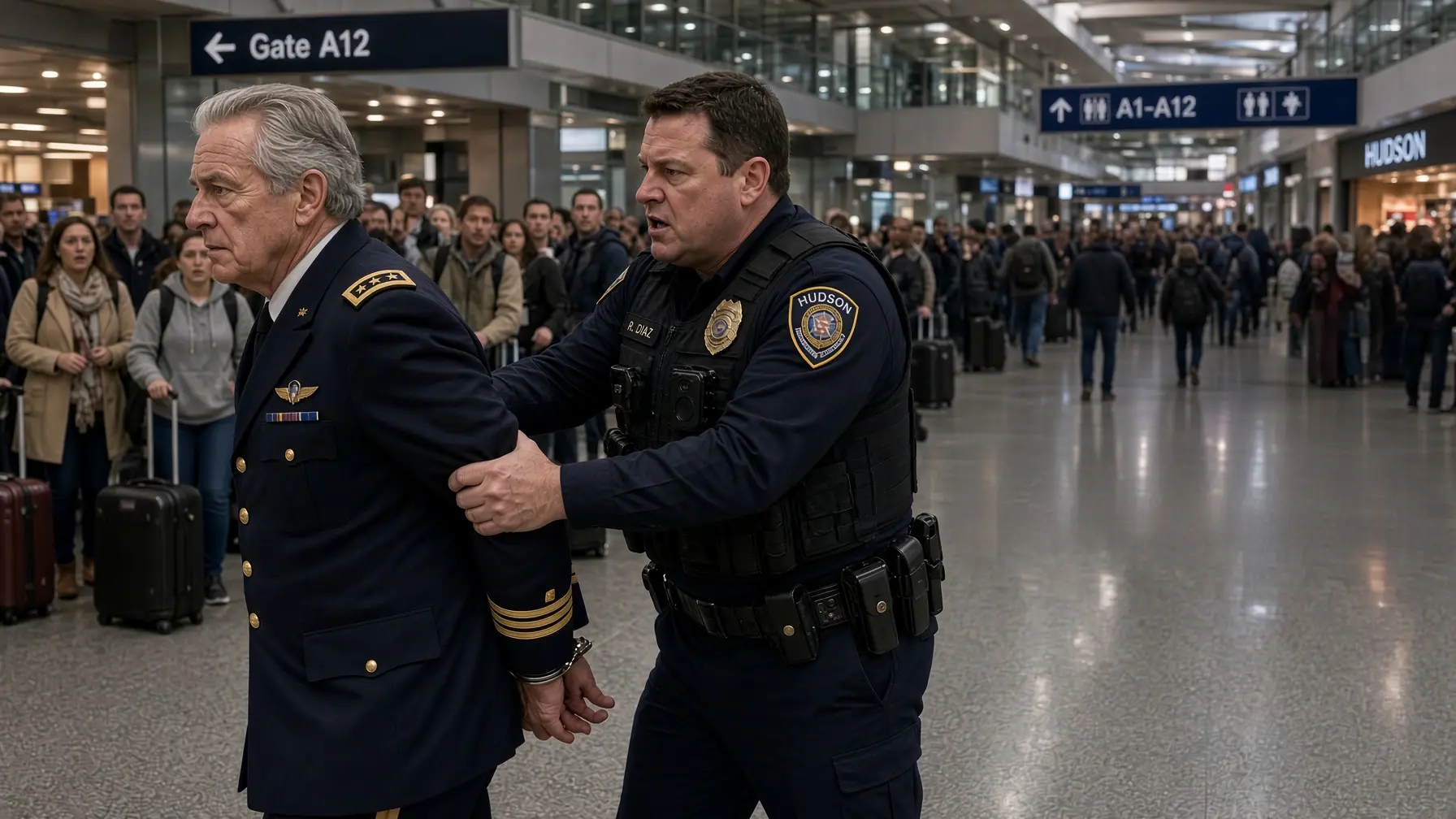
I had been smiling when I stepped off the airplane.
That is the detail I return to most often. Not the handcuffs, although my wrists remembered those long after the marks disappeared. Not the words, although some of them remain as clear as the announcements overhead that morning. The smile.
After almost eighteen hours of travel, I was tired enough that the jet bridge seemed longer than it should have. But I was back on American ground, moving toward the next part of a journey whose arrangements had already been made.
My name is Marcus Hayes. I was a Black man in my sixties, with gray at my temples and knees that reminded me whenever I spent too long in an airplane seat. The uniform I wore was Navy Service Dress Blues. I had served for more than twenty years, and nothing about putting it on had ever felt like dressing as someone else.
I carried a dark sea bag in my left hand. My military identification and a sealed travel packet were inside an accessible compartment, placed there deliberately so I could produce what was needed without unpacking my belongings in public.
At the end of the jet bridge, an airline employee wished us a good morning. I thanked her and moved aside for a mother managing two children and a rolling bag that refused to remain upright.
The younger child looked at my sleeve.
“Are you a sailor?”
“I am.”
“Like on a big ship?”
“Sometimes.”
His mother smiled apologetically, but I told her there was nothing to apologize for. The child wanted to know whether ships had bedrooms, and I told him they did, though some were considerably smaller than his.
He considered that answer with great seriousness.
Then his mother guided him toward the concourse, and I followed at a slower pace, allowing the crowd from the flight to move ahead of me.
I checked the overhead clock.
8:07.
A Tuesday morning at Hartsfield-Jackson Atlanta International Airport. People moved toward coffee counters, connections, restrooms, and exits, each carrying the private urgency that makes airports feel like several different places occupying the same floor.
I shifted the sea bag to ease the weight on my hand.
“Hey. You.”
The voice came from my right.
I turned because the second word was delivered with enough force to make it clear that somebody expected a response.
A police officer approached quickly. His nameplate read VANCE, and his expression suggested he had already decided what kind of conversation we were about to have.
Before I could greet him, his hand closed around my upper arm.
“Where do you think you’re going?”