Michael Turner had always believed that trust was the quiet foundation of a marriage.
Not romance.
Not attraction.
Not even shared history.
Those things mattered, of course. They brought two people together, gave them stories to tell, and carried them through anniversaries and Sunday mornings and ordinary grocery runs. But trust was different. Trust was the floor beneath everything. When it was strong, you walked through life without thinking about it.
When it cracked, you suddenly realized how far there was to fall.
Michael learned that lesson on a Thursday afternoon in Denver, when his flight from Boston landed three hours earlier than expected.
He had been away for a week on an important project for the consulting firm where he worked as a senior operations strategist. The trip had been exhausting: early meetings, late dinners, client presentations, hotel coffee, airport food, and the kind of corporate conversation that made every day feel longer than the one before it.
Still, as the plane descended over Colorado, Michael felt lighter than he had all week.
He was going home.
From the window seat, he watched the mountains rise in the distance, blue-gray beneath a pale autumn sky. He thought of Rachel, his wife of nine years, and smiled faintly. She loved the mountains more than anyone he had ever known. When they bought their house in the suburbs west of Denver, she had stood on the back deck, staring at the far peaks, and said, “This is what peace looks like.”
Michael had believed her.
Their house was not enormous, but it was beautiful in a quiet way. Three bedrooms. Wide windows. A kitchen with dark cabinets and brass handles Rachel had chosen herself. A back deck where they grilled in summer. A living room with a stone fireplace and a large bookshelf that divided the room from the hallway.
It was the first home Michael had ever owned.
And because he loved Rachel, he had spent years making it feel like hers too.
When the plane touched down, he texted her.
Landed early. Long week. Can’t wait to see you.
He stared at the screen for a moment, waiting for the little typing bubbles.
Nothing.
That did not worry him.
Rachel worked as a project coordinator for a design firm downtown, and Thursdays were often busy for her. She might be in a meeting, driving, or in the middle of one of her long calls with vendors.
Michael tucked the phone into his pocket and moved with the slow crowd off the plane.
At baggage claim, he reached into his carry-on and checked the small gift box he had bought in Boston. Inside was a delicate silver bracelet with a small mountain charm hanging from the clasp. He had seen it in a boutique near his hotel and immediately thought of Rachel.
It was simple.
Not flashy.
Exactly the kind of thing she used to love.
He also planned to stop by her favorite Italian restaurant on the way home and pick up dinner. He imagined her opening the door, surprised to see him early, laughing as he held up the food and the gift.
For nine years, Michael had tried to remain intentional in his marriage. He knew romance could fade if people stopped feeding it. So he planned small surprises, remembered dates, sent flowers without needing an apology first, and called from every business trip even when he was tired.
Rachel used to say she loved that about him.
Lately, she said it less.
That thought passed through him quickly, like a bird’s shadow.
He ignored it.
Every marriage had quiet seasons.
He had told himself that many times over the past year.
Rachel had been distant, yes, but she was busy. She had taken on more responsibility at work. Her company had grown. Her team demanded more from her. She came home tired. She spent more time on her phone. She laughed at messages she did not always explain. She went to more after-work dinners.
Michael noticed all of it.
But noticing was not the same as suspecting.
He trusted her.
That was what husbands were supposed to do.
By the time he reached his car in long-term parking, he had decided to skip the restaurant and go straight home first. He wanted to see her. They could order dinner later. Maybe they would drive out somewhere with a view, eat on a patio, talk about nothing important, and let the week fall away.
Traffic was lighter than expected.
The sky over Denver had that late-afternoon brightness that made every roofline and tree look sharper. Michael drove with one hand on the wheel, tired but content, the gift box resting on the passenger seat beside his laptop bag.
At 3:08 p.m., he turned into his neighborhood.
At 3:12, he turned onto his street.
At 3:13, his life changed.
An unfamiliar car was parked in his driveway.
It was a dark blue Audi sedan, clean, expensive, and angled slightly too close to the garage. Michael slowed before pulling in behind it. For a moment, he simply stared.
Maybe a client.
Maybe a friend.
Maybe someone from Rachel’s office.
But Rachel rarely brought colleagues home during the day, and when she did, she always mentioned it.
Michael parked on the street instead of the driveway.
He was not sure why.
Something small and cold had opened in his stomach.
He picked up the gift box, then put it back down.
He stepped out of the car quietly.
The neighborhood was calm. A dog barked somewhere behind a fence. A delivery truck rolled past at the far end of the block. Wind moved through the yellowing leaves of the maple tree near the curb.
Michael walked toward the side gate.
He still had his suitcase in the trunk, still wore his navy travel jacket, still had his phone in his hand. The whole scene felt ordinary enough that he almost laughed at himself for being cautious.
Maybe he was about to embarrass himself.
Maybe he would walk in and find Rachel meeting with a decorator, or a coworker dropping off files, or one of her friends borrowing the kitchen table for some project.
Maybe.
He unlocked the side door and stepped into the mudroom.
The house smelled faintly of vanilla.
Rachel’s candle.
The one she lit when she wanted the house to feel warm.
Michael closed the door gently behind him.
The house was mostly quiet.
Then he heard music.
Soft jazz from the living room speakers.
Rachel almost never played music in the afternoon unless she was cleaning, reading, or trying to create a mood.
Michael stood still.
A low male voice murmured something.
Rachel laughed.
Not her polite laugh.
Her real laugh.
The one Michael had not heard much lately.
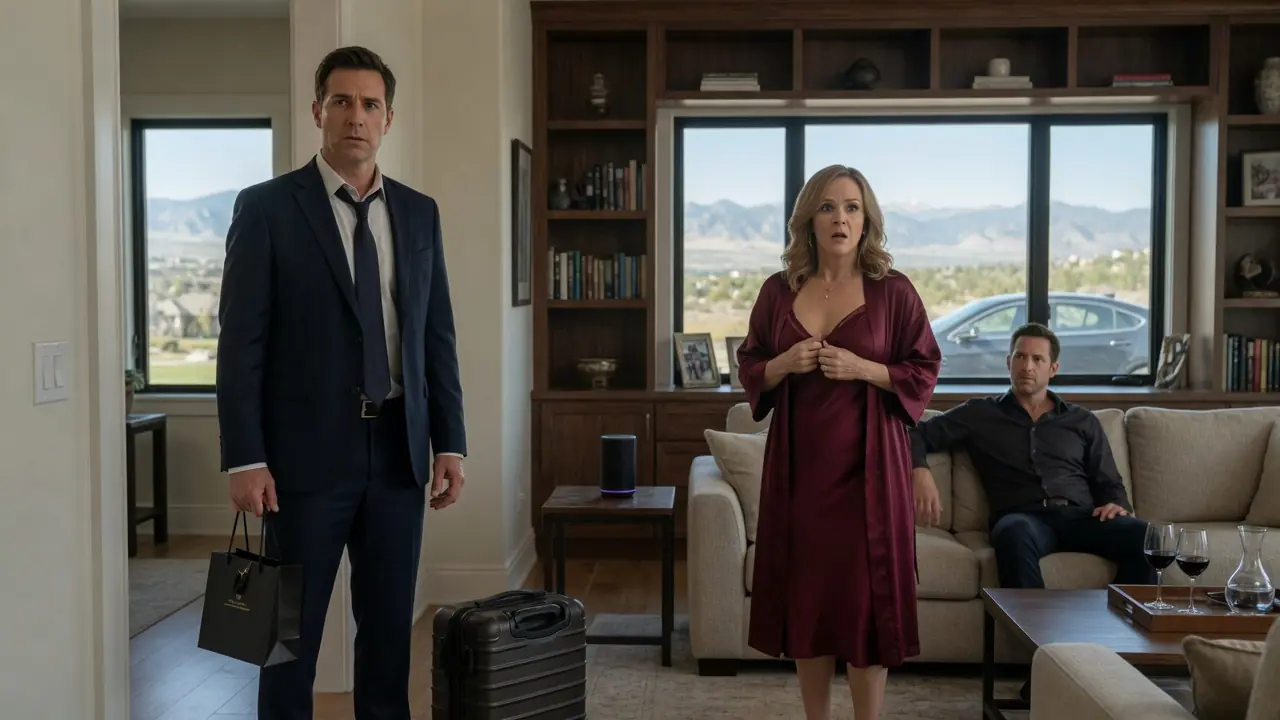
He moved down the hallway slowly, each step deliberate. The large bookshelf stood ahead, dividing the hall from the living room. It was open-backed in places, filled with books, framed photos, small plants, and decorative pieces Rachel had collected over the years.
From behind it, Michael could see into the living room without being seen.
He stopped.
Rachel was sitting on the couch.
Daniel Brooks was with her.
Michael recognized him immediately.
Daniel was Rachel’s colleague, a senior account manager at her firm. Michael had met him twice. Once at a company holiday party and once at a summer barbecue Rachel’s office hosted. Daniel was charming in the easy way some men are charming when they never have to try too hard. Mid-forties, fit, silver at the temples, expensive watch, confident smile.
Michael had disliked him mildly and then forgotten about him.
Now Daniel sat close to Rachel on Michael’s couch, one arm around her waist.
Rachel’s hands rested on Daniel’s chest.
They were kissing.
Not a quick kiss.
Not a mistake that happened and ended before anyone understood it.
A deep, familiar kiss.
The kind of kiss that carried history.
The kind of kiss that said this was not the beginning.
Michael stood behind the bookshelf for nearly a full minute.
Time lost shape.
The music kept playing.
The late afternoon light moved across the floor.
Daniel said something Michael could not hear.
Rachel smiled, soft and intimate, and touched his face.
That was what hurt most.
Not the kiss.
The tenderness.
The look on her face.
It was not drunken. It was not accidental. It was not confusion. It was comfort.
Michael felt something sharp move through his chest.
His first instinct was to step out.
To say her name.
To demand Daniel get out of his house.
To ask how long, why, when, where, how could you, how could you here, in our home, on our couch, under our roof?
But another part of him stopped.
A colder part.
A steadier part.
Michael had spent his career walking into failing companies and figuring out where emotion had replaced structure. He knew what panic did. Panic created noise. Panic destroyed leverage. Panic gave other people time to hide the truth.
So he did not move forward.
He moved back.
One step.
Then another.
He returned down the hallway as silently as he had entered. He left through the side door, closed it without a sound, walked to his car, and sat behind the wheel.
Only then did his hands begin to shake.
He looked through the windshield at the house.
His house.
Their house.
The place where Rachel had once painted the dining room wall twice because the first shade of blue was “too anxious.” The place where they had hosted Thanksgiving. The place where they had hung stockings, planted roses, talked about having children before the doctors told them it would be difficult, then unlikely, then probably not possible.
That grief had once brought them closer.
Or so Michael had believed.
Now another man was inside.
Michael put the car in drive and pulled away.
He did not know where he was going at first.
He drove without music, without calling anyone, without blinking enough. Twenty minutes later, he found himself in the parking lot of a business hotel near the highway. He checked in under his own name because he had no reason not to. The woman at the desk asked if he needed help with luggage.
“No,” he said. “Just the room.”
Once inside, he placed his laptop bag on the desk, took off his jacket, and sat on the edge of the bed.
The room was quiet.
Clean.
Anonymous.
A place without memories.
For a while, he simply stared at the wall.
Then he removed his phone from his pocket.
Rachel had finally responded.
Sorry, crazy afternoon. How was the flight? Miss you. Can’t wait for Saturday.
Saturday.
She thought he was still coming home Saturday.
Michael looked at the message for a long time.
Then he typed:
Flight was fine. Long day. I’ll call later.
He almost added love you.
He could not make his hands type it.
Outside the hotel window, the mountains stood in the distance, calm and indifferent.
Michael leaned back in the chair and whispered to the empty room, “I trusted you completely.”
His voice sounded strange.
Hoarse.
Older.
He closed his eyes.
When he opened them again, the shock was still there, but beneath it something else had begun to form.
A decision.
He would not explode.
He would not give Rachel time to delete messages, move money, create a story, or turn his pain into a dramatic fight where she could call him unstable.
He would protect himself.
He would learn the truth.
All of it.
And then, when he acted, he would act once.
Calmly.
Completely.
That night, Michael did not sleep.
At 6:30 p.m., Rachel called.
He let it ring twice, then answered.
“Hey,” she said brightly. “Sorry I missed your text earlier. Today was insane.”
“I figured.”
“You sound tired.”
“I am.”
“How’s Boston?”
Michael looked around the Denver hotel room.
“Cold,” he said.
Rachel laughed.
“Poor baby.”
The sound made him close his eyes.
She sounded normal.
That was its own kind of cruelty.
For ten minutes, she asked about his project. He answered carefully. She told him she had worked from home that afternoon because she had a headache.
A headache.
Michael looked at his hand on the desk.
His wedding ring caught the lamplight.
“I hope you feel better,” he said.
“Thanks. I’m going to take it easy tonight.”
Another lie.
Or maybe Daniel had already left.
Michael wondered how long he had stayed after Michael drove away. He wondered whether Daniel knew the couch belonged to a husband. He wondered whether Rachel had laughed after the kiss, whether she had mentioned Michael’s flight, whether she had gone into the kitchen afterward and poured wine from glasses Michael had bought for their fifth anniversary.
He kept his voice steady.
They ended the call with Rachel saying, “Love you.”
Michael paused one second too long.
“Good night, Rachel.”
He hung up.
Then he opened his laptop.
By morning, he had searched for private investigators in Denver, read reviews, narrowed the list to three, and booked a consultation with a firm called Mercer & Vale Investigations.
At 9:00 a.m., he called his office and explained that his Boston project had wrapped early but he would be working remotely for a few days to finalize documents.
At 10:30, he met with Evelyn Mercer.
She was not what he expected.
Michael had pictured someone dramatic, perhaps an ex-police officer with a hard stare and a messy desk. Evelyn Mercer was in her late fifties, neatly dressed, calm, and direct. Her office smelled faintly of coffee and paper. There were no film-noir shadows, no wall of surveillance photos, no theatrical mystery.
Just a woman with a legal pad and careful eyes.
“What do you need, Mr. Turner?” she asked.
Michael told her.
Not everything.
Enough.
He had come home early. Found his wife with a colleague. Believed the affair was ongoing. Needed documentation before proceeding legally.
Evelyn did not react with shock.
That almost comforted him.
Professionals who hear terrible things every day learn not to make your pain into their performance.
“Do you intend to confront her?” she asked.
“Eventually.”
“Do not do it before you have legal advice.”
“I won’t.”
“Do you share finances?”
“Yes.”
“Joint credit cards?”
“Yes.”
“Business interests?”
“My retirement accounts. Our house. Investments. No shared business.”
“Children?”
Michael’s throat tightened.
“No.”
Evelyn nodded.
“That simplifies the legal side. Not the emotional side.”
He looked at her.
She continued, “We can document public movements, meetings, hotel visits if any, and patterns. We cannot access private accounts illegally. We cannot record inside private spaces without consent. We stay clean, or the evidence becomes useless.”
“I want clean,” Michael said.
“Good.”
He signed the agreement that afternoon.
Then he went home.
Rachel greeted him Saturday morning as if nothing had changed.
She ran to him at the door, threw her arms around his neck, and kissed him.
Michael accepted the kiss.
That was one of the hardest things he had ever done.
“You’re early!” she said.
“Project wrapped sooner.”
“You should have told me. I would have made dinner.”
“I wanted to surprise you.”
Her smile flickered.
Just for a moment.
Then she recovered.
“Well, you did.”
Michael watched her face.
Had she wondered whether he had come home early Thursday? Had she heard something? Seen some trace? Or was guilt making every surprise feel dangerous?
He handed her the Boston gift bag.
“I got you something.”
Her face softened.
“You didn’t have to.”
“I wanted to.”
She opened the small box and lifted out the silver bracelet.
“Oh, Michael,” she said. “It’s beautiful.”
The mountain charm turned between her fingers.
He had bought it before he knew.
That made the gift feel like something sent from a dead version of himself.
Rachel put it on immediately.
Then she hugged him again.
“I missed you.”
Michael looked over her shoulder into the living room.
The couch had been rearranged slightly.
A throw blanket folded across the back.
The candle replaced.
The room looked clean.
Innocent.
He closed his eyes briefly.
“I missed you too,” he said.
For the next three weeks, Michael became a careful actor.
He was warm enough not to alarm her.
Distant enough to protect himself.
He asked about her day. Cooked dinner. Kissed her cheek. Took her to brunch. Suggested a weekend getaway to Aspen, which she declined because she said work was “too chaotic right now.”
She used that phrase often.
Work.
Chaotic.
Busy.
Late.
Meeting.
Client dinner.
Vendor call.
Michael wrote each one down.
Not emotionally.
Methodically.
Date.
Time.
Claim.
Behavior.
Evelyn’s team worked quietly.
Within ten days, they confirmed what Michael already knew and learned more than he wanted.
Rachel and Daniel had been meeting for at least five months.
Maybe longer.
Lunches.
Hotel afternoons.
Two overnight stays during fake work retreats.
A conference in Santa Fe where Rachel had told Michael she was sharing a suite with a female colleague, but hotel records tied to the joint credit card told another story.
Daniel was married too.
His wife’s name was Elise.
They had two teenage daughters.
Michael sat in Evelyn’s office as she placed the preliminary report in front of him. Photos. Dates. Receipts. Public surveillance notes. Nothing illegal. Nothing dramatic. Enough.
He stared at one hotel receipt longer than the others.
The charge had been paid with his and Rachel’s joint credit card.
Their money.
Not only betrayal.
Financing.
That detail changed something in him.
“I need a lawyer,” he said.
Evelyn nodded.
“I have three referrals.”
He chose Dana Whitfield, a divorce attorney with a reputation for being calm, thorough, and extremely difficult to intimidate.
Dana’s office overlooked downtown Denver. She wore navy suits, spoke precisely, and had no patience for emotional theatrics disguised as strategy.
After reviewing the initial evidence, she looked at Michael over her glasses.
“You have options.”
“I want a clean divorce.”
“Good.”
“I want the house protected.”
“Is it in both names?”
“Yes, but I contributed the down payment from premarital savings. I have records.”
“Good.”
“I want my share of all savings secured.”
“Do not move everything recklessly,” Dana said. “That can hurt you. We will document, freeze where appropriate, and transfer only what you are legally entitled to under advice. If she has misused marital funds, we account for that.”
Michael nodded.
“I don’t want a public scandal.”
“That depends partly on her.”
“I don’t want revenge.”
Dana studied him.
“Many people say that in the first meeting. Few mean it.”
“I mean it.”
“Then your power is in preparation, not punishment.”
That sentence became his anchor.
Preparation, not punishment.
Over the next two weeks, Michael gathered documents.
Bank statements.
Mortgage records.
Retirement accounts.
Investment portfolios.
Credit card histories.
Insurance policies.
Tax returns.
Travel records.
He opened a separate account in his name and moved only what Dana told him he could move. He changed passwords on accounts that were solely his. He updated beneficiaries where legally allowed. He made copies of every important record and stored them securely.
At home, Rachel noticed nothing.
Or if she did, she misread it.
“You seem better since Boston,” she said one night while they washed dishes together.
“Do I?”
“Less stressed.”
Michael dried a plate slowly.
“Maybe the project ending helped.”
She leaned against the counter.
“I was thinking maybe we should take a trip soon. Just us.”
He looked at her.
“Where?”
“I don’t know. Somewhere quiet. Maybe the mountains.”
Her new bracelet flashed under the kitchen light.
Michael wondered if she wore it when she met Daniel.
“Sounds nice,” he said.
She smiled.
There were moments when he almost asked why.
Not angrily.
Not dramatically.
Just why.
Why risk nine years?
Why bring him into our home?
Why kiss me afterward?
Why keep wearing the ring?
Why accept the bracelet?
But Dana had warned him.
Do not ask questions before you are ready for the answers to become weapons.
So he waited.
The right moment came sooner than expected.
Rachel’s company announced a major anniversary celebration at a hotel in downtown Denver. There would be clients, employees, spouses, speeches, drinks, and awards. Rachel wanted Michael to attend.
“You have to come,” she said. “Everyone’s bringing spouses. Daniel and Elise will be there too.”
Michael looked up from his laptop.
“Daniel?”
“He’s on the planning committee.”
“Right.”
She smiled too brightly.
“It’ll be fun.”
Michael agreed.
Then he called Dana.
Then Evelyn.
Then, after a long pause, he asked Evelyn for one more piece of information.
“Can you confirm whether Daniel’s wife knows?”
Evelyn called back two days later.
“No indication. She appears unaware.”
Michael sat with that for a while.
He did not know Elise. He had met her only once in passing, a graceful woman with kind eyes and a tired smile. He imagined her standing at the anniversary event beside Daniel, unaware that half the room might know more about her marriage than she did.
He knew what that felt like now.
He sent her a message through a private email Dana helped him draft.
Mrs. Brooks, my name is Michael Turner. I am Rachel Turner’s husband. I am sorry to contact you this way. I have evidence that affects both our marriages. I am not asking you to believe me without proof, and I am not asking for anything from you. If you are willing to speak with my attorney present, I believe you deserve to know the truth.
Elise responded eighteen hours later.
Only one sentence.
I knew something was wrong, but I did not know what.
They met in Dana’s office.
Elise arrived wearing a gray coat, no makeup, and the expression of someone trying very hard not to collapse in public. Michael showed her enough. Not all. Enough.
She cried quietly.
No drama.
No screaming.
Just a woman folding inward while Dana placed a box of tissues near her hand.
“I’m sorry,” Michael said.
Elise wiped her face.
“No. Thank you for not letting me keep living like a fool.”
Michael understood that sentence too deeply.
Together, they decided not to cause a scene at the company event.
Not publicly.
Not in front of innocent people.
But Elise wanted to attend.
“I want to watch him lie while I know the truth,” she said.
Michael nodded.
“I understand.”
The anniversary celebration took place on a Saturday evening in a ballroom with high ceilings, gold lighting, and floor-to-ceiling windows overlooking downtown. Rachel wore a deep green dress and the silver bracelet Michael had bought her in Boston. She looked beautiful.
Michael told her so.
Because it was true.
And because beauty did not cancel betrayal.
She took his arm as they entered.
“Thank you for coming,” she said.
“Of course.”
Daniel spotted them near the bar.
His expression flickered when he saw Michael.
Then he smiled.
“Michael,” he said, extending a hand. “Good to see you again.”
Michael shook it.
The man’s hand was warm and dry.
Confident.
“Daniel.”
Rachel stood between them, a little too still.
Then Elise appeared beside Daniel.
She looked composed.
Even elegant.
“Michael,” she said, shaking his hand. “Rachel.”
Rachel smiled.
“Elise, you look lovely.”
“So do you,” Elise said.
There was something in her voice that made Daniel glance at her.
He did not yet understand.
For two hours, Michael played the supportive husband.
He smiled.
He made conversation.
He listened to speeches.
He watched Rachel accept compliments from colleagues.
He watched Daniel laugh with clients, touch his wife’s back, then glance across the room at Rachel when he thought nobody noticed.
Michael noticed.
Elise noticed too.
At one point, she stood beside Michael near the windows while Rachel and Daniel were speaking with a group of executives.
“How are you so calm?” she asked.
Michael looked at his reflection in the glass.
“I’m not.”
“You look calm.”
“That’s strategy.”
Elise gave a sad smile.
“I’m holding my champagne glass so tightly I may break it.”
“Try the stem,” he said.
She laughed once, unexpectedly.
It helped them both.
Later, during dinner, Rachel reached for Michael’s hand under the table.
He let her take it.
Her thumb brushed his wedding ring.
He wondered if guilt ever touched her.
Or if she had become so used to compartmentalizing that she could hold her husband’s hand at dinner and meet her lover’s eyes across the room without feeling the distance between the two.
At 10:30, Michael told Rachel he was tired.
She seemed relieved to leave.
In the car, she leaned her head against the seat.
“That went well.”
“Yes.”
“Daniel’s team landed a huge client tonight. Everyone’s thrilled.”
“I’m sure.”
She turned toward him.
“You were quiet.”
“Long week.”
She touched his arm.
“I’m glad you came.”
Michael kept his eyes on the road.
“So am I.”
When they arrived home, Rachel kicked off her heels in the entryway and sighed.
“I’m exhausted. I’m going to wash my face.”
“Before you do,” Michael said, “can we sit down for a few minutes?”
She paused.
“Now?”
“Yes.”
Something in his tone made her look at him more carefully.
“Is everything okay?”
“No.”
The word changed the air.
Rachel slowly followed him into the living room.
The same living room.
The same couch.
The same bookshelf.
Michael placed his laptop on the coffee table and connected it to the television with an HDMI cable. Rachel stood near the armchair, arms crossed.
“Michael, what is this?”
“Sit down.”
Her face tightened.
“I don’t like your tone.”
“I don’t like your boyfriend.”
All the color left her face.
For one second, neither of them moved.
Then Rachel whispered, “What?”
“Sit down,” he repeated.
This time, she did.
Michael opened the folder on his laptop.
The first image appeared on the television.
A photograph of Rachel and Daniel entering a hotel together.
Rachel made a small sound.
The next image.
A receipt.
The next.
A timestamped note from Evelyn’s investigator.
The next.
Messages.
Not all the messages. Only the ones Dana had approved for use. Enough to show intimacy, planning, secrecy, and dates.
Rachel sat frozen.
Her hands moved to her mouth.
The silver bracelet glittered under the lamp.
Michael stood beside the television, remote in hand, calm in a way that had taken three weeks to build.
“I already know everything,” he said. “I know about Daniel. I know about the hotels. I know about Santa Fe. I know you brought him here while I was supposed to be in Boston. I know some of it was paid for with our joint credit card.”
Rachel began crying.
“Michael.”
He raised one hand.
“Do not start with lies. That is the only request I am making tonight.”
She closed her mouth.
A tear slid down her cheek.
“How long?” he asked.
She looked at the floor.
“Five months.”
“Is that the truth?”
“Yes.”
He waited.
Rachel’s shoulders began to shake.
“Maybe six.”
There it was.
The first correction.
The first proof that even now, truth had to be pulled forward.
Michael clicked the remote again.
A document appeared on the screen.
Divorce petition.
Rachel stared at it.
“No.”
“Yes.”
“Michael, please.”
“I have prepared divorce papers. Dana Whitfield is my attorney. You will receive formal copies Monday morning. Elise Brooks knows as well.”
Rachel’s head snapped up.
“Elise knows?”
“Yes.”
Panic moved across her face.
“What did you do?”
“I told her the truth privately. Something you and Daniel denied both of us.”
Rachel stood suddenly.
“You had no right.”
Michael looked at her.
That was the closest he came to raising his voice.
“No right?”
She flinched.
He took a breath and lowered his tone.
“You brought another man into our house. You used our money. You lied to me for months. Do not speak to me about rights tonight.”
Rachel sat down again as if her legs had weakened.
“I didn’t mean for this to happen.”
“That is not an explanation. That is a sentence people use when they dislike consequences.”
“I was lonely.”
“You were married.”
“You were always working.”
“So were you.”
“We stopped talking.”
“You stopped telling the truth.”
She covered her face.
“I still love you.”
Michael looked at her for a long moment.
Three weeks earlier, those words might have broken him.
Now they only made him sad.
“You may believe that,” he said. “But I cannot build a life on love that makes room for this.”
Rachel cried harder.
“It was a mistake.”
“No,” he said. “A mistake happens once in confusion. This was a pattern. A plan. A second life.”
She whispered, “Can we go to counseling?”
“I am going to counseling. Alone. You should too.”
“Please don’t do this.”
“I am not doing this to us. I am responding to what you did.”
She looked toward the television, where the divorce petition still filled the screen.
“What do you want?”
“I want a clean settlement. The house will be addressed according to our contributions and state law. The marital funds you used for hotels and trips will be accounted for. I have already protected my legal share of our savings under my attorney’s guidance. If you are honest, we can handle this privately and with dignity.”
“And if I’m not?”
“Then the evidence goes where the legal process requires it to go.”
He did not threaten her company.
He did not threaten her family.
He did not need to.
The truth was already strong enough.
Rachel understood.
For the first time all night, she looked not only frightened, but aware.
Aware that the marriage had ended long before the papers.
Aware that Michael had not acted out of rage.
Aware that he had given himself time to become someone she could no longer manipulate with tears.
She whispered, “When did you know?”
Michael looked toward the bookshelf.
“Boston ended early.”
Her face crumpled.
“You came home.”
“Yes.”
“You saw us.”
“Yes.”
Rachel bent forward, sobbing into her hands.
Michael did not comfort her.
That was harder than he expected.
His body remembered nine years of reaching for her when she cried. His hand almost moved twice. Both times, he stopped it.
There are moments when not comforting someone feels cruel.
Sometimes it is only self-respect learning to stand.
The next morning, Rachel signed an acknowledgment that she had received Michael’s intent to file and agreed not to move, hide, or misuse marital assets. The formal divorce papers followed Monday.
Daniel did not attend work that week.
Elise had confronted him after the company event. Unlike Michael, she did shout. Michael learned that later through Dana, who spoke with Elise’s attorney. Daniel tried denial first. Then minimization. Then blame. None lasted long.
Rachel took leave from work.
Her firm found out eventually, not because Michael released anything publicly, but because Daniel and Rachel’s affair had affected internal projects, travel expenses, and office conduct policies. Investigations began. Daniel resigned before he could be terminated. Rachel stayed for a while, but the office became unbearable. People stopped entering conversations when she approached. Colleagues who had smiled at the anniversary party looked away in elevators.
Three months later, she left too.
The divorce was not painless, but it was cleaner than it might have been.
Dana was thorough.
Rachel’s attorney was realistic.
The misuse of joint funds was documented. Michael’s premarital contribution to the house was proven. The settlement gave Michael the house temporarily, a larger share of liquid savings to offset Rachel’s documented spending, and clean separation of retirement assets according to law.
Rachel did not fight as hard as Michael expected.
Guilt may have played a role.
So may exhaustion.
Or maybe she understood that any war would pull Daniel, Elise, the firm, and the evidence into brighter light.
The day Rachel moved out, the house felt too large.
She packed quietly.
Michael stayed in the kitchen while movers carried boxes from the bedroom. He heard tape ripping, footsteps, the front door opening and closing. Once, he looked into the living room and saw Rachel standing near the couch.
Her hand rested on the back cushion.
She was crying.
He looked away.
When she came into the kitchen, her eyes were red.
“I’m sorry,” she said.
“I know.”
“I ruined everything.”
Michael did not answer immediately.
Then he said, “You ruined what we had. What comes after is up to each of us.”
She nodded.
“Do you hate me?”
“No.”
That seemed to hurt her.
“I wanted to hate you,” he said. “It would have been simpler.”
She wiped her face.
“What do you feel?”
Michael looked past her toward the mountains outside the window.
“Grief.”
Rachel pressed her lips together.
“I did love you.”
He met her eyes.
“Then I wish you had protected what that meant.”
She left a few minutes later.
The door closed softly behind her.
Michael stood in the kitchen until the light changed.
For several months, he stayed in the house.
At first, he thought keeping it meant winning. But the rooms had become heavy. The couch was impossible. The bedroom felt divided by invisible lines. The back deck, once peaceful, became a place where memories arrived uninvited.
So he sold it.
Not immediately.
Not impulsively.
He repaired what needed repairing, staged the rooms, accepted an excellent offer, and signed the papers without sentimentality.
On the last day, he walked through the empty house alone.
In the living room, he paused by the place where the bookshelf had stood. The buyers had asked him to leave it, and he had agreed. It no longer felt like his.
He stood there for a moment, remembering the afternoon he came home early.
He did not feel the same sharp pain.
Only a quiet, distant sadness.
Then he locked the door and left the keys on the counter.
Michael bought a smaller home closer to the mountains.
A cedar-sided house with large windows, a stone path, and a deck that faced west. It was not as polished as the old place. The kitchen needed updating. The garage door was temperamental. The guest room was small.
But the air felt clean.
The first morning there, he made coffee and watched sunlight climb over the peaks.
For the first time in months, he breathed without feeling like something inside him was bracing for impact.
He started therapy.
He returned to hiking.
He learned to cook meals Rachel had never liked.
He reconnected with friends he had neglected during the slow narrowing of his marriage.
He spent Sundays driving mountain roads with no destination, letting silence become something other than punishment.
Nearly a year after the divorce finalized, Michael met Elena Morales through work.
She was not a dramatic new beginning.
That was what made her different.
Elena was a financial compliance consultant, practical, warm, and direct. She was forty-seven, divorced, with a grown daughter in college and no patience for games. They met during a project review and spent the first two months speaking only about budgets, systems, deadlines, and client messes.
Then one evening, after a long meeting, she asked if he wanted coffee.
Michael almost said no.
Not because he disliked her.
Because peace was still new, and he feared anything that could disturb it.
But Elena’s invitation carried no pressure.
Just coffee.
So he said yes.
Their relationship grew slowly.
Carefully.
Honestly.
On their fourth date, Michael told her about Rachel.
Not all the details.
Enough.
Elena listened without interrupting.
When he finished, she said, “I’m sorry that happened to you. And I’m glad you didn’t let it turn you cruel.”
That sentence stayed with him.
Because cruelty had been available.
It had waited for him at every step.
He could have screamed in the living room.
He could have humiliated Rachel at the company event.
He could have sent photos to everyone she knew.
He could have followed Daniel, confronted him publicly, turned pain into performance.
Instead, he had chosen patience.
Not because he was weak.
Because he understood something now that he had not understood before.
Anger wants a stage.
Wisdom wants a plan.
Two years after the afternoon he came home early, Michael stood on the deck of his mountain house with Elena beside him. Snow touched the distant peaks. The air smelled of pine and cold stone. She handed him a mug of tea and leaned against the railing.
“You’re quiet,” she said.
“Just thinking.”
“About?”
He looked toward the mountains.
“Trust.”
She waited.
He had learned to appreciate people who waited.
“I used to think trust meant never having to verify anything,” he said. “Now I think trust means being with someone who would not punish you for needing the truth.”
Elena nodded.
“That sounds healthier.”
He smiled faintly.
“It cost a lot to learn.”
“Most important lessons do.”
Michael thought of the Boston bracelet.
The blue Audi.
The bookshelf.
The hotel room where he made his first decision.
Evelyn Mercer’s calm office.
Dana Whitfield’s precise advice.
Rachel crying in the living room.
The empty house.
The new house.
The slow return of peace.
Looking back, he understood that the most powerful form of justice had not come from revenge. It had not come from shouting or public humiliation or making Rachel suffer in ways others could applaud.
Justice had come from refusing to become reckless simply because he had been hurt.
It came from staying calm long enough to see clearly.
It came from gathering the truth.
Protecting his future.
Making decisions that did not require apology later.
Rachel had betrayed him in the home they built.
Daniel had mistaken another man’s trust for weakness.
But Michael had not let their choices define the rest of his life.
He had walked into a hotel room broken.
He had walked out with a plan.
And eventually, he had walked into a quieter life that belonged fully to him.
Not because betrayal made him stronger.
He hated when people said things like that.
Pain was not a gift.
But surviving it had shown him the strength he already had.
The strength to stay silent when silence protected him.
The strength to act when action mattered.
The strength to let go of a house, a marriage, and a version of the future he had loved.
The strength to begin again without needing the world to watch.
Michael lifted his mug and looked at the mountains.
For the first time in years, the view did not remind him of what he had lost.
It reminded him of what remained.
Himself.
His peace.
His future.
And the simple, hard-earned truth that calm is not weakness.
Sometimes calm is the sharpest blade a betrayed man can carry.