Sarah Carter opened the front door like she had done a hundred ordinary times before, but that morning there was nothing ordinary about the way her fingers tightened around the handle.
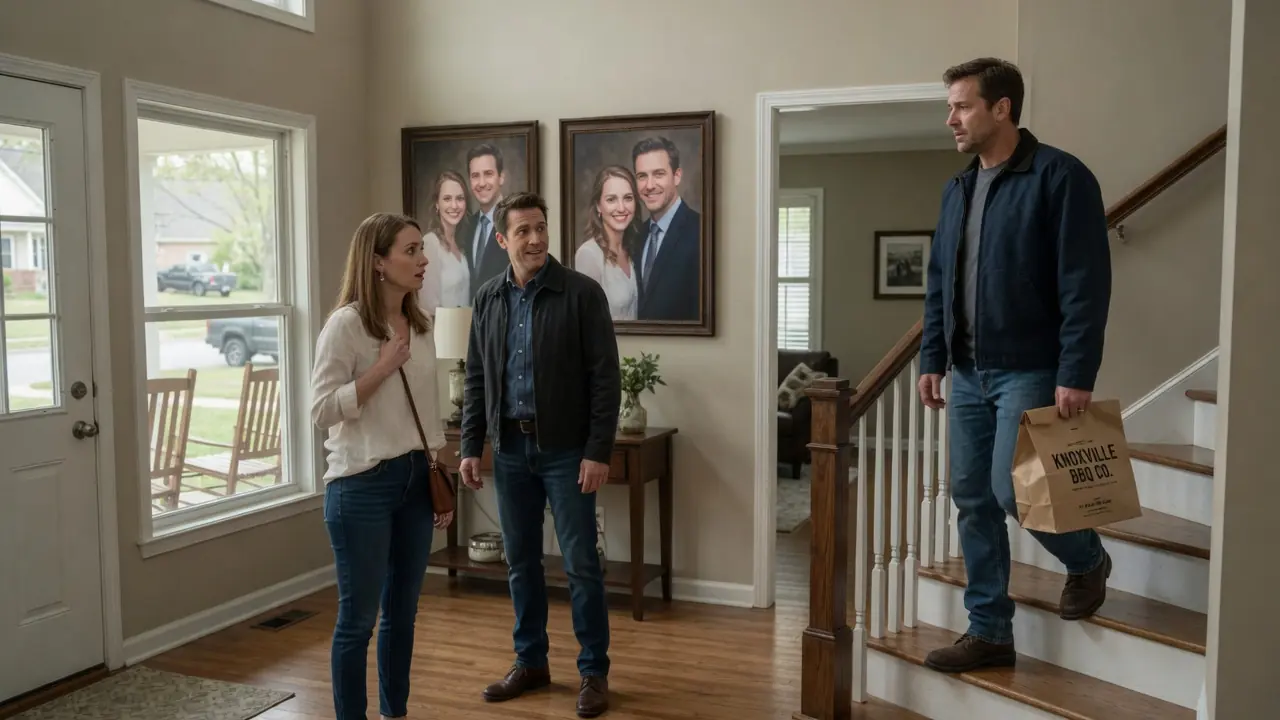
The house behind her was spotless, almost painfully clean, with beige walls, framed wedding photos, and the faint scent of lemon polish hanging in the air.
She wore a loose white blouse, dark jeans, and the small brown crossbody purse Henry had bought her during their anniversary trip to Asheville.
For a moment, she looked like the same woman in the photographs on the wall, smiling beside her husband as if loyalty were something permanent.
Brad Miller stood on the porch with a dark jacket slung over his shoulder and a smile far too comfortable for a man entering another husband’s home.
He was a neighbor from two streets over, the kind of man who waved at mailboxes, borrowed tools he never returned on time, and spoke with the smooth confidence of someone who believed charm could erase consequences. Sarah glanced past him toward the quiet street, then pulled the door wider.
“Come in quickly,” she whispered, her voice low and sharp with nerves.
Brad stepped inside without hesitation.
The front door clicked shut behind him.
The sound was soft, almost harmless, but it landed in the hallway like a confession.
Above them, two wedding portraits hung in matching dark wooden frames. Henry and Sarah smiled beneath spring light, Henry’s arm around her waist, Sarah’s hand resting on his chest. Brad looked at the photographs and gave a small laugh, not loud enough to be cruel, but careless enough to be ugly.
Sarah turned toward him quickly.
“Don’t,” she said. “Not here.”
Brad raised both hands, still smiling, as if he had done nothing wrong.
“Relax, Sarah. He won’t be home for hours.”
She wanted to believe that so badly that she ignored the uneasy feeling pressing under her ribs.
Henry Carter was supposed to be at work until seven that evening.
At forty-two, Henry had built his life around routine, patience, and quiet responsibility. He managed night inventory at a regional warehouse outside Knoxville, Tennessee, a job that was not glamorous but paid the mortgage and kept the bills from swallowing them whole. He was the kind of husband who remembered oil changes, carried groceries in one trip, and still kissed his wife’s forehead before leaving for a long shift.
That morning, before he left, he had stood in the kitchen drinking black coffee while Sarah scrolled through her phone.
“You sleep okay?” he asked.
“Fine,” she said, not looking up.
“You seemed restless.”
“Just a headache.”
He nodded because he had learned not to push too early in the morning. Sarah hated being questioned before coffee, and lately almost everything sounded like questioning to her. He rinsed his mug, set it in the sink, and paused near her chair.
“I might be late tonight,” he said. “New shipment came in wrong.”
She glanced up then, but only briefly.
“Okay.”
There had been a time when she would have said, Be careful driving home. Or, I’ll save you dinner. Or, Don’t work yourself into the ground, Henry. That morning, she only looked back down at her phone.
He kissed the top of her head anyway.
“Love you.”
“Love you too,” she said, but the words came out distracted, like a receipt printed after the purchase had already been forgotten.
Henry told himself not to take it personally.
Marriage had seasons.
That was what he believed.
Not every quiet month meant something was dying. Not every distant look meant betrayal. Sometimes bills, schedules, stress, and ordinary exhaustion could make two people feel like strangers walking through the same house. Henry had been trying to be patient with that.
He had not known patience was about to become the thing Sarah mistook for blindness.
At the warehouse that day, the computer system crashed just after eleven.
At first, everyone assumed it would come back online quickly. Men stood around forklifts, checking phones, drinking bad coffee from the break room, and making jokes about technology being more fragile than cardboard boxes. Henry helped troubleshoot with his supervisor, but by noon, the system was still down, inventory counts could not be verified, and shipments were delayed until the next morning.
“Go home,” his supervisor finally said. “Nothing useful is happening today.”
Henry should have been annoyed about the lost hours.
Instead, he felt a small lift in his chest.
An unexpected afternoon.
A rare one.
He thought of Sarah at home, maybe still dealing with her headache, maybe surprised to see him. They had been strained lately, yes, but not broken. At least that was what he kept telling himself. He could stop by Miller’s Barbecue, her favorite place, and bring home lunch.
A small gesture.
Nothing dramatic.
Just pulled pork with extra pickles, the way she liked it.
He drove there with the radio low and ordered two sandwiches, coleslaw, and sweet tea. While he waited, he checked his phone. No messages from Sarah. That was normal enough, though something about it felt less normal than it used to.
The young woman at the counter handed him the paper bag.
“Smells good,” she said.
“My wife’s favorite,” Henry replied.
He said it with a quiet pride that embarrassed him later.
On the drive home, the takeout bag sat warm on the passenger seat. The smell filled the truck, rich and smoky, and for the first time in weeks, Henry felt hopeful. Maybe Sarah would smile when she saw it. Maybe they would sit on the back porch and eat together. Maybe he would tell her he missed her without making it sound like an accusation.
Maybe they could find their way back to each other.
Then he turned onto their street.
Brad Miller’s gray sedan was parked half a block away beneath the large oak tree near the Hendersons’ empty lot.
Not in front of Henry’s house.
Not in Henry’s driveway.
Not anywhere a guest would normally park.
Henry slowed for only a second, but his whole body seemed to notice at once. His hands remained steady on the wheel. His breathing did not change. Yet inside him, something old and instinctive became alert.
He knew Brad’s car.
Everyone in the neighborhood knew Brad’s car.
Brad liked to keep it spotless. He washed it every Saturday morning in his driveway, shirt sleeves rolled up, laughing with neighbors, making casual comments about interest rates, football, home repairs, and whatever else made him sound useful.
Brad and his wife, Lisa, had moved into the neighborhood four years earlier. Lisa was quiet, practical, and kind in a guarded way. Brad was the opposite. He was always present, always charming, always too ready to help with someone else’s fence, grill, or garage door.
He had borrowed Henry’s power drill twice.
Returned it late twice.
Henry had never liked him much, but dislike was not suspicion. Some people simply rubbed wrong against the grain. Brad had always been one of those people.
Still, Brad’s car beneath the oak tree made no sense.
Henry drove past it, pulled into his own driveway, and turned off the engine.
The house looked peaceful from outside.
Trimmed hedges.
Clean windows.
Two rocking chairs on the porch because Sarah had insisted they made the place feel Southern, though neither of them ever sat there for more than ten minutes. The front door wreath was new. Sarah had bought it the previous weekend and said the old one looked tired.
Henry picked up the takeout bag and walked toward the front door.
Before he reached it, he saw movement through the narrow glass panel beside the door.
He stopped.
Sarah was standing in the entryway, facing Brad.
They were too close.
Close enough that Henry did not need to hear a single word to understand the shape of the moment. Brad leaned forward slightly, smiling in that lazy, confident way Henry had seen at neighborhood cookouts. Sarah’s face was tense, but she did not step away.
Henry stood with his key in his hand and the barbecue bag warming his fingers.
Through the glass, Brad reached toward Sarah’s wrist.
She let him.
Not long.
Not dramatically.
But long enough.
Henry watched another man touch his wife beneath the wedding photographs on the wall.
For one wild second, anger rose in him so fast it seemed to empty the air from his lungs. He imagined throwing the door open, shouting until the whole street came running, demanding answers from both of them while the barbecue went cold on the porch.
But then Sarah turned her head slightly, and Henry saw something worse than passion on her face.
He saw familiarity.
This was not surprise.
This was not a mistake that had happened once.
This was not a moment that slipped out of control before anyone understood where it was going.
The way Brad stood in that hallway told Henry everything.
This man had been inside before.
Henry stepped back from the door without making a sound.
He walked to the side of the house, set the takeout bag carefully beside the trash bin, and stood there with his eyes closed.
His chest hurt.
But he did not cry.
The pain was too fresh for tears, too clean and sharp, like glass that had not yet drawn blood.
He got back into his truck and drove away before either of them knew he had come home.
He drove for nearly an hour with no direction except away.
Past gas stations, pawn shops, churches, strip malls, diners, tire shops, storage units, and rows of houses belonging to people who might be lying to each other too. At a red light, he looked down at his wedding ring and laughed once, a small broken sound that startled him.
Then he stopped laughing.
A decision formed slowly, colder than anger.
Henry would not beg.
He would not shout.
He would not give Sarah and Brad the satisfaction of turning him into the angry husband they could blame later.
If they had built their secret inside his home, then he would answer with silence, patience, and proof.
When Henry returned home that afternoon, Brad’s car was gone.
Sarah was in the kitchen wiping down the counter with frantic little circles, even though the counter was already clean. She looked up when he entered, and her smile appeared half a second too late.
“You’re home early,” she said, trying to sound casual.
“System went down at work,” Henry replied.
His voice came out calm.
Almost gentle.
Sarah nodded too quickly and turned toward the sink, pretending to rinse a glass. Henry watched her shoulders rise and fall. For years, he had believed he knew every version of his wife. Now he was looking at a stranger wearing familiar perfume.
“I thought I’d surprise you with lunch,” he said.
Sarah froze for a moment.
Then she glanced toward his empty hands.
“Oh,” she said. “Where is it?”
Henry looked at her for a long second.
“I lost my appetite.”
Her hand tightened around the glass.
“Are you okay?”
He almost laughed.
Instead, he said, “Just tired.”
That was a useful word.
Sarah had used it often enough lately.
That night, she acted like nothing had happened.
She made pasta. She asked about work. She complained about a neighbor’s barking dog. She even touched Henry’s arm while passing him a plate, and the touch felt so ordinary that it nearly made him sick.
Henry answered when he needed to and smiled when silence would have looked suspicious.
Every word between them felt like furniture arranged over a cracked foundation.
After dinner, Sarah went to the bedroom and stayed there with her phone. Henry sat in the living room beneath their wedding portraits and stared at the hallway where he had seen her with Brad.
The house was quiet, but not peaceful anymore.
It felt like a stage after the actors had left, with all the props still in place and the lie still hanging in the air.
Henry did not sleep much.
At 2:13 a.m., he got out of bed and walked barefoot through the hallway. Sarah slept facing away from him, her phone under her pillow. That detail alone would have meant nothing months earlier. Now it felt like another receipt from a life he had not known he was paying for.
He stood beneath the wedding portraits.
The first one showed them outside the church eight years earlier. Sarah laughing because the wind had caught her veil. Henry looking at her as though the whole world had narrowed to one person.
In the second photograph, they were dancing at the reception, her cheek against his shoulder, his eyes closed.
He remembered that dance.
He remembered whispering, “I’ve got you.”
She had whispered back, “Always?”
And he had said, “Always.”
Henry stood there in the dark and understood that one person’s always could not carry two people forever.
The next morning, he called in sick.
Sarah left at ten for what she called errands, though she dressed better than errands required. She wore fitted jeans, a cream sweater, small gold earrings, and perfume Henry had bought her last Christmas. She kissed his cheek on the way out.
“I won’t be long,” she said.
“Take your time,” Henry replied.
She smiled, relieved by his calm.
He watched through the front window as her car disappeared down the street.
Then he picked up a notebook and began walking slowly through the house.
He did not break anything.
He did not search wildly.
He did not pull drawers onto the floor or tear apart closets like a man in a movie.
Henry moved through each room like a man counting what was already missing.
The basement door had been locked lately, supposedly because Sarah was sorting old decorations. The guest towels were washed twice a week even though they had no guests. There was a faint smell of unfamiliar cologne near the hallway, subtle but real. One of his coffee mugs, the blue one Sarah never used, sat drying near the sink.
He wrote everything down.
Not because each detail proved something alone.
Because betrayal revealed itself in patterns.
In the bedroom, he found the first hard piece.
A receipt tucked behind Sarah’s jewelry tray, folded so tightly it might have been hidden by guilt alone.
It was from a small hotel outside town.
One room.
One night.
Paid in cash.
Dated two weeks earlier.
Henry stared at it until the numbers blurred. Then he took a photo and placed it exactly where he had found it.
He was learning that betrayal leaves fingerprints everywhere, especially when the betrayer believes the victim is too trusting to look.
Over the next week, Henry became the perfect husband.
He brought home groceries without being asked. He listened when Sarah talked. He kissed her cheek before work and asked if she needed anything from town. He cleaned the gutters Saturday morning and fixed the loose handle on the pantry door.
Sarah relaxed little by little.
She mistook his calm for ignorance.
Behind that calm, Henry built a wall of evidence.
He checked bank statements.
Phone records on their shared plan.
Calendar patterns.
The doorbell camera footage from the small security system they had installed the previous winter after packages went missing from the porch.
He did not need private humiliation.
He did not need to follow anyone into a hotel.
He did not need to turn himself into a man who lost sleep outside windows.
He needed enough to prove what Sarah would deny.
Brad appeared more often than Henry expected.
His gray sedan passed their street at strange hours, sometimes circling the block before parking under the oak tree. Once, the doorbell camera caught his shoulder and the edge of his face as Sarah opened the door. Another time, a reflection in the hallway mirror showed him entering while Sarah laughed softly, the wedding photos visible behind them like witnesses.
Henry saved everything in three places.
A secure drive.
A private email folder.
Printed copies placed in a folder at work.
The more he gathered, the quieter he became.
His anger did not disappear. It changed shape. It hardened into something controlled, something that no longer needed volume to become dangerous.
On Friday, Henry met with a divorce attorney named Marlene Brooks in a glass-walled office downtown.
She was in her late fifties, sharp-eyed, plainspoken, and impossible to impress. Her office was tidy, with no sentimental decorations except one framed photograph of a golden retriever on her bookshelf.
Henry sat across from her and placed the folder on the desk.
“I need to know what my options are,” he said.
Marlene read in silence.
She looked at the hotel receipt, the doorbell images, the phone records, the financial statements, and Henry’s handwritten timeline. When she finished, she removed her glasses and studied him carefully.
“You’re calmer than most people who sit in that chair.”
“I’m not calm,” Henry replied. “I’m just finished being careless.”
Marlene nodded, as if that answer made more sense than tears.
She explained the process clearly: legal separation, financial protection, documentation, property division, and what he should not do under any circumstances.
“Do not threaten her,” she said. “Do not confront him physically. Do not give them a story where you become the villain.”
Henry listened to every word.
That last sentence stayed with him all the way home.
Do not give them a story where you become the villain.
He realized then that his revenge would not be loud.
It would be clean, legal, and impossible to twist.
Two days later, Sarah told Henry she wanted to host a small dinner at the house.
She said it might be good for them to reconnect, invite a few neighbors, make things feel normal again.
Henry almost laughed at the word normal.
Instead, he nodded.
“Sure,” he said. “Let’s make it special.”
Sarah seemed relieved.
She invited Brad and his wife, Lisa, along with two other couples from the neighborhood. Henry watched her type the messages with careful innocence. She did not know that Lisa had already called Henry three days earlier.
Lisa Miller was not stupid.
She had noticed the same patterns from the other side.
Brad’s sudden errands.
His guarded phone.
His new attention to clothes.
The way he stepped outside to answer calls that lasted only seconds.
The way he came home smelling faintly of lemon polish.
When Henry contacted her gently, offering proof but not pressure, Lisa went silent for a long time.
Then she said, “Send me what you have.”
Henry did.
Not everything.
Enough.
By the time Sarah planned the dinner, Lisa knew enough to attend for one reason only.
She wanted to see Brad lie to her face one last time.
Henry and Lisa agreed on boundaries.
No screaming.
No public cruelty.
No children present.
No physical confrontation.
No drama beyond the truth itself.
The truth would do enough damage on its own.
The dinner took place on a Saturday evening.
Sarah set the table with white plates, cloth napkins, and the blue glass candleholders she used whenever she wanted the house to look warmer than it felt. She wore the same white blouse Henry had seen her wearing the day Brad came in.
Henry wore a dark button-down shirt and moved through the house helping calmly, as if he were preparing for guests instead of the end of his marriage.
Brad arrived with Lisa at six-thirty.
He smiled too broadly when Henry opened the door.
“Good to see you, man,” Brad said, clapping him lightly on the shoulder.
Henry looked at Brad’s hand.
Then at his face.
“Come in.”
Sarah greeted Lisa with a hug that made Lisa’s jaw tighten.
Lisa smiled anyway, controlled and unreadable.
The other neighbors arrived soon after, filling the house with ordinary sounds: greetings, laughter, chairs scraping, ice dropping into glasses. To anyone watching from outside, it looked like a normal dinner among friends.
But Henry noticed everything.
Sarah avoiding Brad’s eyes too carefully.
Brad glancing at her whenever he thought no one was looking.
Lisa turning her wedding ring slowly around her finger.
The whole room seemed balanced on a thin piece of glass, and Henry was the only one holding the hammer.
For the first hour, they ate and talked.
Sarah served roast chicken, green beans, and mashed potatoes with a brightness that almost looked real. Brad told a story about a difficult client and made everyone laugh. Henry laughed too, softly, at exactly the right moment.
He had never understood until then how easy performance was once the heart had stepped out of the room.
After dinner, Sarah began clearing plates.
Henry stood and said, “Leave them for a minute.”
The room quieted just slightly.
Sarah looked at him with confusion.
“Henry, what are you doing?”
“I want to show everyone something.”
His voice was calm enough that no one moved.
He walked to the living room console and picked up a slim folder and a small remote. The television screen on the wall lit up, showing not a video at first, but a simple photograph of Henry and Sarah on their wedding day.
Sarah’s face softened with surprise.
Then suspicion.
“Henry,” she said, forcing a laugh. “What is this?”
Henry looked at the picture for a moment.
“This was taken eight years ago,” he said. “I used to think it was the happiest day of my life.”
The room became still.
Brad leaned back in his chair, smile fading.
Lisa looked straight ahead.
Sarah’s hand tightened around the back of a dining chair.
Henry clicked the remote.
The wedding photo changed to a doorbell camera image of Brad stepping into Henry’s house.
The timestamp glowed in the corner.
No one spoke.
Sarah’s face drained of color so quickly that she seemed to shrink in place.
Henry clicked again.
A second image appeared.
Then a third.
Brad’s car parked beneath the oak tree.
Sarah opening the front door.
The reflection in the hallway mirror.
The hotel receipt.
The evidence moved across the screen in clean, silent order.
There was no shouting.
No insult.
No performance.
That made it worse.
Brad stood abruptly.
“Turn that off.”
His voice cracked on the last word.
Henry looked at him with cold patience.
“Sit down, Brad.”
“You have no right,” Brad snapped.
Lisa finally turned toward him.
“No,” she said quietly. “He has every right.”
Brad looked at his wife, and for the first time that night, he seemed to understand that the trap had not been built for Sarah alone.
Sarah stepped toward Henry, tears already forming.
“Please,” she whispered. “Not like this.”
Henry looked at her, and the sadness in his eyes was deeper than anger.
“You invited him into our home, Sarah. You stood under our wedding photos with him. You don’t get to choose the room where the truth comes out.”
One of the neighbors pushed back from the table, uncomfortable but unable to look away.
Another lowered her eyes, embarrassed for everyone.
The living room light shone evenly over them all, turning the clean suburban home into a place of judgment.
Sarah covered her mouth with one trembling hand.
Henry clicked one final time.
A document appeared on the screen.
Not a photograph.
A legal filing.
Petition for dissolution of marriage.
Sarah stared at it as if the words were written in a language she had never learned.
“Henry,” she said, her voice breaking. “You already filed?”
He nodded.
“This afternoon.”
Brad cursed under his breath and grabbed his jacket.
Lisa stood at the same time, but not to follow him blindly. She placed a folder of her own on the table.
“Mine is filed Monday,” she told him. “And you can explain to your lawyer why your messages are already printed.”
Brad looked around the room, searching for sympathy and finding none.
The same confidence he had brought into Henry’s house collapsed into panic.
“This is insane,” he said. “You two planned this?”
Henry answered before Lisa could.
“No, Brad. You planned it. We just stopped being the last people to know.”
That sentence landed harder than any shout.
Sarah began crying openly now, but Henry did not move to comfort her.
Once, he would have crossed the room for the smallest tremble in her voice. Once, he would have forgiven a sharp word, a forgotten promise, a bad day stretched too far.
But this was not a bad day.
This was a secret life built inside the home he had paid for with years of labor and faith.
The guests left quietly, one couple at a time.
No one asked for details.
No one tried to defend Sarah.
No one touched the roast chicken still cooling on the table.
The door closed behind the last neighbor, and the house returned to silence.
Sarah stood in the middle of the living room, mascara streaking her cheeks. Brad was gone, chased out not by fists or threats, but by the full weight of exposure. Lisa had left separately, calm and pale, carrying her folder like a woman carrying proof of her own escape.
Henry turned off the television.
“Are you proud of yourself?” Sarah asked suddenly.
Her voice was sharp now, desperate for a way to make him cruel.
“You embarrassed me in front of everyone.”
Henry looked at her for a long moment.
“No,” he said. “You embarrassed yourself. I just stopped hiding it for you.”
She flinched as if the words had struck something deeper than pride.
“I made a mistake,” she said.
Henry shook his head.
“A mistake is forgetting an anniversary. A mistake is saying something ugly in an argument. You opened the door for him more than once.”
Sarah looked toward the hallway.
Toward the wedding pictures.
“I was lonely,” she whispered.
Henry’s face changed then, not softening exactly, but closing with finality.
“So was I,” he said. “But I didn’t bring someone else into our home.”
That was the sentence that ended the conversation.
Sarah tried to speak again, but nothing useful came out. Henry walked upstairs, took the suitcase he had already packed from the guest closet, and carried it down.
Sarah watched him as if the sight of the suitcase hurt more than the divorce papers.
“You’re leaving tonight?”
“Yes.”
“Where will you go?”
Henry paused at the front door.
“Somewhere that doesn’t ask me to pretend.”
He stayed at a small hotel near the interstate for the next week.
The room was plain, with stiff pillows, beige curtains, and a humming air conditioner, but it was honest. No wedding photos looked down at him there. No one lied in the hallway.
The first night, Henry sat on the edge of the bed and waited for grief to arrive cleanly.
It did not.
It came in pieces.
Rage while brushing his teeth.
Shame while turning off the lamp.
Sadness when he realized he did not need to text Sarah goodnight.
Betrayal did not arrive like a storm and then pass. It lingered like smoke in clothes.
Sarah called twenty-three times in two days.
Henry did not answer.
She sent messages that moved from apology to blame to panic and back again.
Henry, please.
Brad meant nothing.
I was confused.
You humiliated me.
We can fix this.
I still love you.
Henry forwarded every message to Marlene Brooks.
He stopped reading them after the fourth one.
Love, he was learning, could become a word people used when consequence finally arrived.
It did not mean the same thing as loyalty.
Brad tried a different approach.
He sent Henry one message from an unknown number.
You ruined my marriage over something that wasn’t your business.
Henry read it twice, then showed it to Lisa and Marlene.
Lisa replied to Brad herself with one sentence.
You ruined your marriage when you walked into another man’s house.
Within a month, the neighborhood knew enough.
People did not say much directly to Henry, but they became gentler with him. Mrs. Alvarez from across the street left a casserole at the hotel front desk with a note that said, You deserved better. A man from two houses down offered to help him move his tools from the garage.
Even silence changed shape around him.
Sarah stayed in the house for a while, but she stopped opening the curtains.
The same windows that once framed her carefully polished life now made her feel watched. Brad moved out of his house after Lisa changed the locks through her attorney. The oak tree where he used to park became a neighborhood landmark no one mentioned by name.
The divorce was not quick, but it was clean.
Henry had prepared too well for confusion. The evidence did not give him everything, but it protected him from being painted as unstable, cruel, or unreasonable. Sarah’s attorney tried to argue that Henry’s dinner reveal was unnecessary, but Marlene simply placed the timeline on the table and said, “My client chose witnesses because your client chose secrecy.”
In mediation, Sarah looked smaller than Henry remembered.
She wore a gray sweater, no necklace, no wedding ring. For a second, he saw the woman from the photographs again, the one who had danced barefoot in their first apartment and cried when they adopted their first rescue dog.
Then she looked away, and the memory released him.
During a break, Sarah found Henry standing near the window with a paper cup of bad coffee in his hand.
“I never thought you would really leave,” she said.
Henry did not look at her right away.
“That was the problem.”
She swallowed.
“I thought you loved me enough to fight for us.”
He turned then.
“I loved you enough to come home early with your favorite lunch.”
Her eyes filled.
“I know.”
“No,” he said quietly. “You know now.”
That sentence ended the break.
By winter, the house was sold.
Henry did not keep the wedding portraits. He placed them in a box with Sarah’s remaining things and left them for her to collect. The new owners painted the entryway pale green and removed the old frames from the wall.
Henry was grateful when he heard that from the realtor, though he did not say why.
He moved into a smaller brick rental on the other side of town.
It had hardwood floors, a narrow kitchen, and a porch that caught the morning sun. He bought only what he needed at first: a bed, a table, two chairs, and a coffeemaker. The emptiness felt strange, but not lonely in the same way the marriage had become lonely.
There is a kind of loneliness that comes from being alone.
There is another kind that comes from sitting beside someone who is already gone.
The first kind hurt.
The second had nearly swallowed him.
Lisa Miller became an unexpected friend.
They did not become lovers, not the way gossip might have wanted. They met sometimes for coffee, speaking honestly about lawyers, shame, anger, and the strange humiliation of being betrayed by people who expected forgiveness as a convenience.
There was comfort in being understood without having to explain every wound.
One afternoon, Lisa sat across from Henry in a small coffee shop near downtown Knoxville, stirring tea she had not tasted.
“Do you ever feel stupid?” she asked.
Henry looked at her.
“Yes.”
She nodded.
“Me too.”
“We weren’t stupid.”
“I know that in my head.”
“Harder everywhere else.”
She gave a small laugh.
“That’s exactly it.”
Henry looked out the window.
A couple walked by holding hands, laughing at something private. Months earlier, the sight would have cut him open. That day, it only made him quiet.
“I keep thinking about the little things,” Lisa said. “Brad saying he needed gas when the tank was full. Changing his phone password. Buying a new shirt and saying it was on sale.”
Henry nodded.
“Sarah started polishing the entryway table every day.”
Lisa looked at him.
“What?”
“The table under our wedding photos. I didn’t understand it then.”
“Now?”
“I think she was cleaning the evidence she could smell but not see.”
Lisa exhaled slowly.
“God.”
They sat in silence for a while.
Then Lisa said, “I hate that I miss who I thought he was.”
Henry looked back at her.
“I think that’s the person we grieve most.”
Their divorces finalized within two weeks of each other.
Brad’s went worse.
Lisa had more financial evidence than Henry realized, including money Brad had moved quietly and messages that proved he had lied about business expenses. Brad tried charm first, then anger, then self-pity. None of it worked as well in legal documents as it had at backyard cookouts.
Sarah signed the final paperwork with trembling hands.
At the courthouse, she stopped Henry near the exit.
“Will you ever forgive me?”
Henry looked at the woman he had once promised always to protect.
“I hope so,” he said.
Hope flickered in her face.
He continued.
“But forgiveness is not a bridge back to the life you burned.”
Her face fell.
He did not say it to be cruel.
He said it because she still seemed to think regret was a key.
Some doors cannot be unlocked by the person who set the fire.
Months passed.
Henry worked.
He slept badly, then better.
He learned to cook for one without making too much. He bought a small radio for the kitchen because silence felt too large at night. He started walking in the mornings before work, first around the block, then farther, until he knew which neighbors watered plants early and which dogs barked at everyone equally.
He went to therapy because Marlene Brooks, without looking up from a document, once said, “You can win the divorce and still lose yourself afterward if you don’t get help.”
Henry did not like therapy.
He liked it even less when it worked.
His therapist, Dr. Paulsen, asked questions Henry had avoided.
“What did you feel before you saw them?”
“Tired.”
“Only tired?”
Henry frowned.
“Lonely.”
“And did you tell Sarah that?”
He looked down.
“Not clearly.”
“Why?”
“Because I thought if I worked harder, stayed patient, and didn’t add pressure, she would come back to me.”
Dr. Paulsen nodded.
“And what did you learn?”
Henry took a long breath.
“That silence can look like love when it’s really fear.”
It was not an excuse for Sarah.
It was a truth about himself.
He began to understand that healing did not mean pretending he had done everything perfectly. It meant separating his flaws from Sarah’s betrayal. He could own his silence without owning her affair. He could regret not speaking sooner without accepting blame for another man standing in his hallway.
That distinction saved him.
One evening, nearly six months after the dinner, Henry returned to the old neighborhood to pick up a forwarded package from Mrs. Alvarez.
He parked beneath the same oak tree where Brad had once hidden his car.
The sight no longer made his chest tighten.
It only reminded him of how quietly people sometimes destroy what others spent years building.
Mrs. Alvarez hugged him at the door.
“You look better,” she said.
Henry smiled.
“I think I am.”
She handed him the package and a small paper bag of cookies.
“For the road,” she said, pretending not to be emotional.
As Henry walked back to his truck, he looked once at the house he used to own.
The porch chairs were gone.
The curtains were different.
A child’s bicycle leaned near the garage, bright red against the driveway.
For the first time, Henry felt no claim over the place.
It was not his home anymore, and maybe that was a mercy. The betrayal had happened there, but it had not ended him there. He had walked away before the lie could teach him to hate himself.
His phone buzzed as he started the truck.
A message from Sarah.
The first in weeks.
I know you may never forgive me, it said. But I am sorry for what I brought into our home.
Henry read the message once.
He did not feel the old surge of anger.
He did not feel the desperate need to answer either.
After a moment, he deleted it.
Some apologies arrive too late to repair anything, but that does not make them meaningless. Henry hoped Sarah meant it, not because he wanted her back, but because truth should change a person if it arrives hard enough.
Still, her regret was no longer his responsibility.
Her loneliness was no longer his assignment.
He drove home through the quiet streets of Knoxville, past porch lights, closed diners, and families settling into their evenings. His new place waited for him with its narrow kitchen and honest silence. There would be no dramatic victory waiting there, no crowd applauding, no perfect ending wrapped in justice.
But there would be peace.
That was what Sarah and Brad had never understood.
Henry’s silence had not been weakness.
It had been the space where he gathered his dignity, counted the cost, and chose a revenge that left his hands clean.
They expected him to break in front of them.
Instead, he let the truth stand up straight.
A year later, Henry saw Lisa again at a fall festival downtown.
They had not met for coffee in months. Life had slowly pulled them in different directions, which felt healthy rather than sad. She looked well. Her hair was shorter, her smile easier. She was standing near a booth selling handmade candles, holding a paper cup of cider.
“Henry Carter,” she said.
“Lisa Miller.”
She raised an eyebrow.
“Not Miller anymore.”
He smiled.
“Right. Lisa Grant again?”
“Lisa Grant again.”
They walked together through the festival for half an hour, speaking like old soldiers from a quiet war. Brad had moved to another county. Sarah had taken a job in Nashville and was renting an apartment there. Neither of them said their ex-spouses’ names with the same sharpness as before.
That felt like progress.
“Are you happy?” Lisa asked.
Henry considered the question.
“I’m peaceful.”
“That may be better.”
“I think so.”
She touched his arm before leaving.
“You deserved better than what happened.”
“So did you.”
“Yes,” she said. “We did.”
Then she walked away, not as a possible new romance, not as a symbol, but as a person who had survived her own version of the same storm.
Henry watched her disappear into the crowd and felt grateful without needing anything else from her.
That winter, Henry bought a small house of his own.
Not large.
Not impressive.
A two-bedroom place with a sloped yard, old oak floors, and a front porch just wide enough for one rocking chair. The kitchen needed work. The bathroom tile was outdated. The garage door complained every time it opened.
He loved it immediately.
On moving day, Mrs. Alvarez’s husband helped carry boxes. A coworker brought a borrowed truck. Henry’s younger sister, June, drove in from Chattanooga with chili, paper plates, and her two loud teenagers.
For the first time in years, Henry heard real laughter in a house where he lived.
That night, after everyone left, he stood in the hallway and looked at the blank walls.
No wedding photos.
No staged proof of happiness.
No polished surface hiding rot beneath it.
Just walls.
Empty.
Waiting.
He slept well that night.
Months later, he finally opened the box he had avoided since the move. It contained old things from his marriage: a Christmas ornament from their first year, a photo booth strip from Nashville, a postcard Sarah sent him during a work trip back when her messages still felt warm.
At the bottom was a small note she had written on their fifth anniversary.
Henry,
Thank you for making ordinary days feel safe.
Love, Sarah
He sat with that note for a long time.
Then he did something he had not been able to do before.
He grieved the good without using it to excuse the bad.
The woman who wrote that note had existed.
The woman who opened the door for Brad had existed too.
One did not erase the other.
But one could not save him from the other anymore.
He placed the note back in the box, closed it, and carried it to the closet.
Not the trash.
Not the mantle.
The closet.
Some memories do not need display or destruction.
They only need a place where they no longer run the house.
Two years after the dinner, Henry ran into Sarah at a grocery store in Knoxville.
She had moved back recently, he had heard, though not to their old neighborhood. She looked different. Less polished. Her hair was shorter, and she wore no makeup except mascara. She stood near the produce section holding apples in a paper bag.
For a second, they simply looked at each other.
“Henry,” she said.
“Sarah.”
“How are you?”
He could hear the carefulness in the question.
“I’m good.”
“I’m glad.”
He believed her.
That surprised him.
She looked down at the apples.
“I’m not going to make this awkward. I just wanted to say something, if that’s okay.”
He nodded.
She took a breath.
“I used to tell myself what happened was because I was lonely. Because we were distant. Because Brad made me feel seen. I know now those were explanations I used so I didn’t have to say I was selfish.”
Henry said nothing.
Sarah’s eyes filled, but she kept her voice steady.
“I brought him into our house because I thought you would never find out. And I thought if you did, you would forgive me because that’s what you always did. That was cruel of me.”
A long silence passed.
Henry felt the old ache, but it no longer owned him.
“Thank you for saying that,” he said.
She nodded.
“I’m sorry, Henry.”
“I know.”
She looked at him, perhaps hoping for more.
He had no more to give.
But he did not need to punish her either.
“I hope you build an honest life,” he said.
Her face crumpled slightly.
“I’m trying.”
“Good.”
They parted near the apples.
No hug.
No dramatic forgiveness.
No rekindled affection.
Only two people standing in the aftermath of choices, one freer than before, one finally speaking truth without demanding reward.
Henry left the store and sat in his truck for a minute before driving away.
His hands did not shake.
That was how he knew healing had entered quietly.
Not with triumph.
With steadiness.
Years later, if someone asked Henry what ended his marriage, he rarely mentioned the dinner first.
He mentioned the barbecue.
The warm paper bag on the passenger seat.
The hope he carried home.
The gray sedan under the oak tree.
The narrow glass panel beside the front door.
The sight of Brad Miller standing beneath Henry’s wedding photos as if the house had already decided who belonged there.
Because that was the real ending.
The dinner only made the truth public.
The marriage ended in silence on the porch, with pulled pork cooling beside the trash bin and Henry stepping backward before anger could make him careless.
He learned many things after that.
He learned that patience without boundaries can become permission.
He learned that calm is not weakness when it is chosen with purpose.
He learned that betrayal does not only break trust in another person. It also challenges your trust in your own judgment, and rebuilding that takes longer than signing papers.
He learned that a home is not made by clean windows, matching plates, or wedding portraits on the wall.
A home is made by honesty.
Without that, even the prettiest hallway becomes a stage for lies.
By the time Henry reached his porch on the third anniversary of the night everything changed, the sky had turned deep blue. He carried a bag of groceries inside, set a small barbecue sandwich on the counter, and turned on a lamp.
The room filled with quiet light.
For the first time in a long time, silence did not feel like betrayal.
It felt like freedom.
Henry sat at his small kitchen table and ate dinner slowly.
No performance.
No pretending.
No one asking him to ignore what stood right in front of him.
Outside, Knoxville settled into evening.
Inside, Henry Carter understood something final and clean.
Sarah had opened the door to another man.
But Henry had opened the door to the truth.
And only one of those doors had led to freedom.