“Daddy?”
The word came from the little girl standing at the end of the hallway, but it sounded more like a question than a greeting.
Daniel Brooks dropped his duffel bag beside the front door. He had imagined this moment for eleven months: the small thunder of running feet, his daughter launching herself at him, her arms wrapping around his neck so tightly that he would have to laugh and tell her he needed to breathe. He had even practiced catching her while standing in the airport, the way a foolish man practices a thing he has been desperate to do.
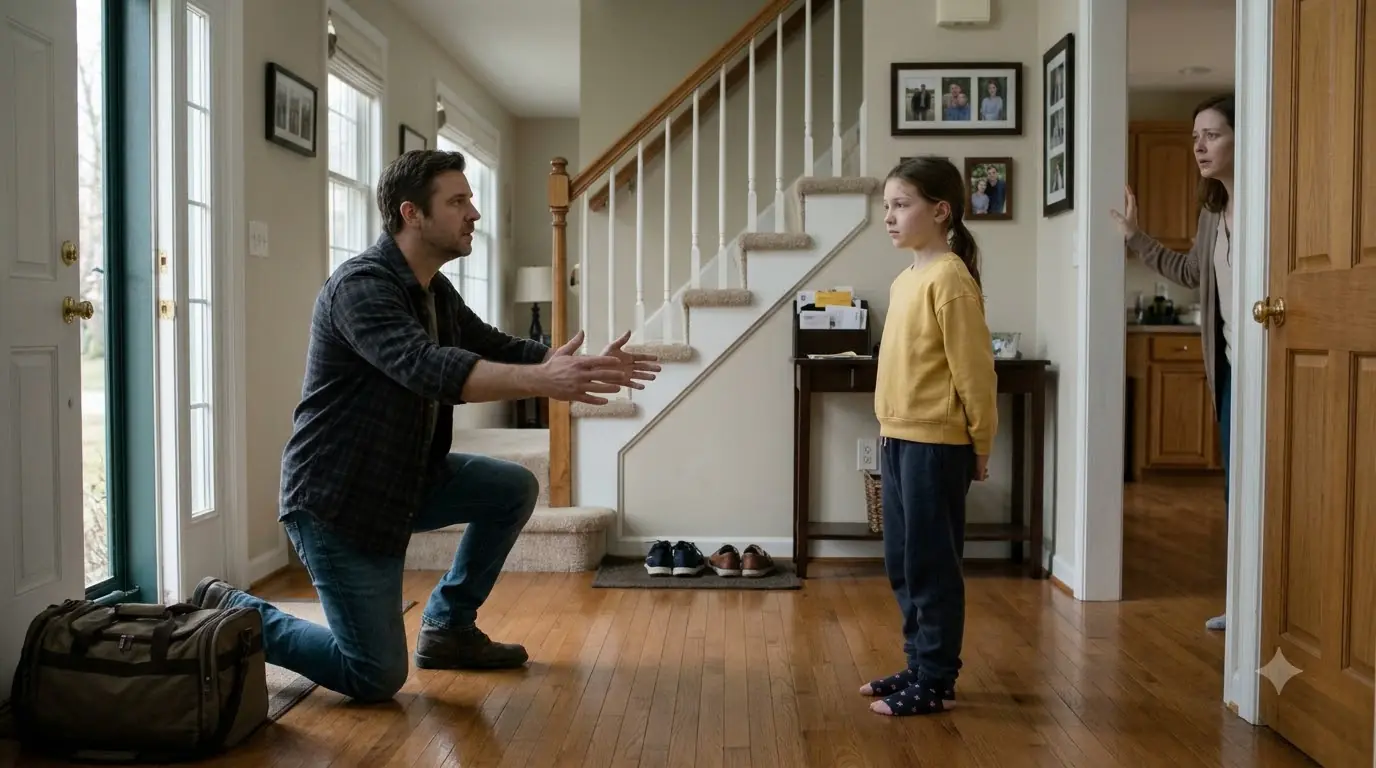
Now eight-year-old Sophie stood twelve feet away in a yellow sweatshirt and socks with pink stars on the heels. She looked taller. Her hair was longer. There was a thin scar near her left eyebrow that he did not recognize. For one glorious second her face lit up, and she ran toward him.
Daniel bent and opened his arms.
Three steps away, Sophie stopped.
Her shoes slid on the hardwood. Her hands went behind her back. The happiness vanished from her expression so quickly that Daniel wondered if he had imagined it.
“Hey, sunshine,” he said, keeping his voice gentle. “It's me.”
“I know.”
He smiled, although something uneasy had started moving inside him. “You can come here.”
Sophie stared at the floor. Then she looked toward the kitchen, where her mother stood in a doorway with one hand against the frame.
“Is he allowed to stay this time?” Sophie asked.
Daniel felt the question strike harder than anything that had happened during the months he was away. He looked at his wife, Claire, expecting confusion, perhaps an awkward explanation that children misunderstood schedules. Instead, Claire's face drained of color.
“Sweetheart,” she whispered.
Sophie stepped backward.
“Because last time,” she said, almost too softly to hear, “they told me the promise wasn't real.”
Daniel straightened slowly. The hallway seemed suddenly longer than it had when he came through the door. He had returned with a wooden toy train in his bag, a postcard from every city he had worked in, and the certainty that his family would be happy to have him home. Standing in front of his daughter, he realized he did not know what had happened inside his own house.
Before he could ask, Sophie turned and went upstairs.
Claire made no attempt to follow her. She just stood in the kitchen doorway, her eyes filled with a grief Daniel had never heard in her voice during their calls.
“What does she mean?” he asked.
Claire opened her mouth, closed it, and looked at the stairs.
“There's something I should have told you.”
Eleven months earlier, the Brooks household had been loud in all the familiar ways.
Sophie had been seven, obsessed with building elaborate towns from cardboard boxes and insisting that each building needed a name. Their kitchen table was often covered with scraps of paper, colored markers, tape, and pieces of string that Daniel found attached to the underside of his work boots. Claire, a speech therapist at the county elementary school, would sigh at the mess and then sit down to help design the town library.
Daniel worked as a bridge and structural repair specialist. Most of his contracts kept him within driving distance of their home in western Pennsylvania. Some required several nights away, but he returned for weekends and rarely missed more than a few consecutive days. He had taught Sophie to ride a bicycle, had built a small bookshelf for her room, and had spent more evenings than he could count sitting on the floor while she explained imaginary city ordinances to him.
He was not a perfect father. He arrived late. He checked his phone during dinner. When the roof leaked, he promised to patch it on Saturday and sometimes did not climb the ladder until Tuesday. But he made breakfast every Sunday, even when he burned the pancakes, and he was the parent Sophie asked to inspect thunderstorms from her bedroom window.
Then a contract came through that promised to change their finances.
The firm Daniel worked for had been awarded an emergency reconstruction project involving a network of storm-damaged bridges and access roads. They needed experienced supervisors willing to travel for an extended period, move between remote sites, and accept unpredictable communication and travel schedules. The pay was more than double his normal earnings, with a substantial completion bonus.
Daniel and Claire had been trying for years to catch up from a complicated stretch of medical bills and a failed home-repair loan. Their mortgage was manageable but unforgiving. Claire had reduced her hours when Sophie's school needed extra support for students who had fallen behind, and Daniel had taken side jobs he was too tired to enjoy.
The contract looked like a solution. He could work hard for one year, pay off the highest-interest debt, repair the roof, and finally give them room to breathe. He told Claire that the sacrifice would be worth it.
She looked at the numbers and agreed.
At first Sophie treated the plan as an adventure. She made a paper calendar and drew a red star on the day Daniel expected to return. They decided he would mail a postcard from every place he traveled. He promised to call as often as he could and told her they would build a train station in their cardboard town when he came home.
The night before he left, Sophie sat cross-legged on her bedroom rug and asked the question that would haunt him later.
“Can you promise you're coming back?”
Daniel stopped folding a shirt. “Of course.”
“But actually promise. Not the kind grown-ups say when they don't know.”
He came over and knelt beside her. “I promise I'll do everything I can to come home when the job is over.”
She frowned. “That's too many words.”
“It's the honest kind.”
She considered this, then reached for his little finger. He hooked his around hers. They sat like that for a moment while the house settled around them.
The following morning she cried so fiercely at the door that Claire carried her inside. Daniel waved through the car window, trying not to cry himself. He told himself her sadness would fade with time, and that the future he was buying with his absence would justify the cost.
For the first two months, the calls came regularly enough. Daniel video-called while Sophie ate dinner or got ready for school. She showed him her cardboard shops, a spelling certificate, and a wobbly bicycle ride that Claire filmed from behind. He sent postcards with short notes written in the rough penmanship Sophie loved teasing.
Then the work spread into harsher terrain. A supply delay stretched their timeline. Several bridges failed additional inspections, changing the schedule and moving crews to another region. Cell signals were unreliable at some locations, and Daniel's workdays became longer. Calls were missed. Letters took weeks. The return date was moved from early summer to late summer and then to autumn.
Each time, Daniel explained the delay to Claire. Each time, he thought she would explain it to Sophie better than he could across a weak connection.
Claire did explain, at first. She made new stars on the calendar. She reminded Sophie that her father was fixing roads people needed and that he was not choosing to be far away because he preferred it. She told her they could still celebrate her birthday when he returned, even if the party happened a month late.
But the child began to change.
At school, Sophie stopped asking other children about their fathers. She did not want to join the class project where students brought pictures of family traditions. She took down the paper calendar from the refrigerator and put it in a drawer. When Daniel's name appeared on Claire's phone, Sophie sometimes ran to the screen. Other times she said she was busy and refused to come downstairs.
Daniel noticed those refusals and assumed they were the natural frustration of being separated. He told Claire not to force the calls. “She'll be okay when I get back,” he said. “I just have to finish.”
Claire wanted to believe him. She was exhausted by getting Sophie ready for school, working, paying bills, managing the house, and answering a hundred questions that never seemed to have a satisfying answer. She was proud of Daniel, and angry at him, and ashamed of being angry because he was working for their future.
Then came the day everything shifted.
It was a Thursday in March. Sophie was at school, working on a spring art assignment, when a teacher announced that one of the children in her class was moving away. The boy had been promised he would return before the new school year, but his parents were not sure. During recess another student said grown-ups always said they would come back because it was easier than saying goodbye.
Sophie pushed him.
Not hard enough to hurt him, but hard enough to alarm the teachers. When the principal asked why she had done it, she said, “Because he was lying.”
Claire was called to the school. She found Sophie seated outside the office with her eyes fixed on her sneakers. The principal spoke carefully about emotional regulation and the need for children to feel safe. Claire took Sophie home early and tried to talk with her over hot chocolate.
Sophie barely spoke until evening. Then she asked whether a promise could stop being true without the person who made it telling you.
Claire did not know how to answer. “Sometimes plans change,” she said.
“Even if you say forever?”
“Even then.”
The child sat in silence. Claire realized later that this was the moment she should have stopped, called Daniel, and found a way to have the three of them talk honestly about the difference between love and a schedule. Instead she tried to comfort Sophie with the words that had comforted her own mother.
“Don't count on a date until somebody's standing at the door.”
She meant that a changed calendar did not mean a broken family. Sophie heard something different. She heard that a promise was a thing you believed only if you were prepared to be disappointed.
That evening, Daniel called from a noisy roadside operations trailer. He was tired, muddy, and excited because one of their bridges had finally reopened. He told Claire another assignment had been added, perhaps six weeks more, but the completion bonus would still be paid. Claire looked at Sophie standing near the refrigerator and asked if they could speak later.
Daniel heard the tension in her voice. “Is everything okay?”
“Sophie had a hard day.”
“Can I talk to her?”
Claire covered the phone and asked. Sophie shook her head.
“She doesn't want to right now.”
“Tell her I love her.”
Claire repeated the words. Sophie went upstairs without answering.
Daniel sat alone for several minutes after the call and told himself he had to finish the job. It felt noble then. It felt like responsibility. He did not understand that responsibility could also become a way of postponing a difficult choice.
A month later, Sophie fell off her bicycle near the cul-de-sac. It was a minor accident that left her with a cut above her eyebrow requiring a few stitches. Claire handled the urgent-care visit, the antibiotics, and the follow-up appointment. She sent Daniel a short message that Sophie was okay and had a little scar. He called immediately, but Sophie refused to talk.
It was the first time he heard an unfamiliar voice behind the refusal: not just anger, but worry. She was afraid that speaking to him might make the disappointment start again. When he asked Claire how to help, she said she had booked an appointment with the school counselor.
That should have been an unmistakable signal to him. Yet the next morning his team was moving equipment across a river crossing, and he had to solve three problems before lunchtime. He told himself that Claire had the situation under control.
In August, the project suffered another delay. The contractor needed its senior personnel to remain through a final inspection. Daniel was offered a choice: return home as originally expected and lose the final bonus, or stay for the inspection and receive an amount large enough to pay down the remaining debt.
He hesitated for two days. He called Claire and told her the choice was theirs together.
But Claire was trying to get Sophie to do homework while a plumber was repairing a pipe behind the washing machine. She heard the figure and the words final inspection and said, “If it's only a few more weeks, maybe finish it.”
Daniel heard support. Claire meant uncertainty. Neither of them slowed down long enough to discover the difference.
When Daniel told Sophie he would not be there on the date printed on her old calendar, the child said nothing. She walked away from the phone. Later that night she opened a drawer, took out the paper calendar, and tore the red star from the page.
Claire found the star in the trash the next morning. She smoothed it on the kitchen counter and began to cry.
When she finally called Daniel to say Sophie was not coping, his phone went unanswered for most of the day. The team had moved into an area without reliable coverage. By the time he returned the call, Claire had been crying too long to speak clearly and was afraid of beginning an argument she could not finish before he had to leave for another shift.
“We'll talk when you're home,” she said.
Daniel remembered those words now as he stood in his own hallway, watching the stairs where Sophie had disappeared. They sounded different with the house around him.
“Tell me,” he said to Claire. “What happened?”
She asked him to sit down.
He did not want to sit. He wanted to go upstairs and tell his daughter that everything was all right, that he had returned as promised and would never disappoint her again. But he had already heard the damage in Sophie's question. He followed Claire to the kitchen, left his coat draped over the chair, and sat.
Claire placed both hands around a mug she had not been drinking from. “She thinks every time you say you're staying, somebody will take you away.”
“That isn't true.”
“She knows that as a fact. She doesn't feel it.”
Daniel looked toward the doorway. “Why didn't you tell me how bad it was?”
“I tried.”
The answer came too quickly for him to dismiss. He thought of the short messages he had read while walking between meetings, the calls he had promised to return, the night he said he couldn't get into something heavy because his crew needed him at five the next morning.
Claire looked at him without anger, which was somehow worse. “I didn't know what to do. She started going to the counselor, and for a while it helped. Then she began asking me if it was her fault you were gone.”
Daniel's stomach tightened. “Her fault?”
“She remembers being mad at you the week before you left. Remember when you missed her school play rehearsal?”
He remembered the argument vaguely. He had been late from work. Sophie had told him she hated his job and wished he would go away so he could stop disappointing her. He had been tired and had replied too sharply before apologizing. They had made up, he thought. They had eaten ice cream. He had forgotten the words within days.
Claire looked down at her hands. “She thinks you heard her wish and went away. She thinks every time the date changed, it was because she had not been good enough to make you want to come back.”
Daniel pressed one hand over his mouth. He could barely breathe.
“And I told her plans change,” Claire continued. “I thought I was teaching her to be realistic. She heard that she shouldn't trust what we say.”
The house clock ticked over the stove. A car passed outside. Upstairs, something scraped against the floor.
Daniel stood abruptly. “I need to tell her.”
Claire rose too. “Not like this.”
“She's blaming herself.”
“I know.”
“Then how am I supposed to sit here?”
“By being the person she can count on for more than one conversation.”
He stared at her. Claire swallowed and continued. “You don't fix eleven months with an apology at the top of the stairs. You tell her the truth and then you show her, day after day, that you're still here.”
Daniel looked at his wife and saw the exhaustion she had been carrying without him. Not simply tiredness, not the fatigue of a full schedule, but the fear of someone who had been trying to protect two people from pain by making it smaller in her own voice.
“I thought I was doing the right thing,” he said.
“So did I.”
The admission gave neither of them relief. It was just a place to begin.
Daniel picked up the duffel bag and carried it quietly upstairs. He stopped outside Sophie's room. The door was open a crack, and he could hear paper rustling.
He knocked against the frame.
“Can I come in?”
There was a pause. “I guess.”
He entered and found his daughter on the rug beside a cardboard town. The little library had a new roof. The houses were arranged along a road made of masking tape. At the edge of the town stood an empty rectangle, neatly outlined but unbuilt.
Daniel set the bag down beside the door. “Looks like your city's gotten bigger.”
Sophie nodded.
“What goes there?” He pointed to the empty rectangle.
“Nothing.”
He sat on the floor several feet away, careful not to crowd her. “Can I stay a while?”
She shrugged.
He opened the duffel bag and took out a small parcel wrapped in plain brown paper. “I got you something.”
Sophie looked at it but did not move.
Daniel almost pushed it toward her. Instead he placed it beside himself. “You don't have to open it now.”
The silence stretched. He saw the thin white mark near her eyebrow and felt again the ache of not having been there to hold her hand when it was stitched.
“Mom told me you've had a hard time,” he said.
“She shouldn't tell people.”
“I'm not people.”
Sophie lifted her eyes. “You were gone.”
He absorbed that. “I was.”
“You said you'd be back.”
“I did.”
“You didn't come on the star day.”
“No.”
“You didn't come on the next star day either.”
He looked down. “No.”
She folded a strip of masking tape into a tiny square. “So why should I hug you?”
For a moment he had no answer. He had been preparing apologies, explanations about work, a promise that he would never leave again. None of them seemed equal to the question.
“You shouldn't have to hug me,” he said finally. “Not because I want one. Not because I've been away. You can decide when you feel ready.”
Sophie studied him with narrow, suspicious eyes. “Are you mad?”
“No.”
“Even if I don't hug you tomorrow?”
“Even then.”
She looked at the empty space in the cardboard town. “Maybe I don't want to be the person who waits.”
Daniel felt the words open something inside him. “I don't want you to feel that way either.”
He spoke carefully, because she deserved a real answer rather than one shaped to end the discomfort. “I took a job because I thought the money would help our family. It did help with some bills, but staying away so long hurt us too. I didn't understand how much. That's my mistake, Sophie. You didn't make me go. Nothing you said made me leave. Adults make their own choices, and I made mine.”
She blinked hard. “Even when I said I wished you would?”
“Even then.”
“I was angry.”
“I know. You're allowed to be angry.”
“I didn't really mean it.”
“I know that too.”
A tear ran down her cheek. She wiped it away before he could offer anything. He stayed where he was.
“Mom says you have to go back to work,” she whispered.
“I do have to work someday. But that long assignment is finished. I'm home now, and I'm not taking another long-distance job without talking with you and Mom about what it would mean. If I have to travel for a day or a night, I'll tell you when I'm leaving and when I expect to return. If plans change, I'll explain instead of leaving you to guess.”
“That's not a promise you can always keep.”
He swallowed. “You're right. I can't control everything.”
She looked almost surprised to hear him admit it.
“But I can keep my promises about telling you the truth and listening when you're hurting,” he added. “Those are promises I have to practice, not just say.”
Sophie stared at the package beside him. “What's in there?”
“Something for the train station we said we'd build.”
She did not reach for it. “I changed the city.”
“I noticed.”
“The train station doesn't go there anymore.”
“Okay.”
“You're not upset?”
“No. It's your city.”
She touched the edge of the empty rectangle. “I didn't know whether to build it.”
Daniel nodded slowly. The little square of space suddenly felt like the most important building in the house.
“Then we can leave it empty until you're ready,” he said.
After a while she asked him to go downstairs. He did. He wanted to stay and talk until every painful thing was undone, but he knew that urge was more about his fear than her needs.
That night Daniel lay awake beside Claire. They talked in low voices long after Sophie had fallen asleep. He listened as Claire described the school counselor's recommendations, the mornings Sophie refused to get dressed, and the way she had started asking for exact dates in every conversation. Claire told him she was angry that he had not recognized how serious things were. He told her he was angry she had shielded him from difficult details. Then, when both had run out of blame, they admitted how frightened they had been of making the other feel worse.
“I don't think we handled any of this well,” Claire said.
“No,” he answered. “We didn't.”
“Can we do better?”
Daniel took her hand. “We have to.”
The next morning Sophie came down to find Daniel making pancakes. He had forgotten where Claire kept the cinnamon, and the first batch was almost black. Sophie stood in the doorway for a long time before telling him the pan was too hot.
He looked over his shoulder. “You might be right.”
“You always burn the first ones.”
“Then I'm consistent.”
She almost smiled.
He did not ask for a hug. He put a plate on the table and asked whether she wanted strawberries. She said no, then changed her mind and asked for three. He gave her exactly three.
At nine, he drove her to school. She sat in the back seat and watched the houses pass. Before she got out, she asked whether he would be there at pickup. Daniel looked at his watch. He had a meeting with his employer at two, but it was a phone call he could reschedule.
“Yes. I'll be here.”
She hesitated. “You have work.”
“I can move the call.”
“What if something happens?”
“Then Mom will know, the school will know, and you'll know. But I'm planning to be here.”
At three fifteen, Daniel parked in the same place and waited. He arrived early, not because an early arrival would erase months of absence, but because he had said he would be there. Sophie saw his car and slowed. When he waved she did not run, but she lifted two fingers in a small greeting.
He considered that a good beginning.
The following week was harder.
One afternoon Sophie came home upset after a classmate asked whether her father would disappear again. She slammed her bedroom door and refused dinner. Daniel wanted to march to the school and demand to know who had said it. Claire suggested he ask Sophie what she wanted instead.
He sat outside her door and said he was available if she needed him. After almost twenty minutes she opened it and told him the classmate had not meant to be cruel. The other child had been confused because Sophie had told everyone different return dates. She was embarrassed by having believed each one.
Daniel sat on the hallway floor and listened. He apologized again, not as a way to hurry her into forgiving him, but because the harm had new details he had not understood before. Then he asked if she wanted him to speak with the teacher. Sophie shook her head. She wanted to do that herself.
“Okay,” he said. “If you change your mind, tell me.”
She looked at him for a long moment. “You're not going to fix it?”
“I'll help if you want. But I think you can decide how to handle this one.”
She nodded, and the next day she told the teacher she did not want her family discussed in class. Daniel was proud of her, and careful not to make a parade out of it.
His meeting with his employer brought a challenge he had not expected. The company wanted to move him almost immediately to another long project with a better title and even more money. The regional director complimented his work and said he had the kind of experience they could use across the country.
Daniel asked about local assignments. There were some, but none paid as much. The director suggested he take a weekend to think about it.
He returned home carrying the offer in a folder and an anxiousness he could not hide. Claire read the numbers after Sophie went to bed. The difference was large enough to make them both quiet.
A year earlier they would have agreed to it within an hour.
Now Daniel pictured his daughter standing three feet away with her hands hidden behind her back.
“What do you want to do?” Claire asked.
He considered telling her he had already decided. Instead he gave the truth. “Part of me wants the money. Part of me wants to throw the paper away so I never have to look at it.”
“Neither is much of a plan.”
“No.”
They made one. They reviewed their budget, separated needs from wishes, and called the bank about restructuring the remaining home-repair balance. Daniel contacted a former colleague who ran a local inspection firm and needed help on smaller projects. The work paid less but offered predictable hours. Claire considered adding one day to her school schedule after the winter break.
They did not solve every problem that night. But for the first time in months they were deciding together, without pretending that a higher paycheck would automatically repair what absence had strained.
Two days later Daniel turned down the long assignment and accepted a local position with the inspection firm. He did not announce it to Sophie as a grand sacrifice made on her behalf. He simply told her he would be working close to home for the foreseeable future.
She looked doubtful. “Forever?”
“No,” he said. “I'm not going to promise forever. But this job is nearby. I'll be home most evenings, and if anything changes, we'll talk.”
Sophie nodded. It was not the magical answer she might once have wanted. It was a better one.
Another complication came from a place Daniel had not expected: himself.
For eleven months he had lived in a world where every problem demanded an immediate practical solution. Broken equipment, missing bolts, unsafe scaffolds, delayed supplies. At home he discovered that emotional damage did not respond to the same methods. He could not inspect Sophie's sadness, identify the failed part, replace it, and declare the system safe.
He made mistakes. He asked too many times whether she was okay. He offered surprises when what she needed was predictability. He became defensive once when she said he had missed everything important. He listed the calls he had made and the things he had paid for before catching the look on her face and realizing he was arguing with a child's hurt as though it were a faulty invoice.
He stopped, apologized, and tried again.
Claire also began talking with a counselor, sometimes alone and sometimes with Daniel. They learned that Sophie had been carrying the belief that she caused his departure even after being told repeatedly that she hadn't. Guilt had become a story she used to explain something she could not control. When the adults spoke about delays without making clear what was and was not her responsibility, the story grew.
It would take more than one reassuring conversation to replace it.
So Daniel began making ordinary commitments and keeping them. He attended a school assembly and sat in the third row. He helped Sophie repair a broken shelf without taking over the entire project. He showed up when she asked him to watch a soccer practice, even though she spent most of the time on the bench. He learned the names of her friends and the teacher she liked and the teacher she thought talked too fast.
Sometimes she seemed glad he was there. Sometimes she acted as though his presence were an inconvenience. He tried not to demand a reward for being a father.
One Saturday in late October, rain began before breakfast and kept falling. Daniel found Sophie in the living room with her cardboard town spread across a blanket. She had moved the little houses again and was painting signs with a brush too large for the letters.
“Need help?” he asked.
“Maybe.”
He sat beside her, leaving a comfortable space.
“What are we making?”
She held up a narrow piece of cardboard. “A station.”
He looked toward the empty rectangle at the edge of the town. “For the train?”
“Maybe for buses too.”
“Good idea. Not everybody wants to ride a train.”
Sophie handed him a ruler. “Can you make the roof? But don't glue it yet.”
He followed her instructions. It took nearly an hour to cut and fold the roof because the measurements kept changing. He could have finished the whole thing in ten minutes with a utility knife and stronger glue, but Sophie wanted to understand the angles. He helped her measure, redo mistakes, and laugh when the first roof collapsed.
When the rain eased, Claire appeared in the doorway and found them surrounded by paper scraps.
“I thought this room had been cleaned.”
Sophie looked up. “We're doing structural engineering.”
Daniel grinned. “Very advanced work.”
Claire rolled her eyes. “Then somebody can structurally engineer a vacuum when you're finished.”
Sophie laughed. The sound filled the room with a warmth Daniel had missed for almost a year.
That evening, after they cleared the table, Sophie went upstairs and returned carrying a folded sheet of paper. She placed it in front of Daniel.
It was the old calendar. The pages were creased and soft from handling. Most of the red stars had been scratched out, and the day he actually came home had no mark at all.
“I didn't know if I should throw it away,” she said.
Daniel looked at the paper. “You can, if you want.”
She touched a crossed-out date. “I used to look at this every morning.”
“I know.”
“Mom said it wasn't good for me.”
“Maybe she was trying to help.”
Sophie nodded. “I thought if I looked at it enough, the day would come faster.”
Daniel could not speak for a moment.
“Then I got mad at it,” she continued. “And I got mad at you.”
“You had good reasons.”
She folded the page closed. “I don't want another calendar like that.”
“Then we won't make one.”
She considered the answer. “Could we make a different one?”
“What kind?”
“One that says things we're going to do. Like small things. Not the kind that are a hundred days away.”
He nodded. “I think we could.”
They sat together and made a simple list for the next week: library on Tuesday, pancakes on Sunday, fixing the loose cabinet door, soccer practice on Thursday, a walk if the weather stayed clear. Daniel wrote the activities on small squares of paper and let Sophie arrange them on the refrigerator.
When she finished, she stepped back and examined the row.
“What if you miss one?” she asked.
“Then we talk about it. We don't pretend it didn't happen. And we make a new plan together.”
She thought about that for a while, then nodded.
Winter brought its own tests. A snowstorm knocked out power in their neighborhood. Daniel spent an afternoon clearing branches from the driveway and helping a neighbor start a generator. Sophie watched him through the window, nervous when he stayed outside longer than expected. Instead of dismissing her worry, he came in, took off his wet gloves, and told her what had happened.
On another evening he was late because a site inspection ran over. He called Claire before the scheduled dinner and spoke briefly to Sophie himself. She sounded upset, but when he arrived twenty minutes later she accepted his explanation. It did not mean the fear had vanished. It meant they had survived a changed plan without turning it into a catastrophe.
Near the end of January, Sophie's school held a family project night. Students displayed models, drawings, and short presentations. Sophie chose to bring her cardboard town, now complete with the train-and-bus station. The roofs had been reinforced, the roads straightened, and every building labeled in her careful handwriting.
Daniel and Claire stood near the back while Sophie explained her design to a small group of parents. She pointed to the station and said it had two kinds of arrivals because sometimes people came by different routes. She did not look at Daniel while she said it, but he felt the sentence settle inside him.
Afterward they walked to the car through crisp evening air. Sophie carried her model in both arms. She asked Daniel to open the trunk and then climbed into the back seat with her project balanced on her lap.
“Did you see my presentation?” she asked.
“Every word.”
“Even the part about the bridges?”
“Especially that.”
She smiled, then frowned. “You didn't think it was too much?”
“No. I thought you knew exactly what your town needed.”
They drove home, stopping for hot chocolate because Claire said an engineering success deserved a celebration. At the kitchen table Sophie described how one classmate had said her station looked like a real one. Daniel listened, laughed, and asked questions without looking at his phone.
Later, while Claire cleaned the mugs, Sophie came into the living room where Daniel was folding a blanket. She stood near him with her hands behind her back, almost exactly the way she had stood in the hallway on the day he returned.
He set the blanket down. “Everything okay?”
“Yes.”
She looked at the floor, then at his face.
“Do you remember when you came home?”
He felt a small tightening in his chest. “Every second.”
“I ran.”
“You did.”
“Then I stopped.”
“I remember.”
She nodded as if checking that he had not changed the story to make it easier.
“I wanted to hug you,” she said. “But I thought if I did, I'd start waiting again.”
Daniel crouched so they were at eye level. “That makes sense to me.”
“It does?”
“Yeah. You were trying to protect yourself.”
She studied him carefully. “I don't feel like I have to do that so much anymore.”
He smiled, but held himself still. “I'm glad.”
Sophie took one step closer.
Then another.
For a moment she stood just outside his reach, the same small distance that had hurt him so deeply months earlier. Daniel did not extend his arms this time. He waited, letting the choice belong to her.
She lifted both hands, put them around his neck, and leaned against him.
Daniel closed his eyes as he held her. There was no triumphant rush, no sense that everything had been fixed by a single embrace. There was simply the warm weight of his daughter, the smell of her shampoo, and the small sound she made as she settled into a place she had feared trusting again.
“I missed you,” she whispered.
“I missed you too, sunshine.”
She drew back enough to look at him. “You can't promise you'll never go away.”
“No,” he answered. “I can't promise that.”
“But you can promise you'll tell me the truth.”
“I can.”
“And you'll come back when you say you can, or you'll tell me if you can't.”
“Yes.”
She thought for a moment. “Okay.”
Then she hugged him again, harder this time.
The next morning Daniel found the little schedule on the refrigerator. Sophie had added one more square to the end of the row, written in uneven purple letters: BUILD SOMETHING TOGETHER.
He touched the paper and smiled.
The money from the long contract had paid debts. It had repaired part of the house. It had given their family a little room to breathe. But the thing that finally made the house feel like home again had cost nothing he could count or deposit: being there for the small moments, telling the truth when plans changed, and waiting without resentment until his daughter was ready to cross the distance herself.
Later that morning, Sophie came downstairs carrying two cardboard walls and a bottle of glue. She stopped at the kitchen doorway, saw him at the table, and grinned.
“Daddy, can we start now?”
Daniel pushed his chair back.
“I'm right here.”