Daniel Brooks had spent months imagining the moment his father would see him standing in the driveway again. He came home in uniform, carrying a sea bag and a smile he had barely stopped wearing since leaving the airport. Then he looked into the open garage and saw a folding cot between the storage boxes.
His father was asleep on it.
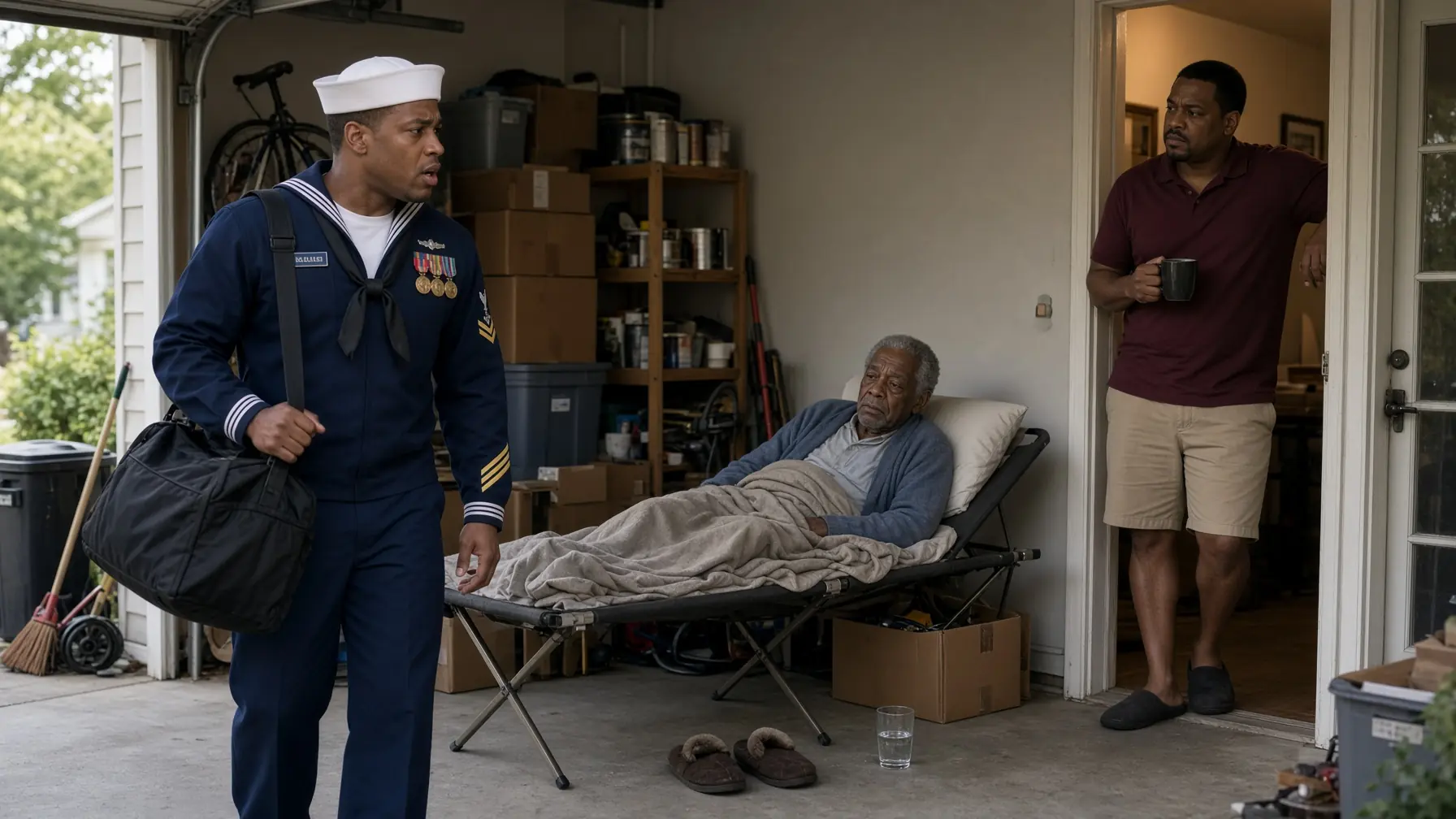
The rideshare car stopped near the curb because Daniel had asked the driver not to pull into the driveway. He wanted those last few steps to belong to him, without an engine announcing his arrival or someone helping unload before he could surprise the old man.
The driver handed over the bag, and Daniel adjusted the strap across his shoulder. The uniform felt formal for an ordinary suburban street, but he had chosen to come home wearing it because he knew what it would mean to Walter.
His father had always looked at him a little differently when he arrived in uniform. Walter usually examined his face first, taking inventory of the son beneath the clothes before allowing himself to admire the rest. The photographs came afterward.
Before leaving, Daniel had packed away a few plans for this return as carefully as the belongings in his bag. There would be time to sit without watching a clock, time to hear the stories that never fit comfortably into a short call, time to notice what his father needed before Walter found a way to insist he needed nothing.
Daniel knew that last part would require patience. His father had always been easier to thank than to help, and even gratitude sometimes made him change the subject. Daniel had promised himself he would stay long enough this time to see past those familiar evasions.
Daniel expected that look.
He had missed it more than he had admitted to anyone.
Across the street, a sprinkler clicked through its pattern on a narrow lawn. A delivery vehicle turned at the corner, and somewhere beyond the neighboring houses, a mower started and settled into a steady hum.
Daylight lay clearly across the driveway and the open garage. Nothing about the house seemed extraordinary from where Daniel stood, and that ordinariness gave him a relief so deep that he stopped for a moment before walking.
He was home.
Not an airport waiting area. Not another temporary place where his belongings remained inside the same bag because unpacking would mean repacking too soon. The pavement beneath his shoes was the pavement where he had learned to ride a bicycle.
The house stood behind the lawn with the familiar arrangement of windows and the small porch that had always seemed larger when he was a boy. Daniel noticed a flowerpot beside the steps and a garden hose that had not been wound properly.
He smiled at the hose.
Walter had always claimed he would put it away after the next use, then invented another reason to use it. Daniel had inherited enough of the habit to recognize it in himself.
The garage door was open.
That was where he expected to find his father.
Walter liked working on small tasks that could be stopped when a neighbor appeared or the weather made staying outside unpleasant. A hinge that needed attention, a loose handle, a piece of wood saved because it might eventually become useful—there had always been some modest project waiting.
At seventy-six, he moved more slowly, but the garage remained part of his routine. Daniel had pictured him standing near the workbench, turning toward the driveway at the sound of familiar footsteps.
He began walking.
The bag shifted against his back, carrying a weight he had stopped noticing during the journey. His eager smile remained, and he looked toward the workbench before the rest of the garage came into focus.
Then his pace changed.
There was something where open floor should have been.
At first, he registered the shape without understanding it: a narrow horizontal line, a blanket, a pair of slippers below. Storage boxes rose on either side, making the space look less like something placed temporarily and more like something fitted carefully where it would inconvenience the rest of the garage as little as possible.
Daniel stopped just outside the opening.
His hand moved automatically to the bag strap, then remained there.
A folding cot.
A glass of water.
His father’s gray hair against a pillow that had been flattened almost to nothing.
Walter lay curled beneath a thin blanket, one knee bent because the cot did not seem long enough for the position in which he had fallen asleep. His faded blue cardigan was still on, the sleeves covering most of his hands.
Daniel’s smile disappeared before he knew it had.
For several seconds, he could not make the scene belong to the morning he had expected. His mind offered explanations with the urgency of someone trying to protect himself from the obvious.
A short rest while working.
A temporary arrangement while something was being repaired.
An afternoon nap, although it was not afternoon.
Each possibility felt possible only until he looked at the slippers again. They were aligned beside the cot, and the water stood within reach. A folded piece of clothing rested on a box near the pillow.
This was not a man who had sat down unexpectedly and become tired. Someone had arranged the practical details of sleeping here.
The realization moved through Daniel slowly enough to hurt in separate places.
He thought of the airport, where he had stood beside his bag and checked his phone for a message from home. He had resisted calling because he wanted the return to be a surprise, and because he had believed surprise would bring joy.
Now that decision felt different.
He stepped into the garage.
The air carried familiar smells: concrete, cardboard, old tools, and the faint trace of lawn equipment. Beneath them was something less familiar in this place, the closeness of bedding and clothing kept among objects instead of inside the house.
A breeze moved through the open door.
Daniel looked at the blanket.
It was thin enough that he could see the outline of Walter’s arm beneath it. He remembered that blanket from years earlier, folded away because there were better ones for sleeping and because nobody in the family liked throwing away something that still had a use.
Its use should not have been this.