Marcus had spent two years imagining the moment he would walk through his front door and hold his wife again. He returned with flowers, a bag over his shoulder, and plans to make up for everything they had missed. But the first thing he noticed about Denise would turn his happiness into a question—and the footsteps coming from their kitchen would make that question far more painful.
The bouquet began to shake before Marcus realized his hand was trembling.
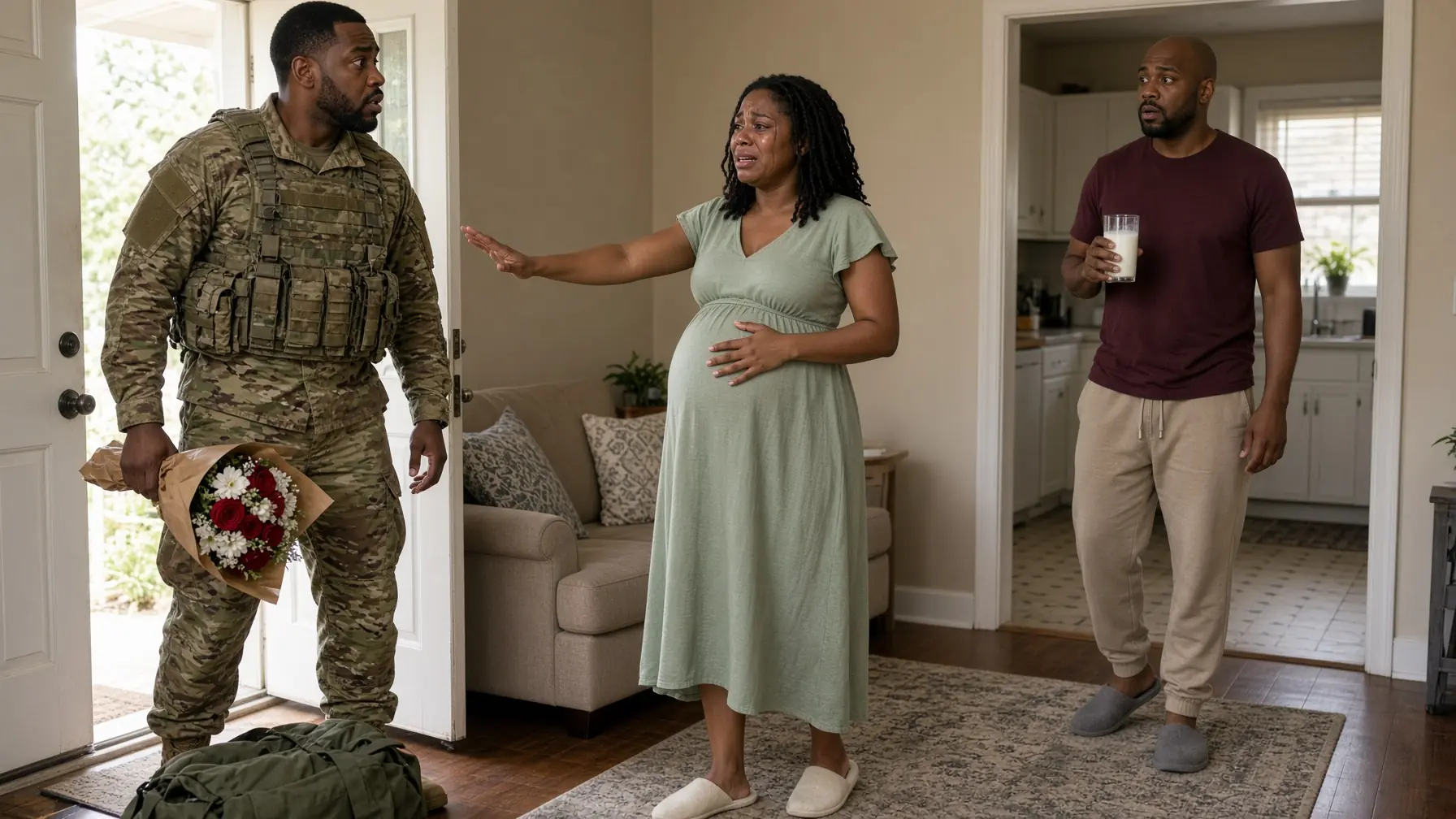
Red and white flowers, wrapped in pale paper, hung between him and the woman he had spent two years trying to get home to. Denise stood beside the sofa in a pale green maternity dress, one hand resting against a belly he could not explain.
His duffel lay on the floor beside the entrance.
A moment earlier, he had been smiling.
Now he could not remember how to move his face back into anything resembling happiness.
“Marcus.”
Denise said his name quietly.
He looked at her hand.
At the curve beneath it.
Then at her face.
He had pictured that face so often during the journey that the real one should have felt familiar. Instead, the fear in her eyes made him feel as though he had walked into the wrong version of his own home.
Behind her, the kitchen doorway stood open.
He did not look at it yet.
He was still trying to understand what stood directly in front of him.
The last time Marcus had held his wife, she had been wearing one of his old T-shirts and telling him he had forgotten his phone charger.
He remembered because it had been such a painfully ordinary thing to say.
His bag was packed. The transportation was waiting. The difficult conversation about his departure had already happened the night before, then happened again in fragments while they tried to make breakfast.
They were both tired of being brave.
Denise had followed him to the door with the charger wound around her hand.
“You’d be calling me from somebody else’s phone tomorrow.”
“I would’ve found one.”
“Yes, because wandering around looking for a charger is exactly how you should begin this.”
He took it from her.
She adjusted the strap of his bag even though it did not need adjusting.
Then her fingers remained against his shoulder.
Neither of them spoke.
Marcus leaned down and rested his forehead against hers.
“We’ll get through it.”
Denise closed her eyes.
“I know.”
He remembered the way she said it.
Not with doubt.
With the exhaustion of someone who understood that getting through something did not mean being unharmed by it.
He kissed her.
She held the front of his shirt.
For a moment, she would not let go.
Marcus had been tempted to make a joke, something about her stretching the fabric or making him late.
He did not.
He held her until her fingers loosened.
Then he stepped outside.
David was at the curb.
His best friend had offered to drive him because Denise had said she did not think she could handle the trip back alone. Marcus had understood without asking her to explain further.
David stood beside the car with his hands in his pockets.
He looked away when Marcus kissed his wife again.
That was one of the things Marcus appreciated about him. David knew when to make a joke and when to let a person have a private moment.
They had known each other long enough to stop counting the years.
David had been there before the marriage, before the house, before Marcus had learned how many forms of patience adulthood required. He knew the stories Marcus told badly and the ones he never told at all.
They had disagreed plenty.
They had also shown up for each other without turning it into something that needed praise.
When Marcus reached the car, David took the duffel.
“Got everything?”
“Apparently not my charger.”
David smiled.
“Good thing one of you pays attention.”
Marcus looked back.
Denise stood in the doorway, arms folded tightly across herself.
He lifted his hand.
She lifted hers.
Then he got into the car.
As they pulled away, Marcus watched the house until the turn at the corner took it out of sight.
David waited several minutes before speaking.
“You okay?”
“No.”
“Good. I’d worry about you if you were.”
Marcus looked out the window.
“Keep an eye on things?”
“I will.”
“If the house needs something—”
“I know.”
“And don’t let her tell you she can handle everything just because she doesn’t want to ask.”
David glanced at him.
“You know she’s going to love hearing that you gave me instructions.”
Marcus smiled faintly.
“I’m serious.”
“So am I.”
They drove another mile in silence.
Then David said, “She won’t be on her own.”
Marcus had nodded.
He had carried that sentence with him longer than he knew.
At first, being away had been a problem they could organize.
They made schedules.
They agreed on call times.
Denise put a calendar on the refrigerator and sent him a photograph of it with his name written across the top in neat green letters.
Marcus laughed when he saw it.
“Am I an appointment now?”
“You’re the most difficult appointment I have.”
He told her he would try to become more punctual.
She said that would be a welcome development.
For the first few weeks, they treated the distance like a complicated household repair. Something inconvenient but manageable if they gathered the right tools.
They sent photographs of meals.
They compared weather.
They left voice messages when they could not connect.