Caleb Thornton entered the school cafeteria carrying nothing more dangerous than a visitor’s badge and a plan to make his daughter smile. Within minutes, he understood why her lunches had been coming home untouched. When she finally noticed him, she did not wave or run toward him; she gave the smallest shake of her head, frightened by what might happen if he stood up. That silent plea followed him out of the building—and into a question the school had spent months avoiding.
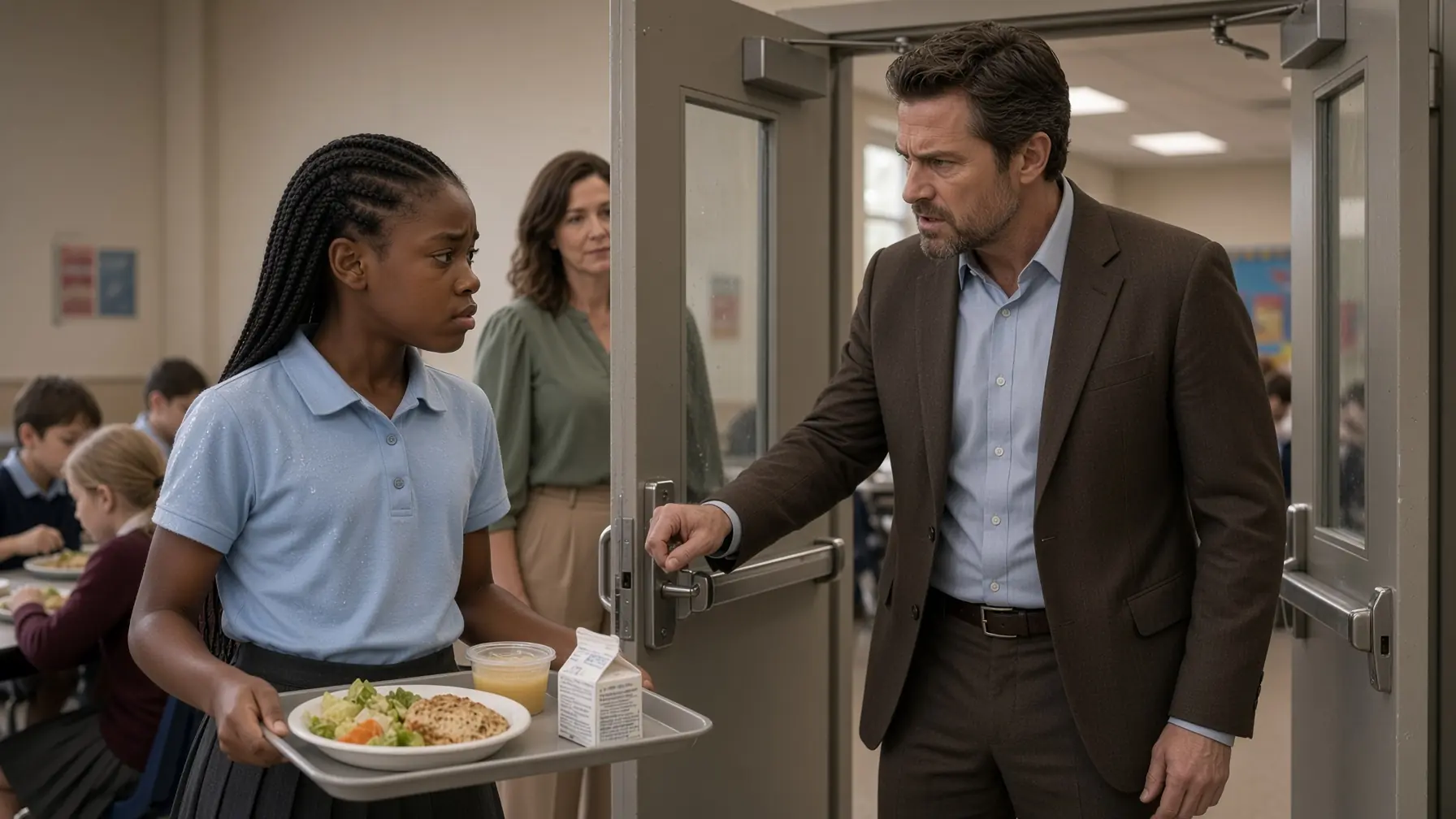
At twelve fifteen, Oakridge Elementary sounded exactly as Caleb remembered school cafeterias sounding. Chairs scraped across tile, children argued over seats, and somebody near the serving counter dropped a spoon. On the wall beside him, construction-paper hands surrounded a poster that read EVERYONE BELONGS HERE.
His daughter stood beneath it with both hands gripping a blue lunch tray.
Imani was eight. Her navy skirt had been pressed that morning, her white collar lay flat, and the braids she had chosen for the week ended in small purple beads. Her lunch bag hung from one wrist, and she was concentrating on keeping the tray level.
“Look. Silent girl.”
The boy who said it did not lower his voice.
A girl beside him laughed. Another leaned toward Imani’s lunch bag and wrinkled her nose.
“Did you bring that weird rice again?”
Imani took another step in the line.
“Hey, Thornton. Why don’t you talk?”
Caleb stopped near a table at the back. He had expected to call her name, perhaps embarrass her a little by asking whether fathers were allowed to share dessert. Instead, he watched her shoulders draw inward.
A blonde girl pointed at her hair.
“They look like spider legs.”
Then came the remark that made him look immediately toward the nearest adult.
“What kind of last name is Thornton for someone like her?”
Darlene Whitkim, Imani’s teacher, stood near the lunch counter. She looked up. Caleb saw her hear the words, saw her recognize which children had spoken, and saw her turn back toward the purse open in her hands.
He had spent enough years in conference rooms to recognize deliberate avoidance.
One of the children stepped into Imani’s path. Her tray tipped, and water ran over her sleeve. She caught the cup before it fell.
“Oops,” the girl said.
Caleb put a hand on the nearest chair, ready to move.
That was when Imani saw him.
Recognition flashed across her face, followed by an expression he had never seen directed at him before. Fear. She shook her head once.
Please don’t.
He understood the request without understanding what obeying it would cost.
Mrs. Whitkim finally called for everyone to sit. The children scattered, still smiling, and Imani walked toward a table where two empty chairs disappeared beneath other children’s backpacks as she approached.
She went to the corner instead.
Caleb sat down.
He would later replay that decision more often than anything else he witnessed that day. He had been afraid of frightening her, afraid of making a public confrontation she would have to survive after he left. But sitting there also meant that, for several terrible minutes, he became another adult who saw her alone and did not go to her.
Across the room, Imani opened her lunch bag.
She arranged her food carefully, folded her napkin, and took a small bite while keeping her eyes on the table.
He recognized every movement.
He had been watching them at home for weeks.
That morning, she had arranged strawberries on her breakfast napkin from largest to smallest. Before leaving, she had checked her backpack three times, tightened both shoelaces until the loops matched, and asked whether her collar looked right.
Caleb had thought she liked order.
Now he wondered whether order was the only protection she believed she possessed.
Two evenings earlier, he had paused in her bedroom doorway after finishing their usual story. She lay beneath a butterfly-patterned comforter, her stuffed giraffe tucked against one shoulder.
He had reached for the light switch.
“Dear God,” she whispered. “Please help me be strong tomorrow at school.”
The words had troubled him enough to keep him awake.
They had not troubled him enough.
At the cafeteria table, Imani took another bite, then stopped eating. Her fingers rested beside the container of rice Caleb had packed that morning.
He remembered standing beside their neighbor, Ms. Adah, while she taught him how much heat the onions needed and why rushing them changed the taste. Imani had watched from a stool, delighted when he finally got the recipe close to right.
The meal that had made her laugh in their kitchen was making her hide at school.
Mrs. Whitkim passed the corner table carrying her own lunch.
She glanced at Imani.
She kept walking.
Caleb looked down at his visitor’s badge. It said PARENT in letters large enough to see across the table.
For the first time that day, the word felt like a question.
Two years earlier, when he adopted Imani, he had promised himself that fatherhood would not become another responsibility delegated to capable employees. He ran a company with offices in several cities, signed documents whose values could purchase whole neighborhoods, and routinely made decisions other people waited months to receive.
But he had learned how to detangle her hair himself.
He had sat through bedtime stories he could recite without looking at the page. He knew which crackers she liked, which shoes rubbed her heels, and that she preferred a light left on in the hallway.
He had believed those details proved he was paying attention.
Now he watched a child who had learned to conceal suffering so carefully that the person who loved her most had mistaken it for politeness.
When the lunch bell rang, Imani carried her tray toward the bins.
More than half her food went into the trash.
She looked toward him once before following her class out. Caleb did not smile as though everything were normal. He touched his hand to his chest, the little gesture they used to say I love you when speaking across a room was impossible.
Her eyes filled.
Then she disappeared through the doors.
He remained seated until the cafeteria had nearly emptied.