Harold Granger parked beside Mara Ellison’s fence because he wanted to witness the end of an argument he believed he had already won. Beyond the western boundary, the air was beginning to shimmer with insects, and the sound moving toward her wheat resembled a radio trapped between stations. Mara stood with a wooden staff in her hand while two hundred thirty-eight bronze turkeys searched the ground around her boots. Three years of work lay between that fence and the approaching swarm, and by sunset, everyone watching would know how much of it had mattered.
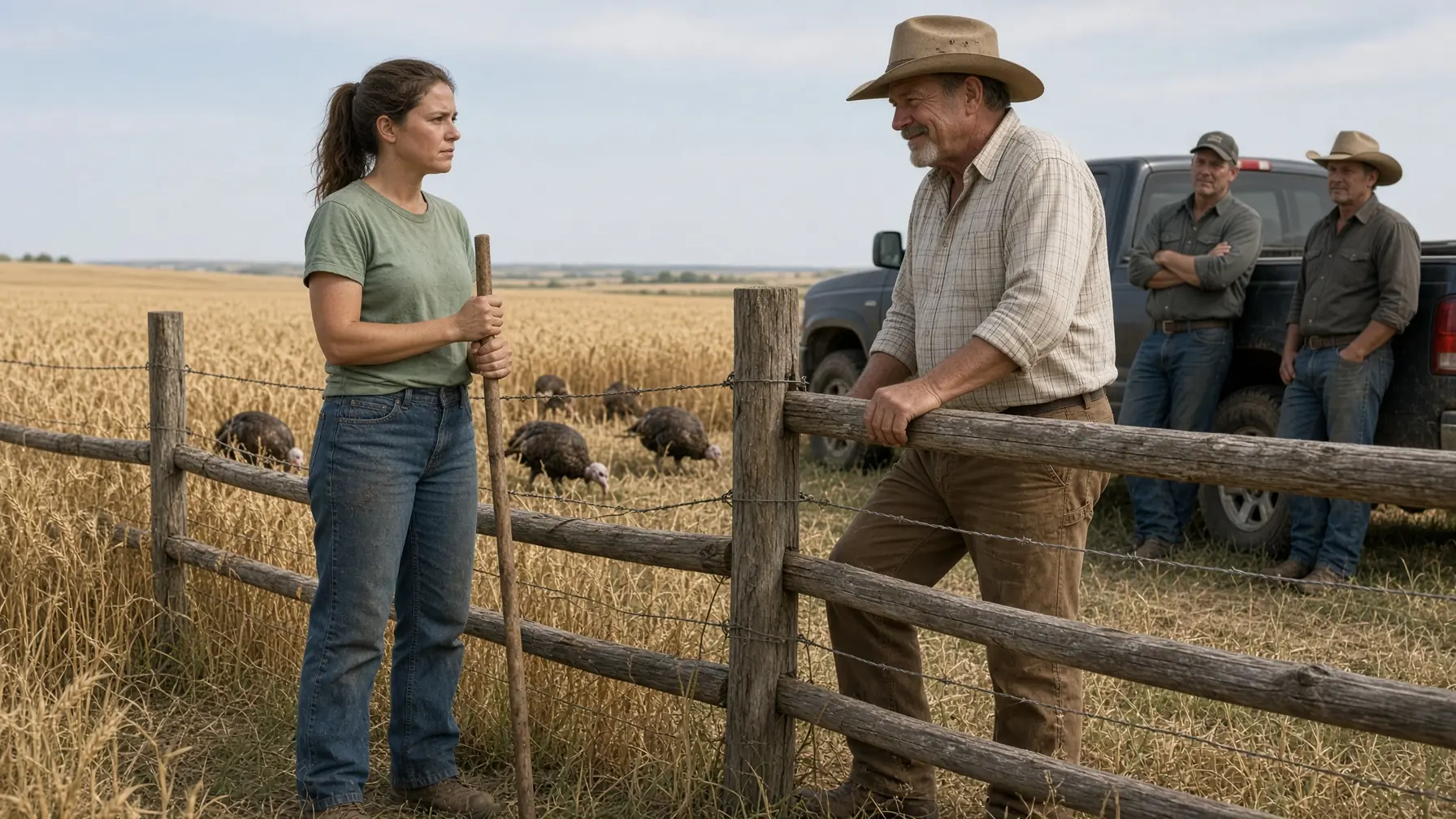
Months before the grasshoppers came, Harold had stood in almost the same place and laughed.
The Kansas sun was lowering behind him, throwing long shadows across the road. Two of his ranch hands leaned against his truck, enjoying themselves. On the other side of the fence, Mara’s wheat looked tired enough to support whatever opinion they had brought with them.
Thin stalks rose from pale ground. Bare patches interrupted the rows. In several places, the leaves had yellowed before the plants had gained much height.
The turkeys made the scene look stranger.
They moved through the wheat with their heads lowered, bronze feathers catching the light. Some paused to scratch. Others darted toward small movements near the soil, swallowing things Harold could not see from the road.
“Five hundred turkeys in dying wheat,” he called. “Sell now before you lose everything.”
Mara walked toward the fence. She wore a faded blue dress beneath a beige apron, and dust had gathered along the seams of her boots. At thirty-one, she already had the tired hands of someone who had spent too many months doing work meant for two people.
“They don’t eat the wheat,” she said. “They eat what’s killing it.”
Harold glanced toward his ranch hands, inviting another laugh.
“You bought five hundred. That isn’t five hundred.”
“No.”
“How many have you buried?”
Mara rested the staff against the fence. “Enough to learn what I should have done differently.”
He seemed disappointed that she had answered.
“Your note comes due soon,” he said. “Then this land becomes mine.”
The ranch hands stopped smiling quite so openly.
Mara looked beyond him toward the road, where his truck sat clean and expensive beside a drainage ditch full of last year’s weeds.
“Come back when the grasshoppers arrive,” she said. “Then watch whose field is still standing.”
Harold studied her for a moment.
“You’ve had your fun. Those birds won’t save you.”
“Then you have nothing to worry about.”
He left the fence without answering. Mara waited until the truck disappeared before turning back toward the flock. Her hands were shaking, so she kept them close to the staff until the shaking stopped.
She had sounded certain.
She wished certainty had been something she could buy as cheaply as Harold seemed to possess it.
Six months earlier, Russell Ellison had died at the kitchen table while comparing seed prices.
There had been no warning large enough for Mara to recognize. He had complained about indigestion, pushed his coffee aside, and asked whether she remembered the name of a supplier they had used two years before.
By the time she understood that something was terribly wrong, he could no longer answer her.
Afterward, people brought casseroles in dishes with their names taped underneath. They hugged her in the doorway. They told her Russell had been a good man, as though the problem might have been that she had forgotten.
When the food stopped arriving, the farm remained.
Five hundred acres. Aging equipment. Seed invoices. Fuel accounts. A note secured against land her family had worked for generations.
Russell’s boots stayed beside the back door for eleven days before Mara moved them into the bedroom. She could not bear to step around them every morning, and she could not bear to put them away.
Harold arrived before the flowers on the kitchen counter had finished dying.
He removed his hat when she opened the door.
“I’m sorry about Russell.”
“Thank you.”
“He was a good man.”
“Yes.”
Harold looked past her toward the papers spread across the table.
“Running a place this size alone isn’t easy.”
Mara said nothing.
“I could take the acreage off your hands. Give you enough to start over without all this hanging over you.”
He spoke gently. That made it worse.
Mara asked him to leave his offer on the table. After he drove away, she read it twice and compared the figure with the farm’s debts, equipment value, and the price of neighboring land sold the previous spring.
He was offering relief at a discount.
Harold owned the largest cattle operation in Millard County and controlled two grain elevators. He also held a seat on the board of the bank carrying her note. His name appeared wherever grain changed hands or farmers asked for more time.
He did not need to threaten her.
A remark at the elevator, a doubtful question at a board meeting, a warning about another weak harvest—each could do work that a direct threat might have made easier to resist.
Mara folded the offer and placed it beneath Russell’s seed calculations.
For several days, she considered accepting it.
Then she opened her grandmother’s cedar chest.
Cecilia’s chest had lived beneath the upstairs window since Mara was a child. It held quilts, letters, faded photographs, and a wedding dress too small for anyone in the family to wear now.
The journal lay in the bottom drawer beneath a stack of folded pillowcases.
Its leather cover had softened almost to cloth. Yellowing tape held several pages together. On the inside cover, in the firm handwriting Mara remembered from birthday cards, her grandmother had written her full name.
Cecilia Anne Ellison.
Mara carried it downstairs expecting recipes or family accounts.
Instead, the first page described a section of wheat.