Silver City, New Mexico Territory, 1881.
The town sat under a hard blue sky, surrounded by red dirt, scrub brush, crooked hills, and silver mines that swallowed men before breakfast and returned some of them before supper with broken bones, torn lungs, fevered eyes, and faces powdered white with dust.
The wind there carried grit.
It carried heat.
It carried gossip, prayer, gun smoke, mule sweat, and the metallic smell of ore dragged out of the earth by men who had come west believing a fortune might still be waiting for them somewhere beneath the stone.
Silver City was young enough to still look unfinished and old enough to have already buried more men than it could remember.
Its streets were wide because wagons needed room to turn. Its sidewalks were narrow because people were expected to move out of the way. Its storefronts had false fronts taller than the buildings behind them, as if every merchant in town wished to appear more prosperous than he was.
There was a general store with flour stacked beside shotgun shells.
A blacksmith shop that rang from dawn until dusk.
Two saloons that never closed unless somebody died inside them, and even then only long enough to mop the floor.
A church that stood unfinished for three years because every time the congregation saved enough for a bell, some emergency took the money.
A jail that leaned slightly to the east.
And a boarding house on Broadway Street run by a Swedish widow who could silence drunk miners with one look and make bread that men spoke of with the kind of reverence usually reserved for gold strikes and mothers.
The town also had mines.
That was why it existed.
That was why men came.
That was why men stayed too long.
The silver veins under the hills promised wages and sometimes wealth, but the mines demanded payment in other ways. Every month, men came out coughing black dust into handkerchiefs. Every month, a support beam failed, a charge went wrong, a mule kicked, a cart slipped, or a fever moved through the camp faster than a prairie fire through dry grass.
Silver City needed a doctor.
It needed a doctor because the mines were killing men at a rate of three per month, and the nearest reliable medical care was in Las Cruces, sixty miles south by road, and sixty miles could be the distance between pain and death.
Dr. Ezra Holloway arrived in Silver City on an evening in late September of 1881.
He came in on the back of a stagecoach coated with dust, carrying a black medical bag, a leather trunk, two changes of clothes, a box of instruments wrapped in oilcloth, and a grief so carefully packed inside him that no one could see it unless they knew where to look.
Ezra Holloway could set a bone in four minutes.
He could stitch a wound so cleanly that the scar would be invisible in a year.
He could diagnose pneumonia from the sound of a cough across a room.
He could smell infection before a patient admitted there was pain.
He could tell by the color of a man’s fingernails whether his heart had given up before the man himself knew it.
He had hands that were steady under pressure, eyes that missed very little, and a voice that became calmest when everyone else in the room began to panic.
He had come to Silver City because it needed a doctor.
That was the reason he gave people.
It was true.
It was not the whole truth.
Ezra Holloway could fix almost anything that was broken in another person’s body.
What he could not fix, what he had been running from since Philadelphia, was the thing that had broken inside his own.
He had come west to heal people, but the woman who ran the boarding house where he lived was about to ask him a question that no patient ever had.
Who heals you?
Dr. Ezra Holloway had not always been the quiet man Silver City came to know.
Before the territory, before the dust, before the boarding house on Broadway Street, he had been a young man in Philadelphia with a future so bright that people leaned close when they spoke of it.
He graduated from the University of Pennsylvania Medical School in 1874 at the top of his class.
He was twenty-five years old, brilliant, and newly married to a woman named Charlotte Whitcomb Holloway.
Charlotte believed in him more than he believed in himself.
She had dark hair, quick hands, and a mind that never stopped asking questions. She read medical texts at the kitchen table while Ezra studied. She corrected his Latin pronunciation with amusement. She pinned flowers above his desk when he forgot there was a world outside anatomy, fever charts, and surgical notes.
When Ezra doubted himself, Charlotte did not soothe him with empty praise. She reminded him of facts.
“You work harder than anyone in your class,” she told him once, when he was still a student and had come home convinced he would fail an examination in pathology. “You remember what others forget. You listen when men twice your age pretend they already know. That matters more than brilliance.”
“I thought you married me for my brilliance,” Ezra said.
“I married you because you keep trying after brilliance gets tired.”
Charlotte was like that.
She had a way of making hope sound practical.
Ezra loved her in ways he did not know how to explain. He loved the way she hummed while arranging books. He loved the small ink stain that always appeared on the side of her right hand because she wrote too quickly. He loved that she spoke to stray cats as though they were unreliable relatives. He loved the sharpness of her wit and the softness that followed it.
When she became pregnant in 1876, Ezra became both terrified and joyous.
Charlotte teased him for reading every obstetrical text he could find.
“You are going to know more about this child than I do,” she said.
“I am trying to be prepared.”
“For a baby?”
“For anything.”
Charlotte smiled then, but the smile faded slightly at the edges.
“Ezra, you cannot prepare away every danger.”
He knew that.
He was a doctor.
Knowing danger was his profession.
But knowing danger did not mean he could accept it.
The labor began on a rain-heavy night in March of 1877.
The city outside their home was wet and dark. The lamps hissed. Horses clattered past on slick cobblestones. Inside the bedroom, Charlotte gripped the sheets and tried not to frighten him by showing how frightened she was.
Ezra had arranged everything in advance.
Clean linens.
Boiled instruments.
A basin.
Towels.
Laudanum measured.
A midwife present, because Charlotte had insisted that no man, not even the father, should pretend he knew childbirth better than women who had lived beside it for decades.
For hours, things seemed difficult but ordinary.
Then they did not.
The baby came late and weak.
A girl.
Small.
Too quiet.
Charlotte smiled when she saw her.
“What will we call her?” the midwife asked.
Ezra never answered.
There was too much wrong too quickly.
Charlotte’s body would not stop failing.
The midwife worked.
Ezra worked.
Another physician was sent for and arrived too late to do anything but witness.
The room became one of those rooms that stays inside a person forever. A room of whispered instructions, wet cloths, lamplight, failing pulses, and the terrible knowledge that every second mattered while nothing he did could change what was happening.
Ezra delivered them both.
He held them both.
He lost them both in the same room, on the same night, with his medical degree on the wall and his hands marked by the work of trying to save the two people he loved most.
His training could not save them.
The finest medical education in America could not save a woman whose body simply would not survive what had happened to it.
The knowledge of that failure, the specific, clinical, unforgivable knowledge of exactly what had gone wrong and exactly how helpless he had been to stop it, broke something inside Ezra Holloway that his profession had no name for.
People came after.
Friends.
Colleagues.
Charlotte’s relatives.
His own father, stiff with grief and useless tenderness.
They said what people say.
You did all you could.
No one could have saved her.
It was God’s will.
You must not blame yourself.
Ezra heard every word and believed none of it.
Because he had been there.
He had felt Charlotte’s hand weaken in his.
He had heard the baby’s small struggle for air fade into silence.
He had known the name of each symptom, each sign, each step in the descent.
He had understood the tragedy as it unfolded, and that understanding did not save anyone.
It only made him a witness with vocabulary.
He buried Charlotte and the unnamed child in a cemetery outside Philadelphia on a day of pale sun and muddy ground.
At the funeral, someone asked whether the baby had been named.
Ezra could not speak.
So the stone read only:
Charlotte Holloway.
Beloved wife.
And infant daughter.
He stood before that stone long after the mourners left.
The earth was newly turned.
A robin hopped along the fence nearby, absurdly alive.
Ezra thought he should pray.
Nothing came.
Three months later, he sold the house.
He packed his medical bag.
He left Philadelphia.
For a year, he practiced in St. Louis.
He worked hard.
Too hard.
He took every patient who came, day or night. He performed surgeries in back rooms and treated factory injuries, childhood fevers, infections, gunshot wounds, and childbirth cases when he could not refuse them.
He was respected.
He was useful.
He was not known.
When people tried to invite him to dinner, he declined.
When a widow brought him preserves, he thanked her and gave them away.
When a colleague suggested he join a medical society and build a proper practice, Ezra left.
From St. Louis, he went to Santa Fe.
Then Albuquerque.
Each place was far enough from Philadelphia for a while, until it was not.
Each town began as escape and became a mirror.
The same lamplight.
The same rooms.
The same women crying behind closed doors.
The same infants struggling.
The same men looking at him with hope and blame.
Ezra learned to stay long enough to help and not long enough to be loved.
By 1881, he reached Silver City because Silver City was as far from Philadelphia as he could get without falling off the map.
It was remote.
Dangerous.
Unpolished.
Hungry.
Full of men who needed a doctor and would not ask questions about the doctor’s past as long as he could keep them alive.
He stepped down from the stagecoach in front of the livery with dust on his coat and exhaustion in his bones.
A boy led a mule past him.
Somewhere nearby, a woman laughed like she had learned to do it loudly to avoid being ignored.
The stage driver tossed Ezra’s trunk down.
“Doctor, you staying?”
“For now.”
The driver spat into the dirt.
“Town could use you.”
“So I’ve been told.”
“Rooms at Lindquist’s are clean. Widow runs it. Don’t cross her.”
Ezra looked down Broadway Street toward the boarding house.
It was a two-story building with a wide porch, clean windows, white curtains, and a sign painted in careful letters:
LINDQUIST BOARDING HOUSE.
MEALS INCLUDED.
NO WHISKEY IN ROOMS.
The porch had been swept that morning.
The brass knob on the front door had been polished.
In a town where everything seemed covered in dust, the boarding house looked like an act of defiance.
Ezra carried his bag and walked toward it.
Maren Lindquist opened the door before he knocked.
She was thirty-one years old, tall for a woman of the era, nearly five feet nine, with blonde hair braided and pinned close to her head. Her face was not soft in the way men in parlors claimed women should be soft. It was clear, strong, and composed, with cheekbones sharpened by work and blue eyes that seemed to notice what others tried to hide.
Her sleeves were rolled to the elbow.
Her hands were roughened by laundry, cooking, hauling water, chopping wood, and all the labor required to make a boarding house appear effortless.
She looked at Ezra’s bag first.
Then at his face.
“You are the doctor.”
“I am.”
“You are late.”
“The stage lost a wheel outside Mimbres.”
“That is what stages do.”
“I apologize if you were waiting supper.”
“I do not wait supper. Supper happens at six. Men who miss it eat what is left.”
Ezra blinked.
Maren stepped aside.
“You have a room if you have money.”
“I do.”
“Weekly payment. In advance. Breakfast at six. Dinner at noon. Supper at six. Sheets changed Monday. Baths Saturday unless you are covered in blood or mine dust, then you wash before you touch my stairs.”
Ezra looked at her.
“That seems reasonable.”
“No spitting indoors. No fighting. No whiskey in the parlor.”
“I do not drink whiskey in parlors.”
“Good. You may drink it elsewhere and answer to God.”
He almost smiled.
Almost.
Maren’s eyes narrowed slightly, as though she had seen the movement and filed it away.
“Name?”
“Ezra Holloway.”
“Maren Lindquist.”
She held out a hand.
He took it.
Her handshake was firm.
Not decorative.
Not hesitant.
A working woman’s hand.
“Welcome to Silver City, Dr. Holloway.”
“Thank you, Mrs. Lindquist.”
“Widow Lindquist, if people must be precise. Maren, if you are eating at my table.”
“I see.”
“You will.”
She took him upstairs herself.
The room was small but clean. A bed with a tight quilt. A washstand. A narrow wardrobe. A chair by the window. A braided rug on the floor. A Bible on the table, not placed ostentatiously, but present.
The window faced west toward the hills.
Ezra set down his bag.
Maren stood in the doorway.
“Your room is paid for by the week. If you are called out at night, you come in quiet. The third stair creaks. Step over it.”
“I will remember.”
“You doctors usually do.”
He looked at her.
“You have housed many doctors?”
“No. But men who believe themselves important tend to step heavily.”
This time he did smile.
A small, tired one.
Maren saw it.
She did not smile back, but something in her eyes warmed by a fraction.
“Supper leftovers are in the kitchen,” she said. “There is stew. Bread also, if Mr. Bell has not eaten it all.”
“Mr. Bell?”
“Miner. Eats like a wolf and complains like a banker.”
Ezra placed his hat on the bed.
“Thank you.”
Maren nodded and turned to go.
At the door, she stopped.
“Doctor.”
“Yes?”
“Silver City will take more from you than you expect.”
Ezra looked at the darkening hills beyond the window.
“It already has.”
Maren studied him for one second too long.
Then she left.
Ezra hung his shingle the next morning.
DR. EZRA HOLLOWAY.
PHYSICIAN AND SURGEON.
His office stood between the apothecary and a tailor whose sign had lost two letters. It had one front room, one back room, a stove that smoked if the wind came from the east, two shelves, a desk, and a table sturdy enough for surgery if no one leaned too hard on the left side.
Patients came before he had finished unpacking.
The first was a boy with a fishhook through his thumb.
The second was a miner with a cough that had been ignored for six weeks.
The third was a woman with a fevered child.
By evening, Ezra had treated fourteen patients and been paid in coins, a sack of potatoes, two eggs, and a promise from a man he did not trust.
Silver City had not exaggerated its need.
Within a month, people stopped asking whether he was staying and began saying “our doctor.”
Ezra did not correct them.
He learned the town by its injuries.
The McCall brothers came in with broken knuckles after fights they both claimed the other started.
Mrs. Pritchard’s oldest boy had asthma that worsened when the dust blew east.
Samuel Keene, the blacksmith, burned his forearms so often Ezra kept salve prepared for him.
A cook at the Palace Saloon cut her palm every other week.
Miners came in with crushed fingers, torn shoulders, infected feet, coughs, fevers, and eyes burned by powder smoke.
Ezra worked constantly.
He became known for his calm.
If a man came in screaming, Ezra spoke softly.
If blood frightened the room, Ezra did not look frightened.
If a mother panicked over a child’s fever, Ezra moved with enough certainty for both of them.
He stitched.
Set.
Wrapped.
Lanced.
Listened.
Watched.
Prescribed quinine, laudanum, rest, poultices, boiled water, and when necessary, honesty.
He was careful with hope.
He did not spend it cheaply.
Silver City respected that.
It also respected the fact that he did not moralize.
He treated drunks, gamblers, miners, churchmen, prostitutes, railroad men, merchants, Mexicans, Anglos, Chinese laundry workers, and anyone else who came through his door.
A body in pain was a body in pain.
He did not ask whether it deserved care.
He slept poorly, ate irregularly, and carried grief so quietly that most people mistook it for discipline.
Maren did not.
She watched him from the beginning.
Maren Lindquist had come to Silver City in 1876 with her husband Erik.
They had left Sweden first, then Minnesota, then followed rumors and rail maps south and west until Erik decided a boarding house in a mining town was safer than a mine itself.
“The miners dig,” he told her. “We feed the men who dig. This is the wiser fortune.”
For a while, he was right.
The boarding house filled quickly.
Miners slept two to a room, then three, until Maren refused more.
She cooked, washed, mended, managed accounts, and learned to understand English spoken with Irish, German, Mexican, and Southern accents.
Erik handled repairs, supplies, and the boarders who drank too much.
They worked like two halves of a hinge.
Then typhoid came in the summer of 1879.
It took a child on the edge of town first.
Then a railroad man.
Then three miners.
Then Erik.
Maren nursed him through six days of fever.
She changed sheets, cooled his skin, prayed in Swedish, cursed in Swedish, bargained with God in English because perhaps God had changed languages with the country.
Erik died before dawn.
Maren closed his eyes.
Then she went downstairs and made breakfast.
There were eight boarders in the house.
They needed coffee.
They needed eggs.
They needed someone to tell them where to sit and when to stop staring.
So she did.
At noon, she arranged burial.
At six, she served supper.
The next morning, she raised the price of rooms by ten cents and wrote to the supplier in Deming for flour.
People thought this meant she was hard.
It did not.
It meant grief had arrived in a house that still required bread.
Maren never remarried.
Not because no one offered.
Two men did, indirectly.
One through a conversation about needing “steady companionship.”
Another through a letter so awkward she burned it out of mercy.
She refused both.
She had no time for men who wanted a wife because they were tired of doing their own laundry.
She had work.
She had a roof to keep.
She had boarders who needed feeding, sheets that needed boiling, accounts that needed balancing, and a reputation that needed guarding because a young widow running a boarding house in a mining town could not afford softness where men might mistake it for invitation.
She ran the boarding house like a ship’s captain.
Meals at six, noon, and six.
Rooms cleaned by eight.
Boots brushed outside.
No spitting indoors.
No fighting.
No whiskey in the parlor.
The boarders obeyed because they feared her displeasure more than they feared hunger.
Ezra Holloway was different from the beginning.
Most men in Silver City tried to make themselves larger.
They stood wide, spoke loud, laughed hard, slapped backs, exaggerated dangers, wore guns lower than necessary, and filled silence as though it might accuse them.
Ezra made himself smaller.
Not weak.
Not timid.
But contained.
He moved through rooms without claiming them.
He listened more than he spoke.
He carried his sorrow like a concealed weapon, close to the body, never displayed, always loaded.
Maren noticed.
She noticed that he rarely took second helpings.
That he thanked her for every meal but did not taste it unless reminded.
That he returned after midnight and washed his hands at the pump even in winter, scrubbing until his knuckles reddened.
That he sometimes stood at the bottom of the stairs after a hard night, staring at nothing, as if trying to remember how to climb.
She noticed that he did not receive letters.
Not one.
She noticed that when children laughed in the parlor, his face changed in a way most people would have missed.
She noticed that pregnant women made him go still.
For four years, she watched.
For four years, Ezra healed the town and allowed no one near the wound inside him.
He was the best doctor Silver City had ever had.
He was also the loneliest man in Grant County.
People trusted him with their bodies, but not one of them knew where he went when the day ended.
They did not know that some nights he sat at the desk in his room and wrote Charlotte’s name on a scrap of paper until the letters no longer looked like language.
They did not know he kept a small ribbon from her hair wrapped in linen at the bottom of his trunk.
They did not know he could not bring himself to say “my daughter” because the child had lived only six hours and he feared claiming her would make the loss larger than he could survive.
They did not know he avoided church on Easter because the word resurrection felt cruel.
Maren did not know all that.
But she knew enough.
One evening in March of 1885, Ezra came home later than usual.
The wind had been bad that day, carrying grit through window cracks and turning the street to a haze.
A support beam had failed in the Doyle mine just after dusk.
Three men had been carried out.
Two lived.
One did not.
The dead man was named Patrick O’Rourke.
Twenty-nine.
Irish.
Red-haired.
Fond of singing after supper.
He owed Maren forty cents and had promised to pay Friday.
The beam had crushed his chest.
Ezra had worked over him for two hours.
The man’s brother stood in the corner saying Hail Marys until his voice became a rasp.
Patrick died anyway.
At almost midnight, Ezra entered the boarding house quietly, stepping over the third stair out of habit before realizing he was not going upstairs.
He stood in the kitchen doorway instead.
The stove was low.
The lamps were turned down.
Maren sat at the table with mending in her lap, though she had stopped sewing when she heard him come in.
Ezra removed his hat.
His face was gray with exhaustion.
His shirt cuff was torn.
His hands were clean, but he stared at them as if they were not.
Maren set aside the mending.
“There is stew.”
“I am not hungry.”
“There is stew,” she repeated.
He sat because men in her kitchen often obeyed before they decided to.
She ladled stew into a bowl, cut bread, and set both before him.
He did not eat.
He stared at his hands.
Maren sat across from him.
She did not speak.
She waited because Maren understood that some silences needed to be sat with, not filled.
Outside, the wind dragged dust against the window.
The clock ticked.
Somewhere upstairs, Mr. Bell snored like a dying sawmill.
After a long time, Ezra said, “I could not save him.”
Maren folded her hands.
“You could not save them all.”
Ezra looked up.
She had said them all, not him.
“What do you mean?”
Maren’s face remained calm.
“You carry every patient you have ever lost. I can see it. You walk as though you are carrying more than your bag.”
Ezra’s jaw tightened.
“I am tired, Mrs. Lindquist.”
“Maren.”
“Maren.”
“You are tired, yes. But this is not only tired.”
He looked away.
She continued, her voice even.
“I have watched you for four years, Dr. Holloway. You heal everyone in this town. Who heals you?”
Nobody had ever asked him that.
In seven years of medicine across four cities, not one person had looked at the doctor and wondered whether the doctor was hurt.
Patients asked if they would live.
Mothers asked if fever would break.
Men asked if they would walk again.
Widows asked whether death had been painful.
No one asked what happened to the man who carried all the answers he did not want.
Ezra did not answer.
The question seemed to enter him and lodge somewhere beneath the ribs.
He picked up his spoon.
He ate because it was easier than speaking.
Maren did not ask again.
She sat with him until the bowl was empty.
Then she took it, rinsed it, and said, “Sleep if you can.”
He went upstairs.
He lay in the dark and heard the question repeat itself in Maren’s steady, accented voice.
Who heals you?
He had no answer.
That frightened him more than the question.
For the next week, Ezra avoided the kitchen after hours.
If he returned late, he went straight upstairs.
If Maren left food for him, he ate it cold in his room.
At meals, he spoke politely and briefly.
Maren let him.
She knew when a man was retreating.
She also knew retreat was not the same as escape.
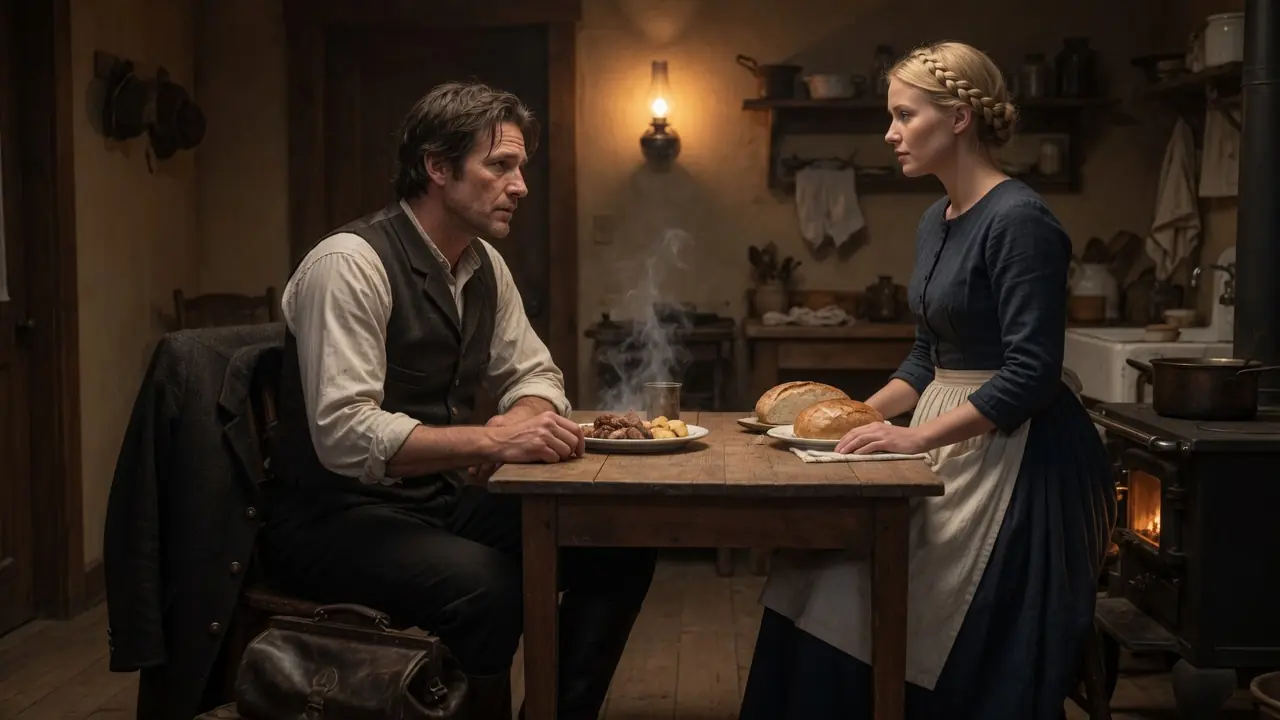
On the eighth night, he came home at ten.
A lamp burned in the kitchen.
A plate sat covered near the stove.
Maren sat at the table kneading dough.
“You left food,” he said.
“You have eyes.”
“I was going to take it upstairs.”
“No.”
He looked at her.
“No?”
“You will eat at the table. Men who eat in rooms attract mice.”
“I do not attract mice.”
“You do if you eat in rooms.”
He should have been annoyed.
Instead, he sat.
Maren uncovered the plate.
Potatoes.
Beans.
A slice of pork.
Bread still warm enough to soften butter.
He ate in silence while she worked dough under her palms.
The motion was firm and rhythmic.
Fold.
Press.
Turn.
Fold.
Press.
Turn.
After several minutes, Ezra said, “You knead as if punishing it.”
“Then you have never seen me punish anything.”
A surprised sound escaped him.
Almost a laugh.
Maren glanced up.
“There. You are not dead.”
“I beg your pardon?”
“Nothing.”
He watched her hands.
“How do you know when it has been kneaded enough?”
Maren looked at him as if deciding whether the question deserved an answer.
“It changes.”
“In what way?”
“The dough becomes less stubborn. It stops tearing when you stretch it. It holds together.”
“That sounds almost diagnostic.”
“It is.”
He looked at her with genuine interest.
She continued.
“Rye behaves differently than wheat. Too much rye and it becomes heavy. Too little patience and it becomes flat. Yeast likes warmth but not heat. Salt keeps it from growing wild. Flour tells you what it wants if your hands are not foolish.”
Ezra set down his fork.
“Flour tells you what it wants?”
“Yes.”
“I have never been spoken to sternly by flour.”
“That is because you do not listen.”
There it was again.
The almost laugh.
Maren saw it and kept working.
That was how it began.
Not with confession.
Not with tears.
Not with romance.
With bread.
Ezra began coming to the kitchen late, at first because Maren insisted he eat downstairs, then because he found he wanted to.
She left a plate on the stove.
Then she began sitting with him.
They talked about ordinary things.
Bread.
Weather.
The price of flour.
Whether Mr. Bell was sneaking whiskey into his room, which he was.
Why the third stair creaked, which Maren said was because the house had opinions.
Ezra discovered that Maren had an exact and passionate knowledge of domestic labor.
She knew which soap removed mine dust best.
She knew how to stretch coffee when supplies were late.
She could tell whether a boarder was sick by how much breakfast he left behind.
She could calculate costs faster than most merchants.
She had opinions about flour and yeast and rising times that were as precise as any medical lecture Ezra had ever heard.
He found himself asking questions.
Real questions.
Why rye flour behaved differently from wheat.
How she knew when dough was ready by touch.
Why bread collapsed in damp weather.
What the crust sounded like when it was done, because Maren could tell by knocking on it.
She answered every question with the seriousness of a professional explaining her craft, because that was what it was.
One night, he said, “You should write this down.”
“What?”
“Your methods.”
“My methods are in my hands.”
“They should be in a book.”
“Men write books so other men can quote them.”
“Women also write books.”
“In Philadelphia, perhaps.”
“In many places.”
Maren gave him a look.
“You think because I do not write my bread in a book, it is less knowledge?”
“No,” Ezra said at once. “I think because it is knowledge, it deserves not to vanish when your hands stop working.”
She looked down at the dough.
For once, she did not have an immediate answer.
The next week, he brought her a blank ledger from the general store.
It was bound in brown leather with lined pages and a ribbon marker.
Maren held it as if he had given her something both useful and dangerous.
“For bread,” he said.
“For bread.”
“And soap, if you like. And costs. And anything else your hands know.”
She ran her fingers over the cover.
“This is too fine for flour.”
“It will survive.”
“Unlike most men.”
“Unlike most men,” he agreed.
Maren wrote on the first page that night.
Bread.
Then, underneath:
A good loaf begins before the flour is wet.
Ezra found that sentence the next morning when the ledger was left open on the kitchen table.
He read it twice.
For reasons he did not examine, it stayed with him all day.
Spring turned into summer.
Silver City baked under the sun.
Dust rose from wagon wheels and settled on every surface before noon.
Ezra’s practice grew.
More patients came from farther out.
Ranch wives arrived in wagons with sick children.
Mexican families came from settlements along the creek.
Miners appeared at all hours, sometimes walking, sometimes carried.
Ezra trained himself not to flinch at anything.
But Maren noticed when certain cases cost him more.
A child with fever.
A young wife coughing blood.
A pregnant woman passing his office window.
He would become quiet afterward.
Not cold.
Not cruel.
Simply distant, as if he had stepped behind glass.
Maren did not demand he explain.
She just placed food before him and sometimes sat nearby with her sewing.
Her presence became a kind of lamp.
Not bright enough to blind.
Just enough to keep the dark from becoming total.
In June, Maren told Ezra about Erik.
It happened on a night when rain came without warning.
The roof ticked and hissed.
The boarders had gone to bed early because rain in Silver City made men sleepy, grateful, or drunk, and Maren allowed only the first two under her roof.
Ezra came home from treating a child with croup.
He was wet through and chilled.
Maren handed him a towel before he could ask.
“Your coat will steam if you sit too close to the stove,” she said.
“Is that medical advice?”
“It is coat advice. More practical.”
He dried his hair and sat at the kitchen table.
Maren poured coffee.
The rain softened the whole house.
For a while, they listened to it.
Then Maren said, “Erik died in rain.”
Ezra looked up.
She had never spoken her husband’s name to him before.
“The fever came in July,” she continued. “Hot month. Bad water. The doctor then was a drunk man with soft hands. He said it would pass. It did not pass.”
Ezra said nothing.
“He was sick six days. On the fourth day, he stopped knowing me. He spoke Swedish to his dead mother and English to the wall. He asked if the cows were brought in, but we had no cows.”
Her mouth moved slightly, not quite a smile.
“I told him yes. The cows were safe.”
Ezra listened.
Maren looked at the coffee in her cup.
“He died before dawn. I washed him. I opened the windows. Then I went downstairs and made breakfast.”
Ezra’s throat tightened.
“The boarders needed food,” she said. “Mr. Bell complained the eggs were too hard. I nearly broke the plate over his head.”
“I am sorry.”
“Do not be. He was right. The eggs were too hard.”
“Maren.”
She looked at him then.
Her eyes were steady, but bright.
“I thought if I stopped moving, I would die too. So I did not stop. I washed sheets. I baked bread. I collected rent. I buried my husband. I raised the room price. I kept moving.”
Ezra understood that too well.
“Does it help?” he asked.
“Moving?”
“Yes.”
“For a while.”
“And then?”
“Then one day you realize you have walked very far and the grief has kept pace.”
The rain continued.
Ezra stared at the table.
He could feel the shape of words inside him, old words, locked words.
Maren had not asked for them.
That made them easier to give.
“My wife died,” he said.
Maren did not move.
“And my daughter. The same night.”
The clock ticked once.
Twice.
“I was the doctor,” Ezra said. “I could not save them.”
It was the first time he had said it aloud to another person since leaving Philadelphia.
The words did not come cleanly.
They scraped.
He told her about Charlotte.
Not all at once.
Not everything.
But enough.
He told her Charlotte was clever and practical and used to tease him for reading too much.
He told her about the baby who lived six hours.
He told her he had never named her.
He told her he left because everywhere he looked, the world continued as if it had not ended.
Maren did not say she was sorry.
Not then.
She did not offer an explanation.
She did not say God had a plan.
She did not tell him he had done all he could, as if repetition could make a man believe what he could not.
She reached across the table and placed her hand over his.
Her palm was warm.
Work-rough.
Steady.
She held it there for a long time.
Finally, she said, “You have been carrying that alone.”
Ezra looked at their hands.
“Yes.”
“You do not have to anymore.”
He closed his eyes.
Something in him recoiled from the offer.
Something else leaned toward it like a starving thing toward bread.
“I do not know how not to.”
“Then you learn.”
“I am not sure I can.”
“You learned medicine.”
“This is different.”
“Yes,” Maren said. “This matters.”
After that night, something shifted.
Not dramatically.
No declarations followed.
No sudden transformation.
Ezra did not wake healed the next morning.
Maren did not become tender in public.
The boarding house did not turn into a place of whispered feelings and sentimental glances.
There was still laundry.
Still dust.
Still miners tracking mud indoors.
Still Mr. Bell complaining.
Still patients at all hours.
But Ezra began eating at the table instead of in his room.
He began sitting on the porch in the evenings when the air cooled.
He began to exist in the boarding house as a person rather than a ghost.
Sometimes Maren joined him on the porch after supper.
She would bring mending or her bread ledger.
He would bring medical journals when mail arrived.
They did not always speak.
The silence between them became comfortable in a way Ezra had forgotten silence could be.
One evening, a boarder named Amos Bell came out to the porch, saw them sitting there, and stopped.
“Oh,” he said.
Maren did not look up from her sewing.
“If you have a thought, Mr. Bell, keep it housebroken.”
Amos retreated indoors.
Ezra looked at her.
“Housebroken?”
“Some thoughts should not be allowed on furniture.”
He laughed then.
A real laugh.
It startled him.
Maren looked satisfied but did not show it too much.
Silver City noticed before Ezra did.
Mrs. Pritchard told the apothecary that the doctor had “color in him again.”
The apothecary told the barber.
The barber told six men by noon.
By evening, half the town had decided Dr. Holloway was either less ill, more rested, or considering marriage.
Ezra remained unaware until a miner with a fractured wrist said, “You and Widow Lindquist keeping company, Doc?”
Ezra tightened the splint harder than necessary.
The miner yelped.
“Hold still.”
“Just asking.”
“Do not.”
The miner wisely did not.
Maren heard the gossip too.
She ignored it until Mrs. Jansen from the dry goods store said, “A woman must be careful with reputation.”
Maren looked at her over a bolt of cloth.
“A woman must also be careful with cinnamon. Too much ruins good bread. Yet people speak less foolishly about that.”
Mrs. Jansen blinked.
Maren bought thread and left.
Still, gossip had weight.
Maren knew it.
Ezra knew it too.
One evening in August, he found her in the kitchen after the boarders had gone to bed.
“I should perhaps take a room elsewhere.”
Maren looked up from the ledger.
“Why?”
“You know why.”
“No. Say it.”
“People are talking.”
“People talk because silence frightens them.”
“I do not wish to damage your standing.”
“My standing is fine.”
“Maren.”
She closed the ledger.
“Do you think my reputation is so weak that coffee in a kitchen can destroy it?”
“No.”
“Do you think I am foolish?”
“No.”
“Do you think I do not know what people say?”
“No.”
“Then do not insult me by pretending to protect me from a town I have managed longer than you have lived in it.”
Ezra looked down.
“I did not mean to insult you.”
“I know.”
“I would not have your kindness cost you.”
“My kindness is mine to spend.”
He looked at her then.
The lamplight caught the loose strands of blonde hair near her temple.
She seemed both tired and unmovable.
“What is this, Maren?” he asked quietly.
She did not answer quickly.
That was rare enough to make him wait.
Finally, she said, “I do not know yet.”
He nodded.
“That is honest.”
“Yes. It is inconvenient.”
Another almost smile.
She continued.
“I know you are still grieving. I know I am too, though mine wears different clothes. I know I do not want to be someone’s nurse because he refuses to live.”
Ezra absorbed that.
“I would not ask that of you.”
“I know.”
“And I do not want a wife because I am lonely.”
“Good.”
“But I am lonely.”
“So am I.”
The words sat between them.
Plain.
True.
Maren opened the ledger again, though she did not write.
Ezra remained standing for another moment, then sat across from her.
Neither spoke of moving out again.
The moment Ezra understood what was happening, what Maren was offering, and what it would cost him to accept it, came through a patient.
In September 1885, Teresa Gutierrez came to Ezra’s office.
She was twenty-three years old, small, dark-haired, and heavily pregnant with her first child.
Her husband, Mateo, stood beside her, twisting his hat until the brim warped.
“My mother says the baby sits wrong,” Teresa said.
Ezra’s body went cold.
A pregnant woman.
A first child.
A worried husband.
The room in Philadelphia came back so quickly that he almost gripped the edge of the desk.
Charlotte’s face.
The lamp.
The midwife’s voice.
The baby’s terrible quiet.
Ezra looked at Teresa and felt old terror rise like floodwater.
He almost sent her away.
He almost said he did not deliver babies.
He almost lied.
Instead, he heard Maren’s voice in memory.
You do not have to carry it alone.
He took a breath.
“Sit, Mrs. Gutierrez.”
Mateo helped her.
Ezra examined her gently, professionally, with every barrier in place.
The child did not sit wrong in the way Teresa’s mother feared. But the baby was large, and Teresa was slight. It could be difficult.
“Your mother is right to be attentive,” Ezra said.
Teresa’s eyes widened.
“Something is wrong?”
“Not wrong. But we will watch carefully.”
“We?”
Ezra paused.
“I will.”
Over the next two months, Ezra monitored Teresa’s pregnancy with a precision that bordered on obsession.
He checked her pulse.
Her swelling.
Her strength.
He advised food, rest, walking, less lifting, more water.
He visited their small adobe house twice without charging because he wanted to see the room where the birth would happen.
He arranged supplies.
He prepared instruments.
He boiled linen until it was whiter than snow.
He laid everything out in his office three times, then packed it, unpacked it, and packed it again.
Maren noticed.
Of course she did.
One evening in late October, she found him in the parlor after midnight, cleaning instruments that were already clean.
The boarders slept upstairs.
The house was quiet.
Ezra sat at the table with forceps, scissors, linen, thread, carbolic, and a basin.
Maren stood in the doorway.
“You will polish the handles off.”
He did not look up.
“They must be ready.”
“They were ready yesterday.”
“I prefer to be certain.”
“You prefer to be punished.”
His hand stilled.
Maren came into the room.
“Teresa Gutierrez?”
Ezra closed the instrument case.
“She is due soon.”
“You are afraid.”
“Yes.”
The answer came before pride could stop it.
Maren sat across from him.
“Because of Charlotte.”
“And the baby.”
“Yes.”
“I thought I could do this work again. I have treated pregnant women. I have advised midwives. But delivery…”
He shook his head.
“I do not know what will happen to me in that room.”
“You will be afraid.”
“That is not reassuring.”
“It is true.”
“I could make a mistake.”
“Yes.”
He looked at her sharply.
She did not flinch.
“You want me to tell you that you cannot fail,” Maren said. “I will not lie. You are a doctor, not God.”
His face tightened.
“But you are not the same man you were in Philadelphia,” she continued. “And Teresa is not Charlotte. Her child is not your daughter. This birth is not that death.”
Ezra closed his eyes.
“I know that.”
“Do you?”
He did not answer.
Maren reached across the table and touched the instrument case.
“Preparation is good. Fear is not failure. But if you enter that room trying to save Charlotte, you will not see Teresa.”
The words struck him with the force of a slap.
Not cruel.
Necessary.
He opened his eyes.
Maren’s face had softened.
“You must bring your skill to Teresa, not your guilt.”
Ezra breathed slowly.
Once.
Twice.
“I do not know how to leave the guilt behind.”
“Then do not leave it. Set it beside you. Let it watch. But do not let it hold the instruments.”
The room was quiet.
Ezra looked at her hand on the case.
“Will you come?”
Maren was still.
“To the delivery?”
“Yes.”
“I am not a midwife.”
“No. But I need someone in the room who knows when I am not seeing clearly.”
Maren considered him.
Then nodded.
“Yes.”
On November 3rd, Teresa went into labor.
The call came at midnight.
Mateo arrived at the boarding house door pounding so hard Mr. Bell shouted from upstairs that thieves had come.
Ezra was dressed in less than three minutes.
Maren was already wrapping bread, coffee, and clean towels in a cloth bundle.
“You are coming?” Mateo asked, surprised.
“Yes,” Maren said.
That ended discussion.
The night was cold.
Stars cut bright holes in the sky.
They rode in Mateo’s wagon, wheels rattling over hard road. Ezra sat silent, one hand on his medical bag. Maren sat beside him, shoulder touching his just enough to remind him he was not alone.
Teresa labored in a small room lit by two lamps.
Her mother was there.
So was an older midwife named Señora Alvarez, who had delivered half the Mexican children within twenty miles and trusted doctors only when they stayed humble.
She looked Ezra up and down.
“You are young,” she said.
“I am thirty-six.”
“You are young for this room.”
Ezra nodded.
“Yes.”
She seemed to approve of the answer.
The labor lasted fourteen hours.
It was slow.
Difficult.
Teresa was strong, then exhausted, then strong again because women in labor often discover strength after all visible strength has been used.
Ezra worked with Señora Alvarez, not over her.
That mattered.
He listened when she said the mother needed to change position.
He listened when she said the baby was moving.
He listened when Maren quietly said his name the one time his face went too pale.
“Ezra.”
Just that.
He looked at her.
She held his gaze.
He came back to the room.
Not Philadelphia.
Not Charlotte.
Teresa.
At two in the afternoon, Ezra delivered a healthy boy.
Ten pounds.
Red-faced.
Furious.
Screaming with a force that made Mateo sob aloud.
Teresa was alive.
She was bleeding, but not badly.
Ezra controlled it.
He held pressure.
He did what he had not been able to do in Philadelphia.
He saved them both.
Or perhaps, more truthfully, this time they all survived.
At four in the afternoon, Ezra walked back to the boarding house beside Maren.
Neither spoke.
The town looked strange in late sun.
Too ordinary.
A dog slept in dust.
A child chased a hoop.
Men argued outside the livery.
Life continuing, not cruelly this time, but generously.
Maren opened the boarding house door.
The kitchen smelled of coffee and yeast.
Ezra stepped inside and stopped.
Maren turned.
She looked at his face and knew something had happened.
Not at the birth.
Inside him.
He said, “I delivered a baby.”
“Yes.”
“Mother and child are alive.”
“Yes.”
“The first one since.”
Maren’s voice was gentle.
“Yes.”
Ezra sat at the kitchen table.
He put his head in his hands.
For the first time in eight years, he cried.
Not quiet tears.
Not controlled grief.
He cried from the part of himself that had been locked in a Philadelphia bedroom with a dead wife and a child who never got named.
He cried for Charlotte.
For the daughter he had not allowed himself to call daughter.
For the young man he had been before he learned that knowledge could fail.
For every mile he had traveled trying to outrun a room that had lived inside him the whole way.
Maren stood behind him.
She placed her hands on his shoulders.
She did not say anything.
She simply stood there, holding the weight of him while the grief he had been running from for eight years finally caught up.
When it was over, Ezra felt emptied, ashamed, and strangely alive.
He wiped his face with both hands.
“I am sorry.”
“Do not apologize for grief in my kitchen.”
He gave a broken laugh.
Then he looked up at her.
“You asked who heals the healer.”
“I did.”
“You do.”
Maren’s hands remained on his shoulders.
“No,” she said.
He looked at her.
“You are healing,” she continued. “I am only not letting you do it alone.”
Ezra closed his eyes.
For once, he accepted the correction.
Winter came early that year.
Snow dusted the hills in December, and Silver City pretended to be surprised even though winter had arrived every year prior.
The boarding house filled with miners who smelled of wet wool and men from outlying ranches trapped by weather.
Maren made stews thick enough to stand a spoon in.
Ezra treated frostbite, lung fevers, accidents, and two foolish saloon injuries involving a chair, a poker table, and a disagreement no one could explain sober.
Teresa Gutierrez brought her baby to the boarding house in a blue blanket.
“He has a name now,” she told Ezra.
The baby slept against her shoulder.
“What name?”
“Samuel Ezra Gutierrez.”
Ezra went still.
Teresa smiled.
“Do not look frightened. It is only a name.”
Maren, standing behind him, said, “Sometimes only a name is a large thing.”
Teresa nodded.
“Yes.”
Ezra touched the baby’s small hand with one finger.
Samuel wrapped his fist around it.
Something in Ezra’s face loosened.
“May he wear it better than I do,” Ezra said.
Maren heard the old guilt in that and the new tenderness too.
Progress, she was learning, was often both.
By Christmas, the whole boarding house understood that something had settled between Ezra and Maren, though no one dared define it too loudly.
Ezra repaired a loose hinge on the pantry door without being asked.
Maren placed an extra blanket in his room before the coldest night.
Ezra began walking with her to the market when supplies were heavy.
Maren began leaving medical journals beside his plate when mail came in, as if his interests belonged in the common room with everyone else’s.
They disagreed often.
About sanitation.
About costs.
About whether Mr. Bell deserved a second helping after insulting the cabbage.
About whether Ezra worked too much.
“You cannot attend every cough in town,” Maren said one January evening.
“I am the only doctor.”
“You will become no doctor if you collapse.”
“People need care.”
“So do you.”
He looked up from his notes.
There it was again.
Not the same question.
The same truth.
“I sleep.”
“You fall unconscious. That is not the same thing.”
“I eat.”
“When threatened.”
“I am sitting here, am I not?”
“Yes. Because I placed food in front of you and remained near enough to be dangerous.”
Ezra smiled.
“I would not call you dangerous.”
“That is why you are alive.”
By late December, Ezra knew he loved her.
He did not know what to do with that knowledge.
Love felt like a room he had once lived in that had burned down with him inside.
He feared entering another.
He feared dishonoring Charlotte.
He feared using Maren’s steadiness as shelter rather than choosing her fully.
He feared losing her.
Most of all, he feared wanting a life.
Wanting was dangerous.
Wanting made a man vulnerable to God, chance, illness, childbirth, weather, and all the indifferent forces that had taken from him before.
Maren, naturally, saw the conflict before he spoke of it.
On December 27th, she found him on the porch after supper, looking west toward the dark hills.
The night was cold enough that their breath showed.
She wore a wool shawl and carried two cups of coffee.
She handed him one.
“Do you intend to freeze as a medical experiment?”
“Not tonight.”
“Good. I have no patience for dramatic death.”
He accepted the cup.
She stood beside him.
For a while, they watched the street.
Light spilled from saloons.
A wagon rolled past.
Somewhere, a fiddle played badly.
Ezra said, “I have been thinking.”
“This is usually costly.”
“Yes.”
Maren waited.
Ezra looked at the cup in his hands.
“I loved Charlotte.”
“I know.”
“I still do.”
“I know.”
“If I…”
He stopped.
Maren turned slightly toward him.
“If you what?”
“If I were to ask something of you, something permanent, it would not be because I have stopped loving her.”
Maren’s face changed, but only slightly.
“No.”
“I do not know if that is fair.”
“To whom?”
“To you.”
“To me?”
“Yes.”
Maren looked out at the street.
“Erik is dead.”
“I know.”
“I loved him.”
“Yes.”
“Sometimes I still miss the way he sang when he chopped wood. Badly. Always too loud.”
Ezra smiled faintly.
“I wish I had heard that.”
“No, you do not.”
They stood in silence.
Then Maren said, “Love is not a cupboard, Ezra. It does not run out of shelves because one thing is already there.”
He looked at her.
She continued.
“I do not ask you to remove Charlotte. I would think less of you if you could. I only ask whether there is room for the living beside the dead.”
Ezra’s throat tightened.
“I think there is.”
“Think?”
“I am afraid there is.”
Maren’s eyes softened.
“That is more honest.”
Ezra turned fully toward her.
“Maren Lindquist.”
“Yes.”
“Would you consider marrying me?”
She looked at him for a long time.
He did not rush to fill the silence.
He had learned from her.
Finally, she said, “You ask as though proposing a medical procedure.”
“I have never done this before.”
“You have been married.”
“I was younger then. Less frightened.”
“Less wise.”
“Perhaps.”
Maren looked toward the house.
The windows glowed.
Inside were boarders, bread, laundry, ledgers, obligations, noise, and all the evidence of a life built after loss.
“What would marriage mean?” she asked.
Ezra blinked.
“I beg your pardon?”
“I know what pastors say. I ask what you mean.”
Ezra took that seriously.
“It would mean I do not leave.”
She listened.
“It would mean my room becomes our room if you wish it, or not until you wish it. It would mean your boarding house remains yours, unless you want it to be ours. It would mean I will not make you smaller to make myself a husband. It would mean I eat supper when you tell me and sleep when I can and try not to die from stubbornness.”
“That last one will require effort.”
“I know.”
“What else?”
“It would mean I choose you. Not as medicine. Not as refuge only. As Maren. As the woman who makes bread as if it were law, who terrifies miners, who sees too much, who has held my grief without flinching.”
Maren looked down.
Ezra continued, voice quieter.
“It would mean I am still afraid. But I am more afraid of spending the rest of my life using loss as an excuse not to live.”
Maren’s eyes shone in the porch light.
She did not cry.
Not then.
She said, “I will marry you, Ezra Holloway.”
He exhaled as if he had been holding his breath for eight years.
“But,” she added.
He almost laughed.
“Of course.”
“I will not stop being myself.”
“I would not survive it if you did.”
“The boarding house remains orderly.”
“Yes.”
“No whiskey in the parlor.”
“Never.”
“And if you begin carrying sorrow alone again, I will be angry.”
“I believe that.”
“You should.”
He reached for her hand.
She gave it.
They stood on the porch holding hands while Silver City went about its noisy business below them, unaware that two wounded people had just decided not to hide from life anymore.
Ezra Holloway and Maren Lindquist were married on January 1, 1886, in the parlor of the Lindquist boarding house.
The preacher stood by the stove because it was the warmest place in the room.
The witnesses were six boarders, Teresa Gutierrez holding her four-month-old son, the apothecary and his wife, Mr. Bell pretending not to cry, and the invisible presence of Charlotte Holloway, whom Ezra had finally learned to carry with love instead of guilt.
Maren wore a blue dress she had altered herself.
Ezra wore the same black suit he wore to funerals, but Maren had brushed it so thoroughly it looked nearly new.
When the preacher asked if anyone objected, Mr. Bell opened his mouth as a joke.
Maren looked at him.
He closed it.
The ceremony was brief.
The supper afterward was not.
Maren had baked three kinds of bread.
Mrs. Pritchard brought preserves.
Teresa brought tamales.
Samuel Keene brought a horseshoe he had shaped into a heart and then looked embarrassed about.
The miners sang badly.
Erik would have been proud of the volume, if not the pitch.
Ezra stood in the kitchen after everyone had eaten, watching Maren direct the clearing of plates with the authority of a general.
She caught him looking.
“What?”
“Nothing.”
“You look like a man about to say something sentimental.”
“I was going to say I am happy.”
She paused.
The room noise softened around them.
“Then say it.”
“I am happy.”
Maren’s face changed.
Not a smile exactly.
Something deeper.
“Good,” she said. “You should practice.”
They ran the boarding house together.
Not equally in all things, because Maren would not allow incompetence in the name of romance.
Ezra was permitted to carry heavy items, repair hinges, lift flour sacks, read accounts when asked, and remove snakes from the yard.
He was not permitted to reorganize the pantry after doing so once alphabetically.
“Beans do not care for letters,” Maren said.
He continued to practice medicine, but differently.
He was still skilled.
Still calm.
Still tireless by most standards.
But he was slower when slowness mattered.
He sat with patients after procedures instead of rushing immediately to the next.
He listened to women more carefully when they described pain.
He began asking miners about sleep, food, and coughs before injuries forced them into his office.
He washed his hands more than other doctors thought necessary and gave lectures about boiled water until half the town repeated them mockingly and then did as told.
He began training an apprentice because Maren pointed out that a town depending on one doctor was a town that had mistaken desperation for planning.
The apprentice was Tommy Bell, nephew of the complaining boarder Amos Bell, a boy of sixteen with quick hands and a stronger stomach than expected.
Ezra at first refused.
“He is undisciplined.”
“He is sixteen,” Maren said.
“He talks constantly.”
“So did you, before grief made you solemn.”
Ezra looked offended.
Maren ignored it.
“He watches you when you work. He remembers details. Teach him.”
“I do not have time.”
“You do not have time to die without a replacement.”
That ended the matter.
Tommy began sweeping Ezra’s office twice a week.
Then cleaning instruments.
Then reading labels.
Then learning bones.
Then assisting with simple dressings.
He fainted once during a procedure on a miner’s infected foot, but he had the decency to fall away from the table and return after throwing up.
Ezra admired that.
By spring, Tommy could wrap a sprain better than most grown men.
Maren continued to bake.
She continued to manage.
She continued to be the steady, clear-eyed presence that had seen through Ezra’s competence to his wound and had the patience to wait for him to let her in.
Marriage did not remove grief.
It changed its place at the table.
Some nights Ezra still woke with Philadelphia in his throat.
Maren learned not to ask too quickly.
She would place a hand on his back.
Sometimes he would speak.
Sometimes he would not.
Sometimes he would say Charlotte’s name, and Maren would listen without flinching because love that demands erasure is only possession wearing a nicer dress.
Sometimes Maren spoke of Erik.
Of his terrible singing.
His optimism.
His habit of buying broken chairs because he believed everything could be repaired.
Ezra once said, “He sounds like a fool.”
Maren said, “He was my fool.”
Ezra nodded.
“I understand.”
In the summer of 1886, Maren became pregnant.
She told Ezra in the kitchen, after breakfast, while he was cleaning his spectacles.
“I am carrying a child,” she said.
He dropped the spectacles.
They hit the floor.
Neither lens broke.
For a moment, he could not move.
Maren watched him carefully.
“I thought you should know before Mr. Bell guesses and tells the entire town incorrectly.”
Ezra gripped the edge of the table.
“How do you feel?”
“Tired. Hungry. Annoyed by coffee.”
“Any pain?”
“No.”
“Bleeding?”
“No.”
“Maren…”
“I know.”
His face had gone white.
She stepped closer.
“This is not Philadelphia.”
“I know.”
“Do you?”
He closed his eyes.
“I want to.”
“That will do for today.”
The pregnancy became the hardest and most sacred test of Ezra’s healing.
He was attentive but had to be forbidden from becoming unbearable.
“No more books at supper,” Maren said in July.
“This concerns maternal health.”
“This concerns my digestion.”
In August, she banned him from checking her pulse more than twice daily.
In September, she handed his obstetrical notes to Tommy and said, “Hide these.”
Tommy looked terrified.
“From the doctor?”
“Yes.”
“Ma’am, he signs my pay.”
“I cook your meals.”
Tommy hid the notes.
Ezra found them in the flour bin two days later and laughed despite himself.
But fear remained.
As Maren grew larger, Ezra sometimes watched her when she slept, not romantically, but with the haunted vigilance of a man who had once seen life turn without warning.
One night in November, Maren woke and found him sitting beside the bed.
“Ezra.”
“I am sorry.”
“What hour?”
“Three.”
“You are watching me breathe?”
“Yes.”
“That is not restful for either of us.”
“I know.”
She shifted carefully and reached for his hand.
“Come here.”
He lay beside her.
She placed his hand over the curve of her belly.
The child moved.
A firm roll beneath his palm.
Ezra’s breath caught.
Maren said, “This child is alive now. I am alive now. Stay here. Not there.”
There.
Philadelphia.
He pressed his forehead to her shoulder.
“I am trying.”
“I know.”
The child came in February of 1887 during a night of hard wind.
Not rain.
Not like Charlotte.
Ezra had planned for another doctor from Santa Fe to attend, but weather delayed him.
Señora Alvarez came instead.
So did Teresa Gutierrez, who insisted she owed attendance to the woman who had stood in the room when Samuel was born.
Maren labored in the same boarding house where she had served thousands of meals.
She was strong.
Furious.
Practical.
She ordered Mr. Bell out of the house when he hovered in panic.
At one point, she gripped Ezra’s wrist and said, “If you look at me like a tragedy one more time, I will rise from this bed and strike you.”
Señora Alvarez nodded.
“She means it.”
Ezra believed her.
The labor was long but not dangerous.
At dawn, a daughter was born.
Loud.
Pink.
Angry at the world.
Maren survived.
The daughter survived.
Ezra held the child in shaking hands.
For several seconds, he could not speak.
Maren, exhausted, looked at him.
“What shall we call her?”
He looked at the baby, then at Maren.
“Charlotte.”
The room went quiet.
Maren’s eyes softened.
“Are you sure?”
Ezra nodded.
“I am giving her the name because I am no longer afraid of it.”
Maren reached out and touched the baby’s cheek.
“Charlotte Lindquist Holloway,” she said.
Ezra smiled.
“My mother will object to Lindquist in the middle.”
“Your mother is in Philadelphia.”
“A strong argument.”
Baby Charlotte cried as if approving the decision.
From that day forward, Ezra understood healing differently.
He had once believed healing meant restoration.
Bone set straight.
Fever broken.
Wound closed.
Pain ended.
But life had taught him that many things never returned to what they had been.
A broken bone carried memory.
A scar remained even if it faded.
A lung once damaged might always be weaker.
A heart could love again without becoming the heart it was before.
Healing was not the erasing of injury.
It was learning how to live with what had happened without letting it remain the only truth.
Silver City changed over the years.
The mines rose and fell.
Men left richer than they arrived, poorer than they arrived, or not at all.
Rail connections improved.
Streets became more settled.
The church finally got its bell.
The jail was repaired and leaned less, though some said that robbed it of character.
Ezra Holloway practiced medicine in Silver City for twenty-three years.
He delivered over two hundred babies.
He lost some.
He saved most.
The losses still hurt.
He allowed them to.
When a patient died, he no longer fled into work without end. He came home. He washed his hands. He sat at the kitchen table. Sometimes he spoke. Sometimes he cried. Sometimes he ate bread in silence while Maren sat across from him and wrote in her ledger.
Maren’s bread ledger became famous in its own quiet way.
It filled with recipes, notes, costs, observations, and stern instructions.
A good loaf begins before the flour is wet.
Never trust yeast that smells too sweet.
Men complain less when fed before corrected.
Grief requires salt, but not too much.
Ezra once read that line and looked at her.
“Is this about bread?”
“Yes,” she said.
He waited.
She continued writing.
“And not only bread.”
Their daughter Charlotte grew up in the boarding house among miners, boarders, patients, bread, bandages, and strict rules about not touching medical instruments without permission.
She had her mother’s height and her father’s eyes.
She learned Swedish prayers, Spanish lullabies from Teresa, anatomy from Ezra, accounts from Maren, and poker from Mr. Bell, who insisted it was mathematics and therefore educational.
When she was nine, she told Ezra she wanted to help people.
“You may,” he said.
“When?”
“When you understand that people are not problems to solve.”
Charlotte frowned.
“What are they?”
Ezra looked toward the kitchen, where Maren was kneading dough.
“People.”
Charlotte considered this.
“That seems obvious.”
“Yes,” Ezra said. “It takes some doctors years to learn it.”
Charlotte became a nurse.
No one was surprised.
By 1905, Ezra and Maren retired from the boarding house.
They sold it to Teresa Gutierrez and her husband Mateo, whose son Samuel Ezra Gutierrez was by then a tall young man with a laugh that filled rooms.
The house remained orderly.
No whiskey in the parlor.
Maren insisted on that clause before signing.
Ezra and Maren moved to a small house on the edge of town.
It had a porch facing the hills and enough land for a kitchen garden.
Maren baked bread every morning until her hands could no longer lift the flour sack.
Then Ezra lifted it for her.
When he tried to knead, she criticized his method.
“You handle dough like a nervous preacher.”
“I am doing my best.”
“That is what worries me.”
They grew old together with the same practical tenderness that had saved them both.
No grand speeches.
No romance of the sort found in books with too many adjectives and too little laundry.
Their love lived in ordinary repetitions.
Coffee poured before asking.
A blanket placed over knees.
Medical spectacles cleaned and left beside the lamp.
Bread cut thick because Ezra liked it that way but would never ask.
A hand found in the dark after a bad dream.
Charlotte visited when she could, bringing medical stories from hospitals farther east.
Ezra listened with pride and professional concern.
Maren listened for whether her daughter was eating enough.
In 1914, Maren fell ill.
She knew before Ezra admitted it.
“You are making the doctor face,” she said from bed.
“I have many faces.”
“Not good ones.”
He tried to smile.
She reached for his hand.
Her hair, once golden, had gone silver-white. Her hands were thinner but still strong when they closed around his.
“I am not afraid,” she said.
“I am.”
“I know.”
He bowed his head.
“I cannot lose you.”
“You can,” she said softly. “You will hate it. But you can.”
“Maren.”
“You lived before me. You will live after me, at least a little while. Do not make all my work useless by becoming a ghost again.”
He laughed through tears.
“You are scolding me from your deathbed.”
“Yes. Pay attention.”
“I am.”
She looked toward the window.
The hills were red in evening light.
“Do you remember the first question I asked you?”
“You asked if I was the doctor.”
“The important one.”
Ezra closed his eyes.
“Who heals you?”
“Yes.”
He brought her hand to his lips.
“You did.”
“No,” she whispered. “We did. That is the answer. We heal each other when we stop pretending pain makes us separate.”
She died three days later.
Ezra sat beside her until dawn.
Charlotte came.
Teresa came.
Samuel came.
Half the town came by the house over the next week with food, flowers, letters, bread, and stories.
Ezra did not run.
He buried Maren beside Erik, because she had asked for that, and left space for himself on the other side.
Some people found that unusual.
Ezra did not care.
Love was not a cupboard.
He lived three more months.
He spent those months organizing papers, writing letters, and copying Maren’s bread ledger by hand for Charlotte.
On the last page, he added a note.
Your mother knew that bread, medicine, grief, and love all require patience. Too much heat ruins what time might have saved. Too little attention lets rot begin. Hold what is broken carefully. Not everything can be fixed, but many things can be tended. There is honor in tending.
He died in his chair on the porch in June, facing the hills.
The medical bag sat beside him.
Maren’s bread ledger rested on his lap.
Their daughter Charlotte found him there.
She cried, then smiled because his face looked peaceful in a way she had rarely seen.
Silver City buried Dr. Ezra Holloway beside Maren.
The preacher spoke of service.
The town spoke of skill.
Patients spoke of babies delivered, bones set, fevers broken, and nights when the doctor came though he had not slept.
Charlotte spoke last.
“My father came west to heal people,” she said. “My mother asked him whether he had healed himself. The answer was no. The answer was also that he did not have to do it alone.”
The wind moved across the cemetery.
Dust lifted briefly from the road, then settled.
In time, Silver City changed again.
The boarding house became a hotel, then offices, then a restored landmark people photographed without knowing all the lives once held inside its walls.
The mines quieted.
The church bell cracked and was replaced.
The old doctor’s office became a dry goods store, then a telegraph office, then something else.
But for many years, older women in Silver City still told young brides to learn Maren Holloway’s bread rule.
A good loaf begins before the flour is wet.
And old men who had once been boys delivered by Dr. Holloway still said the doctor had hands steady enough to pull life back from the edge.
Few remembered the whole story.
How a brilliant doctor fled west carrying guilt.
How a Swedish widow saw the wound beneath the competence.
How late suppers became conversations.
How bread became trust.
How grief, finally spoken, became lighter.
How a child born safely in Silver City allowed a man to mourn a child lost in Philadelphia.
How love did not erase the dead but made room for the living.
Ezra Holloway came to Silver City because the town needed a doctor.
That was true.
But it was not the whole truth.
The whole truth was that Ezra Holloway came west to heal people because he did not know how to heal himself.
And Maren Lindquist, who knew bread, grief, accounts, weather, boarders, and the stubbornness of wounded men, asked the question no patient had ever asked.
Who heals you?
In the end, the answer was not simple.
It was not one person.
Not even Maren, though she was the first to ask.
The answer was presence.
It was bread on the stove after midnight.
It was a hand laid over his at the kitchen table.
It was silence that did not demand performance.
It was being known and not abandoned.
It was learning that grief carried alone becomes a prison, but grief shared becomes part of a life.
It was love brave enough not to compete with memory.
It was a child named Charlotte crying at dawn.
It was staying.
After years of running, Ezra Holloway stayed.
And that was how the healer was healed.