Calvin Mercer walked into Harland Drove John Deere at 8:41 on a cold March morning, carrying his faded green cap in one hand and a folder of unsigned papers in the other. The showroom in western Kansas was bright, clean, and proud, with brand-new tractors lined up beneath white ceiling lights like trophies waiting for owners. Their green paint shone so perfectly that Calvin could see his own tired reflection in one hood as he passed. He looked like a man who belonged in a field, not in a polished showroom, and several young salesmen watched him with the careful smile reserved for farmers they hoped would spend money.
Brandon Cowell stood behind the main sales counter wearing a dark green John Deere shirt, his name badge straight, his hair combed, and his smile already prepared. He had been working on Calvin’s order for eleven months. Forty machines. Tractors, combines, loaders, and specialty units for the Greeley County Farmers Cooperative. The total came to $12.4 million, the biggest sale Brandon had ever touched, and he had spent the entire drive to the dealer imagining the signature landing on the final page.
“Morning, Calvin,” Brandon said, extending his hand. “Big day.”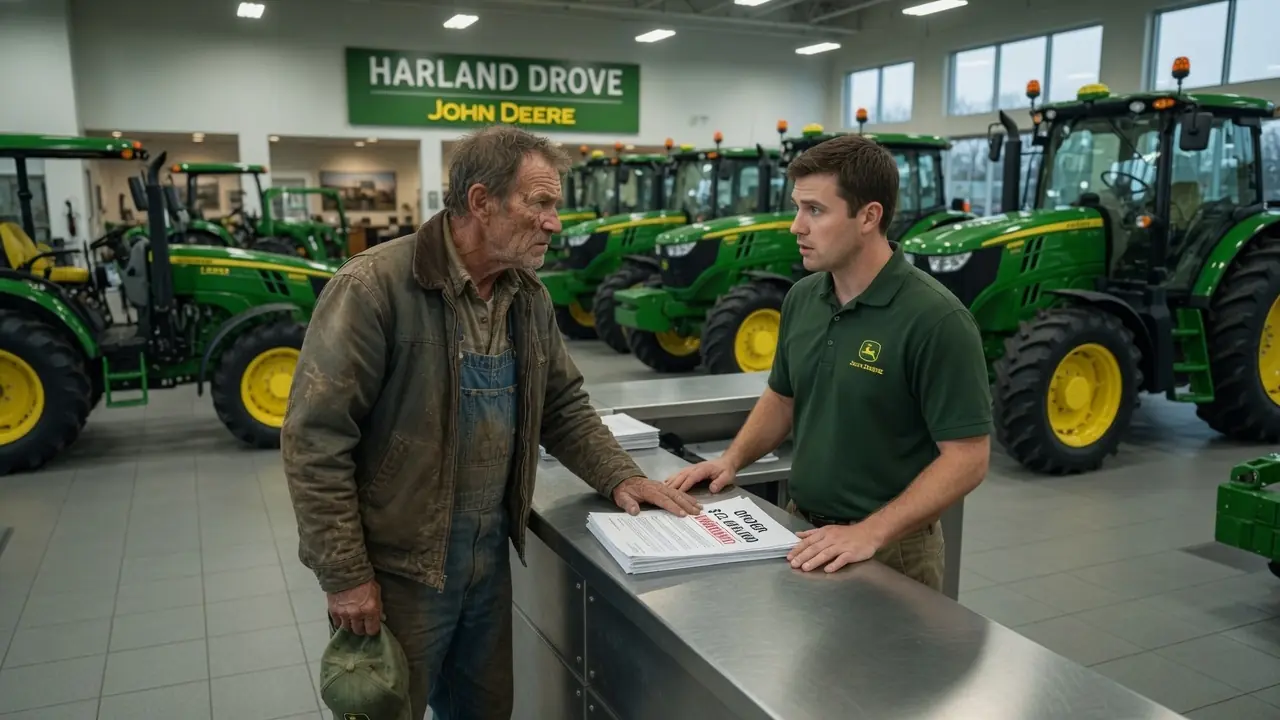
Calvin shook his hand, but did not smile. “Morning, Brandon.”
Brandon noticed the folder immediately. He thought it held the final approval forms from the cooperative board, maybe a few delivery questions, maybe a last adjustment to the finance schedule. He had already told his regional manager the deal was practically finished. He had already told his wife they could finally start the basement renovation before their daughter’s birthday. To Brandon, the papers on the counter were not just documents; they were the sound of his life moving forward.
Calvin placed the folder on the metal sales counter. Behind Brandon, three green tractors sat in a row, all polished and powerful, their yellow wheels turned slightly toward the glass front windows. A large dealership sign hung above the office doors: HARLAND DROVE JOHN DEERE. The place smelled like rubber tires, new paint, coffee, and expensive promises. Calvin looked at the machines for a long moment before he opened the folder.
Brandon’s smile faded only a little. “You want to review the delivery schedule again?”
“No,” Calvin said.
“Financing?”
“No.”
Brandon glanced down at the papers. “Then what are we looking at?”
Calvin pushed the contract packet across the counter toward him. The signature tabs were still untouched. Not one line had been signed. Brandon stared at the pages for several seconds before looking back up.
“I’m not signing today,” Calvin said.
The sentence landed harder than a shouted insult. Brandon blinked, then gave a small laugh because his mind needed an easier explanation than the one forming in front of him. “All right. You want to push it a week? We can do that. I’ll call the delivery coordinator and—”
“I’m canceling the order,” Calvin said. “The full order. All forty units.”
The showroom seemed to lose sound. One salesman near the parts hallway stopped mid-step. A receptionist looked up from her computer. Brandon’s right hand tightened on the edge of the counter.
“Calvin,” he said slowly, “we’ve been building this order for eleven months.”
“I know.”
“Your board approved it in January.”
“I know that too.”
“We’re scheduled for June delivery.”
“I know exactly what we scheduled.”
Brandon looked down at the contract as if the papers might correct Calvin if he stared hard enough. “Is this a cash-flow issue? Because if the cooperative needs different terms, I can get our finance division on the phone before noon.”
“It’s not financing.”
“Then it’s configuration. You don’t like the final unit mix.”
“It’s not the equipment list.”
Brandon’s cheeks began to color. “Then you need to help me understand why I’m standing in my showroom with a $12 million order dying on the counter.”
Calvin took a slow breath. He had rehearsed this moment in his head more times than he wanted to admit. He had imagined Brandon confused, angry, defensive, maybe even desperate. What he had not expected was how young the salesman would suddenly look. Not young in age, but young in the way a man looks when the future he promised himself begins moving away from him.
“I ran the numbers,” Calvin said.
Brandon gave a sharp laugh. “You ran the numbers? Calvin, the numbers are why you placed the order in the first place.”
“The first numbers, yes.”
“What does that mean?”
“It means the purchase price is only the first bill.”
Brandon leaned forward. “Every farmer knows that.”
“Not this bill.”
The dealership manager, Dale Harland, stepped out of his glass office at the back of the showroom. He was a heavyset man in his fifties with a smooth face, expensive boots, and the kind of calm that came from owning the building. He looked from Brandon to Calvin, then to the untouched contract on the counter. His expression tightened.
“Is there a problem here?” Dale asked.
Brandon did not look away from Calvin. “Mr. Mercer is canceling the cooperative order.”
Dale’s eyebrows rose. “The full order?”
“The full order,” Calvin said.
Dale walked closer, trying to smile through the shock. “Calvin, why don’t we step into my office and talk this through?”
Calvin shook his head. “We can talk right here.”
Brandon’s voice sharpened. “Fine. Then talk. Because I need a reason better than ‘I ran the numbers.’”
Calvin placed a second folder on the counter. This one was older, its corners worn, its pages marked with handwritten notes and clipped articles. Brandon looked at it with irritation, not curiosity.
“You’re throwing away a $12 million John Deere order because you think old farmers should keep fixing worn-out machines forever?” Brandon snapped.
Calvin’s eyes hardened. He pushed the unsigned contract back across the counter. “No, Brandon — I’m canceling it because your new machines will lock my farmers out of their own repairs and make them beg your dealer network every time a code flashes.”
Brandon leaned closer, his voice cutting through the showroom. “That’s not a reason, Calvin. That’s fear talking, and fear doesn’t run a modern farm.”
Calvin’s weathered hand landed flat on the folder. “Fear is signing this contract while knowing every farmer I represent will spend the next decade paying for a trap you’re calling progress.”
No one moved.
The four lines hung between them like smoke after a gunshot. Brandon’s mouth opened, then closed. Dale Harland’s expression changed, not because he agreed with Calvin, but because he understood the danger of those words being spoken in front of employees, customers, and tractors waiting to be sold.
“Locked repairs?” Dale said carefully. “That sounds dramatic.”
“It’s accurate.”
Brandon shook his head. “You’re talking about software like it’s some monster hiding in the engine.”
Calvin opened the folder. “It is not hiding. That’s the problem.”
Inside were articles, cost models, service-rate comparisons, notes from independent mechanics, and a spreadsheet printed in clean columns. Calvin had spent sixteen months building that folder, but the first seed had been planted long before Brandon knew the order existed. A retired John Deere engineer named Norm Hastings had walked into Calvin’s cooperative office one evening with a folded roadmap and a warning. The warning was not that John Deere would build bad machines. The warning was that John Deere would build excellent machines farmers could no longer fully control.
Calvin had not believed one document blindly. He was too careful for that. He had read trade publications, talked to Kansas State researchers, called independent mechanics across western Kansas, and studied the rising importance of locked diagnostics and dealer-only software systems. Again and again, the conclusion came back the same. The new machines would not just cost money at purchase; they would change who controlled the repair.
Brandon pointed at the tractors behind him. “Those machines are the future.”
Calvin looked at them. “Maybe. But whose future?”
“The farmers’ future.”
“No,” Calvin said. “Not if the farmer owns the iron but has to ask permission to fix the brain.”
Dale folded his arms. “Calvin, authorized service exists for a reason. These machines are complex. You want certified technicians working on them.”
“I want farmers to have options.”
“They’ll have options.”
“Will Cleat Dawson be able to diagnose a locked engine code on a new unit without your authorization tool?”
Dale’s face went still.
Calvin nodded once. “That’s what I thought.”
Brandon frowned. “Who’s Cleat Dawson?”
“An independent mechanic outside Dighton,” Calvin said. “He has kept half the equipment in this region alive for twenty years. Men like him are the reason small farmers survive breakdowns in harvest season.”
Brandon looked frustrated. “Independent mechanics can still work on plenty of things.”
“For now.”
“You’re building a nightmare out of guesses.”
Calvin turned one page and tapped a column. “Authorized diagnostic rates in this region are already nearly double what independent mechanics charge. If new software locks out independents, what keeps that rate honest?”
“Competition,” Brandon said.
“From whom?”
Brandon’s answer did not come.
That silence mattered. It told Calvin what the showroom shine had tried to hide. The machines were beautiful, powerful, and impressive, but behind them was a business structure changing quietly beneath the farmers’ feet. Once a cooperative bought forty new machines tied to dealer-only diagnostics, service was no longer a market. It became a doorway with one key.
Dale stepped in, his voice smoother. “Calvin, every brand is moving toward more software. You can’t avoid the future by pretending it won’t come.”
“I’m not avoiding the future,” Calvin said. “I’m refusing to buy a cage before the door locks.”
Brandon rubbed his forehead. “You realize what this does to us?”
“I do.”
“To me?”
Calvin looked at him then, and some of the hardness left his face. “Yes, Brandon. I do.”
Brandon seemed almost hurt by that. “I spent eleven months on this. I answered every call. I changed configurations. I worked delivery around your planting windows. I went to bat for your cooperative with my regional manager.”
“I know.”
“And now you walk in here and tell me it’s dead because you believe some mechanic in Dighton and a stack of papers?”
Calvin’s voice lowered. “I believe the numbers.”
“The numbers say new equipment increases efficiency.”
“The numbers you showed me say that.”
Brandon’s eyes flashed. “Careful.”
“The numbers I ran include service dependence, diagnostic lockouts, rising dealer labor rates, downtime waiting on authorized technicians, and the cost of losing independent repair competition.”
“That’s speculation.”
“It’s risk.”
“Risk is part of farming.”
“So is knowing when not to plant.”
That line struck Brandon harder than Calvin intended. The salesman looked away, jaw tight, his hand still resting near the contract he had expected to celebrate. Calvin could almost hear the phone call Brandon would have to make to his regional manager. He could imagine the anger, the disbelief, the questions Brandon could not answer because Calvin had not given him all the evidence. But Calvin had never made decisions to protect a salesman’s forecast.
He made decisions to protect farmers.
Dale leaned over the counter. “Let me ask you something directly. Are you buying from someone else?”
“No.”
“Case IH?”
“No.”
“New Holland?”
“No.”
“So what is this really?”
“We are retaining and refurbishing our existing fleet.”
Brandon laughed again, but this time it sounded bitter. “Your existing fleet is eight to twelve years old.”
“I know how old my fleet is.”
“You’ll drown in maintenance.”
“I’ve modeled it.”
“You modeled rust?”
Calvin’s eyes sharpened. “I modeled reality.”
The showroom grew colder. A young couple near a compact tractor quietly left through the side door. The receptionist had stopped typing completely. One of the mechanics from the service bay stood half-hidden near the hallway, listening with his arms crossed.
Brandon pointed toward the line of tractors. “These machines are reliable.”
“I’m not questioning the paint, Brandon.”
“Then what are you questioning?”
“The chain around the owner’s wrist.”
Dale’s face darkened. “That is an unfair way to describe a dealership that has supported farmers in this county for decades.”
Calvin looked at him. “Then support them by promising in writing that every one of these forty machines can be diagnosed and repaired by independent mechanics with full access to service codes, reset functions, and repair documentation for the life of the equipment.”
Dale said nothing.
Brandon glanced at him.
Calvin let the silence stretch. “That is why I am canceling.”
Dale’s jaw worked once. “We cannot make promises outside manufacturer policy.”
“I know.”
“Then you’re asking for something impossible.”
“No,” Calvin said. “I’m refusing to buy what you cannot promise.”
Brandon stepped back from the counter as if the words had pushed him. He looked at the contract, then at the tractors, then at Calvin. For the first time that morning, his anger cracked enough for fear to show beneath it.
“Do you understand what my manager is going to say?” Brandon asked.
“Yes.”
“He’s going to say I lost the largest sale in this county because I couldn’t control the conversation.”
Calvin picked up his cap. “Then tell him the conversation was bigger than you.”
“That won’t help me.”
“No,” Calvin said softly. “It may not.”
There was no pleasure in his voice. Calvin did not enjoy ruining Brandon’s morning. He did not enjoy watching a man’s commission disappear. But he had spent too many nights staring at spreadsheets, too many mornings speaking to mechanics, too many afternoons listening to farmers worry about repair costs. If he signed because canceling was uncomfortable, he would be choosing comfort over responsibility.
And responsibility was not comfortable by design.
Dale cleared his throat. “Calvin, I strongly urge you to take twenty-four hours before making this final.”
“It is final.”
“Your board may not appreciate how this looks.”
“My board voted seven to two.”
That surprised Brandon. “They already voted?”
“Yes.”
“You came here knowing?”
“I came here to tell you in person.”
Brandon’s expression twisted. “That supposed to make it honorable?”
“It makes it direct.”
“Direct would have been warning me months ago.”
“Months ago, I was still verifying.”
“Verifying what? That someday software might cost more?”
“That someday is coming faster than you think.”
Brandon shook his head. “Farmers always complain about costs. Then they buy the machine that gets the work done.”
“Not this time.”
“You don’t speak for every farmer.”
Calvin looked him dead in the eye. “Today I speak for the ones who trusted me to read what they didn’t have time to read.”
The words settled over Brandon like a weight. That was the part he had missed during eleven months of negotiation. Calvin was not just a customer. He was the man dozens of farmers had trusted with the cooperative’s future. They did not elect him to chase shine. They trusted him to see storms before they reached the field.
Brandon picked up the first page of the contract and stared at the empty signature line. “There has to be a way back.”
“There isn’t.”
“What if we cut the price?”
“No.”
“What if we include service credits?”
“No.”
“What if Dale calls regional and gets you a written service-rate guarantee for the first year?”
Calvin shook his head. “First year doesn’t matter.”
Brandon’s voice rose. “Then what does?”
“Year seven.”
Brandon stopped.
Calvin opened the spreadsheet and turned it toward him. “Year seven is where the damage becomes impossible to pretend is temporary. That is where service cost increases, debt structure, and lost independent repair access start eating the margin faster than the new machines create efficiency.”
Brandon looked at the numbers, but Calvin could tell he was not ready to absorb them. The spreadsheet was not flashy. It had no sales graphics, no smiling farmer photos, no manufacturer claims. Just rows, columns, assumptions, labor rates, service hours, downtime estimates, interest costs, and fleet refurbishment projections. It was the opposite of a showroom. It did not shine. It simply waited to be true.
Dale looked at it longer than Brandon did. “Where did you get these assumptions?”
“From people who work closer to breakdowns than boardrooms.”
“That is not an answer.”
“It is the answer you should have started with years ago.”
Dale’s eyes narrowed. “Calvin, you are standing in my dealership accusing my business of trapping farmers.”
“I’m standing in your dealership refusing to let my cooperative become dependent on repair access we do not control.”
“There’s a difference.”
“Not to the farmer waiting in a field with a locked code and wheat ready to cut.”
The mechanic near the hallway looked down at the floor. Calvin saw it. Dale saw Calvin see it. That tiny moment told more truth than anyone wanted spoken.
Brandon gathered the contract pages with stiff hands. “I need something in writing.”
“You’ll have it by noon,” Calvin said.
“Reason for cancellation?”
“Strategic fleet-cost reassessment.”
Brandon laughed humorlessly. “That’s all?”
“That is the official reason.”
“And unofficially?”
Calvin put his cap back on his head. “Unofficially, I won’t sign away repair freedom for forty machines because a dealership promised me progress.”
Brandon looked at him with a mixture of anger and helpless respect. “You really believe this.”
“I do.”
“You’re willing to look foolish for it?”
Calvin paused. That question mattered more than Brandon knew. He had already imagined the feed store talk, the county fair whispers, the cooperative members questioning whether he had lost his nerve. He knew other managers would call him outdated. He knew someone would buy new and brag about efficiency while Calvin’s team rebuilt old machines with grease on their hands and criticism at their backs.
“Yes,” Calvin said. “For as long as it takes.”
Brandon’s face changed. “As long as what takes?”
“For the bill to arrive where everyone can see it.”
No one answered that.
Calvin picked up the older folder, leaving only the unsigned contract on the counter. He looked once more at the line of tractors. They were beautiful machines. He could admit that. He even felt the old pull of them, the farmer’s weakness for power, clean metal, and the promise of fewer breakdowns. But beauty had never been the same as ownership, and promise had never been the same as protection.
He turned toward the door.
“Calvin,” Brandon called.
Calvin stopped.
“If you’re wrong, this sets your cooperative back years.”
Calvin looked back at him. “And if I’m right, signing today sets them back a decade.”
The dealership doors opened with a soft mechanical sigh as Calvin walked out. Cold air moved into the showroom behind him. Through the glass, Brandon watched the older man cross the parking lot toward a dusty pickup that looked older than some of the tractors Calvin had just refused to buy. The truck started on the second try, then pulled away toward the highway.
Inside, nobody spoke for nearly half a minute.
Then Dale picked up the unsigned contract and said, “Call regional.”
Brandon nodded, but did not move right away. His eyes stayed on the folder Calvin had left behind in his mind, the one full of numbers he had not wanted to read. For the first time all morning, he looked at the green tractors not as products, but as questions.
The months after Calvin canceled the order were hard. At the cooperative, the refurbishment program began immediately, and the machine shop filled with old parts, rebuilt pumps, replacement bearings, and mechanics who worked long days keeping aging equipment alive. Some farmers trusted Calvin because they had trusted him for years. Others muttered that he had lost his edge. A few said openly that the cooperative should have bought the new fleet before prices rose again.
Brandon heard those comments too. Every time a farmer walked into Harland Drove John Deere, someone mentioned Calvin Mercer and the canceled order. Some laughed. Some shook their heads. Some said he was too cautious for modern agriculture. Brandon repeated the approved line from regional: Harland Drove respected all customer decisions and remained committed to supporting producers. But privately, the lost sale followed him like a shadow.
The first year, nothing dramatic happened. Neighboring cooperatives that bought new John Deere machines showed improved fuel efficiency, better operator comfort, and fewer mechanical failures. Calvin’s cooperative spent more than expected on refurbishment. Critics grew louder. Brandon told himself Calvin had made a bad decision, and for a while, the world seemed willing to agree with him.
But in the second year, small signals began to appear.
Independent mechanics started complaining that certain diagnostic functions were no longer accessible. A combine owner outside Dighton had to wait three days for an authorized technician to reset a software fault after a sensor replacement. A farmer near Leoti paid more for diagnostic labor than for the physical part that failed. The stories came quietly at first, scattered like early drops before a storm.
By 2015, the storm arrived.
Authorized service rates climbed sharply. Diagnostic access tightened. Farmers with newer machines discovered that owning the equipment did not mean controlling the repair. A locked code could stop a machine worth hundreds of thousands of dollars, and the only person allowed to clear it might be days away and billing by the hour at a rate no independent mechanic could compete with because independent mechanics were not allowed in.
That was when Brandon remembered Calvin’s words.
Year seven.
The damage did not appear all at once. It accumulated, invoice by invoice, delay by delay, harvest hour by harvest hour. Farmers who had mocked Calvin began asking quieter questions. Cooperative managers who had called him timid began comparing service bills. The machines still performed well, but the cost structure around them had changed exactly the way Calvin said it would.
One morning, nearly four years after the canceled order, Brandon stood in the same showroom when Doug Sellers walked in from the Tri-County Cooperative. Doug had bought a newer fleet after Calvin canceled his. He looked older now, his face drawn from sleepless seasons and debt meetings. He placed a service invoice on Brandon’s counter.
“Two hundred forty-seven dollars an hour for diagnostics,” Doug said.
Brandon looked at the invoice and felt his stomach sink.
Doug’s voice was flat. “Calvin warned people, didn’t he?”
Brandon did not answer right away.
Behind them, the tractors still shone under the lights. The showroom still smelled like rubber and coffee and money. But something had changed. The machines looked different to Brandon now, not because they were worse, but because he finally understood that a sale did not end when the contract was signed. Sometimes that was when the real cost began.
“He canceled because of this,” Doug said.
Brandon looked toward the counter where Calvin had once pushed the unsigned contract back. He could still see the older farmer standing there, cap in hand, eyes hard, voice calm enough to be mistaken for stubbornness. At the time, Brandon had thought Calvin was afraid of progress. Now he understood that Calvin had been afraid of dependency, and dependency had turned out to be worth fearing.
“Yes,” Brandon said quietly. “He canceled because of this.”
Doug closed his eyes. “And we laughed.”
Brandon looked at the invoice again. “A lot of us did.”
A few months later, the Western Kansas Cooperative Service Alliance held its first meeting in Tribune. Calvin organized it, but he did not gloat. He brought spreadsheets, service-rate comparisons, contract proposals, and a plan to negotiate collectively with regional service management. Sixteen cooperatives eventually joined. Their combined service volume was large enough that even the dealer network had to listen.
Brandon attended one of the meetings as a dealership representative, sitting across from Calvin at a long table. The room was crowded with men who had once doubted him. Norm Hastings, the retired engineer who had first warned Calvin, sat near the back with his hat in his hands. Doug Sellers sat near the front, quiet and humbled.
Calvin laid out the numbers the same way he always had. Carefully. Plainly. Without revenge.
When the presentation ended, Brandon approached him near the coffee urn. “You knew before any of us.”
Calvin poured coffee into a paper cup. “I had evidence before most people had invoices.”
“I thought you were killing my sale.”
“I was protecting my farmers.”
Brandon nodded slowly. “I know that now.”
Calvin looked at him. “That’s the hard part about being right early. For a while, it looks exactly like being wrong.”
Brandon gave a tired smile. “You could have said more that day.”
“In your showroom?”
“Yes.”
Calvin shook his head. “You weren’t ready to hear it.”
Brandon thought about arguing, then realized he could not. On that morning at Harland Drove John Deere, he had not wanted truth. He had wanted a signature, a commission, a successful quarter, and a story where progress looked clean and profitable. Calvin had brought him a different story, one full of locked repairs, service dependence, and farmers losing control over machines they had paid for with borrowed money.
Brandon held out his hand. “I’m sorry.”
Calvin shook it. “Then do better when the next farmer asks a question that makes the sale harder.”
Years later, farmers still told the story of Calvin Mercer canceling the $12.4 million John Deere order inside Harland Drove. Some told it like a business legend, the old cooperative manager who saw the software trap before everyone else. Some told it like a warning about repair rights. Some told it like a humiliation of a salesman who thought a deal was finished before the farmer read the real cost.
Calvin never liked any version that made him sound heroic. To him, the story was simpler. A salesman saw forty machines. A dealership saw a record sale. A cooperative manager saw ten years of repair bills hiding behind green paint.
So he pushed the contract back.
And months later, when the invoices came due across western Kansas, every farmer finally understood why.