The night of the Sternwood engagement ball.
Rosalind Fairfax stood near a column in dark green silk and watched 200 people celebrate a choice that had already been made without her.
The ballroom was warm with candlelight, and the music was bright.
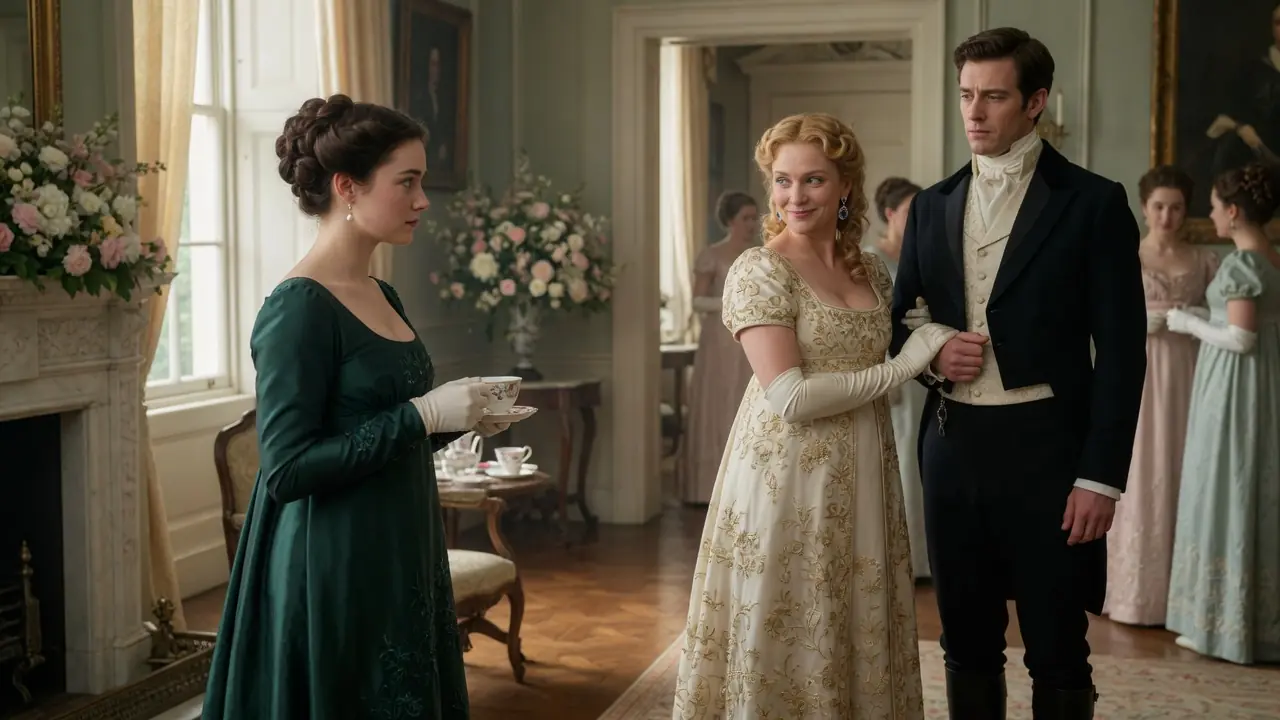
Philippa Hargrove stood near the mantelpiece in ivory and gold, radiant in the way that women are radiant when they have won something they wanted badly enough to fight for.
Rosalind had come because not coming would have been its own kind of declaration.
And she was finished making declarations.
She had made one six weeks ago in a drawing room, and it had cost her more than she expected.
And she was still paying.
She held her glass and did not drink from it.
She watched the room move around Philippa like a tide around a fixed point.
And she told herself she felt nothing in particular.
Which was how she knew she felt everything.
Across the ballroom, Lord Alaric, Duke of Sternwood, set down his glass.
He set it down with the deliberate care of a man who had made a decision and did not want the glass in his hand when he acted on it.
Then he turned from the cluster of guests surrounding his fiancée and began to cross the floor.
The room noticed.
Rosalind noticed the room noticing.
Which was worse?
Two hundred guests tracking the trajectory of a duke walking away from his own celebration, away from the woman wearing his ring, toward the column where the difficult one was standing in dark green.
The music continued.
Philippa's conversation continued.
But the attention of the room shifted the way attention does when something is happening that cannot be unseen.
He stopped two feet from her.
That precise distance.
Close enough to speak without being overheard.
Far enough to be technically irreproachable.
He had always known exactly where the lines were drawn.
"Dance with me," Alaric said.
"Alaric," Rosalind looked at him steadily.
His face was composed.
But there was something beneath the composure that she recognized from two years of arguing with him at midnight in a library.
The expression of a man who had run out of constructed things to say and was left with only the true one.
"That would be unwise," Rosalind said.
"I know," Alaric said.
He did not move away.
Lady Trentham's drawing room on a Wednesday afternoon in early spring was the kind of room that had been arranged to suggest ease while providing none.
The furniture was beautiful and slightly too formal, and the light came through tall windows in the manner of light that had been approved of.
From the adjoining room through a half-open door came the sounds of the trousseau.
Laughter.
The rustle of fabric.
The particular brightness of women gathered around a future.
Rosalind stood by the far window with a cup of tea she had not tasted.
She had been standing there for 11 minutes.
She knew because the clock on the mantelpiece had a particularly clear chime.
And she had been counting.
The door opened.
Philippa Hargrove entered and closed it behind her with the precision of a woman who had rehearsed the moment.
She was wearing the sapphire earrings.
Rosalind registered this before she registered anything else.
The earrings Alaric had given her.
Catching the afternoon light.
Brilliant and deliberate against ivory silk with gold thread at the collar.
Philippa had dressed for this conversation.
Rosalind set down the tea.
She set it down carefully on the exact center of the saucer.
And when she looked up, her face was entirely composed.
"He chose you because you were easier," Rosalind said.
Philippa's smile held for two seconds.
It was a very good smile.
The kind built through years of practice in rooms exactly like this one.
Then something shifted behind it.
A tightening of the jaw that the smile could not quite conceal.
"That is cruel," Philippa said.
"That is accurate," Rosalind said. "He proposed to you because you never once asked him to be better than he already is. You are the path of least resistance, Philippa. You make every room lighter and every decision easier. And you never, not once, required him to look at himself honestly. That is not love. That is convenience wearing a very pretty gown."
Philippa's hand went to the earring at her left ear.
A small, involuntary gesture.
There and gone.
"You are jealous," Philippa said.
"I am devastated," Rosalind said. "Jealousy wants what you have. I wanted what he was too afraid to become."
She walked out through the trousseau room, past the laughter and the fabric swatches and the bright voices of women planning a future, into the cold garden beyond.
She stood on the gravel path and breathed the February air.
And did not permit herself to do anything that could not be undone.
She was accurate.
She was alone.
She was breathing hard, and the garden held her without comment.
Within four days, Philippa had told Lady Whitaker that Rosalind Fairfax could not accept Lord Sternwood's decision with the grace one might hope for from a woman of her breeding.
Lady Whitaker told Mrs. Alderton.
Mrs. Alderton told everyone else.
The county, which had been cautiously sympathetic, adjusted its position with the efficiency of a social machine that runs on this particular fuel.
The word that began to travel ahead of Rosalind's name was difficult.
Not unkind.
Difficult.
Which was worse, because difficult meant she had done it to herself.
At Thornley, Lord Thornley watched his daughter from his chair by the fire.
He was 63 and visibly ailing.
The kind of ailing that had settled in for a long residence.
And he watched Rosalind move through the room with the particular attention of a man who had been watching her for 26 years and knew when she was performing competence and when she actually possessed it.
"Sit down," he said.
"I have the tenant accounts to finish," Rosalind said.
"The accounts will wait," Lord Thornley said. "Sit down, Rosalind."
She sat.
She folded her hands in her lap with the precision of a woman keeping her hands from doing anything that might reveal their condition.
"Your mother was the cleverest woman I ever loved," Lord Thornley said. "Cleverer than me by a considerable margin, and she knew it. And she never made me feel diminished by it, which was itself a form of genius. But the thing about your mother, the thing I have been trying to find the words for since you were about 14 years old, was that she told me what she wanted. Without constructing a case first. Without assembling evidence and precedent and logical frameworks. She simply told me, this is what I want. This is what I need. This is what would make me happy. She trusted me with the plain sentence."
Rosalind looked at the fire.
"You build cases," Lord Thornley said. "You build them beautifully. Better than any solicitor I have ever employed. But you build them for everything except yourself. You will argue the merits of a drainage proposal at midnight with the intensity of a woman who has staked her life on the outcome. But what you want, what you actually want beneath all the argument, that you will not say. You make everyone decode it. And some people, Rosalind, are not good enough at decoding."
"He should have been," Rosalind said.
"Yes," Lord Thornley said. "He should have been. But you might have helped him."
She did not answer.
The fire said nothing useful.
Outside, the Thornley grounds lay under the gray February sky, and the tenant cottages she had spent two years trying to improve stood in their rows, solid and waiting.
Lady Pemberton's card party three weeks later was attended by most of the county and all of the people Rosalind would have preferred not to see in the same room.
She came because withdrawal had already been interpreted as bitterness.
And she would not give the narrative any more material than it had already collected.
She was standing near the window, watching a hand of whist she had no stake in, when Philippa approached.
The room's attention gathered the way it always did when Philippa moved with purpose.
She came toward Rosalind with her hands extended and her expression arranged into something that might have been warmth on a less studied face.
"Rosalind," Philippa said, taking both her hands. "I have been meaning to find you all evening. I wanted to say, I think you have been so brave about the situation. Truly, it cannot have been easy. And the way you have conducted yourself has been admirable."
The room heard.
The room was designed to hear.
Rosalind felt the air in the room change.
A subtle adjustment, like a barometer reading shifting one degree.
The county's sympathy, which had been tentatively neutral, tilted.
She was no longer the wronged party.
She was the one who needed to be complimented on her bravery.
She was the one who had not moved on.
"Thank you, Philippa," Rosalind said.
She said nothing else.
There was nothing else to say that would not make it worse, and she knew it.
And Philippa knew she knew it.
And for one second, they looked at each other across the handclasp with complete mutual understanding.
Then Philippa released her hands and turned back to the room.
And the room turned with her.
And Rosalind was left at the window with the knowledge that she had just been publicly confirmed as the difficult one.
She left early.
The walk home from Pemberton Hall to Thornley was 40 minutes on the lane and 20 across the fields.
She walked the fields alone in the dark because she needed the ground under her feet and the cold on her face and the absence of anyone watching her conduct herself with grace.
Mrs. Louisa Carr had been Rosalind's godmother for 26 years and had the particular advantage of a woman who had watched someone since childhood.
She knew exactly which performances to dismantle and exactly when to dismantle them.
She intercepted Rosalind in the Carr garden on a Tuesday morning in March, when the first green was coming through the beds and Rosalind had been walking for an hour without particular direction.
"Come and sit," Mrs. Carr said. "I have something to ask you. And I would rather you were sitting when I ask it."
They sat on the stone bench at the garden's east wall, where the sun reached in the morning.
Mrs. Carr was 42, a widow of seven years, and she had the directness of a woman who had already survived the thing she feared most and discovered she was still standing afterward.
"Do you want him?" Mrs. Carr said. "Or do you want to be right about him?"
Rosalind opened her mouth and then closed it.
"Because those are different things," Mrs. Carr continued. "And you have been treating them as the same thing for six weeks, possibly longer. Telling Philippa she was easier. That was true, I do not doubt it. But you delivered it as though it settled something. As though being right about his cowardice meant you were free of the wanting. And I do not think it settled anything at all."
Rosalind looked at the garden beds, the green coming through the dark soil, something new insisting on itself.
She did not answer.
She was aware that not answering was itself an answer and that Mrs. Carr was aware of this, too.
They sat in the morning sun for another few minutes.
And then Rosalind stood and said she had tenant accounts waiting.
And Mrs. Carr let her go without pressing further because she had asked the question and the question had landed.
And some things need time to do their work.
Lord Stavely began calling at Thornley that same month.
He was 30 years old, genuinely kind in the way that some men are kind without effort or calculation, and genuinely interested in Rosalind in a way she found, after careful examination, entirely insufficient.
His conversations were pleasant.
They produced no friction.
He agreed with her about the drainage proposals, admired her management of the tenant leases, and never once looked at her as though she had said something that required him to reconsider a position he had held for years.
He was comfortable to be with.
And being comfortable with him felt like looking at her next 20 years laid out in orderly sequence, admired, respected, known only so far as she chose to be known, which was not far at all.
Then she read the pamphlet.
Alaric's parliamentary speech on poor relief had been printed and circulated in March.
She had been avoiding it deliberately.
She read it on a Tuesday evening when her father was asleep and the house was quiet, sitting at the Thornley library desk with a lamp pulled close.
By the third page, something cold had settled in her chest.
By the fifth, she had placed the pamphlet flat on the desk with both hands and was staring at the wall.
Her frameworks.
Her county data.
The specific figures she had compiled from three years of tenant records.
The allocation models she had developed across two winters of calculation.
Her proposed remedies.
Her phased implementation structure.
Her arguments about the relationship between land tenure security and agricultural productivity.
All of it.
In his voice.
In his name.
Before Parliament.
Without a single acknowledgement of where any of it had come from.
She sat with the pamphlet for a long time.
She did not tear it.
Not tearing it cost her more than tearing it would have because tearing it would have been a release, and she did not permit herself releases that could not be defended as rational.
The Thornley-Sternwood Joint Poor Relief Fund had been their project, hers and Alaric's, built across two years of arguments that had begun at a house party and continued in libraries and on morning walks and through correspondence that was nominally about policy and was actually about something that neither of them had named.
The land reform maps were the physical record of it.
Large sheets annotated in two different hands covered every parish in the county, tracking enclosures and tenant situations and proposed school sites and drainage plans.
Her handwriting in dark ink.
His in a slightly lighter hand.
Corrections and counter-corrections accumulating across the margins like the transcript of a conversation that had been going on for years.
Philippa, as Alaric's fiancée, had been invited onto the board in February.
At the April meeting, she moved to redirect the fund's resources to a London charity for displaced workers and dissolve the rural school plan.
She framed it as modernization.
The London charity was well-established, she said, with proven outcomes and reputable governance.
The rural school plan, while admirable in intention, was ambitious in scope and uncertain in execution.
Surely the fund's resources would be better directed toward an organization with an established record.
The maps were spread on the table.
Rosalind had brought them because they were the evidence.
Three years of data annotated with every calculation that underpinned the school plan, every figure that demonstrated why the rural approach was not ambitious but necessary.
She watched Philippa make the motion and watched the board members look at each other with the particular expression of people who were calculating social risk.
Alaric picked up the edge of one map.
He began to read from it.
Rosalind's annotations.
Her calculations.
The figures she had written at 2:00 in the morning on a November night 18 months ago, when she had finally worked out the allocation model.
He read them in a steady voice, her handwriting next to his on every page, the record of two years of midnight work made visible and public and undeniable.
He read for four minutes.
Then he set the map down.
Philippa's motion was called.
Alaric did not speak against it.
He did not speak for it.
He sat with his hands flat on the table and his face composed, and he said nothing at all.
And his silence was the blow.
Not because it was unexpected, but because she had somewhere beneath the architecture of her certainty expected something different.
Rosalind defended the school plan alone.
She spoke for 11 minutes from the maps, from the data, from three years of evidence.
And she was precise and clear and utterly without feeling in her voice.
Because her voice was the only instrument she had.
And she would not waste it on anything that was not the argument.
The board voted to retain the rural plan.
She won on the evidence.
She gathered the maps and walked out of the room without looking at Alaric.
She walked out of the Sternwood Estate office and down the drive and along the lane toward Thornley.
And the spring afternoon held her without comment.
And she did not look back.
That evening, Alaric stood alone in the Sternwood library.
The maps were still pinned to the wall where they had been since December.
He had never instructed anyone to take them down.
Which he recognized, standing in the lamplight, as a decision he had been making repeatedly without acknowledging it as a decision.
He stood in front of the largest map, the one covering the north parishes.
And he traced her annotations with one finger.
North boundary.
He estimated.
Walk it.
Allocation error. See revised calculation attached.
This figure is from 1817. Get the current survey.
He is wrong about the drainage. See Carr Estate comparison.
Her handwriting was precise and slightly impatient.
The handwriting of a woman who wrote quickly because her mind moved faster than the pen.
He traced one correction, then another.
He found the entry he had been looking for without knowing he was looking for it.
A marginal note in the upper right corner of the north parish map, dated 18 months ago.
He estimated from the terrace.
Walk the boundary.
The measurement is wrong by 40 yards and it matters.
He stood at the wall for a long time.
These maps were the only honest record of any relationship he had conducted in this house.
Every other conversation he had in these rooms was performed to some degree.
The Duke's composure.
The Duke's certainty.
The Duke's considered opinion on matters of policy and estate management.
But the maps were different.
The maps were what happened when he and Rosalind Fairfax argued past the point where performance was possible.
When the hour was too late and the problem too specific, and the only thing that worked was honest thought meeting honest thought across a table.
He had proposed to Philippa three weeks after the north boundary conversation.
He had not examined that timing until this moment.
The following afternoon, Philippa called on Rosalind at Thornley.
She arrived with the warm concern of a woman who had decided that magnanimity was the most powerful position available to her.
She sat in the Thornley drawing room with her hands folded in her lap and her expression arranged into something genuinely sympathetic.
Or near enough to genuine that the distinction required close attention.
"I have been thinking about you," Philippa said. "I know yesterday was difficult. The board meeting, it cannot have been comfortable."
"I managed," Rosalind said.
"Lord Stavely has asked after you twice," Philippa said. "I thought you should know. He is a good man, Rosalind. He would be patient with you. And it would do you good to be seen with someone. To let the county see that you are moving forward. It would help. I think you know it would help."
Rosalind looked at her.
The afternoon light was coming through the Thornley drawing room windows, the same light that had come through Lady Trentham's windows six weeks ago.
And Philippa's face was the same face.
And the earrings were the same earrings.
"Stop managing my loneliness," Rosalind said. "You are not that generous, and I am not that broken. Lord Stavely is a kind man who wants an uncomplicated wife. And I am not that either. And we would both know it within a fortnight. I do not need a consolation suitor, Philippa. I need you to stop pretending this is kindness."
Philippa stood.
Her composure was intact, perfectly, completely intact.
But her hands were slightly too still, held at her sides with a deliberate quiet that was not quite natural.
"I am trying to help," Philippa said.
"You are trying to close the chapter," Rosalind said. "There is a difference."
Philippa left.
The drawing room was quiet.
Rosalind sat in it for a long time, listening to the clock.
That same evening, Philippa sat beside Alaric in the Sternwood drawing room and asked him what he thought about at midnight.
"The canal bill," Alaric said. "The third reading is in May, and I am not satisfied with the amendment language."
"You work too hard," Philippa said.
And she covered his hand with hers.
And she smiled at him with a warmth that had always been genuine.
He had never doubted that it was genuine.
And he smiled back because he had never given her a reason not to believe him.
Later, after the house was quiet, he went to the library.
He stood at the maps.
Her handwriting at midnight, the same hour, the same room, the annotations accumulating across the margins.
He estimated.
Walk it.
He read every note she had left in the upper north parish map, then moved to the central parishes, then the southern boundary.
Her mind in his library.
The argument continuing on the wall long after she had gone home.
He understood, standing there at midnight with the lamp turned low, that it had never been the canal bill.
She came back to the Sternwood library on a Thursday evening, three days before the ball.
She had left a book in December, a survey of enclosure law she had borrowed and forgotten to return.
And she came to retrieve it because she needed it for the school plan documentation and because she had decided that needing the book was a sufficient reason and she would not examine it further.
She let herself in through the side entrance, which the housekeeper had always permitted, and walked the familiar corridor to the library door.
She opened it and found Alaric standing at the map wall.
He was facing the maps, his back to the door, his right hand raised and tracing one of her annotations with his finger.
The same gesture she had not witnessed, but that he had been making for weeks.
He did not turn when the door opened.
Perhaps he thought it was the housekeeper.
Perhaps he had reached the stage where he no longer cared.
Rosalind stood in the doorway.
She did not announce herself.
She read her own handwriting over his shoulder, the north parish map, the corrections in dark ink, the marginal note about the boundary estimate.
She could see exactly where his finger rested.
She crossed the room quietly and stood behind him, close enough to read the annotations over his shoulder without touching him.
Her breathing slowed.
His breathing slowed.
Neither of them spoke.
Then she reached past him, her arm beside his, the length of one sentence, and pointed to a figure in the lower right corner of the map.
"That allocation was wrong," Rosalind said. "I wrote it at 2:00 in the morning in November, and I miscalculated the per-household figure. I corrected it the following week. The corrected version is in the folder on the left shelf."
Her arm was beside his for the length of those two sentences.
Then she withdrew it.
She crossed to the left shelf, found the folder, found the book she had come for, which was beside the folder and which she had known, if she was honest, was approximately where it would be.
She picked up the book.
She had touched the map before she touched the book.
She was aware of this.
She left without looking back.
And the corridor was cold.
And her hands were entirely steady, which cost her something she did not quantify.
Three days later, at the Sternwood engagement ball, Alaric set down his glass and crossed the floor toward her and said, "Dance with me."
And she said, "That would be unwise."
And he said, "I know."
And did not move away.
And the story had arrived at the place where it began.
Later that evening, when the celebration was at its height and the ballroom was loud with music and champagne and the particular brightness of 200 people performing enjoyment, Rosalind slipped away from the column and the crowd and the careful performance of her own composure.
She went to the library.
She told herself she had gone to return the book she had borrowed on Thursday.
She set it on the shelf.
Then she stood at the map table, because the maps were there.
And she could not not stand at them.
The library held her the way it always had.
The particular silence of a room built for serious thought.
The lamplight.
The smell of paper and ink and old wood.
She heard the celebration below as a muffled brightness, entirely separate from this room and everything in it.
The door opened.
"You are in my library," Alaric said.
"I am returning the book I borrowed in December," Rosalind said, without turning. "Your steward should have taken these maps down before the celebration. Your fiancée's guests do not need to see your handwriting next to mine on every parish boundary in the county."
"I told him to leave them."
She turned then.
He was standing just inside the door in his evening clothes.
His composure present but thin.
The composure of a man who had been maintaining it all evening at considerable cost.
"Why?" Rosalind asked.
"Because they are the most honest thing in this house," Alaric said.
She looked at him steadily.
She had spent six weeks telling herself she felt nothing in particular.
And standing in this room looking at his face, she understood that she had been lying to herself with her customary precision.
"Philippa asked me what I think about at midnight," Alaric said. "I told her the canal bill."
"And she believed you," Rosalind said.
"She had no reason not to."
"I have never given her a reason not to believe me."
"Not once."
"Not in any particular."
"That is the problem."
"She trusts a man who does not exist."
"The man who exists," Rosalind said, "has been in this room for two years."
"Yes."
He moved to the map table.
Not toward her.
To the table.
To the maps.
Standing on the opposite side so the annotated sheets were between them.
"And the woman who exists in this room never once said what she wanted. She argued about drainage. She corrected my Latin at 2:00 in the morning. She found the error in my north boundary calculation and wrote, 'He estimated, walk it,' in the margin, and then walked home without saying anything else. She made herself indispensable to my thinking and invisible to my life. And when I was too afraid to reach for her, she told Philippa the truth and called it courage."
"It was the truth," Rosalind said.
"It was half the truth."
His voice was not loud.
It was the voice he used when he had stopped constructing and was saying the plain sentence.
"The other half is that you would rather be right about me than risk asking me to choose you. You would rather say, 'He chose easier,' than say, 'I wanted him to choose me.' Because wanting, saying that plainly, without argument, without the case built first, is the one thing you cannot do without losing the control you have built your entire life on."
She gripped the edge of the map table.
The maps were under her hands.
Two years of shared work, two years of annotations in two different hands, the evidence of what they had built together spread flat on the table between them.
"You are describing what I did," Rosalind said. "You are not describing what you did. You proposed to another woman because she would not ask you to be anything more than a duke in a drawing room. You chose the woman who let you be small, Alaric. You chose the woman who would never write, 'He estimated, walk it,' in the margin of your map. Because being corrected by someone who loves you is the thing you could not bear."
"Yes," he said.
"Then do not stand in your library and speak to me about fortresses. You built one, too. Yours was made of a charming woman and a comfortable engagement and the certainty that no one would look underneath and find that you had been estimating from the terrace your entire life."
He said quietly, "Yes."
"And then?"
"And your voice is the thing that reaches underneath. It has always been your voice, not your arguments, not your frameworks, not your county data, though God knows the county data was better than anything I had. Your voice reading my own maps back to me at 1:00 in the morning, finding the errors I had missed, asking questions I could not answer. I proposed to Philippa three weeks after you asked me whether I had walked the north parish boundary or whether I was estimating from the terrace."
He paused.
"I had been estimating."
"You knew."
"You always knew."
"And I could not bear being known that well by someone I had not earned the right to be known by."
The room was quiet.
Below, the music continued.
Rosalind released the edge of the table.
She looked at the maps, her handwriting next to his.
Two years of honest work, the only honest thing in this house.
He had said it.
And he was right.
And she had known it before he said it.
"I wanted you to choose me," Rosalind said.
She said it without construction, without argument, without the architecture of a woman who had spent 26 years building cases for everything except herself.
Six words, plain and undefended.
"I wanted it at the house party when you caught my elbow on the path and held it for three steps while I kept talking about enclosure law, as though the talking could cover what the three steps meant. I wanted it every night in this room. I wanted it when you brought me coffee at half past one because you had noticed my cup was empty and you said nothing about noticing. You simply brought it. I could not say it because saying it meant that being unchosen would destroy me. And I have spent my entire life constructing a self that cannot be destroyed."
He had gone very still in the way people go still when something has reached them that no defense was built to stop.
"I choose you," Alaric said. "Not because you are difficult, because you are the only person who has ever made me want to be worth choosing."
"That is not enough," Rosalind said.
"I know."
"Because Philippa is in the ballroom wearing your ring. She is not a consolation prize. She is a woman who loves you genuinely. And she heard me tell her she was easier, and she has spent six weeks trying to prove I was wrong, and she deserves the truth from you before she deserves anything else. Go and tell her. Not tomorrow. Tonight. Without constructing an explanation first. Without the duke's composure and the carefully assembled rationale. Just say it plainly."
He turned toward the door.
She stayed at the table, her hands resting flat on the maps.
He stopped at the door.
He stood there for a moment, his hand not yet on the handle.
And then he turned back and crossed the room.
He knelt at the edge of the map table.
Not a proposal.
The posture of a man making himself lower than the surface where she worked.
Making himself small in the only way that was not cowardice.
She leaned forward.
The kiss was slow.
And her hands rested flat on the maps throughout, not gripping, not pulling, simply resting.
The first time her hands had rested in two years.
Then she said, "Go."
He went.
She stayed.
The library held her with all its familiar silence.
And the maps were under her hands.
And two years of annotations in two different hands recorded everything that had happened in this room.
And everything that had not been said until tonight.
Three days later, the engagement was dissolved on Philippa's terms.
She required Alaric to write the letter to The Times himself, to settle income on her, and to acknowledge that the dissolution was his failure.
Not a mutual decision.
Not a change of circumstances.
But his failure specifically.
He wrote the letter in a single draft without revision.
And he sent it before he permitted himself to think about what came next.
Philippa told Rosalind in a letter that she would not be the woman who was jilted.
She would be the woman who was wronged and compensated, which was a better position and one she intended to occupy with full dignity.
The letter was three pages and entirely without warmth.
And it was the most honest thing Philippa had ever written to her.
Alaric arrived at Thornley library on a Tuesday morning.
Rosalind's territory.
The room where she had been reading and arguing and managing the estates since she was 14 years old.
He found her at the desk, annotating tenant records because her hands needed occupation when her heart had no container for what it was holding.
"It is done," Alaric said.
"I know," Rosalind said. "Philippa wrote to me."
"She wrote to you?"
He stopped in the doorway.
"She sent the terms. She told me that if I forgive you too quickly, she will never speak to me again."
Rosalind set down her pen.
"She told me I was right about easier. She did not enjoy writing that line. I could tell from the pressure of the pen."
"What did you say in your reply?"
"I told her I have never done anything quickly in my life," Rosalind said.
"She will know what that means."
He remained in the doorway.
She remained at the desk.
The Thornley library held them both with its familiar smell of old paper and the particular light of a room that faced east and caught the morning.
"I will argue with your steward," Rosalind said. "I will rewrite your speeches when the logic is lazy. And your logic is frequently lazy in the first draft. You know it is. I will tell you when your estimates are wrong, and your boundaries are off, and your parliamentary amendments need three more weeks of work before they are ready. I will need you to stay in the argument. Not retreat to a more comfortable version of what I said. Not find a way to agree that is really a way to end the conversation."
"I will stay," Alaric said.
"You said that once to Philippa," Rosalind said.
"I said to Philippa what I thought a duke in a comfortable engagement ought to say," Alaric said. "I am saying to you what I actually mean. I am only now learning that those are different things. And that the difference matters more than anything else."
She picked up the north parish map from the stack on her desk.
The one with her corrections in dark ink.
The one that had been on his library wall.
The one with, He estimated, walk it, in the upper right corner.
She turned it so he could see.
"This boundary is still wrong," Rosalind said. "You corrected it in February, and you still estimated."
"I did not estimate," Alaric said. "I measured."
"You measured from the terrace."
"I measured from the field."
"Then walk it with me," Rosalind said. "Thursday. Walk the whole boundary and prove the measurement is right."
Something moved in his face.
Not a smile, exactly.
But the expression that precedes one in a man who has learned that being wrong by 40 yards in the north parish is not, in this particular arrangement, a disadvantage.
"And if I am right?" Alaric asked.
"You are not right," Rosalind said. "But you may come and be wrong with me on Thursday, and we will settle it on the ground rather than from the terrace, which is how it should have been settled two years ago."
He did not cross the room.
She did not stand from the desk.
The distance between them held the particular quality of two people who had spent two years being honest about everything except the one thing and were learning now to close the gap without constructing a bridge first.
Simply walking toward each other across open ground.
Autumn came to Thornley with the particular quality of autumn in that county.
The light going gold, and the fields going brown, and the tenant cottages standing solid in their rows.
The new school building was visible from the library window.
Fourteen families housed in improved conditions.
That had taken three years of maps and arguments, and one board meeting to secure.
Rosalind was at her desk on an October morning when Philippa's monthly letter arrived.
They wrote monthly now.
The letters were not warm.
But they were honest.
Which for both of them was more valuable than warmth, and harder to produce.
She read through the letter and found near the end, in Philippa's precise and slightly pressured hand:
Lord Stavely proposed last month.
I accepted.
He does not argue with me about drainage.
He argues with me about the garden, whether the roses should go on the south wall or the east wall.
And he has opinions about it, which I did not expect and which I find I do not mind.
It will do.
Rosalind read the line twice.
Then she set the letter down on the desk beside the ledger.
Alaric came in with coffee.
He set the cup beside the ledger without ceremony because bringing her coffee when her cup was empty was simply something he did now.
Without announcement.
As naturally as reading her corrections in the margin and going back to remeasure the boundary.
"You are staring at the wall," Alaric said.
"Philippa accepted Lord Stavely," Rosalind said.
"Ah."
He sat in the chair across the desk.
"Is she happy?"
"She says it will do," Rosalind said. "For Philippa, that is practically effusive."
He looked at her.
She picked up the coffee cup and wrapped both hands around it.
The gesture he had noticed months ago.
The one that meant she was holding something carefully.
"No one is taking anything from you again," Alaric said.
She looked at him over the rim of the cup.
"I know," she said. "I am simply holding it because I want to."
The land reform maps were framed on the library wall.
She had had them framed in September.
Their annotations preserved under glass.
The north boundary corrected.
The school built.
The allocation figures revised and accurate.
Two hands' worth of handwriting side by side.
The record of everything they had argued about and built and failed to name for two years.
"Thursday," Rosalind said.
"What about Thursday?" Alaric asked.
"The south boundary. I checked your measurements from last month's survey. You estimated from the terrace again. I can tell because the figures are too round."
"I walked the south boundary on a Tuesday," Alaric said. "In the rain. I have mud on the boots to prove it."
"You walked halfway and estimated the rest," Rosalind said. "The measurements go round at the third marker. That does not happen when you walk it properly."
"Walk it with me Thursday," Alaric said. "And prove I am wrong."
"I always prove you are wrong," Rosalind said.
"You do," Alaric said. "And I keep walking. That is the arrangement."
She did not let go of the cup.
He did not leave the chair.
The Thornley library held them both in the October morning light.
The maps on the wall with their annotations preserved under glass.
The south boundary still waiting for Thursday.
When they would walk it together.
Through whatever the October weather produced.
And argue the entire way.
And neither of them would estimate from the terrace.
Because they had both learned that the only honest measurement is made with your feet on the ground.